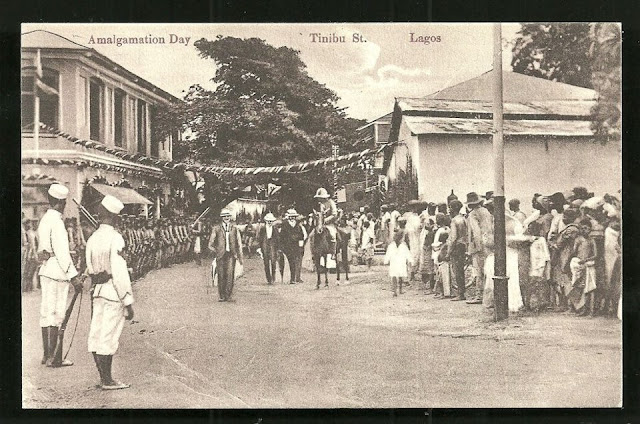
Amalgamation Day in Lagos, 1914

Amalgamation Day in Lagos, 1914

09 September, 2013

On Obasanjo's Regime

For the record, I am neutral towards Nigerian politicians, political parties, political factions and political operators. I support none of them, and oppose all of them.

Having said that, I ran into comments (on a popular Nigerian website) by someone defending the Obasanjo Administration. His comments are in red, my responses in black.


1.  Obasanjo is the only leader to free Nigeria from Billions of in debt owed to the Paris and London Clubs. It's worth remembering that this was debt contracted by all of Nigeria's former Heads of State.

As the man said, General Obasanjo was one of the former Heads of State that create the debt problem in the first place.  He then paid $12 billion in exchange for the cancellation of the balance of $18 billion on our debt. Much was said about how we would have $20 billion in savings over 20 years, or $1 billion a year.

What no one pointed out was, at a low level of compounded interest, the future value of $12 billion is worth at least $20 billion over 20 years, so the Paris Club members did in fact get from us the $20 billion over 20 years they purported to have forfeited.

Secondly, the value of $12 billion used to leverage private investment in infrastructure was worth more to the Nigerian Gross Domestic Product than $20 billion over 20 years.

And thirdly, because of a lack of fundamental reform, restructuring and transformation (and because of political leaders like Obasanjo who took advantage of the lack of reform), the Federal Government of Nigeria has, since the "debt cancellation" deal, incurred new debt that has left us with the same level of debt as we had before we cancelled it. So we are back at square one only a few years later. Indeed, that $1-billion-a-year in savings that were supposed to be spent on Millennium Development Goals does not exist, as we are now paying interest on the new debts.

And mind you, that is just the federal debt. The states and local government areas of the Fourth Republic have been running up debts without question, checks or balances. There has been no analysis that I have seen as to whether or not the states and LGAs can sustain the debts they are incurring, or as to whether or not the projects they are carrying out can generate the revenue to pay back their costs plus interest.

2.  Obasanjo excelled in the area of privatization. Under OBJ Nigeria made a whopping $7.07bn - the sum generated from the sales of many state own companies.

According to Vice-President Namadi Sambo, 80% of privatized firms are moribund, which, in his view defeats the purpose of employment-generation and economic diversification. I am not sure what to say about this.  As an economist I am theoretically supposed to say that firms with no economic reason to exist should be shut down. As an economist inclined towards the development of Nigeria, I have to ask more questions. Why did these firms shut down?  Is it because there was not an enabling environment? Infrastructure driving the cost of business up?  Or was it a question of asset-stripping, or of shutting down a government-owned cement corporation to strengthen a near-monopoly in the cement market?

This isn't an abstract conversation. There has been so much back-and-forth in ownership and other issues regarding the Ajaokuta Steel Comples, NITEL, the Aluminium Smelting Corporation of Nigeria, the Oil Refineries, the Lagos-Ibadan Expressway Concession (awarded to Bi-Courtney and then taken away from Bi-Courtney), and Electricity, among other big-ticket economic sectors. Things go in one direction with great fanfare, and then with less fanfare (much less fanfare) those same things are reversed. The Lagos State government has just bought back the Lekki-Epe Expressway Concession after years of controversy

Again, I ask for more in the way of analyses. It is not just a question of saying we had "debt cancellation" or that "we got $7 billion in privatization money". We must always ask whether there was some other thing that we could have done that would have got us more.

Let me give you an example.

Let us say getting $7 billion from privatization is the best thing possible. Now, the Central Bank of Nigeria, under Professor Charles Soludo, one of Obasanjo's proteges consolidated Nigerian banks, but neglected his duties of oversight and regulation, largely because the bank bosses were friends, allies and political associates of President Obasanjo. They were untouchable because of their contacts with Aso Rock ... and because of that, current CBN Governor Sanusi Lamido Sanusi has had to spend more than $10 billion bailing out the banks. In addition, between them, Soludo and Sanusi spent tens of billions of our reserves defending the value of the Naira. Most other countries would see a fall in the price of their currency as an opportunity to increase their manufacturing and other exports, but since Nigeria imports everything ....

If a person does something that earns ₦700.00 while simultaneously doing or failing to do something else that loses ₦700,000.00, should we throw a party for the small gain or ponder the reasons for the larger loss?

Speaking of which ....

3.  Obasanjo left Nigeria external reserves to the tune of $60bn. Today, this amount has all but gone.

Rising demand for crude oil from China and India helped drive the exogenous processes that hugely increased Nigeria's external reserves. Internal, domestic policy decisions by the Nigerian government eroded that windfall. Remember when President Obasanjo moved Dr. Ngozi Okonjo-Iweala from the Finance Ministry to the External Affairs Ministry? He was about to use federal government money to carry out what he called "do or die politics" in the run up to the 2007 Elections. That type of fiscal indiscipline is the reason Nigeria has borrowed so much new debt since the "debt cancellation" that we are back to owing as much as we owed before the "cancellation". The expensive, violent "do or die elections" elevated Obasanjo's protege, Dr. Goodluck Jonathan, to the Vice-Presidency.

As Interim President, Dr. Jonathan's federal government generated a truly massive fiscal deficit during the 2011 Elections. That deficit was rolled into the ever-growing debt. Indeed, the funny thing about the debt is we the citizens of Nigeria have to repay loans taken by the federal government to buy elections for Presidents Obasanjo and Jonathan.

After the 2011 Election, President Jonathan re-hired Dr. Okonjo-Iweala as Finance Minister to burnish his government's reputation with the Western European and North American financial institutions.  I suspect she will be sidelined again when the 2015 Elections come up, and it is time to run up more debt to buy an election.

4.  Obasanjo appointed foreign fund managers in collaboration with the Nigerian Central Bank to partner local banks in the management of Nigeria's foreign reserves. The banking reforms led to the recapitalisation of the Nigerian banking system and brought down the number of banks from 89 to 25 viable banks.

And these would be the banks that were bailed out by the CBN to the tune of more than $10 billion and the foreign reserves that dropped dramatically because of bad fiscal and monetary policy and policy-execution?

5.  Under Obasanjo, the non Oil sector grew and the economy diversified.

Obasanjo can take credit for de-regulating the telephone markets.

6.  Under Obasanjo, Nigeria, from being a pariah state, became one where foreign investment poured in. Nigeria's credit rating was considerably improved under Obasanjo.

The same was true the last time we had an oil boom.  Angola and Equatorial Guinea are also attracting investment. Now, unless Obasanjo is responsible for the economic development in China and India ...

Sarcasm aside, the same infrastructural and policy bottlenecks to economic activity continued to exist, and still exist now. More dangerously, much more dangerously, the security situation and public security deteriorated markedly during Obasanjo's administration, and the deterioration continued under his hand-picked successors.  Aside from the usual problems and dysfunctions of the Nigerian security apparatus, the nature of Fourth Republic politics is such that the people most responsible for violence and insecurity are the same people politicians rely on to rig electoral victories for them. As such the government has never been serious about bringing these groups to justice, and gave them so much room to operate and grow that they (the state, local and federal governments, and the various political fixers and godfathers) have lost control of their former minions. But even as these groups become ever-greater threats to the federal government, the politicians are still maintaining alliances with them in the hope of using them again at the next election.

Nigeria was on it's last legs when Obasanjo came to office. A Loan Shark wouldn't have touched Nigeria with a barge pole. Obasanjo made Nigeria attractive again. Goodluck Jonathan is today enjoying the benefits of that achievement.

The violence and insecurity bred by Fourth Republic "do or die politics" might make the writer rethink the meaning of being on your "last legs".  The legacy of violence has continued into the Goodluck Jonathan administration. The government might pacify the Northeast, but if the history of the Fourth Republic is anything to go by, something else will kick up somewhere else. The federal, state and local governments remain averse to real political and security reform, as it would result in most of them being prosecuted and jailed. This leaves we the citizens in a state of near-constant exposure to violence of one form or another.

(+1) + (-1) = 0

Strange title for a post, right?

Someone directed me to this New York Times article on Rwandan leader Paul Kagame. Kagame isn't just favoured by the Western European and North American governments, he gets a lot of glowingly positive press from quite a few Africans.  Every week, The East African publishes a regular column by Frederick Golooba-Mutebi, who functions as an uncritical, downright fawning town crier for President Kagame.

I will never pretend to know or understand Rwanda as well as a Rwandan would. I am an outsider, and will always be so.

But in the equation I used at the title of this post, and equal about of negative and positive nets to zero. If you increase the magnitude of the negative, it would move from 0 to a negative value.

I am sure I have mentioned before that I am the most politically neutral person you will ever meet. I do not support any political party or politician or political ideology. And yes, that is neutrality, as much as you will see in this world where everyone seems to have someone or something that they support, sometimes without enthusiasm and other times quite passionately.


For more than 10 years, there was vicious, vicious, unbelievably vicious violence in Liberia and Sierra Leone. A proper discussion of why this came to be is too vast for a blog. Suffice to say there were many internal/domestic actors, many regional African actors, and many global/international actors who bear some degree of responsibility. It might be politically incorrect of me to say, but as citizens, we also share responsibility for watching passively as our countries collapse all around us. Collapse is never instantaneous; it always happens over a period of time long enough for us to do something to stop it.

On the list of people who are most responsible, you will find three African presidents, two of whom are dead, and one of whom is still alive. One of the dead presidents remains popular with many Africans because he is perceived to have made his country an "economic miracle" (inasmuch as it collapsed in anarchy after his death, because his was a one-man dictatorship with no institutions of substance beyond himself). The second dead president is popular with certain sections of the "Pan-Africanist" movement, because of his rhetoric in favour of a United States of Africa (inasmuch as his spent his decades in the presidency fomenting wars all over the continent). The third, still-living, still-in-power president is praised in the Western European and North American media for being a key sub-regional interlocutor, mediator and ally in terms of their security interests in the region.

What nobody ever talks about is how much responsibility the three bear for the horrors visited on Liberia and Sierra Leone. Whatever good thing they may happen to have done in there own countries, or on behalf of Western European and North American security interests (leaving aside the question of whether their interests and ours are compatible), cannot make up for what happened in Liberia and Sierra Leone.

The Rwandan Genocide happened. There is a vital security interest for Rwanda in the Democratic Republic of the Congo. But sometimes .... no .... very often .... no ... always in the arena of "strategic national interests", governments use a real "interest" as an excuse to do other things that have nothing to do with that "interest". And with all due respect to the fans of President Kagame, his actions in and policies toward the DR-Congo are a massive negative that outweighs whatever good he may be doing within Rwanda.

There is dispute as to how many people have died directly and indirectly because of the Congolese catastrophe. Some say the numbers in terms of "excess death" are already higher than the numbers for the Rwandan Genocide. Others say the "excess death" toll is lower than the Rwandan Genocide. But so long as the "excess death" numbers continue climbing year-after-year, this dispute may be moot.

If you've been reading this blog, you would know that I favour analytical explanations for violence in Nigeria over simply claiming one ethnic groups hates another one. As such, I want to be careful in the next thing I say, which is that the 1994 Genocide was not the first incident of Hutu-on-Tutsi, or for that matter Tutsi-on-Hutu communal violence. I would have to be a Rwandan or Burundian, with their level of knowledge of their country, to come up with an explanation for why this violence occurs, but it has happened often enough for me to say that there is no particular reason for assuming that it will not happen again.

I am not a prophet of doom ... but, as you might have noticed from reading this blog, I really dislike the way so-called "experts" analyze the continent. And I think it is rather dangerous that we Africans accept their analysis as truth.

Kagame's government is not the first government to be in power in the aftermath of one of these violent incidents. And this is not the first time that it has appeared, on the surface, that it was over and would never happen again.

The DR-Congo is a rather large place, and insofar as Rwandan policy does nothing to help the place, and plenty to harm it, Kagame is not exactly making Rwanda safer in the long-term. Maybe not even in the medium-term.  Whatever the real security interests of Rwanda are, the policies of the Kigali government are not making the region more secure or less insecure.

To be honest, I am not entirely certain that Kagame's domestic policies are making the country safer.  To what extent are things quiet because the underlying issues have been resolved, and to what extent do things simply appear to be quiet because he has established an unchallenged institutional capacity to coerce the appearance of resolution from his people?

The late President Felix Houphouet-Boigny received an even greater magnitude of positive, appreciative media support from Western Europe and North America. Within Africa, he was seen as the man responsible for what was perceived to be a miracle economy in Cote d'Ivoire. Then he died, and the people were exposed to the realities of a country where there were no real institutions beyond Houphouet-Boigny.  They had no electoral system really, no judicial system, no political parties, no security system (with all due respect, their Army and Police were too small, and way too ineffectual).  There was nothing. Just Houphouet-Boigny.

There are two lessons. The first is that no matter how pretty a country might look when in the grip of a one-man government, there are inherent, structural dangers to such a system, dangers that would exist even without the complication of genocide or of anarchy in a neighbouring DRC. The second lesson is the fact that praise or even criticism from the Western European and North American media does not really tell you whether or not the person they are praising is doing the right thing, or whether the person they are criticizing is doing the wrong thing. We have to step out of their centuries-long shadow, and start to ask ourselves what a proper government of an African country is supposed to look like and function like.

I know people will say that I should not be unrealistic, and that under the circumstances, this is better than the alternative .... but this is the same nonsense excuse that has been used repeatedly over the decades, and the one thing we should have learned by now is these supposedly "realistic" solutions to dilemmas end up perpetuating the very thing that the so-called "realists" think they are countering.

I just find it very hard to overlook what is happening in the DR-Congo when I read an article about how Paul Kagame is transforming Rwanda. Why does it not occur to people that events in the DR-Congo can, in the medium- to longer-term, wreck whatever Kagame builds in Rwanda in the short-term?

03 September, 2013

On so-called "Experts" and the Nigerian narrative

In some respect, this is a follow-up of this post, and in some respects it follows-up on my posts on "propaganda" and how the way we talk about things influences peoples perceptions of those things in a problematic way.

You may have been following the controversies kicked off when Governor Fashola of Lagos "deported" citizens of Nigeria from Lagos State to Onitsha in Anambra State. Apparently these deportations have been going on for a while, with deportees getting "shipped" out to the northernmost states. The arrival of deportees in Onitsha kicked off a firestorm of debate, which almost immediately took ethnic and regional shape. Especially on the internet, where insults were traded based on nasty stereotypes.

The discussion wasn't so much about the constitutionality of the action, nor have we begun the long overdue conversation about what Nigerian citizenship actually means. Instead we had people like Femi Fani-Kayode publishing ethnic slurs against Igbos.

I have never liked or respected Femi Fani-Kayode. He used to criticize President Obasanjo in the most vociferous of terms, but when Obasanjo gave him a cushy job as a pro-government spin-doctor, he became a dogged and rather sycophantic defender of the man he was only recently pillorying. A man who will sell himself to the highest bidder, and who forms his opinions based on whomever is willing to pay him the most, is not a man to be taken seriously.

People like Fani-Kayode should be ignored, and not given a wider platform from which to spread their bile. Unfortunately, Fani-Kayode's remarks attracted a firestorm of responses. And even more unfortunately, the responses took an ethnic and regional shape, provoking similarly ethnic and regional responses.

I want to focus on what such response to Fani-Kayode, because it highlights something I have talked about in prior posts. The full text of the response is here.

I am not interested in the response per se, just in the introduction of the author, and in the author's first two paragraphs.

This is the author's name:


Dr. N. Tony Nwaezeigwe
Senior Research Fellow
Institute of African Studies,
University of Nigeria,
Nsukka.


He is a PhD, a senior research fellow, an "expert" on African Studies. You are probably expecting something that will put an end to the pointless ethnic stereotyping and insults, something that will move us towards a discussion of the core issues and how to resolve them .... but ... then ...


Nigeria’s nationality question is neither the creation of the Igbo nor the Yoruba. It is the consequence of Hausa-Fulani’s megalomaniac quest for political power in the nation. Yet the Hausa-Fulani accept the fact that both the Igbo and Yoruba hold the key to their attainment of this divine-right objective only if both groups agree to remain suspicious of the other. It therefore becomes obvious that the solution to this national question can only be attained if both the Igbo and Yoruba realize that their mutual understanding and respect of the other’s perception of Nigeria’s progress would save the nation millions in loss of human and material resources.


First, both the Igbo and Yoruba, seen respectively as mentors to other minority ethnic groups in the South and Middle Belt should see their assumed characteristic rivalry, if at all there is something like that, as healthy to the overall development of the Nigerian nation and, not the vice versa. Second, both groups should be aware that this question of Nigeria’s nationality will always persist so long as the Hausa-Fulani feel that without any one of their own being at the helms of authority in this country, there will be no peace. And one fundamental means of achieving this Arabian power mentality is to ensure there is perpetual state of political belligerency between the Igbo and Yoruba.


And there you have it. Right from the very start, he plunges into the same ethnic stereotyping, the same insults. His response to Femi Fani-Kayode's unwarranted attacks on the Igbos as an ethnic group ... is to launch an unwarranted attack of his on on the Hausa and Fulani ethnic groups. Actually, there is a sly insult aimed at the so-called "minority" ethnic groups, who tend to react negatively to the suggestion that they are the political subordinates of Tripod ethnic groups to which they were yoked during the Independence Era and the First Republic.

This type of "discourse" has been the bane of Nigerian politics since the 1950s, and while people tend to point at violent incidents in our past as "proof" of their negative views of other ethnic groups, it is more correct to say that the violence was a result and a consequence of all of us having negative views about each other.  To many things are instantly misinterpreted as being pan-ethnic in nature, and too many times entire ethnic groups have been assigned the blame for actions carried out by small groups of people who happen to be from that ethnic group.

The people doing the misinterpretation are not "uneducated"; if anything, the public perception that "experts" know what they are talking about has tended to lend credence to problematic theories that do little to explain why our problems came to be, and why they exist. And it is not just our academics and intellectuals that do this -- the foreign experts are just as bad.  I am at a point where I almost want to call on the entire planet to consider anything and everything ever written or said about "Africa" by a foreign "experts" at any point in the past or present to be by definition false.

Indeed, among the many problems of African academia is the tendency to repeat-back or echo the conclusions foreign "researchers" make about our continent and to treat these as being established fact. This then leads to the tendency to adopt grand plans that are bound to fail, because they have nothing to do with the actual issues. Once the plan fails, we start to hear explanations for the failure that do not take into account the fact that the plan, and the "facts" upon which it was based, was bound to fail from the start.


There is a video posted on the internet, in which the late Sardauna of Sokoto, Sir Ahmadu Bello made certain comments about "Igbos", accusing them in effect of intending to take over and dominate the Northern Region.  A lot of present-day Nigerians would criticize the Sardauna's comments, entirely unaware that they approach the "issues" in exactly the same way he did. Some people are forthright about their views on other ethnic groups (like the Fani-Kayode and Dr. Nwaezeigwe) while other people make a point of sounding politically correct until you scratch them a little or subject them to just a little stress and their true feeling about other ethnic groups and regions emerge.

Back in the 1950s, somehow and for some reason, everyone in the political and academic circles, and consequently a lot of people in the wider society, became apprehensive that they were going to be "dominated" by other sociocultural groups. The late Sardauna may have been blunt in his comments, but everyone showed by their actions that they had the same feelings about other ethnic groups as he did. Indeed, the nascent Federation of Nigeria lost the Bamenda and Buea areas to Cameroun largely because the "minority" groups in those areas took their chance to escape "domination" by the Eastern Region's "majority" ethnic group. Western Region politics also changed in the 1950s to accommodate these suspicions, which had effects on national politics.

Our politics have neither resolved nor recovered from the problems and questions that arose in the 1950s. We are still stuck in the same arguments we've been having since the 1950s, and are still subject to the same consequent violence that has plagued us in greater or lesser intensity since then.

It is time to change the conversation.

Plans and Masterplans

Mallam Nasir El-Rufai became rather famous (or infamous) as Minister of the Federal Capital Territory during the Fourth Republic's Obasanjo Administration. His claim to fame (or infamy) lay in his project of demolishing buildings within the FCT that did not conform to the Abuja Masterplan.

El Rufai was praised by many in the media and commentariat, and much was said about people not obeying rules and how important orderly planning was ....

.... but does it ever occur to anyone that our constitutions, statutes, edicts and "masterplans" never take the reality of Nigeria into consideration?

Sometimes, the people who put these documents together seem to be thinking and talking about an alternate place in a different universe and not Nigeria. Sometimes they seem to be trying to superimpose whatever they saw when they were schooling abroad on top of the realities of Nigeria, without understanding why those places they saw abroad came to look like that, and why whatever they saw there is not applicable to Nigeria.

Sometimes they seem to be copy-and-pasting from a textbook, or adopt standard-issue, one-size-fits-all plans drawn up by foreign consultants and institutions. Sometimes, they don't seem to be aware that the advice they receive from abroad is heavy on the strategic interests of whoever is giving them the advice and light on anything of relevance to us.

Fundamentally, we have not really discussed what our strategic interests are, besides saying things like "An Africa-Focused Foreign Policy", "Non-Aligned", "Pan-Africanism", "Africa Must Unite", "African Solutions for African Problems" and other political slogans which sound like they are saying a lot when they in fact say very little or nothing of substance. At the end of the day, we seem to drift along without any particular plan, inasmuch as we have libraries full of voluminous plans we have drafted and re-drafted over the last 52 years.

The Abuja Masterplan was not, and is not a realistic document. Governor Babatunde Fashola's plan to rid Lagos of the destitute by deporting them to their states of origin is laughable; if he really thinks this plan will work, then he is not who his many fans say he is.

There are poor people in Nigeria.

There are unemployed and underemployed people in Nigeria.

I don't know what the real statistics are. Most of the statistics they use in their $1-a-day and $2-a-day talk sound fabricated, but there are a lot of people in Nigeria who are economically disadvantaged.

It is a reality.

And it is a reality that these people are going to migrate to cities, and are going to find a ways to live and places to live where they don't have to pay a lot in transportation costs to get to wherever they hustle daily. The daily hustle brings in only so much money, and you don't want transportation to eat up most of it.

Telling them to go back to their villages doesn't make sense. If there was anything waiting for them in their villages, they would not have left in the first place. If you had done something to develop their villages' economic potential, you wouldn't now be wringing your hands as to what to do with them in the cities.

Even in the cities, urban redevelopment is always sold as a plan to build "affordable housing", but in practice usually means housing that is not affordable to most Nigerians. Indeed, the Abuja Masterplan is an odd document that effectively moved federal civil servants to a city where federal civil servants could not afford the rent.

Look, we all know that our local, state and federal governments do not have the resources to create a European-style welfare state. Actually, the Europeans don't have enough resources for that either, and no one ever honestly talks about why they are able to keep their welfare states in spite of their resource deficiency ... but this blog is not about Europe.

If you are the government and you cannot provide welfare to the teeming poor, why would you make it government policy to block the poor from making money for themselves? Okay, you think street traders make the streets look unattractive, what do you want them to do? Sit at home and starve? Or maybe go into crime?

There are economic reasons why the "Keke Napep" and "Okada/Achaba" industries exist; the fact that you don't like them does not mean that there is no place for them in the Nigerian market. If there were an economic basis for everyone in Nigeria to be driving a private limousine, that would have happened long ago without government intervention.

I get that commercial motorcyclists are notorious for flouting the laws; but if you are going to ban an industry notorious for flouting the law, start with politicians. Our problems with enforcing our laws constitute an entirely separate issue that should be resolved in and of itself. If you effectively banned all "okada", there would still be lawlessness in the land. We can become a society that enforces its laws, or we can remain a society that doesn't, while banning "okada" as though it makes a difference.

In fact, what is wrong with our policy-makers anyway? They think people's adaptation to economic difficulty makes the city look less beautiful, but rather than ease the economic difficulties, they try to sweep the poor people under the carpet so they don't have to see them

It doesn't work, but they keep doing it.

CBN's Sanusi Lamido Sanusi on Vested Interests

The always outspoken Central Bank of Nigeria boss addresses "youths" on confronting vested interests. Perhaps the event organizers should have given him more time to speak.


02 September, 2013

About "Communal Violence"

Conversations and discourse about Nigerian politics usually revolves around sociocultural identity, whether it be region, ethnicity, geopolitical zone, senatorial zone, religion, local government or town of origin. Debate about the presidency is about whose turn it is in the "geopolitical zone" rotation (and whether or not certain zones are "ripe" to produce the presidency). Gubernatorial discussions are about which "senatorial zone" has yet to produce the governor.

It is not just federal offices that are "zoned" or subject to "federal character"; the concepts are applied even within states where everyone ostensibly belongs to the same ethnicity and religious faith, within local governments too  -- and are as controversial at these levels as at the federal level.

Discourse tends to be geared towards facilitating divide-and-rule. And while commentators in the southern half of the federal republic tend to portray the northernmost fifth of our landmass as being "feudal", the truth is politics everywhere in Nigeria is "feudal", insofar as it is designed around a spiderweb of patron-client networks, each network pyramid-shaped, each client of a patron serving as the patron of his own set of clients, each of whom have their own clients, and so forth.

The same type of politic discourse that serves divide-and-rule also serves neo-feudal politics. Each apex network (or wannabe apex network) strives to define itself as the official representative of a "marginalized" sociocultural subgroup that must be placated with federal largesse -- channeled of course through the network. This process tends to be relatively orderly under periods of "military" rule, and inevitably violent and chaotic when "civilians" are in the Presidential or Prime Ministerial mansion.

And this discourse helps our governments abdicate their responsibilities without having to explain why they have failed to fulfill their duties. Take for example the recurrent clashes, year-after-year, between farmers and pastoralists in certain parts of the country. At the root, this is about land, about land use; the violence of the confrontations is linked to the fact that this is life or death for the protagonists -- losing even one cow is a serious "financial" blow to the pastoralists, and losing a field of crops to cattle will ruin a farmer. There is no safety net for either of them (and I am saying that as a statement of fact, and not of advocacy), nor will the government or society step in to help either one of them if they should suffer catastrophic loss. Significantly, neither the farmer nor the pastoralist counts on the police or the judiciary to protect them, knowing that neither institution does or will.

There are things that could be done to avoid this entirely PREDICTABLE annual event.

But all three tiers of government, all law enforcement and public security agencies, all of them do exactly NOTHING ....

.... except participate, fuel and sustain the political climate in which these events are interpreted as "ethnic" or "religious" clashes between people who are portrayed as fundamentally hating each other because of each other's ethnicity or religion.

Describing these clashes in this manner frees the government from its responsibilities, and allows the government to avoid accepting responsibility for its failure to prevent these violent clashes. An economic problem of land use is something the government can fix, but once you invoke the theory of "tribal hatred" as your explanation, you are deflecting people into the discourse that blames every problem in Nigeria on the fact that X number of ethnic groups were Amalgamated, a discourse that ends with the argument that splitting Nigeria would solve all of our problems.

The fact that solutions exist to the land use problem do not factor into the conversations. In fact, in all my decades of life, I have not once witnessed a political debate on potential solutions to the annually recurrent issue. The people of the affected areas, and the people of Nigeria at large, have never faced an election where the governments' handling of the issue was at stake, or where alternate suggestions of how to handle the issue were offered. "Tribal hatred" is the conclusion, and that is the end of it.

The "tribal hatred" gimmick works for the media about as well as it works for politicians. The media treat us to screaming headlines when any event of mass violence can be given an inter-ethnic or inter-religious colouration, but I can tell you of many incidents of political and "communal" violence that have occurred in places I am intimately familiar with that never showed up in any media report, because there was no "tribal hatred" angle to report.

In fact, one of the reasons why insecurity, violence and the dysfunction in our public safety agencies has never attained the importance in policy discourse that it should is we tend to treat the outcomes of dysfunctional security agencies as though they were outcomes instead of "tribal hatred".  Something that has a solution is talked about as though it were something that couldn't possibly be solved.

There are lots of places in this world where violent gangs draw membership from specific linguistic, regional, cultural and racial groups. Indeed, many organized crime groups are known as "families" or "clans", and they build their internal loyalty systems by creating distinctions between themselves and their rivals on those same lines.

There is usually an unwritten understanding between such groups and the governments of the countries in which they operate -- they can do this, this and this, and the government will look away, but if they do this, this, or this, the government will bring down a hammer on them.

Among the things that the government wouldn't allow happen is a White Supremacist gang going on an unchecked, unopposed killing rampage in a predominantly Black neighbourhood. By the same token, an African-American gang would not be allowed to go on an unlimited killing spree in a Hispanic neighbourhood. And Hispanic gangs do not get to spend 12 daylight hours randomly killing people in White-majority neighbourhood.

If any of the events I mentioned in the paragraph above ever actually happened, the citizens would be outraged at the government! Questions would be asked about where the police were, why their response times were so slow, etc.  Politicians would scramble to find scapegoats within the police and/or the bureaucracy, and to burnish their reputations as being tough on crime.

True, their media would create screaming headlines, just like ours, but people wouldn't sweep the failure of the government under the carpet by concluding that "tribal hatred" was the reason for the violence and then moving on. Nor would their media cover it as though the entirety of the respective racial groups took a secret vote and authorized the killers to do the killing on their collective behalves.

Seriously, why do we consider these incidents of mass violence to be "communal"? Why do we discuss them as though one entire ethnic group of twenty million people had attacked another entire ethnic group of twenty million people?  All of our focus is on blaming ethnic groups and regions, with little focus on identifying the specific individuals responsible.

Haven't we learned the danger of this?  What happened when an entire ethnic group was blamed for the actions of a relatively small band of 1966 coup plotters?  And while the subsequent pogroms against people from that ethnic group were unjust (and that is putting it mildly), why was an entire ethnic group blamed for that too? You can arrest 15 people, but you cannot arrest 20 million people -- this is the problem, that we keep discouraging ourselves from solving small problems by allowing the people who should be solving the problems convince us that the problems are too large for them (or us collectively) to solve.

28 August, 2013

Permit the Digression ....

Were these really the first women to serve as "police" in Nigeria?  Either way, it is an interesting historical video.

11 August, 2013

What We Say About Ourselves - 1

My apologies for not updating this blog in a while.

My three most recent posts have been on "propaganda" in the foreign/international media (here, here and here). It is usually not as overt as these examples, and the massaging, spinning, pointed editing and unabashed distortion of the "news" is not always done to quite that degree.

But you already knew that.  Most people know "news" dissemination outlets -- be they government information ministers, mainstream media, "alternative" media, "satirists", bloggers, etc. -- try to push their viewers/listeners/readers towards adopting whatever happens to be that particular outlets' political or ideological agenda.

You also know that most people who criticize media bias, are not really criticizing media bias as an abstract concept, but are rather lambasting that part of the media (mainstream or alternative) that is not biased in favour of their agenda; such people amusingly tout equally biased outlets that happen to be biased in favour of their agendas as being more truthful.

If you are like me, and you just want to know what exactly is going on, you are out of luck.

But all those posts about media in the rest of the world are a digression from the purpose of this blog. 

Frankly, we Nigerians/Africans spend too much time and energy on what is done by other peoples in their own countries. Many of us are loquacious "experts" when it comes to the minutiae of politics in the USA, Britain, France, Israel-Palestine and the Arabian Peninsula (much of this "expertise" based on dubious reports from the international media).

In the meantime:
(a)  We know comparatively little about politics in the African countries that are our continental next-door neighbours.
(b) We don't know anywhere near as much as we should about other regions within our own countries.
(c) We are so powerless in the politics of our own hometowns that we cannot make the authorities do so much as clear the piles of garbage that build up on our streets.

It doesn't matter though. We know everything about USA, Britain, France and Western Asia.

While I am here, criticizing "propaganda" in the foreign media, the truth is the Nigerian and African media get their "news" of the world by culling stories from the foreign media. We get our news about the rest of Africa ... by culling stories from the foreign media.

Dangerously, our constitution-writers, media commentators, academics, intellectuals, politicians, technocrats, policy-makers, diplomats, generals and other decision-makers also tend to cull their thoughts and "analysis" of our problems, prospects and path to development from foreign sources as well. The African continent is known for self-defeating policy-making, in part because so many key decision-makers have absorbed other people's views of the African continent, and have come to the conclusion that "African strategic interests" are a set of actions and decisions that are actually in other people's strategic interests at the expense of ours.

Ultimately, we the Africans are producers of some of the world's most insidiously anti-African propaganda.

More on this in subsequent posts.

11 March, 2013

Infrastructure and Trade

One of the longstanding clichés about the African continent is the statement that it is easier to do something (e.g. transportation, phone calls, trade in goods, investment, e.t.c.) between an African country and a European or North American country than it is to do the same thing between that African country and another African country -- even if that other country is right next door.


The report above details the positive changes in the lives of Nigerians and Camerounians attendant upon the completion of the Enugu-Bamenda highway. Our people are entrepreneurs, gifted at figuring out ways to earn a living provided the opportunity to earn a living is not blocked, limited or otherwise distorted in service of the interests of the internal and external powers that be.

These are things we should have started doing as far back as the 1960s, shifting away from the economically distortionary colonial transportation network (particularly railways) designed to move our raw materials to the ports and onwards to Europe, and shifting towards a new transportation structure that allows for intra-African comparative advantages to define new patterns of economic activity. Unfortunately, we spent the 1960s fighting each other, and have spent the decades since then in simmering distrust.

The Insidiousness of Propaganda (3) - Another Example

You've probably seen this video. It is almost 2 years old.


This type of example is easy to "reveal" or "expose".  What bothers me are the adjustments and edits made to information reported as "news", that none of us as viewers/readers/listeners are in a position to detect.

For the record, this isn't a rant against the "mainstream media". To be honest, critics of the media are as apt to "adjust" and "edit" as the news outlets are. And don't get me started on politicians, and on the people who are very adamantly attached to politicians, political parties and political ideologies.