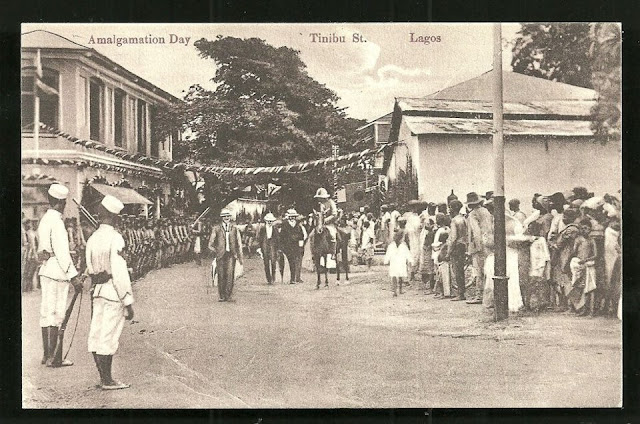
Amalgamation Day in Lagos, 1914

Amalgamation Day in Lagos, 1914
Showing posts with label Crime. Show all posts

16 September, 2013

The Stories We Should Tell Louder

Back in 2010, a semi-acquaintance of mine attended a panel discussion on Nigeria that was held in London sometime in 2010.  This is an edited excerpt of what he wrote about the event:

The place was full to the brim and the debate was vigorous. The debate was about whether Nigeria was an African superpower and how an area that was able to produce incredible works of art like the Ife sculptures could end up the way it is today.
The panel included Father Kukah, who had interesting stories to tell about the religious conflict in Kaduna. One was about his sister who had a shop and was close to an elderly Muslim neighbour. When Christians were about to be attacked, the old man asked her to hide all her goods in his house. So when her shop got burnt down, she didn't lose much. But then the Muslim's house got burnt down in a revenge attack by "Christians" and she lost everything.   

Father Matthew Hassan Kukah, and indigene of Kaduna State, was subsequently named Bishop of Sokoto in 2012.  Before Jos in Plateau State took over as city most frequently mentioned in the context of "communal violence", Kaduna City, capital of Kaduna State, held that infamous position.

Father Kukah is one of many prominent Nigerian religious and sociocultural leaders who work very hard to end the scourge of communal violence. The story he told of the closeness between regular Muslims and Christians (his sister and her elderly neighbour) is one that deserved wider attention in the Federal Republic. The story he told of the senselessness of ultimately self-defeating nature of the violence should also have found a wider audience in Nigeria.

But nobody knows about it.  The nature of the discourse in Nigeria is to loudly trumpet any and all news (even if unconfirmed) that contributes to sustaining the state of oft-violent distrust, division and dysfunction, and to downplay and minimize anything that would or could create a rallying point for the super-majority of Nigerians who would work to end the dysfunction if only there was an available route towards doing so.

We Nigerians (and Africans) often complain that the foreign media tends to highlight negative news about Africa, and to downplay positive news. We argue that the relentless negativity contributes to the sustenance of the the conditions that create the negative outcomes.

But we ourselves tend to highlight the negative about ourselves, and about each other.

I am not talking about criticism, constructive or otherwise. The only way anything can improve is to realize what about ourselves needs improvement ... but that implicitly acknowledges that we are able to improve. The problem with the negativity is that it is built on the notion that ... the best way to explain it is to revert, once again, to what we easily understand, non-African racism towards Black Africans.  The racist theory that Black people are inferior presupposes that we cannot possibly be as good as anyone else, that we are automatically and irredeemably .... fill in the blank with negatives.

When certain Nigerians tout the division of the country as the "only solution" to our problems, or when people say that the Amalgamation was the source of all of our problems, there is an inherent belief that it is not possible to live in the same country with the other Nigerians, that it is not possible for us to live with them in the same country. Because they are just inherently and irredeemably ... fill in the blank with negatives.

I have had conversations with people where they start out agreeing with me in terms of critiquing the problems, but somewhere along the line, while I am still trying to analyze how we can all come together to solve the problem, the other person(s) branch off toward blaming another ethnic nation, geographical region, "geopolitical zone", or even senatorial zone for the problems. Even within a single town or city, the finger gets pointed at a socioculturally distinct neighbour (Ife and Modakeke, Aguleri and Umuleri, K-dere and B-dere, Zangon and Kataf), who is somehow to blame for the lack of jobs, the scarcity of land, and any other problems.

I know from experience that if you push through and continue arguing your case, those person(s) you are discussing with swing back from the knee-jerk response of blaming some other sociocultural group, and rejoin your analysis of what we could do together to fix the problem. However, the end of the conversation invariably involves both you and them concluding that it is unlikely that the problem will be solved in the real world.

As I've asserted in prior posts, this sort of negative political reaction to each other is the product of a sea of information in which we all swim.

Negativity, Violence and Shock Value sell newspapers and keep eyes attached to television sets. But while this is true of the commercial media everywhere, the overall nature of the discourse in most of the world's successful countries is to magnify and trumpet the best part of their national soul, and to sweep the less honourable parts of their national history under the carpet. Even what purports, in this age of political correctness, to be a less patriotic and hagiographic version of their history still rather underplays much of less edifying parts of their past; and much of what is presented as the "progress" of the present could be interpreted rather differently if one took a less rose-tinted view of events.

We do the opposite. We bury the best parts of our Federal Republic's shared soul, and overplay the worst parts of us.  We not only treat the violent fringe as if it were the "normal" Nigeria, but go out of our way from an institutional and governmental point of view to facilitate the actions of the violent fringe as though we are not supposed to be otherwise, or rather cannot be otherwise. That is it right there. The idea that this, the violence, is who we are, and that it is not possible not to be this way.

But I didn't have to hear Father Kukah's story to know that the truth of Nigeria is quite different. In fact, while incidents of mass violence are rightly given wide coverage in the news, at any given point in time, most of Nigeria and Nigerians are not in fact subject to any violence.

Father Kukah's statement about violence and reprisal violence in the City of Kaduna, reminded me of a television report about two men who had previously been leaders of rival gangs of "youths" in Kaduna, gangs that attacked neighbourhoods of people from the sociocultural group of the rival gang (similar to what has been happening in the City of Jos since 1999).  It was one of the few reports I had seen that didn't portray the violence as being one-sided.

These gangs are made up of youths who are unemployed, poor and prone to inducement by political factions. Indeed, a lot of violence in Nigeria is carried out by starving boys and youths who loot the homes and businesses of wealthier "foreigners" (i.e. non-indigenes). One of the more unfortunate aspects of our shared human history repeats itself: when poverty and economic uncertainty rise in any country (even in those so sure of their supposed "enlightenment"), the tendency is for gangs of poor, unemployed youths to see wealthy "foreigners" as having taken opportunities that should have gone to locals.

Of course, if we looked at it this way, we would have been obliged to fix the economic problems of our cities. But now that we just conclude it is ethnic or religious violence, we can throw up our hands and say there is nothing we can do about it.

What really struck me about the story is the two former gang leaders working together to end the violence in the city is how little coverage they received in the Nigerian media. They should be household names, but I only learned of them briefly and only from a foreign media source, not the Nigerian media.

It is time we gave greater prominence to stories of the good people, at least enough so that our people know there is another side to the Federal Republic of Nigeria.

Here are links to previous posts I have made about stories that we should tell louder:

THE STORIES WE IGNORE An excellent feature by Tadaferua Ujorha for Daily Trust.

FIGHTING FOR PEACE An excerpt from a Weekly Trust essay by Carmen McCain about an old man who died doing the right thing, but who has been forgotten while we glorify and give national honours to the men and women responsible for creating the situation that killed this good man.

WE STAND TOGETHER Three articles.

GOOD DEEDS IN CENTRAL NIGERIA Self-explanatory (I hope the embedded links are still live).

For the Record: On the State of Emergency in the Northeast

I haven't said anything about it. And I am not going to now.

I often say on this blog that it is difficult to know what it actually happening, anywhere in the world.  You can't trust politicians, and you can't really trust the news media, be it "mainstream" or "alternative" (especially on issues of real importance).  There are a lot of people in the world who talk as though they are "experts" on what is going on, and other people who differ from and criticize the "experts" based on their belief that they are more correctly informed about what is going on than the "experts". Strangely, an ever-growing proportion of younger people get their "news" from comedians who are not necessarily funny or particularly insightful. The comedian-as-expert concept reached a new high at the last Italian elections, when a political party founded by a comedian did exceptionally well.

At the end of the day, even if you read/watched/listened/studied everything said by everyone from every conceivable bias and pretension to "expertise", if you were fully honest with yourself, you would admit that you don't actually know what exactly happened, who exactly did what, how exactly they did it, and why they did it ... even if the results of whatever happened directly affect you.

You may ask whether I am being a hypocrite, since I write a blog and offer opinions on the issues.

Perhaps. But what can you do?

I will say this: My intent with this blog is not necessarily to comment on specific items of "news", but to talk about the issues generally. In other words, my response to a news article about a specific thing the Inspector-General of Police reportedly/allegedly did would be to engage in a broader discussion of why the Nigerian Police Force functions the way it does, why there has not been (and will not be in the near- or mid-term future) any reform of the Nigerian Police Force, and why nothing substantive about the operations of the Police will change until such and such reform is instituted.

Such commentary, be it sensible or silly in your opinion, is not necessarily tied to whether or not the report on the Inspector-General of Police is factual, counter-factual, partly-factual, or polemical.

The problem with commenting on the State of Emergency in the Northeast is .... people are dying. Soldiers are dying. Civilians are dying. Suspects are dying. Criminals are dying.

I am not comfortable forming opinions, much less commenting, on this type of thing when I do not actually know what is going on.

Eventually, things will calm down, the dust will settle, and we will all be able in theory to get a better handle on what happened (past-tense). Emphasis on "in theory", because to be quite honest, we the people of Nigeria have little or no certainty of information on what happened in the three ECOMOG wars, the Somalia mission in the early 1990s, the various coups, or the Civil War. What information as is out there is quantitatively insufficient, and qualitatively dubious.

It doesn't help that our fractured politics distorts analyses to begin with.

Speaking of politics, one of these days, someone will do a credible, mathematical analysis that will show that the Fourth Republic has been the most corrupt period of our history, and the second-most violent (behind only the 2.5 years of the Civil War). By and large, the politicians are responsible for the various violent crises that have hit the Federal Republic, one-after-another, since 1999, sometimes by deliberate commission and other times by equally-deliberate omission.

So you will not see any commentary from me on the State of Emergency.

What I can say is I wish nothing but the best for the people of Borno, Yobe and Adamawa.

And I wish there was something in my power to do to help out.

09 September, 2013

On Obasanjo's Regime

For the record, I am neutral towards Nigerian politicians, political parties, political factions and political operators. I support none of them, and oppose all of them.

Having said that, I ran into comments (on a popular Nigerian website) by someone defending the Obasanjo Administration. His comments are in red, my responses in black.


1.  Obasanjo is the only leader to free Nigeria from Billions of in debt owed to the Paris and London Clubs. It's worth remembering that this was debt contracted by all of Nigeria's former Heads of State.

As the man said, General Obasanjo was one of the former Heads of State that create the debt problem in the first place.  He then paid $12 billion in exchange for the cancellation of the balance of $18 billion on our debt. Much was said about how we would have $20 billion in savings over 20 years, or $1 billion a year.

What no one pointed out was, at a low level of compounded interest, the future value of $12 billion is worth at least $20 billion over 20 years, so the Paris Club members did in fact get from us the $20 billion over 20 years they purported to have forfeited.

Secondly, the value of $12 billion used to leverage private investment in infrastructure was worth more to the Nigerian Gross Domestic Product than $20 billion over 20 years.

And thirdly, because of a lack of fundamental reform, restructuring and transformation (and because of political leaders like Obasanjo who took advantage of the lack of reform), the Federal Government of Nigeria has, since the "debt cancellation" deal, incurred new debt that has left us with the same level of debt as we had before we cancelled it. So we are back at square one only a few years later. Indeed, that $1-billion-a-year in savings that were supposed to be spent on Millennium Development Goals does not exist, as we are now paying interest on the new debts.

And mind you, that is just the federal debt. The states and local government areas of the Fourth Republic have been running up debts without question, checks or balances. There has been no analysis that I have seen as to whether or not the states and LGAs can sustain the debts they are incurring, or as to whether or not the projects they are carrying out can generate the revenue to pay back their costs plus interest.

2.  Obasanjo excelled in the area of privatization. Under OBJ Nigeria made a whopping $7.07bn - the sum generated from the sales of many state own companies.

According to Vice-President Namadi Sambo, 80% of privatized firms are moribund, which, in his view defeats the purpose of employment-generation and economic diversification. I am not sure what to say about this.  As an economist I am theoretically supposed to say that firms with no economic reason to exist should be shut down. As an economist inclined towards the development of Nigeria, I have to ask more questions. Why did these firms shut down?  Is it because there was not an enabling environment? Infrastructure driving the cost of business up?  Or was it a question of asset-stripping, or of shutting down a government-owned cement corporation to strengthen a near-monopoly in the cement market?

This isn't an abstract conversation. There has been so much back-and-forth in ownership and other issues regarding the Ajaokuta Steel Comples, NITEL, the Aluminium Smelting Corporation of Nigeria, the Oil Refineries, the Lagos-Ibadan Expressway Concession (awarded to Bi-Courtney and then taken away from Bi-Courtney), and Electricity, among other big-ticket economic sectors. Things go in one direction with great fanfare, and then with less fanfare (much less fanfare) those same things are reversed. The Lagos State government has just bought back the Lekki-Epe Expressway Concession after years of controversy

Again, I ask for more in the way of analyses. It is not just a question of saying we had "debt cancellation" or that "we got $7 billion in privatization money". We must always ask whether there was some other thing that we could have done that would have got us more.

Let me give you an example.

Let us say getting $7 billion from privatization is the best thing possible. Now, the Central Bank of Nigeria, under Professor Charles Soludo, one of Obasanjo's proteges consolidated Nigerian banks, but neglected his duties of oversight and regulation, largely because the bank bosses were friends, allies and political associates of President Obasanjo. They were untouchable because of their contacts with Aso Rock ... and because of that, current CBN Governor Sanusi Lamido Sanusi has had to spend more than $10 billion bailing out the banks. In addition, between them, Soludo and Sanusi spent tens of billions of our reserves defending the value of the Naira. Most other countries would see a fall in the price of their currency as an opportunity to increase their manufacturing and other exports, but since Nigeria imports everything ....

If a person does something that earns 700.00 while simultaneously doing or failing to do something else that loses 700,000.00, should we throw a party for the small gain or ponder the reasons for the larger loss?

Speaking of which ....

3.  Obasanjo left Nigeria external reserves to the tune of $60bn. Today, this amount has all but gone.

Rising demand for crude oil from China and India helped drive the exogenous processes that hugely increased Nigeria's external reserves. Internal, domestic policy decisions by the Nigerian government eroded that windfall. Remember when President Obasanjo moved Dr. Ngozi Okonjo-Iweala from the Finance Ministry to the External Affairs Ministry? He was about to use federal government money to carry out what he called "do or die politics" in the run up to the 2007 Elections. That type of fiscal indiscipline is the reason Nigeria has borrowed so much new debt since the "debt cancellation" that we are back to owing as much as we owed before the "cancellation". The expensive, violent "do or die elections" elevated Obasanjo's protege, Dr. Goodluck Jonathan, to the Vice-Presidency.

As Interim President, Dr. Jonathan's federal government generated a truly massive fiscal deficit during the 2011 Elections. That deficit was rolled into the ever-growing debt. Indeed, the funny thing about the debt is we the citizens of Nigeria have to repay loans taken by the federal government to buy elections for Presidents Obasanjo and Jonathan.

After the 2011 Election, President Jonathan re-hired Dr. Okonjo-Iweala as Finance Minister to burnish his government's reputation with the Western European and North American financial institutions.  I suspect she will be sidelined again when the 2015 Elections come up, and it is time to run up more debt to buy an election.

4.  Obasanjo appointed foreign fund managers in collaboration with the Nigerian Central Bank to partner local banks in the management of Nigeria's foreign reserves. The banking reforms led to the recapitalisation of the Nigerian banking system and brought down the number of banks from 89 to 25 viable banks.

And these would be the banks that were bailed out by the CBN to the tune of more than $10 billion and the foreign reserves that dropped dramatically because of bad fiscal and monetary policy and policy-execution?

5.  Under Obasanjo, the non Oil sector grew and the economy diversified.

Obasanjo can take credit for de-regulating the telephone markets.

6.  Under Obasanjo, Nigeria, from being a pariah state, became one where foreign investment poured in. Nigeria's credit rating was considerably improved under Obasanjo.

The same was true the last time we had an oil boom.  Angola and Equatorial Guinea are also attracting investment. Now, unless Obasanjo is responsible for the economic development in China and India ...

Sarcasm aside, the same infrastructural and policy bottlenecks to economic activity continued to exist, and still exist now. More dangerously, much more dangerously, the security situation and public security deteriorated markedly during Obasanjo's administration, and the deterioration continued under his hand-picked successors.  Aside from the usual problems and dysfunctions of the Nigerian security apparatus, the nature of Fourth Republic politics is such that the people most responsible for violence and insecurity are the same people politicians rely on to rig electoral victories for them. As such the government has never been serious about bringing these groups to justice, and gave them so much room to operate and grow that they (the state, local and federal governments, and the various political fixers and godfathers) have lost control of their former minions. But even as these groups become ever-greater threats to the federal government, the politicians are still maintaining alliances with them in the hope of using them again at the next election.

Nigeria was on it's last legs when Obasanjo came to office. A Loan Shark wouldn't have touched Nigeria with a barge pole. Obasanjo made Nigeria attractive again. Goodluck Jonathan is today enjoying the benefits of that achievement.

The violence and insecurity bred by Fourth Republic "do or die politics" might make the writer rethink the meaning of being on your "last legs".  The legacy of violence has continued into the Goodluck Jonathan administration. The government might pacify the Northeast, but if the history of the Fourth Republic is anything to go by, something else will kick up somewhere else. The federal, state and local governments remain averse to real political and security reform, as it would result in most of them being prosecuted and jailed. This leaves we the citizens in a state of near-constant exposure to violence of one form or another.

09 January, 2013

On the issue of Kidnapping

Dr. Okonjo-Iweala is the Finance Minister and "Coordinating Minister for the Economy".  Last year,  her mother, Professor Kamene Okonjo, was kidnapped and later released.

I am vvery happy that it all ended well and safely for her mother, but the Finance Minister seemed to have chosen to use the incident to play politics, telling a press conference her mother's abduction was linked to the controversial fuel subsidy issue.

Let me stress that I am not heartless. I know exactly how she must have felt when she was told her mother was in the hands of the kidnappers, and exactly how she must have felt to embrace her mother again when it was all over. In such situations you might do or say things that you wouldn't do or say in other circumstances.

But Dr. Okonjo-Iweala occupies what is purported to be the most powerful position in the Jonathan Administration cabinet. In theory, she wields (or is meant to wield) more influence than the any of the Vice-President, the External Affairs Minister or the Defence Minister.  She is presented to the public as though she were President Jonathan's "prime minister" and guiding force of his government.  Of course, the true nature of Nigerian politics is such that other priorities and principals are likely more influential on the President's decision-making than anything Dr. Okonjo-Iweala says or does ....

.... but you start to wonder if the Nigerian Federal Government is giving the long-running epidemic of kidnapping the seriousness, focus, attention and resources it deserves.

With the greatest of respect, the kidnapping of Dr. Okonjo-Iweala's mother had nothing to do with politics or the fuel subsidy issue. It was just another kidnapping in a thriving criminal enterprise. Her mother's situation was only unique in the sense that kidnappings only make the national news when a prominent citizen is taken. Aside from having a daughter who is the Finance Minister, the Okonjo Family are Ogwashi-Ukwu royalty; one newspaper properly addressed Professor Kamene Okonjo as "Her Royal Highness".

Before I go on to talk about the scourge of kidnapping, let me take a moment to put it in perspective, since this blog post may be read by foreigners who don't have firsthand experience of Nigeria. Before the Nigeria'99 World Youth Cup, and years later in advance of the 2010 World Cup hosted by South Africa, one noticed segments of the foreign media creating the impression that as soon as you walked out of your aeroplane into Nigeria or South Africa you would be accosted by violent criminals.

I do want to discuss our public security problems, and I do consider this issue to be at or near the top of the priority list for reform, restructuring and transformation, but I do not want to add to the type of misinformation that preceded Nigeria'99.  There are at least 100 million people living in Nigeria, most of whom are not directly affected by crime of any kind of a daily basis. In all the time I lived in Nigeria, I was never affected by crime. My first personal experience of crime came after I moved to the USA for tertiary education.

Having said that, all Nigerians would agree that the rate of kidnapping in the Federal Republic is far too high, and that the kidnappers are very bold in their actions because they know the odds of facing any kind of judicial sanction are far too slim.

Dr. Okonjo-Iweala's mother is not the first high-profile victim, nor is she the first family-member of a high-profile person to be kidnapped. Indeed, not too long after her release came news Nkiru Sylanus had been kidnapped. Ms. Sylvanus is a not-famous Nigerian film actress who now serves as a Special Assistant on Public Affairs to Imo State Governor Rochas Okorocha.  The criminals who kidnapped Dr. Okonjo-Iweala's mother had demanded ₦200 million; those who took Ms. Sylvanus wanted ₦100 million.

Ms. Sylvanus was released after her family paid ₦8 million. The Nigerian Police Force subsequently issued a public statement saying her family had paid the ransom though they (the police) had told the family not too. After Ms. Sylvanus' release, the police arrested and paraded suspects in her kidnapping and other kidnapping cases.

The articles I've read on Professor Kamen Okonjo's release do not mention whether a ransom was paid or not, but shortly before her release, the army (i.e. not the police) arrested 63 people for questioning regarding the kidnapping.

I don't mean to sound cynical, but our police (and politicians) have little or no credibility in public security issues. One particular boldfaced lie told not too long ago about an extra-judicial execution in Maiduguri will probably go down in our history as the most infamous lie ever told by Nigerian Police brass.  The safest position to take is to say I do not know if there was or wasn't just cause to arrest any of the suspects arrested on suspicion of involvement with these two kidnappings. Maybe there was. Maybe there wasn't.  Maybe someone, anyone had to be arrested for reasons of public appearances, and maybe someone was.

Before accusing me of cynicism, consider these two examples, the first a Vanguard article discussing the case of a pregnant woman who was arrested and held for 6 months, the second a BBC report on a lucky man who was detained without charges for 7 years, during which time he was shot in the leg and tortured, having been arrested on suspicion of being an armed robber -- his parents were told a year into his detention that he was dead.

The people described in the cases above are lucky, both to be alive (what with the issue of extra-judicial executions), but also because someone in the media bothered to tell their stories. As Nigerian citizens, we go about our daily lives with little thought for the 70% of all Nigerian prison inmates who have been stuck in prison "awaiting trial" for years or decades. Some have not been charged with anything.  Some who are arrested as "suspects", mysteriously die during or following "interrogation". Some are only in prison because they are related to someone the police is looking for (by the way, if someone is a hardened criminal, the person most likely doesn't care enough about anyone, to accept starvation and prison-borne diseases in exchange for a family member's freedom).

I don't deal in optimism, pessimism, cynicism or any other "ism". I don't even subscribe to any of the political or ideological "isms".  My thing is to look at problems that have been around for a very long time without anything being done to either fix/correct or even just ameliorate.

While the police were parading their suspects in the Nkiru Sylvanus case, gunmen were busy at work kidnapping a member of the Gombe State House of Assembly.  The linked-to article describes it as the first reported kidnapping in Gombe, but, as I keep pointing out on this blog, these type of events only make it into the news media (and attract the attention of governmental institutions) when it affects someone important, or when the event plays in to one of the broader political narratives constantly being woven by those with the loudest voices in our society (e.g. when an event can be used to reinforce inter-ethnic, inter-regional and and inter-cultural suspicion and distrust). Luckily and happily, the Gombe State lawmaker  was released on the 2nd of January in the New Year ....

.... but surely the scope of the problem is clear? Indeed, the article discussing the arrest of suspects in the Nkiru Sylvanus case also mentioned the since-resolved abduction of the four-year-old daughter of the Publicity Secretary of the Imo State branch of the People’s Democratic Party (PDP)!


I have often pointed out that the nature of Fourth Republic politics obliges politicians to hire private armies of thugs in order to advance their political ambitions. In-between elections, these armed men tend to find ways to make money for themselves through smuggling, brigandage, "militancy" to extort pay-offs and contracts, kidnapping, armed robbery, and assorted other violent criminal enterprises. I am not saying that every person involved in these type of crimes moonlights as a political enforcer during election periods. I am saying the inverse -- that all of the election-year political enforcers moonlight as criminals between elections.

The respected, but now troubled, Nigerian news magazine Newswatch did a story years ago, questioning allegations that Obioma Nwankwo alias Osisikankwu, the infamous kingpin of kidnapping and armed robbery who declared war on Abia State, had began his criminal career as an enforcer manipulating elections on behalf of People's Progressive Alliance then-gubernatorial candidate (and current Governor) Theodore Orji.

It is difficult to know for sure if the allegations reported by Newswatch are factual, however, I have always maintained that the only good thing that came of the 2003-2006 Anambra State political crisis precipitated by Chris Ubah is it gave Nigerians a very clear and unvarnished view of the realities of Nigerian politics.  Politics is no different in the Niger-Delta, the Southwestern states, Kwara State and in the Northwest, the East-Middle-Belt or the Northeast.


It creates a situation, a paradox, where all three tiers of Nigeria's governments are obliged to contradict themselves, to negate their own actions when it comes to issues of law enforcement and public security. On the one hand, they do certain things that are technically designed to improve public security, but on the other hand they do other things that aggressively and deliberately render their law enforcement efforts ineffectual to the degree of being essentially nonexistent.

There have been reported incidents over the years of Nigerian soldiers arriving at the headquarters of a smuggling operation to find the smugglers had been tipped off to their arrival and had disappeared. And there was the very, very embarrassing incident of an impounded smugglers' ship escaping from Nigerian Navy custody without challenge (two Admirals were later shown to have aided the criminal escape).

For these reasons, citizens tend to suspect law enforcement agencies, security agencies and politicians know a lot more about these organized criminal groups than they admit.  The fact that they operate so freely brings up suspicions of political involvement, which are, ironically, then exploited by the three tiers of government to deflect attention from their ineffectual efforts to control and limit crime. President Jonathan has made vague allegations about insurgency collaborators in his government, and Finance Minister Okonjo-Iweala has raised the spectre of the fuel subsidy "cabal" being involved in the kidnapping industry.

The same sort of vague "gist" you get from street conversations.

Or blogs.

09 July, 2012

The first female Chief Justice of Nigeria

Firstly, news of more "communal violence", this time in Ogun State.

Secondly, better news. It looks like the Federal Republic of Nigeria will get its first female Chief Justice of Nigeria.  President Goodluck Jonathan has sent Justice Aloma Mariam Mukhtar's name to the Senate for confirmation as the next Chief Justice of the Supreme Court. It might be the first thing he has done since assuming the Presidency that I wholeheartedly support and endorse.

 Usually, rising up the ladder in Nigeria implies the status quo is happy with your work; underneath what appears on the surface to be movement in shifting sands of Nigerian politics masks the presence of an immobile rock just beneath the sand.

But this is different.  Whatever else is true of her, Justice Mukhtar has spent her life being the first to do a lot of things, things that stereotypically she supposedly should not have been in a position to do.

Usually I post just links, so the newspapers get the traffic their investment merit, but this time I will post the full article from This Day here.

Before I do, let me tell you something that makes me angry and sad at the same time.  You see, I posted news of Justice Mukhtar's pending appointment to a discussion forum for Nigerian affairs that I frequent. To my surprise, the first response came from a man who proceeded to insist it was a bad move from Jonathan because "they" (his words) would be in control when challenges to Jonathan's 2015 election come before the Supreme Court.

We complain a lot about our leaders. But as I always say, the path towards changing our Federal Republic lies in changing ourselves first. Far too many of us think the way he thinks. As long as that remains the case, we will continue to have the kind of leaders we have.

Do you know that "zoning" is not just a national political phenomenon? In my little Local Government Area, a place most of you have never heard of, the Chairmanship, Councillor seats, Federal legislative seat, and State assembly seats are all zoned to different sections of the LGA. And much like at the Federal level, it has not produced the best of leaderships ....

The story:


Justice Aloma Mukhtar Nominated First Female CJN
05 Jul 2012

By Kunle Akogun
Nigeria is set to get its first female chief justice with President Goodluck Jonathan sending the name of Justice Aloma Mariam Mukhtar to the Senate for confirmation as the new Chief Justice of Nigeria (CJN).
If confirmed by the Senate, Justice Mukhtar will succeed the CJN, Justice Dahiru Musdapher, who is due to retire on July 14 having attained the mandatory retirement age of 70 years.
Even though, Mukhtar, expected to be sworn in by July 16, will be the first woman to be appointed CJN, her elevation will not be the first time she will be making history on the bench.
Born in Kano State, Mariam was the first female Northerner to become a lawyer. She was the first woman to be appointed a justice of the Court of Appeal. She is also the first female justice of the Court of Appeal to make it to the Supreme Court.
Her appointment, after the Senate clearance, will make her the 13th head of the nation’s judiciary since the appointment of Chief Justice Adetokunbo Ademola, the first CJN, who held the post from 1958–1972.
Jonathan, in a letter dated July 3, and read on the floor of the Senate Wednesday by Senate President David Mark, sought the senators’ approval to make Mukhtar Musdapher’s successor.
In the letter, Jonathan told the senators that Mukhtar’s nomination was in conformity with Section 231 Sub-section (1) of the 1999 Constitution.
The letter read: “In conformity with Section 231 Sub-section (1) of the 1999 Constitution of the Federal Republic of Nigeria, as amended, which gives the president powers to appoint a Chief Justice of Nigeria, acting on the recommendation of the National Judicial Council and subject to confirmation of the appointment by the Senate, I have the honour to forward the nomination of Honourable Justice Aloma Mariam Mukhtar, CON, CFR, for confirmation as Chief Justice of Nigeria.
“It is my hope that this request will receive the usual expeditious attention of the distinguished Senate of the Federal Republic of Nigeria.”
Jonathan also forwarded to the Senate the names of Hon. Justices Kumai Bayang Akaahs (North-west zone) and Stanley Shenko Alagoa (South-south zone) for confirmation as justices of the Court of Appeal.
Jonathan, in a letter also read by Mark, said both “appointments have been necessitated by the impending retirement from service of Hon. Justice Dahiru Musdapher, Chief Justice of Nigeria, and Hon. Justice F. F. Tabai.”
The road to Mukhtar’s historic emergence began in April when Musdapher served the National Judicial Council (NJC) the mandatory three-month notice of retirement.
Mukthar was called to the Nigerian Bar on June 26, 1967. By September 24, 1987, she became the first female to be sworn into the Court of Appeal. When the Senate confirmed her appointment on May 10, 2005, she was also the first female justice of the Supreme Court of Nigeria.
Born on November 20, 1944, she attended St. George’s Primary School, Zaria, St. Bartholomew’s School, Wusasa, Zaria, Rossholme School for Girls, East Brent, Somersets, England, Reading Technical College, Reading, Berkshire England, Gibson and Weldon College of Law and was called to the English Bar in Absentia in November, 1966.
She worked as a pupil state counsel, Ministry of Justice, Northern Nigeria in 1967; Office of the Legal Draftsman, Interim Common Services Agency, Magistrate Grade I, North Eastern State Government in 1971; Chief Registrar, Kano State Government Judiciary, 1973; Judge of the High Court of Kano State, 1977-1987; Justice of the Court of Appeal, 1987-1993; presiding justice of the Court of Appeal, 1993-2005; and justice of the Supreme Court from June 2005 to date.

28 December, 2011

The stories we ignore

I don't talk too much on this blog about the recurrent incidents of violence in our federal republic. Violence in Nigeria is a complex, complicated, exasperating, saddening and depressing issue that cannot fully be discussed in the confines of an e-blog.

Every once in a while I try to write what I always hope would be an abbreviated essay on the problem, but even while unfinished and still growing in length, these "abbreviated" essays eventually resemble short books. And even these "short books" are insufficient to truly discuss the issue.

What I want to do in this week of bloody attacks and bloody reprisal attacks is to remind us of the stories we tend to ignore. But even so, I have had to rewrite and edit down this introduction portion, because it grew to 14 pages! I am just going to get straight to the article and leave out any commentary. There are enough people commenting on the violence. One gets the impression that the way we talk about the issue reinforces the problem rather than solves it, that we sometimes miss the forest for the trees. In any case, there are enough people talking about it.

But first the introduction.

A month ago, Tadaferua Ujorha of Daily Trust gathered reports of courageous citizens who, at risk to their own lives, did what we all wish we were brave enough to do.

I normally prefer to post a link to the source sites for news articles, or at most block-quote a relevant excerpt. It is important for Nigerian news organizations to receive the "clicks", and associated revenues accruing. They invested resources on news-gathering, and will stop doing so if they are not making money. At least one of Ujorha's collected stories came from financially-struggling NEXT, which has had to massively reduce its investment in investigative journalism.

But in this rare case, I think the article is important enough that I will post the whole thing on this blog. Not many people (if anyone at all) read my blog, and I don't if any of you who do read take the time to click on the links (many of the older links are now non-functioning anyway). I want to make sure anyone who reads this blog post will also read the article.

Of course, you may not consider it to be as important as I do, but there is a way that we have come to think of each other as Nigerians. Our perceptions of each other have been, are now, and will be quite a stumbling block on the path of doing anything of positive impact ... in security issues as much as anywhere else.

Tadaferua Ujorha's collection of reports highlights two aspects of us as Nigerians, the heroic few who risk their lives to save their fellow citizens, and also the majority of us who lock ourselves away in our homes or run to the relative safety of the nearest police or army barracks, hoping against hope that the violence does not hit us or our families. We are together in this -- believe it or not, we are all at risk, and until we realize this we are not going to get anywhere.

Read the article, and if you like it, you might want to click the link anyway. I do not know how the whole revenue-from-clicks thing works, but if you want this type of reporting, you've got to help them pay for it:

‘I will never forget you’

Written by Tadaferua Ujorha who was in Kaduna, Kano & Niger
Tuesday, 29 November 2011 05:00

He has the courage of a Lion.

Adamu Bologi, a Muslim, is not likely to forget April 2011 in a hurry. It was the month when post-election violence broke out in Niger State, as well as in other parts of northern Nigeria. Bologi left for work early that morning, as he is wont to do.
He is a Librarian at Newsline, the Niger state government-owned newspaper. Later, he left to return home to give his wife some money. Home is Tunga, a part of Minna, and Tunga is a multicultural setting, accommodating a diversity of ethnic groups. Here are bad roads, open gutters and numerous dwellings, some large, some small. Too close to each other, some would say. It was while he was heading home that rioting broke out. There was thunder in Tunga on that day, and smoke from a burning Church filled part of the sky. The ‘Corpers Lodge’ was also torched. Fear and anxiety filled the hearts of many. All of a sudden a dark cloud fell upon the area. People fled their homes and headed for the nearby police barracks, the usual point of convergence at such moments. There was pandemonium on the streets. Men, women and children fled. The nearby Conqueror’s House Church, on Bay Clinic road,was burnt. According to Bologi ‘I saw some fifty persons holding cutlasses, sticks, and knives. They were saying if you are a Muslim go inside,we are looking for Christians. There is one compound near mine. Everyone living there is a Christian. The rioters focused on that house, and all the occupants instantly fled with their children’. He says that at risk of losing his life, he ferried all of them to the nearby barracks. He did all this alone. He adds ‘There was no other Muslim with me when I was going round.They just stayed by their doors,and looked from their windows’. While returning from the barracks he met the group of rioters who were upset with him and said so. His words ‘They heard that I am the one who took people to the barracks. So they warned me’. Here he was putting his life and properties at risk. After this he met a woman weeping as she walked along the road. His words ‘When returning from the barracks I met a woman who was crying, and she had two children by her side. I asked her what was wrong, but all she could utter was ‘my husband, my husband’. I took her to my room together with the two children. I gave her water to drink, and asked my wife to look after her. I then went out to look for her husband’. It was while he was outside looking for her husband that he came across another woman, being harassed by a mob.His words ‘They beat the woman and she fell down. The woman kept running and falling down, with her child too. She stood up, ran, but was felled again. I told them to stop beating her. But they didn’t stop. She was shouting. I then put her in the mosque of my house. I asked her to remove her slippers, before entering, because we don’t enter the mosque with slippers on’. After ferrying her into the mosque, he then went outside again, to see if he could locate her husband, whom she continually referred to, amidst tears. He walked to the nearby police barracks to see if he could seek him out, and on his way back he saw a man wearing a trouser and a vest, who turned out to be her husband. He hurried with him to his house, and now reunited husband and wife.

Not a drop of blood fell

Pastor Jeremy Omachi, bold and outspoken with a commanding voice, is the man he saved.He is Igala from Kogi State, and tells Daily Trust a moving story of his experiences in the following words ‘On 18 April 2011, a day after the Presidential elections,at about 11:00am I suddenly heard people chanting. I ran out to find out what was happening. I saw groups of people coming towards our house. I locked the door, and put my wife behind me,and asked ‘why are you people after us?’ They said ‘since you people refused to vote for Buhari, and you voted for Goodluck, we have come to kill you and to burn the Church’. In the ensuing exchange he signaled to his wife to flee from the house, and she did. Then the mob proceded to attack him with matchets and sticks. Then an amazing thing happened. According to him ‘Seven times they hit my head with their matchets, but the matchet did not draw blood. So all of us were shocked, and I thought it was not real again… But you could hear the sound of the matchet as it made contact with my head. It was as though it was iron hitting iron .Somebody even asked me why my head seems to be immune to cuts from a matchet.Then I fell unconscious.’ Later, he escaped from his house and headed in the direction of the police barracks. On his way there he had an encounter with Bologi. His words ‘Bologi ran after me. He asked me to stop,and asked if I am the Pastor. Then he took me to his house. Life came into my wife, when she saw me. She had already cried and believed that I was dead’.Later in the interview with Daily Trust, Pastor Omachi says of the events ‘I see Bologi as someone who has the kind of passion that I have.May the Almighty raise up more of such in our generation.’ The duo met for the first time after the events of April, when this reporter visited Minna in September this year while investigating this story. During the meeting Bologi says that if events were to repeat themselves he would behave in a similar fashion and save many more people. His words ‘I will behave in the same way. I will do much more than I did.This is a rented house.I am paying rent. If it were my personal house, I would have done much more than I did’. Bologi’s moving story has also been captured by Next.

Hayab helps a youth

In Kaduna, Reverend Joshua Hayab, Special Adviser to the Kaduna State Governor on Christian Matters, receives a phone call a day after the presidential elections. It was from the house of Mai Ungwar Gbagyi, which is in the Television area of Kaduna, a predominantly Christian community. The call was to the effect that a Muslim youth was about to be killed at the house. In fact the mob was prepared to burn down the house,if the boy won’t be released to them. There was tension in the area. Groups there were reacting to outbreaks of violence relating to the April Presidential elections. Reverend Hayab hurries to the location, and finds a mob gathered around the house of Mai Ungwar Gbagyi. He pleads with the restive youths ,and is finally allowed to leave the house with the much troubled youth. His words ‘I pleaded with them, and I convinced them why they must not kill this boy. I put him in the car and asked the driver to lock the car. I stood outside and spoke to them some more,and then they became calm. But before I knew what was happening another mob had come. I jumped into the car and we quickly drove away’. As they drove along, they came across another mob which also wanted to despatch the muslim youth in the Reverends car. His words ‘I came out of the car,and instructed the driver to lock the car from the inside. They now said ‘this bearded man in front of your car is a muslim, and we would not allow him to pass’. They later smashed both windscreens of the car. The youth was still inside the car when this happened. Upon instruction from the Reverend, the driver sped off and escaped the mob who were lined up all over the road.The Reverend who was still with the mob, was rescued shortly thereafter by soldiers from the nearby Command Secondary School. The driver had escaped there, and alerted the soldiers on duty about what was happening. Reverend Hayab says ‘It was akin to Divine intervention.In less than five minutes ,a military car just appeared from nowhere.’.

‘I won’t forget’

Dr Garba Shehu Matazu,a former Member of the House of Representatives, and now Senior Special Adviser on Higher Education to the Katsina State Governor, tells an interesting story of events in Kaduna, on the same day Reverend Hayab was rescuing the Muslim youth. In fact both men were within minutes of each other on that day. His words ‘I got to the Abuja junction with my driver. We saw people blocking the road, putting tyres and coming out with dangerous weapons, shouting and stopping vehicles. I told my driver, lets quickly get out of Kaduna. Unfortunately,on getting to the Abuja road, we actually met our brothers, both male and female Christians, also blocking the road. There was no way we could proceed,and there was no way we could return to the town… I asked the driver to reverse.While he was doing so,the crowd began to pursue us with dangerous weapons. We got to the junction by Command Secondary School. We could not go right where we were pursued, and we could not go left to Sabon Tasha. Hundreds of them had blocked the road with dangerous weapons.I then asked my driver to enter the Command Secondary School. I met both Christians and Muslims there.Infact by entering there you had become a refugee’. Outside the school were hundreds of armed and angry youths. Paradoxically, it was a Christian soldier who took Dr Matazu to the house of the Commandant of the institution. Another paradox lies in the fact that here is a former Chair of the House Committee on Education, who by an interesting turn of events so eloquently fashioned by nature, found solace in a secondary school at a time of crises. It was within the Command Secondary School that he met Reverend Hayab, who arranged for a number of cars to be brought from Government House Kaduna. These were used to convey both the Muslim youth, earlier saved by the Reverend, Dr Matazu, as well as many others made up of both Muslims and Christians, out of the Command Secondary School, to their homes in Kaduna. Reverend Hayab says ‘I put a call across to the ADC Government House. I said look my car has been damaged. I can’t even drive the car again. I can’t even leave the Command Secondary School. I told him that I am together with Hon Matazu and a few others. Can you send a team to rescue us? As we were standing there we could see young people outside the school with daggers. They certainly wont allow anyone to pass. Then help came in the form of armed security men and a convoy of cars from Government House’. But leaving the premises of the school was a bit difficult.According to Dr Matazu ‘When we were coming out of the entrance of the school, the youths blocked us. Despite the mobile police men, the well armed SSS,who were shooting in the air, they were adamant’. On getting close to his home, he turned to Reverend Hayab, saying ‘Thank you…Thank you... I will never forget you’.The youth whom he saved was taken to Government House Kaduna, and later returned to Rigasa where he lives. Reverend Hayab says that he does not know the name of the boy whom he saved from the mob. His words ‘I don’t know his name. I saw him as a brother from another family, and I wanted to save him. Somehow in a crisis situation we can still demonstrate a good heart towards one another, because the Almighty created us to live together’. He asks rhetorically ‘In my wife’s family, her mother is the only Christian, all others in the family are Muslims, and we are all of the same Jaba tribe. Now, do you want me to look at a Muslim as an enemy, when my inlaw comes from a family that is predominantly Muslim?’

Binta’s Hijab

In Kano, a woman’s Hijab worked wonders during the April crises. Soft spoken Binta Adamu is a Nurse resident in the city. In April this year she was very close to scenes of rioting in the city. There were two Christian classmates of hers with her at that time. What to do to save their lives? Swift thinking was required. Her woman’s intuition rose to the fore. She quickly reached for two extra Hijabs and gave the Lady’s to wear. Of course, the Lady’s were more than willing to accept them in the circumstances. That is how she saved their lives, because they kept on passing mobs who looked at them through the glass of the car they were in, and concluded that the three Lady’s within, wearing Hijabs, were all Muslims. None would have thought otherwise. With the trio was Hamman Ibrahim Rassan, another classmate and a Christian from Adamawa state. He led the Lady’s to a point very close to their homes, when they parted with Hajiya Binta.

The Suleiman’s of Tudun Wada

A households previous good deeds in Kano, helped to turn their residence into a small camp for the displaced. It is human nature to always remember the kind and good inhabitants of a town. Alhaji Mohammed Suleiman also lives in Kano. In 1981, he retired from the Murtala Mohammed Hospital as Chief Nursing Officer. During the post-election violence in Kano, his residence in Tudun Wada became a Mecca for non indigenes and other distressed persons. He has lived in Tudun Wada for more than forty years, and his family is known for its good works in the community. It is as though he has been nursing or played a healing role in the community all these years. No wonder a great crowd gathered during the crises. According to Alhaji Suleiman ‘Many people rushed here,and we harboured them.Many people from around this area came. In this area our family is respected a lot. My wife,in particular, has been very kind to everybody here. That’s why a huge crowd came seeking refuge here’. Hajiya Hadiza Usman, who also hails from Kano, is Alhaji Suleiman’s neighbour in Tudun Wada, Kano. Her comments on events in Tudun Wada shortly after the elections ‘We saw people running,and so we peeped out from the doorways. We soon heard people screaming outside,and people said it was because of the election results. My neighbour came earlier that morning ,and told me that if anything happened her children were in her house, and that I should take care of them’. Thus when the crises began, Hajiya Hadiza went and brought her neighbours children to the safety of her own house. A woman from Edo State, as well as an Idoma Lady found refuge in her house ,as well.

Kind Kamuru

Something remarkable happened in Kamuru in April this year ,where the Hausa community is ‘almost as old as the community itself’, one contact says. Kamuru is located in Southern Kaduna. When rioting broke out, community leaders took steps to protect the Muslim members of the community. It is a Christian community and there is a significant Hausa presence there. However, in the dead of night, houses belonging to Muslims were burnt down. Allahmagani Yohanna tells Daily Trust about what happened next. His words ‘A group of the elite of Kamuru came together and said they should put money and materials together and visit the area ,to talk to the Hausa-Fulani victims, and to appeal to them to remain calm and to come back. The idea was to make them feel at home, and for us to put together whatever materials we could, to make life a little better for them’. He says that some of the Hausas who lost their homes eventually became refugees in houses in neighbouring Ikulu villages. ‘They took in the Hausa-Fulani, those that had been displaced. They did everything possible to make them comfortable. He says his father is the District Head of Dutsen Bako, and adds that their house was turned into a refugee camp. His words ‘We literally turned our house into a refugee camp, and encouraged all those that have been displaced to come and stay there. Those that stayed at our house were up to four hundred’. The elite of Kamuru provided foodstuff, clothes, as well as accommodation for the displaced Hausas of Kamuru. Bishop Matthew Kukah of the Sokoto Diocese hails from Kamuru. Allahmagani Yohanna adds ‘Bishop Kukah’s house did the same, by ensuring that all that were displaced were kept there. They were fed, clothed, and some of them stayed there for weeks, until it became possible for them to go back home. ‘Finally, Allahmagani Yohanna comments on the changes in society which have occurred over time. His words ‘We have differences, but we have to live with these differences. It wasn’t like this before. During my secondary school days, I hardly remembered that somebody was a Muslim,or someone was a Christian, or that someone is Hausa-Fulani. We grew up living in peace. We are Christians in our house,but during the crises we were providing the Muslims with materials they need to pray.Irrespective of our differences we are still one’.

‘Pastor, hurry into my house, hurry’

Alhaji Usman Idris is a businessman, and dwells in Ungwar Rimi,a part of Kaduna town. There’s a COCIN Church in front of his house.Over the years he has developed good relations with the Church community, such that whenever he travels, he leaves the keys of his house at the Church for safekeeping. During the April crises a mob came around ,intent on destroying the Church, and killing its Pastor. Alhaji Idris says ‘Immediately we realised that these boys would not listen to what we were going to tell them, we had to tell the Reverend to hurry inside my house, together with his family. We called the police, who eventually came, and some of the rioters were arrested. We were able to save the Pastor himself, and he has now relocated to another part of the town.But he comes to the Church daily.’ Policemen still guard the Church during the regular Hours of Worship that hold on Sundays. However, the musical instruments belonging to the church were destroyed during the attack. Alhaji Idris speaks of a fire that occurred not too long ago very close to his house.It was women from the Church who brought buckets of water out of the Church, to put out the fire at a house which belongs to a Muslim.’ Alhaji Usman Idris,who hails from Zaria, speaks of growing up and associating with the former District Head of Zangon-Kataf. His words ‘When I was a boy in secondary school,the former District Head of Zangon-Kataf who died, was a bosom friend of my father. Whenever he comes to Zaria, I leave my apartment for him. He’s a Christian, and I go to his family to spend my holidays’.

Reverend John Davun, the Pastor who found refuge in Alhaji Idris’ house, tells Daily Trust ‘If a Muslim Brother would save me because of my Faith, I would give him kudos for that. As a Christian I would embrace him. Afterall, Christianity is all about peace.’

An Imam patrols

Aminu Abdullahi Yusuf is an Imam of the Misbahul –Islam Foundation Mosque, Unguwar Rimi, Kaduna. During the crises his efforts saved more than three Churches from being burnt to the ground. This is because he organized patrols through the area. No wonder he still retains a slim athletic build. His words ‘I was at home when I received a phone call that trouble had started in Tudun Wada. I went out and saw a ball of smoke, and I went straight to the District Police Officer. The DPO was happy to see me. I asked him to give me two policemen, because when trouble started in the past I would take two policemen inside my car,and we would go street by street, line by line to see how we could keep the peace. What I did was to tell everybody coming out to go back inside. So we would be able to control the situation by this method.If any crises ever occurs I had the habit of instantly calling the Pastor of the neighbouring Church, or he would call me. We coordinate very well.’ April 2011 was very similar to previous occasions when he did his patrols. According to him ‘Unguwar Rimi was already occupied by hooligans. We went street by street ,and we patrolled around all the houses, and we were able to prevent the loss of lives or properties. The policemen were given the order to shoot at sight. I asked them not to shoot anybody, as this would escalate the crises.’ He says that he and the DPO were regularly communicating throughout the period, by means of their mobile phones.’ This went on for two days, from morning till night. It was hectic. We saved three Churches by this effort. Usually, when there is a crises in Unguwar Rimi, we make special efforts to protect the Churches. So,this time the Churches in Bakin Kasuwa, and also the one at Low Cost were all protected.’
12 June, 2011

Diezani's dodgy deals

You should read this investigative report from NEXT.

I suppose everyone is innocent until proven guilty, but I am cynically amused that Femi Falana has been retained to defend the interests of the beneficiaries of this reportedly dodgy deal. There is a reason most Nigerians don't take the protestations of "progressives" seriously ....

Former minister of petroleum, Diezani Allison-Madueke, (L) shakes hands with then acting President Goodluck Jonathan after taking the oath of office during the swearing-in ceremony of new ministers in Abuja, April 6, 2010.
Photo Credit: NEXT

25 April, 2011

True Courage

An inspiring story reported by NEXT about a Nigerian citizen who risked his life to save his fellow citizens during the post-election violence.

I have two comments for NEXT though.

Firstly, identifying the gentleman by name is risky enough; going further to tell the whole world his place of employment is putting his life in danger. Any violent radical who thinks what he did was wrong could easily go there looking for him.

This is something I don't understand about the Nigerian media in general. They do not investigate or report important stuff we citizens need to know because they don't want to put themselves at risk of commercial, political, and physical retaliation .... but they think nothing of broadcasting other people's phone numbers, home addresses and even graphic pictures of corpses without regard to the sensitivities of family members of the deceased.

Secondly, there is heavy emphasis in NEXT's report (and in the subsequent online public commentary) about how this was a "Moslem" helping "Christians". The impression they give is that they think this singular fact makes it a "man bite dog" story.

Let us be honest with ourselves. When it comes to life-and-death issues, to circumstances where a person runs a real risk of losing their life if they do the right thing, Nigerians in general (regardless of religion or ethnicity) are extremely reluctant to put themselves on the line to protect their fellow citizens .... even if that fellow citizen is of the same ethnic, religious, kindred or village origin.

It is why Fela Kuti sang that song about us being so afraid to die we would never rise up against our oppressors.

It is why incomprehensible things happen to Nigerians all over Nigeria, and there is no reaction whatsoever from the public .... not while it is happening, not after it happens. No reaction. No effort. Nothing.

What this gentleman did is amazing by NIGERIAN standards, not by "Moslem" standards. More than that actually, because what he did was impressive by HUMAN standards; most people on Earth simply would not have done what he did. Even as I salute him, I can but pray that I would find similar courage if I ever found myself in a similar situation.

I wish he was a policeman. Or maybe I should say I wish the Nigerian Police Force was more like him. Either way, he was out in the streets, facing down thugs and protecting citizens.

I have immense respect for him. What he did makes him far more useful to Nigeria and Nigerians than all the useless politicians who ran in the 2011 Elections, both those who "won" and those who "lost".

God bless him.