When I started this blog, my intention was to build up to the centenary of Amalgamation, which was this year, 1st January, 2014.
A lot of things happened in the interim, in my life and in the life of the Federal Republic, and as you may have noticed there was no blog post commemorating the date. In fact, I have not posted anything since last year.
And it is difficult to restart.
What does one say? Even in times when things are more predictable (for lack of a better term), it is always difficult to sum up the Federal Republic of Nigeria, in whole or in part, using something so simplistic as words or sentences. What do you say? If only it were possible to telepathically transmit the sense of something, but even then, how to make sense of Nigeria, Africa or even of the Earth?
Nigeria's GDP-rebasing project, which looked like it would never end, finally concluded and Nigeria leap-frogged South Africa to be recognized as the biggest aggregate economy (measured by GDP) on the African continent. There are even suggestions (see video courtesy CCTV-Africa below) that the rebased figures still underestimate the size of Nigeria's economy:
On the other hand, I have frequently said on this forum that the Fourth Republic (1999-date) is the second-most violent period of our history behind only the years 1966-1970. Think about that for a second. The only period of our history more violent than the present one, is a 4-year stretch during which there was an ultra-violent coup, an ultra-violent counter-coup, widespread mass killings, and ultimately a two-and-half year Civil War.
What is particularly concerning is the violence of the Fourth Republic has been on an upward trajectory. With each passing year since 1999, it has gotten worse. What is happening now is just the worst part of a trend that has shown no sign of abating. It is all nice and good to blame Goodluck Jonathan, and I certainly think he has a big share of the blame, but this all started long before his "lucky" ascent to the Presidency, and to be quite blunt, every arm of all three tiers of the Fourth Republic administration share in the blame. Nor is the blame restricted only to those who govern; the so-called "opposition" are as much a part of the problem.
From time to time on this blog, I point out that I warned about this in an essay I wrote 11 years ago in 2003 -- even then it was already clear that the ever-rising violence was going to get out of hand, and that the various private armies and militia groups were getting dangerously well-armed and acquiring ever greater capacity for violence relative to the official security institutions.
The two-facedness of the politicians was also clear then -- they refused, and still refuse to deal with vulnerabilities and weaknesses of the security space, because they themselves maintain illegal militia and private armies (not to mention alliances with private armies on contract around election time ). One of the great problems with law enforcement reform in Nigeria is the people constitutionally responsible for reforming law enforcement are people who would be in jail if our law enforcement worked. The same is true in the public security space writ large -- it is like asking a fox to make sure the henhouse is secure.
This isn't really a problem unique to Nigeria. Many, probably most global and national institutions are run by individuals and interest-groups whose individual and group "strategic interests" ensure that the institution in practice facilitates whatever it is that it was theoretically set up to prevent.
But let me not digress to far off the point of this my "return" post.
The good news is good news because if we ever get around to the process of decreasing the amount of bad news, we are going to need to stand on the strong platform provided by the good news. And there is no stronger leg to stand on than the leg of a large and growing economy. That is the thing about the Federal Republic of Nigeria .... even in our darker moments, you cannot but notice that the potential good things are so extensive that if harnessed properly they would swamp the bad things.
But there is much to talk about, and hopefully I will speak more frequently.
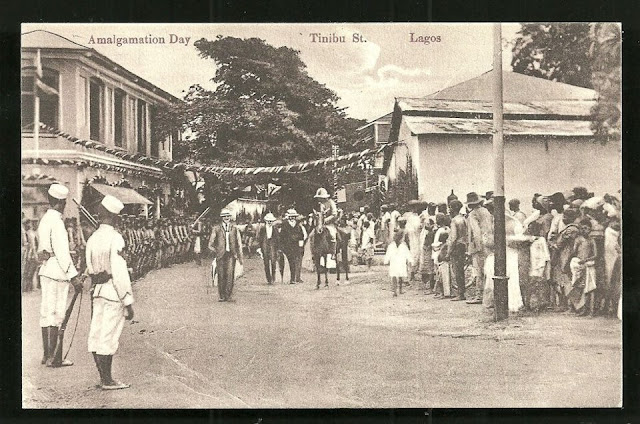
Amalgamation Day in Lagos, 1914
Showing posts with label National Security. Show all posts
Showing posts with label National Security. Show all posts
04 July, 2014


16 September, 2013
The Stories We Should Tell Louder
Back in
2010, a semi-acquaintance of mine attended a panel discussion on Nigeria
that was held in London sometime in 2010. This is an edited excerpt of
what he wrote about the event:
Father Matthew Hassan Kukah, and indigene of Kaduna State, was subsequently named Bishop of Sokoto in 2012. Before Jos in Plateau State took over as city most frequently mentioned in the context of "communal violence", Kaduna City, capital of Kaduna State, held that infamous position.
Father Kukah is one of many prominent Nigerian religious and sociocultural leaders who work very hard to end the scourge of communal violence. The story he told of the closeness between regular Muslims and Christians (his sister and her elderly neighbour) is one that deserved wider attention in the Federal Republic. The story he told of the senselessness of ultimately self-defeating nature of the violence should also have found a wider audience in Nigeria.
But nobody knows about it. The nature of the discourse in Nigeria is to loudly trumpet any and all news (even if unconfirmed) that contributes to sustaining the state of oft-violent distrust, division and dysfunction, and to downplay and minimize anything that would or could create a rallying point for the super-majority of Nigerians who would work to end the dysfunction if only there was an available route towards doing so.
We Nigerians (and Africans) often complain that the foreign media tends to highlight negative news about Africa, and to downplay positive news. We argue that the relentless negativity contributes to the sustenance of the the conditions that create the negative outcomes.
But we ourselves tend to highlight the negative about ourselves, and about each other.
I am not talking about criticism, constructive or otherwise. The only way anything can improve is to realize what about ourselves needs improvement ... but that implicitly acknowledges that we are able to improve. The problem with the negativity is that it is built on the notion that ... the best way to explain it is to revert, once again, to what we easily understand, non-African racism towards Black Africans. The racist theory that Black people are inferior presupposes that we cannot possibly be as good as anyone else, that we are automatically and irredeemably .... fill in the blank with negatives.
When certain Nigerians tout the division of the country as the "only solution" to our problems, or when people say that the Amalgamation was the source of all of our problems, there is an inherent belief that it is not possible to live in the same country with the other Nigerians, that it is not possible for us to live with them in the same country. Because they are just inherently and irredeemably ... fill in the blank with negatives.
I have had conversations with people where they start out agreeing with me in terms of critiquing the problems, but somewhere along the line, while I am still trying to analyze how we can all come together to solve the problem, the other person(s) branch off toward blaming another ethnic nation, geographical region, "geopolitical zone", or even senatorial zone for the problems. Even within a single town or city, the finger gets pointed at a socioculturally distinct neighbour (Ife and Modakeke, Aguleri and Umuleri, K-dere and B-dere, Zangon and Kataf), who is somehow to blame for the lack of jobs, the scarcity of land, and any other problems.
I know from experience that if you push through and continue arguing your case, those person(s) you are discussing with swing back from the knee-jerk response of blaming some other sociocultural group, and rejoin your analysis of what we could do together to fix the problem. However, the end of the conversation invariably involves both you and them concluding that it is unlikely that the problem will be solved in the real world.
As I've asserted in prior posts, this sort of negative political reaction to each other is the product of a sea of information in which we all swim.
Negativity, Violence and Shock Value sell newspapers and keep eyes attached to television sets. But while this is true of the commercial media everywhere, the overall nature of the discourse in most of the world's successful countries is to magnify and trumpet the best part of their national soul, and to sweep the less honourable parts of their national history under the carpet. Even what purports, in this age of political correctness, to be a less patriotic and hagiographic version of their history still rather underplays much of less edifying parts of their past; and much of what is presented as the "progress" of the present could be interpreted rather differently if one took a less rose-tinted view of events.
We do the opposite. We bury the best parts of our Federal Republic's shared soul, and overplay the worst parts of us. We not only treat the violent fringe as if it were the "normal" Nigeria, but go out of our way from an institutional and governmental point of view to facilitate the actions of the violent fringe as though we are not supposed to be otherwise, or rather cannot be otherwise. That is it right there. The idea that this, the violence, is who we are, and that it is not possible not to be this way.
But I didn't have to hear Father Kukah's story to know that the truth of Nigeria is quite different. In fact, while incidents of mass violence are rightly given wide coverage in the news, at any given point in time, most of Nigeria and Nigerians are not in fact subject to any violence.
Father Kukah's statement about violence and reprisal violence in the City of Kaduna, reminded me of a television report about two men who had previously been leaders of rival gangs of "youths" in Kaduna, gangs that attacked neighbourhoods of people from the sociocultural group of the rival gang (similar to what has been happening in the City of Jos since 1999). It was one of the few reports I had seen that didn't portray the violence as being one-sided.
These gangs are made up of youths who are unemployed, poor and prone to inducement by political factions. Indeed, a lot of violence in Nigeria is carried out by starving boys and youths who loot the homes and businesses of wealthier "foreigners" (i.e. non-indigenes). One of the more unfortunate aspects of our shared human history repeats itself: when poverty and economic uncertainty rise in any country (even in those so sure of their supposed "enlightenment"), the tendency is for gangs of poor, unemployed youths to see wealthy "foreigners" as having taken opportunities that should have gone to locals.
Of course, if we looked at it this way, we would have been obliged to fix the economic problems of our cities. But now that we just conclude it is ethnic or religious violence, we can throw up our hands and say there is nothing we can do about it.
What really struck me about the story is the two former gang leaders working together to end the violence in the city is how little coverage they received in the Nigerian media. They should be household names, but I only learned of them briefly and only from a foreign media source, not the Nigerian media.
It is time we gave greater prominence to stories of the good people, at least enough so that our people know there is another side to the Federal Republic of Nigeria.
Here are links to previous posts I have made about stories that we should tell louder:
THE STORIES WE IGNORE An excellent feature by Tadaferua Ujorha for Daily Trust.
FIGHTING FOR PEACE An excerpt from a Weekly Trust essay by Carmen McCain about an old man who died doing the right thing, but who has been forgotten while we glorify and give national honours to the men and women responsible for creating the situation that killed this good man.
WE STAND TOGETHER Three articles.
GOOD DEEDS IN CENTRAL NIGERIA Self-explanatory (I hope the embedded links are still live).
The place was full to the brim and the debate was vigorous. The debate was about whether Nigeria was an African superpower and how an area that was able to produce incredible works of art like the Ife sculptures could end up the way it is today.
The panel included Father Kukah, who had interesting stories to tell about the religious conflict in Kaduna. One was about his sister who had a shop and was close to an elderly Muslim neighbour. When Christians were about to be attacked, the old man asked her to hide all her goods in his house. So when her shop got burnt down, she didn't lose much. But then the Muslim's house got burnt down in a revenge attack by "Christians" and she lost everything.
Father Matthew Hassan Kukah, and indigene of Kaduna State, was subsequently named Bishop of Sokoto in 2012. Before Jos in Plateau State took over as city most frequently mentioned in the context of "communal violence", Kaduna City, capital of Kaduna State, held that infamous position.
Father Kukah is one of many prominent Nigerian religious and sociocultural leaders who work very hard to end the scourge of communal violence. The story he told of the closeness between regular Muslims and Christians (his sister and her elderly neighbour) is one that deserved wider attention in the Federal Republic. The story he told of the senselessness of ultimately self-defeating nature of the violence should also have found a wider audience in Nigeria.
But nobody knows about it. The nature of the discourse in Nigeria is to loudly trumpet any and all news (even if unconfirmed) that contributes to sustaining the state of oft-violent distrust, division and dysfunction, and to downplay and minimize anything that would or could create a rallying point for the super-majority of Nigerians who would work to end the dysfunction if only there was an available route towards doing so.
We Nigerians (and Africans) often complain that the foreign media tends to highlight negative news about Africa, and to downplay positive news. We argue that the relentless negativity contributes to the sustenance of the the conditions that create the negative outcomes.
But we ourselves tend to highlight the negative about ourselves, and about each other.
I am not talking about criticism, constructive or otherwise. The only way anything can improve is to realize what about ourselves needs improvement ... but that implicitly acknowledges that we are able to improve. The problem with the negativity is that it is built on the notion that ... the best way to explain it is to revert, once again, to what we easily understand, non-African racism towards Black Africans. The racist theory that Black people are inferior presupposes that we cannot possibly be as good as anyone else, that we are automatically and irredeemably .... fill in the blank with negatives.
When certain Nigerians tout the division of the country as the "only solution" to our problems, or when people say that the Amalgamation was the source of all of our problems, there is an inherent belief that it is not possible to live in the same country with the other Nigerians, that it is not possible for us to live with them in the same country. Because they are just inherently and irredeemably ... fill in the blank with negatives.
I have had conversations with people where they start out agreeing with me in terms of critiquing the problems, but somewhere along the line, while I am still trying to analyze how we can all come together to solve the problem, the other person(s) branch off toward blaming another ethnic nation, geographical region, "geopolitical zone", or even senatorial zone for the problems. Even within a single town or city, the finger gets pointed at a socioculturally distinct neighbour (Ife and Modakeke, Aguleri and Umuleri, K-dere and B-dere, Zangon and Kataf), who is somehow to blame for the lack of jobs, the scarcity of land, and any other problems.
I know from experience that if you push through and continue arguing your case, those person(s) you are discussing with swing back from the knee-jerk response of blaming some other sociocultural group, and rejoin your analysis of what we could do together to fix the problem. However, the end of the conversation invariably involves both you and them concluding that it is unlikely that the problem will be solved in the real world.
As I've asserted in prior posts, this sort of negative political reaction to each other is the product of a sea of information in which we all swim.
Negativity, Violence and Shock Value sell newspapers and keep eyes attached to television sets. But while this is true of the commercial media everywhere, the overall nature of the discourse in most of the world's successful countries is to magnify and trumpet the best part of their national soul, and to sweep the less honourable parts of their national history under the carpet. Even what purports, in this age of political correctness, to be a less patriotic and hagiographic version of their history still rather underplays much of less edifying parts of their past; and much of what is presented as the "progress" of the present could be interpreted rather differently if one took a less rose-tinted view of events.
We do the opposite. We bury the best parts of our Federal Republic's shared soul, and overplay the worst parts of us. We not only treat the violent fringe as if it were the "normal" Nigeria, but go out of our way from an institutional and governmental point of view to facilitate the actions of the violent fringe as though we are not supposed to be otherwise, or rather cannot be otherwise. That is it right there. The idea that this, the violence, is who we are, and that it is not possible not to be this way.
But I didn't have to hear Father Kukah's story to know that the truth of Nigeria is quite different. In fact, while incidents of mass violence are rightly given wide coverage in the news, at any given point in time, most of Nigeria and Nigerians are not in fact subject to any violence.
Father Kukah's statement about violence and reprisal violence in the City of Kaduna, reminded me of a television report about two men who had previously been leaders of rival gangs of "youths" in Kaduna, gangs that attacked neighbourhoods of people from the sociocultural group of the rival gang (similar to what has been happening in the City of Jos since 1999). It was one of the few reports I had seen that didn't portray the violence as being one-sided.
These gangs are made up of youths who are unemployed, poor and prone to inducement by political factions. Indeed, a lot of violence in Nigeria is carried out by starving boys and youths who loot the homes and businesses of wealthier "foreigners" (i.e. non-indigenes). One of the more unfortunate aspects of our shared human history repeats itself: when poverty and economic uncertainty rise in any country (even in those so sure of their supposed "enlightenment"), the tendency is for gangs of poor, unemployed youths to see wealthy "foreigners" as having taken opportunities that should have gone to locals.
Of course, if we looked at it this way, we would have been obliged to fix the economic problems of our cities. But now that we just conclude it is ethnic or religious violence, we can throw up our hands and say there is nothing we can do about it.
What really struck me about the story is the two former gang leaders working together to end the violence in the city is how little coverage they received in the Nigerian media. They should be household names, but I only learned of them briefly and only from a foreign media source, not the Nigerian media.
It is time we gave greater prominence to stories of the good people, at least enough so that our people know there is another side to the Federal Republic of Nigeria.
Here are links to previous posts I have made about stories that we should tell louder:
THE STORIES WE IGNORE An excellent feature by Tadaferua Ujorha for Daily Trust.
FIGHTING FOR PEACE An excerpt from a Weekly Trust essay by Carmen McCain about an old man who died doing the right thing, but who has been forgotten while we glorify and give national honours to the men and women responsible for creating the situation that killed this good man.
WE STAND TOGETHER Three articles.
GOOD DEEDS IN CENTRAL NIGERIA Self-explanatory (I hope the embedded links are still live).
Perpetuating the Propaganda Ourselves
In these posts (here, here and here), I talked about how other peoples sometimes work to create a negative opinion or prejudice about us among their people.
But we very often do the same thing.
Most countries in the world are able to maintain a public image in the rest of the world that is built on whoever is perceived to be the "best" of their population. Until recently, there was a global image of the British "gentleman" and "lady", even though there were many people in Britain whose conduct was closer to that of a football hooligan. The Japanese are known for being good at technological products, for being good at exporting things, and for the "salary man" in the world of business, even though there are many Japanese who do the most scandalous of things (some of the stuff they show on Japanese television is ... legally and without much fuss ... is downright weird, and that is putting it extremely mildly). The United States also projects an image to the rest of the world that is not really congruent with reality.
It is true that all of these places are richer than Nigeria. What is not true is the very loudly unspoken idea that they are richer than us because their people are "superior" to us, better than us at an inherent level, or that their culture is "superior" to ours.
Many of us tend to perpetuate these sorts of ideas. When a Nigerian does something bad, we the Nigerians react as though the person and the person's actions were symptomatic of all Nigeria and all Nigerians. Conversely, when someone does good, it gets dismissed or is not talked about quite as much as the bad person/thing.
It is strange that we label ourselves with negative things, and then talk about foreign countries, even African countries, as though they are completely innocent of those negative things. In reality, if you pick any particular negative act, and assign a Naira or Dollar amount to the absolute magnitude of however much of that act is done by Nigerians, and then do similar analyses of the "perfect" foreign lands, you will find that they do far more of it than we do.
Let me give you and easy example. For a while, the word "Nigerian" and the phrase "potential drug pusher" were used interchangeably by the immigration authorities at airports all over the world. The United States even went so far as to "decertify" Nigeria at some point for supposedly failing to act to control the illegal narcotics trade. Today, you still see the casual equation of "Nigerian" with "drug dealer" in the South African media (and I still regret the $10.00 I spent watching the South African-produced District 9).
But even at the high point of Nigerians being involved in the illegal narcotics business, the total "Nigerian" involvement was microscopic when compared to the United States, the various Western European countries and Japan. There were more of their citizens involved in the business than ours, a higher proportion of their citizenry involved than ours, and the Dollar amount of their involvement made ours look like 50 kobo groundnut money by comparison.
Yet nobody treated their citizens in total as if they were all guilty of drug crime until proven innocent.
This type of negative stereotyping is bad when it comes from foreigners, but we do it to ourselves.
Treating an individual person's crime as though it was a crime committed by his or her entire ethnic group is a recurring theme in our recent political history. And assuming that bad Nigerians epitomize all Nigerians is a standard reaction to any bad news about a random Nigerian in Nigeria or anywhere in the world.
Indeed, there is this mysterious tendency to question everything about ourselves and our society any time we hear that one of our number was caught doing something bad abroad. At best, he or she is said to be giving all of us a bad name. In the meantime, people from abroad have done, are doing, and will do far worse things on the African continent and in the wider world without any fear of being prosecuted for it. And nobody gives their whole country a bad name because of it.
Take all the snide comments about the so-called "Nigerian Scam" (a.k.a 419) on the internet. If you add up all of the money scammed by every Nigerian scammer that has ever existed, it would add up to less than what a single American (Bernie Madoff) scammed off of the people duped into investing in his Ponzi Scheme. Should we call such schemes the "American Scam"? Or should that term be reserved for the various exotic financial instruments and derivatives that nearly wrecked the entire global economy?
Look, before anyone start shouting insults at me, I am not trying to get people to place negative labels on foreign countries. Just pointing out that we Nigerians should stop accepting the negative labels other people place on us and should stop creating/propagating negative labels of our own.
Believe it or not, the super-majority of Nigerians are kind, decent, good people. If this weren't the case, the Federal Republic would have collapsed into anarchy a long time ago. Most of the things that are supposed to enforce the political "order" are dysfunctional or nonexistent, likewise the things that are supposed to support the economy (for example our banks lend only to "safe" borrowers like the government, import-exporters and Big Business), yet there is an "order" to life in Nigeria that is built on we the people effectively governing and "policing" ourselves.
Life in Nigeria often involves interacting with the institutions of state only insofar as there are certain things you have to give them (e.g. an extorted sum of money at a police checkpoint). Beyond that, it is often as though we don't have a government (or a "formal" private sector), yet we still manage to get things done. We generate our own electricity, provide ourselves with water, construct our own "roads" and generally get things done in an economic system built substantially on trust because nobody has the time or resources to enforce contracts through the court system. It is all on trust, something that doesn't exist if you believe the negative stereotype.
Yes, there are scammers who take advantage of the situation, but if the scammers were in the majority, everything in Nigeria would have long since ground to a halt. Life is able to proceed in Nigeria because we Nigerians mostly do the "right" thing without compulsion or coercion, and where we fall short it is usually because of the reality that condition bends the crayfish. There are situations in which doing the "right" thing is either difficult, impossible or metaphorically masochistic -- for example, a certain element of nepotism, kinsman-ism, clique-ism and ethnicism comes into play in an economic and political system built on knowing someone enough to trust them, rather than relying on impartial and effective judicial enforcement of contracts.
But we are not fundamentally bad people.
And don't let them get away with convincing people otherwise.
I often say that "communal violence" in Nigeria is predictable and avoidable, but for various reasons the powers that be refuse to do what is necessary to avoid it. Under normal circumstances, we the people should have reacted with anger to their failure to do the necessary, but we have allowed the discourse to be dominated by those who work to convince us that the entire sociocultural group to which one side or the other in these incidents belong are "bad people" who attack the other side because of the sheer "badness" of their entire sociocultural group. This is how "they" behave, is the basic response, and since there is nothing you can do to change "their" behaviour, we just have to live with the fact that "they" will keep doing this.
Do you realize that Nigeria would be an entirely different type of country if it was true that every member of every ethnic group hated every member of one or all of the other ethnic groups?
What we have now, in terms of violence, is what happens when the violent few are allowed to plague the peaceful majority from every sociocultural background.
We are also dealing, separately, with the fact that the most desperate economic groups in the country don't have anything other than violence to defend what few economic rights they have. Most "communal violence" in Nigeria revolves around land disputes between communities, about ownership of land, about who is or is not an indigene (i.e. has or doesn't have right to a portion of the land), and about the competing land-linked interests of farmers and pastoralists.
We are good people. And it is time we start believing that about ourselves.
But we very often do the same thing.
Most countries in the world are able to maintain a public image in the rest of the world that is built on whoever is perceived to be the "best" of their population. Until recently, there was a global image of the British "gentleman" and "lady", even though there were many people in Britain whose conduct was closer to that of a football hooligan. The Japanese are known for being good at technological products, for being good at exporting things, and for the "salary man" in the world of business, even though there are many Japanese who do the most scandalous of things (some of the stuff they show on Japanese television is ... legally and without much fuss ... is downright weird, and that is putting it extremely mildly). The United States also projects an image to the rest of the world that is not really congruent with reality.
It is true that all of these places are richer than Nigeria. What is not true is the very loudly unspoken idea that they are richer than us because their people are "superior" to us, better than us at an inherent level, or that their culture is "superior" to ours.
Many of us tend to perpetuate these sorts of ideas. When a Nigerian does something bad, we the Nigerians react as though the person and the person's actions were symptomatic of all Nigeria and all Nigerians. Conversely, when someone does good, it gets dismissed or is not talked about quite as much as the bad person/thing.
It is strange that we label ourselves with negative things, and then talk about foreign countries, even African countries, as though they are completely innocent of those negative things. In reality, if you pick any particular negative act, and assign a Naira or Dollar amount to the absolute magnitude of however much of that act is done by Nigerians, and then do similar analyses of the "perfect" foreign lands, you will find that they do far more of it than we do.
Let me give you and easy example. For a while, the word "Nigerian" and the phrase "potential drug pusher" were used interchangeably by the immigration authorities at airports all over the world. The United States even went so far as to "decertify" Nigeria at some point for supposedly failing to act to control the illegal narcotics trade. Today, you still see the casual equation of "Nigerian" with "drug dealer" in the South African media (and I still regret the $10.00 I spent watching the South African-produced District 9).
But even at the high point of Nigerians being involved in the illegal narcotics business, the total "Nigerian" involvement was microscopic when compared to the United States, the various Western European countries and Japan. There were more of their citizens involved in the business than ours, a higher proportion of their citizenry involved than ours, and the Dollar amount of their involvement made ours look like 50 kobo groundnut money by comparison.
Yet nobody treated their citizens in total as if they were all guilty of drug crime until proven innocent.
This type of negative stereotyping is bad when it comes from foreigners, but we do it to ourselves.
Treating an individual person's crime as though it was a crime committed by his or her entire ethnic group is a recurring theme in our recent political history. And assuming that bad Nigerians epitomize all Nigerians is a standard reaction to any bad news about a random Nigerian in Nigeria or anywhere in the world.
Indeed, there is this mysterious tendency to question everything about ourselves and our society any time we hear that one of our number was caught doing something bad abroad. At best, he or she is said to be giving all of us a bad name. In the meantime, people from abroad have done, are doing, and will do far worse things on the African continent and in the wider world without any fear of being prosecuted for it. And nobody gives their whole country a bad name because of it.
Take all the snide comments about the so-called "Nigerian Scam" (a.k.a 419) on the internet. If you add up all of the money scammed by every Nigerian scammer that has ever existed, it would add up to less than what a single American (Bernie Madoff) scammed off of the people duped into investing in his Ponzi Scheme. Should we call such schemes the "American Scam"? Or should that term be reserved for the various exotic financial instruments and derivatives that nearly wrecked the entire global economy?
Look, before anyone start shouting insults at me, I am not trying to get people to place negative labels on foreign countries. Just pointing out that we Nigerians should stop accepting the negative labels other people place on us and should stop creating/propagating negative labels of our own.
Believe it or not, the super-majority of Nigerians are kind, decent, good people. If this weren't the case, the Federal Republic would have collapsed into anarchy a long time ago. Most of the things that are supposed to enforce the political "order" are dysfunctional or nonexistent, likewise the things that are supposed to support the economy (for example our banks lend only to "safe" borrowers like the government, import-exporters and Big Business), yet there is an "order" to life in Nigeria that is built on we the people effectively governing and "policing" ourselves.
Life in Nigeria often involves interacting with the institutions of state only insofar as there are certain things you have to give them (e.g. an extorted sum of money at a police checkpoint). Beyond that, it is often as though we don't have a government (or a "formal" private sector), yet we still manage to get things done. We generate our own electricity, provide ourselves with water, construct our own "roads" and generally get things done in an economic system built substantially on trust because nobody has the time or resources to enforce contracts through the court system. It is all on trust, something that doesn't exist if you believe the negative stereotype.
Yes, there are scammers who take advantage of the situation, but if the scammers were in the majority, everything in Nigeria would have long since ground to a halt. Life is able to proceed in Nigeria because we Nigerians mostly do the "right" thing without compulsion or coercion, and where we fall short it is usually because of the reality that condition bends the crayfish. There are situations in which doing the "right" thing is either difficult, impossible or metaphorically masochistic -- for example, a certain element of nepotism, kinsman-ism, clique-ism and ethnicism comes into play in an economic and political system built on knowing someone enough to trust them, rather than relying on impartial and effective judicial enforcement of contracts.
But we are not fundamentally bad people.
And don't let them get away with convincing people otherwise.
I often say that "communal violence" in Nigeria is predictable and avoidable, but for various reasons the powers that be refuse to do what is necessary to avoid it. Under normal circumstances, we the people should have reacted with anger to their failure to do the necessary, but we have allowed the discourse to be dominated by those who work to convince us that the entire sociocultural group to which one side or the other in these incidents belong are "bad people" who attack the other side because of the sheer "badness" of their entire sociocultural group. This is how "they" behave, is the basic response, and since there is nothing you can do to change "their" behaviour, we just have to live with the fact that "they" will keep doing this.
Do you realize that Nigeria would be an entirely different type of country if it was true that every member of every ethnic group hated every member of one or all of the other ethnic groups?
What we have now, in terms of violence, is what happens when the violent few are allowed to plague the peaceful majority from every sociocultural background.
We are also dealing, separately, with the fact that the most desperate economic groups in the country don't have anything other than violence to defend what few economic rights they have. Most "communal violence" in Nigeria revolves around land disputes between communities, about ownership of land, about who is or is not an indigene (i.e. has or doesn't have right to a portion of the land), and about the competing land-linked interests of farmers and pastoralists.
We are good people. And it is time we start believing that about ourselves.
On the Inherent Risks of Political Protests
A Camerounian posted something on a popular Nigerian discussion forum. He was commenting on recent events in Egypt. For the record, I have not expressed an opinion on Egypt on this blog, and I am not going to do so on this blog. I will address something else about the Camerounian's comments.
Here is what he said:
Here is what he said:
Many people go out every year protesting for political reasons.Many die in the cause.In Egypt hundreds of people have died because they wanted one person, who might turn his back on them, to be placed back to power. I have been in protests before and I remember the dangers and group effect that make you do things you won't do if alone.I have come to see the world today different from the average person at least politically.
Some people really die protesting for what will not even help them or will not change their status.
Is it better to just ask for your bread and tea from the ruling elite and a house above your head and live peaceful till death takes us naturally? I love this life and won't go and die because i want to make it better for others because it doesn't get better at all and many people don't even get what they asked when they succeed in their protest.Nowadays I actually feel sorry for people going out and dying in protests. I will say do protest but if i sense it is getting out of hand, go back home. Dying is not worth it, what is your take?
It is a much more complicated issue than that, though, isn't it?
On the one hand, George Orwell's "Animal Farm" is a fairly accurate description of what happens following "coups", "revolutions" and other changes of government. One way or another, what comes after tends to bear a striking resemblance to what came before. All of the things that were supposedly fought against continue on, albeit under new management. And the ideologues and intellectuals that purportedly to argue in favour of changing things metamorphose into defenders of everything they previously criticized, insofar as their political faction is advantaged.
Indeed, one could argue that one of the many problems with post-colonial African countries is the "heroes of liberation" inherited all of the (undemocratic, unaccountable, unchecked) powers of the imperialists, as well as all of the coercive institutions created to impose that power on the citizenry (as well as political techniques like ethnic divide-and-rule), and have since proceeded to use that power in exactly the same manner without reform. The fact that our governments continue to take instruction from colonial-type world powers, whether directly (bilaterally) or indirectly (via institutions like the Bretton Woods agencies), only adds to the feeling that we have Black African Governor-Generals masquerading as Presidents.
On the other hand, I will admit to being tempted to tell the Camerounians that his attitude is the reason Paul Biya has been President of Cameroun for 31 years (and why Ahmadou Ahidjo was President for 22 years before Biya chased him out of the country. If he opens his mouth and says the wrong thing, Yaounde has only to threaten violent reprisal, and he will quieten down.
So, what is the answer?
I don't know. I don't think there are easy answers. I am not going to pretend to be an action hero myself.
As I said in the first paragraph, this blog post is not about Egypt.
Speaking about Nigeria, I do think that we the citizens are collectively to blame. We allow ourselves to be divided against each other so easily that we don't seem to realize that we collectively outnumber the totality of the squabbling political/economic factions that govern us. We not only outnumber them in the society at large, but we outnumber them in the Army and the Police as well.
Our overwhelming advantage was not brought to bear during the colonial period, and has not been brought to bear in the post-colonial period either. Even the soldiers and polices, who are drawn from us, from our families, have been shooting at us on behalf of governments, colonial and post-colonial alike, for more than 150 years (dating back to before the foundation of the Lagos Colony).
I am not sure any of us Nigerians would have to die to change Nigeria. We just have to collectively want it and collectively make it happen.
On the one hand, George Orwell's "Animal Farm" is a fairly accurate description of what happens following "coups", "revolutions" and other changes of government. One way or another, what comes after tends to bear a striking resemblance to what came before. All of the things that were supposedly fought against continue on, albeit under new management. And the ideologues and intellectuals that purportedly to argue in favour of changing things metamorphose into defenders of everything they previously criticized, insofar as their political faction is advantaged.
Indeed, one could argue that one of the many problems with post-colonial African countries is the "heroes of liberation" inherited all of the (undemocratic, unaccountable, unchecked) powers of the imperialists, as well as all of the coercive institutions created to impose that power on the citizenry (as well as political techniques like ethnic divide-and-rule), and have since proceeded to use that power in exactly the same manner without reform. The fact that our governments continue to take instruction from colonial-type world powers, whether directly (bilaterally) or indirectly (via institutions like the Bretton Woods agencies), only adds to the feeling that we have Black African Governor-Generals masquerading as Presidents.
On the other hand, I will admit to being tempted to tell the Camerounians that his attitude is the reason Paul Biya has been President of Cameroun for 31 years (and why Ahmadou Ahidjo was President for 22 years before Biya chased him out of the country. If he opens his mouth and says the wrong thing, Yaounde has only to threaten violent reprisal, and he will quieten down.
So, what is the answer?
I don't know. I don't think there are easy answers. I am not going to pretend to be an action hero myself.
As I said in the first paragraph, this blog post is not about Egypt.
Speaking about Nigeria, I do think that we the citizens are collectively to blame. We allow ourselves to be divided against each other so easily that we don't seem to realize that we collectively outnumber the totality of the squabbling political/economic factions that govern us. We not only outnumber them in the society at large, but we outnumber them in the Army and the Police as well.
Our overwhelming advantage was not brought to bear during the colonial period, and has not been brought to bear in the post-colonial period either. Even the soldiers and polices, who are drawn from us, from our families, have been shooting at us on behalf of governments, colonial and post-colonial alike, for more than 150 years (dating back to before the foundation of the Lagos Colony).
I am not sure any of us Nigerians would have to die to change Nigeria. We just have to collectively want it and collectively make it happen.
For the Record: On the State of Emergency in the Northeast
I haven't said anything about it. And I am not going to now.
I often say on this blog that it is difficult to know what it actually happening, anywhere in the world. You can't trust politicians, and you can't really trust the news media, be it "mainstream" or "alternative" (especially on issues of real importance). There are a lot of people in the world who talk as though they are "experts" on what is going on, and other people who differ from and criticize the "experts" based on their belief that they are more correctly informed about what is going on than the "experts". Strangely, an ever-growing proportion of younger people get their "news" from comedians who are not necessarily funny or particularly insightful. The comedian-as-expert concept reached a new high at the last Italian elections, when a political party founded by a comedian did exceptionally well.
At the end of the day, even if you read/watched/listened/studied everything said by everyone from every conceivable bias and pretension to "expertise", if you were fully honest with yourself, you would admit that you don't actually know what exactly happened, who exactly did what, how exactly they did it, and why they did it ... even if the results of whatever happened directly affect you.
You may ask whether I am being a hypocrite, since I write a blog and offer opinions on the issues.
Perhaps. But what can you do?
I will say this: My intent with this blog is not necessarily to comment on specific items of "news", but to talk about the issues generally. In other words, my response to a news article about a specific thing the Inspector-General of Police reportedly/allegedly did would be to engage in a broader discussion of why the Nigerian Police Force functions the way it does, why there has not been (and will not be in the near- or mid-term future) any reform of the Nigerian Police Force, and why nothing substantive about the operations of the Police will change until such and such reform is instituted.
Such commentary, be it sensible or silly in your opinion, is not necessarily tied to whether or not the report on the Inspector-General of Police is factual, counter-factual, partly-factual, or polemical.
The problem with commenting on the State of Emergency in the Northeast is .... people are dying. Soldiers are dying. Civilians are dying. Suspects are dying. Criminals are dying.
I am not comfortable forming opinions, much less commenting, on this type of thing when I do not actually know what is going on.
Eventually, things will calm down, the dust will settle, and we will all be able in theory to get a better handle on what happened (past-tense). Emphasis on "in theory", because to be quite honest, we the people of Nigeria have little or no certainty of information on what happened in the three ECOMOG wars, the Somalia mission in the early 1990s, the various coups, or the Civil War. What information as is out there is quantitatively insufficient, and qualitatively dubious.
It doesn't help that our fractured politics distorts analyses to begin with.
Speaking of politics, one of these days, someone will do a credible, mathematical analysis that will show that the Fourth Republic has been the most corrupt period of our history, and the second-most violent (behind only the 2.5 years of the Civil War). By and large, the politicians are responsible for the various violent crises that have hit the Federal Republic, one-after-another, since 1999, sometimes by deliberate commission and other times by equally-deliberate omission.
So you will not see any commentary from me on the State of Emergency.
What I can say is I wish nothing but the best for the people of Borno, Yobe and Adamawa.
And I wish there was something in my power to do to help out.
I often say on this blog that it is difficult to know what it actually happening, anywhere in the world. You can't trust politicians, and you can't really trust the news media, be it "mainstream" or "alternative" (especially on issues of real importance). There are a lot of people in the world who talk as though they are "experts" on what is going on, and other people who differ from and criticize the "experts" based on their belief that they are more correctly informed about what is going on than the "experts". Strangely, an ever-growing proportion of younger people get their "news" from comedians who are not necessarily funny or particularly insightful. The comedian-as-expert concept reached a new high at the last Italian elections, when a political party founded by a comedian did exceptionally well.
At the end of the day, even if you read/watched/listened/studied everything said by everyone from every conceivable bias and pretension to "expertise", if you were fully honest with yourself, you would admit that you don't actually know what exactly happened, who exactly did what, how exactly they did it, and why they did it ... even if the results of whatever happened directly affect you.
You may ask whether I am being a hypocrite, since I write a blog and offer opinions on the issues.
Perhaps. But what can you do?
I will say this: My intent with this blog is not necessarily to comment on specific items of "news", but to talk about the issues generally. In other words, my response to a news article about a specific thing the Inspector-General of Police reportedly/allegedly did would be to engage in a broader discussion of why the Nigerian Police Force functions the way it does, why there has not been (and will not be in the near- or mid-term future) any reform of the Nigerian Police Force, and why nothing substantive about the operations of the Police will change until such and such reform is instituted.
Such commentary, be it sensible or silly in your opinion, is not necessarily tied to whether or not the report on the Inspector-General of Police is factual, counter-factual, partly-factual, or polemical.
The problem with commenting on the State of Emergency in the Northeast is .... people are dying. Soldiers are dying. Civilians are dying. Suspects are dying. Criminals are dying.
I am not comfortable forming opinions, much less commenting, on this type of thing when I do not actually know what is going on.
Eventually, things will calm down, the dust will settle, and we will all be able in theory to get a better handle on what happened (past-tense). Emphasis on "in theory", because to be quite honest, we the people of Nigeria have little or no certainty of information on what happened in the three ECOMOG wars, the Somalia mission in the early 1990s, the various coups, or the Civil War. What information as is out there is quantitatively insufficient, and qualitatively dubious.
It doesn't help that our fractured politics distorts analyses to begin with.
Speaking of politics, one of these days, someone will do a credible, mathematical analysis that will show that the Fourth Republic has been the most corrupt period of our history, and the second-most violent (behind only the 2.5 years of the Civil War). By and large, the politicians are responsible for the various violent crises that have hit the Federal Republic, one-after-another, since 1999, sometimes by deliberate commission and other times by equally-deliberate omission.
So you will not see any commentary from me on the State of Emergency.
What I can say is I wish nothing but the best for the people of Borno, Yobe and Adamawa.
And I wish there was something in my power to do to help out.
02 September, 2013
About "Communal Violence"
Conversations and discourse about Nigerian politics usually revolves around sociocultural identity, whether it be region, ethnicity, geopolitical zone, senatorial zone, religion, local government or town of origin. Debate about the presidency is about whose turn it is in the "geopolitical zone" rotation (and whether or not certain zones are "ripe" to produce the presidency). Gubernatorial discussions are about which "senatorial zone" has yet to produce the governor.
It is not just federal offices that are "zoned" or subject to "federal character"; the concepts are applied even within states where everyone ostensibly belongs to the same ethnicity and religious faith, within local governments too -- and are as controversial at these levels as at the federal level.
Discourse tends to be geared towards facilitating divide-and-rule. And while commentators in the southern half of the federal republic tend to portray the northernmost fifth of our landmass as being "feudal", the truth is politics everywhere in Nigeria is "feudal", insofar as it is designed around a spiderweb of patron-client networks, each network pyramid-shaped, each client of a patron serving as the patron of his own set of clients, each of whom have their own clients, and so forth.
The same type of politic discourse that serves divide-and-rule also serves neo-feudal politics. Each apex network (or wannabe apex network) strives to define itself as the official representative of a "marginalized" sociocultural subgroup that must be placated with federal largesse -- channeled of course through the network. This process tends to be relatively orderly under periods of "military" rule, and inevitably violent and chaotic when "civilians" are in the Presidential or Prime Ministerial mansion.
And this discourse helps our governments abdicate their responsibilities without having to explain why they have failed to fulfill their duties. Take for example the recurrent clashes, year-after-year, between farmers and pastoralists in certain parts of the country. At the root, this is about land, about land use; the violence of the confrontations is linked to the fact that this is life or death for the protagonists -- losing even one cow is a serious "financial" blow to the pastoralists, and losing a field of crops to cattle will ruin a farmer. There is no safety net for either of them (and I am saying that as a statement of fact, and not of advocacy), nor will the government or society step in to help either one of them if they should suffer catastrophic loss. Significantly, neither the farmer nor the pastoralist counts on the police or the judiciary to protect them, knowing that neither institution does or will.
There are things that could be done to avoid this entirely PREDICTABLE annual event.
But all three tiers of government, all law enforcement and public security agencies, all of them do exactly NOTHING ....
.... except participate, fuel and sustain the political climate in which these events are interpreted as "ethnic" or "religious" clashes between people who are portrayed as fundamentally hating each other because of each other's ethnicity or religion.
Describing these clashes in this manner frees the government from its responsibilities, and allows the government to avoid accepting responsibility for its failure to prevent these violent clashes. An economic problem of land use is something the government can fix, but once you invoke the theory of "tribal hatred" as your explanation, you are deflecting people into the discourse that blames every problem in Nigeria on the fact that X number of ethnic groups were Amalgamated, a discourse that ends with the argument that splitting Nigeria would solve all of our problems.
The fact that solutions exist to the land use problem do not factor into the conversations. In fact, in all my decades of life, I have not once witnessed a political debate on potential solutions to the annually recurrent issue. The people of the affected areas, and the people of Nigeria at large, have never faced an election where the governments' handling of the issue was at stake, or where alternate suggestions of how to handle the issue were offered. "Tribal hatred" is the conclusion, and that is the end of it.
The "tribal hatred" gimmick works for the media about as well as it works for politicians. The media treat us to screaming headlines when any event of mass violence can be given an inter-ethnic or inter-religious colouration, but I can tell you of many incidents of political and "communal" violence that have occurred in places I am intimately familiar with that never showed up in any media report, because there was no "tribal hatred" angle to report.
In fact, one of the reasons why insecurity, violence and the dysfunction in our public safety agencies has never attained the importance in policy discourse that it should is we tend to treat the outcomes of dysfunctional security agencies as though they were outcomes instead of "tribal hatred". Something that has a solution is talked about as though it were something that couldn't possibly be solved.
There are lots of places in this world where violent gangs draw membership from specific linguistic, regional, cultural and racial groups. Indeed, many organized crime groups are known as "families" or "clans", and they build their internal loyalty systems by creating distinctions between themselves and their rivals on those same lines.
There is usually an unwritten understanding between such groups and the governments of the countries in which they operate -- they can do this, this and this, and the government will look away, but if they do this, this, or this, the government will bring down a hammer on them.
Among the things that the government wouldn't allow happen is a White Supremacist gang going on an unchecked, unopposed killing rampage in a predominantly Black neighbourhood. By the same token, an African-American gang would not be allowed to go on an unlimited killing spree in a Hispanic neighbourhood. And Hispanic gangs do not get to spend 12 daylight hours randomly killing people in White-majority neighbourhood.
If any of the events I mentioned in the paragraph above ever actually happened, the citizens would be outraged at the government! Questions would be asked about where the police were, why their response times were so slow, etc. Politicians would scramble to find scapegoats within the police and/or the bureaucracy, and to burnish their reputations as being tough on crime.
True, their media would create screaming headlines, just like ours, but people wouldn't sweep the failure of the government under the carpet by concluding that "tribal hatred" was the reason for the violence and then moving on. Nor would their media cover it as though the entirety of the respective racial groups took a secret vote and authorized the killers to do the killing on their collective behalves.
Seriously, why do we consider these incidents of mass violence to be "communal"? Why do we discuss them as though one entire ethnic group of twenty million people had attacked another entire ethnic group of twenty million people? All of our focus is on blaming ethnic groups and regions, with little focus on identifying the specific individuals responsible.
Haven't we learned the danger of this? What happened when an entire ethnic group was blamed for the actions of a relatively small band of 1966 coup plotters? And while the subsequent pogroms against people from that ethnic group were unjust (and that is putting it mildly), why was an entire ethnic group blamed for that too? You can arrest 15 people, but you cannot arrest 20 million people -- this is the problem, that we keep discouraging ourselves from solving small problems by allowing the people who should be solving the problems convince us that the problems are too large for them (or us collectively) to solve.
It is not just federal offices that are "zoned" or subject to "federal character"; the concepts are applied even within states where everyone ostensibly belongs to the same ethnicity and religious faith, within local governments too -- and are as controversial at these levels as at the federal level.
Discourse tends to be geared towards facilitating divide-and-rule. And while commentators in the southern half of the federal republic tend to portray the northernmost fifth of our landmass as being "feudal", the truth is politics everywhere in Nigeria is "feudal", insofar as it is designed around a spiderweb of patron-client networks, each network pyramid-shaped, each client of a patron serving as the patron of his own set of clients, each of whom have their own clients, and so forth.
The same type of politic discourse that serves divide-and-rule also serves neo-feudal politics. Each apex network (or wannabe apex network) strives to define itself as the official representative of a "marginalized" sociocultural subgroup that must be placated with federal largesse -- channeled of course through the network. This process tends to be relatively orderly under periods of "military" rule, and inevitably violent and chaotic when "civilians" are in the Presidential or Prime Ministerial mansion.
And this discourse helps our governments abdicate their responsibilities without having to explain why they have failed to fulfill their duties. Take for example the recurrent clashes, year-after-year, between farmers and pastoralists in certain parts of the country. At the root, this is about land, about land use; the violence of the confrontations is linked to the fact that this is life or death for the protagonists -- losing even one cow is a serious "financial" blow to the pastoralists, and losing a field of crops to cattle will ruin a farmer. There is no safety net for either of them (and I am saying that as a statement of fact, and not of advocacy), nor will the government or society step in to help either one of them if they should suffer catastrophic loss. Significantly, neither the farmer nor the pastoralist counts on the police or the judiciary to protect them, knowing that neither institution does or will.
There are things that could be done to avoid this entirely PREDICTABLE annual event.
But all three tiers of government, all law enforcement and public security agencies, all of them do exactly NOTHING ....
.... except participate, fuel and sustain the political climate in which these events are interpreted as "ethnic" or "religious" clashes between people who are portrayed as fundamentally hating each other because of each other's ethnicity or religion.
Describing these clashes in this manner frees the government from its responsibilities, and allows the government to avoid accepting responsibility for its failure to prevent these violent clashes. An economic problem of land use is something the government can fix, but once you invoke the theory of "tribal hatred" as your explanation, you are deflecting people into the discourse that blames every problem in Nigeria on the fact that X number of ethnic groups were Amalgamated, a discourse that ends with the argument that splitting Nigeria would solve all of our problems.
The fact that solutions exist to the land use problem do not factor into the conversations. In fact, in all my decades of life, I have not once witnessed a political debate on potential solutions to the annually recurrent issue. The people of the affected areas, and the people of Nigeria at large, have never faced an election where the governments' handling of the issue was at stake, or where alternate suggestions of how to handle the issue were offered. "Tribal hatred" is the conclusion, and that is the end of it.
The "tribal hatred" gimmick works for the media about as well as it works for politicians. The media treat us to screaming headlines when any event of mass violence can be given an inter-ethnic or inter-religious colouration, but I can tell you of many incidents of political and "communal" violence that have occurred in places I am intimately familiar with that never showed up in any media report, because there was no "tribal hatred" angle to report.
In fact, one of the reasons why insecurity, violence and the dysfunction in our public safety agencies has never attained the importance in policy discourse that it should is we tend to treat the outcomes of dysfunctional security agencies as though they were outcomes instead of "tribal hatred". Something that has a solution is talked about as though it were something that couldn't possibly be solved.
There are lots of places in this world where violent gangs draw membership from specific linguistic, regional, cultural and racial groups. Indeed, many organized crime groups are known as "families" or "clans", and they build their internal loyalty systems by creating distinctions between themselves and their rivals on those same lines.
There is usually an unwritten understanding between such groups and the governments of the countries in which they operate -- they can do this, this and this, and the government will look away, but if they do this, this, or this, the government will bring down a hammer on them.
Among the things that the government wouldn't allow happen is a White Supremacist gang going on an unchecked, unopposed killing rampage in a predominantly Black neighbourhood. By the same token, an African-American gang would not be allowed to go on an unlimited killing spree in a Hispanic neighbourhood. And Hispanic gangs do not get to spend 12 daylight hours randomly killing people in White-majority neighbourhood.
If any of the events I mentioned in the paragraph above ever actually happened, the citizens would be outraged at the government! Questions would be asked about where the police were, why their response times were so slow, etc. Politicians would scramble to find scapegoats within the police and/or the bureaucracy, and to burnish their reputations as being tough on crime.
True, their media would create screaming headlines, just like ours, but people wouldn't sweep the failure of the government under the carpet by concluding that "tribal hatred" was the reason for the violence and then moving on. Nor would their media cover it as though the entirety of the respective racial groups took a secret vote and authorized the killers to do the killing on their collective behalves.
Seriously, why do we consider these incidents of mass violence to be "communal"? Why do we discuss them as though one entire ethnic group of twenty million people had attacked another entire ethnic group of twenty million people? All of our focus is on blaming ethnic groups and regions, with little focus on identifying the specific individuals responsible.
Haven't we learned the danger of this? What happened when an entire ethnic group was blamed for the actions of a relatively small band of 1966 coup plotters? And while the subsequent pogroms against people from that ethnic group were unjust (and that is putting it mildly), why was an entire ethnic group blamed for that too? You can arrest 15 people, but you cannot arrest 20 million people -- this is the problem, that we keep discouraging ourselves from solving small problems by allowing the people who should be solving the problems convince us that the problems are too large for them (or us collectively) to solve.
28 August, 2013
Permit the Digression ....
Were these really the first women to serve as "police" in Nigeria? Either way, it is an interesting historical video.
09 January, 2013
On the issue of Kidnapping
Dr. Okonjo-Iweala is the Finance Minister and "Coordinating Minister for the Economy". Last year, her mother, Professor Kamene Okonjo, was kidnapped and later released.
I am vvery happy that it all ended well and safely for her mother, but the Finance Minister seemed to have chosen to use the incident to play politics, telling a press conference her mother's abduction was linked to the controversial fuel subsidy issue.
Let me stress that I am not heartless. I know exactly how she must have felt when she was told her mother was in the hands of the kidnappers, and exactly how she must have felt to embrace her mother again when it was all over. In such situations you might do or say things that you wouldn't do or say in other circumstances.
But Dr. Okonjo-Iweala occupies what is purported to be the most powerful position in the Jonathan Administration cabinet. In theory, she wields (or is meant to wield) more influence than the any of the Vice-President, the External Affairs Minister or the Defence Minister. She is presented to the public as though she were President Jonathan's "prime minister" and guiding force of his government. Of course, the true nature of Nigerian politics is such that other priorities and principals are likely more influential on the President's decision-making than anything Dr. Okonjo-Iweala says or does ....
.... but you start to wonder if the Nigerian Federal Government is giving the long-running epidemic of kidnapping the seriousness, focus, attention and resources it deserves.
With the greatest of respect, the kidnapping of Dr. Okonjo-Iweala's mother had nothing to do with politics or the fuel subsidy issue. It was just another kidnapping in a thriving criminal enterprise. Her mother's situation was only unique in the sense that kidnappings only make the national news when a prominent citizen is taken. Aside from having a daughter who is the Finance Minister, the Okonjo Family are Ogwashi-Ukwu royalty; one newspaper properly addressed Professor Kamene Okonjo as "Her Royal Highness".
Before I go on to talk about the scourge of kidnapping, let me take a moment to put it in perspective, since this blog post may be read by foreigners who don't have firsthand experience of Nigeria. Before the Nigeria'99 World Youth Cup, and years later in advance of the 2010 World Cup hosted by South Africa, one noticed segments of the foreign media creating the impression that as soon as you walked out of your aeroplane into Nigeria or South Africa you would be accosted by violent criminals.
I do want to discuss our public security problems, and I do consider this issue to be at or near the top of the priority list for reform, restructuring and transformation, but I do not want to add to the type of misinformation that preceded Nigeria'99. There are at least 100 million people living in Nigeria, most of whom are not directly affected by crime of any kind of a daily basis. In all the time I lived in Nigeria, I was never affected by crime. My first personal experience of crime came after I moved to the USA for tertiary education.
Having said that, all Nigerians would agree that the rate of kidnapping in the Federal Republic is far too high, and that the kidnappers are very bold in their actions because they know the odds of facing any kind of judicial sanction are far too slim.
Dr. Okonjo-Iweala's mother is not the first high-profile victim, nor is she the first family-member of a high-profile person to be kidnapped. Indeed, not too long after her release came news Nkiru Sylanus had been kidnapped. Ms. Sylvanus is a not-famous Nigerian film actress who now serves as a Special Assistant on Public Affairs to Imo State Governor Rochas Okorocha. The criminals who kidnapped Dr. Okonjo-Iweala's mother had demanded ₦200 million; those who took Ms. Sylvanus wanted ₦100 million.
Ms. Sylvanus was released after her family paid ₦8 million. The Nigerian Police Force subsequently issued a public statement saying her family had paid the ransom though they (the police) had told the family not too. After Ms. Sylvanus' release, the police arrested and paraded suspects in her kidnapping and other kidnapping cases.
The articles I've read on Professor Kamen Okonjo's release do not mention whether a ransom was paid or not, but shortly before her release, the army (i.e. not the police) arrested 63 people for questioning regarding the kidnapping.
I don't mean to sound cynical, but our police (and politicians) have little or no credibility in public security issues. One particular boldfaced lie told not too long ago about an extra-judicial execution in Maiduguri will probably go down in our history as the most infamous lie ever told by Nigerian Police brass. The safest position to take is to say I do not know if there was or wasn't just cause to arrest any of the suspects arrested on suspicion of involvement with these two kidnappings. Maybe there was. Maybe there wasn't. Maybe someone, anyone had to be arrested for reasons of public appearances, and maybe someone was.
Before accusing me of cynicism, consider these two examples, the first a Vanguard article discussing the case of a pregnant woman who was arrested and held for 6 months, the second a BBC report on a lucky man who was detained without charges for 7 years, during which time he was shot in the leg and tortured, having been arrested on suspicion of being an armed robber -- his parents were told a year into his detention that he was dead.
The people described in the cases above are lucky, both to be alive (what with the issue of extra-judicial executions), but also because someone in the media bothered to tell their stories. As Nigerian citizens, we go about our daily lives with little thought for the 70% of all Nigerian prison inmates who have been stuck in prison "awaiting trial" for years or decades. Some have not been charged with anything. Some who are arrested as "suspects", mysteriously die during or following "interrogation". Some are only in prison because they are related to someone the police is looking for (by the way, if someone is a hardened criminal, the person most likely doesn't care enough about anyone, to accept starvation and prison-borne diseases in exchange for a family member's freedom).
I don't deal in optimism, pessimism, cynicism or any other "ism". I don't even subscribe to any of the political or ideological "isms". My thing is to look at problems that have been around for a very long time without anything being done to either fix/correct or even just ameliorate.
While the police were parading their suspects in the Nkiru Sylvanus case, gunmen were busy at work kidnapping a member of the Gombe State House of Assembly. The linked-to article describes it as the first reported kidnapping in Gombe, but, as I keep pointing out on this blog, these type of events only make it into the news media (and attract the attention of governmental institutions) when it affects someone important, or when the event plays in to one of the broader political narratives constantly being woven by those with the loudest voices in our society (e.g. when an event can be used to reinforce inter-ethnic, inter-regional and and inter-cultural suspicion and distrust). Luckily and happily, the Gombe State lawmaker was released on the 2nd of January in the New Year ....
.... but surely the scope of the problem is clear? Indeed, the article discussing the arrest of suspects in the Nkiru Sylvanus case also mentioned the since-resolved abduction of the four-year-old daughter of the Publicity Secretary of the Imo State branch of the People’s Democratic Party (PDP)!
I have often pointed out that the nature of Fourth Republic politics obliges politicians to hire private armies of thugs in order to advance their political ambitions. In-between elections, these armed men tend to find ways to make money for themselves through smuggling, brigandage, "militancy" to extort pay-offs and contracts, kidnapping, armed robbery, and assorted other violent criminal enterprises. I am not saying that every person involved in these type of crimes moonlights as a political enforcer during election periods. I am saying the inverse -- that all of the election-year political enforcers moonlight as criminals between elections.
The respected, but now troubled, Nigerian news magazine Newswatch did a story years ago, questioning allegations that Obioma Nwankwo alias Osisikankwu, the infamous kingpin of kidnapping and armed robbery who declared war on Abia State, had began his criminal career as an enforcer manipulating elections on behalf of People's Progressive Alliance then-gubernatorial candidate (and current Governor) Theodore Orji.
It is difficult to know for sure if the allegations reported by Newswatch are factual, however, I have always maintained that the only good thing that came of the 2003-2006 Anambra State political crisis precipitated by Chris Ubah is it gave Nigerians a very clear and unvarnished view of the realities of Nigerian politics. Politics is no different in the Niger-Delta, the Southwestern states, Kwara State and in the Northwest, the East-Middle-Belt or the Northeast.
It creates a situation, a paradox, where all three tiers of Nigeria's governments are obliged to contradict themselves, to negate their own actions when it comes to issues of law enforcement and public security. On the one hand, they do certain things that are technically designed to improve public security, but on the other hand they do other things that aggressively and deliberately render their law enforcement efforts ineffectual to the degree of being essentially nonexistent.
There have been reported incidents over the years of Nigerian soldiers arriving at the headquarters of a smuggling operation to find the smugglers had been tipped off to their arrival and had disappeared. And there was the very, very embarrassing incident of an impounded smugglers' ship escaping from Nigerian Navy custody without challenge (two Admirals were later shown to have aided the criminal escape).
For these reasons, citizens tend to suspect law enforcement agencies, security agencies and politicians know a lot more about these organized criminal groups than they admit. The fact that they operate so freely brings up suspicions of political involvement, which are, ironically, then exploited by the three tiers of government to deflect attention from their ineffectual efforts to control and limit crime. President Jonathan has made vague allegations about insurgency collaborators in his government, and Finance Minister Okonjo-Iweala has raised the spectre of the fuel subsidy "cabal" being involved in the kidnapping industry.
The same sort of vague "gist" you get from street conversations.
Or blogs.
I am vvery happy that it all ended well and safely for her mother, but the Finance Minister seemed to have chosen to use the incident to play politics, telling a press conference her mother's abduction was linked to the controversial fuel subsidy issue.
Let me stress that I am not heartless. I know exactly how she must have felt when she was told her mother was in the hands of the kidnappers, and exactly how she must have felt to embrace her mother again when it was all over. In such situations you might do or say things that you wouldn't do or say in other circumstances.
But Dr. Okonjo-Iweala occupies what is purported to be the most powerful position in the Jonathan Administration cabinet. In theory, she wields (or is meant to wield) more influence than the any of the Vice-President, the External Affairs Minister or the Defence Minister. She is presented to the public as though she were President Jonathan's "prime minister" and guiding force of his government. Of course, the true nature of Nigerian politics is such that other priorities and principals are likely more influential on the President's decision-making than anything Dr. Okonjo-Iweala says or does ....
.... but you start to wonder if the Nigerian Federal Government is giving the long-running epidemic of kidnapping the seriousness, focus, attention and resources it deserves.
With the greatest of respect, the kidnapping of Dr. Okonjo-Iweala's mother had nothing to do with politics or the fuel subsidy issue. It was just another kidnapping in a thriving criminal enterprise. Her mother's situation was only unique in the sense that kidnappings only make the national news when a prominent citizen is taken. Aside from having a daughter who is the Finance Minister, the Okonjo Family are Ogwashi-Ukwu royalty; one newspaper properly addressed Professor Kamene Okonjo as "Her Royal Highness".
Before I go on to talk about the scourge of kidnapping, let me take a moment to put it in perspective, since this blog post may be read by foreigners who don't have firsthand experience of Nigeria. Before the Nigeria'99 World Youth Cup, and years later in advance of the 2010 World Cup hosted by South Africa, one noticed segments of the foreign media creating the impression that as soon as you walked out of your aeroplane into Nigeria or South Africa you would be accosted by violent criminals.
I do want to discuss our public security problems, and I do consider this issue to be at or near the top of the priority list for reform, restructuring and transformation, but I do not want to add to the type of misinformation that preceded Nigeria'99. There are at least 100 million people living in Nigeria, most of whom are not directly affected by crime of any kind of a daily basis. In all the time I lived in Nigeria, I was never affected by crime. My first personal experience of crime came after I moved to the USA for tertiary education.
Having said that, all Nigerians would agree that the rate of kidnapping in the Federal Republic is far too high, and that the kidnappers are very bold in their actions because they know the odds of facing any kind of judicial sanction are far too slim.
Dr. Okonjo-Iweala's mother is not the first high-profile victim, nor is she the first family-member of a high-profile person to be kidnapped. Indeed, not too long after her release came news Nkiru Sylanus had been kidnapped. Ms. Sylvanus is a not-famous Nigerian film actress who now serves as a Special Assistant on Public Affairs to Imo State Governor Rochas Okorocha. The criminals who kidnapped Dr. Okonjo-Iweala's mother had demanded ₦200 million; those who took Ms. Sylvanus wanted ₦100 million.
Ms. Sylvanus was released after her family paid ₦8 million. The Nigerian Police Force subsequently issued a public statement saying her family had paid the ransom though they (the police) had told the family not too. After Ms. Sylvanus' release, the police arrested and paraded suspects in her kidnapping and other kidnapping cases.
The articles I've read on Professor Kamen Okonjo's release do not mention whether a ransom was paid or not, but shortly before her release, the army (i.e. not the police) arrested 63 people for questioning regarding the kidnapping.
I don't mean to sound cynical, but our police (and politicians) have little or no credibility in public security issues. One particular boldfaced lie told not too long ago about an extra-judicial execution in Maiduguri will probably go down in our history as the most infamous lie ever told by Nigerian Police brass. The safest position to take is to say I do not know if there was or wasn't just cause to arrest any of the suspects arrested on suspicion of involvement with these two kidnappings. Maybe there was. Maybe there wasn't. Maybe someone, anyone had to be arrested for reasons of public appearances, and maybe someone was.
Before accusing me of cynicism, consider these two examples, the first a Vanguard article discussing the case of a pregnant woman who was arrested and held for 6 months, the second a BBC report on a lucky man who was detained without charges for 7 years, during which time he was shot in the leg and tortured, having been arrested on suspicion of being an armed robber -- his parents were told a year into his detention that he was dead.
The people described in the cases above are lucky, both to be alive (what with the issue of extra-judicial executions), but also because someone in the media bothered to tell their stories. As Nigerian citizens, we go about our daily lives with little thought for the 70% of all Nigerian prison inmates who have been stuck in prison "awaiting trial" for years or decades. Some have not been charged with anything. Some who are arrested as "suspects", mysteriously die during or following "interrogation". Some are only in prison because they are related to someone the police is looking for (by the way, if someone is a hardened criminal, the person most likely doesn't care enough about anyone, to accept starvation and prison-borne diseases in exchange for a family member's freedom).
I don't deal in optimism, pessimism, cynicism or any other "ism". I don't even subscribe to any of the political or ideological "isms". My thing is to look at problems that have been around for a very long time without anything being done to either fix/correct or even just ameliorate.
While the police were parading their suspects in the Nkiru Sylvanus case, gunmen were busy at work kidnapping a member of the Gombe State House of Assembly. The linked-to article describes it as the first reported kidnapping in Gombe, but, as I keep pointing out on this blog, these type of events only make it into the news media (and attract the attention of governmental institutions) when it affects someone important, or when the event plays in to one of the broader political narratives constantly being woven by those with the loudest voices in our society (e.g. when an event can be used to reinforce inter-ethnic, inter-regional and and inter-cultural suspicion and distrust). Luckily and happily, the Gombe State lawmaker was released on the 2nd of January in the New Year ....
.... but surely the scope of the problem is clear? Indeed, the article discussing the arrest of suspects in the Nkiru Sylvanus case also mentioned the since-resolved abduction of the four-year-old daughter of the Publicity Secretary of the Imo State branch of the People’s Democratic Party (PDP)!
I have often pointed out that the nature of Fourth Republic politics obliges politicians to hire private armies of thugs in order to advance their political ambitions. In-between elections, these armed men tend to find ways to make money for themselves through smuggling, brigandage, "militancy" to extort pay-offs and contracts, kidnapping, armed robbery, and assorted other violent criminal enterprises. I am not saying that every person involved in these type of crimes moonlights as a political enforcer during election periods. I am saying the inverse -- that all of the election-year political enforcers moonlight as criminals between elections.
The respected, but now troubled, Nigerian news magazine Newswatch did a story years ago, questioning allegations that Obioma Nwankwo alias Osisikankwu, the infamous kingpin of kidnapping and armed robbery who declared war on Abia State, had began his criminal career as an enforcer manipulating elections on behalf of People's Progressive Alliance then-gubernatorial candidate (and current Governor) Theodore Orji.
It is difficult to know for sure if the allegations reported by Newswatch are factual, however, I have always maintained that the only good thing that came of the 2003-2006 Anambra State political crisis precipitated by Chris Ubah is it gave Nigerians a very clear and unvarnished view of the realities of Nigerian politics. Politics is no different in the Niger-Delta, the Southwestern states, Kwara State and in the Northwest, the East-Middle-Belt or the Northeast.
It creates a situation, a paradox, where all three tiers of Nigeria's governments are obliged to contradict themselves, to negate their own actions when it comes to issues of law enforcement and public security. On the one hand, they do certain things that are technically designed to improve public security, but on the other hand they do other things that aggressively and deliberately render their law enforcement efforts ineffectual to the degree of being essentially nonexistent.
There have been reported incidents over the years of Nigerian soldiers arriving at the headquarters of a smuggling operation to find the smugglers had been tipped off to their arrival and had disappeared. And there was the very, very embarrassing incident of an impounded smugglers' ship escaping from Nigerian Navy custody without challenge (two Admirals were later shown to have aided the criminal escape).
For these reasons, citizens tend to suspect law enforcement agencies, security agencies and politicians know a lot more about these organized criminal groups than they admit. The fact that they operate so freely brings up suspicions of political involvement, which are, ironically, then exploited by the three tiers of government to deflect attention from their ineffectual efforts to control and limit crime. President Jonathan has made vague allegations about insurgency collaborators in his government, and Finance Minister Okonjo-Iweala has raised the spectre of the fuel subsidy "cabal" being involved in the kidnapping industry.
The same sort of vague "gist" you get from street conversations.
Or blogs.
08 January, 2013
Central African Republic and Regional Security
This blog focuses mostly on the reform, restructuring and transformation of the Federal Republic of Nigeria, so there haven't really been that many posts on pan-continental issues.
One could argue, I suppose, that matters that affect Nigeria are by definition matters of importance to the continent. What is indisputable is we Africans tend to pay too much attention to political matters in Western Europe (particularly France and the United Kingdom), North America (particularly the USA) and Western Asia ....
.... and too little attention to matters occurring in other African countries or regions.
The quality of information available, to the extent that we do follow events in our neighbourhoods (or even in our own countries) is questionable. We get a lot of "news", "analysis" and "discourse" from foreign (i.e. non-African sources) or from domestic sources that have been influenced by foreign sources (and are often led by managers or journalists who were educated abroad, or educated at home by professors who were educated abroad). What is presented as the consensus opinion about an issue is something that sounds like what an outsider would come up with from a brief glance at the surface, and does not sound like the product of a person or people who truly understand what is going on, or even just have the complete set of basic facts about the what, why, who and how.
But I digress.
Like I said, I don't write too often about pan-continental issues except insofar as the issues affecting Nigeria are similar to the issues affecting other countries, or insofar as anything that affects Nigeria is important to Africa at large.
I did, however, write this post about African governments that disguise and propagandize their efforts at undemocratic self-preservation against the will of their citizens by purporting to be opposed to "unconstitutional changes of government" (i.e. coups).
Sometime in December, 2012, elements of three Central African Republic rebels groups united to form a new, larger rebel alliance. This Alliance proved so successful so quickly that it was in position to overrun the capital, Bangui, in a short time. The USA shut down its embassy, and President Bozize called on his neighbours (and on France), to save his government. Bozize is desperate to agree to offer to share power with the rebels (as though he couldn't have done this a long time ago).
France and the United States are doing the usual thing of officially and publicly professing their political non-involvement, calling for peaceful resolution, etc, etc. As to what they are or are not doing secretly, practically and unofficially, one way or the other, we will only know after we see the results.
African countries have rushed to prop up Bozize's regime. His closest ally is the government of Chad, who rely on him to not support Chadian rebels the way other C.A.R. governments have done; Chadian President Idris Deby pledged to send up to 2,000 soldiers to bolster Bozize. Support also came from Congo-Brazzaville, Gabon and Cameroun. The hastily-assembled force currently on the ground to protect Bangui from the rebel alliance includes: Chad (400 troops), South Africa (200 troops), Cameroun (120), Gabon (120), and Congo-Brazzaville (120).
Look, if I lived in Bangui or had family living in Bangui, I would want to do anything to avoid the city becoming a combat zone ... again.
I understand that motivation. I have had family in a war zone before. And not just once.
However, the preservation of the Bozize Regime does absolutely nothing to fix the chronic and persistent problems (including a near-constant security crisis) that have plagued the C.A.R. for decades.
Mind you, allowing the rebels to sweep him out of office wouldn't fix the problem either.
This is my problem with Nigerian politics. It is also my problem with African politics. And while I do not have any particular visceral reaction towards the domestic politics of countries in the rest of the world, one notices the same pattern in that citizens are always presented with a situation where none of the choices they are allowed to make is a choice that would actually fix the problems they want to have fixed. You always get a choice between nothing you want, and are expected to choose the party or person that you dislike but dislike less than you dislike the other person or parties.
For other parts of the world, outside of Africa, the deliberately restricted scope of political choice is not that big of a problem, at least not at present. For example, I suppose the average Japanese person feels some sort of effect from the fact that neither the DPJ or LDP has any answers to Japan's 20-year economic questions, but none of them suffers in the way that a citizen of the C.A.R. suffers due to the absence of a political choice representing a solution to their dillenma.
Presented with this reality, a lot of people's reactions boil down to "don't let the perfect be the enemy of the good" or "don't let the good be the enemy of the better", but these so-called "solutions" to the problems of countries like C.A.R. are themselves no more than lubrication for the continuation of all of the basic problems. This isn't a case of opposing an improvement in the name of perfection, but is more a case of asking why we are fanning the flames when we should be putting them out.
Remember what I said about understanding how someone who lived in Bangui or had family there would want to avoid the city becoming a warzone? If I lived in Bangui or had family there, I would have experienced this same exact anxiety, trepidation and fear so many times over the last 50 years that I would be sick and tired of it, and would be wondering why we just keep lubricating the continuation of the never-ending conflicts. Being told that soldiers from the rest of Africa are here to make sure the same thing continues happening decades in the future would prompt me to join those people who make perilous journeys across the Sahara just to get to anywhere other than their own countries.
None of these things solve the problem.
It reminds me of a semi-acquaintance of mine, who supports the idea of sending Nigerian soldiers to go and fight in Mali. According to him, if they don't go, it would mean the forces holding the north of Mali would be able to send weapons to the insurgents behind a wave of violence in Nigeria.
But this is warped thinking.
There is nothing that Nigerian troops could or would do in Mali that would stop the flow of weapons to Nigerian insurgent groups. Even if Nigeria single-handedly conquered all of Mali, planted the Nigerian flag, and declared Mali to be the 37th State of Nigeria, all of the insurgent and militant groups in Nigeria would still be getting weapons. I wrote an essay nine years ago, ahead of the 2003 Elections, that complained about the Nigerian Federal Government's inability to do anything about the smuggling of heavy weapons into the country, among other complaints. Back then, everyone thought Mali was an African success story, rating them (along with Ghana) among the most democratic and well-governed countries on the continent.
Mind you, the fact that I wrote the essay in 2003 does not mean the problem of insurgent/militant groups' access to heavy weaponry started in 2003. On the contrary, it was already a long-standing problem by then.
Look, sending Nigerian troops to Darfur has not brought peace to Darfur, nor has it done anything to stop the flow of weapons across African borders in general, or in particular the smuggling of heavy weapons into Nigeria. Nigerian soldiers have died in Darfur, though nowhere near as many as died in Liberia and Sierra Leone. We've also lost soldiers in Somalia in the early 1990s without there being an appreciable difference in the levels of violence for another 20+ years.
Sierra Leone and Liberia are usually presented as examples of the success of this kind of intervention, but both countries remain fragile in security terms. If anything the "peace" has provided a veil behind which the same forces that created problems in Sierra Leone and Liberia have expanded to affect Cote d'Ivoire (especially), as well as Guinea and Guinea-Bissau to a certain extent. Weapons, armed persons and (in the case of Guinea-Bissau) globally proscribed narcotic products, continue to move across the borders of the wider Mano River Region with ease.
I am not being a pessimist. What I am doing is trying to promote some kind of proactive thinking. The truth of the matter is the Mano River Region is not so much at peace as it is in a sort of inter-war lull before the next outbreak, wherever that outbreak might be.
Indeed, proactive thinking is clearly nonexistent in these many crises. Whatever one may think of the prior government of Libya (or even for that matter of the current government of Libya), the NATO countries' actions in Libya have resulted in something of a catastrophe for Mali and West Africa, and nobody foresaw the possibility or did anything to ward it off or to contain it once it became clear what was going to happen.
I love the Federal Republic of Nigeria, but I hate the "Giant of Africa" tag that our political leaders like to bandy about. Self-hype is no substitute for basic, simple proactive thinking about strategic interests in our immediate neighbourhood, and self-praise does not hide from anyone the fact that we have little or no influence on events as near to us as Chad, Equatorial Guinea and Niger Republic, much less further afield. We watched what happened in Libya as spectators, watched the fallout as spectators. We are now scrambling to send soldiers to Mali because other people have told us to do so, and not because we have carefully considered what we have to do to finally fix underlying problems in our country and our region. These "experts" whose requests we are obeying are the same people whose "expertise" created the problem in the first place.
You are probably wondering when I will get to a suggested solution, as opposed to a long litany of complaints.
But that is just it. The name of this blog is "For A New Federal Republic", and it is sub-titled "Reform, Restructure and Transform" the Federal Republic of Nigeria.
We can't keep things in Nigeria the way they are, and then deceive ourselves that sending soldiers to this or that country will fix the problem with security in our country and in our neighbourhood.
We can't fight to keep the Bozize Government in place, essentially keeping everything in the C.A.R. fundamentally the same as it has always been, and deceive ourselves that we have brought peace to the place.
There is so much that is fundamentally problematic about the nature of the politics and economies of Nigeria and its neighbourhood and all of it has to be fixed, or we will remain excessively and unnecessarily prone to these type of problems.
Indeed, one can argue that the biggest reason why countries like the C.A.R. cannot reach their economic potential is Nigeria, the country that should be the engine driving the region, is doing everything in the world to AVOID achieving its economic potential.
You cannot correct this by sending soldiers here, there and everywhere across Africa.
We must REFORM, RESTRUCTURE AND TRANSFORM the FEDERAL REPUBLIC.
One could argue, I suppose, that matters that affect Nigeria are by definition matters of importance to the continent. What is indisputable is we Africans tend to pay too much attention to political matters in Western Europe (particularly France and the United Kingdom), North America (particularly the USA) and Western Asia ....
.... and too little attention to matters occurring in other African countries or regions.
The quality of information available, to the extent that we do follow events in our neighbourhoods (or even in our own countries) is questionable. We get a lot of "news", "analysis" and "discourse" from foreign (i.e. non-African sources) or from domestic sources that have been influenced by foreign sources (and are often led by managers or journalists who were educated abroad, or educated at home by professors who were educated abroad). What is presented as the consensus opinion about an issue is something that sounds like what an outsider would come up with from a brief glance at the surface, and does not sound like the product of a person or people who truly understand what is going on, or even just have the complete set of basic facts about the what, why, who and how.
But I digress.
Like I said, I don't write too often about pan-continental issues except insofar as the issues affecting Nigeria are similar to the issues affecting other countries, or insofar as anything that affects Nigeria is important to Africa at large.
I did, however, write this post about African governments that disguise and propagandize their efforts at undemocratic self-preservation against the will of their citizens by purporting to be opposed to "unconstitutional changes of government" (i.e. coups).
Sometime in December, 2012, elements of three Central African Republic rebels groups united to form a new, larger rebel alliance. This Alliance proved so successful so quickly that it was in position to overrun the capital, Bangui, in a short time. The USA shut down its embassy, and President Bozize called on his neighbours (and on France), to save his government. Bozize is desperate to agree to offer to share power with the rebels (as though he couldn't have done this a long time ago).
France and the United States are doing the usual thing of officially and publicly professing their political non-involvement, calling for peaceful resolution, etc, etc. As to what they are or are not doing secretly, practically and unofficially, one way or the other, we will only know after we see the results.
African countries have rushed to prop up Bozize's regime. His closest ally is the government of Chad, who rely on him to not support Chadian rebels the way other C.A.R. governments have done; Chadian President Idris Deby pledged to send up to 2,000 soldiers to bolster Bozize. Support also came from Congo-Brazzaville, Gabon and Cameroun. The hastily-assembled force currently on the ground to protect Bangui from the rebel alliance includes: Chad (400 troops), South Africa (200 troops), Cameroun (120), Gabon (120), and Congo-Brazzaville (120).
Look, if I lived in Bangui or had family living in Bangui, I would want to do anything to avoid the city becoming a combat zone ... again.
I understand that motivation. I have had family in a war zone before. And not just once.
However, the preservation of the Bozize Regime does absolutely nothing to fix the chronic and persistent problems (including a near-constant security crisis) that have plagued the C.A.R. for decades.
Mind you, allowing the rebels to sweep him out of office wouldn't fix the problem either.
This is my problem with Nigerian politics. It is also my problem with African politics. And while I do not have any particular visceral reaction towards the domestic politics of countries in the rest of the world, one notices the same pattern in that citizens are always presented with a situation where none of the choices they are allowed to make is a choice that would actually fix the problems they want to have fixed. You always get a choice between nothing you want, and are expected to choose the party or person that you dislike but dislike less than you dislike the other person or parties.
For other parts of the world, outside of Africa, the deliberately restricted scope of political choice is not that big of a problem, at least not at present. For example, I suppose the average Japanese person feels some sort of effect from the fact that neither the DPJ or LDP has any answers to Japan's 20-year economic questions, but none of them suffers in the way that a citizen of the C.A.R. suffers due to the absence of a political choice representing a solution to their dillenma.
Presented with this reality, a lot of people's reactions boil down to "don't let the perfect be the enemy of the good" or "don't let the good be the enemy of the better", but these so-called "solutions" to the problems of countries like C.A.R. are themselves no more than lubrication for the continuation of all of the basic problems. This isn't a case of opposing an improvement in the name of perfection, but is more a case of asking why we are fanning the flames when we should be putting them out.
Remember what I said about understanding how someone who lived in Bangui or had family there would want to avoid the city becoming a warzone? If I lived in Bangui or had family there, I would have experienced this same exact anxiety, trepidation and fear so many times over the last 50 years that I would be sick and tired of it, and would be wondering why we just keep lubricating the continuation of the never-ending conflicts. Being told that soldiers from the rest of Africa are here to make sure the same thing continues happening decades in the future would prompt me to join those people who make perilous journeys across the Sahara just to get to anywhere other than their own countries.
None of these things solve the problem.
It reminds me of a semi-acquaintance of mine, who supports the idea of sending Nigerian soldiers to go and fight in Mali. According to him, if they don't go, it would mean the forces holding the north of Mali would be able to send weapons to the insurgents behind a wave of violence in Nigeria.
But this is warped thinking.
There is nothing that Nigerian troops could or would do in Mali that would stop the flow of weapons to Nigerian insurgent groups. Even if Nigeria single-handedly conquered all of Mali, planted the Nigerian flag, and declared Mali to be the 37th State of Nigeria, all of the insurgent and militant groups in Nigeria would still be getting weapons. I wrote an essay nine years ago, ahead of the 2003 Elections, that complained about the Nigerian Federal Government's inability to do anything about the smuggling of heavy weapons into the country, among other complaints. Back then, everyone thought Mali was an African success story, rating them (along with Ghana) among the most democratic and well-governed countries on the continent.
Mind you, the fact that I wrote the essay in 2003 does not mean the problem of insurgent/militant groups' access to heavy weaponry started in 2003. On the contrary, it was already a long-standing problem by then.
Look, sending Nigerian troops to Darfur has not brought peace to Darfur, nor has it done anything to stop the flow of weapons across African borders in general, or in particular the smuggling of heavy weapons into Nigeria. Nigerian soldiers have died in Darfur, though nowhere near as many as died in Liberia and Sierra Leone. We've also lost soldiers in Somalia in the early 1990s without there being an appreciable difference in the levels of violence for another 20+ years.
Sierra Leone and Liberia are usually presented as examples of the success of this kind of intervention, but both countries remain fragile in security terms. If anything the "peace" has provided a veil behind which the same forces that created problems in Sierra Leone and Liberia have expanded to affect Cote d'Ivoire (especially), as well as Guinea and Guinea-Bissau to a certain extent. Weapons, armed persons and (in the case of Guinea-Bissau) globally proscribed narcotic products, continue to move across the borders of the wider Mano River Region with ease.
I am not being a pessimist. What I am doing is trying to promote some kind of proactive thinking. The truth of the matter is the Mano River Region is not so much at peace as it is in a sort of inter-war lull before the next outbreak, wherever that outbreak might be.
Indeed, proactive thinking is clearly nonexistent in these many crises. Whatever one may think of the prior government of Libya (or even for that matter of the current government of Libya), the NATO countries' actions in Libya have resulted in something of a catastrophe for Mali and West Africa, and nobody foresaw the possibility or did anything to ward it off or to contain it once it became clear what was going to happen.
I love the Federal Republic of Nigeria, but I hate the "Giant of Africa" tag that our political leaders like to bandy about. Self-hype is no substitute for basic, simple proactive thinking about strategic interests in our immediate neighbourhood, and self-praise does not hide from anyone the fact that we have little or no influence on events as near to us as Chad, Equatorial Guinea and Niger Republic, much less further afield. We watched what happened in Libya as spectators, watched the fallout as spectators. We are now scrambling to send soldiers to Mali because other people have told us to do so, and not because we have carefully considered what we have to do to finally fix underlying problems in our country and our region. These "experts" whose requests we are obeying are the same people whose "expertise" created the problem in the first place.
You are probably wondering when I will get to a suggested solution, as opposed to a long litany of complaints.
But that is just it. The name of this blog is "For A New Federal Republic", and it is sub-titled "Reform, Restructure and Transform" the Federal Republic of Nigeria.
We can't keep things in Nigeria the way they are, and then deceive ourselves that sending soldiers to this or that country will fix the problem with security in our country and in our neighbourhood.
We can't fight to keep the Bozize Government in place, essentially keeping everything in the C.A.R. fundamentally the same as it has always been, and deceive ourselves that we have brought peace to the place.
There is so much that is fundamentally problematic about the nature of the politics and economies of Nigeria and its neighbourhood and all of it has to be fixed, or we will remain excessively and unnecessarily prone to these type of problems.
Indeed, one can argue that the biggest reason why countries like the C.A.R. cannot reach their economic potential is Nigeria, the country that should be the engine driving the region, is doing everything in the world to AVOID achieving its economic potential.
You cannot correct this by sending soldiers here, there and everywhere across Africa.
We must REFORM, RESTRUCTURE AND TRANSFORM the FEDERAL REPUBLIC.
26 September, 2012
Interviews with Nigerian World War Two veterans
Corporal Sani Akpa (rtd)
The lighting is poor, but the content is clear.
Al Jazeera feature on Isaac Fadoyebo - Burma Campaign Survivor
01 July, 2012
On the so-called "reprisals".
He is not my friend, but he and I frequent the same places, and so I hear the things he says.
I am talking about someone, a fellow Nigeria from the Southern half of the country who supports what the media calls "reprisal" violence against people from the North in response to the bombings of churches in the North. His exact words were, "doing nothing is not an option".
The problem with his point of view is ... the reprisals do nothing.
When you attack innocent members of another sociocultural community, you have not injured, hurt, apprehended or killed any of the people who carried out the attack. They are still around, freely preparing their next attacks, and laughing at you because you are doing exactly what they want.
The attackers want Nigerians from different religions to fight each other. That is how they want the world to be. That is the point of their attacks on the churches.
You see, contrary to everything you may have heard from Nigerian and foreign pundits, the people of Nigeria are not interested in killing each other. Most of us are not as brave as the courageous citizens whose profile articles I included on this blog (HERE, HERE, HERE and HERE). We are afraid of standing up to killers because we don't want to be killed ourselves. This applies not just to "communal" violence but to armed robbery as well as to government agents and agencies violently maltreating citizens. Inaction has never meant support.
But when one set of citizens attacks another set of citizens in the name of "reprisal" violence, they create a separate cycle of violence that has nothing to do with the initial attack. Recently in the City of Kaduna, gangs of youths from one community carried out "reprisals", which prompted youths from the community thus attacked to carry out "reprisals" to the "reprisals", at which point the first group of youths carried out a "reprisal" to the "reprisal" to the "reprisal" and so forth until the Kaduna State government imposed a curfew and the federal government deployed troops to the streets. None of the youths spilling blood on the Kaduna City streets, from either side, had anything to do with the initial attack that sparked the initial reprisal. And none of the people they killed had anything to do with that attack either.
Insecurity in the North has hurt Moslems AND Christians both. The insurgents are killing Nigerians regardless of their religious affiliation. The reprisals are simply adding to the insecurity, and are not in any way, shape or form having an impact on the likelihood of more insurgent attacks.
I believe the 13-year period from 1999 to 2012 is the second-most violent in our modern history behind only the period from 1966 to 1970. Do you recall what happened in 1966 and 1967? Southern Christians, particularly the Igbo, were attacked in what the attackers claimed was a reprisal for what the attackers perceived to be as an "Igbo" coup-de-tat.
Bore anyone starts abusing me, I am not saying the 1966-1967 attackers were right to view it as an "Igbo" coup, and I am not saying they were right or justified in attacking the Igbo because of it.
Listen to me clearly and hear that I am making the opposite case.
It is wrong to attack innocent members of a sociocultural community simply because they share the same language, ethnicity, region of origin or religion as a person or group of people who committed a violent crime.
It is wrong today. It was wrong yesterday. It will be wrong tomorrow.
And it has the dangerous effect of moving our country from a situation where a small group of people do a violent thing, to a situation where millions of people start feeling obliged to fight Civil Wars against millions of other people when absolutely none of them was involved in conceiving, planning or carrying out the initial act of violence -- and when none of them even asked for or supported the initial act of violence in the first place.
It is so frustrating.
This should be a moment in history for the entirety of the Nigerian citizenry to rallies to confrong a shared threat. But lo and behold, our distrust of each other is as high as ever, and our perception of each other as being threats to ourselves is just as strong.
In prior posts, I have argued that our leaders do not want to fix underlying problems that give rise to violence because they rely on the continuation of those problems for their continued access to power, influence and wealth.
But what is our excuse as citizens? Do we gain anything from acting in a way that fuels the fire that will consume us all if we are not careful? We are like our ancestors who were still throwing spears at each other while a shared enemy approached with giant iron ships and Maxim guns to conquer us all.
If more of us were like the courageous few detailed in those links I provided, Nigeria would be a safer, better, happier place for all of us. We should lionize the good citizens among us, place them on a pedestal and hold them out to our children as examples for us all to follow. They are the ones who should lead us away from the precipice.
I am talking about someone, a fellow Nigeria from the Southern half of the country who supports what the media calls "reprisal" violence against people from the North in response to the bombings of churches in the North. His exact words were, "doing nothing is not an option".
The problem with his point of view is ... the reprisals do nothing.
When you attack innocent members of another sociocultural community, you have not injured, hurt, apprehended or killed any of the people who carried out the attack. They are still around, freely preparing their next attacks, and laughing at you because you are doing exactly what they want.
The attackers want Nigerians from different religions to fight each other. That is how they want the world to be. That is the point of their attacks on the churches.
You see, contrary to everything you may have heard from Nigerian and foreign pundits, the people of Nigeria are not interested in killing each other. Most of us are not as brave as the courageous citizens whose profile articles I included on this blog (HERE, HERE, HERE and HERE). We are afraid of standing up to killers because we don't want to be killed ourselves. This applies not just to "communal" violence but to armed robbery as well as to government agents and agencies violently maltreating citizens. Inaction has never meant support.
But when one set of citizens attacks another set of citizens in the name of "reprisal" violence, they create a separate cycle of violence that has nothing to do with the initial attack. Recently in the City of Kaduna, gangs of youths from one community carried out "reprisals", which prompted youths from the community thus attacked to carry out "reprisals" to the "reprisals", at which point the first group of youths carried out a "reprisal" to the "reprisal" to the "reprisal" and so forth until the Kaduna State government imposed a curfew and the federal government deployed troops to the streets. None of the youths spilling blood on the Kaduna City streets, from either side, had anything to do with the initial attack that sparked the initial reprisal. And none of the people they killed had anything to do with that attack either.
Insecurity in the North has hurt Moslems AND Christians both. The insurgents are killing Nigerians regardless of their religious affiliation. The reprisals are simply adding to the insecurity, and are not in any way, shape or form having an impact on the likelihood of more insurgent attacks.
I believe the 13-year period from 1999 to 2012 is the second-most violent in our modern history behind only the period from 1966 to 1970. Do you recall what happened in 1966 and 1967? Southern Christians, particularly the Igbo, were attacked in what the attackers claimed was a reprisal for what the attackers perceived to be as an "Igbo" coup-de-tat.
Bore anyone starts abusing me, I am not saying the 1966-1967 attackers were right to view it as an "Igbo" coup, and I am not saying they were right or justified in attacking the Igbo because of it.
Listen to me clearly and hear that I am making the opposite case.
It is wrong to attack innocent members of a sociocultural community simply because they share the same language, ethnicity, region of origin or religion as a person or group of people who committed a violent crime.
It is wrong today. It was wrong yesterday. It will be wrong tomorrow.
And it has the dangerous effect of moving our country from a situation where a small group of people do a violent thing, to a situation where millions of people start feeling obliged to fight Civil Wars against millions of other people when absolutely none of them was involved in conceiving, planning or carrying out the initial act of violence -- and when none of them even asked for or supported the initial act of violence in the first place.
It is so frustrating.
This should be a moment in history for the entirety of the Nigerian citizenry to rallies to confrong a shared threat. But lo and behold, our distrust of each other is as high as ever, and our perception of each other as being threats to ourselves is just as strong.
In prior posts, I have argued that our leaders do not want to fix underlying problems that give rise to violence because they rely on the continuation of those problems for their continued access to power, influence and wealth.
But what is our excuse as citizens? Do we gain anything from acting in a way that fuels the fire that will consume us all if we are not careful? We are like our ancestors who were still throwing spears at each other while a shared enemy approached with giant iron ships and Maxim guns to conquer us all.
If more of us were like the courageous few detailed in those links I provided, Nigeria would be a safer, better, happier place for all of us. We should lionize the good citizens among us, place them on a pedestal and hold them out to our children as examples for us all to follow. They are the ones who should lead us away from the precipice.
Where is the debate on our external military deployments?
As recently as 2008, there were over 5,000 Nigerian soldiers deployed on various "peacekeeping" missions worldwide.
Our soldiers have been on "peacekeeping" duty in Darfur for years now, and apparently there are still Nigerian "peacekeepers" in Liberia almost a quarter of a century since we first intervened. The Nigerian government has sent or will soon be sending Nigerian police officers to Mogadishu to "train" the Somali police. Nigerian soldiers are being sent to Guinea-Bissau as part of an ECOWAS force. There is much talk of deploying Nigerian soldiers as part of an ECOWAS force that will be sent to Mali. There are (or were) Nigerian soldiers and police officers deployed to Haiti (I found out when I read the news of one of them being killed there).
I don't know if Nigerian soldiers are posted to other locations, because there is very little public discussion of where it is we are sending our soldiers, why it is we are sending them, what it is that we expect them to do once they get there, how they are supposed to do what we expect, and (most importantly) whether any of it makes any sense, both in terms of the official mission goals and in terms of our own strategic interests.
We have court-martialed soldiers who served with ECOMOG for protesting that their peacekeeping pay was being stolen by their senior officers (life sentences for 27 protesting soldiers were commuted to 7 years imprisonment). We have court-martialed wounded former ECOMOG soldiers for protesting at their abandonment at Egyptian hospitals. And Nigerian soldiers have died in Somalia, Haiti, Darfur, Liberia and Sierra Leone. We really ought to do better for our troops.
Peacekeeping, as a concept, enjoys the support of most of the world's politicians, diplomats, pundits, bureaucrats, journalists, etc., and as such enjoys excellent public relations. No one would ever dare to publicly question whether peacekeeping missions actually succeed at what it is the proponents say peacekeeping does. When missions end, there is a tendency to declare whatever is left behind to be a success (something which happens with wars too), and then to stop talking aloud about the country in question -- especially when the country in question starts to go down a path that makes you wonder what the point of the peacekeeping was (or whether the mission ended because people got bored, or ran out of money, and not because something substantial had changed).
Before you get on my case, this blog post is not about "peacekeeping" per se.
I do have to say that I wonder about the fact that we Nigerians pride ourselves (for example) on participating in peacekeeping operations in the Congo/Zaire in the 1960s, and on the fact that the late General J.T.U. Aguiyi-Ironsi commanded that peacekeeping operation. In my opinion, that mission was a fig leaf behind which the charismatic and courageous Patrice Lumumba was murdered by his foreign and local enemies, who then replaced him with the kleptocratic, nation-destroying Mobutu Sese Seko. In other words, I fear we helped perpetuate the two-century-long and on-going destructive exploitation of the Congo.
This is how I think. Call me crazy if you want, but again, this blog post is not about peacekeeping per se.
During the ECOMOG wars, we used to ask ourselves: "Why is Nigeria fighting to bring democracy to other countries when there is no democracy in Nigeria?"
Today, you can ask the question: "Why is Nigeria fighting to bring security and stability to other countries when security and stability are at risk in Nigeria?"
It isn't as simple as demanding that our security forces focus on providing security at home. You see, even if you are someone who believes in external interventions, you have to ask a very, very pointed question: "Why are we ignoring Niger Republic and the Republic of Chad, but are sending soldiers to Mali, Darfur and Somalia?"
There are certain countries in the world who like to refer to themselves as "the international community", and who like to act like decisions they make among themselves are the decisions of the whole world. It seems to me that Nigeria's polices on peacekeeping are driven primarily by what the "international community" thinks is important to the "international community" and not by what is important to Nigeria.
There are reasons why Mali and Somalia make the "international community" nervous, and Darfur became something of a cause celebre among "international" journalists as well as among Hollywood stars. These places get talked about a lot in multilateral agencies, in diplomatic circles, and on the 24-hour "global" news cycle. Nigerian and African leaders want to be seen as "world leaders" hobnobbing with the leaders of the "international community", standing "shoulder to shoulder" to face "the world's problems".
Did you know that Northwestern and Northeastern Nigeria are currently suffering from wide-scale starvation? I am going to post about that next, but what I want to say here and now is that the Nigerian government is doing exactly NOTHING to help the Nigerian citizens in the Northwest and Northeast. Do you know why they are doing nothing? Because nobody is talking about it in the "global" news, and it isn't a topic at multilateral agencies and diplomatic circles, and think tanks in the countries of the "international community" are not producing papers about it.
Indeed, Nigeria had neither a presence nor influence in terms of the substantive responses to the crises in the Cote d'Ivoire, and area of immense strategic importance to us, because the "international community" did not desire us to be there (being as Cote d'Ivoire is an overseas department of a key member of the "international community").
And the Nigerian government has taken an extremely disinterested, laissez faire, approach to the absolute tyranny to our south in Equatorial Guinea. Back in the 1980s, Nigeria had to bribe the Nguema Clan to drop their plans to offer their country to the Apartheid government in South Africa for the construction of a forward air base. But more important than that, countries like Equatorial Guinea, and governments like the one led by the Nguema Clan, are part of the reason our continent keeps having these crises, and are (just as importantly) part of the reason why the continent's ability to react to crises is limited. We can't rely on Equatorial Guinea to help do things in Africa that they have been trying to avoid ever happening in their own country; indeed, if the number of African countries with "good" governments increased, then the number of countries that would want to see the end of the Nguema Clan's rule would by definition have increased by the same amount.
But Nigeria does nothing about it. Partly because Nigeria's leaders are also keen to maintain the current state of African governance -- like the Nguema Clan, they too fear an Africa of "good" government. But the other reason Nigeria does nothing about Equatorial Guinea is the government of Equatorial Guinea is a vital, strategic partner of the "international community", so there is no pressure from them on Nigeria to contribute troops to an Equatorial Guinea intervention force.

You may not recognize President Teodoro Obiang Nguema standing next to the smiling President Barrack Obama in a 2009 photograph. You also may not know that the Nguema Clan lead the worst dictatorship in Africa; Equatorial Guinea is an African version of North Korea, right down to the pseudo-monarchic rule of one family. Except unlike North Korea, Equatorial Guinea has crude oil, and the Nguema Clan have sided with the USA (rather than China) in the race for African resources. C'est la vie.
But I digress ..
We've got to start thinking about our continent and our planet from our own perspective. We've got to think through problems as they actually are, and not approach fundamental issues based on whatever is the flavour of the moment on the 24-hour "global" news channels, and in the halls of multilateral agencies and state houses of the "international community"
The fundamental nature of Niger Republic and the Republic of Chad is such that they both constitute a hindrance to any serious efforts to make peace, safety and security permanent in the north of our Federal Republic. We cannot solve our problems without solving their problems, and their problems are long-standing. We have known about their problems (and our interlinked problems) forever, but we have been of no use to them (or to ourselves) in terms of solving the problems. We ignore our own problems, and apply the same disregard to their problems.
Look, the things I wish for Nigeria are the same things I wish for every country in the world. But even if we "succeeded" (whatever that means) in Darfur or Mali, we would not have succeeded at all because the wider Sahel Region would still lack any kind of anchor to peace, prosperity, growth and stability. Indeed, what would be the point of success in Darfur, when the Darfur Region is surrounded by Libya, Chad, Sudan, South Sudan and the Central African Republic? Any "success" there would be fleeting, and to be honest, there has been no success so far, and there is unlikely to be any success, so it is a moot point, apart from the fact that our soldiers have been dying there.
I don't understand how our leaders think. If you were sitting in Abuja, thinking about the best thing you could do, from Abuja, to improve the security and prosperity of Nigeria and of the entire African continent, why exactly would you do any of the things our government chooses to do. Do we really think that this is where our scarce resources would be the most effective in tackling the issue? Indeed, while I wish for Somalia everything that I wish for Nigeria, why would participation in a Horn of African intervention be high on your list? And why do we continually commit troops to missions that we neither fund nor control? Why do we assume the decisions made by outside powers on how to react to African issues are the best choices? And why do we trust that promised funds and equipment will be forthcoming, no matter how many times we learn otherwise?
Nigeria's strategic interests in Africa are actually quite simple. One could bore you with a long, verbose exposition, but the simple phrase "Peace and Prosperity" sums it up nicely. We need our neighbours to be peaceful. We need our neighbours to be prosperous. Heck, we could do with some peace and prosperity ourselves. But this paradigm we have committed ourselves to is not working, is it?
If anything, interventions have a way of leading to outcomes that were not intended by those who championed, approved of, and ordered the interventions. When retired General Ibrahim Babangida made the decision to initiate the ECOMOG operation (for reasons that remain shrouded in mystery), I am quite sure he never anticipated Nigeria would get drawn into two full-fledged wars in Liberia and Sierra Leone. The Nigerian government has never revealed the truth about casualties, or about the massive expenditure required to sustain our war effort for as long as we did.
And I am sure Babangida didn't expect we would still have soldiers in Liberia and Sierra Leone 20 years later.
Heck, if we take it all the way back to the beginning of our participation in such mission, I am quite sure the First Republic government did not intend to help provide cover for Lumumba's assassination when they decided to commit Nigerian troops to the mission.
I am afraid that the current federal administration will sleep-walk Nigeria into another long-term war, this time in Mali, and with greater casualties than the last time. And leaving aside the question of whether this is or is not the right thing to do (by the way, I don't think it is the right thing to do) there is no guarantee that the "international community" countries that want us to fight this war will provide any materiel or funding.
One thing I have learned from ECOMOG is there is a limit to the number of Nigerian soldiers we can forward-deploy to participate in a war. The maximum number was insufficient to do more than hold Monrovia, and when the defence of Freetown became vital (after Taylor outflanked us by expanding the war to Freetown), we had to participate in a charade in order to pull our troops out of Monrovia to go and hold Freetown.
By "charade", I mean the Liberian Presidential "Election" won by Charles Taylor. The small group of countries that call themselves the "international community" were uncomfortable with Nigeria's Abacha-era ECOMOG presence in Liberia; they paid for the elections and were quick to hail the polls as a successful conclusion of the Liberian Civil War. The Nigerian government played along with this because it allowed us to declare "victory" and move our forward-deployed troops to Freetown. Liberia was still prone to the same disaster the "elections" had supposedly forestalled. That both the Nigerian government and the "international community" knew that Taylor was behind the war in Sierra Leone, and that he was indirectly killing thousands of Sierra Leonians, and an unknown number of Nigerian soldiers. Yet, everyone played along with the farce that Taylor was a president and the elections were a success (which is a reminder of why we should look very carefully at the "victories" declared in wars and other interventions, including "peacekeeping").
Permit me to digress and say that Taylor's ability to make war in Liberia and Sierra Leone was linked to his support in certain neighbouring ECOWAS member countries, and to his ability to trade with countries in Europe. The two wars only started going against Taylor when a new government came to power in his most powerful regional rival, and when talk of "blood diamonds" shamed his trading partners outside Africa into cutting their trade with him. While our soldiers were dying at the hands of Taylor's army as well as his proxy army, we did little or nothing to interdict his sources of support. As students, we were all familiar with the statement "plus one minus one equals zero". The great problem with ECOMOG is we were committing plus-X to the fight, while doing nothing about the circumstances that allowed Charles Taylor the freedom to respond with minus-X, thus creating a long stalemate.
This is the problem with Darfur, and will be the problem with Mali.
There are only so many soldiers Nigeria can forward-deploy beyond our borders. The number is insufficient to pacify Darfur, even if we committed it entirely to Darfur. Because Darfur is surrounded by Libya, Sudan, South Sudan, Chad and the Central African Republic, places where Nigeria has zero influence, we are unable to do anything about the things that fuel the conflict in Darfur. Adding Mali to the mix just adds another straw to the back of a camel that has already set down most of its existing load due to lack of capacity.
The things I wish for Nigeria are the same things I wish for all our neighbours in Africa. But the things the Nigerian government keeps involving itself with lead to the loss of Nigerian soldiers' lives, without in anyway achieving the creation of the peaceful and prosperous Africa we need. It didn't happen in the Congo/Zaire in the 1960s and it hasn't been happening since then. The "international community" doesn't credit us with participating in winning World War Two, and doesn't seem to acknowledge that we lost a lot of soldiers during our participation in the Somalia intervention from which the term "Blackhawk Down" was derived. On behalf of the families of the soldiers we lost in Somalia, I must ask, what was the point of that intervention? What did it achieve? Was it worth their lives?
People will say that I should not let the "great" be the enemy of the "good", that the imperfection of these interventions shouldn't be a reason to "abandon" the people of these countries....
.... but you know what? A lot of the things that are done in the international sphere seem to be part and parcel of what creates the problems in the first place. And when asked to participate in and interventions, it is almost like we are being asked to restore the situation back to what it was, even though what it was is what gave rise to the crisis in the first place. Everyone has heard the adage about people not learning from history being doomed to repeat it? It seems to me that our soldiers are being sent to warfronts in order to initiate the repetition of history.
In short, to say we are doing the "good" because we can't do the "great" is to assume that "good" is being done. Yes, I know the wars come to an end, but do the wars really end any sooner than they would have if there had been no intervention? In spite of thousands of peacekeeping soldiers, the Great Lakes are still afire, and Sudan (North, South and Darfur) are not at peace. It was more than a decade after the ECOMOG intervention before the Liberian and Sierra Leonian wars petered out (and no, it was not the United Kingdom that ended the wars, contrary to wat you might have heard).
Besides, I am not saying Nigeria should do nothing. I am saying that what we are currently doing is not what we should be doing, and that we are focused too far afield when the first priority must be Niger Republic and the Republic of Chad (but only in concert with efforts to bring the same measure of peace and stability to every region of Nigeria, not just the North, but every part of the country).
We start from there. Whatever else we do after that, we must start from there.
I cannot stop our government from deploying our soldiers and policemen. I am just asking that we debate and discuss each deployment before approving it.
Even if you entirely disagree with everything I have written, surely you agree that we should discuss these deployments a lot more than we do?
Our soldiers have been on "peacekeeping" duty in Darfur for years now, and apparently there are still Nigerian "peacekeepers" in Liberia almost a quarter of a century since we first intervened. The Nigerian government has sent or will soon be sending Nigerian police officers to Mogadishu to "train" the Somali police. Nigerian soldiers are being sent to Guinea-Bissau as part of an ECOWAS force. There is much talk of deploying Nigerian soldiers as part of an ECOWAS force that will be sent to Mali. There are (or were) Nigerian soldiers and police officers deployed to Haiti (I found out when I read the news of one of them being killed there).
I don't know if Nigerian soldiers are posted to other locations, because there is very little public discussion of where it is we are sending our soldiers, why it is we are sending them, what it is that we expect them to do once they get there, how they are supposed to do what we expect, and (most importantly) whether any of it makes any sense, both in terms of the official mission goals and in terms of our own strategic interests.
We have court-martialed soldiers who served with ECOMOG for protesting that their peacekeeping pay was being stolen by their senior officers (life sentences for 27 protesting soldiers were commuted to 7 years imprisonment). We have court-martialed wounded former ECOMOG soldiers for protesting at their abandonment at Egyptian hospitals. And Nigerian soldiers have died in Somalia, Haiti, Darfur, Liberia and Sierra Leone. We really ought to do better for our troops.
Peacekeeping, as a concept, enjoys the support of most of the world's politicians, diplomats, pundits, bureaucrats, journalists, etc., and as such enjoys excellent public relations. No one would ever dare to publicly question whether peacekeeping missions actually succeed at what it is the proponents say peacekeeping does. When missions end, there is a tendency to declare whatever is left behind to be a success (something which happens with wars too), and then to stop talking aloud about the country in question -- especially when the country in question starts to go down a path that makes you wonder what the point of the peacekeeping was (or whether the mission ended because people got bored, or ran out of money, and not because something substantial had changed).
Before you get on my case, this blog post is not about "peacekeeping" per se.
I do have to say that I wonder about the fact that we Nigerians pride ourselves (for example) on participating in peacekeeping operations in the Congo/Zaire in the 1960s, and on the fact that the late General J.T.U. Aguiyi-Ironsi commanded that peacekeeping operation. In my opinion, that mission was a fig leaf behind which the charismatic and courageous Patrice Lumumba was murdered by his foreign and local enemies, who then replaced him with the kleptocratic, nation-destroying Mobutu Sese Seko. In other words, I fear we helped perpetuate the two-century-long and on-going destructive exploitation of the Congo.
This is how I think. Call me crazy if you want, but again, this blog post is not about peacekeeping per se.
During the ECOMOG wars, we used to ask ourselves: "Why is Nigeria fighting to bring democracy to other countries when there is no democracy in Nigeria?"
Today, you can ask the question: "Why is Nigeria fighting to bring security and stability to other countries when security and stability are at risk in Nigeria?"
It isn't as simple as demanding that our security forces focus on providing security at home. You see, even if you are someone who believes in external interventions, you have to ask a very, very pointed question: "Why are we ignoring Niger Republic and the Republic of Chad, but are sending soldiers to Mali, Darfur and Somalia?"
There are certain countries in the world who like to refer to themselves as "the international community", and who like to act like decisions they make among themselves are the decisions of the whole world. It seems to me that Nigeria's polices on peacekeeping are driven primarily by what the "international community" thinks is important to the "international community" and not by what is important to Nigeria.
There are reasons why Mali and Somalia make the "international community" nervous, and Darfur became something of a cause celebre among "international" journalists as well as among Hollywood stars. These places get talked about a lot in multilateral agencies, in diplomatic circles, and on the 24-hour "global" news cycle. Nigerian and African leaders want to be seen as "world leaders" hobnobbing with the leaders of the "international community", standing "shoulder to shoulder" to face "the world's problems".
Did you know that Northwestern and Northeastern Nigeria are currently suffering from wide-scale starvation? I am going to post about that next, but what I want to say here and now is that the Nigerian government is doing exactly NOTHING to help the Nigerian citizens in the Northwest and Northeast. Do you know why they are doing nothing? Because nobody is talking about it in the "global" news, and it isn't a topic at multilateral agencies and diplomatic circles, and think tanks in the countries of the "international community" are not producing papers about it.
Indeed, Nigeria had neither a presence nor influence in terms of the substantive responses to the crises in the Cote d'Ivoire, and area of immense strategic importance to us, because the "international community" did not desire us to be there (being as Cote d'Ivoire is an overseas department of a key member of the "international community").
And the Nigerian government has taken an extremely disinterested, laissez faire, approach to the absolute tyranny to our south in Equatorial Guinea. Back in the 1980s, Nigeria had to bribe the Nguema Clan to drop their plans to offer their country to the Apartheid government in South Africa for the construction of a forward air base. But more important than that, countries like Equatorial Guinea, and governments like the one led by the Nguema Clan, are part of the reason our continent keeps having these crises, and are (just as importantly) part of the reason why the continent's ability to react to crises is limited. We can't rely on Equatorial Guinea to help do things in Africa that they have been trying to avoid ever happening in their own country; indeed, if the number of African countries with "good" governments increased, then the number of countries that would want to see the end of the Nguema Clan's rule would by definition have increased by the same amount.
But Nigeria does nothing about it. Partly because Nigeria's leaders are also keen to maintain the current state of African governance -- like the Nguema Clan, they too fear an Africa of "good" government. But the other reason Nigeria does nothing about Equatorial Guinea is the government of Equatorial Guinea is a vital, strategic partner of the "international community", so there is no pressure from them on Nigeria to contribute troops to an Equatorial Guinea intervention force.

You may not recognize President Teodoro Obiang Nguema standing next to the smiling President Barrack Obama in a 2009 photograph. You also may not know that the Nguema Clan lead the worst dictatorship in Africa; Equatorial Guinea is an African version of North Korea, right down to the pseudo-monarchic rule of one family. Except unlike North Korea, Equatorial Guinea has crude oil, and the Nguema Clan have sided with the USA (rather than China) in the race for African resources. C'est la vie.
But I digress ..
We've got to start thinking about our continent and our planet from our own perspective. We've got to think through problems as they actually are, and not approach fundamental issues based on whatever is the flavour of the moment on the 24-hour "global" news channels, and in the halls of multilateral agencies and state houses of the "international community"
The fundamental nature of Niger Republic and the Republic of Chad is such that they both constitute a hindrance to any serious efforts to make peace, safety and security permanent in the north of our Federal Republic. We cannot solve our problems without solving their problems, and their problems are long-standing. We have known about their problems (and our interlinked problems) forever, but we have been of no use to them (or to ourselves) in terms of solving the problems. We ignore our own problems, and apply the same disregard to their problems.
Look, the things I wish for Nigeria are the same things I wish for every country in the world. But even if we "succeeded" (whatever that means) in Darfur or Mali, we would not have succeeded at all because the wider Sahel Region would still lack any kind of anchor to peace, prosperity, growth and stability. Indeed, what would be the point of success in Darfur, when the Darfur Region is surrounded by Libya, Chad, Sudan, South Sudan and the Central African Republic? Any "success" there would be fleeting, and to be honest, there has been no success so far, and there is unlikely to be any success, so it is a moot point, apart from the fact that our soldiers have been dying there.
I don't understand how our leaders think. If you were sitting in Abuja, thinking about the best thing you could do, from Abuja, to improve the security and prosperity of Nigeria and of the entire African continent, why exactly would you do any of the things our government chooses to do. Do we really think that this is where our scarce resources would be the most effective in tackling the issue? Indeed, while I wish for Somalia everything that I wish for Nigeria, why would participation in a Horn of African intervention be high on your list? And why do we continually commit troops to missions that we neither fund nor control? Why do we assume the decisions made by outside powers on how to react to African issues are the best choices? And why do we trust that promised funds and equipment will be forthcoming, no matter how many times we learn otherwise?
Nigeria's strategic interests in Africa are actually quite simple. One could bore you with a long, verbose exposition, but the simple phrase "Peace and Prosperity" sums it up nicely. We need our neighbours to be peaceful. We need our neighbours to be prosperous. Heck, we could do with some peace and prosperity ourselves. But this paradigm we have committed ourselves to is not working, is it?
If anything, interventions have a way of leading to outcomes that were not intended by those who championed, approved of, and ordered the interventions. When retired General Ibrahim Babangida made the decision to initiate the ECOMOG operation (for reasons that remain shrouded in mystery), I am quite sure he never anticipated Nigeria would get drawn into two full-fledged wars in Liberia and Sierra Leone. The Nigerian government has never revealed the truth about casualties, or about the massive expenditure required to sustain our war effort for as long as we did.
And I am sure Babangida didn't expect we would still have soldiers in Liberia and Sierra Leone 20 years later.
Heck, if we take it all the way back to the beginning of our participation in such mission, I am quite sure the First Republic government did not intend to help provide cover for Lumumba's assassination when they decided to commit Nigerian troops to the mission.
I am afraid that the current federal administration will sleep-walk Nigeria into another long-term war, this time in Mali, and with greater casualties than the last time. And leaving aside the question of whether this is or is not the right thing to do (by the way, I don't think it is the right thing to do) there is no guarantee that the "international community" countries that want us to fight this war will provide any materiel or funding.
One thing I have learned from ECOMOG is there is a limit to the number of Nigerian soldiers we can forward-deploy to participate in a war. The maximum number was insufficient to do more than hold Monrovia, and when the defence of Freetown became vital (after Taylor outflanked us by expanding the war to Freetown), we had to participate in a charade in order to pull our troops out of Monrovia to go and hold Freetown.
By "charade", I mean the Liberian Presidential "Election" won by Charles Taylor. The small group of countries that call themselves the "international community" were uncomfortable with Nigeria's Abacha-era ECOMOG presence in Liberia; they paid for the elections and were quick to hail the polls as a successful conclusion of the Liberian Civil War. The Nigerian government played along with this because it allowed us to declare "victory" and move our forward-deployed troops to Freetown. Liberia was still prone to the same disaster the "elections" had supposedly forestalled. That both the Nigerian government and the "international community" knew that Taylor was behind the war in Sierra Leone, and that he was indirectly killing thousands of Sierra Leonians, and an unknown number of Nigerian soldiers. Yet, everyone played along with the farce that Taylor was a president and the elections were a success (which is a reminder of why we should look very carefully at the "victories" declared in wars and other interventions, including "peacekeeping").
Permit me to digress and say that Taylor's ability to make war in Liberia and Sierra Leone was linked to his support in certain neighbouring ECOWAS member countries, and to his ability to trade with countries in Europe. The two wars only started going against Taylor when a new government came to power in his most powerful regional rival, and when talk of "blood diamonds" shamed his trading partners outside Africa into cutting their trade with him. While our soldiers were dying at the hands of Taylor's army as well as his proxy army, we did little or nothing to interdict his sources of support. As students, we were all familiar with the statement "plus one minus one equals zero". The great problem with ECOMOG is we were committing plus-X to the fight, while doing nothing about the circumstances that allowed Charles Taylor the freedom to respond with minus-X, thus creating a long stalemate.
This is the problem with Darfur, and will be the problem with Mali.
There are only so many soldiers Nigeria can forward-deploy beyond our borders. The number is insufficient to pacify Darfur, even if we committed it entirely to Darfur. Because Darfur is surrounded by Libya, Sudan, South Sudan, Chad and the Central African Republic, places where Nigeria has zero influence, we are unable to do anything about the things that fuel the conflict in Darfur. Adding Mali to the mix just adds another straw to the back of a camel that has already set down most of its existing load due to lack of capacity.
The things I wish for Nigeria are the same things I wish for all our neighbours in Africa. But the things the Nigerian government keeps involving itself with lead to the loss of Nigerian soldiers' lives, without in anyway achieving the creation of the peaceful and prosperous Africa we need. It didn't happen in the Congo/Zaire in the 1960s and it hasn't been happening since then. The "international community" doesn't credit us with participating in winning World War Two, and doesn't seem to acknowledge that we lost a lot of soldiers during our participation in the Somalia intervention from which the term "Blackhawk Down" was derived. On behalf of the families of the soldiers we lost in Somalia, I must ask, what was the point of that intervention? What did it achieve? Was it worth their lives?
People will say that I should not let the "great" be the enemy of the "good", that the imperfection of these interventions shouldn't be a reason to "abandon" the people of these countries....
.... but you know what? A lot of the things that are done in the international sphere seem to be part and parcel of what creates the problems in the first place. And when asked to participate in and interventions, it is almost like we are being asked to restore the situation back to what it was, even though what it was is what gave rise to the crisis in the first place. Everyone has heard the adage about people not learning from history being doomed to repeat it? It seems to me that our soldiers are being sent to warfronts in order to initiate the repetition of history.
In short, to say we are doing the "good" because we can't do the "great" is to assume that "good" is being done. Yes, I know the wars come to an end, but do the wars really end any sooner than they would have if there had been no intervention? In spite of thousands of peacekeeping soldiers, the Great Lakes are still afire, and Sudan (North, South and Darfur) are not at peace. It was more than a decade after the ECOMOG intervention before the Liberian and Sierra Leonian wars petered out (and no, it was not the United Kingdom that ended the wars, contrary to wat you might have heard).
Besides, I am not saying Nigeria should do nothing. I am saying that what we are currently doing is not what we should be doing, and that we are focused too far afield when the first priority must be Niger Republic and the Republic of Chad (but only in concert with efforts to bring the same measure of peace and stability to every region of Nigeria, not just the North, but every part of the country).
We start from there. Whatever else we do after that, we must start from there.
I cannot stop our government from deploying our soldiers and policemen. I am just asking that we debate and discuss each deployment before approving it.
Even if you entirely disagree with everything I have written, surely you agree that we should discuss these deployments a lot more than we do?
Subscribe to:
Posts (Atom)