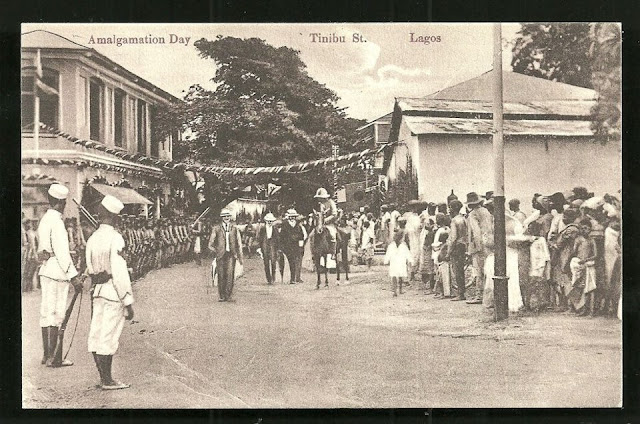
Amalgamation Day in Lagos, 1914
Showing posts with label Nigerian News. Show all posts
Showing posts with label Nigerian News. Show all posts
02 October, 2013
Femi Aribisala on "Bigmanism"
If you haven't already, take a look at this funny essay in yesterday's Vanguard.


30 September, 2013
How we write about ourselves.
I promise you I decided to write this post before the recent tragic events at the College of Agriculture, Gujba in Yobe State.
Two things I have said often on this blog.
(a) The Fourth Republic is probably the single most corrupt period of our history so far; and
(b) The Fourth Republic is the second-most violent period in our recent history, behind only the Civil War. The First Republic would be third on the list of violent periods, despite the fact that many seem to look at it as though it were some sort of golden age of peace and prosperity.
There is enough violence going on that I would probably have had to apologize regardless of when I eventually wrote the post. But for the record, I was going to write this before what happened in Yobe.
But firstly, may the souls of the victims Rest in Peace. I don't know what else to say. There is nothing I can do to help.
I wanted to write a post about the way our media covers murder and mass murder, specifically the tendency to show graphic pictures of the victims.
Elsewhere in the world, they spare the families of the
deceased the shocking sight of their loved ones in the aftermath of something
like this .... whereas in Nigeria, the victims' bodies are
displayed without blurring, censoring or respectfully-placed pixels.
By the way, those media outlets from elsewhere in the world do not extend that level of respect to us when covering incidents of mass violence on our continent. For example, some years ago, on a weekend morning (i.e. when children were likely to be home), one of the USA's basic cable networks ran a documentary on Liberia and Sierra Leone, and showed everything, including one man's head which had been detached from his body and placed on a table. Had he been an American victim of a crime in the USA, either (a) they wouldn't have shown the head; or (b) they would have blurred his eyes so we the viewers (and particularly his family) would not .... see him. In fact, I think their channels are afraid of being sued by the families of American victims, but fear no consequence from us.
Still, how can we demand respect from other people when we do not respect ourselves? Reminds me of a speech I gave on Nigeria, where I instructed the audience to stop referring to Africa's (ethnic) nations as "tribes". After talking about this, that and the other, I took my seat and prepared to listen to the Kenyan who was due to speak next about Kenya. To my dismay, he spent the entire time referring to every single ethnic group in Kenya, one after the other, as a "tribe". It was a small enough group that I could see the people in the audience looking at each other in confusion.
By the way, I am not squeamish and this post is not about squeamishness. There is a time and place to look at and see the ugly realities of human history, of the human present and (unfortunately) of the human future. In the time and the place, I do not turn away.
That isn't what our media is doing, though. In fact, as you know, I am generally critical of how our media cover mass murders and single-victim murders. Their coverage of "communal violence" does very little to give us factual information about what actually happened, why it happened, and who actually did it. Their coverage of "communal violence" on the contrary tends to serve a fuel-on-the-fire role of sustaining the exact sort of cloud of misinformation that makes "communal violence" both likely and recurrent.
There are analysts and commentators who talk about something called "disaster porn". I wish they had chosen a different name for it (and shudder to think that some people will stumble onto this page after doing a web-search for something else). You can do a web-search yourself to find essays on "disaster porn" ... and when you've done that, consider that I think what the Nigerian media does is 100% "disaster porn" and 0% information.
More importantly they show 0% sensitivity in not even considering the fact that someone's mother, or father or spouse or child might opt to find out what happened in the world today, and find themselves looking unexpectedly at the graphic image of their murdered relative. You tend to hear police in certain countries talk about not revealing the names of the victims to the media until after their families have been informed -- in Nigeria, particularly now in the era of the internet, the pictures of the dead are posted even before the police know how many dead people there are, much less the names of family members to notify.
Do we even notify the families? A friend of mine, my next-door neighbour growing up, was murdered on the campus of one of our universities back when "cult violence" was rampant. His body was unceremoniously dumped with a pile of other bodies collected that night, and his parents had no idea what had happened because no one (not the police, not the university, no one at all) told them anything. After they hadn't heard from him in a long while, they travelled to the university, presuming to ask him what was going on .... only to be directed to the morgue, where they found him in a pile of other bodies.
That particular incident didn't make the news, because it was didn't met the threshold to count as good "disaster porn". There is a lot of stuff, violent stuff that happens in our Federal Republic that no one ever hears about, because there isn't an "angle" to it, no existing strings the news can be used to pull.
But that isn't really what this post is about.
There is a time and place for graphic images of violence and disaster. And there is a time and place when images can be presented, but should be "censored" to show sensitivity to the families of the victims.
There is also a philosophical principle involved in sensitizing people to something by showing them what it is without editing. But there is also a dangerous result where people see something so often they become inured to it (indeed, seeing incredibly graphic images of mass murder does not seem to lead to protests or outrage about the media showing us such images; on the contrary, we don't seem to react to it at all).
I wish someone would speak to the Nigerian media, and explain to them the difference. Unlike our politicians, I think the media is capable of learning.
May the souls of the victims Rest in Peace.
02 September, 2013
About "Communal Violence"
Conversations and discourse about Nigerian politics usually revolves around sociocultural identity, whether it be region, ethnicity, geopolitical zone, senatorial zone, religion, local government or town of origin. Debate about the presidency is about whose turn it is in the "geopolitical zone" rotation (and whether or not certain zones are "ripe" to produce the presidency). Gubernatorial discussions are about which "senatorial zone" has yet to produce the governor.
It is not just federal offices that are "zoned" or subject to "federal character"; the concepts are applied even within states where everyone ostensibly belongs to the same ethnicity and religious faith, within local governments too -- and are as controversial at these levels as at the federal level.
Discourse tends to be geared towards facilitating divide-and-rule. And while commentators in the southern half of the federal republic tend to portray the northernmost fifth of our landmass as being "feudal", the truth is politics everywhere in Nigeria is "feudal", insofar as it is designed around a spiderweb of patron-client networks, each network pyramid-shaped, each client of a patron serving as the patron of his own set of clients, each of whom have their own clients, and so forth.
The same type of politic discourse that serves divide-and-rule also serves neo-feudal politics. Each apex network (or wannabe apex network) strives to define itself as the official representative of a "marginalized" sociocultural subgroup that must be placated with federal largesse -- channeled of course through the network. This process tends to be relatively orderly under periods of "military" rule, and inevitably violent and chaotic when "civilians" are in the Presidential or Prime Ministerial mansion.
And this discourse helps our governments abdicate their responsibilities without having to explain why they have failed to fulfill their duties. Take for example the recurrent clashes, year-after-year, between farmers and pastoralists in certain parts of the country. At the root, this is about land, about land use; the violence of the confrontations is linked to the fact that this is life or death for the protagonists -- losing even one cow is a serious "financial" blow to the pastoralists, and losing a field of crops to cattle will ruin a farmer. There is no safety net for either of them (and I am saying that as a statement of fact, and not of advocacy), nor will the government or society step in to help either one of them if they should suffer catastrophic loss. Significantly, neither the farmer nor the pastoralist counts on the police or the judiciary to protect them, knowing that neither institution does or will.
There are things that could be done to avoid this entirely PREDICTABLE annual event.
But all three tiers of government, all law enforcement and public security agencies, all of them do exactly NOTHING ....
.... except participate, fuel and sustain the political climate in which these events are interpreted as "ethnic" or "religious" clashes between people who are portrayed as fundamentally hating each other because of each other's ethnicity or religion.
Describing these clashes in this manner frees the government from its responsibilities, and allows the government to avoid accepting responsibility for its failure to prevent these violent clashes. An economic problem of land use is something the government can fix, but once you invoke the theory of "tribal hatred" as your explanation, you are deflecting people into the discourse that blames every problem in Nigeria on the fact that X number of ethnic groups were Amalgamated, a discourse that ends with the argument that splitting Nigeria would solve all of our problems.
The fact that solutions exist to the land use problem do not factor into the conversations. In fact, in all my decades of life, I have not once witnessed a political debate on potential solutions to the annually recurrent issue. The people of the affected areas, and the people of Nigeria at large, have never faced an election where the governments' handling of the issue was at stake, or where alternate suggestions of how to handle the issue were offered. "Tribal hatred" is the conclusion, and that is the end of it.
The "tribal hatred" gimmick works for the media about as well as it works for politicians. The media treat us to screaming headlines when any event of mass violence can be given an inter-ethnic or inter-religious colouration, but I can tell you of many incidents of political and "communal" violence that have occurred in places I am intimately familiar with that never showed up in any media report, because there was no "tribal hatred" angle to report.
In fact, one of the reasons why insecurity, violence and the dysfunction in our public safety agencies has never attained the importance in policy discourse that it should is we tend to treat the outcomes of dysfunctional security agencies as though they were outcomes instead of "tribal hatred". Something that has a solution is talked about as though it were something that couldn't possibly be solved.
There are lots of places in this world where violent gangs draw membership from specific linguistic, regional, cultural and racial groups. Indeed, many organized crime groups are known as "families" or "clans", and they build their internal loyalty systems by creating distinctions between themselves and their rivals on those same lines.
There is usually an unwritten understanding between such groups and the governments of the countries in which they operate -- they can do this, this and this, and the government will look away, but if they do this, this, or this, the government will bring down a hammer on them.
Among the things that the government wouldn't allow happen is a White Supremacist gang going on an unchecked, unopposed killing rampage in a predominantly Black neighbourhood. By the same token, an African-American gang would not be allowed to go on an unlimited killing spree in a Hispanic neighbourhood. And Hispanic gangs do not get to spend 12 daylight hours randomly killing people in White-majority neighbourhood.
If any of the events I mentioned in the paragraph above ever actually happened, the citizens would be outraged at the government! Questions would be asked about where the police were, why their response times were so slow, etc. Politicians would scramble to find scapegoats within the police and/or the bureaucracy, and to burnish their reputations as being tough on crime.
True, their media would create screaming headlines, just like ours, but people wouldn't sweep the failure of the government under the carpet by concluding that "tribal hatred" was the reason for the violence and then moving on. Nor would their media cover it as though the entirety of the respective racial groups took a secret vote and authorized the killers to do the killing on their collective behalves.
Seriously, why do we consider these incidents of mass violence to be "communal"? Why do we discuss them as though one entire ethnic group of twenty million people had attacked another entire ethnic group of twenty million people? All of our focus is on blaming ethnic groups and regions, with little focus on identifying the specific individuals responsible.
Haven't we learned the danger of this? What happened when an entire ethnic group was blamed for the actions of a relatively small band of 1966 coup plotters? And while the subsequent pogroms against people from that ethnic group were unjust (and that is putting it mildly), why was an entire ethnic group blamed for that too? You can arrest 15 people, but you cannot arrest 20 million people -- this is the problem, that we keep discouraging ourselves from solving small problems by allowing the people who should be solving the problems convince us that the problems are too large for them (or us collectively) to solve.
31 December, 2012
INEC de-registers 31 parties
You've probably read all about it and formed your opinions by now. In case there is anyone who hasn't, you can read about the first 28 de-registered parties in this report from This Day, and the 3 additional de-registered parties from the Nigerian Guardian.
A lot of these parties were non-functioning. Many, if not most, were "briefcase" parties, to be offered (for a price) to ambitious politicians who had lost in another party's primaries and were looking for a platform-of-convenience from which to run for the office anyway.
Quite a lot of our politicians hop around from party to party, looking to settle in whichever one allows them to run in the immediately approaching election. The way it happens in practice is cynical and immoral, but in theory there is nothing wrong with this in terms of democracy. I don't particularly like politicians (and citizens) who are rigidly wedded to a particular party or ideology, and I am not opposed in theory to politicians and voters moving from one party to another.
Among the de-registered parties, there are one-man parties. These are not so much "parties" as they are the brand name of a particular political individual.
This can be a problematic thing, as when the late Alhaji Olusola Saraki used the Allied Congress Party of Nigeria as a tool in what was essentially an intra-family feud. The late godfather of Kwara politics wanted his daughter, Senator Gbemisola Saraki, to replace his son, Governor Bukola Saraki, as Kwara State Governor. Since Bukola had control of the state's branch of the PDP (seizing said control from his father), the late godfather more or less created or recreated the ACPN as a platform for his daughter to challenge his son's preferred successor (i.e. his son's political godson).
On the other hand, there is nothing wrong with this in terms of democracy, and in the context of Nigeria, where mainstream politics is inherently problematic, it can even be a good thing, in an ineffective sort of way. The National Conscience Party was for a long time the personal political vehicle of the late Chief Gani Fawehinmi. I agreed with Chief Fawenhimi's stance on many issues, and respected his courage to speak loud where others were silent with fear. I disagreed with his views on certain other issues. But it would have been a travesty to de-register his party based on some arbitrary INEC decision. Since Fawehinmi's death, it appears his son is attempting to keep the party alive. I wish him luck.
Perhaps a better example is the Peoples Redemption Party, which was de-registered, unlike the NCP. The PRP is now a personal political vehicle for Balarabe Musa, the 76-year-old ex-Governor of Kaduna State during the Second Republic. In theory, Balarabe Musa is trying to carry on the political tradition of the late Mallam Aminu Kano, a legendary figure in Kano State, Hausaland, Northern Nigerian and Nigerian politics. I am not sure how effective Balarabe Musa has been at continuing his mentor's politics in practice, but de-registering the PRP is something that is only possible in a country of arbitrariness, constitutional confusion, and a profound lack of appreciation of history. The First Republic's Northern Elements Progressive Union, and it's Second Republic continuation as the Peoples Redemption Party, were both, to a large extent, the personal political vehicles for the late Mallam Aminu Kano, but that did not diminish the importance and the impact of both parties on the Federal Republic. Is it really the business of the Electoral Commission to decide to junk a party with such history?
Seriously, what business is it of INEC?
Unlimited "freedom" doesn't exist anywhere in the world, and never has, contrary to the self-congratulation of certain commentators in certain countries. I am not advocating unlimited freedom to form organizations; I do think registered and recognized political parties should largely be congruent with Nigerian society and culture. To use an absurd example, if someone wanted to start a local branch of a racist European or American political organization in Nigeria, I do not think we are under any obligation to grant it recognition or civic protections. I was going to give an example of one of these racist organizations, but I don't want the internet to direct people searching for things like that to this blog. I have the same view of internal "racism" (if you can call it that), and do not believe a political organization advocating violent attacks by one Nigerian community against any other Nigerian community should receive civic recognition or protection.
But so long as a political party or organization exists in normal Nigerian political space, it should not be the prerogative of the Electoral Commission to decide which political parties can or cannot be registered. If it is too unwieldy to manage the list at the federal level, then lists of registered entities should be maintained at the Third Tier of governance.
Perhaps there can be a minimum threshold of some kind for a party's candidate to be placed on the ballot, though these sort of rules (in Nigeria and everywhere else in the world) have a tendency of ruling out regular citizens and leaving politics in the hand of ... people who are less than ideal for the task.
Definitely, INEC should discontinue the practice of making payments to the registered parties. The Electoral Commission justified its actions in part by saying that some of the parties were created so the party owners can collect subsidy payments from INEC without actually doing any politicking with the money. But why is INEC giving any of them money in the first place?
If money must be given to support the smaller parties, there should be some kind of qualification, with the amount of money given tied to the degree to which a party meets or exceeds that qualification. For example, funds might be given only to parties that win a certain number of seats, with a higher sum given to those who win more seats. This should be based on the cheapest seats to run for, since it is difficult for a smaller party to win any kind of seat without support funding in the first place. Currently, the cheapest seat to run for is a local government council seat -- winning just one or two of these should earn a party a bigger infusion of support cash than they would get per seat for each subsequent seat. Of course, this won't be a perfect system (I still wonder why INEC is in the business of paying anything to the parties), but it is better than randomly de-registering parties.
A lot of people's instant reaction to the news of INEC de-registering 31 would have been to support it because they think Nigeria has too many political parties. Usually these people trot out foreign-country examples of "two party systems", portray this as being the ideal, and point to the admittedly odd sight of African countries with as many as 15 people running for President.
I am tempted to launch into an explanation of why the much-hyped "two party system" is not as ideal or optimal as the hype portrays it to be. But I think such a thing is best reserved for a volume of books, and not a blog ....
.... and a quicker, more shorthand thing to say would be to remind everyone that we are talking about the Federal Republic of Nigeria, a specific place with specific people, a specific set of cultures and a specific society. Shift away from the notion that there is a single, perfect way that EVERY country must be. Shift away from the obsession some Africans have with creating mimicry and facsimiles of everything they see in other countries, even if those things are specific, organic outgrowths of those other countries' specific histories, and have no relevance to Nigeria or Africa.
Instead of trying to shoehorn Nigerian into the political system of some other country, why don't we allow the political system of Nigeria be expressive of the Nigerian society, which is not a two-party society welded and wedded to something called "the left" and something called "the right".
It didn't make any sense when General Ibrahim Babangida attempted (or pretended to attempt) to shoehorn Nigerian into the Social Democratic Party and the National Republican Convention.
It doesn't make sense today when opposition politicians talk about creating a giant opposition alliance to challenge the Peoples Democratic Party.
And it only added fuel to a dangerous fire when the First Republic parties amassed into the United Progressives Grand Alliance and the Nigerian National Alliance.
Balarabe Musa's PRP might be inconsequential in the grand scheme of the Fourth Republic, but it is a more organic outgrowth of Nigerian society and politics than any of these other schemes.
And a massive part of the problem with Post-Colonial Africa has been the persistence of the Colonial Paradigm -- the existence of "governments" and (more importantly) systems of governance that have no real or virtual connection to the people and lands they purport to govern. Our governments are indifferent to us, and we are indifferent to our governments. Thus the tragedy of the commons, where nobody feels the need to maintain or secure a thing because nobody feels any sense of ownership of or responsibility toward the thing.
We the people can starve to death and the governments don't care because there is no mechanism for transferring or translating our desperation (or our anger) to the governments.
Conversely, one day, everyone could be hailing the supposed economic miracle of Cote d'Ivoire or the allegedly deepened democracy of Mali, and the next day these countries are doing their best impression of a failed or failing state, because, like the emperor without clothes, the political and economic institutions of the countries crumble the moment anyone challenges their claim toward being the legitimate institutions of that particular geographical patch of land. The fall of the government means nothing to us, because the government meant nothing to us.
Let us stop with the experimenting and constitutional gymnastics, and just allow for an organic politics, not a managed politics.
Post-script: By the way, all of those countries known as "two-party" countries actually have more than two parties. Indeed, there are, and have been, at any given time, far more than three parties represented in the British Parliament.
06 August, 2012
A couple of articles, one old and one new
THE NEW
Dr. Charles Soludo, the immediate prior Governor of the Central Bank of Nigeria is engaging in the worldwide practice of ex-officialdom -- calling in "retirement" for things that they had the chance to do when they were in office but chose not to do because doing so would have lost them that office. Some of these ex-officials (e.g. USA's ex-President Clinton) make a lot of money doing this.
Anyway, Soludo (now a columnist for This Day) has written a very interesting critique of the Federal Republic's statistics. As well all know, our data and statistics has not in the past, and does not in the present, engender much confidence. In writing this blog, I have often had to base a statement on some bit of official statistics, while simultaneously admitting that the statistics may or may not be accurate. Soludo, a former boss at the National Bureau of Statistics, as well as being a former CBN boss, is a credible person to confirm that I am appropriating hesitant about relying on official statistics even where they confirm my point of view.
And if you think I was being harsh on Soludo by criticizing his after-the-fact realization that proper statistics are important, understand that he is one of the reasons people like me are forced to be hesitant when trying to analyze what is going on in Nigeria. Even as all evidence point to the fact that the bubble that existed at that time on the Nigeria Stock Market was about to burst, Soludo, then the CBN governor, continued to publicly insist that his data showed him no such thing was happening. Indeed, even before that, as lax regulation from the CBN and SEC allowed the bubble to grow particularly large in the banking sector, while simultaneously allowing banks to criminally or unethically manipulate data and outcomes, and to criminally or unethically use the proceeds from this manipulation, Soludo at the CBN just as strenuously denied any such thing was happening.
You should read the whole article if you haven't already (click the link and give them the traffic), but I will reproduce this quote from the piece: "If the poverty numbers are correct, then the GDP numbers are wrong. If the GDP numbers are correct, then the poverty numbers must be wrong."
THE OLD
If I sometimes come off cynical, it is because experience has taught me to be cynical. Some years ago, Nigeria launched a communications satellite. Or rather, a satellite was launched on our behalf by foreign partners. This satellite was ultimately "lost" rather quickly after launch, and had to be replaced. But that wasn't the real problem. The real problem is even if it had worked exactly the way it was supposed to, it still wouldn't have worked. According to an engineer quoted in this old article:
It isn't just us. There have been scandals in Uganda and Tanzania after what was meant to be brand-new, state-of-the-art imported equipment arrived and turned out to be old-fashioned technology in a state of dysfunction and/or disrepair. Arguably, even rich world governments tend to pay out excessive sums of public money to favoured corporations (and frankly, to NGOs and "civil society" as well) who deliver goods and services not necessarily commensurate to what they were paid.
But this is why I hesitate to shout "Uhuru" when any of our three tiers of governments announces something that in theory sounds like a good plan. Because at the end of the day, there is always someone (within our country and outside of it) making a lot of money off of making sure the plan is executed in a way that does not quite exactly achieve whatever it was that was promised when the plan was announced.
Dr. Charles Soludo, the immediate prior Governor of the Central Bank of Nigeria is engaging in the worldwide practice of ex-officialdom -- calling in "retirement" for things that they had the chance to do when they were in office but chose not to do because doing so would have lost them that office. Some of these ex-officials (e.g. USA's ex-President Clinton) make a lot of money doing this.
Anyway, Soludo (now a columnist for This Day) has written a very interesting critique of the Federal Republic's statistics. As well all know, our data and statistics has not in the past, and does not in the present, engender much confidence. In writing this blog, I have often had to base a statement on some bit of official statistics, while simultaneously admitting that the statistics may or may not be accurate. Soludo, a former boss at the National Bureau of Statistics, as well as being a former CBN boss, is a credible person to confirm that I am appropriating hesitant about relying on official statistics even where they confirm my point of view.
And if you think I was being harsh on Soludo by criticizing his after-the-fact realization that proper statistics are important, understand that he is one of the reasons people like me are forced to be hesitant when trying to analyze what is going on in Nigeria. Even as all evidence point to the fact that the bubble that existed at that time on the Nigeria Stock Market was about to burst, Soludo, then the CBN governor, continued to publicly insist that his data showed him no such thing was happening. Indeed, even before that, as lax regulation from the CBN and SEC allowed the bubble to grow particularly large in the banking sector, while simultaneously allowing banks to criminally or unethically manipulate data and outcomes, and to criminally or unethically use the proceeds from this manipulation, Soludo at the CBN just as strenuously denied any such thing was happening.
You should read the whole article if you haven't already (click the link and give them the traffic), but I will reproduce this quote from the piece: "If the poverty numbers are correct, then the GDP numbers are wrong. If the GDP numbers are correct, then the poverty numbers must be wrong."
THE OLD
If I sometimes come off cynical, it is because experience has taught me to be cynical. Some years ago, Nigeria launched a communications satellite. Or rather, a satellite was launched on our behalf by foreign partners. This satellite was ultimately "lost" rather quickly after launch, and had to be replaced. But that wasn't the real problem. The real problem is even if it had worked exactly the way it was supposed to, it still wouldn't have worked. According to an engineer quoted in this old article:
The satellite was limited because the type of frequency it used was disturbed by clouds in the atmosphere, and did not work properly in Nigeria's rainy season or during the Harmattan, when clouds of dust blow down from the Sahara, he said.The satellite also operated on frequencies already allocated to other companies and interfered with other providers' equipment.
It isn't just us. There have been scandals in Uganda and Tanzania after what was meant to be brand-new, state-of-the-art imported equipment arrived and turned out to be old-fashioned technology in a state of dysfunction and/or disrepair. Arguably, even rich world governments tend to pay out excessive sums of public money to favoured corporations (and frankly, to NGOs and "civil society" as well) who deliver goods and services not necessarily commensurate to what they were paid.
But this is why I hesitate to shout "Uhuru" when any of our three tiers of governments announces something that in theory sounds like a good plan. Because at the end of the day, there is always someone (within our country and outside of it) making a lot of money off of making sure the plan is executed in a way that does not quite exactly achieve whatever it was that was promised when the plan was announced.
08 August, 2011
Asuquo E.B.

This image is culled from BUSINESS DAY.

I am a daily reader of the excellent newspaper Business Day. For the record, they have paid me nothing for the "endorsement".
Nor have I received anything for telling you this: "Asuquo E.B.", their resident editorial cartoonist, is quite good at his craft. His jabs are pithy and well-directed 98% of the time.
Per the other 2%, well, he did something I don't think anyone in his position should do -- he took sides during the 2011 Presidential Election. He is a citizen, fully entitled to cast his vote for the candidate of his choice, but there is a difference between a satirist and a political propagandist, and Asuquo's election-season bias affected his work.
Still, no two people agree on everything all the time.
I look forward to enjoying Asuquo E.B.'s work for years to come.
And just in case anyone is wondering, I am NOT opposed to interest-free banking (a.k.a. "Islamic Banking"). We should do whatever it takes to bring the majority of Nigerians into the banking system. Indeed, we should forget about what other countries do or do not do and stop trying to mimic Europe, North America or West Asia (a.k.a. the "Middle East"). A proper banking system suited to the environment of Nigeria would be a mix of forms that are otherwise considered "formal", "informal", and "traditional". Somehow, we have to draw it all together into a larger, stronger whole. And if the introduction of interest-free banking will spur on a deepening of the capital market in parts of the country that are currently "under-banked", then I am all for it.
08 October, 2010
Today's News
A strong editorial from NEXT complains that the government and opposition are both being dishonest and disingenuous regarding the October 1 Abuja bomb blasts. NEXT regrets that both sides have politicized the issue (as indicated in this Daily Trust report, opposition politicians have demanded Jonathan's resignation, and asked the National Assembly to impeach him if he doesn't resign). NEXT's editorial demands honesty from the president, less flame-fanning from the opposition, and a credible investigation.
Business Day talks to sources about the on-going forensic audit of the Nigerian Stock Exchange. The audit may raise questions about the role of the NSE’s External Auditors, Messrs Akintola Williams Deloitte ... which is interesting, since the current, interim Director-General of the NSE was only recently the chairman and CEO of Akintola Williams Delloite, for West and Central Africa.
And This Day quotes the leader of the "Niger-Delta Peoples Volunteer Force" (another crude oil bunkering, election-rigging "militia") Mujahid Asari-Dokubo blaming Henry Okah exclusively for the October 1 bomb attack in Abuja, while accusing the Nigerian intelligence and security agencies of ignoring the warning he (Dokubo) gave them before the event. Asari-Dokubo further says Henry Okah hates Goodluck Jonathan, that Jonathan was the target of Henry Okah's attacks, and insists Okah is saying the Jonathan administration attempted to get him (Okah) to participate in a cover-up of MEND involvement in order to embarass the Jonathan administration because (again) Okah hates Jonathan.
Henry Okah is a criminal, and lacks credibility. With that said, Mujahid Asari-Dokubo is also a criminal, and also lacks credibility. The various militia groups in the Niger-Delta have frequently gone to war with each other on behalf of different politicians, and sometimes (like most organized crime syndicates) for control of lucrative territory for criminal enterprise (go to the Human Rights Watch website, they have many reports about the violence in the Niger-Delta). Asari-Dokubo indirectly admits in the article that he and Henry Okah are currently enemies, which makes his statements lose even more credibility; the fact that he is clearly currying favour with the government (something he also did under the preceding Obasanjo and Yar'Adua regimes) lowers the already nonexistent credibility even further.
The politicians and their underworld cronies are still playing silly games. Whatever "leads" investigators may have had have probably gone cold by now. The Nigerian Police Force is bad at preventing the contamination of crime scenes, bold-facedly lies to the public about how, why and when suspects in detention died, and has a tendency of arresting innocent people and locking them away for years claiming them to be guilty of a crime (or related by blood to someone they claim is guilty of a crime) with this conviction-by-police-fiat never adequately tested in any court. As for the "intelligence" agencies, the only thing they are good at is harassing the political opponents of whoever/whatever is the government of the day.
It is getting to a point where we may never know who carried out the Abuja Bombing. Like so many other such events (including the murder of Dele Giwa) it may become a thing that everyone spreads rumours and suspicions about, but no one knows for sure.
24 August, 2010
News Comment
Should we citizens be angry that a suspected conman allegedly "duped" a federal legislator of =N=130,000.00 ... or should we take this report from NEXT as partial evidence of Nigerians' long-held belief that politicians pay (dare I say "bribe") journalists, newspapers, radio and TV stations for positive coverage.
So-called brown envelope journalism has been around (or rumoured to be around) for about as long as journalism has been around. It works directly, with media outlets either receiving money in exchange for good publicity for the client (or negative publicity for the client's opponent). It also allegedly works inversely as well, like an extortion racket, with media outlets (allegedly) innundating us with negative stories about a politician who is not yet paying them, in order to put pressure on the politician to pay up, kind of like what is known in other countries as a protection racket.
Allegedly.
Speaking of public perception of the federal republic's institutions, a poll was released that showed 70% of respondents believe our judiciary is corrupt.
12 August, 2010
News Comments
Another politician decamps to the PDP.
This time its Governor Theodore Orji of Abia State, who is decamping from All Peoples Grand Alliance (APGA) to the Peoples Democratic Party (PDP). Governor Orji had previously decamped from the Progressive Peoples Alliance (PPA) to join APGA. And before that, he had jumped from the PDP to join the PPA. Perhaps bookmakers in Las Vegas and Macau should give odds and take bets on where Theodore Orji will be next year.
Elsewhere, the publication NEXT reports the newly renamed "Action Congress of Nigeria" (it used to be called "Action Congress") will annoint former EFCC boss Nuhu Ribadu as its presidential candidate for the 2011 (s)elections. It will be interesting to see Ribadu insisting he will fight corruption, while standing side-by-side with the ACN's sole shareholder, Bola Ahmed Tinubu. A bit like calling yourself a vegetarian while you are consuming copious amounts of meat, but that sort of hypocrisy is the defining characteristic of Mr Ribadu.
And Vanguard reports the PDP has decided to keep the Regional Zoning phenomenon peculiar to the Fourth Republic, but will allow current President Goodluck Jonathan to seek the party nomination even though he is not an indigene of the region whose turn it is right now.
I have frequently said on this blog that Nigerian politics is empty, hollow and lacking in substance. The fact that the argument over "zoning" is the dominant issue of this (s)election campaign is basically par for the course. Even if we took the rubbish of "zoning" on its own merits, there sure is a lot of hypocrisy going around. In 1999, all we heard was "power shift" to a specific region, and I guarantee in 2015 an "apex socio-cultural group" from another specific region will insist it is now their turn because the last time a man from their region held the president's chair was 44 years ago. Today, the people who benefitted from the rubbish of zoning, and the people who hope to benefit in the future from the rubbish of zoning ... are criticizing zoning, so as to block yet another specific region from keeping the presidency for another four years. Today they criticize it, tomorrow they will demand its reintroduction -- why criticize Theodore Orji for jumping around like a grasshopper, when all of our politicians are all clones of Theodore Orji?
Personally, I have never bought into the belief that there is a qualitative difference between "Northern" politicians and "Southern" politicians, between Christian politicians and Moslem politicians, between civilian politicians/plutocrats and militicians/plutocrats from the army. The rubbish of "zoning" and "power shift" extends even to the states, where senatorial zones are supposed to take turns in filling political positions with corrupt men that have no ideals and no plans for societal progress or economic development.
If we don't change is the fundamental, substantive nature of our society, then it doesn't really matter which region produces the president, because that president will just do the same ridiculous things that were done before him, that will be done after him, and that would have been done if one of his rivals had "won" instead. It has been over 50 years since the march to Independence in the 1950s, and we have consistently produced the same type of politics and the same type of leaders pursuing self-defeating policies and lacking in any type of vision of what our federal republic should be, and bereft of any comprehension of what our real long-term strategic interests are. Yet, it is a question of demand and supply, and the politicians definitely supply our insatiable demand for rubbish conversations about rubbish topics like zoning.
Look, it just doesn't make a difference to me if my country is mismanaged and maladministered by a man from Badagry, Maiduguri, Oloibiri, Sabon Birni or Awka-Nri.
What the heck is the difference?
When are we going to talk about issues, and measure candidates based on their ability to deliver on the issues?
When will our politics be relevant to real life, and not to this cartoon existence we seem unable to escape?
11 June, 2010
News Comments
KANO
As I said would happen yesterday, the EFCC has released Alhaji Takai, and has made some vague, indecipherable noises on how the investigation will be on-going. Interestingly, the article named the specific political rival who called the EFCC in, Alhaji Abdulkareem Dayyabu. What will happen next is Governor Shekarau will deploy the powers of the Governor's Office to crush Dayyabu ... or the governor will have a private chat (more like a negotiation) with President Jonathan. Basically, Shekarau wants to be free to impose Takai on Kano, without interference from Abuja, while President Jonathan wants to impose himself on Nigeria in 2011 and needs the support of the political machines controlled by the all of the governors (particularly one is so key a state as Kano). A simple quid-pro-quo will be worked out.
In better news, the Kano Metropolitan Area looks to be getting some version of rail mass transit. The Kano project is the latest on a list that includes the Lagos State rail mass transit project, and the mono-rail line planned in Calabar to link Margaret Ekpo International Airport with the Tinapa Resort, Shopping, Conference and Entertainment complex.
HEALTH AND WELFARE
I doubt any high-ranking government official reads this blog. But on the off-chance that any of them do, could they please take a look at this news report and do something about it? Haba. Why would you build a clinic, equip the clinic with everything it needs ... but fail to connect it to the electricity grid? In fact, why was the clinic opened for business if it has no electricity?
10 June, 2010
News of the day
ABUJA
Mobile Police in Abuja shot a bus conductor in the knee. The conductor's crime? He had the temerity to ask the officers to pay their bus fare. Apparently the Mobile Policemen felt they had the right to ride commercial buses for free, and the right to enforce this freedom-from paying their due bills by using gunfire on innocent blue-collar workers who are only doing their jobs.
KANO
Nuhu Ribadu has barely returned from self-imposed exile, yet the EFCC is already reverting to its Ribadu-era form.
Being that Big Men dislike subjecting their ambitions to democratic votes, the many ANPP aspirants seeking to succeed Ibrahim Shekarau as Governor of Kano State after the 2011 "elections" decided against having a democratic intra-party primary decide the All Nigeria People's Party candidate for next year's "elections". No, the ANPP powerbrokers decided to give Governor Shekarau the right to singlehandedly designate one of them as his automatic successor; since governors control their respective State "Independent" Electoral Commissions, control their respective state treasuries (with fully bought-and-paid-for rubber-stamp State Assemblies), and control their respective local government areas (appointing chairmen and councillors as though they were handmaids), being your governor's handpicked successor is as good as "winning" the election before it is held.
Each of the aspirants had spent the last 8 years kissing Shekarau's ... never mind. The point is, they each thought they were the governor's favourite, and they each thought that this undemocratic arrangement would result in the governor picking one of them and using his power to shut their rivals up.
As it turns out, the governor picked none of them. The would-be aspirants have reacted very negatively to Shekarau's selection of Alhaji Salihu Sagir Takai as his imposed replacement (sample stories here, here and in most detail here.
Some of Alhaji Takai's expanding list of opponents seem to have remembered that manipulating the outcome of "elections" was the most important role of the Economic and Financial Crimes Commission during the Obasanjo II administration.
Since almost everyone involved in politics in Nigeria is tainted with the pervasive corruption of the system, you can ALWAYS find proof of wrongdoing by any politician ... provided you are actually interested in finding it. Indeed, as much as I am no fan of Nuhu Ribadu (working to make one corrupt faction stronger at the expense of another corrupt faction does not constitue fighting corruption), or of Farida Waziri (who only has the job as a scratch-my-back-I-scratch-yours recognition of her husband's political influence in Gombe State), no one, not even a saint, could fight corruption from within the system. The system itself is so corrupt in its entirety, that "fighting corruption" would entail prosecuting almost everyone in the political system, which the political system (by definition) would never allow.
In any case, Alhaji Takai's opponents have set the EFCC on him. The ANPP does not control the EFCC, so one can see the hidden hand of the Peoples Democratic Party, and the federal government, trying to exploit divisions in the ANPP ahead of the 2011 "elections".
In Fourth Republic politics, aspirants who fail to get the nomination ticket for their current political party simply decamp to one of the other 35 registered parties from where they battle their rivals in a contest to see whose machinery will be more successful in manipulating/dictating the outcome. Specifically, one or more of Shekarau/Takai's rivals is clearly in discussions with the Peoples Democratic Party (and with President Jonathan) about decamping to the PDP ... and Alhaji Takai's arrest may be the first step in the eventual replacement of the ANPP with the PDP as the controlling faction in Kano State.
Oh, don't worry. I doubt Takai will be held for long, or charged with anything. They will hold him for a while, "question him", and then release him. Farida Waziri (like Ribadu before her) will make vague sounds about planning to prosecute him at some unspecified future date.
The PDP has made its point.
06 May, 2010
President Umaru Yar'Adua died yesterday
Yesterday, 5th May 2010 at 9pm, the 13th President of the Federal Republic of Nigeria passed away. Reports from Daily Trust and NEXT. He will be buried today at 2pm Nigerian time.
May his soul Rest In Perfect Peace.
Goodluck Ebele Jonathan was sworn in as President this morning.
Thursday, 6th of May has been declared a national holiday, and President Jonathan has called for a week of mourning.
From a historical perspective, President Yar'Adua is the fifth Head of State/Government of the federal republic to die in office in the last half-century. Prime Minister Tafawa Balewa was assasinated (1966), as were Heads of State J.T.U. Aguiyi-Ironsi (1967) and Murtala Mohammed (1976). Mystery still surrounds the death of Sani Abacha, and certain supporters of the late Moshood Abiola would insist President Yar'Adua was the sixth.
A decent man died yesterday. It doesn't mean we must stop talking about issues that affect the lives and welfare of over 100 million of God's children, but my condolences go out to his family and to my fellow citizens.
01 March, 2010
Fiscal Priorities
I have always believed wasteful spending that is nonetheless technically legal consumes (i.e. wastes) more of our money that "corruption" (i.e. direct theft, extortion, rent-seeking, rent-extraction, etc).
Bauchi governor Isa Yuguda is spending millions in state government revenue to fund his political machine ahead of the 2011 general elections. Technically speaking, he is legally entitled to put all these non-productive functionaries on the state payroll. They will spend the next year on duties that have nothing to do with governing the state (i.e. working to "deliver" an election victory for Yuguda).
Borno is part of the great a beautiful Northeast, the region of the country that has the worst social and economic indicators. Ali Modu Sheriff, the state's imperial governor, has decided his priority is to create new emirates and chiefdoms, which will suck additional state government resources and funding. Sheriff wants to reward his allies with their own little kingdoms to rule, and might also wants to create a kingdom specifically for his father to be emir of.
In Lagos, the popular Babatunde Fashola has been accused of fiscal impropriety by a previously unknown group. It is hard to know how to react in the absence of a credible academic, researcher, media outlet, think-tank or other entity capable of analyzing the accusations and pronoucing believably on their truth or falsehood.
It is public knowledge that Fashola awarded the contract for collecting at least a portion of Lagos State's internal generated revenue (i.e. taxes) to a tax-collection firm owned by his godfather, Bola Ahmed Tinubu, also Fashola's predecessor as governor. Awarding tax-collection contracts to your godfather(s), and allowing him(them) to keep an unnatural percentage of the money they collect ostensibly on the state's behalf is a technically "legal" way of funneling state revenue to your godfathers. It is the sort of arrangement Chris Uba wished to set up under the Chris Ngige administration in Anambra, before their relationship went sour.
With that said, Babatunde Fashola is one of the more popular governors in Nigeria because he is seen to have plowed public funds (and encouraged private investement) in a vast array of infrastructure projects that are beginning to give Lagosians hope that the "mega-city" could come closer to achieving some of its full potential. As one acquaintance (and Lagos resident) said to me, "People are now happy to pay their taxes, where before they would dodge their taxes, because they can see their money going into positive improvements."
But Lagos is a city-state with enormous needs, and as much as Fashola does, he will need so much more resources to meet the city-state's vast challenges and opportunities. So if a too-large proportion of the state's revenues are going into corruption, patronage, rent-seeking, rent-extracting, conflict-of-interest, self-enrichment, and (the most important of all) waste, then it is appropriate to put a stop to it so all resources are properly focused on this most important Nigerian city.
Still, what to believe? The rumour is these accusations emanate from Bola Ahmed Tinubu's political machine, and are a way to remind Fashola (who is now more popular than Tinubu ever was) that he could be broken just as easily as he was created. I am not sure what Tinubu could be afraid of; Fashola has no political machine of his own, and Lagos State is as much Tinubu's "private property" as Kwara State is to the Saraki family.
In Kano State, children as young as 10 are working to earn money to buy themselves a plate of rice a day. And inasmuch as I championed the cause of forthrightly dealing with the issue of toxic assets in the Nigerian banking industry (posts on this topic dominate the early days of this blog), it does seem a little humbling (if not depressing) when you think about the difficult lives of these children and contrast it with the =N=620 billion (about $4.13 billion) the Central Bank of Nigeria has spent to recapitalize troubled banks.
On a positive note, the federal government will spend =N=19 billion (about $127 million) to for land reclamation and shore protection in the Niger-Delta. The islands that make up the Delta have been losing land to the Atlantic Ocean for as long as I can remember. I am not sure the sum released will be sufficient; the Eko Atlantic City project in Lagos costs much more, and it will take more than that level of investment to restore land eroded by the ocean and to protect the new reclaimed land.
I have long believed that the "oil derivation" money that goes to Niger-Delta states should not be paid into the states' general fund accounts, but should instead be set aside to deal with the issue of reclaiming and protecting land ... particularly since the world's oceans are set to rise over the course of this century. To be honest, I have more faith in using 21st century technology to enhand and protect the Niger-Delta island shorelines than I do in these pointless international conferences about climate change. I don't think anything will happen, or that anybody will do anything, to stop the oceans rising. We have to prepare ourselves and our coastline for the inevitable, or we are looking at serious problems a few decades down the road.
Giving "oil derivation" money to state governors is like begging, pleading and asking for the money to be wasted (if not stolen). If Nigeria had a functioning democracy (we don't), I would have opted for putting a referendum to the people of the Niger-Delta as to whether they want to earmark a portion of the derivation money for environmental recovery (including reclamation and protection, as well as cleaning up areas damaged by the oil industry) -- and to mandate a portion of that earmark to pay a trusted auditing firm that can monitor how the money is spent (to see if it is being used efficiently/effectively or being wasted), without said firm fearing that its contract will be cancelled if it does not doctor its reports to match what the governments wants to hear.
24 January, 2010
Lake Chad
Sunday Trust has a feature on the ever-shrinking Lake Chad.
Next up, a blog commentary on Jos .... to be posted today or tomorrow hopefully.
Next up, a blog commentary on Jos .... to be posted today or tomorrow hopefully.
10 December, 2009
Quick rants - Yar'Adua, Children, Soludo, and the Police
The major topic of political conversation in federal republic continues to be President Yar'Adua's extended stay in Jeddah, Saudi Arabia for medical attention. I do not want to say anything about the issue until he comes back home, to Abuja, in full health. When he gets back, I will (hopefully) put together a post discussing the issues arising; for now, I am less interested in the politics and more interested in his health. Aso Rock's spokesmen said it was acute pericarditis, which is treatable. I wish him well.
In other news:
The Minister of State for Education, Hajiya Aishatu Jibrin Dukku has said at least 10 million children in the north of the federal republic are left to support themselves through begging. The root causes of this problematic statistic run the full spectrum of political, economic and socio-cultural, and the reforms necessary to improve the lives of our children are by consequence political, economic and socio-cultural as well. The issue predates the Yar'Adua administration; in fact, the issue, like seasonal meningitis, has been around for a long time, with no one actually doing anything substantive, permanent and long-term about it.
The Independent (independent? are they kidding?) National Electoral Commission (INEC) did not include former Central Bank Governor Charles Soludo's name on its list of "cleared" candidates for the Anambra State gubernatorial elections early next year. They did not list any candidate for the Peoples Democratic Party; the courts are still adjudicating the legality of Soludo's emergence as PDP candidate, and I think INEC means to add Soludo's name if the courts uphold his candidature. I am not sure what they would do if the courts rule against Soludo; the deadline for nominating new candidates has passed. As you might expect, Soludo's emergence as candidate was yet another example of just how anti-democratic the PDP truly is -- not just undemocratic, but viscerally ANTI-democratic. The rest of the parties are just as bad, so it isn't really like voters have any choice; and to top it off, election results do not reflect what voters chose anyway. That Soludo accepts this farce, is happily participating in the joke, and hopes to benefit therefrom is just another reason why I think so-called "progressives" in Nigeria are the worst hypocrites you can find. Men like Ribadu and the late Moshood Abiola (though I hate to speak ill of the dead) are elevated to hero status by these progressives, even though their import and impact of what they actually do and did is and was to elevate, sustain and strengthen EVERYTHING the "progressives" rhetorically claim they oppose.
And finally, Amnesty International has accused the Nigerian Police Force of hundreds of extra-judicial killings every year (two articles, here and here). To be honest, organizations like Amnesty are about as useful as the "progressives" in Nigerian politics when it comes to hard and difficult issues like reforming the police; there is a lot of talk, but nothing comes of it (hey, at least I admit that this blog of mine has ZERO impact on policy-making and governance, and do not pretend to be a relevant or powerful authority making an impact on the world).
Nigerian citizens have always known the Police carried out extra-judicial killings, there just hasn't been anything we could do about it. Or maybe there was lots we could do, but we just haven't bothered ourselves to stand up and do it. When the Boko Haram affair started, we all looked at it as another "Maitatsine", another of the recurring bouts of violence Nigeria has suffered over the decades, but in the long-run the event will probably be remembered for the extra-judicial executions of leading suspects and the Police command structure's lies about it. It is not that we were surprised they lied, nor were we surprised they extra-judicially executed suspects, no, what made the event stand out is the executions were PROVEN and the lies were EXPOSED. In a country run on rumours instead of news, it is rare for something we all know to be proven in such a public way.
The Police have denied the Amnesty Report. They have also denied carrying out collective punishment in Ogun State), attacking an entire village of innocent citizens in revenge for the murder of a Police commander by youths suspected to be from that village. And they have insisted the recent killings in Enugu State were of armed robbers.
I have talked a lot about the Police in the year since I started this blog. Without going into voluminous discourse, let me just briefly repeat that the Police (like our politics) are an extension of our society, an outgrowth of what we collectively do, and (perhaps more importantly) of what we collectively fail to do.
Collective punishment was a British colonial practice that we Nigerians did not discard after regaining self-rule in 1960. Our 1960s leaders remain massively popular, but their refusal to substantively reform the institutions of the colonial state they inherited set the stage for much of what has happened since then. More importantly, we the citizens practice collective punishment too; our version is mostly non-violent, but on occasion Nigeria is hit by communal violence driven in large part by a tendency to blame everyone from Ethnic/Religious Group XYZ for the (alleged and usually unproven) crimes committed by one member of Ethnic/Religious Group XYZ. In the first paragraph of this post, I mentioned Yar'Adua's extended absence raising the temperature of political discourse; a depressing amount of that discourse has revolved around ethno-religious accusations, denials, counter-accusations and threats.
And many members of the public do not, and have not, necessarily frowned on "extra-judicial" punishment, up to and including lynchings, by civilians on other civilians deemed to be criminals (be they alleged pick-pockets, alleged stealers of genitals for juju, alleged kidnappers, alleged anything, including alleged desecrators of holy books), without any credible trial proving their guiilt. Since we don't have accurate elections, or an accurate picture of our polity, it is hard to come up with a statistical picture of just how many of us have been ambivalent about it in the past or present, but not too long ago various ethnic and religious "militia" arose in different parts of the country, ostensibly to fight "armed robbers" (though more accurately serving as political enforcers and armed wings for ethno-religious extremists) and many citizens stood up to defend their extra-judicial violence.
Add in the lack of confidence in the judicial system, and it becomes difficult to create a climate where extra-judicial punishment (including beatings) by police is unacceptable, because so many citizens' knee-jerk reaction to crime is to instantly punish the suspect, lest they disappear into the non-functioning morass of the judicial system. Indeed, there are thousands of people in Nigerian prisons who may be guilty of nothing at all, but who remain there because there is no campaign or pressure to review their cases and/or release them -- at a certain level, the society believes they deserve what they get, because they are "criminals".
All I am saying is there is a reason I call for a level of reform, restructuring and transformation that can only be termed REVOLUTIONARY. You cannot reform Nigeria on a piece-by-piece basis, as everything is connected to everything else, and much of the reforms we need are reliant on other reforms (an intricate, interconnected web of reforms) in order to be successful. And the most important thing to note is we have to change ourselves and change the way we think as individual citizens and as a society.
Nigerian Police officers are not born that way. They are made to be that way. It is not magic, but a sequence of life experiences from outside the Force as much as within it. We are their victims, but we are also their creators.
Seriously, where are the voices and forces of revolutionary reform?
07 December, 2009
27 October, 2009
The Bode George conviction
Bode George, former Chairman of the Nigerian Ports Authority, and one of the regional capos-da-tutti-capi of godfathers during the Obasanjo years, has been convicted of corruption. The new EFCC, led by Farida Waziri, brought a long list of charges against him and four other members of the 2001/2003 NPA Board based on the alleged fraudulent award off contracts worth =N=84 billion or US$562 million.
I suppose the five were unaware then-President Obasanjo was waging a "war on corruption" while they were looting. Bode George remained one of Obasanjo's most senior lieutenants all the way up to the "do-or-die" politics of 2007, which makes it amusing that Nuhu Ribadu has tried to inject his presence into the Bode George conviction. Unsurprisingly the "investigation" only gathered pace in July of 2008, after 2007, after Obasanjo, after Ribadu. The blunt fact is the EFCC investigations in the Ribadu era were mostly used (in the aftermath of the failure of the Third Term bid) not for prosecutions, but to threaten and blackmail political figures/networks into supporting the "do or die" politics of 2007 (the Third Term by other means through the installation of a man they believed would be a stooge). The most interesting victim of the arm-twisting has to be Sani Ahmed Yerima, who gained fame as the "Sharia Governor" of Zamfara, but who rather hastily ended his campaign for the presidency and discovered a newfound support for Yar'Adua after hints emerged that the EFCC was thinking about exposing him for who he really was (i.e. just another corrupt governor).
But I digress.
Depending on which source you find most trustworthy, Bode George and his four co-defendants were convicted on 35 (i.e. 28+7) of 68 counts (Daily Trust), 28 of 47 counts (NEXT), or 47 of 68 counts (Guardian).
Media accuracy aside, the men were convicted of 35 counts, and sentenced to six months for each of 28 counts, and two years for each of 7 counts. This adds up to 28 years in jail ....
.... however, this being Nigeria, the sentences are to run concurrently, which means they will actually be in prison for only two years total.
If they were in jail awaiting trial, or in jail during trial, the "time spent" will count against the two years, and they could be out in less than two.
The slap on the wrist serves its political purpose I suppose. We the citizens are treated to a spectacle, much like the Alamieseyegha and Tafa Balogun prosecutions, a big jamboree to "show" the government is serious about corruption (even if the sentences are a joke, as they always are). It is also a warning to the "Obsanjo Boys" to take heed, or else this could be them.
The more sensible Tony Anenih has already transitioned from being an "Obasanjo Boy" to being a "Yar'Adua Boy"; his hand was present in the anti-democratic elevation of Charles Soludo to the PDP Anambra gubernatorial ticket, a move President Yar'Adua has been silently championing for months. Making Soludo the gubernatorial candidate was intended in part to crush the political ambitions of Andy Uba, another "Obsanjo Boy" (and someone who should probably be charged with corruption as well).
A couple of flowers have been plucked, but the forest of misgovernment is still as thick and lush as ever. The manner in which Soludo was "chosen" to inherit the Anambra crown is a pointer to the continued sickness in the system. Charles Soludo has a personality cult, just like Ribadu, but if the system is so dirty that he can not win a candidature nomination or an election without manipulation and rigging, then it is by definition too dirty for anyone to expect him to govern effectively since he will be governing through the same system. And as Ribadu before him, Soludo is now a PARTICIPANT and BENEFICIARY of the system, not an outsider, not a critic, not a reformer; to reform the system is to rob himself of his privileges, status and standard of living. Going forward, Soludo will be as attached to Yar'Adua as Ribadu was to Obasanjo; his job will be to use the governor's office as a bully platform to get the political machines (led by godfathers large and small) in the state to "deliver" Anambra for Yar'Adua's reelection in 2011.
If you are looking for true reform/restructuring/transformation .... don't expect to find it. It is not on Yar'Adua's agenda, nor will it be on Soludo's.
27 July, 2009
Trust Is Earned
A few days ago I posted a blog praising NEXT for setting the pace for Nigerian media houses online. In that piece I briefly mentioned the Daily Trust, but did not do them justice as the piece was primarly about NEXT.
The Daily Trust, and its sister papers the Weekly Trust and the Sunday Trust have also established a strong online presence. The Trust group bring a perspective to Nigerian news different from those of the Lagos-based newspaper giants.
It is important to get the full picture. The Nigerian film industry is a case in point. I do not claim to have read every single edition of every single Nigerian newspaper, but over the years I have found articles on the Kano branch of the film industry only in the Trust group and NEXT. Everywhere else (internatonal media inclusive), the film industry is treated as synonmous with Lagos. By the way, I hate the words "Nollywood" and "Kannywood". Someone needs to come up with a better name for our film industry!
Come to think of it, what is up with the mimicry? European Union begat African Union, UEFA Champions League begat CAF Champions League, Federal Bureau of Investigation (FBI) begat Federal Intelligence and Investigation Bureau (FIIB), and who do they think they are fooling, hiding FDA (Food and Drug Administration) in the middle of NAFDAC (National Food and Drug Administration and Control. What is with these technocrats? They school abroad (or study "abroad" in university at Nigeria), and come to the conclusion that the solution to a problematic institution (e.g. the Organization of African Unity) is to change its name to a name they see in Europe or North America? Haba, don't they get that it wouldn't matter if we called it the Pounded Yam Union, provided it actually and substantively delivered the services it was created to do, abi? At the end of the day, there is nothing to gain from constantly rearranging the facade of things, while studiously ignoring the substance.
You know what provides good substance?
The Trust group of news media sites.
22 July, 2009
234 .... Next
I am impressed with the multimedia news outlet NEXT.
There are other Nigerian newspapers that provide quality service online (too numerous to mention, though The Guardian is excellent, and if you want to escape the Lagos-bubble, check out Daily Trust). And I do appreciate the fact that I can listen to Radio Nigeria's Kapital FM (Abuja) on my computer (though they are frequently off the air) and Brila FM (though they only seem to be talking about the English Premiership when I tune in).
But NEXT is making a conscious effort (in my opinion) to be World-class, as opposed to Naija-class or Africa-class. Come to think of it, most Nigeria web outlets lag behind the leading sites from South Africa, Kenya (I particularly enjoy The East African) and the Maghreb in terms of getting the full experience of current affairs, analysis, audio-visual media and interactive features.
I believe very strongly in the potential of the Nigerian media, and I would not critique it so if I did not care about it. I want them to figure out ways to make money from the worldwide web; while newspapers in the United States and Europe claim to be suffering, the internet gives Nigerian news media a chance to tap into the dollars, euros, and riyals of the Nigerian Diaspora.
I rely on the media for information, and I want the best product I can get. NEXT is not doing anything "new" or "revolutionary", and there are any number of news media sites around the world that do much more. But they seem to be working hard to change the way media sites are run within that sub-set of the world media that is the Nigerian media. Hopefully others catch up and compete; I still like Kickoff Nigeria, but they have not become the one-stop shop for the best in Nigerian football news that I had been hoping (I dare say they provide less information now than they did before.
It is not easy. Soup wey sweet, na money do am, and at some level the sites have to figure out ways of making money to pay for improved information-gathering and investigative journalism.
Good luck to them.
Here are two examples of the audio-visual product from NEXT. Granted they do seem to ask their anchors to blow phonetics on the main news broadcasts (an example below), but they do a weekly news round-up/discussion in Pidgin as well (second below). Perhaps the phonetics evince a desire to attract an "international" audience, as opposed to a strictly Naijan audience.
Subscribe to:
Posts (Atom)