As I always say, it is difficult to know what is actually going on in the world. Politicians, the media, academics and other so-called analysts, so-called "experts" in general, they all like to talk as though they know what is going on, but a lot of the time they don't, and even when they do they tend to tell the rest of us an edited (at best) or blatantly distorted (at worst) version of what is happening, with the intent of getting us to come to certain conclusions (i.e. the conclusions supportive of their agenda, whoever they happen to be).
There has been a lot of "low intensity" conflict in South Sudan since its separation from Sudan. Of course, no conflict is "low intensity" to the people who get killed, to the families left behind, or to the communities negatively impacted by whatever metric. The current political impasse may or may not lead to a bigger civil war (and one suspects outside players, regional and global, will bring pressure to bear on the key leaders to avoid open war), but it is likely that the state of low intensity conflict will continue.
In this, both Sudans are the same. The erstwhile "North" Sudan is also a place of constant, ceaseless, simmering conflict.
As a Nigerian, I am used to people who claim dividing a country will somehow solve the country or countries' problems. I have always wondered why people think that. It doesn't make any sense. If you divided Nigeria, each new piece will inherit every problem is already has ... and will also inherit the same useless political leaders that have already proven useless at solving the problems.
There is this tendency to point to the Czech and Slovakian republics as some sort of example. I am tempted to ponder whether the example is as great as is portrayed, but the fact of the matter is even if it were the most perfect example of separation ever recorded, it would still remain the case that both subsequent countries inherited status quo ante conditions from the preceding Czechoslovakia that are absent from other areas that are often portrayed as potential beneficiaries from the same outcomes.
Besides, the European continent is an odd place. Every few decades, there is a dramatic adjustment of internal borders that is hailed as a sign of great statesmanship, and is treated as though it were not only permanent but also a solution to all the problems that had existed before the realignment of borders. After some years, or some decades, there is another upheaval, whereupon borders change dramatically again. With all due respect, and meaning no offence to either country or to the citizens therein, but there is no particular reason to believe the Czech or Slovak republics will remain as they are indefinitely, or even that the future citizens of both countries will remember the separation fondly.
Heck, contrary to popular belief, the entity "Nigeria" as currently constituted might outlast the current European borders; as it stands, we have already outlasted the USSR, the GDR, Yugoslavia, and Czechoslovakia. It seems Belgium is under stress, the Scottish National Party is flirting with a referendum, and one wonders if the much-ballyhooed European Union has more staying power than the Nigerian Federal Republic.
Look, I am not trying to offend anyone, but problems are problems. You either solve them or you don't. I am not overly fond of Felix Houphouet-Boigny's politics, but there is a statement credited to him (I don't know if he really said it) on the topic of uniting all former African colonies of France into one country. He asked whether they were all supposed to unite and share each other's poverty.
Uniting two poor countries won't make a rich one. Dividing a poor country will not create two rich ones. Dividing a violence-prone country creates two violence-prone countries. Dividing a lawless country creates two lawless countries. The Czech and Slovak republics did not become relatively wealthy because they were divided, and they would not have been relatively poor if they had stayed together.
That is all I am saying.
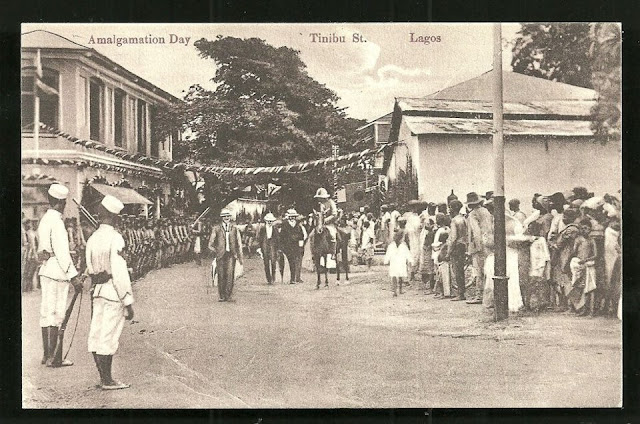
Amalgamation Day in Lagos, 1914
Showing posts with label African Society. Show all posts
Showing posts with label African Society. Show all posts
20 December, 2013


30 September, 2013
How we write about ourselves.
I promise you I decided to write this post before the recent tragic events at the College of Agriculture, Gujba in Yobe State.
Two things I have said often on this blog.
(a) The Fourth Republic is probably the single most corrupt period of our history so far; and
(b) The Fourth Republic is the second-most violent period in our recent history, behind only the Civil War. The First Republic would be third on the list of violent periods, despite the fact that many seem to look at it as though it were some sort of golden age of peace and prosperity.
There is enough violence going on that I would probably have had to apologize regardless of when I eventually wrote the post. But for the record, I was going to write this before what happened in Yobe.
But firstly, may the souls of the victims Rest in Peace. I don't know what else to say. There is nothing I can do to help.
I wanted to write a post about the way our media covers murder and mass murder, specifically the tendency to show graphic pictures of the victims.
Elsewhere in the world, they spare the families of the
deceased the shocking sight of their loved ones in the aftermath of something
like this .... whereas in Nigeria, the victims' bodies are
displayed without blurring, censoring or respectfully-placed pixels.
By the way, those media outlets from elsewhere in the world do not extend that level of respect to us when covering incidents of mass violence on our continent. For example, some years ago, on a weekend morning (i.e. when children were likely to be home), one of the USA's basic cable networks ran a documentary on Liberia and Sierra Leone, and showed everything, including one man's head which had been detached from his body and placed on a table. Had he been an American victim of a crime in the USA, either (a) they wouldn't have shown the head; or (b) they would have blurred his eyes so we the viewers (and particularly his family) would not .... see him. In fact, I think their channels are afraid of being sued by the families of American victims, but fear no consequence from us.
Still, how can we demand respect from other people when we do not respect ourselves? Reminds me of a speech I gave on Nigeria, where I instructed the audience to stop referring to Africa's (ethnic) nations as "tribes". After talking about this, that and the other, I took my seat and prepared to listen to the Kenyan who was due to speak next about Kenya. To my dismay, he spent the entire time referring to every single ethnic group in Kenya, one after the other, as a "tribe". It was a small enough group that I could see the people in the audience looking at each other in confusion.
By the way, I am not squeamish and this post is not about squeamishness. There is a time and place to look at and see the ugly realities of human history, of the human present and (unfortunately) of the human future. In the time and the place, I do not turn away.
That isn't what our media is doing, though. In fact, as you know, I am generally critical of how our media cover mass murders and single-victim murders. Their coverage of "communal violence" does very little to give us factual information about what actually happened, why it happened, and who actually did it. Their coverage of "communal violence" on the contrary tends to serve a fuel-on-the-fire role of sustaining the exact sort of cloud of misinformation that makes "communal violence" both likely and recurrent.
There are analysts and commentators who talk about something called "disaster porn". I wish they had chosen a different name for it (and shudder to think that some people will stumble onto this page after doing a web-search for something else). You can do a web-search yourself to find essays on "disaster porn" ... and when you've done that, consider that I think what the Nigerian media does is 100% "disaster porn" and 0% information.
More importantly they show 0% sensitivity in not even considering the fact that someone's mother, or father or spouse or child might opt to find out what happened in the world today, and find themselves looking unexpectedly at the graphic image of their murdered relative. You tend to hear police in certain countries talk about not revealing the names of the victims to the media until after their families have been informed -- in Nigeria, particularly now in the era of the internet, the pictures of the dead are posted even before the police know how many dead people there are, much less the names of family members to notify.
Do we even notify the families? A friend of mine, my next-door neighbour growing up, was murdered on the campus of one of our universities back when "cult violence" was rampant. His body was unceremoniously dumped with a pile of other bodies collected that night, and his parents had no idea what had happened because no one (not the police, not the university, no one at all) told them anything. After they hadn't heard from him in a long while, they travelled to the university, presuming to ask him what was going on .... only to be directed to the morgue, where they found him in a pile of other bodies.
That particular incident didn't make the news, because it was didn't met the threshold to count as good "disaster porn". There is a lot of stuff, violent stuff that happens in our Federal Republic that no one ever hears about, because there isn't an "angle" to it, no existing strings the news can be used to pull.
But that isn't really what this post is about.
There is a time and place for graphic images of violence and disaster. And there is a time and place when images can be presented, but should be "censored" to show sensitivity to the families of the victims.
There is also a philosophical principle involved in sensitizing people to something by showing them what it is without editing. But there is also a dangerous result where people see something so often they become inured to it (indeed, seeing incredibly graphic images of mass murder does not seem to lead to protests or outrage about the media showing us such images; on the contrary, we don't seem to react to it at all).
I wish someone would speak to the Nigerian media, and explain to them the difference. Unlike our politicians, I think the media is capable of learning.
May the souls of the victims Rest in Peace.
16 September, 2013
Ngugi: English is Not an African language
My comments:
(a) I am not sure why the interviewer kept claiming an author's books would not reach wider audiences if he or she wrote them in an African language. Books written originally in the English language are translated into other languages so non-English speakers can access them. A book written originally in Kikuyu or Ashanti could just as easily be translated for wider audiences. It is not that big of a deal.
(b) What really gets on my nerves is how African governments align themselves in "Francophone" and "Anglophone" blocs in continental and global diplomatic disputes and discourse. I cannot tell you in words typed on a blog how much that aggravates me. A man named Kouame Ousmane Cisse and another man named Kwame Usman Sesay will determinedly back "Francophone" and "Anglophone" candidates respectively, for no sensible reason other than a European language. Laughably, neither of the candidates, if appointed, would do anything that substantively improves the lot of the people of the sociocultural group to which both Kouame and Kwame belong.
The worst part of the "Anglophone"/"Francophone" discourse is the fact that these governments have yet to collectively articulate an African discourse on vital issues. Not an African position on the issues (which does not exist, in spite of talk to the contrary), but an African discourse. There are a billion people on the African continent; we are not all supposed to share the same position on issues, however we can come to better conclusions about those issues if we actually substantively discuss them as Africans.
Much of what is put out there as being in Africa's "interest", are stuff that are not in our interests at all. Much of what is put out there as being in Africa's "interest" are ideas and policy-decisions that were not generated by we Africans to begin with. And much of what our "intellectuals" come up with is very ideological (e.g. "Africa Must Unite") .... and the problem here is not just that there are very few practicalities in it, but that no one ever questions whether the ideology, if made practical, would advance or actually hinder the continent's progress.
But I am beginning to digress. If you haven't watched it already, here is the video:
(a) I am not sure why the interviewer kept claiming an author's books would not reach wider audiences if he or she wrote them in an African language. Books written originally in the English language are translated into other languages so non-English speakers can access them. A book written originally in Kikuyu or Ashanti could just as easily be translated for wider audiences. It is not that big of a deal.
(b) What really gets on my nerves is how African governments align themselves in "Francophone" and "Anglophone" blocs in continental and global diplomatic disputes and discourse. I cannot tell you in words typed on a blog how much that aggravates me. A man named Kouame Ousmane Cisse and another man named Kwame Usman Sesay will determinedly back "Francophone" and "Anglophone" candidates respectively, for no sensible reason other than a European language. Laughably, neither of the candidates, if appointed, would do anything that substantively improves the lot of the people of the sociocultural group to which both Kouame and Kwame belong.
The worst part of the "Anglophone"/"Francophone" discourse is the fact that these governments have yet to collectively articulate an African discourse on vital issues. Not an African position on the issues (which does not exist, in spite of talk to the contrary), but an African discourse. There are a billion people on the African continent; we are not all supposed to share the same position on issues, however we can come to better conclusions about those issues if we actually substantively discuss them as Africans.
Much of what is put out there as being in Africa's "interest", are stuff that are not in our interests at all. Much of what is put out there as being in Africa's "interest" are ideas and policy-decisions that were not generated by we Africans to begin with. And much of what our "intellectuals" come up with is very ideological (e.g. "Africa Must Unite") .... and the problem here is not just that there are very few practicalities in it, but that no one ever questions whether the ideology, if made practical, would advance or actually hinder the continent's progress.
But I am beginning to digress. If you haven't watched it already, here is the video:
09 September, 2013
(+1) + (-1) = 0
Strange title for a post, right?
Someone directed me to this New York Times article on Rwandan leader Paul Kagame. Kagame isn't just favoured by the Western European and North American governments, he gets a lot of glowingly positive press from quite a few Africans. Every week, The East African publishes a regular column by Frederick Golooba-Mutebi, who functions as an uncritical, downright fawning town crier for President Kagame.
I will never pretend to know or understand Rwanda as well as a Rwandan would. I am an outsider, and will always be so.
But in the equation I used at the title of this post, and equal about of negative and positive nets to zero. If you increase the magnitude of the negative, it would move from 0 to a negative value.
I am sure I have mentioned before that I am the most politically neutral person you will ever meet. I do not support any political party or politician or political ideology. And yes, that is neutrality, as much as you will see in this world where everyone seems to have someone or something that they support, sometimes without enthusiasm and other times quite passionately.
Someone directed me to this New York Times article on Rwandan leader Paul Kagame. Kagame isn't just favoured by the Western European and North American governments, he gets a lot of glowingly positive press from quite a few Africans. Every week, The East African publishes a regular column by Frederick Golooba-Mutebi, who functions as an uncritical, downright fawning town crier for President Kagame.
I will never pretend to know or understand Rwanda as well as a Rwandan would. I am an outsider, and will always be so.
But in the equation I used at the title of this post, and equal about of negative and positive nets to zero. If you increase the magnitude of the negative, it would move from 0 to a negative value.
I am sure I have mentioned before that I am the most politically neutral person you will ever meet. I do not support any political party or politician or political ideology. And yes, that is neutrality, as much as you will see in this world where everyone seems to have someone or something that they support, sometimes without enthusiasm and other times quite passionately.
For more than 10 years, there was vicious, vicious, unbelievably vicious violence in Liberia and Sierra Leone. A proper discussion of why this came to be is too vast for a blog. Suffice to say there were many internal/domestic actors, many regional African actors, and many global/international actors who bear some degree of responsibility. It might be politically incorrect of me to say, but as citizens, we also share responsibility for watching passively as our countries collapse all around us. Collapse is never instantaneous; it always happens over a period of time long enough for us to do something to stop it.
On the list of people who are most responsible, you will find three African presidents, two of whom are dead, and one of whom is still alive. One of the dead presidents remains popular with many Africans because he is perceived to have made his country an "economic miracle" (inasmuch as it collapsed in anarchy after his death, because his was a one-man dictatorship with no institutions of substance beyond himself). The second dead president is popular with certain sections of the "Pan-Africanist" movement, because of his rhetoric in favour of a United States of Africa (inasmuch as his spent his decades in the presidency fomenting wars all over the continent). The third, still-living, still-in-power president is praised in the Western European and North American media for being a key sub-regional interlocutor, mediator and ally in terms of their security interests in the region.
What nobody ever talks about is how much responsibility the three bear for the horrors visited on Liberia and Sierra Leone. Whatever good thing they may happen to have done in there own countries, or on behalf of Western European and North American security interests (leaving aside the question of whether their interests and ours are compatible), cannot make up for what happened in Liberia and Sierra Leone.
The Rwandan Genocide happened. There is a vital security interest for Rwanda in the Democratic Republic of the Congo. But sometimes .... no .... very often .... no ... always in the arena of "strategic national interests", governments use a real "interest" as an excuse to do other things that have nothing to do with that "interest". And with all due respect to the fans of President Kagame, his actions in and policies toward the DR-Congo are a massive negative that outweighs whatever good he may be doing within Rwanda.
There is dispute as to how many people have died directly and indirectly because of the Congolese catastrophe. Some say the numbers in terms of "excess death" are already higher than the numbers for the Rwandan Genocide. Others say the "excess death" toll is lower than the Rwandan Genocide. But so long as the "excess death" numbers continue climbing year-after-year, this dispute may be moot.
If you've been reading this blog, you would know that I favour analytical explanations for violence in Nigeria over simply claiming one ethnic groups hates another one. As such, I want to be careful in the next thing I say, which is that the 1994 Genocide was not the first incident of Hutu-on-Tutsi, or for that matter Tutsi-on-Hutu communal violence. I would have to be a Rwandan or Burundian, with their level of knowledge of their country, to come up with an explanation for why this violence occurs, but it has happened often enough for me to say that there is no particular reason for assuming that it will not happen again.
I am not a prophet of doom ... but, as you might have noticed from reading this blog, I really dislike the way so-called "experts" analyze the continent. And I think it is rather dangerous that we Africans accept their analysis as truth.
Kagame's government is not the first government to be in power in the aftermath of one of these violent incidents. And this is not the first time that it has appeared, on the surface, that it was over and would never happen again.
The DR-Congo is a rather large place, and insofar as Rwandan policy does nothing to help the place, and plenty to harm it, Kagame is not exactly making Rwanda safer in the long-term. Maybe not even in the medium-term. Whatever the real security interests of Rwanda are, the policies of
the Kigali government are not making the region more secure or less
insecure.
To be honest, I am not entirely certain that Kagame's domestic policies are making the country safer. To what extent are things quiet because the underlying issues have been resolved, and to what extent do things simply appear to be quiet because he has established an unchallenged institutional capacity to coerce the appearance of resolution from his people?
The late President Felix Houphouet-Boigny received an even greater magnitude of positive, appreciative media support from Western Europe and North America. Within Africa, he was seen as the man responsible for what was perceived to be a miracle economy in Cote d'Ivoire. Then he died, and the people were exposed to the realities of a country where there were no real institutions beyond Houphouet-Boigny. They had no electoral system really, no judicial system, no political parties, no security system (with all due respect, their Army and Police were too small, and way too ineffectual). There was nothing. Just Houphouet-Boigny.
There are two lessons. The first is that no matter how pretty a country might look when in the grip of a one-man government, there are inherent, structural dangers to such a system, dangers that would exist even without the complication of genocide or of anarchy in a neighbouring DRC. The second lesson is the fact that praise or even criticism from the Western European and North American media does not really tell you whether or not the person they are praising is doing the right thing, or whether the person they are criticizing is doing the wrong thing. We have to step out of their centuries-long shadow, and start to ask ourselves what a proper government of an African country is supposed to look like and function like.
I know people will say that I should not be unrealistic, and that under the circumstances, this is better than the alternative .... but this is the same nonsense excuse that has been used repeatedly over the decades, and the one thing we should have learned by now is these supposedly "realistic" solutions to dilemmas end up perpetuating the very thing that the so-called "realists" think they are countering.
I just find it very hard to overlook what is happening in the DR-Congo when I read an article about how Paul Kagame is transforming Rwanda. Why does it not occur to people that events in the DR-Congo can, in the medium- to longer-term, wreck whatever Kagame builds in Rwanda in the short-term?
11 August, 2013
What We Say About Ourselves - 1
My apologies for not updating this blog in a while.
My three most recent posts have been on "propaganda" in the foreign/international media (here, here and here). It is usually not as overt as these examples, and the massaging, spinning, pointed editing and unabashed distortion of the "news" is not always done to quite that degree.
But you already knew that. Most people know "news" dissemination outlets -- be they government information ministers, mainstream media, "alternative" media, "satirists", bloggers, etc. -- try to push their viewers/listeners/readers towards adopting whatever happens to be that particular outlets' political or ideological agenda.
You also know that most people who criticize media bias, are not really criticizing media bias as an abstract concept, but are rather lambasting that part of the media (mainstream or alternative) that is not biased in favour of their agenda; such people amusingly tout equally biased outlets that happen to be biased in favour of their agendas as being more truthful.
If you are like me, and you just want to know what exactly is going on, you are out of luck.
But all those posts about media in the rest of the world are a digression from the purpose of this blog.
Frankly, we Nigerians/Africans spend too much time and energy on what is done by other peoples in their own countries. Many of us are loquacious "experts" when it comes to the minutiae of politics in the USA, Britain, France, Israel-Palestine and the Arabian Peninsula (much of this "expertise" based on dubious reports from the international media).
In the meantime:
(a) We know comparatively little about politics in the African countries that are our continental next-door neighbours.
(b) We don't know anywhere near as much as we should about other regions within our own countries.
(c) We are so powerless in the politics of our own hometowns that we cannot make the authorities do so much as clear the piles of garbage that build up on our streets.
It doesn't matter though. We know everything about USA, Britain, France and Western Asia.
While I am here, criticizing "propaganda" in the foreign media, the truth is the Nigerian and African media get their "news" of the world by culling stories from the foreign media. We get our news about the rest of Africa ... by culling stories from the foreign media.
Dangerously, our constitution-writers, media commentators, academics, intellectuals, politicians, technocrats, policy-makers, diplomats, generals and other decision-makers also tend to cull their thoughts and "analysis" of our problems, prospects and path to development from foreign sources as well. The African continent is known for self-defeating policy-making, in part because so many key decision-makers have absorbed other people's views of the African continent, and have come to the conclusion that "African strategic interests" are a set of actions and decisions that are actually in other people's strategic interests at the expense of ours.
Ultimately, we the Africans are producers of some of the world's most insidiously anti-African propaganda.
More on this in subsequent posts.
My three most recent posts have been on "propaganda" in the foreign/international media (here, here and here). It is usually not as overt as these examples, and the massaging, spinning, pointed editing and unabashed distortion of the "news" is not always done to quite that degree.
But you already knew that. Most people know "news" dissemination outlets -- be they government information ministers, mainstream media, "alternative" media, "satirists", bloggers, etc. -- try to push their viewers/listeners/readers towards adopting whatever happens to be that particular outlets' political or ideological agenda.
You also know that most people who criticize media bias, are not really criticizing media bias as an abstract concept, but are rather lambasting that part of the media (mainstream or alternative) that is not biased in favour of their agenda; such people amusingly tout equally biased outlets that happen to be biased in favour of their agendas as being more truthful.
If you are like me, and you just want to know what exactly is going on, you are out of luck.
But all those posts about media in the rest of the world are a digression from the purpose of this blog.
Frankly, we Nigerians/Africans spend too much time and energy on what is done by other peoples in their own countries. Many of us are loquacious "experts" when it comes to the minutiae of politics in the USA, Britain, France, Israel-Palestine and the Arabian Peninsula (much of this "expertise" based on dubious reports from the international media).
In the meantime:
(a) We know comparatively little about politics in the African countries that are our continental next-door neighbours.
(b) We don't know anywhere near as much as we should about other regions within our own countries.
(c) We are so powerless in the politics of our own hometowns that we cannot make the authorities do so much as clear the piles of garbage that build up on our streets.
It doesn't matter though. We know everything about USA, Britain, France and Western Asia.
While I am here, criticizing "propaganda" in the foreign media, the truth is the Nigerian and African media get their "news" of the world by culling stories from the foreign media. We get our news about the rest of Africa ... by culling stories from the foreign media.
Dangerously, our constitution-writers, media commentators, academics, intellectuals, politicians, technocrats, policy-makers, diplomats, generals and other decision-makers also tend to cull their thoughts and "analysis" of our problems, prospects and path to development from foreign sources as well. The African continent is known for self-defeating policy-making, in part because so many key decision-makers have absorbed other people's views of the African continent, and have come to the conclusion that "African strategic interests" are a set of actions and decisions that are actually in other people's strategic interests at the expense of ours.
Ultimately, we the Africans are producers of some of the world's most insidiously anti-African propaganda.
More on this in subsequent posts.
22 January, 2013
The Insidiousness of Propaganda (2)
This post continues from the one immediately prior.
I have known for decades that there is no such thing as "objective" and "unbiased" when it comes to the media. Indeed, I strive to get "news" from rival sources with contradictory biases, knowing that each side will highlight the part of the news that ties into their bias and ignore the part of the news that doesn't. Even so, I caught myself one day having a viscerally negative reaction to a politician from a foreign country (i.e. not Nigeria) after months of reading relentlessly negative portrayals of that politician from variously biased news sources from the man's home continent.
What made these sources (from the "right" and the "left") dislike the man was his contrary opinion on one specific issue on which journalists from the "right" and "left" of this particular region agreed on. The thing is, the man had every right to have that opinion, and regardless of whether I agreed with him or not, the journalists' shared position was simply an ideological opinion and not an absolute truth.
To be honest, I didn't and don't have an opinion on the man, because I do not understand the man's language and hence have never heard (or read) him expressing his opinion in his own words, from his own mouth (or pen). Everything I have ever heard or learned about him came from the mouths and pens of people who dislike him because he doesn't share their opinion. They tend to caricature him as being stupid, looking stupid and talking stupid. I always made it a point to disregard the caricaturing, but one day, in one moment, after years of reading about him in the English-language media, I looked at a picture of him and the first thing that came to mind was he looked stupid.
I instantaneously caught myself, realized that for all my efforts to block out the propaganda, I had in fact been affected by it.
This video, pulled from Youtube, discusses how journalists, politicians and the media can subtly or openly influence and manipulate citizen perceptions of other peoples.
I have known for decades that there is no such thing as "objective" and "unbiased" when it comes to the media. Indeed, I strive to get "news" from rival sources with contradictory biases, knowing that each side will highlight the part of the news that ties into their bias and ignore the part of the news that doesn't. Even so, I caught myself one day having a viscerally negative reaction to a politician from a foreign country (i.e. not Nigeria) after months of reading relentlessly negative portrayals of that politician from variously biased news sources from the man's home continent.
What made these sources (from the "right" and the "left") dislike the man was his contrary opinion on one specific issue on which journalists from the "right" and "left" of this particular region agreed on. The thing is, the man had every right to have that opinion, and regardless of whether I agreed with him or not, the journalists' shared position was simply an ideological opinion and not an absolute truth.
To be honest, I didn't and don't have an opinion on the man, because I do not understand the man's language and hence have never heard (or read) him expressing his opinion in his own words, from his own mouth (or pen). Everything I have ever heard or learned about him came from the mouths and pens of people who dislike him because he doesn't share their opinion. They tend to caricature him as being stupid, looking stupid and talking stupid. I always made it a point to disregard the caricaturing, but one day, in one moment, after years of reading about him in the English-language media, I looked at a picture of him and the first thing that came to mind was he looked stupid.
I instantaneously caught myself, realized that for all my efforts to block out the propaganda, I had in fact been affected by it.
This video, pulled from Youtube, discusses how journalists, politicians and the media can subtly or openly influence and manipulate citizen perceptions of other peoples.
The Insidiousness of Propaganda (1)
I prefer not to copy and paste entire articles from newspapers' websites. Many people earn their living through journalism. Heaven knows jobs are scarce everywhere in the world, and that formal sector jobs are especially scarce in the Federal Republic of Nigeria. We have neither Welfare nor the Dole, so one shouldn't make it more difficult for people to support themselves, their families and their retirement through honest work.
Having said that, there is a point I want to make, and in order to make that point, I have to be sure you read the entirety of the article I am about to post here. I don't read the newspaper from which it was sourced, but my attention was drawn to it by a writer on another website.
Having said that, there is a point I want to make, and in order to make that point, I have to be sure you read the entirety of the article I am about to post here. I don't read the newspaper from which it was sourced, but my attention was drawn to it by a writer on another website.
This is how racism takes root
The different ways the media covered two cases of men grooming children for sex show how shockingly easy it is to demonise a whole community
Joseph Harker
The Guardian, Sunday 22 July 2012 20.30 BST
By now surely everyone knows the case of the eight men convicted of picking vulnerable underage girls off the streets, then plying them with drink and drugs before having sex with them. A shocking story. But maybe you haven't heard. Because these sex assaults did not take place in Rochdale, where a similar story led the news for days in May, but in Derby earlier this month. Fifteen girls aged 13 to 15, many of them in care, were preyed on by the men. And though they were not working as a gang, their methods were similar – often targeting children in care and luring them with, among other things, cuddly toys. But this time, of the eight predators, seven were white, not Asian. And the story made barely a ripple in the national media.
Of the daily papers, only the Guardian and the Times reported it. There was no commentary anywhere on how these crimes shine a light on British culture, or how middle-aged white men have to confront the deep flaws in their religious and ethnic identity. Yet that's exactly what played out following the conviction in May of the "Asian sex gang" in Rochdale, which made the front page of every national newspaper. Though analysis of the case focused on how big a factor was race, religion and culture, the unreported story is of how politicians and the media have created a new racial scapegoat. In fact, if anyone wants to study how racism begins, and creeps into the consciousness of an entire nation, they need look no further.
Imagine you were living in a town of 20,000 people – the size of, say, Penzance in Cornwall – and one day it was discovered that one of its residents had been involved in a sex crime. Would it be reasonable to say that the whole town had a cultural problem, that it needed to address the scourge – that anyone not doing so was part of a "conspiracy of silence"? But the intense interest in the Rochdale story arose from a January 2011 Times "scoop" that was based on the conviction of at most 50 British Pakistanis out of a total UK population of 1.2 million, just one in 24,000: one person per Penzance.
Make no mistake, the Rochdale crimes were vile, and those convicted deserve every year of their sentences. But where, amid all the commentary, was the evidence that this is a racial issue; that there's something inherently perverted about Muslim or Asian culture?
Even the Child Protection and Online Protection Centre (Ceop), which has also studied potential offenders who have not been convicted, has only identified 41 Asian gangs (of 230 in total) and 240 Asian individuals – and they are spread across the country. But, despite this, a new stereotype has taken hold: that a significant proportion of Asian men are groomers (and the rest of their communities know of it and keep silent).
But if it really is an "Asian" thing, how come Indians don't do it? If it's a "Pakistani" thing, how come an Afghan was convicted in the Rochdale case? And if it's a "Muslim" thing, how come it doesn't seem to involve anyone of African or Middle Eastern origin? The standard response to anyone who questions this is: face the facts, all those convicted in Rochdale were Muslim. Well, if one case is enough to make such a generalisation, how about if all the members of a gang of armed robbers were white; or cybercriminals; or child traffickers? (All three of these have happened.) Would we be so keen to "face the facts" and make it a problem the whole white community has to deal with? Would we have articles examining what it is about Britishness or Christianity or Europeanness, that makes people so capable of such things?
In fact, Penzance had not just one paedophile, but a gang of four. They abused 28 girls, some as young as five, and were finally convicted two years ago. All were white. And last month, at a home affairs select committee, deputy children's commissioner Sue Berelowitz quoted a police officer who had told her that "there isn't a town, village or hamlet in which children are not being sexually exploited".
Whatever the case, we know that abuse of white girls is not a cultural or religious issue because there is no longstanding history of it taking place in Asia or the Muslim world.
How did middle-aged Asian men from tight-knit communities even come into contact with white teenage girls in Rochdale? The main cultural relevance in this story is that vulnerable, often disturbed, young girls, regularly out late at night, often end up in late-closing restaurants and minicab offices, staffed almost exclusively by men. After a while, relationships build up, with the men offering free lifts and/or food. For those with a predatory instinct, sexual exploitation is an easy next step. This is an issue of what men can do when away from their own families and in a position of power over badly damaged young people.
It's a story repeated across Britain, by white and other ethnic groups: where the opportunity arises, some men will take advantage. The precise method, and whether it's an individual or group crime, depends on the particular setting – be they priests, youth workers or networks on the web.
Despite all we know about racism, genocide and ethnic cleansing, the Rochdale case showed how shockingly easy it is to demonise a community. Before long, the wider public will believe the problem is endemic within that race/religion, and that anyone within that group who rebuts the claims is denying this basic truth. Normally, one would expect a counter-argument to force its way into the discussion. But in this case the crimes were so horrific that right-thinking people were naturally wary of being seen to condone them. In fact, the reason I am writing this is that I am neither Asian nor Muslim nor Pakistani, so I cannot be accused of being in denial or trying to hide a painful truth. But I am black, and I know how racism works; and, more than that, I have a background in maths and science, so I know you can't extrapolate a tiny, flawed set of data and use it to make a sweeping generalisation.
I am also certain that, if the tables were turned and the victims were Asian or Muslim, we would have been subjected to equally skewed "expert" commentary asking: what is wrong with how Muslims raise girls? Why are so many of them on the streets at night? Shouldn't the community face up to its shocking moral breakdown?
While our media continue to exclude minority voices in general, such lazy racial generalisations are likely to continue. Even the story of a single Asian man acting alone in a sex case made the headlines. As in Derby this month, countless similar cases involving white men go unreported.
We have been here before, of course: in the 1950s, West Indian men were labelled pimps, luring innocent young white girls into prostitution. By the 1970s and 80s they were vilified as muggers and looters. And two years ago, Channel 4 ran stories, again based on a tiny set of data, claiming there was an endemic culture of gang rape in black communities. The victims weren't white, though, so media interest soon faded. It seems that these stories need to strike terror in the heart of white people for them to really take off.
What is also at play here is the inability of people, when learning about a different culture or race, to distinguish between the aberrations of a tiny minority within that group, and the normal behaviour of a significant section. Some examples are small in number but can be the tip of a much wider problem: eg, knife crime, which is literally the sharp end of a host of problems affecting black communities ranging from family breakdown, to poverty, to low school achievement and social exclusion.
But in Asia, Pakistan or Islam there is no culture of grooming or sex abuse – any more than there is anywhere else in the world – so the tiny number of cases have no cultural significance. Which means those who believe it, or perpetuate it, are succumbing to racism, much as they may protest. Exactly the same mistake was made after 9/11, when the actions of a tiny number of fanatics were used to cast aspersions against a 1.5 billion-strong community worldwide. Motives were questioned: are you with us or the terrorists? How fundamental are your beliefs? Can we trust you?
Imagine if, after Anders Breivik's carnage in Norway last year, which he claimed to be in defence of the Christian world, British people were repeatedly asked whether they supported him? Lumped together in the same white religious group as the killer and constantly told they must renounce him, or explain why we should believe that their type of Christianity – even if they were non-believers – is different from his. "It's nothing to do with me", most people would say. But somehow that answer was never good enough when given by Muslims over al-Qaida. And this hectoring was self-defeating because it caused only greater alienaton and resentment towards the west and, in particular, its foreign policies.
Ultimately, the urge to vilify groups of whom we know little may be very human, and helps us bond with those we feel are "like us". But if we are going to deal with the world as it is, and not as a cosy fantasyland where our group is racially and culturally supreme, we have to recognise when sweeping statements are false.
And if we truly care about the sexual exploitation of girls, we need to know that we must look at all communities, across the whole country, and not just at those that play to a smug sense of superiority about ourselves.
01 November, 2012
About treaties banning coups
The Economic Community of West African States (ECOWAS) is apparently working on another of those treaties that ban coups-de-tat.
The standard position of the African Union is to condemn coups as "unconstitutional changes of government".
The half-dozen-to-a-dozen countries that call themselves "the international community" also tend to condemn coups, at least officially anyway. Sometimes, in years past, the "international community" has instigated coups, and other times the new occupant of the office is a ready to work with them as they are with him, so after a while all is forgotten. In recent years, the United States (George W. Bush administration) supported a coup in Venezuela against Hugo Chavez before withdrawing the support once the coup failed, and took an acquiescent position (Barrack Obama administration) to the successful coup in Honduras against the Chavez-allied Manuel Zelaya.
I don't support coups-de-tat in Africa for the same reason that I don't support opposition political parties. They tend to be led by people who are exactly the same as the people they are overthrowing or opposing.
However I find myself laughing at ECOWAS and the African Union when they condemn coups as "unconstitutional changes of government". The majority of the membership of these bodies are now and have always been leaders who are "unconstitutionally" in power in the first place.
I am not talking about elections. Most countries in Africa hold elections, though in a lot of countries these elections are more or less civilian coups-de-tat. I mean, that is what a rigged election is, isn't it?
Elsewhere the rules are rigged in such a way as to guarantee only one possible victor at the polls. To be fair, almost every "democratic" country in the world has rules that lock power into the hands of particular political parties, even if the parties in question do not hold positions reflective of what the majority of the countries' people want. But whereas there is some leeway for power to switch back and forth between these parties in other countries, the level of distortion in most African countries reaches the level of contradicting the constitution's pretence of guaranteeing democratic governance. In other words, the country is a one-party dictatorship (and in some cases consequently a one-man dictatorship) masquerading as a democracy.
Look, this really isn't a topic that requires lots of rhetoric and grammar.
All things considered, the ECOWAS and AU position on coups is less about safeguarding the rights of we citizens to choose our governments, and more about self-preservation. Our continent is full of presidents who never want to lose power, and in some cases political parties that never want to lose power. Our sub-regional and continental organizations are basically a self-help society of men and political parties keen to help each other stay in office forever, and as such they take a dim view of anyone who would dare remove one of them.
Okay, I will stop being sarcastic and be serious for a moment.
There is a saying (which I will paraphrase) that anyone who makes peaceful change impossible is by definition making violence change unavoidable. Here is my problem. The various governments in Africa make it impossible to democratically remove any of the governments in Africa, so while I do not support coups (for the reasons I stated above), the only alternative our leaders offer us is for them (or their parties) be in office forever, with dire consequences for our countries and our continent.
This is why Nigerians and Africans are apathetic towards coups. As much as commentators might condemn coups, citizens generally shrug their shoulders and carry on, because the government that just fell was irrelevant to them at best, harmful to them at worst. That is not to say that they support the coups, because they expect the new government to be irrelevant to them at best, and harmful to them at worst.
So while the political leaders in ECOWAS and the AU react with outrage to coups, most Africans react with apathy .... and with amusement to the sight of hypocrites accusing other people of thwarting the constitution. Because lets be honest, inasmuch as there hasn't been a coup in Nigeria since 1999, there hasn't been much "constitutionalism" either. And we are actually one of the better cases on the continent.
I believe that the people of Africa would stand up and fight if there was something worth fighting for or defending. I believe the reason our people don't fight is there is no sense in risking their lives or dying on behalf of politicians, political parties and political systems that either frustrate their life hopes or actively harm them on a day-to-day basis.
The only way to ensure a stable political environment in Nigeria or Africa, is to create a political environment worth fighting to preserve. And this is the thing our political leaders do not understand, or do not want to understand.
So they can write as many treaties as they want banning coups, it won't save them from coups, or in the case of Egypt and Tunisia, from a sudden explosion of long-pent-up rage at the political system.
Indeed, one gets the distinct impression that even the army officers and soldiers do not feel these governments and political systems are worth dying for. There is a tendency among them to make peace with the new, rather than defend the old.
The standard position of the African Union is to condemn coups as "unconstitutional changes of government".
The half-dozen-to-a-dozen countries that call themselves "the international community" also tend to condemn coups, at least officially anyway. Sometimes, in years past, the "international community" has instigated coups, and other times the new occupant of the office is a ready to work with them as they are with him, so after a while all is forgotten. In recent years, the United States (George W. Bush administration) supported a coup in Venezuela against Hugo Chavez before withdrawing the support once the coup failed, and took an acquiescent position (Barrack Obama administration) to the successful coup in Honduras against the Chavez-allied Manuel Zelaya.
I don't support coups-de-tat in Africa for the same reason that I don't support opposition political parties. They tend to be led by people who are exactly the same as the people they are overthrowing or opposing.
However I find myself laughing at ECOWAS and the African Union when they condemn coups as "unconstitutional changes of government". The majority of the membership of these bodies are now and have always been leaders who are "unconstitutionally" in power in the first place.
I am not talking about elections. Most countries in Africa hold elections, though in a lot of countries these elections are more or less civilian coups-de-tat. I mean, that is what a rigged election is, isn't it?
Elsewhere the rules are rigged in such a way as to guarantee only one possible victor at the polls. To be fair, almost every "democratic" country in the world has rules that lock power into the hands of particular political parties, even if the parties in question do not hold positions reflective of what the majority of the countries' people want. But whereas there is some leeway for power to switch back and forth between these parties in other countries, the level of distortion in most African countries reaches the level of contradicting the constitution's pretence of guaranteeing democratic governance. In other words, the country is a one-party dictatorship (and in some cases consequently a one-man dictatorship) masquerading as a democracy.
Look, this really isn't a topic that requires lots of rhetoric and grammar.
All things considered, the ECOWAS and AU position on coups is less about safeguarding the rights of we citizens to choose our governments, and more about self-preservation. Our continent is full of presidents who never want to lose power, and in some cases political parties that never want to lose power. Our sub-regional and continental organizations are basically a self-help society of men and political parties keen to help each other stay in office forever, and as such they take a dim view of anyone who would dare remove one of them.
Okay, I will stop being sarcastic and be serious for a moment.
There is a saying (which I will paraphrase) that anyone who makes peaceful change impossible is by definition making violence change unavoidable. Here is my problem. The various governments in Africa make it impossible to democratically remove any of the governments in Africa, so while I do not support coups (for the reasons I stated above), the only alternative our leaders offer us is for them (or their parties) be in office forever, with dire consequences for our countries and our continent.
This is why Nigerians and Africans are apathetic towards coups. As much as commentators might condemn coups, citizens generally shrug their shoulders and carry on, because the government that just fell was irrelevant to them at best, harmful to them at worst. That is not to say that they support the coups, because they expect the new government to be irrelevant to them at best, and harmful to them at worst.
So while the political leaders in ECOWAS and the AU react with outrage to coups, most Africans react with apathy .... and with amusement to the sight of hypocrites accusing other people of thwarting the constitution. Because lets be honest, inasmuch as there hasn't been a coup in Nigeria since 1999, there hasn't been much "constitutionalism" either. And we are actually one of the better cases on the continent.
I believe that the people of Africa would stand up and fight if there was something worth fighting for or defending. I believe the reason our people don't fight is there is no sense in risking their lives or dying on behalf of politicians, political parties and political systems that either frustrate their life hopes or actively harm them on a day-to-day basis.
The only way to ensure a stable political environment in Nigeria or Africa, is to create a political environment worth fighting to preserve. And this is the thing our political leaders do not understand, or do not want to understand.
So they can write as many treaties as they want banning coups, it won't save them from coups, or in the case of Egypt and Tunisia, from a sudden explosion of long-pent-up rage at the political system.
Indeed, one gets the distinct impression that even the army officers and soldiers do not feel these governments and political systems are worth dying for. There is a tendency among them to make peace with the new, rather than defend the old.
Subscribe to:
Posts (Atom)