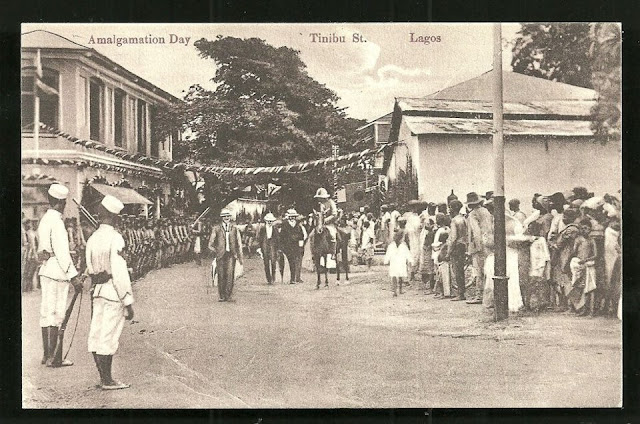
Amalgamation Day in Lagos, 1914

Amalgamation Day in Lagos, 1914
Showing posts with label Miscellaneous. Show all posts

22 January, 2013

The Insidiousness of Propaganda (2)

This post continues from the one immediately prior.

I have known for decades that there is no such thing as "objective" and "unbiased" when it comes to the media. Indeed, I strive to get "news" from rival sources with contradictory biases, knowing that each side will highlight the part of the news that ties into their bias and ignore the part of the news that doesn't. Even so, I caught myself one day having a viscerally negative reaction to a politician from a foreign country (i.e. not Nigeria) after months of reading relentlessly negative portrayals of that politician from variously biased news sources from the man's home continent.

What made these sources (from the "right" and the "left") dislike the man was his contrary opinion on one specific issue on which journalists from the "right" and "left" of this particular region agreed on.  The thing is, the man had every right to have that opinion, and regardless of whether I agreed with him or not, the journalists' shared position was simply an ideological opinion and not an absolute truth.

To be honest, I didn't and don't have an opinion on the man, because I do not understand the man's language and hence have never heard (or read) him expressing his opinion in his own words, from his own mouth (or pen). Everything I have ever heard or learned about him came from the mouths and pens of people who dislike him because he doesn't share their opinion. They tend to caricature him as being stupid, looking stupid and talking stupid. I always made it a point to disregard the caricaturing, but one day, in one moment, after years of reading about him in the English-language media, I looked at a picture of him and the first thing that came to mind was he looked stupid.

I instantaneously caught myself, realized that for all my efforts to block out the propaganda, I had in fact been affected by it.

This video, pulled from Youtube, discusses how journalists, politicians and the media can subtly or openly influence and manipulate citizen perceptions of other peoples.


The Insidiousness of Propaganda (1)

I prefer not to copy and paste entire articles from newspapers' websites. Many people earn their living through journalism. Heaven knows jobs are scarce everywhere in the world, and that formal sector jobs are especially scarce in the Federal Republic of Nigeria. We have neither Welfare nor the Dole, so one shouldn't make it more difficult for people to support themselves, their families and their retirement through honest work.


Having said that, there is a point I want to make, and in order to make that point, I have to be sure you read the entirety of the article I am about to post here. I don't read the newspaper from which it was sourced, but my attention was drawn to it by a writer on another website.


This is how racism takes root
The different ways the media covered two cases of men grooming children for sex show how shockingly easy it is to demonise a whole community


Joseph Harker
The Guardian, Sunday 22 July 2012 20.30 BST

By now surely everyone knows the case of the eight men convicted of picking vulnerable underage girls off the streets, then plying them with drink and drugs before having sex with them. A shocking story. But maybe you haven't heard. Because these sex assaults did not take place in Rochdale, where a similar story led the news for days in May, but in Derby earlier this month. Fifteen girls aged 13 to 15, many of them in care, were preyed on by the men. And though they were not working as a gang, their methods were similar – often targeting children in care and luring them with, among other things, cuddly toys. But this time, of the eight predators, seven were white, not Asian. And the story made barely a ripple in the national media.

Of the daily papers, only the Guardian and the Times reported it. There was no commentary anywhere on how these crimes shine a light on British culture, or how middle-aged white men have to confront the deep flaws in their religious and ethnic identity. Yet that's exactly what played out following the conviction in May of the "Asian sex gang" in Rochdale, which made the front page of every national newspaper. Though analysis of the case focused on how big a factor was race, religion and culture, the unreported story is of how politicians and the media have created a new racial scapegoat. In fact, if anyone wants to study how racism begins, and creeps into the consciousness of an entire nation, they need look no further.

Imagine you were living in a town of 20,000 people – the size of, say, Penzance in Cornwall – and one day it was discovered that one of its residents had been involved in a sex crime. Would it be reasonable to say that the whole town had a cultural problem, that it needed to address the scourge – that anyone not doing so was part of a "conspiracy of silence"? But the intense interest in the Rochdale story arose from a January 2011 Times "scoop" that was based on the conviction of at most 50 British Pakistanis out of a total UK population of 1.2 million, just one in 24,000: one person per Penzance.

Make no mistake, the Rochdale crimes were vile, and those convicted deserve every year of their sentences. But where, amid all the commentary, was the evidence that this is a racial issue; that there's something inherently perverted about Muslim or Asian culture?

Even the Child Protection and Online Protection Centre (Ceop), which has also studied potential offenders who have not been convicted, has only identified 41 Asian gangs (of 230 in total) and 240 Asian individuals – and they are spread across the country. But, despite this, a new stereotype has taken hold: that a significant proportion of Asian men are groomers (and the rest of their communities know of it and keep silent).

But if it really is an "Asian" thing, how come Indians don't do it? If it's a "Pakistani" thing, how come an Afghan was convicted in the Rochdale case? And if it's a "Muslim" thing, how come it doesn't seem to involve anyone of African or Middle Eastern origin? The standard response to anyone who questions this is: face the facts, all those convicted in Rochdale were Muslim. Well, if one case is enough to make such a generalisation, how about if all the members of a gang of armed robbers were white; or cybercriminals; or child traffickers? (All three of these have happened.) Would we be so keen to "face the facts" and make it a problem the whole white community has to deal with? Would we have articles examining what it is about Britishness or Christianity or Europeanness, that makes people so capable of such things?

In fact, Penzance had not just one paedophile, but a gang of four. They abused 28 girls, some as young as five, and were finally convicted two years ago. All were white. And last month, at a home affairs select committee, deputy children's commissioner Sue Berelowitz quoted a police officer who had told her that "there isn't a town, village or hamlet in which children are not being sexually exploited".

Whatever the case, we know that abuse of white girls is not a cultural or religious issue because there is no longstanding history of it taking place in Asia or the Muslim world.

How did middle-aged Asian men from tight-knit communities even come into contact with white teenage girls in Rochdale? The main cultural relevance in this story is that vulnerable, often disturbed, young girls, regularly out late at night, often end up in late-closing restaurants and minicab offices, staffed almost exclusively by men. After a while, relationships build up, with the men offering free lifts and/or food. For those with a predatory instinct, sexual exploitation is an easy next step. This is an issue of what men can do when away from their own families and in a position of power over badly damaged young people.

It's a story repeated across Britain, by white and other ethnic groups: where the opportunity arises, some men will take advantage. The precise method, and whether it's an individual or group crime, depends on the particular setting – be they priests, youth workers or networks on the web.

Despite all we know about racism, genocide and ethnic cleansing, the Rochdale case showed how shockingly easy it is to demonise a community. Before long, the wider public will believe the problem is endemic within that race/religion, and that anyone within that group who rebuts the claims is denying this basic truth. Normally, one would expect a counter-argument to force its way into the discussion. But in this case the crimes were so horrific that right-thinking people were naturally wary of being seen to condone them. In fact, the reason I am writing this is that I am neither Asian nor Muslim nor Pakistani, so I cannot be accused of being in denial or trying to hide a painful truth. But I am black, and I know how racism works; and, more than that, I have a background in maths and science, so I know you can't extrapolate a tiny, flawed set of data and use it to make a sweeping generalisation.

I am also certain that, if the tables were turned and the victims were Asian or Muslim, we would have been subjected to equally skewed "expert" commentary asking: what is wrong with how Muslims raise girls? Why are so many of them on the streets at night? Shouldn't the community face up to its shocking moral breakdown?

While our media continue to exclude minority voices in general, such lazy racial generalisations are likely to continue. Even the story of a single Asian man acting alone in a sex case made the headlines. As in Derby this month, countless similar cases involving white men go unreported.

We have been here before, of course: in the 1950s, West Indian men were labelled pimps, luring innocent young white girls into prostitution. By the 1970s and 80s they were vilified as muggers and looters. And two years ago, Channel 4 ran stories, again based on a tiny set of data, claiming there was an endemic culture of gang rape in black communities. The victims weren't white, though, so media interest soon faded. It seems that these stories need to strike terror in the heart of white people for them to really take off.

What is also at play here is the inability of people, when learning about a different culture or race, to distinguish between the aberrations of a tiny minority within that group, and the normal behaviour of a significant section. Some examples are small in number but can be the tip of a much wider problem: eg, knife crime, which is literally the sharp end of a host of problems affecting black communities ranging from family breakdown, to poverty, to low school achievement and social exclusion.

But in Asia, Pakistan or Islam there is no culture of grooming or sex abuse – any more than there is anywhere else in the world – so the tiny number of cases have no cultural significance. Which means those who believe it, or perpetuate it, are succumbing to racism, much as they may protest. Exactly the same mistake was made after 9/11, when the actions of a tiny number of fanatics were used to cast aspersions against a 1.5 billion-strong community worldwide. Motives were questioned: are you with us or the terrorists? How fundamental are your beliefs? Can we trust you?

Imagine if, after Anders Breivik's carnage in Norway last year, which he claimed to be in defence of the Christian world, British people were repeatedly asked whether they supported him? Lumped together in the same white religious group as the killer and constantly told they must renounce him, or explain why we should believe that their type of Christianity – even if they were non-believers – is different from his. "It's nothing to do with me", most people would say. But somehow that answer was never good enough when given by Muslims over al-Qaida. And this hectoring was self-defeating because it caused only greater alienaton and resentment towards the west and, in particular, its foreign policies.

Ultimately, the urge to vilify groups of whom we know little may be very human, and helps us bond with those we feel are "like us". But if we are going to deal with the world as it is, and not as a cosy fantasyland where our group is racially and culturally supreme, we have to recognise when sweeping statements are false.

And if we truly care about the sexual exploitation of girls, we need to know that we must look at all communities, across the whole country, and not just at those that play to a smug sense of superiority about ourselves.

19 February, 2009

07 February, 2009

Welcome to the New Federal Republic

Welcome. Lafia. E kaabo. Nno.

Next year, on the 1st of October, 2010, the Federal Republic of Nigeria will mark fifty years since the end of British imperial rule. And an even bigger anniversary is on the horizon, less than five years away. On the 1st of January, 2014, it will be a hundred years since the 1914 Amalgamation created “NIGERIA”.

With two big anniversaries coming back-to-back (so to speak) the people of Nigeria should be taking stock, thinking about where we are, where we’ve been, and where we are going.

I love Nigeria. I love our many cultures and nationalities, our people and our geography. Diversity is a beautiful thing, even if we don’t realize it yet. Reject the popular pessimism, and the mythologized view of “the good old days”, a perfect past that never was. Do not deny that Nigeria has made progress, and is a better place today than it was in the colonial and pre-colonial periods.

But has our progress has been slower, shallower, narrower, less rooted, and smaller scale than could have been achieved with a different set of decisions and actions? If it has, what decisions and actions should we take going forward to accelerate our development?


Take the lasting national economic emergency that is the electric power generation.


My hometown did not have electricity in 1960. No one complained or was “angry” about it back then; our expectations of life were different in those days. After more than thirty years, and with a lot of self-help (e.g. buying a transformer with community contributions since the government and NEPA claimed to lack funds), the town was at last connected to the national grid. As you know, the grid does not have enough juice to power Lagos, much less all of Nigeria.

This is the Nigerian conundrum.

On the one hand, there is clear progress; one town is many steps closer to the goal of electricity than it was in the so-called “good old days”. Nevertheless, considering the critical role of power and energy in a modern economy, is this really the best we could have done after fifty years?

Let me try to illustrate how far we are from where we need to be. With a third of Nigeria’s population, and per capita income (reflecting economic activity) five times higher than ours, 45,000MW of supply is insufficient to free South Africa from sporadic blackouts. I offer a layman’s suggestion that 150,000MW will be insufficient for Nigeria to fully function at the height of its economic possibilities. It is a travesty that Nigeria produces only 4,000MW from a pathetically insufficient installed capacity of 10,000MW.

We are so far behind, it is not funny.

And fifty years is sufficient for rapid progress and development.

The world’s wealthiest countries completed industrial revolutions and socio-economic transformations in less than half a century. Nigeria has had the benefit of 20th and 21st century knowledge, where some countries worked with no more than 19th century information and technology. The late Deng Xiaopping opened up the Chinese economy 30 years ago, and rapid change began 20 years ago. Do not use China’s size as an excuse; read scholarly and non-scholarly works comparing African countries (e.g. Ghana) and Asian countries (e.g. Malaysia) that were on economic par fifty years ago. And please, don’t point to the countries that have done worse than us; such regressive thinking is why we officially pride ourselves on being the “Giant” of the world’s poorest and politico-economically weakest continent. And we are not even that: South Africa has a bigger economy, Cameroun more success in football, Botswana better governed, Benin Republic more democratic, and Egypt more geo-strategically relevant.

Ninety-five years ago, the British amalgamated us into a single political entity. They could do it because they had the power to do so and the will to exercise that power thus. The experience of subjugation should have taught us that being scientifically, technologically, militarily, economically, and politically weaker than other nations exposes us to their exercise of raw power. Rapid progress after 1960 should have been our target, not six years of political strife followed by 30 months of war.

Nigerians complain and criticize a lot, and I am glad we do. One reason we lagged in past historic epochs was our sense of contentment with what we had. In the “good old days”, we did not expect better, and did not demand better. Nowadays we want more, and we are frustrated that we are not getting it.

This is good. But are we demanding the right things?

Over the last fifty years, we have invested a lot of energy doing things that had little or no relevance to what we need to move our federal union forward.

In the latter half of the 1960s, Nigeria mobilized two armies that collectively fielded perhaps half-a-million soldiers (or more) over the course the Civil War. Combining these two armies and deploying them, suitably equipped and trained, against the Apartheid war machine in 1967 would have been the proportional equivalent of attacking Nigeria in 2009 with an army of 28 million soldiers. The Apartheid regime ostensibly represent 2.26 million South Africans of European descent in 1967 – and the near-20 million black South Africans in 1967 would proportionally translate to a 1.4 billion-person fifth column in 2009’s Nigeria. It was a numbers game they could not have won, given equal technology and training.

Another example. Think what good over 500 thousand soldiers could have done in the Congo-Kinshasa in the 1960s. The armies of Mobutu and Moise Tshombe together numbered far fewer. In this alternate universe, wealthier versions of Nigeria and DR-Congo could have been huge trading partners by now, driving trade and wealth creation across West and Central Africa. In either case, South Africa or Congo-Kinshasa, the casualties would likely have been fewer than the number of citizens Nigeria lost to major and minor violence between 1960 and 1970.

I am not advocating war. I hate war. But I want you to realize Nigeria has always had the resources to do the vital things we need to do to create a platform for true growth and development. Nothing has been out of our reach, its just we have not bothered to reach for them. For example, it is hard to be a force for citizen democracy in Congo-Kinshasa when we were quite incapable of it at home in Nigeria.


It could all have been different. Nothing was written in stone. If our outcomes have not been optimal, blame our choices, decisions and actions. In fact let us admit that the constant distinction we like to make between “military” rule and “civilian” rule is an excuse, an obfuscation designed to free we the people from responsibility. The “military” and “civilian” (who are often the same people, or share the same basic “ideology” if you can call it that) are both outgrowths of Nigerian society, reflecting our vices and exploiting our self-inflicted divisions. Today, some of us very conveniently heap the blame for our frustrations on current President Umaru Yar’Adua. Leave the man alone! He is not the one who created the system. We have changed presidents more frequently than most countries in Africa or Asia; when will we realize that we have to change the system if we want different outcomes?


We have to elevate the discourse. We are arguing about the wrong things. In fact, Nigerian politics has been a long, loud, loquacious, sometimes violent argument about NOTHING.

Think about it. In all of the malarkey before, during, and after the discredited 2007 general elections, do you recall any candidate saying anything that convinced you he had a plan to address the electricity crisis?


The current socio-political environment will not produce a solution to communal violence or electricity or anything else in the near or distant future. With the fiftieth anniversary of Independence is upon us, and the centennial of Amalgamation just behind it, let us slow down and take the time to think. Think deeply. Then we must decide. And after we decide, we must do, and do with all of our collective might.


Join me. Let’s ponder our past, consider our present, and argue (yes argue) about how to chart a stronger future.


I don’t mind if you disagree with me. In disagreeing you will probably make more sense than anything in our current political discourse. Indeed, as much as I am a supporter of Nigerian unity, I recognize that if Nigeria was a truly democratic place, there would be political parties (and concomitant voters) doing what the SNP is doing in Scotland, or what the Parti/Bloc Quebecois is doing in Canada. So I want to hear from you, from all of you.


You will certainly hear from me. I intend to talk about anything and everything related to the future of the Federal Republic of Nigeria, from the constitutional review process to the national football teams.


Did I mention there is a World Cup next year?

Welcome to my blog. I am new at this, and it will probably take me a couple of weeks to work out the kinks. Stay tuned, the debate is just beginning.

Oh, and I’ll try to keep my posts to two pages and under. It is hard to do when dealing with complicated issues, but I’ll give it my best shot.