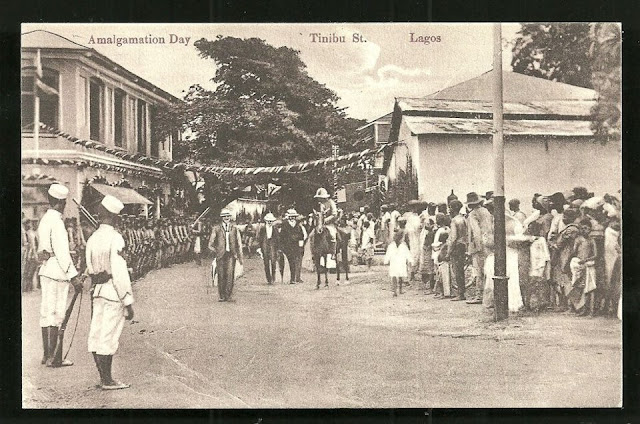
Amalgamation Day in Lagos, 1914

Amalgamation Day in Lagos, 1914

19 October, 2022

The 2023 Election Season will be a long one

 I am both surprised and also not surprised that I haven't posted here in more than 3 years. A recurring theme on this blog has been my acknowledgement that what I write here doesn't change anything in the real world, so there isn't really a concrete "reason" to keep writing.

That said, we Nigerians find ourselves, as we've often done since the 1950s, facing a federal election in which the three leading candidates hail from the three legs of the so-called tripod. As is usual with our polls, the supporters of each candidate are saying unrealistic about their favourite candidates, preparing for their future role in defending him (if he wins) against the inevitable criticism that he is not doing any of the things his supporters claimed he would do.

Maybe we should talk about the Fourth Republic in its entirety so far, since all three major candidates have been part of the political class that has ruled (not governed) the federal republic, the states and the local governments for more than twenty-three years.

Maybe we should ask if Nigeria's issues can be resolved through elections, or whether we need something altogether more fundamentally and substantively different than the 1999 Constitution, the present political class, and any likely replacement constitution this political class would come up with .... because as much as I agree that our constitution is problematic (as is the fact that we still don't have a mutually agreed-upon social contract or compact), the main reason we keep having problematic constitutions is our constitutions continue to be written by problematic politicians and militicians .... and when people suggest we ditch the 1999 Constitution for a new one, they invariably (when you get past their rhetoric flourishes) intend for the new constitution to be written by the same types of person who were in charge of writing every other problematic constitution.

 Which would take us back to square one. And in a way, the launch of each of our civilian-led "Republics" and the start of each of our military-led "Republics" has been a square-one moment that could notionally have lead to the necessary reforms, restructuring and transformation, but which always lead in practice to more of the same style of (mis)governance, except with a bit more atomization of the states and local governments .... and in the case of the Fourth Republic, a gigantic amount of debt .... and insecurity.

20 May, 2019

Picking up the blogging baton and running again


I started this blog in the second half of Olusegun Obasanjo's third term as president. Yes, I said "third term". The first was between 1976 and 1979. In total, he was the federal head of government for 11 years, which is currently the record ... ahead of Yakubu Gowon (9 years), the late Abubakar Tafawa Balewa (almost 9 years), Goodluck Jonathan (8 years) and Ibrahim Babangida (almost 8 years). If current-President Buhari completes his 3rd term overall (his second of the Fourth Republic) in 2023, he would leapfrog Babangida, Jonathan, Tafawa Balewa and Gowon to become the second-longest occupier of the top seat in the federal cabinet.

I am obviously counting the 3 years (1957-1960) of the Balewa-led federal administration prior to de jure independence. If we assume the current President completes his term in 2023, then 6 men would have led Nigeria's federal government for almost 55 of the 66 years between 1957 and 2023. A person could write a separate volumes of books on separate topic areas related to this fact ....

.... but that isn't what this post is about.

As I was saying, I started this blog towards the end of Obasanjo's third term. There have been periods when I have consistently written essays and commentaries, and periods when the blog has sort of lain fallow and just a little forgotten.

I am going to try to start writing consistently again .... since I have time on my hands.

As I've said from the beginning, I do not support any Nigerian (or foreign) politicians. You could say I am somewhat hostile to all of them. From the start in the 1950s, Nigeria's politics has never really been fit for purpose. Possibly the greatest problem with political discussion and political action in Nigeria is the belief that all debates, discussions, agreements and resolutions must take place within the still-existing framework of the politics we've practiced (under civilians and soldiers alike) since the 1950s. Then there are the thick, and thickly-problematic layers of danger and difficulty presented by African continental politics and global geopolitics, two paradigms designed and intended from the start to be functionally and consistently harmful to African (and hence Nigerian) strategic interests.

As always, there is a lot to talk about.

28 September, 2018

Talking About So-Called Defectors

In the late 1990s, at the start of the Fourth Republic, certain politicians affiliated to what you might call the pro-Abiola faction of Nigerian politics withdrew from a nascent political organization because, they said, it was allowing politicians from the pro-Abacha faction to join. The pro-Abiola politicians went on to form the Alliance for Democracy (AD), while the All Nigerian Peoples Party (ANPP) became the banner of many, maybe most, but definitely not all of the pro-Abacha politicians.

Success and failure in Nigerian politics has little or nothing to do with proving that you are better at solving our problems than your rivals. It is about making mutually beneficial deals with godfathers, "stakeholders", "illustrious sons", basically people with the (perceived or actual) power to "deliver" discrete geographical blocs to the support column of the politicians and political parties. A person's ability to trade and subsequently "deliver" their village, town, local government area, senatorial zone, state or "geopolitical zone" is, of itself, subject to the same sort of deal-making. The credible threat of violence, and the actual use of violence, were part of the Fourth Republic's deal-making; arguably, the subsequent public security disasters of the Fourth Republic gestated in large part from this early use of "communal violence" and assassination as tools of politicking.

Anyway ...

It became clear the Peoples Democratic Party (PDP), acting with ruthless venality, had corralled an juggernaut alliance of these backroom deal-makers, their political godsons and acolytes. Then came news that the AD, who had said they would never work with "Abacha Politicians" (i.e. the ANPP), had formed an anti-PDP electoral alliance with the ANPP (i.e. the Abacha Politicians). At the time, senior AD politicians said terrible things about Olusegun Obasanjo, the PDP presidential candidate....

.... which made it interesting when they flip-flopped four years later, and became incumbent President Obasanjo's most strident defenders and promoters ahead of the 2003 elections. They more or less said they would question the continued existence of Nigeria if Obasanjo didn't win.

I don't mean to pick on the AD/AC/ACN, though the faction, controlled since 2003 by former Lagos govenor Bola Tinubu, continues to switch political alliances every four years.

I could as easily have talked about incumbent Imo Governor Rochas Okorocha, who in the last 20 years has variously been a member of the PDP, the ANPP, the Action Alliance (AA), the Peoples Progressive Alliance (PPA), the All Progressives Grand Alliance (APGA), and the APC. Okorocha joined and left the PDP two or three times, and is now, as a member of the APC, theoretically an ally of Bola Tinubu. This lip-service alliance has served the disparate purposes of both men for now, but is almost definitely semi-temporary. Yes, "semi-temporary". There is no basis to the alliance beyond two political sole proprietors' short-term calculation that the alliance works in the short-term for their short-term interests. It could be they continue to think the alliance works for them, and it could be they change their minds tomorrow. So let us call their alliance semi-temporary.


Nigerian politicians, inclusive of those who call themselves "progressive", have formed and broken a succession of ad-hoc alliances through the life of the Fourth Republic. It has been consistently funny to hear the APC blame Nigeria's problems on 16 years of the PDP, when every prominent member of the APC was either a member of the PDP, or a part of one of the other parties that governed Nigeria's three tiers during those 16 years. If the 1999-2015 period was the 16-year failure the APC says it was, then the defector-filled APC is as much to blame for it as the remnant PDP.

How can people like Nasir El-Rufai and Rotimi Amaechi keep straight faces when blaming the PDP for 16 years of bad government? Has Bola Tinubu forgotten that the AD/AC/ACN played a decisive role in reelecting Olusegun Obasanjo and Goodluck Jonathan? And how can President Buhari claim the defectors (reverse-defectors?) are corrupt people who are leaving APC because they are afraid of his nonexistent anti-corruption war? Does he think anyone believes the remaining members of APC are all angels of purity?

There are people who think German Chancellor Angela Merkel is the most powerful woman in the world. Oddly enough, President Buhari was standing right next to her when he dismissed his wife's opinions, because (in his words) she belonged in the kitchen, the parlour and "the other room". I do not know what he meant by "the other room", because I am innocent ...

.... but I am going to borrow his metaphor, and say Nigerian politics in the Fourth Republic is like a house. And the political parties are like rooms in a single house. The politicians are like housemates, who are free to choose their roommates, but who never actually leave the house they all share. The halls of this house are always full of housemates carrying their mattresses from one room to another, but solidarity to the house remains strong. They are in it together. They are housemates.


We should probably stop treating the Big Two, the PDP and the APC, as though they were cohesive entities. Yes, every political party on Earth is a tense alliance of competing interests, but the Nigerian mega-parties are not even minimally coherent. Hopping back and forth between the two parties is not really a "defection", but is more like an actor moving back and forth between the original television series and the spinoff series.

30 August, 2018

The things politicians say

I am not naive; I know politics all over the world is a game of information manipulation and outright deception. Still, I've always been intrigued by the degree to which politicians, political parties, and the mass media are able to convince millions of people to be emotional, unquestioning supporters of one or another politician or political faction.

The fundamental dishonesty of politics is not a problem for those countries whose citizens inherit the benefits and privileges their ancestors created for them via 500 years of unrelenting, globe-spanning violence that reshaped Planet Earth's political and economic functioning. Their countries consume an epically outsize share of the planet's resources regardless of who wins their elections.

But we in Africa, and in Nigeria specifically, need to have serious conversations about serious issues ... including issues that really should have been resolved back in the 1950s before the event officially referred to as "Independence". We are materially harmed by politics perennially free of anything that could be considered "substance", suffused with outright lies and factually insupportable assertions, with promises that are not intended to be delivered, and promises that are contextually undeliverable.

Speaking of undeliverable promises, why do our governments (all of them) like to set and pompously declare totally random "deadlines" for the accomplishment of things? It will be done by the end of the year, they insist, their faces determined and serious in the glare of the cameras. Meanwhile, a rational person can see the thing in question could only be accomplished over a 10-year period of consistent policy superintended by a succession of competent governments.

Sometimes the issue is something inherently unpredictable like the insurgency, yet our governments will set deadlines for "victory". According to Buhari, the deadline for victory was December of 2015 -- he was going to win the war within half a year of taking office.

Then there was that 3-year deadline (1999-2002) set for the unification of all non-CFA currencies in West Africa. This was back when Charles Soludo was Governor of the Central Bank of Nigeria. The 2002 deadline got stretched to 2005, then 2009. As of today, the new deadline is 2020, some 21 years after the initial 3-year deadline was set in 1999. And at an ECOWAS conference held this year, some participants vocalized their rational expectation that the 2020 deadline will also be missed.

Our leaders think these "deadlines" make them sound competent and serious, but in reality they just end up sounding like they don't understand the topics they are talking about. In fact, they sound like they fought so hard to become the government (by "election" or coup) without ever having given a single thought to any of the problems they would have to resolve once they became the government.

I am starting to digress, as I tend to do.

This post was intended to briefly talk about a member of the National Assembly I watched launching a "constituency project" on Channels TV . He told the people gathered for the event that they should vote for (here he mentioned his political party and its definite presidential candidate) because that was the only way they would continue to get "constituency projects".

Legislators all over the world use their control over the government treasury money to buy popularity in their home constituencies. Even in legislatures where political rivalries are heated, the legislators are always able to set their differences aside long enough to collectively renew their self-given right to use public money as a reelection tool. In some places it is called "pork barrel" spending, and it doesn't make that much fiscal difference in countries that benefit from the way the planet has been designed to function over the last 500 years' violence.

I am not fond of fiscal waste. And it is democratically unfair for aspirant candidates to have to face incumbent politicians who are allowed to use government money as the de facto reelection campaign funds. I find it particularly crass the way Nigerian politicians behave as though they are using their personal money to give their constituents a personal gift out of their personal kindness. The schedule for these "launchings" always includes a moment where selected people are lined up to deliver, one after another, sychophantic remarks extolling the saviour-like magnificence of the politician.

Unbeknownst to these citizens, they will pay a heavy fiscal price in the near- to medium-term future. There is little thought to the fiscal or operational sustainability of these projects, or to whether it is or isn't the best possible way to permanently solve whatever the core problem is. When the federal and state debts start to bite, there will be fiscal cuts to many areas, including maintenance of the projects and salaries/pensions (which will not be cut per se, but just won't be paid).

But I am digressing again.

This legislator on Channels TV lied to his constituents, telling them there would be no "constituency projects" if they didn't vote for his party and its presidential candidate.

The truth is, regardless of who they vote for, and whichever party wins, the winner will join with his (or her) legislative colleagues to reauthorize spending on "constituency projects". There is little or no discussion in Fourth Republic politics about fiscal responsibility, and I am beginning to think we will remember the Fourth Republic as the most fiscally reckless period of our history. Every candidate in Nigeria with a realistic chance of "winning" a legislative election, is by definition a candidate who will not act to block wasteful, but reelection-enhancing, spending by legislators.

The legislators will not stop themselves from spending in this way, and they won't stop the executives either, especially the 36 state governors. Our state legislatures function as little more than expensively assembled rubber stamps.

02 December, 2017

The building where "Nigeria" was "born"

I am not sure how to feel about the picture below.

On the one hand, it is the place where violent foreign invaders finalized the process of their conquest and domination of our peoples.

On the other hand, it is also the place where the "Federal Republic of Nigeria" more or less came into existence.

But whether you look at the place as a negative memory, or as a piece of the foundational story of "Nigeria", surely the place shouldn't look the way it looks? Shouldn't it be a place we visit to either remind ourselves of a bad thing we must strive to avoid (i.e. foreign dominance), or to remind ourselves of a good thing like Nigerian unity (it is a good thing, isn't it?).

Maybe the way the building looks is best understood as a metaphor for "Nigeria".

Whatever their propaganda might say, the British/European intervention in "Nigeria" was intended purely to benefit the British/Europeans at our expense. Nevertheless, they accidentally created a political platform from which we the people, peoples and nations of "Nigeria" could defend ourselves and our interests in a world designed to be hostile to our interests.

Except, that "Nigeria" has not, is not, and (if nothing changes) will not do for its citizens the things that it is supposed to do for its citizens. Take for example the issues involving "African" migrants facing danger and death in order to make it to supposedly better lives outside the continent. Notice that once the foreign news organizations started to give saturation coverage to the deaths of more than 20 Nigerians and the "slave market" in Libya, our federal government started making noises about doing things they would already have done years ago if they actually gave a damn about our citizens. Note I say "federal government" and not the name of any specific Fourth Republic president, as the "migrant" problem has existed for many years -- as has governmental disinterest in the fate of the "migrants".

Yeah, the state of the building where Nigeria was "born" is a metaphor for the Federal Republic that was "born" there. If "Nigeria" functioned the way it is supposed to function, the building where it was "born" would look a lot different.

This is the building Premium Times identified as being the place in Zungeru, Niger State where Mr. Frederick Lugard signed the documents that created "Nigeria" by Amalgamation.


24 October, 2017

Subtracting 90 from 310 International Organizations

A month ago, Kemi Adeosun, the Minister of Finance, announced Nigeria would withdraw from 90 of the 310 "international organizations" we are presently part of. We apparently owe payments of one kind or another, payments we cannot afford, to a number of these organizations. Unsurprisingly, there is uncertainty as to how much we are owing; a "committee" said the arrears were $120 million, but the Ministry of Finance (and other ministries) believe we owe a lot more than that.

The Minister gave no indication as to which organizations we would be withdrawing from. Its been a month, and there is still no guidance .... not just as to which specific organizations, but also as to what particular types of organizations they consider to be superfluous.

The number "90" is very specific. Did they already identify the 90, or did they just randomly decided to fix our number of memberships at 220 and withdrawals at 90 just to have specific numbers to report?

If it is the former, they could at least give us some sense as to what sorts of organizations are on the list; it is a very significant thing the government is planning to do, and they did not mention any of this in their 2015 campaign, so it would be nice if they didn't act like we gave them a mandate to do such things secretly without telling anyone what they are doing.

On the other hand, if it is the latter, and they just randomly fixed the two numbers at 220 and 90 without actually first deciding on a criteria for withdrawals, then they may find that when they do develop a criteria, the organizations that meet or fail to meet the criteria will not fit neatly into the nice round numbers of 220 and 90.

Don't misunderstand me. I support the reduction in the number of international organizations Nigeria is a part of; I just want to know what it is they are doing.

If it was up to me, frankly, the magnitude of the reduction would be greater. However, I wouldn't make a move without first discussing it with the public. Or rather starting a public discourse on what Nigeria's strategic interests are, how the rest of the continent/planet impacts upon these interests, what would be the best path towards protecting our interests .... and then we would have to talk about whether or not any international organization that currently exists helps, hinders or is irrelevant to the protection of our citizens' interests.

Because to be honest, it really shouldn't be about the money. We shouldn't join or leave organizations based on whether we are owing, or whether we can afford to pay. Even if we can afford to pay to be in 220 organizations, we shouldn't be in any of them that is irrelevant or harmful to Nigeria, and if we cannot afford to pay to be in 310, but there is something about the 310 that is practically useful to Nigeria, then we should find the money somehow (perhaps by selling Governor Okorocha's Zuma statue to wealthy foreign collectors of curios and oddities).

I've got to be honest with you. I don't really think any of the international organizations do anything that is useful to Nigerian or African progress. The hype surrounding these organizations is that they step in to fund insufficient "aid" programmes for refugees of a politically-created disasters. What we need to be doing is dealing with the issues that make these politically-create disasters predictably incessant, and as to whether international organizations help, hinder or are irrelevant to that ... well, we can argue about that in another blog post.

23 October, 2017

Elections Without Purpose

There are certain people who keep saying we all must vote, and who keep insisting that anyone who doesn't vote will by definition lose the right to criticize the governments (all three tiers) after the vote.

But what are you supposed to do when the political system is designed to present you with different versions of the same thing you do NOT want as a citizen?  Different versions of the same future disappointment? Are you supposed to keep wasting your time "voting"? By padding the turnout numbers, are you not merely granting the toga of credibility to the very thing you do not want? By picking one of the bad options presented, are you not empowering the bad option to claim that the things he does are done with your permission and approval?

In fact, why do we complain about "rigging" (and even about coups) when we are still going to be forced to stomach a type of government we do not want, even if there is a "free and fair" vote? It is not just that the same type of person will occupy political, bureaucratic and technocratic positions, but very often is is literally the same people.

Please, don't do that thing we sometimes do in Nigeria of looking at the name of the person speaking, and then interpreting everything he or she subsequently says from an ethnic or regional prism. Yes, I am Igbo, but the structure and fundamental nature of Nigerian politics has never made sense to me.

The first political thought I recall having was as a child during the Second Republic. The election was coming up, and I was excited by the pageantry of it all. But then I realized that underneath the facade, the election boiled down to little more Igbos vote NPP, Yorubas vote UPN, and Hausas/Fulanis vote NPN. The regional/ethnic chess game did not stop with the three legs of the so-called "tripod", but as a little child, and as an Igbo, it didn't make sense to me that I was expected to support a party (and the politicians within it) simply because I was Igbo. I wouldn't have been able to properly articulate it at the time, it just seemed to me that it was a stupid way to choose leaders of the country. I would later learn about the 1950s, the First Republic, the Civil War .... and all I could think of was how different it all could have, and should have been. All I could see were the errors and mistakes of people who were, and still are, surprisingly popular considering their decisions set us on a path to the kind of politics we still practices .... and the kind of violence our federal republic is still plagued by.

If we are honest with ourselves, we would admit our method of choosing leaders has not progressed much since the Second Republic, and political figures are wildly popular in specific regions for reasons that have nothing to do with whether they actually understand what our problems are, first of all, before we even ask if they understand the solutions. Actually, and more depressingly, not a lot has changed in our politics since the 1950s. In fact, if there is a so-called "national question" then it is comprised of several dozen questions (plural) that should have been answered in the 1950s, but have not been answered up till now, and do not look like they will be answered any time soon.

It is interesting that we are still being treated to the sights and sounds of people trying to break up the federal republic. There are those who advocate this openly, those who hide their real intent behind euphemisms, and those who aim to create enclaves within the country where the laws of the country do not apply. The biggest problem in Nigerian politics since the 1950s has been the absence of a basic understanding of the strategic interests of the various ethnic nations within the Nigerian federal republic. We would have interacted with ourselves differently, approached our continent differently, and (especially) approached the rest of the planet ... much differently. As it stands, it is 2017, and people are still talking about destroying the best platform from which we can protect ourselves and advance ourselves on this planet that has been designed to function with hostility to our interests.


Anyway, all of this is just rhetoric. Let me say something practical.


The All Progressives Congress (APC) goes on and on about how the Peoples Democratic Party (PDP) ruined Nigeria over the first 16 years of the Fourth Republic. But have you noticed something about the APC? The APC is comprised almost entirely of the people who ruled Nigeria in the first 16 years of the Fourth Republic. Some of them were PDP, some were AD/AC/ACN, some were ANPP/CPC, and some were APGA/PPA, but all of them, in one way or another, held significant power at the federal and state levels between 1999 and 2015. When they describe the first 16 years of the Fourth Republic as a time of failure, they are indicting themselves as well as their rivals who are still in the PDP for the time being (pending their eventual decamping to the APC. If they couldn't fix Nigeria's problems of Nigeria under their previous incarnations, why are we supposed to believe they will do so as old wine in a new bottle? In fact, is anyone surprised that they are not doing so?

By the way, President Buhari himself may not have held power in the Fourth Republic prior to 2015, but he has served at the highest levels of the Nigerian federal government since the early 1970s, in a variety of powerful portfolios, including that of military Head of State. There are a lot of things his supporters say he can and will do, but he has had more than 47 years in "politics" to do these things, and not only did he not do these things, but realistically he never showed the signs that he could.

Again, I am not an ethnicist and this is not about President Buhari's region of origin. I began this essay by asking whether there was any point to "voting" when there is never anyone on the ballot worth voting for. My critique of Buhari is applicable to all of his predecessors, to all of his would-be predecessors, and to his would-be successors. I started this blog during the Obasanjo Administration, and if you read my posts from the beginning, through the Goodluck Jonathan Administration, up till today, you will find my views are consistent, and are consistently applied to everyone. There may not have been an Igbo president during the Fourth Republic, but figures like Ngozi Okonjo-Iweala and Charles Soludo (among others) have had strong influence on the direction of Fourth Republic (and on its predictable economic woes), and I have never hesitated in objectively critiquing anyone.

Okay, now that I am done with the unfortunately necessary disclaimers ....

Our politics have always been disconnected from our practical problems. Our politics follow an internally consistent logic that produces recurrent outcomes to "elections" and "coups". The thing is, the internal logic of our politics was never about ascertaining the source of the country's problems, deducing solutions to the country's problems, or vetting potential candidates according to how well they fit into the framework of problem-definition and problem-solution. If anything, your success in Nigerian politics is dependent on convincing "stakeholders" that you have no intention (perhaps no ability) to fundamentally change anything in a way that will put Nigeria on the path to having an economy like that of Germany or Japan.

But in 2019, we will be told we have to vote.

Why? For who? For what?

I'd like to say that before we hold another pointless "vote", our federal republic first needs to have a conversation about .... our federal republic. But in the real world, there would be no point to such a conversation, as it would be dominated by the same personages and voices that we would need to do away with if we are going to have any chance of having a meaningful discourse.

Something has to change.

An Investigative Report on Exam Malpractice


In places where law enforcement and judicial system are perceived (rightly or wrongly) to have some degree of effectiveness, people do break the law in blunt and undisguised ways ... but a much larger number of people (and corporations) contrive of ways to break the spirit and intent of the law, while positioning themselves to be able to argue that their actions could reasonably be construed as falling within the "letter" of the law. The wealthier you are, as an individual or corporation, the more capable you are of organizing your "law-breaking" and eventual legal defence in such a way as to avoid a conviction, or at the very least to ensure that you are convicted of a lesser or even minor offence (often following a plea deal). The poorer you are, the less access you have to these particular tools of "law-breaking".

In Nigeria, the police do arrest people, and the courts do convict people, but Nigeria's people, polity, economy and society operate in a context where the quality of law enforcement and the judiciary is presumed to alternate between involuntarily ineffectual, deliberately dysfunctional and consensually corrupt.

I do not think we Nigerians as a people are "worse" than anyone else when it comes to crime, however, there are certain kinds of crime that are committed bluntly and openly in Nigeria, whereas in other places anyone who wanted to commit the crime (and trust me, many do) would have to be more "sophisticated" in their criminality, or would have to dream wistfully of what they would have done if the risks of getting caught didn't outweigh the possible gain.

There is also the issue of compensation. In certain countries, officialdom are frankly overpaid. Yes, they are paid far more than would be economically feasible if the world's economy was normal. In this context, it is easier to uphold certain standards that are perceived to be beneficial to the society at large.

In Nigeria, where civil servants and pensioners can be owed more than a year's arrears of salary, it can be .... difficult for people with rent due at the end of the month to listen to their conscience. I am not making excuses for their behaviour, but it has long depressed me that Nigerian policy-making does not take into account basic economics. Our governments, at all three tiers, keep coming up with macro-level policies that they claim will lead to particular outcomes, while leaving in place all of the economic realities that effectively force people at the micro level to make decisions that in aggregate will negate whatever it is the macro so-called policy claims it is going to achieve.

Anyway, all this is a set up to get you to read this investigative article from The Punch newspaper. The stats at the bottom of the page indicate only about 450 or so people have read the electronic version of the article, which I think is unfortunate. This is exactly the sort of investigative reporting we all want (or say we want). Yes, I know most Nigerians still get their newspaper news from actual "paper" newspapers, but those get replaced each day and anyone who didn't read it on the day (a year ago) it was published on paper will have missed the news anyway.

A reporter went undercover to expose blatant, unashamed, criminal examination malpractices. I am not one of those people who assumed "everyone" in Nigeria is a criminal (I am a Nigerian, and I am not a criminal), but the exam malpractice problem clearly extends far beyond the single centre the reporter exposed.

And yes, it is a long article in a time when the internet has shortened people's attentions spans, and yes, I know "data" costs in Nigeria. Still, isn't it better to read the facts of a thing that we all know is happening, rather than basing our "knowledge" about it on the usual rumours that are never actually true, even if they are based on (and hint at) things that are true?

 PS: Is it the proper etiquette to say I was directed toward the article by the journalist Kadaria Ahmed? She posted a link.

29 August, 2016

A Return To Discourse

It has been a couple of years since I posted regularly on this blog. You know how it is with life. A lot has happened, and I have been busy.

There is a new president, but the issues remain the same.

I hope to restart regular commentary.

There is much to talk about.

I am embedding Sunny Okosuns 1980s hit "Which Way Nigeria". It is interesting that he references mistakes make during the 1970s Oil Boom, considering the mistakes we made during the 2000s Oil Boom.

It is also interesting that President Buhari is back for a second stint as Nigeria's Head of State. His first tenure, beginning in 1983, was separated from President Obasanjo's first tenure by a 4-year administration led by a lifelong civilian who took office as the 1970s Oil Boom ended and the emerging global economic environment of the 1980s turned problematic for Nigeria. Decades later, their respective second tenures in the Fourth Republic were separated 8 years, and two lifelong civilians who took over from Obasanjo just as the 2000s Oil Boom ended and the global environment of the 2010s turned problematic for Nigeria.

Many things have changed in our economy, notably telephony and the internet, but fundamentally nothing of real significance has changed.

Add to this a political system that never answered any of the questions raised in the 1950s, opting instead to recycle the same questions tediously without solution.  Back then, they worried about which Region was to produce the Prime Minister. Today, the argument is over which "geopolitical zone" should produce the presidents (and which senatorial zone is to produce the governor), with little or no discussion of anything that can be termed an issue of importance or substance. Let us be honest with ourselves; everyone who has served as president in the Fourth Republic did so based on "geopolitical zone" calculations, and not because they ever did or said anything that would lead anyone to think that they understood our problems much less had deduced a solution to any of the problems.

Anyway, enjoy the late Sunny Okosuns (RIP) singing "Which Way Nigeria".


04 July, 2014

Both the Economy and the Violence are growing

When I started this blog, my intention was to build up to the centenary of Amalgamation, which was this year, 1st January, 2014.

A lot of things happened in the interim, in my life and in the life of the Federal Republic, and as you may have noticed there was no blog post commemorating the date. In fact, I have not posted anything since last year.

And it is difficult to restart.

What does one say? Even in times when things are more predictable (for lack of a better term), it is always difficult to sum up the Federal Republic of Nigeria, in whole or in part, using something so simplistic as words or sentences. What do you say? If only it were possible to telepathically transmit the sense of something, but even then, how to make sense of Nigeria, Africa or even of the Earth?

Nigeria's GDP-rebasing project, which looked like it would never end, finally concluded and Nigeria leap-frogged South Africa to be recognized as the biggest aggregate economy (measured by GDP) on the African continent.  There are even suggestions (see video courtesy CCTV-Africa below) that the rebased figures still underestimate the size of Nigeria's economy:


On the other hand, I have frequently said on this forum that the Fourth Republic (1999-date) is the second-most violent period of our history behind only the years 1966-1970.  Think about that for a second.  The only period of our history more violent than the present one, is a 4-year stretch during which there was an ultra-violent coup, an ultra-violent counter-coup, widespread mass killings, and ultimately a two-and-half year Civil War.

What is particularly concerning is the violence of the Fourth Republic has been on an upward trajectory. With each passing year since 1999, it has gotten worse. What is happening now is just the worst part of a trend that has shown no sign of abating. It is all nice and good to blame Goodluck Jonathan, and I certainly think he has a big share of the blame, but this all started long before his "lucky" ascent to the Presidency, and to be quite blunt, every arm of all three tiers of the Fourth Republic administration share in the blame. Nor is the blame restricted only to those who govern; the so-called "opposition" are as much a part of the problem.

From time to time on this blog, I point out that I warned about this in an essay I wrote 11 years ago in 2003 -- even then it was already clear that the ever-rising violence was going to get out of hand, and that the various private armies and militia groups were getting dangerously well-armed and acquiring ever greater capacity for violence relative to the official security institutions.

The two-facedness of the politicians was also clear then -- they refused, and still refuse to deal with vulnerabilities and weaknesses of the security space, because they themselves maintain illegal militia and private armies (not to mention alliances with private armies on contract around election time ).  One of the great problems with law enforcement reform in Nigeria is the people constitutionally responsible for reforming law enforcement are people who would be in jail if our law enforcement worked. The same is true in the public security space writ large -- it is like asking a fox to make sure the henhouse is secure.

This isn't really a problem unique to Nigeria. Many, probably most global and national institutions are run by individuals and interest-groups whose individual and group "strategic interests" ensure that the institution in practice facilitates whatever it is that it was theoretically set up to prevent.

But let me not digress to far off the point of this my "return" post.

The good news is good news because if we ever get around to the process of decreasing the amount of bad news, we are going to need to stand on the strong platform provided by the good news.  And there is no stronger leg to stand on than the leg of a large and growing economy.  That is the thing about the Federal Republic of Nigeria .... even in our darker moments, you cannot but notice that the potential good things are so extensive that if harnessed properly they would swamp the bad things.

But there is much to talk about, and hopefully I will speak more frequently.

20 December, 2013

Brief Comment on South Sudan

As I always say, it is difficult to know what is actually going on in the world. Politicians, the media, academics and other so-called analysts, so-called "experts" in general, they all like to talk as though they know what is going on, but a lot of the time they don't, and even when they do they tend to tell the rest of us an edited (at best) or blatantly distorted (at worst) version of what is happening, with the intent of getting us to come to certain conclusions (i.e. the conclusions supportive of their agenda, whoever they happen to be).

There has been a lot of "low intensity" conflict in South Sudan since its separation from Sudan. Of course, no conflict is "low intensity" to the people who get killed, to the families left behind, or to the communities negatively impacted by whatever metric.  The current political impasse may or may not lead to a bigger civil war (and one suspects outside players, regional and global, will bring pressure to bear on the key leaders to avoid open war), but it is likely that the state of low intensity conflict will continue.

In this, both Sudans are the same.  The erstwhile "North" Sudan is also a place of constant, ceaseless, simmering conflict.

As a Nigerian, I am used to people who claim dividing a country will somehow solve the country or countries' problems.  I have always wondered why people think that. It doesn't make any sense. If you divided Nigeria, each new piece will inherit every problem is already has ... and will also inherit the same useless political leaders that have already proven useless at solving the problems.

There is this tendency to point to the Czech and Slovakian republics as some sort of example. I am tempted to ponder whether the example is as great as is portrayed, but the fact of the matter is even if it were the most perfect example of separation ever recorded, it would still remain the case that both subsequent countries inherited status quo ante conditions from the preceding Czechoslovakia that are absent from other areas that are often portrayed as potential beneficiaries from the same outcomes.

Besides, the European continent is an odd place. Every few decades, there is a dramatic adjustment of internal borders that is hailed as a sign of great statesmanship, and is treated as though it were not only permanent but also a solution to all the problems that had existed before the realignment of borders.  After some years, or some decades, there is another upheaval, whereupon borders change dramatically again. With all due respect, and meaning no offence to either country or to the citizens therein, but there is no particular reason to believe the Czech or Slovak republics will remain as they are indefinitely, or even that the future citizens of both countries will remember the separation fondly.

Heck, contrary to popular belief, the entity "Nigeria" as currently constituted might outlast the current European borders; as it stands, we have already outlasted the USSR, the GDR, Yugoslavia, and Czechoslovakia. It seems Belgium is under stress, the Scottish National Party is flirting with a referendum, and one wonders if the much-ballyhooed European Union has more staying power than the Nigerian Federal Republic.

Look, I am not trying to offend anyone, but problems are problems. You either solve them or you don't. I am not overly fond of Felix Houphouet-Boigny's politics, but there is a statement credited to him (I don't know if he really said it) on the topic of uniting all former African colonies of France into one country.  He asked whether they were all supposed to unite and share each other's poverty.

Uniting two poor countries won't make a rich one. Dividing a poor country will not create two rich ones.  Dividing a violence-prone country creates two violence-prone countries. Dividing a lawless country creates two lawless countries.  The Czech and Slovak republics did not become relatively wealthy because they were divided, and they would not have been relatively poor if they had stayed together.

That is all I am saying.

13 December, 2013

Continuing the focus on Fiscal health ....


If you haven't done so already, peruse this brief report from Business Day (Nigeria) on the fiscal implications of the 2014-2016 Medium Term Expenditure Framework.

10 December, 2013

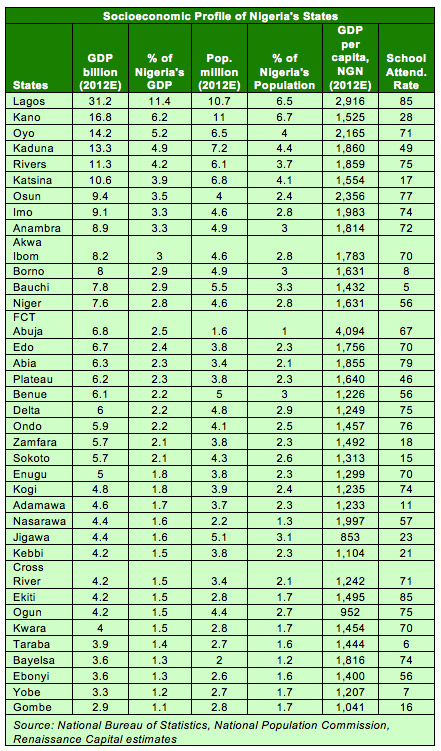
Economic Statistics of the Nigerian States & Territories

I am not sure I trust our census results or any other "official" statistics. I don't just mean Nigerian government statistics, but the statistics produced by multilateral agencies, non-governmental organizations, academic researchers and even the mass media.

But you have to work with what you have.

Renaissance Capital did a report on the economies of Nigeria's 36 states and 1 Territory.

The Middle Eastern business site Zawya posted this table indicating some of the key findings of the Renaissance Report:


24 November, 2013

Still Talking About Nigerian Debt

Image from Ghana Business News


As you know, if you've been reading this blog (the stats tell me there are at least a few of you), I am not overly fond of the "debt cancellation deal" of 2005.

The future value of the $12 billion we paid was equal (at a minimal interest rate) to what our Paris Club creditors could have realistically expected to receive from us based on what we were actually paying at the time.  The opportunity cost, or lost value to us, was much greater;  those reserves could have been used to leverage even greater spending (greater than the reserves) on our infrastructure problems (or health problems, or education problems, or security problems, or etc), with economic effects in excess of the so-called billion-dollar-a-year savings.

And we were always bound to run up new debt, meaning we would resume paying the same amount (or more) in debt service that we were already paying, except with $12 billion less in our accounts. Indeed, in the years since the "debt cancellation" we have borrowed back about as much as we owed before the "cancellation", though nobody notices because it has been accumulated as "domestic debt" and not the more noticeable "Paris Club" debt.

The Federal Government's Debt Management Office says the Federal Government currently owes $45 billion in "domestic debt".  Most of this was borrowed after the "debt cancellation" deal, and it is 50% higher than our "cancelled" external debt was in 2005.  The DMO has data on the states' external debts, but if they have data on the domestic debt owed by the states, I haven't found it yet.  Most articles I have found on the internet that rank state debt in Nigeria only reference each state's external (i.e. foreign) debts, and don't acknowledge that is another set of debts they are not reporting on.  Like the federal government, the states' debts to Nigerian banks are likely much higher than their debts to foreign creditors.

The Vanguard columnist who writes under the pseudonym "Les Leba" has a tendency of pointing out that the debts are the result of our governments depositing oil revenues in Nigerian banks, and then borrowing back the government deposits as loans from the Nigerian banks at double-digit interest rates.  It isn't a new concept; the African continent's historic Paris Club debts were for all intents and purpose a function of African countries depositing their foreign reserves and export revenues in Paris Club countries and then borrowing back their own money from the foreign countries with interest tacked on.  The term "Paris Club" is apt, considering the fiscal and debt relationships between France and the CFA Zone are especially weird.

We tend to keep our eyes on the Federal Government when it comes to issues of debt.  Nevertheless, the 36 State Governments and the Federal Capital Territory are also borrowing, and it seems no one is paying attention.  There has been no legislative, political or democratic limitation to the borrowing of the states since 1999; our state governors (and the FCT minister) are far more powerful, relatively speaking, within their respective "domains" than the President is over Nigeria. 

I am unaware of any independent, credible studies of the sustainability of the growing debt loads of the states.  There are a few states where one suspects debt loads have passed the point of "comfort"; I have had interesting conversations with people who have praised their state governors for spending on certain projects, while simultaneously telling me they doubt their states can pay the contractors or the banks that funded the projects.

Truth be told, the state governors are in office a maximum of 8 years, winning re-election in part by rigging and in part by popularity bought with the debt, after which they leave office as wealthy men and leave the state's debt for their successor(s) to deal with.  What do they care?

Debt is unavoidable for governments, corporations and individuals.  It is not necessarily or inherently a bad thing.  But there are questions to be asked and answered. One of the most important questions relating to our 36+1 states is whether each individual state's ability to repay its debts. When the civil service minimum wage was increased by the Federal Government, most state governments protested their inability to pay; clearly their margin for new expenditures is thin to the degree of nonexistence. Yet their debts, and (by definition) their annual fiscal commitments to pay those debts, will continue to grow, eating and exceeding that nonexistent margin.

There are other questions, like what is this debt being used to do?  There are lots of things that either look nice, or feel nice, but which don't generate revenue sufficient to pay for their creation or for their maintenance.  Many Local Government Areas and States have nice new medical facility buildings but cannot not afford to properly staff, equip or resource the buildings to a degree that would have a real impact on the health of the respective communities. And as they commit ever more of their budgets to paying debts, they will have even less in the way of discretionary resources.

Speaking of which, as I said earlier, Nigeria at the Federal level has borrowed back as much in new debts as we used to owe before the "cancellation" deal. Much of this debt was not used for anything relevant to economic growth or citizen welfare.  There was a particularly large jump in the debt in the run-up to the 2011 Elections; effectively Nigerian citizens have to (re)pay the political/electoral expenses of the Jonathan Administration and the Peoples Democratic Party.

The debt situation is about to get worse, though the statistics will show that it has gotten better.

Let me explain.

Nigeria's Gross Domestic Product is currently being recalculated via "rebasing".  It has been almost 25 years since we last rebased the GDP calculation, and the expectation is we will either overtake South Africa and become the biggest economy in Africa, or will dramatically shorten the amount of time before we overtake them.

The new, much higher GDP figure will cause all of our macroeconomic ratios to change. It will mean the various governments' tax collections will be a smaller total share of the economy.  It will mean the various governments' total deficits will be a smaller share of the total economy.  It will mean the debt-to-GDP ratio will drop. It will also mean the number used to represent the estimated growth rate of the economy will change from the 6-to-7% range to the 3.5-to-5% range.

To make a long story short, the three tiers of government are likely to use the rebased GDP size as a justification to increase their borrowing.  One of the most annoying (to me) terms used by so-called experts (foreign and local) in relationship to Nigeria is "under-borrowed".  They seem to think there is a specific amount of debt, relative to GDP, that we are supposed to be carrying, and if we are not carrying that amount of debt, they insist that we borrow a bunch of money for no reason at all beyond their insistence that we need to owe as much as they think we are supposed to owe.

We should owe only as much as is necessary. If the necessary amount of debt is less than what the experts claim it should be, then ... so what?

And even if there is a necessity, an indisputable need to borrow for a particular thing, perhaps the first question we Nigerian citizens should ask ourselves is what type of governments, government leaders and civil service bureaucracies we want to be in charge of this borrowing. Because, if we maintain the current system, we run the risk of having, for example, an $80 billion need in an infrastructure sector, for which our governments borrow $165 billion, and mysteriously deliver only $20 billion of new infrastructure that is useless without the other $60 billion's worth of completion, and now we the citizens owe $165 billion in addition to capitalized interest in exchange for a situation that is not demonstrably different from the situation that existed before we borrowed.

There is also going to be a lot of talk about increasing government revenues from taxation and fees.  Some of this talk will be in terms of relieving the need to borrow.  Some of it will be in terms of raising funds to pay back loans already borrowed and loans to be borrowed.

There are two sides to this coin.  Whatever the real GDP of Nigeria is (I am not sure anyone really knows, rebased or otherwise), the citizens of Nigeria have long borne the fiscal costs of providing for themselves many of the things that are theoretically supposed to be provided by the public or private sectors of the economy.  Assuming the government can efficiently tax the people so as to increase government revenue and decrease the discretionary revenue of private citizens, is there not a chance that the private citizen will be less able to provide himself and his extended family with those goods/services without there being a replacement of those goods/services from the government (i.e. paid for from the increased taxes)?  Suppose the money just goes to pay debt?  Suppose the money pays for more PDP election "victories"?  Suppose the money goes to the right place, but $165 billion of spending in the right place mysteriously purchases only $20 billion worth of the whatever it is?

I am not being cynical (though I am sometimes a cynic).  These are the kind of debates we should be having in our political space, rather than arguing with ourselves which of the "geopolitical zones" deserves the next "turn".

We have borrowed a lot of money.  We are going to borrow a lot more, it seems. There needs to be more of a discussion about this ... before someone starts telling us it is a great idea to spend $24 billion to "cancel" $60 billion, only to borrow another $70 billion eight years afterwards.
02 October, 2013

Femi Aribisala on "Bigmanism"

If you haven't already, take a look at this funny essay in yesterday's Vanguard.

"Independence" Day 2013

Another year since 1960.

The big anniversary comes up in three months -- the Amalgamation Centennial on the 1st of January 2014.

I wish the Centennial was occurring in a different, better set of circumstances. As it stands, I suspect critical comments as to whether the Amalgamation was a good thing or not will predominate over celebratory comments.

The three tiers of government will probably put on glitzy shows, that will be more about expensive (as in contract-generating) excess. As per usual there will not really be anything that grabs at the heart and soul of who we are and why we are, nothing that really expresses our cultures or identities as distinct peoples or as a unified Federal Republic.


30 September, 2013

How we write about ourselves.


I promise you I decided to write this post before the recent tragic events at the College of Agriculture, Gujba in Yobe State.

Two things I have said often on this blog.

(a) The Fourth Republic is probably the single most corrupt period of our history so far; and

(b) The Fourth Republic is the second-most violent period in our recent history, behind only the Civil War. The First Republic would be third on the list of violent periods, despite the fact that many seem to look at it as though it were some sort of golden age of peace and prosperity.

There is enough violence going on that I would probably have had to apologize regardless of when I eventually wrote the post. But for the record, I was going to write this before what happened in Yobe.

But firstly, may the souls of the victims Rest in Peace. I don't know what else to say. There is nothing I can do to help.

I wanted to write a post about the way our media covers murder and mass murder, specifically the tendency to show graphic pictures of the victims.

Elsewhere in the world, they spare the families of the deceased the shocking sight of their loved ones in the aftermath of something like this .... whereas in Nigeria, the victims' bodies are displayed without blurring, censoring or respectfully-placed pixels.

By the way, those media outlets from elsewhere in the world do not extend that level of respect to us when covering incidents of mass violence on our continent. For example, some years ago, on a weekend morning (i.e. when children were likely to be home), one of the USA's basic cable networks ran a documentary on Liberia and Sierra Leone, and showed everything, including one man's head which had been detached from his body and placed on a table. Had he been an American victim of a crime in the USA, either (a) they wouldn't have shown the head; or (b) they would have blurred his eyes so we the viewers (and particularly his family) would not .... see him. In fact, I think their channels are afraid of being sued by the families of American victims, but fear no consequence from us.

Still, how can we demand respect from other people when we do not respect ourselves? Reminds me of a speech I gave on Nigeria, where I instructed the audience to stop referring to Africa's (ethnic) nations as "tribes". After talking about this, that and the other, I took my seat and prepared to listen to the Kenyan who was due to speak next about Kenya. To my dismay, he spent the entire time referring to every single ethnic group in Kenya, one after the other, as a "tribe". It was a small enough group that I could see the people in the audience looking at each other in confusion.

By the way, I am not squeamish and this post is not about squeamishness. There is a time and place to look at and see the ugly realities of human history, of the human present and (unfortunately) of the human future. In the time and the place, I do not turn away.
That isn't what our media is doing, though. In fact, as you know, I am generally critical of how our media cover mass murders and single-victim murders.  Their coverage of "communal violence" does very little to give us factual information about what actually happened, why it happened, and who actually did it.  Their coverage of "communal violence" on the contrary tends to serve a fuel-on-the-fire role of sustaining the exact sort of cloud of misinformation that makes "communal violence" both likely and recurrent.

There are analysts and commentators who talk about something called "disaster porn". I wish they had chosen a different name for it (and shudder to think that some people will stumble onto this page after doing a web-search for something else).  You can do a web-search yourself to find essays on "disaster porn" ... and when you've done that, consider that I think what the Nigerian media does is 100% "disaster porn" and 0% information.

More importantly they show 0% sensitivity in not even considering the fact that someone's mother, or father or spouse or child might opt to find out what happened in the world today, and find themselves looking unexpectedly at the graphic image of their murdered relative. You tend to hear police in certain countries talk about not revealing the names of the victims to the media until after their families have been informed -- in Nigeria, particularly now in the era of the internet, the pictures of the dead are posted even before the police know how many dead people there are, much less the names of family members to notify.

Do we even notify the families?  A friend of mine, my next-door neighbour growing up, was murdered on the campus of one of our universities back when "cult violence" was rampant. His body was unceremoniously dumped with a pile of other bodies collected that night, and his parents had no idea what had happened because no one (not the police, not the university, no one at all) told them anything. After they hadn't heard from him in a long while, they travelled to the university, presuming to ask him what was going on .... only to be directed to the morgue, where they found him in a pile of other bodies.

That particular incident didn't make the news, because it was didn't met the threshold to count as good "disaster porn".  There is a lot of stuff, violent stuff that happens in our Federal Republic that no one ever hears about, because there isn't an "angle" to it, no existing strings the news can be used to pull.

But that isn't really what this post is about.

There is a time and place for graphic images of violence and disaster. And there is a time and place when images can be presented, but should be "censored" to show sensitivity to the families of the victims.

There is also a philosophical principle involved in sensitizing people to something by showing them what it is without editing. But there is also a dangerous result where people see something so often they become inured to it (indeed, seeing incredibly graphic images of mass murder does not seem to lead to protests or outrage about the media showing us such images; on the contrary, we don't seem to react to it at all).

I wish someone would speak to the Nigerian media, and explain to them the difference. Unlike our politicians, I think the media is capable of learning.

May the souls of the victims Rest in Peace.

16 September, 2013

Quick Stats on Nigerian and South African Banks

I am posting this for the statistical content, and not in support of the viewpoint being expressed by its author via Business Day.

While I am on the topic of Business Day, there were a few months there where the quality of their sites and their journalism mysteriously weakened. But they appear to be returning to form as a, if not the, leading business publication in the Federal Republic.

I do think they need a little less coverage of random foreign business news culled from foreign news outlets, and a little more coverage of Nigerian business specifics. Seriously though, is the GDP in Jigawa or Taraba growing or shrinking? Farm output in Benue or Yobe going up or down? River transporation demand in Bayelsa going up or down?

Yeah, I know, it is easy for me to talk.

Anyway, I don't agree with the point that there should be fewer banks in Nigeria. What we need are stronger banks, regardless of the number. Soludo's consolidation of banks did little or nothing to affect the governance problems (among other problems) at our banks; it didn't help that Soludo's CBN was extremely lax in oversight and enforcement of the rules, partly by choice and partly because the banking grandees were untouchables, members of the PDP and supporters (funders) of President Obasanjo.

Philosophizing and ideologizing are neither here nor there in the practical world of economics, but it always bothered me that Soludo's idea of compelling Nigeria to have banks the size of South Africa consisted of dividing the same-sized pie among fewer banks, rather than increasing the size of the pie and the size of each banks' slice as a result.

I know we are a lot poorer than Japan, South Korea, Germany, France and the United Kingdom, but there is no fundamental reason why this should be the case. Sure, there is a lot of literature from a lot of people who purport to explain the discrepancy, but much of that (if not all of it) suffers from the same ailment that affects writings on history. In terms of this blog (and this blog post), the important thing to say is what I have already said: There is no fundamental reason why the Federal Republic of Nigeria should be poorer than the aforementioned. Whatever you assert to be the cause for this state of affairs is by definition something that can be corrected (and that should have been corrected a long time ago). We should plan our banking sector based on achieving that aim, as opposed to aiming at a destination (South Africa's economy) that is actually (with due respect) smaller than what we should be aiming for.

Besides, there are reasons why the South African banking industry is an oligopoly, and those reasons have nothing to do with free market determinism. In fact, one might be tempted to argue that the banking oligopoly is as problematic to the South Africa's long-term economic (and political) future as the oligopoly in land ownership and commercial agriculture.

You know what I mean.

Feel free to disagree with me. Nigerian politics would be a lot more relevant to Nigerian development if we engaged in serious debates about the banking industry, rather than asking ourselves which geopolitical zone, senatorial zone or other zone has the next chance in the rotation to produce the executive or legislator.

Anyway, here is the statistical diagram, courtesy of Business Day. You might have to click on it to see the full thing:

The Stories We Should Tell Louder

Back in 2010, a semi-acquaintance of mine attended a panel discussion on Nigeria that was held in London sometime in 2010.  This is an edited excerpt of what he wrote about the event:

The place was full to the brim and the debate was vigorous. The debate was about whether Nigeria was an African superpower and how an area that was able to produce incredible works of art like the Ife sculptures could end up the way it is today.
The panel included Father Kukah, who had interesting stories to tell about the religious conflict in Kaduna. One was about his sister who had a shop and was close to an elderly Muslim neighbour. When Christians were about to be attacked, the old man asked her to hide all her goods in his house. So when her shop got burnt down, she didn't lose much. But then the Muslim's house got burnt down in a revenge attack by "Christians" and she lost everything.   

Father Matthew Hassan Kukah, and indigene of Kaduna State, was subsequently named Bishop of Sokoto in 2012.  Before Jos in Plateau State took over as city most frequently mentioned in the context of "communal violence", Kaduna City, capital of Kaduna State, held that infamous position.

Father Kukah is one of many prominent Nigerian religious and sociocultural leaders who work very hard to end the scourge of communal violence. The story he told of the closeness between regular Muslims and Christians (his sister and her elderly neighbour) is one that deserved wider attention in the Federal Republic. The story he told of the senselessness of ultimately self-defeating nature of the violence should also have found a wider audience in Nigeria.

But nobody knows about it.  The nature of the discourse in Nigeria is to loudly trumpet any and all news (even if unconfirmed) that contributes to sustaining the state of oft-violent distrust, division and dysfunction, and to downplay and minimize anything that would or could create a rallying point for the super-majority of Nigerians who would work to end the dysfunction if only there was an available route towards doing so.

We Nigerians (and Africans) often complain that the foreign media tends to highlight negative news about Africa, and to downplay positive news. We argue that the relentless negativity contributes to the sustenance of the the conditions that create the negative outcomes.

But we ourselves tend to highlight the negative about ourselves, and about each other.

I am not talking about criticism, constructive or otherwise. The only way anything can improve is to realize what about ourselves needs improvement ... but that implicitly acknowledges that we are able to improve. The problem with the negativity is that it is built on the notion that ... the best way to explain it is to revert, once again, to what we easily understand, non-African racism towards Black Africans.  The racist theory that Black people are inferior presupposes that we cannot possibly be as good as anyone else, that we are automatically and irredeemably .... fill in the blank with negatives.

When certain Nigerians tout the division of the country as the "only solution" to our problems, or when people say that the Amalgamation was the source of all of our problems, there is an inherent belief that it is not possible to live in the same country with the other Nigerians, that it is not possible for us to live with them in the same country. Because they are just inherently and irredeemably ... fill in the blank with negatives.

I have had conversations with people where they start out agreeing with me in terms of critiquing the problems, but somewhere along the line, while I am still trying to analyze how we can all come together to solve the problem, the other person(s) branch off toward blaming another ethnic nation, geographical region, "geopolitical zone", or even senatorial zone for the problems. Even within a single town or city, the finger gets pointed at a socioculturally distinct neighbour (Ife and Modakeke, Aguleri and Umuleri, K-dere and B-dere, Zangon and Kataf), who is somehow to blame for the lack of jobs, the scarcity of land, and any other problems.

I know from experience that if you push through and continue arguing your case, those person(s) you are discussing with swing back from the knee-jerk response of blaming some other sociocultural group, and rejoin your analysis of what we could do together to fix the problem. However, the end of the conversation invariably involves both you and them concluding that it is unlikely that the problem will be solved in the real world.

As I've asserted in prior posts, this sort of negative political reaction to each other is the product of a sea of information in which we all swim.

Negativity, Violence and Shock Value sell newspapers and keep eyes attached to television sets. But while this is true of the commercial media everywhere, the overall nature of the discourse in most of the world's successful countries is to magnify and trumpet the best part of their national soul, and to sweep the less honourable parts of their national history under the carpet. Even what purports, in this age of political correctness, to be a less patriotic and hagiographic version of their history still rather underplays much of less edifying parts of their past; and much of what is presented as the "progress" of the present could be interpreted rather differently if one took a less rose-tinted view of events.

We do the opposite. We bury the best parts of our Federal Republic's shared soul, and overplay the worst parts of us.  We not only treat the violent fringe as if it were the "normal" Nigeria, but go out of our way from an institutional and governmental point of view to facilitate the actions of the violent fringe as though we are not supposed to be otherwise, or rather cannot be otherwise. That is it right there. The idea that this, the violence, is who we are, and that it is not possible not to be this way.

But I didn't have to hear Father Kukah's story to know that the truth of Nigeria is quite different. In fact, while incidents of mass violence are rightly given wide coverage in the news, at any given point in time, most of Nigeria and Nigerians are not in fact subject to any violence.

Father Kukah's statement about violence and reprisal violence in the City of Kaduna, reminded me of a television report about two men who had previously been leaders of rival gangs of "youths" in Kaduna, gangs that attacked neighbourhoods of people from the sociocultural group of the rival gang (similar to what has been happening in the City of Jos since 1999).  It was one of the few reports I had seen that didn't portray the violence as being one-sided.

These gangs are made up of youths who are unemployed, poor and prone to inducement by political factions. Indeed, a lot of violence in Nigeria is carried out by starving boys and youths who loot the homes and businesses of wealthier "foreigners" (i.e. non-indigenes). One of the more unfortunate aspects of our shared human history repeats itself: when poverty and economic uncertainty rise in any country (even in those so sure of their supposed "enlightenment"), the tendency is for gangs of poor, unemployed youths to see wealthy "foreigners" as having taken opportunities that should have gone to locals.

Of course, if we looked at it this way, we would have been obliged to fix the economic problems of our cities. But now that we just conclude it is ethnic or religious violence, we can throw up our hands and say there is nothing we can do about it.

What really struck me about the story is the two former gang leaders working together to end the violence in the city is how little coverage they received in the Nigerian media. They should be household names, but I only learned of them briefly and only from a foreign media source, not the Nigerian media.

It is time we gave greater prominence to stories of the good people, at least enough so that our people know there is another side to the Federal Republic of Nigeria.

Here are links to previous posts I have made about stories that we should tell louder:

THE STORIES WE IGNORE An excellent feature by Tadaferua Ujorha for Daily Trust.

FIGHTING FOR PEACE An excerpt from a Weekly Trust essay by Carmen McCain about an old man who died doing the right thing, but who has been forgotten while we glorify and give national honours to the men and women responsible for creating the situation that killed this good man.

WE STAND TOGETHER Three articles.

GOOD DEEDS IN CENTRAL NIGERIA Self-explanatory (I hope the embedded links are still live).