It has been a couple of years since I posted regularly on this blog. You know how it is with life. A lot has happened, and I have been busy.
There is a new president, but the issues remain the same.
I hope to restart regular commentary.
There is much to talk about.
I am embedding Sunny Okosuns 1980s hit "Which Way Nigeria". It is interesting that he references mistakes make during the 1970s Oil Boom, considering the mistakes we made during the 2000s Oil Boom.
It is also interesting that President Buhari is back for a second stint as Nigeria's Head of State. His first tenure, beginning in 1983, was separated from President Obasanjo's first tenure by a 4-year administration led by a lifelong civilian who took office as the 1970s Oil Boom ended and the emerging global economic environment of the 1980s turned problematic for Nigeria. Decades later, their respective second tenures in the Fourth Republic were separated 8 years, and two lifelong civilians who took over from Obasanjo just as the 2000s Oil Boom ended and the global environment of the 2010s turned problematic for Nigeria.
Many things have changed in our economy, notably telephony and the internet, but fundamentally nothing of real significance has changed.
Add to this a political system that never answered any of the questions raised in the 1950s, opting instead to recycle the same questions tediously without solution. Back then, they worried about which Region was to produce the Prime Minister. Today, the argument is over which "geopolitical zone" should produce the presidents (and which senatorial zone is to produce the governor), with little or no discussion of anything that can be termed an issue of importance or substance. Let us be honest with ourselves; everyone who has served as president in the Fourth Republic did so based on "geopolitical zone" calculations, and not because they ever did or said anything that would lead anyone to think that they understood our problems much less had deduced a solution to any of the problems.
Anyway, enjoy the late Sunny Okosuns (RIP) singing "Which Way Nigeria".
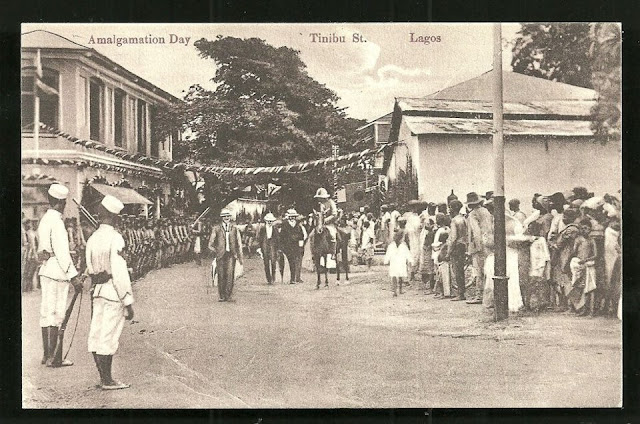
Amalgamation Day in Lagos, 1914
29 August, 2016


04 July, 2014
Both the Economy and the Violence are growing
When I started this blog, my intention was to build up to the centenary of Amalgamation, which was this year, 1st January, 2014.
A lot of things happened in the interim, in my life and in the life of the Federal Republic, and as you may have noticed there was no blog post commemorating the date. In fact, I have not posted anything since last year.
And it is difficult to restart.
What does one say? Even in times when things are more predictable (for lack of a better term), it is always difficult to sum up the Federal Republic of Nigeria, in whole or in part, using something so simplistic as words or sentences. What do you say? If only it were possible to telepathically transmit the sense of something, but even then, how to make sense of Nigeria, Africa or even of the Earth?
Nigeria's GDP-rebasing project, which looked like it would never end, finally concluded and Nigeria leap-frogged South Africa to be recognized as the biggest aggregate economy (measured by GDP) on the African continent. There are even suggestions (see video courtesy CCTV-Africa below) that the rebased figures still underestimate the size of Nigeria's economy:
On the other hand, I have frequently said on this forum that the Fourth Republic (1999-date) is the second-most violent period of our history behind only the years 1966-1970. Think about that for a second. The only period of our history more violent than the present one, is a 4-year stretch during which there was an ultra-violent coup, an ultra-violent counter-coup, widespread mass killings, and ultimately a two-and-half year Civil War.
What is particularly concerning is the violence of the Fourth Republic has been on an upward trajectory. With each passing year since 1999, it has gotten worse. What is happening now is just the worst part of a trend that has shown no sign of abating. It is all nice and good to blame Goodluck Jonathan, and I certainly think he has a big share of the blame, but this all started long before his "lucky" ascent to the Presidency, and to be quite blunt, every arm of all three tiers of the Fourth Republic administration share in the blame. Nor is the blame restricted only to those who govern; the so-called "opposition" are as much a part of the problem.
From time to time on this blog, I point out that I warned about this in an essay I wrote 11 years ago in 2003 -- even then it was already clear that the ever-rising violence was going to get out of hand, and that the various private armies and militia groups were getting dangerously well-armed and acquiring ever greater capacity for violence relative to the official security institutions.
The two-facedness of the politicians was also clear then -- they refused, and still refuse to deal with vulnerabilities and weaknesses of the security space, because they themselves maintain illegal militia and private armies (not to mention alliances with private armies on contract around election time ). One of the great problems with law enforcement reform in Nigeria is the people constitutionally responsible for reforming law enforcement are people who would be in jail if our law enforcement worked. The same is true in the public security space writ large -- it is like asking a fox to make sure the henhouse is secure.
This isn't really a problem unique to Nigeria. Many, probably most global and national institutions are run by individuals and interest-groups whose individual and group "strategic interests" ensure that the institution in practice facilitates whatever it is that it was theoretically set up to prevent.
But let me not digress to far off the point of this my "return" post.
The good news is good news because if we ever get around to the process of decreasing the amount of bad news, we are going to need to stand on the strong platform provided by the good news. And there is no stronger leg to stand on than the leg of a large and growing economy. That is the thing about the Federal Republic of Nigeria .... even in our darker moments, you cannot but notice that the potential good things are so extensive that if harnessed properly they would swamp the bad things.
But there is much to talk about, and hopefully I will speak more frequently.
A lot of things happened in the interim, in my life and in the life of the Federal Republic, and as you may have noticed there was no blog post commemorating the date. In fact, I have not posted anything since last year.
And it is difficult to restart.
What does one say? Even in times when things are more predictable (for lack of a better term), it is always difficult to sum up the Federal Republic of Nigeria, in whole or in part, using something so simplistic as words or sentences. What do you say? If only it were possible to telepathically transmit the sense of something, but even then, how to make sense of Nigeria, Africa or even of the Earth?
Nigeria's GDP-rebasing project, which looked like it would never end, finally concluded and Nigeria leap-frogged South Africa to be recognized as the biggest aggregate economy (measured by GDP) on the African continent. There are even suggestions (see video courtesy CCTV-Africa below) that the rebased figures still underestimate the size of Nigeria's economy:
On the other hand, I have frequently said on this forum that the Fourth Republic (1999-date) is the second-most violent period of our history behind only the years 1966-1970. Think about that for a second. The only period of our history more violent than the present one, is a 4-year stretch during which there was an ultra-violent coup, an ultra-violent counter-coup, widespread mass killings, and ultimately a two-and-half year Civil War.
What is particularly concerning is the violence of the Fourth Republic has been on an upward trajectory. With each passing year since 1999, it has gotten worse. What is happening now is just the worst part of a trend that has shown no sign of abating. It is all nice and good to blame Goodluck Jonathan, and I certainly think he has a big share of the blame, but this all started long before his "lucky" ascent to the Presidency, and to be quite blunt, every arm of all three tiers of the Fourth Republic administration share in the blame. Nor is the blame restricted only to those who govern; the so-called "opposition" are as much a part of the problem.
From time to time on this blog, I point out that I warned about this in an essay I wrote 11 years ago in 2003 -- even then it was already clear that the ever-rising violence was going to get out of hand, and that the various private armies and militia groups were getting dangerously well-armed and acquiring ever greater capacity for violence relative to the official security institutions.
The two-facedness of the politicians was also clear then -- they refused, and still refuse to deal with vulnerabilities and weaknesses of the security space, because they themselves maintain illegal militia and private armies (not to mention alliances with private armies on contract around election time ). One of the great problems with law enforcement reform in Nigeria is the people constitutionally responsible for reforming law enforcement are people who would be in jail if our law enforcement worked. The same is true in the public security space writ large -- it is like asking a fox to make sure the henhouse is secure.
This isn't really a problem unique to Nigeria. Many, probably most global and national institutions are run by individuals and interest-groups whose individual and group "strategic interests" ensure that the institution in practice facilitates whatever it is that it was theoretically set up to prevent.
But let me not digress to far off the point of this my "return" post.
The good news is good news because if we ever get around to the process of decreasing the amount of bad news, we are going to need to stand on the strong platform provided by the good news. And there is no stronger leg to stand on than the leg of a large and growing economy. That is the thing about the Federal Republic of Nigeria .... even in our darker moments, you cannot but notice that the potential good things are so extensive that if harnessed properly they would swamp the bad things.
But there is much to talk about, and hopefully I will speak more frequently.
20 December, 2013
Brief Comment on South Sudan
As I always say, it is difficult to know what is actually going on in the world. Politicians, the media, academics and other so-called analysts, so-called "experts" in general, they all like to talk as though they know what is going on, but a lot of the time they don't, and even when they do they tend to tell the rest of us an edited (at best) or blatantly distorted (at worst) version of what is happening, with the intent of getting us to come to certain conclusions (i.e. the conclusions supportive of their agenda, whoever they happen to be).
There has been a lot of "low intensity" conflict in South Sudan since its separation from Sudan. Of course, no conflict is "low intensity" to the people who get killed, to the families left behind, or to the communities negatively impacted by whatever metric. The current political impasse may or may not lead to a bigger civil war (and one suspects outside players, regional and global, will bring pressure to bear on the key leaders to avoid open war), but it is likely that the state of low intensity conflict will continue.
In this, both Sudans are the same. The erstwhile "North" Sudan is also a place of constant, ceaseless, simmering conflict.
As a Nigerian, I am used to people who claim dividing a country will somehow solve the country or countries' problems. I have always wondered why people think that. It doesn't make any sense. If you divided Nigeria, each new piece will inherit every problem is already has ... and will also inherit the same useless political leaders that have already proven useless at solving the problems.
There is this tendency to point to the Czech and Slovakian republics as some sort of example. I am tempted to ponder whether the example is as great as is portrayed, but the fact of the matter is even if it were the most perfect example of separation ever recorded, it would still remain the case that both subsequent countries inherited status quo ante conditions from the preceding Czechoslovakia that are absent from other areas that are often portrayed as potential beneficiaries from the same outcomes.
Besides, the European continent is an odd place. Every few decades, there is a dramatic adjustment of internal borders that is hailed as a sign of great statesmanship, and is treated as though it were not only permanent but also a solution to all the problems that had existed before the realignment of borders. After some years, or some decades, there is another upheaval, whereupon borders change dramatically again. With all due respect, and meaning no offence to either country or to the citizens therein, but there is no particular reason to believe the Czech or Slovak republics will remain as they are indefinitely, or even that the future citizens of both countries will remember the separation fondly.
Heck, contrary to popular belief, the entity "Nigeria" as currently constituted might outlast the current European borders; as it stands, we have already outlasted the USSR, the GDR, Yugoslavia, and Czechoslovakia. It seems Belgium is under stress, the Scottish National Party is flirting with a referendum, and one wonders if the much-ballyhooed European Union has more staying power than the Nigerian Federal Republic.
Look, I am not trying to offend anyone, but problems are problems. You either solve them or you don't. I am not overly fond of Felix Houphouet-Boigny's politics, but there is a statement credited to him (I don't know if he really said it) on the topic of uniting all former African colonies of France into one country. He asked whether they were all supposed to unite and share each other's poverty.
Uniting two poor countries won't make a rich one. Dividing a poor country will not create two rich ones. Dividing a violence-prone country creates two violence-prone countries. Dividing a lawless country creates two lawless countries. The Czech and Slovak republics did not become relatively wealthy because they were divided, and they would not have been relatively poor if they had stayed together.
That is all I am saying.
There has been a lot of "low intensity" conflict in South Sudan since its separation from Sudan. Of course, no conflict is "low intensity" to the people who get killed, to the families left behind, or to the communities negatively impacted by whatever metric. The current political impasse may or may not lead to a bigger civil war (and one suspects outside players, regional and global, will bring pressure to bear on the key leaders to avoid open war), but it is likely that the state of low intensity conflict will continue.
In this, both Sudans are the same. The erstwhile "North" Sudan is also a place of constant, ceaseless, simmering conflict.
As a Nigerian, I am used to people who claim dividing a country will somehow solve the country or countries' problems. I have always wondered why people think that. It doesn't make any sense. If you divided Nigeria, each new piece will inherit every problem is already has ... and will also inherit the same useless political leaders that have already proven useless at solving the problems.
There is this tendency to point to the Czech and Slovakian republics as some sort of example. I am tempted to ponder whether the example is as great as is portrayed, but the fact of the matter is even if it were the most perfect example of separation ever recorded, it would still remain the case that both subsequent countries inherited status quo ante conditions from the preceding Czechoslovakia that are absent from other areas that are often portrayed as potential beneficiaries from the same outcomes.
Besides, the European continent is an odd place. Every few decades, there is a dramatic adjustment of internal borders that is hailed as a sign of great statesmanship, and is treated as though it were not only permanent but also a solution to all the problems that had existed before the realignment of borders. After some years, or some decades, there is another upheaval, whereupon borders change dramatically again. With all due respect, and meaning no offence to either country or to the citizens therein, but there is no particular reason to believe the Czech or Slovak republics will remain as they are indefinitely, or even that the future citizens of both countries will remember the separation fondly.
Heck, contrary to popular belief, the entity "Nigeria" as currently constituted might outlast the current European borders; as it stands, we have already outlasted the USSR, the GDR, Yugoslavia, and Czechoslovakia. It seems Belgium is under stress, the Scottish National Party is flirting with a referendum, and one wonders if the much-ballyhooed European Union has more staying power than the Nigerian Federal Republic.
Look, I am not trying to offend anyone, but problems are problems. You either solve them or you don't. I am not overly fond of Felix Houphouet-Boigny's politics, but there is a statement credited to him (I don't know if he really said it) on the topic of uniting all former African colonies of France into one country. He asked whether they were all supposed to unite and share each other's poverty.
Uniting two poor countries won't make a rich one. Dividing a poor country will not create two rich ones. Dividing a violence-prone country creates two violence-prone countries. Dividing a lawless country creates two lawless countries. The Czech and Slovak republics did not become relatively wealthy because they were divided, and they would not have been relatively poor if they had stayed together.
That is all I am saying.
13 December, 2013
Continuing the focus on Fiscal health ....

If you haven't done so already, peruse this brief report from Business Day (Nigeria) on the fiscal implications of the 2014-2016 Medium Term Expenditure Framework.
10 December, 2013
Economic Statistics of the Nigerian States & Territories
I am not sure I trust our census results or any other "official" statistics. I don't just mean Nigerian government statistics, but the statistics produced by multilateral agencies, non-governmental organizations, academic researchers and even the mass media.
But you have to work with what you have.
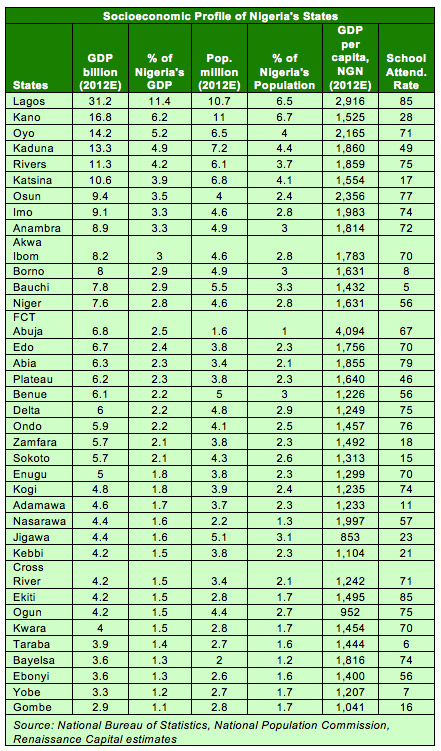
Renaissance Capital did a report on the economies of Nigeria's 36 states and 1 Territory.
The Middle Eastern business site Zawya posted this table indicating some of the key findings of the Renaissance Report:

But you have to work with what you have.
Renaissance Capital did a report on the economies of Nigeria's 36 states and 1 Territory.
The Middle Eastern business site Zawya posted this table indicating some of the key findings of the Renaissance Report:
24 November, 2013
Still Talking About Nigerian Debt

Image from Ghana Business News
As you know, if you've been reading this blog (the stats tell me there are at least a few of you), I am not overly fond of the "debt cancellation deal" of 2005.
The future value of the $12 billion we paid was equal (at a minimal interest rate) to what our Paris Club creditors could have realistically expected to receive from us based on what we were actually paying at the time. The opportunity cost, or lost value to us, was much greater; those reserves could have been used to leverage even greater spending (greater than the reserves) on our infrastructure problems (or health problems, or education problems, or security problems, or etc), with economic effects in excess of the so-called billion-dollar-a-year savings.
And we were always bound to run up new debt, meaning we would resume paying the same amount (or more) in debt service that we were already paying, except with $12 billion less in our accounts. Indeed, in the years since the "debt cancellation" we have borrowed back about as much as we owed before the "cancellation", though nobody notices because it has been accumulated as "domestic debt" and not the more noticeable "Paris Club" debt.
The Federal Government's Debt Management Office says the Federal Government currently owes $45 billion in "domestic debt". Most of this was borrowed after the "debt cancellation" deal, and it is 50% higher than our "cancelled" external debt was in 2005. The DMO has data on the states' external debts, but if they have data on the domestic debt owed by the states, I haven't found it yet. Most articles I have found on the internet that rank state debt in Nigeria only reference each state's external (i.e. foreign) debts, and don't acknowledge that is another set of debts they are not reporting on. Like the federal government, the states' debts to Nigerian banks are likely much higher than their debts to foreign creditors.
The Vanguard columnist who writes under the pseudonym "Les Leba" has a tendency of pointing out that the debts are the result of our governments depositing oil revenues in Nigerian banks, and then borrowing back the government deposits as loans from the Nigerian banks at double-digit interest rates. It isn't a new concept; the African continent's historic Paris Club debts were for all intents and purpose a function of African countries depositing their foreign reserves and export revenues in Paris Club countries and then borrowing back their own money from the foreign countries with interest tacked on. The term "Paris Club" is apt, considering the fiscal and debt relationships between France and the CFA Zone are especially weird.
We tend to keep our eyes on the Federal Government when it comes to issues of debt. Nevertheless, the 36 State Governments and the Federal Capital Territory are also borrowing, and it seems no one is paying attention. There has been no legislative, political or democratic limitation to the borrowing of the states since 1999; our state governors (and the FCT minister) are far more powerful, relatively speaking, within their respective "domains" than the President is over Nigeria.
I am unaware of any independent, credible studies of the sustainability of the growing debt loads of the states. There are a few states where one suspects debt loads have passed the point of "comfort"; I have had interesting conversations with people who have praised their state governors for spending on certain projects, while simultaneously telling me they doubt their states can pay the contractors or the banks that funded the projects.
Truth be told, the state governors are in office a maximum of 8 years, winning re-election in part by rigging and in part by popularity bought with the debt, after which they leave office as wealthy men and leave the state's debt for their successor(s) to deal with. What do they care?
Debt is unavoidable for governments, corporations and individuals. It is not necessarily or inherently a bad thing. But there are questions to be asked and answered. One of the most important questions relating to our 36+1 states is whether each individual state's ability to repay its debts. When the civil service minimum wage was increased by the Federal Government, most state governments protested their inability to pay; clearly their margin for new expenditures is thin to the degree of nonexistence. Yet their debts, and (by definition) their annual fiscal commitments to pay those debts, will continue to grow, eating and exceeding that nonexistent margin.
There are other questions, like what is this debt being used to do? There are lots of things that either look nice, or feel nice, but which don't generate revenue sufficient to pay for their creation or for their maintenance. Many Local Government Areas and States have nice new medical facility buildings but cannot not afford to properly staff, equip or resource the buildings to a degree that would have a real impact on the health of the respective communities. And as they commit ever more of their budgets to paying debts, they will have even less in the way of discretionary resources.
Speaking of which, as I said earlier, Nigeria at the Federal level has borrowed back as much in new debts as we used to owe before the "cancellation" deal. Much of this debt was not used for anything relevant to economic growth or citizen welfare. There was a particularly large jump in the debt in the run-up to the 2011 Elections; effectively Nigerian citizens have to (re)pay the political/electoral expenses of the Jonathan Administration and the Peoples Democratic Party.
The debt situation is about to get worse, though the statistics will show that it has gotten better.
Let me explain.
Nigeria's Gross Domestic Product is currently being recalculated via "rebasing". It has been almost 25 years since we last rebased the GDP calculation, and the expectation is we will either overtake South Africa and become the biggest economy in Africa, or will dramatically shorten the amount of time before we overtake them.
The new, much higher GDP figure will cause all of our macroeconomic ratios to change. It will mean the various governments' tax collections will be a smaller total share of the economy. It will mean the various governments' total deficits will be a smaller share of the total economy. It will mean the debt-to-GDP ratio will drop. It will also mean the number used to represent the estimated growth rate of the economy will change from the 6-to-7% range to the 3.5-to-5% range.
To make a long story short, the three tiers of government are likely to use the rebased GDP size as a justification to increase their borrowing. One of the most annoying (to me) terms used by so-called experts (foreign and local) in relationship to Nigeria is "under-borrowed". They seem to think there is a specific amount of debt, relative to GDP, that we are supposed to be carrying, and if we are not carrying that amount of debt, they insist that we borrow a bunch of money for no reason at all beyond their insistence that we need to owe as much as they think we are supposed to owe.
We should owe only as much as is necessary. If the necessary amount of debt is less than what the experts claim it should be, then ... so what?
And even if there is a necessity, an indisputable need to borrow for a particular thing, perhaps the first question we Nigerian citizens should ask ourselves is what type of governments, government leaders and civil service bureaucracies we want to be in charge of this borrowing. Because, if we maintain the current system, we run the risk of having, for example, an $80 billion need in an infrastructure sector, for which our governments borrow $165 billion, and mysteriously deliver only $20 billion of new infrastructure that is useless without the other $60 billion's worth of completion, and now we the citizens owe $165 billion in addition to capitalized interest in exchange for a situation that is not demonstrably different from the situation that existed before we borrowed.
There is also going to be a lot of talk about increasing government revenues from taxation and fees. Some of this talk will be in terms of relieving the need to borrow. Some of it will be in terms of raising funds to pay back loans already borrowed and loans to be borrowed.
There are two sides to this coin. Whatever the real GDP of Nigeria is (I am not sure anyone really knows, rebased or otherwise), the citizens of Nigeria have long borne the fiscal costs of providing for themselves many of the things that are theoretically supposed to be provided by the public or private sectors of the economy. Assuming the government can efficiently tax the people so as to increase government revenue and decrease the discretionary revenue of private citizens, is there not a chance that the private citizen will be less able to provide himself and his extended family with those goods/services without there being a replacement of those goods/services from the government (i.e. paid for from the increased taxes)? Suppose the money just goes to pay debt? Suppose the money pays for more PDP election "victories"? Suppose the money goes to the right place, but $165 billion of spending in the right place mysteriously purchases only $20 billion worth of the whatever it is?
I am not being cynical (though I am sometimes a cynic). These are the kind of debates we should be having in our political space, rather than arguing with ourselves which of the "geopolitical zones" deserves the next "turn".
We have borrowed a lot of money. We are going to borrow a lot more, it seems. There needs to be more of a discussion about this ... before someone starts telling us it is a great idea to spend $24 billion to "cancel" $60 billion, only to borrow another $70 billion eight years afterwards.
02 October, 2013
Femi Aribisala on "Bigmanism"
If you haven't already, take a look at this funny essay in yesterday's Vanguard.
"Independence" Day 2013
Another year since 1960.
The big anniversary comes up in three months -- the Amalgamation Centennial on the 1st of January 2014.
I wish the Centennial was occurring in a different, better set of circumstances. As it stands, I suspect critical comments as to whether the Amalgamation was a good thing or not will predominate over celebratory comments.
The three tiers of government will probably put on glitzy shows, that will be more about expensive (as in contract-generating) excess. As per usual there will not really be anything that grabs at the heart and soul of who we are and why we are, nothing that really expresses our cultures or identities as distinct peoples or as a unified Federal Republic.
The big anniversary comes up in three months -- the Amalgamation Centennial on the 1st of January 2014.
I wish the Centennial was occurring in a different, better set of circumstances. As it stands, I suspect critical comments as to whether the Amalgamation was a good thing or not will predominate over celebratory comments.
The three tiers of government will probably put on glitzy shows, that will be more about expensive (as in contract-generating) excess. As per usual there will not really be anything that grabs at the heart and soul of who we are and why we are, nothing that really expresses our cultures or identities as distinct peoples or as a unified Federal Republic.
30 September, 2013
How we write about ourselves.
I promise you I decided to write this post before the recent tragic events at the College of Agriculture, Gujba in Yobe State.
Two things I have said often on this blog.
(a) The Fourth Republic is probably the single most corrupt period of our history so far; and
(b) The Fourth Republic is the second-most violent period in our recent history, behind only the Civil War. The First Republic would be third on the list of violent periods, despite the fact that many seem to look at it as though it were some sort of golden age of peace and prosperity.
There is enough violence going on that I would probably have had to apologize regardless of when I eventually wrote the post. But for the record, I was going to write this before what happened in Yobe.
But firstly, may the souls of the victims Rest in Peace. I don't know what else to say. There is nothing I can do to help.
I wanted to write a post about the way our media covers murder and mass murder, specifically the tendency to show graphic pictures of the victims.
Elsewhere in the world, they spare the families of the
deceased the shocking sight of their loved ones in the aftermath of something
like this .... whereas in Nigeria, the victims' bodies are
displayed without blurring, censoring or respectfully-placed pixels.
By the way, those media outlets from elsewhere in the world do not extend that level of respect to us when covering incidents of mass violence on our continent. For example, some years ago, on a weekend morning (i.e. when children were likely to be home), one of the USA's basic cable networks ran a documentary on Liberia and Sierra Leone, and showed everything, including one man's head which had been detached from his body and placed on a table. Had he been an American victim of a crime in the USA, either (a) they wouldn't have shown the head; or (b) they would have blurred his eyes so we the viewers (and particularly his family) would not .... see him. In fact, I think their channels are afraid of being sued by the families of American victims, but fear no consequence from us.
Still, how can we demand respect from other people when we do not respect ourselves? Reminds me of a speech I gave on Nigeria, where I instructed the audience to stop referring to Africa's (ethnic) nations as "tribes". After talking about this, that and the other, I took my seat and prepared to listen to the Kenyan who was due to speak next about Kenya. To my dismay, he spent the entire time referring to every single ethnic group in Kenya, one after the other, as a "tribe". It was a small enough group that I could see the people in the audience looking at each other in confusion.
By the way, I am not squeamish and this post is not about squeamishness. There is a time and place to look at and see the ugly realities of human history, of the human present and (unfortunately) of the human future. In the time and the place, I do not turn away.
That isn't what our media is doing, though. In fact, as you know, I am generally critical of how our media cover mass murders and single-victim murders. Their coverage of "communal violence" does very little to give us factual information about what actually happened, why it happened, and who actually did it. Their coverage of "communal violence" on the contrary tends to serve a fuel-on-the-fire role of sustaining the exact sort of cloud of misinformation that makes "communal violence" both likely and recurrent.
There are analysts and commentators who talk about something called "disaster porn". I wish they had chosen a different name for it (and shudder to think that some people will stumble onto this page after doing a web-search for something else). You can do a web-search yourself to find essays on "disaster porn" ... and when you've done that, consider that I think what the Nigerian media does is 100% "disaster porn" and 0% information.
More importantly they show 0% sensitivity in not even considering the fact that someone's mother, or father or spouse or child might opt to find out what happened in the world today, and find themselves looking unexpectedly at the graphic image of their murdered relative. You tend to hear police in certain countries talk about not revealing the names of the victims to the media until after their families have been informed -- in Nigeria, particularly now in the era of the internet, the pictures of the dead are posted even before the police know how many dead people there are, much less the names of family members to notify.
Do we even notify the families? A friend of mine, my next-door neighbour growing up, was murdered on the campus of one of our universities back when "cult violence" was rampant. His body was unceremoniously dumped with a pile of other bodies collected that night, and his parents had no idea what had happened because no one (not the police, not the university, no one at all) told them anything. After they hadn't heard from him in a long while, they travelled to the university, presuming to ask him what was going on .... only to be directed to the morgue, where they found him in a pile of other bodies.
That particular incident didn't make the news, because it was didn't met the threshold to count as good "disaster porn". There is a lot of stuff, violent stuff that happens in our Federal Republic that no one ever hears about, because there isn't an "angle" to it, no existing strings the news can be used to pull.
But that isn't really what this post is about.
There is a time and place for graphic images of violence and disaster. And there is a time and place when images can be presented, but should be "censored" to show sensitivity to the families of the victims.
There is also a philosophical principle involved in sensitizing people to something by showing them what it is without editing. But there is also a dangerous result where people see something so often they become inured to it (indeed, seeing incredibly graphic images of mass murder does not seem to lead to protests or outrage about the media showing us such images; on the contrary, we don't seem to react to it at all).
I wish someone would speak to the Nigerian media, and explain to them the difference. Unlike our politicians, I think the media is capable of learning.
May the souls of the victims Rest in Peace.
16 September, 2013
Quick Stats on Nigerian and South African Banks
I am posting this for the statistical content, and not in support of the viewpoint being expressed by its author via Business Day.
While I am on the topic of Business Day, there were a few months there where the quality of their sites and their journalism mysteriously weakened. But they appear to be returning to form as a, if not the, leading business publication in the Federal Republic.
I do think they need a little less coverage of random foreign business news culled from foreign news outlets, and a little more coverage of Nigerian business specifics. Seriously though, is the GDP in Jigawa or Taraba growing or shrinking? Farm output in Benue or Yobe going up or down? River transporation demand in Bayelsa going up or down?
Yeah, I know, it is easy for me to talk.
Anyway, I don't agree with the point that there should be fewer banks in Nigeria. What we need are stronger banks, regardless of the number. Soludo's consolidation of banks did little or nothing to affect the governance problems (among other problems) at our banks; it didn't help that Soludo's CBN was extremely lax in oversight and enforcement of the rules, partly by choice and partly because the banking grandees were untouchables, members of the PDP and supporters (funders) of President Obasanjo.
Philosophizing and ideologizing are neither here nor there in the practical world of economics, but it always bothered me that Soludo's idea of compelling Nigeria to have banks the size of South Africa consisted of dividing the same-sized pie among fewer banks, rather than increasing the size of the pie and the size of each banks' slice as a result.
I know we are a lot poorer than Japan, South Korea, Germany, France and the United Kingdom, but there is no fundamental reason why this should be the case. Sure, there is a lot of literature from a lot of people who purport to explain the discrepancy, but much of that (if not all of it) suffers from the same ailment that affects writings on history. In terms of this blog (and this blog post), the important thing to say is what I have already said: There is no fundamental reason why the Federal Republic of Nigeria should be poorer than the aforementioned. Whatever you assert to be the cause for this state of affairs is by definition something that can be corrected (and that should have been corrected a long time ago). We should plan our banking sector based on achieving that aim, as opposed to aiming at a destination (South Africa's economy) that is actually (with due respect) smaller than what we should be aiming for.
Besides, there are reasons why the South African banking industry is an oligopoly, and those reasons have nothing to do with free market determinism. In fact, one might be tempted to argue that the banking oligopoly is as problematic to the South Africa's long-term economic (and political) future as the oligopoly in land ownership and commercial agriculture.
You know what I mean.
Feel free to disagree with me. Nigerian politics would be a lot more relevant to Nigerian development if we engaged in serious debates about the banking industry, rather than asking ourselves which geopolitical zone, senatorial zone or other zone has the next chance in the rotation to produce the executive or legislator.
Anyway, here is the statistical diagram, courtesy of Business Day. You might have to click on it to see the full thing:

While I am on the topic of Business Day, there were a few months there where the quality of their sites and their journalism mysteriously weakened. But they appear to be returning to form as a, if not the, leading business publication in the Federal Republic.
I do think they need a little less coverage of random foreign business news culled from foreign news outlets, and a little more coverage of Nigerian business specifics. Seriously though, is the GDP in Jigawa or Taraba growing or shrinking? Farm output in Benue or Yobe going up or down? River transporation demand in Bayelsa going up or down?
Yeah, I know, it is easy for me to talk.
Anyway, I don't agree with the point that there should be fewer banks in Nigeria. What we need are stronger banks, regardless of the number. Soludo's consolidation of banks did little or nothing to affect the governance problems (among other problems) at our banks; it didn't help that Soludo's CBN was extremely lax in oversight and enforcement of the rules, partly by choice and partly because the banking grandees were untouchables, members of the PDP and supporters (funders) of President Obasanjo.
Philosophizing and ideologizing are neither here nor there in the practical world of economics, but it always bothered me that Soludo's idea of compelling Nigeria to have banks the size of South Africa consisted of dividing the same-sized pie among fewer banks, rather than increasing the size of the pie and the size of each banks' slice as a result.
I know we are a lot poorer than Japan, South Korea, Germany, France and the United Kingdom, but there is no fundamental reason why this should be the case. Sure, there is a lot of literature from a lot of people who purport to explain the discrepancy, but much of that (if not all of it) suffers from the same ailment that affects writings on history. In terms of this blog (and this blog post), the important thing to say is what I have already said: There is no fundamental reason why the Federal Republic of Nigeria should be poorer than the aforementioned. Whatever you assert to be the cause for this state of affairs is by definition something that can be corrected (and that should have been corrected a long time ago). We should plan our banking sector based on achieving that aim, as opposed to aiming at a destination (South Africa's economy) that is actually (with due respect) smaller than what we should be aiming for.
Besides, there are reasons why the South African banking industry is an oligopoly, and those reasons have nothing to do with free market determinism. In fact, one might be tempted to argue that the banking oligopoly is as problematic to the South Africa's long-term economic (and political) future as the oligopoly in land ownership and commercial agriculture.
You know what I mean.
Feel free to disagree with me. Nigerian politics would be a lot more relevant to Nigerian development if we engaged in serious debates about the banking industry, rather than asking ourselves which geopolitical zone, senatorial zone or other zone has the next chance in the rotation to produce the executive or legislator.
Anyway, here is the statistical diagram, courtesy of Business Day. You might have to click on it to see the full thing:

Subscribe to:
Posts (Atom)