Take some time out of your day and read this article from Daily Trust.
There are other jumbo spending packages not mentioned by Daily Trust, particularly spending at the second- and third-tier, as well as spending that was not disbursed by the Central Bank of Nigeria.
I wonder (and worry) sometimes if anyone knows how much money our three tiers of government receive and spend. Crime films popularized the notion of mobsters keeping two sets of accounting "books", one for the taxman and one for their internal use. I doubt our governments keep records of the many off-the-books transactions, but the official numbers used by the Minister, Commissioners and Supervisory Councillors of Finance are not fully reflective of reality.
Nevertheless, we must make every effort to keep track of what our three tiers of government say they are spending, what they say they are spending it on, what was actually spent, and what were the measurable outcomes of the spending.
Highlights from Daily Trust's article on the subject of earmarked spending and credit facilities in the last couple of years):
Four Banks' Bailout: =N=650 billion (US$4.3 billion)
Banking Sector Toxic Asset Bailout (AMCON): =N=1.037 trillion (US$7 billion)
The AMCON-led bailout was in the form of bonds yielding 10.125% due 31st December 2013.
Aviation Intervention Fund: =N=300 billion (US$2 billion)
Intended more to bailout banks stuck with non-performing aviation-related loans
Electricity/Power: =N=300 billion (US$2 billion)
CBN and Bank of Industry credit facility
SME/Manufacturer's Loan Restructuring Facility: =N=200 billion (US$1.3 billion)
The Daily Trust article was not very clear on whether this was the same as, or different from, Textile Industry intervention funds (nor were they clear on whether the Textile Industry fund was =N=100 billion or =N=200 billion).
Entertainment Industry: =N=30 billion (US$200 million)
The Daily Trust Article incorrectly said $200 million is equal to =N=150 billion. The value of the Naira moves up and down, but $200 million is more or less about =N=30 billion.
Commercial Agriculture Credit Scheme: =N=200 billion (US$1.3 billion)
Who is getting this money? What are they using it for?
Automobile Intervention Fund (speculated): =N=550 billion (US$3.7 billion)
To encourage Nigerian consumers to buy Made-In-Nigeria cars, buses, etc.
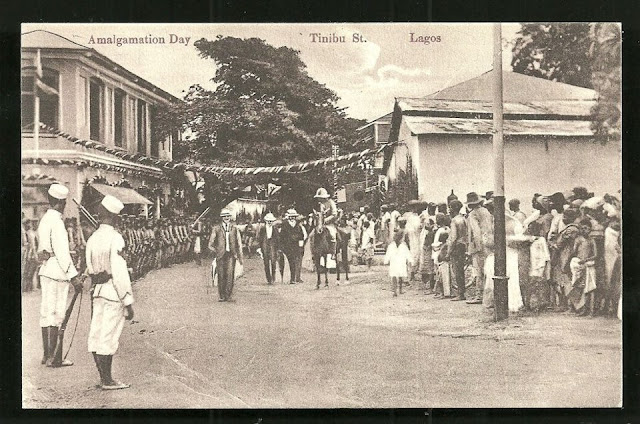
Amalgamation Day in Lagos, 1914
27 March, 2011


25 March, 2011
ECOWAS and Cote d'Ivoire
The 39th Ordinary Summit of the Heads of States and Government of the Economic Community of West African States (ECOWAS) ended yesterday in Abuja, and while NEXT chose to see the statement released as a statement of intent for military action in Cote d'Ivoire (this editorial gives away their perception that war is imminent), I see ECOWAS' statement as being the usual, dangerous fudge.
It is "usual" because they have not really decided to do any specific thing other than keep pushing a decision down the road until the situation resolves itself. But it is dangerous becomes sometimes people end up in wars they do not want to fight because they keep making commitments to fight, and (especially) engaging in the gamble of drawing lines in the sand and promising to fight if someone crosses that line; almost always they truly and deeply hope the person backs down and doesn't cross their line, yet once the line is crossed they must either fight or lose credibility.
You shouldn't talk about military action unless you are serious about it.
And Nigeria shouldn't be getting involved in military actions of uncertain duration, uncertain length and uncertain expense. The budget and debt situations of the self-anointed dozen or so countries who named themselves the "international community" mean they cannot credibly promise to refund our expenses.
Alas, the Federal Government could care less what I or any other citizen thinks. They are too busy trying to impress the "international community" and play at being a regional giant. For all I know, NEXT may be right, and the government may be planning a military intervention in Cote d'Ivoire.
If it has to happen, we shouldn't take sides.
I know the "international community" says Ouattara won the election (only Heaven knows how they are so sure when the vote was rigged in both the North and South of the country).
And I know Laurent Gbagbo is yet another in the line of believers in the concept of Ivoirite, a xenophobic, tribalist, regionalist, divide-and-rule device invented by ex-President Henri Konan Bedie as a strategy for cementing his hold on power.
But the reality of the Ivoirien political situation is the country has to move beyond Neo-Houphouetist politics and politicians, and must specifically move past the personalities and political factions and rivalries associated with Bedie, Ouattara and Gbagbo. These men are polarizing figures, and their continued dominance of the political stage is an invitation to future instability, regardless of what happens in the present case.
That is the view from Cote d'Ivoire's domestic angle.
From the point of view of Nigeria's strategic regional interests, it hardly matters which of the three major factions wins the presidency. Ouattara and Bedie (both political scions of the Houphouet-Boigny) would govern the country as an overseas department of France, with monetary policy drawn up in Paris, and fiscal policy designed in the IMF offices in Washington; they would both treat Nigeria as an existential threat and not as an ally or trading partner. And while Laurent Gbagbo hates the French (because they were allies of his lifetime rival Houphouet-Boigny, a man who undemocratically oppresses Gbagbo and his supporters), he too sees Nigeria as an existential threat, and not as a regional ally or potential major tradting partner.
As with most of our "Big Brother" nonsense since 1960, we would be in effect facilitating the rise of a government (one way or another) that will treat us with utter disdain, regardless of the fact that we helped them.
All things considered, if Nigerian soldiers go into Cote d'Ivoire, it shouldn't be to fight one faction as the ally of another faction. We should only go in to serve as a neutral force, spread out around the country, to superintend a new national election in which everyone with a political history is barred from contesting. We should only go in at the invitation of both factions, consequent on both sides agreeing to the plan for new elections with a completely clean and new slate of candidates.
Of course neither side will agree to this .... and I have no problem with that, so long as neither side expects our soldiers to DIE to put them in office. I am tired of people using Nigeria to chop awoof. If you want us involved in resolving your disputes, do it our way; if you don't want to do it our way, then don't ask us to risk our lives and money to do it your way -- it is your way, so you take all the risk and leave us out of it.
We need to start articulating firm positions consistent with our strategic outlook, rather than just parroting whatever happens to be the reigning (and always temporary) opinion of the "international community"
EDIT: I thought I was the only one who felt a new election should be held, with the current faction leaders barred from standing again. As it turns out, a South-Africa-based Ivoirien professor agrees with me somewhat.
EDIT-2: Some of you may be wondering why my comments above do not address the humanitarian situation. There is violence in Cote d'Ivoire and the possibility (though not guarantee) of worsening violence if nothing changes in the immediate future. In reality, my comments do address the humanitarian situation, not by attacking the symptoms but instead by attacking the disease itself. I repeat again that the Neo-Houphouetist brand of politics embodied by Bedie, Ouattara and Gbagbo is the proximate source of the political, economic and sociocultural crises in the Cote d'Ivoire -- and it is militias loyal to these men that are responsible for the violence. To end the symptoms, you have to end the disease. It is long past time for a new post-colonial Cote d'Ivoire to emerge from the political debris of the old, neo-colonial Cote d'Ivoire.
Convivial Form .... Violent Substance

Hajiya Halima Aminu Tijjani (Photo Credit: Daily Trust)
Hajiya Halima Aminu Tijjani, is a senatorial candidate running on the ticket of the Action Congress of Nigeria (ACN) in Kaduna State. She was viciously beaten by thugs acting on the orders of the Barrister Musa Soba, Kaduna State Chairman of the ACN.
My last post before this one had videos and links to videos of the 2011 Presidential and Vice-Presidential debates organized by NN24. Whatever you think of the candidates and of their answers to the questions, the debates present a particular image of how Nigerian politics is conducted.
But dig a little deeper and you find out that politics in Nigeria has changed very little since the First Republic. It is VERY violent, and female candidates are not spared. Daily Trust reported on female candidates who have endured vicious beatings, attempted kidnapping, and intimidation by thugs (it is 3-pages long with a lot of information, though I would have liked a lot more detail).
Before you tell me I shouldn't blame the principals for the actions of such "low level" political operators, let me remind you that these operators, these political bosses, these wielders of "structures" and "machines" that control outcomes "on the ground" are the people the political VIPs hire and pay to produce what you might call favourable outcomes on behalf of the VIP.
It is why I don't take politicians seriously when they criticize their rivals (but not themselves or their allies) for instigating violence, as President Jonathan did here, and General Buhari did here.
Speaking of those two candidates, any number of CPC-aligned thugs have responded violently to the arrival of the PDP presidential campaign train in their cities, while pro-Jonathan PDP governors have not hesitated to use hired thugs, uniformed security officials (who are supposed to be neutral) and illegal, unconstitutional edicts and proclamations (without parliamentary approval) to hinder or quash the campaign rallies of the president's rivals.
Would the bosses of "grassroots" political machines wield such power without the patronage and protection of the Big Men? Or it is that the Big Men would not wield the power they control without the backing of the machine bosses? Either way, the two groups work hand in hand to dictate political outcomes.
It is one of several reasons our Police Force and general law enforcement are deliberately kept dysfunctional. When political bosses hire thugs and send thugs to beat, intimidate or assassinate other politicians, they do so on the understanding that the powers-that-be will let them get away with it. Even if the assault is done by an opponent of someone who has power, the person with power would still prefer to let it go because he knows he will want to do the same thing soon, and he does not want to start a tradition or custom of people who do things like that getting arrested. Besides, he knows the day will come when he is no longer in power, when the other Big Men could revenge against him if he punished them too much when he had power.
And visiting such violence on women isn't even a new thing. A classmate of mine, a mother of two and a women's leader in one of the smaller "opposition" parties, was murdered. Not to mention the fact that women are, like men, general victims of the low-intensity, below-the-radar violence that characterizes "elections" in Nigeria.
If only the image presented by the debates reflected reality.
EDIT:

Scene of political violence at Fortune High School (Photo Credit: Sahara Reporters)
While I was still composing this post, more political violence broke out in Akwa Ibom, Ekiti, Jigawa, Edo and Ondo States. Various bands of thugs loyal to the Peoples Democratic Party, the Action Congress of Nigeria, the Congress for Progressive Change and the All Nigerian Peoples Party were variously involved in the murder, mayhem and destructions.
A few links: In Akwa Ibom; in Jigawa, Ondo and Ekiti; pictures of the Akwa Ibom aftermath from Sahara Reporters.
You cannot rig in a territory you don't "control". Like urban gangs the world over, these thug armies are laying claim to "turf" ahead of the polls.
Expect the presidential candidates to express their dismay and disappointment, their shock and their horror, their resolve to bring the guilty to justice, blah, blah, blah, blah.
VIDEO: The Presidential Debates - Minus the President
THE VICE-PRESIDENTIAL DEBATES
I tried to find an embeddable video for the Vice-Presidential Debate that was organized by cable news channel NN24, moderated by Kadaria Ahmed (of NEXT), and boycotted by the PDP's incumbent Vice-President Namadi Sambo. While there are brief, embeddable clips on Youtube, but if you want a full-length version, click on this link hosted on the website Yousabi.com to watch a full 84-minute video of the event.
THE PRESIDENTIAL DEBATES
I did find two videos of the 2011 Presidential Debates, which were also organized by cable news channel NN24, also hosted by Kadaria Ahmed, and also boycotted by the PDP candidate, incumbent President Goodluck Jonathan.
The first video was edited (not by me) and begins with Buhari's opening statement, and runs for 73 minutes, while the second video begins earlier (allowing you to hear Kadaria Ahmed's opening statement) and runs for only 58 minutes.
The second video is interesting because you hear the audience applaud after Kadaria Ahmed's comment on the President's absence. If you are wondering why the audience applauded, it is because they had been sitting there for an hour or so waiting for the President, who had said he would show up but then didn't and didn't bother to tell anyone he had changed his mind. When he had not arrived by the time set for the debate to begin, NN24 delayed proceedings by an hour or so because they thought he was being fashionably late (as self-important, pompous Big Men usually are) and they didn't want to start live broadcast of a debate only for the President (technically the most important candidate to have on the stage) to wander in halfway through. Eventually, after an hour, they decided to begin the debate .... at which point Kadaria made her comment and the audience applauded.
FIRST VIDEO: EDITED (NOT BY ME) FULL VERSION
SECOND VIDEO: INCLUDES KADARIA AHMED'S OPENING COMMENTS
Restoration of trust
The Federal Government evacuated around 4,000 Nigerians from Libya and closed the embassy in Tripoli. I overheard two Nigerians discussing this, and lamenting the fact that Nigerians have so low an opinion of their government that some did not think the government would lift a finger to help stranded Nigerians.
They have a point. An important one. Too many of us Nigerians take the pessimistic view of things. It is a drawback to our progress and one of many reasons you won't see Tunisia/Egypt-style popular uprisings in Nigeria.
It is a paradox really.
On the one hand, we are the most optimistic people on Earth. We offers prayers to the Almighty, give thanks for our many blessings, and look toward the future with hope. As we say in pidgin, somehow, some way, e go betta. Our optimism is a disadvantage actually; so many of us believe we might one day rise to a position of power and influence that it is impossible to rally people to fight sources of dysfunction like corruption -- no one wants to fix the dysfunction until after they have had a chance to milk it and enjoy it for themselves (after we have enjoyed our share and left office as wealthy men, we convert and become latter-day believers in reform, criticizing all of our successors, one after another, for doing the same exact things we did when we were in office).
On the other hand, the late Fela Anikulapo-Kuti mocked us all as being so afraid of dying we are incapable of rallying to fight for our own commonweal. We assume any effort made to improve things will fail, that anyone who believes otherwise is a mugu, and that people who fight for a better Nigeria will suffer while they live and die unlamented by a populace that never cared enough to lift a finger to help. Apathy set in long ago, long before our villages sold our fellows as slaves, long before our twins were killed in the bush; we have been apathetic so long, I am not sure we remember how to fight for our rights. It is like people believe it is better to have no constitutional rights and be alive, rather than die in a fight for rights that you do not believe you will ever have.
Both my blogs reflect this Nigerian duality.
If I didn't have faith in Nigeria, if I didn't believe our federal republic could be so much more than what it is, if I didn't think only a brief period of reform, restructuring and transformation lay between us and our ideal destiny, then I would have given up hope long ago and would not be as passionate about the issues as I am or so disappointed that the necessary reforms are not even being contemplated. I have no apathy in my bones, none!
On the other hand, anyone who reads my blogs will get the sense that I don't think anything will change anytime soon.
Funny, isn't it?
No, not really funny. Kind of sad to be honest.
Our spiritual duality as citizens extends to our opinions of politicians and captains of industry.
On the one hand, we praise them and hail them, partly in admiration and respect, and partly because in our society you have to kiss the arse of the man above you (and oppress the man below you) if you want to maintain your own little niche in our insufficient economy.
On the other hand, our society assumes every politician and plutocrat is a thief, a vagabond, an unprincipled, unethical, philandering, nation-destroying rogue. Citizens assume they are all "guilty until proven innocent"; if any prove to be innocent, citizens view him as a mugu who doesn't know he is supposed to enrich himself.
So, yes, those two Nigerians I referenced in the first paragraph are right. There is a profound cynicism among us Nigerians. Religion, Football and Cynicism, the three core Nigerian beliefs.
With that said ...
Most of us Nigerians spent at least some of the first two decades of our lives believing the best, making the optimistic assumption, and hoping with all of our hearts.
We were disappointed again, and again.
Our beliefs, optimism and hopes were used, abused, manipulated, distorted, betrayed and then discarded like trash ... again and again.
This kills our hope. This kills our dreams.
They destroy our trust.
The idealistic part of our souls is crushed by the weight of reality slapping us in the face, and we are left most of us bitter, twisted, cynical, frustrated. We are a happy people, but beneath all of our smiles lies simmering rage -- one small spark, and we go off! Eventually, most of us give up on our dream of a better Nigeria, and shift our ambitions towards exploiting the many dysfunctions of the existing Nigeria for our personal pecuniary gain.. Those who succeed become dependent on the dysfunction, and are inspired to destroy anything and anyone that might want to reform the country. Those who don't succeed remain hopeful, first that they will one day get their chance to hammer, and later that their children will get the hammering chance they never had; these children become adults who have been taught to be both fervent in their religious observance and at the same time frighteningly sociopathic in their pursuit of wealth (at the high end) and survival (at the low).
As I type this, it occurs to me that I must still be extremely optimistic about the federal republic, because I refused to make that transition. Usually when you say that, people laugh at you and say it is only because you have never had a chance to "chop" ... but I did have such an opportunity, as I noted in this recent blog post, and turned it down. A powerful person offered me what would have been a dream job in Abuja, based on the job description anyway. But as is often the case, what the job really was, and what the job had been advertised to be, were two different things. I very quickly realized that in practice I would be working for someone whose job was rigging elections.
I couldn't do it.
I didn't do it.
You don't have to believe me. That too is a reflection of the loss of trust. A Nigerian is the one person on Earth who will never believe that another Nigerian turned down a chance at illicit money and illegal political power.
Believe it or not, I was thus briefly exposed to the inner world of the people who run elections in Nigeria. They were so comfortable with what they were doing. Joking and laughing at people who criticized them. If I had opened my mouth and said, "But what you are doing is wrong," they would have laughed even harder. As it stood, I smiled and nodded, told him I would let him know in a couple of days, then sent him an email to say "No".
Moments like that make you feel that we are quite far from where we need to be.
Which brings me back to the two Nigerians in the first paragraph who were complaining about the pervasive cynicism in Nigeria.
Again, I say they are right, but it is not on us the people to spontaneously start trusting institutions that have betrayed us and continue to betray us even now.
It is for those institutions to EARN our trust back.
And that cannot happen if we the people remain estranged from our institutions.
We must take them back and make them be what we want them to be.
The people who currently run our institutions do not believe they need to earn the public's confidence. Like the man who offered me a job, they would laugh if you earnestly asked them to do their jobs in a manner that would restore your trust.
In fact, that is the funny thing about Nigeria. The way our country works, you are supposed to kiss the arse of the man above you ... and oppress the man below you. The idea that somebody who is "up" should work hard to earn the trust of someone who is "down" is anathema. "Democracy" is supposed to moderate this natural human tendency; since there are always more people "down" than there are people "up", the "up" people agree to all sorts of wealth redistribution systems and constitutional rights of pro forma equality so as to make nice to the "down" people who could (in theory) vote to seize all their wealth. But in Nigeria, there is no such moderation; as Machiavelli might have said, power exists to do whatever power wants (maybe he did say it, I don't know, I've never read Machiavelli).
There is an arrogance, a shamelessness to it. Take the Nigerian Police Force, who routinely look us all in the eye and LIE about extra-judicial killings. When exposed, they make it quite clear to all and sundry that they could care less about being caught lying about something so important.
Everyone in Nigeria assumes the Police lies about everything. Everyone knows that most people killed and/or arrested by the Police are not guilty of anything. Everyone knows the Police are incapable of properly investigating a crime. Everyone knows the Police defend corrupt leaders against the people, rather than defending the people against corrupt leaders.
The Police have an AWFUL public image, just abysmally awful.
And guess what? The Nigerian Police Force do not give a damn about it. They are not interested in earning the people's trust. The upper echelon of the Force holds all of us Nigerian citizens in contempt. Who are we to talk when they are talking? If they hear pim, they will unsheathe their AK-47s and shoot us down like dogs.
I don't understand it.
The phenomenon runs across-the-board phenomenon, embracing even the national pastime, football.
All over the world, people are suspicious of the "official age" of Nigerian football players. In Nigeria itself, cynicism rules, Nigerians don't trust Nigerians, and we all secretly assume every player is guilty of age cheating until proven innocent. Those players who do use their real and true age live under the same cloud of suspicion as their less honest colleagues.
We all know this suspicion exists and that it is pervasive.
Age-cheating thing is driven by the desire to make oneself attractive to European clubs ... and by the Nigerian public's any-means-necessary desire for "glory" in age-restricted international competitions for small boys.
The thing is, age-cheating doesn't achieve what the cheats want it to achieve.
As of 2011, it would be politically incorrect for the managers of European clubs to say out loud that they make adjustments in magnitude of pay and length of contract offered to Nigerian players to hedge against their suspicions that the players are four or more years older than they claim.
And as far as fans' desire for international success, we all know our senior national team suffers in the long-run. We all know that we are paying for our small boy trophies with the loss of the really important senior trophies.
Yet we keep doing it. We know we are not deceiving anyone. We know we are only shooting ourselves in the foot. But we keep doing it.
In fact, it is a very good example of how optimism is killed.
Nigeria hosted the last Under-17 World Championship in 2009, and we were all happy when the MRI scan ruled out so many players the NFF had been planning to use in the tournament. Our optimism soared.
Then came Fortune Chukwudi and Kayode Olanrewaju ... and the realization that MRI scanning was not scientifically fool-proof.
Mind you, I don't want to gang up on these two young men. I understand the financial pressures they are under, and I realize a contract in Europe would change their lives and the lives of their families.
In fact, right now I am not concerned with Fortune or Kayode, but with the Nigerian Football Federation. We were lucky that the broader football world does not take small boy competitions as seriously as we do, so the issue didn't get HUGE media coverage. Nevertheless, the revelations about Fortune Chukwudi did go around the world.
Here was an opportunity for the NFF to once and for all quash all those rumours about Nigerian players by proving Adokiye Amiesimaka was wrong or mistaken. Unless Fortune and Kayode suddenly emerged out of a vacuum, they would each have built up a young lifetime's worth of documentary proof (even if they have nothing else, they have school report cards) and character witnesses. If I put on my cynic's hat and speculate, the NFF could even have forged documents, faked proof, and paid witnesses to lie.
What bothers me is they didn't do anything.
FIFA has always known teams cheat at age-restricted competitions, but strangly prefers to act only when it has no other option. As soon as the NFF realized FIFA was not going to torpedo the tournament by making a big fuss out of the Fortune Chukwudi affair, they flat out didn't care that everyone was talking about us as cheats. The NFF pretended they had heard nothing from Adokiye, had seen nothing in the news. Vague allusions to saboteurs and enemies and unpatriotic behaviour was as much as we got. We even kept using Fortune in matches, as if to give the world a middle finger. It is like we were saying "Ha ha ha, we cheat and you know it, and we don't care, ha ha ha!"
Tomorrow when people say they don't trust the ages of Nigerian players, someone will say we are cynics. Here is the one agency whose duty to Nigerian players, Nigerian football and Nigerian fans is to restore CREDIBILIITY in the system, and it quite clearly does not care about the fact that it has no credibility.
Heck, the Nigerian Football Federation is the source of the "21 or 28" song the Newcastle fans sang about Obafemi Martins. In the last few years the NFF have occasionally put up websites and occasionally taken down websites. On one occasion when a site was up, they listed a birth-date for Martins that was different from his "official" birth-date. Now, it is quite possible it was a genuine mistake, and that Martins is using his real age .... but there is so much doubt swirling around, so little credibility, that managers in Europe likely assumed Martins was 28 (his club career has certainly become rather erratic of late).
And they don't care! The NFF doesn't give a damn about the fact that it generates nothing but distrust.
I am glad the Federal Government evacuated those Nigerians in Libya. On behalf of my fellow citizens I say thank you and kudos.
But I still don't trust you.
24 March, 2011
Nigeriocracy
So, I was witness to yet another conversation between people with varying opinions on the Fourth Republic.
One person said "democracy" as practiced in Nigeria was too expensive (not just in terms of what is taken or wasted when a person is in government, but also the expense in money, lives and injuries from their fight to get into office and stay there) and delivered to little value for all the expense. He was of the opinion that the Federal Republic should be a one-party dictatorship. And yes, he trotted out China as his example of an economically successful one-party state.
The other person said "democracy" is a process and not an event. He argued the Fourth Republic was "young", that we were still "learning" and that we would get better at it with time.
They are both wrong.
We are neither practicing "democracy", nor are we in the process of it. And our history, dare I say "civilization" is as old as anywhere else in the world; we have had enough time to make enough mistakes over millennia -- if we refuse to learn from our mistakes, it does not mean we are too "young" to know right from wrong.
But if we are not practicing "democracy", then what should we call the operating system of Nigerian governance?
I do not think Political Science has a word for it. Despite the similarities, it is not an oligarchy or plutocracy nor is it a feudal or corporatist state. Despite "federal character", our is neither a consociational nor confessional state. We have never really had an "autocracy" or "dictatorship" per se (on a couple of occasions we did come close), and while we have never been exactly "federal", we have never been anything remotely approaching "unitary" either.
All that talk about "Westminster" and "Presidential" is window-dressing. Our First Republic had much in common with the rest of post-Independence Africa, but was also rather unique on our continent, for any number of reasons, the consequences of regional federalism being just one driving force of the disparity. Actually, all of our experiments with civilian-rule have been unique in Africa; federalism again drove some, but by no means all (or even most) of the differences. There are peculiarities about Nigeria's politics (too lengthy to discuss here) that allowed us to be the only country in Africa to defeat an attempt to amend the constitution for a Third Term without resort to extra-constitutional means (on the extremely rare instances that tenure-extension were defeated in Africa, it was done by means of military coup or more recently citizen "revolutions").
The same could be said for our years of military rule, each more accurately described as military-led "diarchies" of soldiers and civilians. It would take too long to discuss, but know that there is a reason Nigeria have never had the 20-year, 30-year and 40-year presidencies that occur elsewhere in Africa (and the world), in spite of supposedly being ruled by "dictators".
So what is the operating system of Nigerian political governance? I am not a Political Scientist, but as near as I can tell, Political Science does not have a word to describe our political system.
It is time for our professors to write a scholarly papers and books outlining the Nigeriocracy paradigm. They should be sure to academically break down the different strains of Nigeriocracy. It could be sub-divided into military-led and civilian-led Nigeriocracy, or maybe divided by time-period, as each Era practiced Nigeriocracy differently.
Why not?
Our academics, who learned everything they know from educational systems set up by European imperial powers during the Colonial Era. Like kindergarten kids trying to jam a shapes or blocks into the wrong slot, rather than give up and put it in the right slot, the academics tend to try too hard to fit Nigeria/African political paradigms into neat, predefined European slots.
European feudal history drives it's present-day political paradigms. Conservatives are ideological heirs to the supporters of the monarchy, aristocracy and Church. Socialist rhetoric about peasants and the proletariat gives you a clue as to their historical origins. When the British yab their Liberal-Democrats as being "too posh to be Labour, and too nice to be Tories", the bespeak a centuries-long line of city-based merchants, skilled workers, artisans, scribes, clerics, army officers and others who were neither serfs/peasants nor aristocrats/royals. Even the relatively "new" Greens are an echo of what used to be agrarian political parties dedicated to Farmers' interests.
Other parts of the world have modern political paradigms that are just as rooted in their own particular histories. The easiest example is Taiwan, where the two major political coalitions are pro-business, pro-trade and "conservative", but differ on the singular, Taiwan-specific issue of the island's relationship with the Peoples Republic of China. And that issue is itself only one the latest manifestations of a political metamorphosis in Greater China that began with the decay and decline of the Imperial Era and the intervention of European, North American and Japanese power.
Anyway, before I end up writing a book ....
... we Nigerians need to recognize the existence of something I am now calling "Nigeriocracy".
We need to study it and understand it.
Then we need to get rid of it and replace it with something that actually works and that better reflects an undistorted expressions of our real, underlying web of potential choices, potential options and potential futures.
But while I am on the subject ....
.... people who think dictatorship is good and democracy bad because China is currently doing well are engaged in intellectual dishonesty. They look only at the last 30 years and insist it proves dictatorship produces wealth. They pretend not to notice the decades when tens of millions died because the dictators didn't know what they were doing, and the people had no way of making the dictators stop enforcing policies that were creating famine. And they have completely forgotten the centuries of decline under dictatorial Emperors who were equally clueless.
When a system cannot regenerate itself politically, or change its government to match its changing reality, it will wither away. Even in officially democratic countries in Europe, men who come to office (and to politics) full of energy and ideas, usually leave office a decade later (and politics decades later) as washed-up, worn-out failures whose careers had long outlived their political usefulness.
If you are governed by a royal dynasty, a permanent one-party state, or a strongman dictator, you have no ability to influence whether you get a "good" one or a "bad" one. But, and this is important, even if you do get a "good" one, it will eventually lose steam, decay and decline, and you will be in no position to swap it out for something better.
I am just saying.
How to react
A distant acquaintance of mine has taken up a new job. Lets say it a public relations job with a quasi-governmental agency. The "agency" in question is very public, very well known, possibly the best known agency in the country, so I am being deliberately vague; any more information than what I have given above and you will immediately and instantly know who (and what) I am talking about. I don't want to personalize it; it is not about him, and I don't want to sound like this is a comment on him.
The thing is this:
My acquaintance is someone whom I have relied on to give me the unvarnished truth. His previous job gave him access to the truth about certain things; not everything, not even most things, but certain, specific things. He gave away enough of what he knew to the public to be good at his job (one of the best in the country actually), but by his own admission kept most of what he knew unpublished; to do otherwise would mean losing his job, losing his access to off-the-record information, dire financial consequences for his family and possibly worse.
Nevertheless, I had access to some, by no means all or even most of what he knew but would never publish. It was not much, but it was valuable ... to me anyway.
We citizens of the federal republic are kept in the dark about so many things. We simply do not know. The frightening thing is life goes on and you have to make very important decisions every day in order to move forward in your own life, so we are compelled as citizens to form very, very firm opinions about things that we are actually ignorant of. It is maybe part of the reason wuruwuru has taken hold in our society; we are trying to bend the rules so we guarantee a specific outcome, since we have no foundation from which to build towards that outcome in a normal. With so many things utterly uncertain, we cheat to introduce a measure of (self-defeating) certainty.
I will be honest and hold up my hand and admit to my lack of information. I have written many posts on this blog about the "Toxic Asset" problem in the Nigerian banking industry, and if you have read all of them, you will notice that I have been scrounging around for information, have been making educated guesses on what little information they have allowed us to have, and have frequently raised doubt on what they tell us are the official numbers (it is either their numbers are mutually contradictory, or the numbers are a bit like telling a person that you harvested a bumper crop of cassava when that person knows for a fact that maize was the only thing you planted and maize was the only thing that grew on that farm all year -- if you are going to say it metamorphosed into cassava, you have to offer some kind of explanation or facts to people so they can see a rational connection between facts that point one way and statements that point another).
Yet, we still have to form opinions on these things. We have to ....
.... though in practice we don't. Most Nigerians are perfectly willing to let the government do whatever it wants to do.
If they like the person who happens to be leading the governmental entity (too often for reasons that have nothing to do with job performance) they react to every utterance with praise, and react to anyone questioning the leader's decision-making with scorn.
Conversely, if they do not like the person leading the governmental entity (again, too often for reasons that have nothing to do with job performance), they react to everything he says and does with unfounded accusations and suspicions (everything Sanusi Lamido Sanusi does, for example, is greeted by certain commentators with accusations he is punishing ethnic groups XYZ and ABC, and empowering a "cabal" from ethnic group LMN).
But when you listen to what we citizens say or read what we write, you realize we are forming these opinions based on little or nothing in the way of empirically substantiated fact. More importantly, because we allow the powers-that-be to do whatever they want anyway, it does not really matter whether our opinions as citizens are right or wrong. The decision-makers and policy-designers do not care what we think, and do not respond to our opinions; and we do nothing to make them responsive.
Anyway, this is my conundrum.
My acquaintance has a new job that (within the operating context of Nigeria) is a massive career boost for him, both professionally and financially.
Part of me is happy for him.
But part of me is sad, because it is now his job to be the spin-doctor of that agency. Instead of feeding me with little snippets of behind-the-scenes factual information, he will now receive a monthly salary in exchange for making up the lies that he used to infinitesimally expose.
Okay, okay, obviously he is not going to be lying the whole time. I know that. He doesn't really have to. We Nigerians take so little interest in what our governmental and quasi-governmental agencies do, rarely questioning what they say or measuring what they say against what they should be saying (and more importantly doing), so my acquaintance could basically get away with repeating the bland, meaningless, nothings that people in his (new) position are paid to repeat ad nauseam to the public.
It is just such a change from being someone who (secretly) questioned the nothing that officialdom fed us to being someone who creates and provides the nothing on behalf of officialdom.
This happens a lot it seems. People who were critics of the way things are done when they were on the outside instantly transforming into defenders of the very things they criticized once they are on the inside.
It would be fair of you to ask if I would do the same if I had the opportunity.
The thing is, I did have the opportunity. As I have mentioned two or three times on this blog, I was offered a well-paying, fantastic, Abuja-based job some years back. If you looked at the job description on paper, it was a dream job for me. But regardless of what was written on the job description sheet, the practical truth is had I taken that job I would have been working for a man who was paid to rig elections. This is not an impression or a suspicion but a fact. I can't go into detail, but this was something I saw and experienced for myself, and immediately said "I can't do this". I've spent my whole life opposed to the practice of election rigging. How could I close my eyes and pretend to myself that I didn't know? How could I take a pay cheque every month while compromising myself like that?
Please don't tell me about "working from within" to change the system. All that happens is the system changes you. I hadn't even agreed to take the job, and I was already surrounded by a bunch of yes-men who were hailing my would-be boss, kissing his arse, for doing things that should have been criminally prosecuted! I was expected to join them and hail him, to join them and laugh at his stupid jokes about what he was doing. How many years of doing that before it becomes part of your true personality? Those men were not born arse-kissers, and at some point in their lives they may actually have desired a better Nigeria every bit as much as I do. Yet, there they were, hailing a man for doing the opposite of what our country deserves.
Come to think of it, the man in question lost political favour a couple of years afterward, and ultimately lost his Abuja job. If I had taken that job, if I had been working for him, I would have been obliged to tenaciously defend him because if he lost his job, I would by default lose mine. It is why so many previously sensible people spend so much time defending crooks and vagabonds once they are admitted inside ... and it is why my acquaintance will start making up lies rather than telling truths that could lose him his new job.
So I am happy for him. I really am.
But I am kind of sad too.
Can't say I blame him. It is not like there is some sort of alternate political force he, no, we could throw our support to. As things stand, you either play ball by the rules of the existing system, or you suffer outside it.
I was in a position (financial and otherwise) to turn down that job. Most of my fellow citizens are not. In some respects that is even more depressing.
22 March, 2011
People and Power
A fellow citizen acquaintance of mine was complaining the other day about the high cost of DSTV and HiTV. More specifically, he was complaining about how much money he would have to spend to watch the English Premier League (only Heaven knows how much money we collectively waste on the EPL; if only we invested a fraction of that on our own clubs and sporting structures).
Anyway, this acquaintance half-jokingly said that if he was a candidate for the presidency, one of his campaign promises would be to get the EPL, La Liga, UEFA Champions League, Serie A, Bundesliga and UEFA Confederation Cup to Nigerians at affordable prices.
I thought about it, and came to the depressing conclusion that a candidate who ran on such a platform would stand a strong chance of winning a surprisingly large share of the vote .... if not winning accommodations at Aso Rock outright.
I am not yabbing us Nigerians.
I am commenting on human beings in general, on people everywhere.
All over the world, democratic and pseudo-democratic politicians win more votes promising comfortable, pleasurable, substantively meaningless short-term rubbish ... and lose votes if they offer real, practical, applicable solutions to serious systemic problems.
Dictators and autocrats know this too; health care, education and transportation infrastructure can be rubbish, but holidays, festivals and carnivals will always rock. In Africa, countries that are begging for food aid will nevertheless find the resources to host major sporting tournaments, building (at great expense) for the event the sort of infrastructure their real economies desperately need but will never get.
To be honest, even the richest country in Africa is guilty of this. South Africa in the next few years (if it hasn't happened already) will outgrow Apartheid-era infrastructure that was originally designed to service 10% of the population only. One can't help but wonder if the billions of dollars spent hosting several events in the last 17 years (of which the 2010 World Cup was the biggest), might not have been better spent updating and expanding infrastructure. The promoters of these sort of big events always say that there are economic benefits to be accrued from hosting .... but the reality is the organizing bodies (e.g. IOC, FIFA, IRB, ICC, etc) reap profits without costs, while the host nations reap costs without profits.
Don't get me wrong. I am quite happy South Africa hosted the event. I am not sure why they felt the need to build so many new stadia, when they already had enough World-Cup-level stadia to have hosted the event long before they decided to apply for the hosting privilege. And as I have said above, this sort of thinking is not strictly "African".
One thing I have never understood about the United States is how cities that are struggling with debts and poor social services nevertheless decided to build multi-billion dollar stadia and then hand over ownership entirely and for free (!) to professional sports franchises that could afford to build their own stadium. They do not sell it or allowing the team to use municipal property on contract. No, they give it away like a Christmas or Sallah gift; it is now the property of the franchise which gains a massive new asset on its balance sheet without paying a kobo for it. I lived in Washington DC at a time when the city was closing down hospitals that catered to the poor because of budget difficulties, and when the city's public schools were acknowledged to be abysmal, yet the city was talking about using its money to build a stadium for a baseball team. It didn't make sense.
The strange thing is we the people then complain profusely because our governments fail to deliver those substantively more important things that have a more substantively more significant effect on our substantive quality of living.
It is a paradox.
Saving Nigeria's Lions
As the fake presenter on the old BBC sketch comedy show Monty Python would say, "And now for something completely different".
This post is about lions. This interesting report from Daily Trust tells of people who are trying to save what few lions left roaming the small and ever-shrinking geographic slice of our federal republic that can still be called "wilderness". The species has disappeared from three of five locations, and there are only 50 adult lions left in those two remaining locations (Kainji Lake National Park, and Yankari Game Reserve).
This post is about lions. This interesting report from Daily Trust tells of people who are trying to save what few lions left roaming the small and ever-shrinking geographic slice of our federal republic that can still be called "wilderness". The species has disappeared from three of five locations, and there are only 50 adult lions left in those two remaining locations (Kainji Lake National Park, and Yankari Game Reserve).
14 March, 2011
Political Gists
From NEXT: The absence of ideas and substance in the 2011 campaigning.
From Business Day: The High Cost of Campaigning
From Business Day: The High Cost of Campaigning
Subscribe to:
Posts (Atom)