The Federal Government evacuated around 4,000 Nigerians from Libya and closed the embassy in Tripoli. I overheard two Nigerians discussing this, and lamenting the fact that Nigerians have so low an opinion of their government that some did not think the government would lift a finger to help stranded Nigerians.
They have a point. An important one. Too many of us Nigerians take the pessimistic view of things. It is a drawback to our progress and one of many reasons you won't see Tunisia/Egypt-style popular uprisings in Nigeria.
It is a paradox really.
On the one hand, we are the most optimistic people on Earth. We offers prayers to the Almighty, give thanks for our many blessings, and look toward the future with hope. As we say in pidgin, somehow, some way, e go betta. Our optimism is a disadvantage actually; so many of us believe we might one day rise to a position of power and influence that it is impossible to rally people to fight sources of dysfunction like corruption -- no one wants to fix the dysfunction until after they have had a chance to milk it and enjoy it for themselves (after we have enjoyed our share and left office as wealthy men, we convert and become latter-day believers in reform, criticizing all of our successors, one after another, for doing the same exact things we did when we were in office).
On the other hand, the late Fela Anikulapo-Kuti mocked us all as being so afraid of dying we are incapable of rallying to fight for our own commonweal. We assume any effort made to improve things will fail, that anyone who believes otherwise is a mugu, and that people who fight for a better Nigeria will suffer while they live and die unlamented by a populace that never cared enough to lift a finger to help. Apathy set in long ago, long before our villages sold our fellows as slaves, long before our twins were killed in the bush; we have been apathetic so long, I am not sure we remember how to fight for our rights. It is like people believe it is better to have no constitutional rights and be alive, rather than die in a fight for rights that you do not believe you will ever have.
Both my blogs reflect this Nigerian duality.
If I didn't have faith in Nigeria, if I didn't believe our federal republic could be so much more than what it is, if I didn't think only a brief period of reform, restructuring and transformation lay between us and our ideal destiny, then I would have given up hope long ago and would not be as passionate about the issues as I am or so disappointed that the necessary reforms are not even being contemplated. I have no apathy in my bones, none!
On the other hand, anyone who reads my blogs will get the sense that I don't think anything will change anytime soon.
Funny, isn't it?
No, not really funny. Kind of sad to be honest.
Our spiritual duality as citizens extends to our opinions of politicians and captains of industry.
On the one hand, we praise them and hail them, partly in admiration and respect, and partly because in our society you have to kiss the arse of the man above you (and oppress the man below you) if you want to maintain your own little niche in our insufficient economy.
On the other hand, our society assumes every politician and plutocrat is a thief, a vagabond, an unprincipled, unethical, philandering, nation-destroying rogue. Citizens assume they are all "guilty until proven innocent"; if any prove to be innocent, citizens view him as a mugu who doesn't know he is supposed to enrich himself.
So, yes, those two Nigerians I referenced in the first paragraph are right. There is a profound cynicism among us Nigerians. Religion, Football and Cynicism, the three core Nigerian beliefs.
With that said ...
Most of us Nigerians spent at least some of the first two decades of our lives believing the best, making the optimistic assumption, and hoping with all of our hearts.
We were disappointed again, and again.
Our beliefs, optimism and hopes were used, abused, manipulated, distorted, betrayed and then discarded like trash ... again and again.
This kills our hope. This kills our dreams.
They destroy our trust.
The idealistic part of our souls is crushed by the weight of reality slapping us in the face, and we are left most of us bitter, twisted, cynical, frustrated. We are a happy people, but beneath all of our smiles lies simmering rage -- one small spark, and we go off! Eventually, most of us give up on our dream of a better Nigeria, and shift our ambitions towards exploiting the many dysfunctions of the existing Nigeria for our personal pecuniary gain.. Those who succeed become dependent on the dysfunction, and are inspired to destroy anything and anyone that might want to reform the country. Those who don't succeed remain hopeful, first that they will one day get their chance to hammer, and later that their children will get the hammering chance they never had; these children become adults who have been taught to be both fervent in their religious observance and at the same time frighteningly sociopathic in their pursuit of wealth (at the high end) and survival (at the low).
As I type this, it occurs to me that I must still be extremely optimistic about the federal republic, because I refused to make that transition. Usually when you say that, people laugh at you and say it is only because you have never had a chance to "chop" ... but I did have such an opportunity, as I noted in this recent blog post, and turned it down. A powerful person offered me what would have been a dream job in Abuja, based on the job description anyway. But as is often the case, what the job really was, and what the job had been advertised to be, were two different things. I very quickly realized that in practice I would be working for someone whose job was rigging elections.
I couldn't do it.
I didn't do it.
You don't have to believe me. That too is a reflection of the loss of trust. A Nigerian is the one person on Earth who will never believe that another Nigerian turned down a chance at illicit money and illegal political power.
Believe it or not, I was thus briefly exposed to the inner world of the people who run elections in Nigeria. They were so comfortable with what they were doing. Joking and laughing at people who criticized them. If I had opened my mouth and said, "But what you are doing is wrong," they would have laughed even harder. As it stood, I smiled and nodded, told him I would let him know in a couple of days, then sent him an email to say "No".
Moments like that make you feel that we are quite far from where we need to be.
Which brings me back to the two Nigerians in the first paragraph who were complaining about the pervasive cynicism in Nigeria.
Again, I say they are right, but it is not on us the people to spontaneously start trusting institutions that have betrayed us and continue to betray us even now.
It is for those institutions to EARN our trust back.
And that cannot happen if we the people remain estranged from our institutions.
We must take them back and make them be what we want them to be.
The people who currently run our institutions do not believe they need to earn the public's confidence. Like the man who offered me a job, they would laugh if you earnestly asked them to do their jobs in a manner that would restore your trust.
In fact, that is the funny thing about Nigeria. The way our country works, you are supposed to kiss the arse of the man above you ... and oppress the man below you. The idea that somebody who is "up" should work hard to earn the trust of someone who is "down" is anathema. "Democracy" is supposed to moderate this natural human tendency; since there are always more people "down" than there are people "up", the "up" people agree to all sorts of wealth redistribution systems and constitutional rights of pro forma equality so as to make nice to the "down" people who could (in theory) vote to seize all their wealth. But in Nigeria, there is no such moderation; as Machiavelli might have said, power exists to do whatever power wants (maybe he did say it, I don't know, I've never read Machiavelli).
There is an arrogance, a shamelessness to it. Take the Nigerian Police Force, who routinely look us all in the eye and LIE about extra-judicial killings. When exposed, they make it quite clear to all and sundry that they could care less about being caught lying about something so important.
Everyone in Nigeria assumes the Police lies about everything. Everyone knows that most people killed and/or arrested by the Police are not guilty of anything. Everyone knows the Police are incapable of properly investigating a crime. Everyone knows the Police defend corrupt leaders against the people, rather than defending the people against corrupt leaders.
The Police have an AWFUL public image, just abysmally awful.
And guess what? The Nigerian Police Force do not give a damn about it. They are not interested in earning the people's trust. The upper echelon of the Force holds all of us Nigerian citizens in contempt. Who are we to talk when they are talking? If they hear pim, they will unsheathe their AK-47s and shoot us down like dogs.
I don't understand it.
The phenomenon runs across-the-board phenomenon, embracing even the national pastime, football.
All over the world, people are suspicious of the "official age" of Nigerian football players. In Nigeria itself, cynicism rules, Nigerians don't trust Nigerians, and we all secretly assume every player is guilty of age cheating until proven innocent. Those players who do use their real and true age live under the same cloud of suspicion as their less honest colleagues.
We all know this suspicion exists and that it is pervasive.
Age-cheating thing is driven by the desire to make oneself attractive to European clubs ... and by the Nigerian public's any-means-necessary desire for "glory" in age-restricted international competitions for small boys.
The thing is, age-cheating doesn't achieve what the cheats want it to achieve.
As of 2011, it would be politically incorrect for the managers of European clubs to say out loud that they make adjustments in magnitude of pay and length of contract offered to Nigerian players to hedge against their suspicions that the players are four or more years older than they claim.
And as far as fans' desire for international success, we all know our senior national team suffers in the long-run. We all know that we are paying for our small boy trophies with the loss of the really important senior trophies.
Yet we keep doing it. We know we are not deceiving anyone. We know we are only shooting ourselves in the foot. But we keep doing it.
In fact, it is a very good example of how optimism is killed.
Nigeria hosted the last Under-17 World Championship in 2009, and we were all happy when the MRI scan ruled out so many players the NFF had been planning to use in the tournament. Our optimism soared.
Then came Fortune Chukwudi and Kayode Olanrewaju ... and the realization that MRI scanning was not scientifically fool-proof.
Mind you, I don't want to gang up on these two young men. I understand the financial pressures they are under, and I realize a contract in Europe would change their lives and the lives of their families.
In fact, right now I am not concerned with Fortune or Kayode, but with the Nigerian Football Federation. We were lucky that the broader football world does not take small boy competitions as seriously as we do, so the issue didn't get HUGE media coverage. Nevertheless, the revelations about Fortune Chukwudi did go around the world.
Here was an opportunity for the NFF to once and for all quash all those rumours about Nigerian players by proving Adokiye Amiesimaka was wrong or mistaken. Unless Fortune and Kayode suddenly emerged out of a vacuum, they would each have built up a young lifetime's worth of documentary proof (even if they have nothing else, they have school report cards) and character witnesses. If I put on my cynic's hat and speculate, the NFF could even have forged documents, faked proof, and paid witnesses to lie.
What bothers me is they didn't do anything.
FIFA has always known teams cheat at age-restricted competitions, but strangly prefers to act only when it has no other option. As soon as the NFF realized FIFA was not going to torpedo the tournament by making a big fuss out of the Fortune Chukwudi affair, they flat out didn't care that everyone was talking about us as cheats. The NFF pretended they had heard nothing from Adokiye, had seen nothing in the news. Vague allusions to saboteurs and enemies and unpatriotic behaviour was as much as we got. We even kept using Fortune in matches, as if to give the world a middle finger. It is like we were saying "Ha ha ha, we cheat and you know it, and we don't care, ha ha ha!"
Tomorrow when people say they don't trust the ages of Nigerian players, someone will say we are cynics. Here is the one agency whose duty to Nigerian players, Nigerian football and Nigerian fans is to restore CREDIBILIITY in the system, and it quite clearly does not care about the fact that it has no credibility.
Heck, the Nigerian Football Federation is the source of the "21 or 28" song the Newcastle fans sang about Obafemi Martins. In the last few years the NFF have occasionally put up websites and occasionally taken down websites. On one occasion when a site was up, they listed a birth-date for Martins that was different from his "official" birth-date. Now, it is quite possible it was a genuine mistake, and that Martins is using his real age .... but there is so much doubt swirling around, so little credibility, that managers in Europe likely assumed Martins was 28 (his club career has certainly become rather erratic of late).
And they don't care! The NFF doesn't give a damn about the fact that it generates nothing but distrust.
I am glad the Federal Government evacuated those Nigerians in Libya. On behalf of my fellow citizens I say thank you and kudos.
But I still don't trust you.
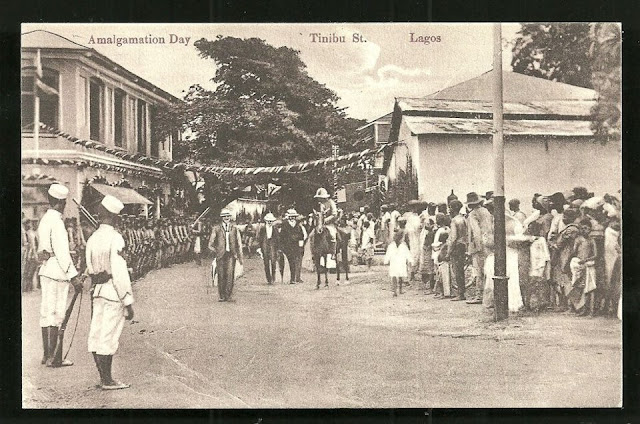
Amalgamation Day in Lagos, 1914
Showing posts with label Nigerian Football. Show all posts
Showing posts with label Nigerian Football. Show all posts
25 March, 2011


16 June, 2009
FIFA changes the rules
Across the world, more and more people are eligible at birth for the citizenships of more than one country. It used to be if a player featured at any level for a national team of one of the countries he was eligible for, he was locked into playing for that country at the international level forever. Well, not forever, but you get the drift.
The rule was changed, to allow players eligible for more than one citizenship at the time they first donned a junior international jersey to switch, but only once, only if they had never featured for the full senior national team, and only before their 21st birthday. You could play for the Under-17s or Under-21s and still be eligible to switch, provided you did so before your 21st birthday. After you hit 21, you could not change your international allegiance.
This week comes news that FIFA has changed the rule again, taking off the age-limit. Now, provided you have not played for the full senior team, and were eligible for the alternate choice from the start, you can switch your allegiance (only once) at any age (I have seen one source that said the new limit is your 28th birthday, but most sources say there is no limit.
I want Nigeria to develop a programme for developing players in Nigeria. I also want us to start thinking of making our domestic league financially competitive with the biggest leagues in the world (admittedly this is impossible without our broader economy, GDP and GDP/per capita, growing to rival the biggest in size, but then rapid economic growth is a national priority in and of itself).
I am a traditionalist. I believe a Nigerian is a Nigerian regardless of where he is born, and I want the children born in the Diaspora to grow up proud of their Nigerian heritage and identity; and whatever other citizenship documents they may hold, I want them to seek the Nigerian passport as well.
In this vein, I would like our embassies to have an official (no more than one) who's job is to keep in touch with potential sporting stars among the young Diaspora. I don't mean waiting until they are stars, and then trying to claim somebody when we contributed nothing to their development. No, I mean being there from the start. The embassies should look after our citizens, and the parents of every Nigerian child outside our borders (even those who will not become sportsmen) should feel the protective umbrella of the nearest embassy. Indeed, the embassy should be at the heart of the socio-cultural life of our citizen communities abroad.
But specific to sports, we need to have the best Nigerian athletes, born anywhere, proudly representing the federal republic at the highest level. I want us to run successful sports programmes that any athlete would want to be a part of. I want to see sporting teams of Nigerians of various ethnic, regional, religious and "birth place" backgrounds working together as a unit to achieve sportiing success.
Is this not what Nigeria is? A union of differing peoples, united for common advancement and achievement?
We have not really done any of this.
Still, there are young sportsmen and sportswomen of the Diaspora, who could be very important to Nigeria as we seek to climb to the zenith of world sports. As many of them as can be persuaded to don our colours, should be welcomed "home".
The FIFA rule change opens the doors for us to talk to, perhaps even persuade a handful of footballers who have only recently crossed the old age-limit threshold. We do not have to try too hard. If they say no, we can let it go.
But let us at least try, if for no other reason than to convey to them (and to the broader Diaspora) that we recognize them as our brothers, sisters, sons and daughters.
That we do not think of them as "foreigners".
The rule was changed, to allow players eligible for more than one citizenship at the time they first donned a junior international jersey to switch, but only once, only if they had never featured for the full senior national team, and only before their 21st birthday. You could play for the Under-17s or Under-21s and still be eligible to switch, provided you did so before your 21st birthday. After you hit 21, you could not change your international allegiance.
This week comes news that FIFA has changed the rule again, taking off the age-limit. Now, provided you have not played for the full senior team, and were eligible for the alternate choice from the start, you can switch your allegiance (only once) at any age (I have seen one source that said the new limit is your 28th birthday, but most sources say there is no limit.
I want Nigeria to develop a programme for developing players in Nigeria. I also want us to start thinking of making our domestic league financially competitive with the biggest leagues in the world (admittedly this is impossible without our broader economy, GDP and GDP/per capita, growing to rival the biggest in size, but then rapid economic growth is a national priority in and of itself).
I am a traditionalist. I believe a Nigerian is a Nigerian regardless of where he is born, and I want the children born in the Diaspora to grow up proud of their Nigerian heritage and identity; and whatever other citizenship documents they may hold, I want them to seek the Nigerian passport as well.
In this vein, I would like our embassies to have an official (no more than one) who's job is to keep in touch with potential sporting stars among the young Diaspora. I don't mean waiting until they are stars, and then trying to claim somebody when we contributed nothing to their development. No, I mean being there from the start. The embassies should look after our citizens, and the parents of every Nigerian child outside our borders (even those who will not become sportsmen) should feel the protective umbrella of the nearest embassy. Indeed, the embassy should be at the heart of the socio-cultural life of our citizen communities abroad.
But specific to sports, we need to have the best Nigerian athletes, born anywhere, proudly representing the federal republic at the highest level. I want us to run successful sports programmes that any athlete would want to be a part of. I want to see sporting teams of Nigerians of various ethnic, regional, religious and "birth place" backgrounds working together as a unit to achieve sportiing success.
Is this not what Nigeria is? A union of differing peoples, united for common advancement and achievement?
We have not really done any of this.
Still, there are young sportsmen and sportswomen of the Diaspora, who could be very important to Nigeria as we seek to climb to the zenith of world sports. As many of them as can be persuaded to don our colours, should be welcomed "home".
The FIFA rule change opens the doors for us to talk to, perhaps even persuade a handful of footballers who have only recently crossed the old age-limit threshold. We do not have to try too hard. If they say no, we can let it go.
But let us at least try, if for no other reason than to convey to them (and to the broader Diaspora) that we recognize them as our brothers, sisters, sons and daughters.
That we do not think of them as "foreigners".
15 June, 2009
Football and the Olympics
So, Jacques Rogge, the head of the International Olympic Committee has warned that if FIFA changes the eligibility rules for the Olympic Football tournament, the IOC might cut the size of the tournament (i.e. reduce the number of teams) or drop the tournament altogether because "the value of the event" (in Rogge's words) would be diminished.
The Olympics is too large and too expensive for most countries to host. Even those countries that can afford it are essentially wasting money; according to everything I have read over the years, the United States is the only country that makes a profit when it hosts the Olympics. Every other host loses money, though the IOC makes money. Frankly it is a bloated event, that should be hosted across an entire country (maybe more than one) rather than force single cities to build more (white elephant) sporting facilities than they could ever find use for in the decades after the Olympics have moved on.
You can probably guess that I am only interested in a small fraction of the sports at the Olympics. The rest of the events, the majority of the events, do not interest me at all. And I am not alone.
There are two kinds of sports.
The first group, the majority, are sports that use the brand of the Olympics to generate interest in what is essentially their most important global championship. During the Olympics, the "world" pays attention to their sport; after the Olympics, the world loses interest.
The second group are sports that are so popular they do not need the Olympic brand to validate their world championships or world champions. The three biggest sports have self-standing world championships, the FIFA World Cup, the Rugby World Cup and the Cricket World Cup. Association Football is the world's most popular sport, and I suspect most fans would give up any number of Olympic medals in any number of sports if meant their football team would win the World Cup.
In tennis, it is more important to win the Davis Cup, Fed Cup or one of the tennis majors (US Open, Aussie Open, Roland Garros and Wimbledon); the Olympic gold medal in tennis is nowhere near the top of the agenda. I don't know much about golf, but I have never heard of a golf Olympic champion, nor have I noticed any golf fans excited about such a person if he or she exists.
Basketball is different. It is a popular sport worldwide, but the Olympics might just edge the Basketball equivalent of a World Cup in significance. This is probably due to the United States, the home of basketball. Americans love the Olympics; for the average American, "world champion" at something and "Olympic champion" of the same thing are synonymous. But then the broader American public have traditionally had little interest in Football, Rugby and Cricket, the sports that prove that a single-event World Championship can be more prestigious than an Olympic medal -- and this is also the country that describes its national champions as world champions.
For those of us who follow the major world sports, the Olympics congests the calendar while providing little in the way of an explanation for the congestion.
No really, what does the Olympic medal decide in football?
We have a world champion, decided at the World Cup. We have a junior champion, decided at the World Youth Cup. And we have a school-boy or cadet world champion, decided at the Under-17 World Championships. Each of these world championships has an equivalent continental championship that decides the continental champions at each level.
So what does the Olympics decide? The Under-23 champion? Of what use is that?
I am a citizen of a country (Nigeria) that has won the Olympic gold in football (in 1996), and if given the choice, I would trade it in for an extra Nations Cup title or a World Cup title. I don't know what the Olympic gold signifies. We were not the African champion, and we were not the World Champion. It was just another age-restricted trophy.
We endanger the health of football players, and the commercial viability of football (scarcity is value) by forcing our star players to play far too many matches every year, without rest. They don't rest. In the off-season, they are playing friendlies, qualifiers, continental championships and the World Cup.
There is fault on the club end too. The biggest example of unnecessary fixture congestion is the UEFA Champions League. It is bloated, featuring way too many unnecessary (boring) matches in the earlier phases. What used to be rare and fantastic encounters between European giants are now routine, mundane repeats of encounters we have seen several times before (particularly this year when there were nearly four English teams in the semi-finals).
In Africa, the uneccesary Championship of African Nations (CHAN) has been created. We already have the wonderful African Nations Cup, which not only crowns the undisputed champion of Africa, but also is (in my opinion anyway, as an African fan) the second-most important football tournament behind the World Cup. What is the CHAN for? We should not dilute the Nations Cup's value by crowning some sort of co-champion at the CHAN, nor do we need a new tournament restricted to players based in African domestic leagues; we already have the sub-continental championships (the CECAFA Cup, the COSAFA Cup, the Amilcar Cabral Cup, the CEMAC Cup and the Arab Nations Cup) that are contested exclusively by players based in African domestic leagues.
There is a similar story to tell elsewhere. Brazil for one could do with a simpler system of domestic football championships. All in all, football needs to be streamlined so we get quality over quantity, and to give our players time to rest between seasons.
As it stands today, FIFA does not even include the Olympics on its unified calendar, so clubs are not required to release their players for it (something Rogge complained about in the article).
If football was dropped from the Olympics, who would notice? Who would miss it?
There are too many international agencies that continue to operate in the 21st Century in ways that were outdated even in the 20th, and the administrative organs of world sport are no different. The IOC and FIFA could both do with some reform, but in a practical sense the Olympics should be downsized, made less expensive and more focussed by restricting it to those sports that need the Olympic brand. Everything else should have stand-alone World Championships, that are small enough for most countries to dream of hosting.
The Olympics is too large and too expensive for most countries to host. Even those countries that can afford it are essentially wasting money; according to everything I have read over the years, the United States is the only country that makes a profit when it hosts the Olympics. Every other host loses money, though the IOC makes money. Frankly it is a bloated event, that should be hosted across an entire country (maybe more than one) rather than force single cities to build more (white elephant) sporting facilities than they could ever find use for in the decades after the Olympics have moved on.
You can probably guess that I am only interested in a small fraction of the sports at the Olympics. The rest of the events, the majority of the events, do not interest me at all. And I am not alone.
There are two kinds of sports.
The first group, the majority, are sports that use the brand of the Olympics to generate interest in what is essentially their most important global championship. During the Olympics, the "world" pays attention to their sport; after the Olympics, the world loses interest.
The second group are sports that are so popular they do not need the Olympic brand to validate their world championships or world champions. The three biggest sports have self-standing world championships, the FIFA World Cup, the Rugby World Cup and the Cricket World Cup. Association Football is the world's most popular sport, and I suspect most fans would give up any number of Olympic medals in any number of sports if meant their football team would win the World Cup.
In tennis, it is more important to win the Davis Cup, Fed Cup or one of the tennis majors (US Open, Aussie Open, Roland Garros and Wimbledon); the Olympic gold medal in tennis is nowhere near the top of the agenda. I don't know much about golf, but I have never heard of a golf Olympic champion, nor have I noticed any golf fans excited about such a person if he or she exists.
Basketball is different. It is a popular sport worldwide, but the Olympics might just edge the Basketball equivalent of a World Cup in significance. This is probably due to the United States, the home of basketball. Americans love the Olympics; for the average American, "world champion" at something and "Olympic champion" of the same thing are synonymous. But then the broader American public have traditionally had little interest in Football, Rugby and Cricket, the sports that prove that a single-event World Championship can be more prestigious than an Olympic medal -- and this is also the country that describes its national champions as world champions.
For those of us who follow the major world sports, the Olympics congests the calendar while providing little in the way of an explanation for the congestion.
No really, what does the Olympic medal decide in football?
We have a world champion, decided at the World Cup. We have a junior champion, decided at the World Youth Cup. And we have a school-boy or cadet world champion, decided at the Under-17 World Championships. Each of these world championships has an equivalent continental championship that decides the continental champions at each level.
So what does the Olympics decide? The Under-23 champion? Of what use is that?
I am a citizen of a country (Nigeria) that has won the Olympic gold in football (in 1996), and if given the choice, I would trade it in for an extra Nations Cup title or a World Cup title. I don't know what the Olympic gold signifies. We were not the African champion, and we were not the World Champion. It was just another age-restricted trophy.
We endanger the health of football players, and the commercial viability of football (scarcity is value) by forcing our star players to play far too many matches every year, without rest. They don't rest. In the off-season, they are playing friendlies, qualifiers, continental championships and the World Cup.
There is fault on the club end too. The biggest example of unnecessary fixture congestion is the UEFA Champions League. It is bloated, featuring way too many unnecessary (boring) matches in the earlier phases. What used to be rare and fantastic encounters between European giants are now routine, mundane repeats of encounters we have seen several times before (particularly this year when there were nearly four English teams in the semi-finals).
In Africa, the uneccesary Championship of African Nations (CHAN) has been created. We already have the wonderful African Nations Cup, which not only crowns the undisputed champion of Africa, but also is (in my opinion anyway, as an African fan) the second-most important football tournament behind the World Cup. What is the CHAN for? We should not dilute the Nations Cup's value by crowning some sort of co-champion at the CHAN, nor do we need a new tournament restricted to players based in African domestic leagues; we already have the sub-continental championships (the CECAFA Cup, the COSAFA Cup, the Amilcar Cabral Cup, the CEMAC Cup and the Arab Nations Cup) that are contested exclusively by players based in African domestic leagues.
There is a similar story to tell elsewhere. Brazil for one could do with a simpler system of domestic football championships. All in all, football needs to be streamlined so we get quality over quantity, and to give our players time to rest between seasons.
As it stands today, FIFA does not even include the Olympics on its unified calendar, so clubs are not required to release their players for it (something Rogge complained about in the article).
If football was dropped from the Olympics, who would notice? Who would miss it?
There are too many international agencies that continue to operate in the 21st Century in ways that were outdated even in the 20th, and the administrative organs of world sport are no different. The IOC and FIFA could both do with some reform, but in a practical sense the Olympics should be downsized, made less expensive and more focussed by restricting it to those sports that need the Olympic brand. Everything else should have stand-alone World Championships, that are small enough for most countries to dream of hosting.
06 June, 2009
Nigeria versus Kenya - 2010 World Cup & Nations Cup Qualifier
The Eagles take on the Harrambee Stars tomorrow, Matchday Two of the final phase of the joint qualifiers for the 2010 World Cup and Nations Cup. After our morale-boosting away friendly win over Les Bleus of France, I am expecting (and hoping) for a victory that relaunches our campaign for a place in South Africa next year.
We MUST win. Matchdays Three (Tunisia vs. Nigeria) and Four (Nigeria vs. Tunisia) will probably decide the group. Regardless of what happens in the other Matchday Two encounter (between Tunisia and Mozambique) it is vital that we go into Matchday Three with the maximum four points available to us after the draw in Maputo.
As a staunch fan of the Eagles, my tension is high. Not for this match per se, but for the entire qualifier series. You can't blame me, after all we didn't qualify for the 2006 World Cup despite finishing even on points with Angola and ahead on goal difference. I actually like the head-to-head rule, but that did not relieve me of the disappointment (under-statement) I felt when we missed out on the German party.
I hope Mozambique proves strong enough to get a draw away in Tunisia, because even if the Nigeria wins Matchdays Two, Three and Four (my dream results of course), we would be on ten points, only four points ahead of the Tunisians if they beat Mozambique at home to earn six. Better to be six ahead, but that will only happen if the Mozambicans can win a hard-fought draw this weekend.
Yes, I know it seems unrealistic to hope for the Eagles to win away in Tunisia, but it is because I respect the Tunisians that I hope we strive to open as big a lead as we can as early as we can. If this thing stays close (or if we stay behind, as we are right now, on one point to their three), it will get REALLY tense before it is all over.
Good luck Eagles!
We MUST win. Matchdays Three (Tunisia vs. Nigeria) and Four (Nigeria vs. Tunisia) will probably decide the group. Regardless of what happens in the other Matchday Two encounter (between Tunisia and Mozambique) it is vital that we go into Matchday Three with the maximum four points available to us after the draw in Maputo.
As a staunch fan of the Eagles, my tension is high. Not for this match per se, but for the entire qualifier series. You can't blame me, after all we didn't qualify for the 2006 World Cup despite finishing even on points with Angola and ahead on goal difference. I actually like the head-to-head rule, but that did not relieve me of the disappointment (under-statement) I felt when we missed out on the German party.
I hope Mozambique proves strong enough to get a draw away in Tunisia, because even if the Nigeria wins Matchdays Two, Three and Four (my dream results of course), we would be on ten points, only four points ahead of the Tunisians if they beat Mozambique at home to earn six. Better to be six ahead, but that will only happen if the Mozambicans can win a hard-fought draw this weekend.
Yes, I know it seems unrealistic to hope for the Eagles to win away in Tunisia, but it is because I respect the Tunisians that I hope we strive to open as big a lead as we can as early as we can. If this thing stays close (or if we stay behind, as we are right now, on one point to their three), it will get REALLY tense before it is all over.
Good luck Eagles!
30 March, 2009
The draw with Mozambique
Yesterday the Eagles drew 0-0 away at Mozambique in our first match of the final phase of African qualifying for the 2010 World Cup. The Mambas scored two goals that were disallowed by the referee, so we should be grateful for the point.
In theory, it is too early to press the panic button. It is, after all, only the first match. The Eagles ALWAYS struggle in World Cup qualifiers; we are rarely conclusively in or out until the final match day. This is normal.
This is also worrying, because the way we perform in World Cup qualifiers leaves little or no room for error.
We squeezed past Cote d'Ivoire on goal difference to qualify for the 1994 World Cup, and pipped Guinea by a point to make it to the 1998 edition. We qualified for the 2002 World Cup thanks to Ghana, who did us a favour by beating Liberia away in Monrovia, which opened the door for us to sneak in by one point. Four years later, in the qualifiers for 2006, we were again praying for another team to do us a favour, hoping Rwanda would beat Angola on the last match-day so we could sneak in again; alas, though they were at home in Kigali, the Rwandans lost by a lone goal, finishing bottom of the group. Angola went to the World Cup.
If you want to know how disorganized our 2006 qualifier campaign was, note that the Nigerian Football Federation, the Nigerian sports media, and most Nigerian fans did not even know CAF was prioritizing the head-to-head rule until we were already on the brink of elimination ... when we were held to a 1-1 draw in our home match against Angola. We had already lost to them away in Luanda, having fielded an under-strength team because we thought they were "minnows" who wouldn't give us any trouble. Suddenly we realized head-to-head was the first tie-breaker, and that our usual surge of heroic victories in the final matches of every series of qualifiers (which happens every time we find ourselves staring elimination in the face) would not be enough to overcome Angola. Even if we won every match (which we did), and by high margins (which we did, 2-5 over Algeria, and 5-0 over Zimbabwe) the Angolans would hold the head-to-head advantage unless SOMEONE beat them, and no one did.
This is what happens when you lose control of your fate. You end up watching matches you have no influence on, and hoping teams that have no motivation (since they are already out) would do you a favour.
For a team like the Eagles that perennially walks a tight-rope in World Cup qualifying, seemingly innocuous match results can (and have) come back to bite us in the end.
It is not a new phenomenon. In the 3-team final stage of qualifying for the 1978 World Cup, Nigeria finished with 3 points, behind Egypt (4 points); Tunisia went to their first World Cup having finished with 5 points.. The heart-breaking thing is we lost our HOME MATCH in Lagos against Tunisia; that one result would have given us 5 points, and left them on 3 points, sending us to the World Cup. Did I mention we were AT HOME?
Fast forward twelve years, and there was dissent in our camp ahead of our 1990 World Cup qualifier away against Gabon; a couple of players ultimately to boycotted the match. We lost 2-1 in Libreville to the Gabonese. I recognize that no team wins all of its matches, and I am in no way disrespecting Gabon's 1990 squad, but it is this sort of away match that ends up deciding your fate. Had we somehow pulled out a victory in Libreville, our final match against mega-rivals Cameroun, away in Yaounde, would have been irrelevant. As it stood, before kickoff in Yaounde, Cameroun would qualify with a win, and Nigeria would have qualified with a draw; after a brusing, vicious encounter (one Nigerian player rushed to hospital, a couple more Nigerians left bleeding) Cameroun had won a ticket to Italia'90 at our expense. They used that ticket well, going on a Cinderella run to the quarterfinals.
Again, I recognize the fact that no team wins always, but too often we have dropped points and acted like it didn't really matter because it was just one match, only to find that it mattered more than we thought.
I hope we don't end up looking back at this weekend's 2010 qualifier against Mozambique, wondering what might have been with two extra points. Our principal rivals this time are Tunisia, seasoned campaigners who know how to grind out the results necessary to get into the World Cup. In fact, with four appearances, they are Africa's second-most frequent World Cup representatives (behind only five-appearance Cameroun). Unlike Guinea or Liberia or even Angola, the Tunisians will not do us any favours. And while we were lucky to escape Maputo with a draw, the Tunisians ground out 3 vital away points in Nairobi against Kenya. If they get another three away points in Maputo later this year, while we content ourselves with another draw in our upcoming match in Nairobi, qualification could get a little complicated.
Last weekend's result in Maputo means two potentially crucial points dropped, and given our history in the qualifiers (and the fact that the Mambas had two goals called off) we need to be really worried. True, the Eagles have declined in recent years and are no longer the dominant force we used to be. True, second- and third-tier teams in Africa have dramatically improved of recent, with Senegal making the 2002 World Cup, Togo and Angola making it in 2006, not to mention the slew of upsets and shocks in the first weekend of final qualifying for the 2010 World Cup. And true, the final phase of qualifying will be tougher than the first phase where we won 6 matches out of 6 against weaker teams.
But once we recognize and acknowledge your limitations and obstacles, we should not run or hide from them, or use them as an excuse not to try harder. If we want a place in South Africa in 2010, we are going to have to work incredibly hard to get it. In fact, we have to take a page out of the book of the Tunisians, and learn how to use hard work, tactics and team ethic to make up for a lack of stars -- because we don't have superstars anymore. We have got to study our opponents in excruciating detail, and figure out simple but effective strategies to grind out 3-point results from here to the final match-day. Let us not do the usual thing of waiting until elimination creeps up on us, only to post a run of heroic results while praying that some other team does us a favour.
The priority in Nigerian football right now is to qualify for the World Cup. The upcoming Under-21 and Under-17 World Championships are NOT IMPORTANT. Heck, if there is any player currently on a youth team who could add some extra effectiveness to the senior side, draft him immediately.
Up Eagles! Up Nigeria!
In theory, it is too early to press the panic button. It is, after all, only the first match. The Eagles ALWAYS struggle in World Cup qualifiers; we are rarely conclusively in or out until the final match day. This is normal.
This is also worrying, because the way we perform in World Cup qualifiers leaves little or no room for error.
We squeezed past Cote d'Ivoire on goal difference to qualify for the 1994 World Cup, and pipped Guinea by a point to make it to the 1998 edition. We qualified for the 2002 World Cup thanks to Ghana, who did us a favour by beating Liberia away in Monrovia, which opened the door for us to sneak in by one point. Four years later, in the qualifiers for 2006, we were again praying for another team to do us a favour, hoping Rwanda would beat Angola on the last match-day so we could sneak in again; alas, though they were at home in Kigali, the Rwandans lost by a lone goal, finishing bottom of the group. Angola went to the World Cup.
If you want to know how disorganized our 2006 qualifier campaign was, note that the Nigerian Football Federation, the Nigerian sports media, and most Nigerian fans did not even know CAF was prioritizing the head-to-head rule until we were already on the brink of elimination ... when we were held to a 1-1 draw in our home match against Angola. We had already lost to them away in Luanda, having fielded an under-strength team because we thought they were "minnows" who wouldn't give us any trouble. Suddenly we realized head-to-head was the first tie-breaker, and that our usual surge of heroic victories in the final matches of every series of qualifiers (which happens every time we find ourselves staring elimination in the face) would not be enough to overcome Angola. Even if we won every match (which we did), and by high margins (which we did, 2-5 over Algeria, and 5-0 over Zimbabwe) the Angolans would hold the head-to-head advantage unless SOMEONE beat them, and no one did.
This is what happens when you lose control of your fate. You end up watching matches you have no influence on, and hoping teams that have no motivation (since they are already out) would do you a favour.
For a team like the Eagles that perennially walks a tight-rope in World Cup qualifying, seemingly innocuous match results can (and have) come back to bite us in the end.
It is not a new phenomenon. In the 3-team final stage of qualifying for the 1978 World Cup, Nigeria finished with 3 points, behind Egypt (4 points); Tunisia went to their first World Cup having finished with 5 points.. The heart-breaking thing is we lost our HOME MATCH in Lagos against Tunisia; that one result would have given us 5 points, and left them on 3 points, sending us to the World Cup. Did I mention we were AT HOME?
Fast forward twelve years, and there was dissent in our camp ahead of our 1990 World Cup qualifier away against Gabon; a couple of players ultimately to boycotted the match. We lost 2-1 in Libreville to the Gabonese. I recognize that no team wins all of its matches, and I am in no way disrespecting Gabon's 1990 squad, but it is this sort of away match that ends up deciding your fate. Had we somehow pulled out a victory in Libreville, our final match against mega-rivals Cameroun, away in Yaounde, would have been irrelevant. As it stood, before kickoff in Yaounde, Cameroun would qualify with a win, and Nigeria would have qualified with a draw; after a brusing, vicious encounter (one Nigerian player rushed to hospital, a couple more Nigerians left bleeding) Cameroun had won a ticket to Italia'90 at our expense. They used that ticket well, going on a Cinderella run to the quarterfinals.
Again, I recognize the fact that no team wins always, but too often we have dropped points and acted like it didn't really matter because it was just one match, only to find that it mattered more than we thought.
I hope we don't end up looking back at this weekend's 2010 qualifier against Mozambique, wondering what might have been with two extra points. Our principal rivals this time are Tunisia, seasoned campaigners who know how to grind out the results necessary to get into the World Cup. In fact, with four appearances, they are Africa's second-most frequent World Cup representatives (behind only five-appearance Cameroun). Unlike Guinea or Liberia or even Angola, the Tunisians will not do us any favours. And while we were lucky to escape Maputo with a draw, the Tunisians ground out 3 vital away points in Nairobi against Kenya. If they get another three away points in Maputo later this year, while we content ourselves with another draw in our upcoming match in Nairobi, qualification could get a little complicated.
Last weekend's result in Maputo means two potentially crucial points dropped, and given our history in the qualifiers (and the fact that the Mambas had two goals called off) we need to be really worried. True, the Eagles have declined in recent years and are no longer the dominant force we used to be. True, second- and third-tier teams in Africa have dramatically improved of recent, with Senegal making the 2002 World Cup, Togo and Angola making it in 2006, not to mention the slew of upsets and shocks in the first weekend of final qualifying for the 2010 World Cup. And true, the final phase of qualifying will be tougher than the first phase where we won 6 matches out of 6 against weaker teams.
But once we recognize and acknowledge your limitations and obstacles, we should not run or hide from them, or use them as an excuse not to try harder. If we want a place in South Africa in 2010, we are going to have to work incredibly hard to get it. In fact, we have to take a page out of the book of the Tunisians, and learn how to use hard work, tactics and team ethic to make up for a lack of stars -- because we don't have superstars anymore. We have got to study our opponents in excruciating detail, and figure out simple but effective strategies to grind out 3-point results from here to the final match-day. Let us not do the usual thing of waiting until elimination creeps up on us, only to post a run of heroic results while praying that some other team does us a favour.
The priority in Nigerian football right now is to qualify for the World Cup. The upcoming Under-21 and Under-17 World Championships are NOT IMPORTANT. Heck, if there is any player currently on a youth team who could add some extra effectiveness to the senior side, draft him immediately.
Up Eagles! Up Nigeria!
14 March, 2009
Football & Sports - Unite Naija-born & Diaspora-born talent
The Nigerian Football Federation has asked Eagles’ Manager Amodu Shuaibu to fly to Italy to try to persuade Angelo Ogbonna Obinze to pledge his international future to Nigeria.
Obinze is 20, plays left-back, centre-back and defensive-midfield, versatility that could prove useful to a manager facing an injury crisis, or put in a position where he must make forced substitutions. Obinze is eligible to play for Nigeria or Italy. I do not think he has represented Italy at the youth level; and if he has, he is allowed to switch his allegiance once until his 21st birthday this May. We have nothing to lose and a lot to potentially gain by convincing Obinze to commit to the Eagles.
We do not have to “cap” Obinze to tie him to the Eagles. According to FIFA’s statutes, a player wishing to switch nationality need only officially communicate this decision to the appropriate FIFA committee. The committee evaluates his declaration to ensure he is still eligible (i.e. before 21st birthday, and possessed both citizenships from the start), and then approves (or not). I do not think Obinze has played for Italy at the youth level, so we have no FIFA hoops to jump through. He need only pledge his future to Nigeria, and we are good to go.
Uwa Elderson Echiejile (Junior Eagles, Canada’07), Chibuzor Okonkwo (Olympic Eagles, Beijing’08) and Matthew Edile (Eaglets, Togo’07, Korea’07, Junior Eagles, Rwanda’09) featured for our youth teams at left-back in recent years. Like Obinze, they are young players, and it is anyone’s guess which one will be the second-best Nigerian left-back when they are all in their mid-20s. Obinze (Serie A) and Echiejile (Ligue 1) are playing at a higher level than the other two, but the Eagles currently have no substantive back-up for Taiye Taiwo (and his accurate cannon of a shot might be a bigger goal threat if he was playing in the midfield, where he ends up most of the time anyway).
Except for truly exceptional super-talents, it is difficult to tell which cadet footballers will become superstars, which ones will become solid-but-otherwise-average professionals, and which one will fail to make it to the professional ranks. Humans mature physically at different rates, and the x-factor of footballing talent also matures at different rates; dominating youth-level ball with physicality and/or raw talent does not guarantee the advantage will be retained at the senior level. Unscrupulous agents, desperate players and negligent law-enforcement add off-the-field issues to consider when pondering the career trajectory of cadet players. Ultimately, no one can claim to know which cadet will be the best at his field position several years in the future. We cannot even pretend to know when we will need to rest or retire players who currently occupy senior national team positions.
To ensure the highest probability of having 22 high-quality players for the Eagles to call on, Nigeria must have access to the widest possible pool of POTENTIAL talent. Contrary to myth, we are not so “abundantly blessed with talent” that we do not need to widen our nets to catch more fish. I have the utmost respect for every player who has donned the Eagles’ jersey – I wish I was good enough – but the truth is we have had quite a few “average” players in our national team. It is one of the most important reasons for our continuous fifteen-year decline since 1994; good players retired or lost form year-after-year, and there was no one of comparable quality to replace them.
Nigeria-born talent is the rock on which football and wider sporting glory must be built. The majority of our citizenry is Nigeria-based, and we will not know true sporting success until our domestic talent-development institutions produce sprinters who can beat the Americans and Caribbeans to Olympic gold, to use one example. We have no top tennis players and are absent from the upper ranks of most sports other than football – and we now outsource the development of our best young Nigeria-born footballers to European clubs, applauding as they leave our shores at ever-younger ages.
We must nevertheless expand our nets to draw in the best Diaspora-born athletes. These sportsmen and women have dual citizenship, and could choose to represent their “other” country. It is our job to do everything in our power to convince them to choose Nigeria. Francis Obikwelu was Nigeria-born, but we let him go, and he went on to win an Olympic silver medal for Portugal; he is a reminder that it is foolish to let good people go, on the false, self-deluding assumption that we have so much talent we will never need them. A related idea, that we are too big to “beg” anybody, must also be discarded. Attracting the best Nigeria-eligible athletes is not about “begging” anyone, but about creating an attractive environment for both Nigeria-born and Diaspora-born sportsmen, giving them the best chance to win for themselves, and for Nigeria.
Unfortunately, the Nigerian Football Federation is engaged in the usual rudimentary, ad hoc, unplanned, disorganized, “fire brigade” activity. Someone, somewhere learned of Obinze (probably by watching Supersport one weekend), and subsequently the NFF orders the Eagles’ manager to go convince one specific player to pledge for Nigeria.
This random approach will never achieve optimal results. We must be systemic and holistic, not random and ad hoc. Rather than chase a single player, as if he was the messiah, we should set up a continuous programme with dedicated staff to spread our nets and capture as many Diaspora-born potentials as we can convince to make the commitment.
Do not misunderstand me. Diaspora-born players are NOT inherently better than their Nigeria-born counterparts, the best of them can be more suited to the playing style of their “other” country than they are to Nigeria (e.g. Gabriel Agbonlahor), and Nigeria-born players will remain the principal source of the national team’s talent pool. Half-hearted, unserious efforts to woo Diaspora-born players like Patrick Owomoyela, Dennis Aogo, Gabriel Agbonlahor and Chinedu Ede came to naught (I am still trying to forget the opportunists Alen Orman and Michael Lamey). Of these players, Aogo is probably the only real loss, and only because he’d have made a good back-up for Taiwo.
We did not have to do any work to win the allegiance of the dual citizens who opted for Nigeria, men like Osaze Odemwingie, Efan Ekoku, George Abbey, Victor Anichebe and Reuben Agboola. Significantly, this list includes players who spent some or all of their childhood or youth in Nigeria. It also includes players who would not have made it onto the roster of their “other” country. And it includes Osaze Odemwingie, a talented, intelligent, hard-worker under-rated by managers and fans, and played out of position. Odemwingie won his first senior cap at age 23, having never played for any of our youth teams; none of our youth team managers thought he would grow up to become a senior team mainstay, which is the crux of my point. We can afford to “wait and see” with Nigeria-born players, but with dual citizens, by the time we discover we really need a particular player, it may be too late.
Some Nigerian Diaspora parents feel a sense of achievement related to their kids being more American than the Americans or more British than the British. Self-consciously they insist it is impossible to raise a Diaspora child to consider himself or herself a Nigerian (which is not true). It would be difficult to convince a young athlete with a background like this to choose Nigeria unless he or she had no chance at the other countries’ team.
There are also many Nigerian parents abroad who do teach their children about their Nigerian heritage. These parents would be immensely proud to see their child win a major event in the colours of their homeland. All Nigerian men grow up idolizing the Eagles, wishing we could be good enough to play in the Eagles’ jersey. These men become fathers who could help us persuade their talented sons to make themselves available for Eagles’ selection. All parties should understand that being available for selection does not mean guaranteed selection, starting shirt, or place on the bench.
It would take time (and resources) to set up a programme designed to draw as many Diaspora-born athletes, in every sport not just football, to the Nigerian flag. For the time being, the Nigerian Football Federation should expand the “invitation” beyond Obinze.
19-year-old Stefano Chuka Okaka is a big man with excellent technique. He can play with his back to goal, hold up the ball, keep possession and set up team-mates (the role Kanu holds today) and can make powerful runs taking the ball from midfield to the 18-yard box (as Yekini and Amokachi did). At age 16 he debuted in the UEFA Cup for Roma, an Italian record, and scored his first goal against Napoli in the Coppa.
18-year-old Funso Ojo has cracked the first team squad at PSV Eindhoven. He can play anywhere in the midfield or on the defence line. Call me a biased fan, but I think any player has a better chance of winning international trophies with the Eagles than with Belgium, so he may be easier to convince than Stefano Okaka.
22-year-old goalkeeper Carl Ikeme of Wolverhampton Wanderers fought his way to the starting assignment before injury struck. The English “Championship” is really the second division, but is arguably stronger than the French second division where Austin Ejide is second-choice (behind Magno Novaes) at SC Bastia, and is definitely stronger than the Israeli first division where Vincent Enyeama starts for Hapoel Tel Aviv. I am NOT saying Ikeme is a better keeper than Ejide or Enyeama; the Eagles’ current numbers one and two are the “standard” and I suggest only that Ikeme meets the standard. Wolves are favourites to win automatic promotion to the Premier League (Bastia is mid-table), and Wayne Hennessy (a future England international and Ikeme’s competition) is likely to be sold to a bigger club.
We have quite a few promising Nigeria-born players coming through the ranks or in the team right now. John Micheal “Mikel” Obi’s was impressive for Chelsea in the away leg against Juventus in the UEFA Champions League. Taiye Taiwo would have it at least to the bench of either of the great Eagles teams (late-70s-to-1980, and 1988-to-2000), and Joseph Yobo is solid. I expect big things from Rabiu Ibrahim and Solomon Okoronkwo.
But we must make sure our “pool” is an ocean, and draw in as many Nigeria-eligible players as possible.
Obinze is 20, plays left-back, centre-back and defensive-midfield, versatility that could prove useful to a manager facing an injury crisis, or put in a position where he must make forced substitutions. Obinze is eligible to play for Nigeria or Italy. I do not think he has represented Italy at the youth level; and if he has, he is allowed to switch his allegiance once until his 21st birthday this May. We have nothing to lose and a lot to potentially gain by convincing Obinze to commit to the Eagles.
We do not have to “cap” Obinze to tie him to the Eagles. According to FIFA’s statutes, a player wishing to switch nationality need only officially communicate this decision to the appropriate FIFA committee. The committee evaluates his declaration to ensure he is still eligible (i.e. before 21st birthday, and possessed both citizenships from the start), and then approves (or not). I do not think Obinze has played for Italy at the youth level, so we have no FIFA hoops to jump through. He need only pledge his future to Nigeria, and we are good to go.
Uwa Elderson Echiejile (Junior Eagles, Canada’07), Chibuzor Okonkwo (Olympic Eagles, Beijing’08) and Matthew Edile (Eaglets, Togo’07, Korea’07, Junior Eagles, Rwanda’09) featured for our youth teams at left-back in recent years. Like Obinze, they are young players, and it is anyone’s guess which one will be the second-best Nigerian left-back when they are all in their mid-20s. Obinze (Serie A) and Echiejile (Ligue 1) are playing at a higher level than the other two, but the Eagles currently have no substantive back-up for Taiye Taiwo (and his accurate cannon of a shot might be a bigger goal threat if he was playing in the midfield, where he ends up most of the time anyway).
Except for truly exceptional super-talents, it is difficult to tell which cadet footballers will become superstars, which ones will become solid-but-otherwise-average professionals, and which one will fail to make it to the professional ranks. Humans mature physically at different rates, and the x-factor of footballing talent also matures at different rates; dominating youth-level ball with physicality and/or raw talent does not guarantee the advantage will be retained at the senior level. Unscrupulous agents, desperate players and negligent law-enforcement add off-the-field issues to consider when pondering the career trajectory of cadet players. Ultimately, no one can claim to know which cadet will be the best at his field position several years in the future. We cannot even pretend to know when we will need to rest or retire players who currently occupy senior national team positions.
To ensure the highest probability of having 22 high-quality players for the Eagles to call on, Nigeria must have access to the widest possible pool of POTENTIAL talent. Contrary to myth, we are not so “abundantly blessed with talent” that we do not need to widen our nets to catch more fish. I have the utmost respect for every player who has donned the Eagles’ jersey – I wish I was good enough – but the truth is we have had quite a few “average” players in our national team. It is one of the most important reasons for our continuous fifteen-year decline since 1994; good players retired or lost form year-after-year, and there was no one of comparable quality to replace them.
Nigeria-born talent is the rock on which football and wider sporting glory must be built. The majority of our citizenry is Nigeria-based, and we will not know true sporting success until our domestic talent-development institutions produce sprinters who can beat the Americans and Caribbeans to Olympic gold, to use one example. We have no top tennis players and are absent from the upper ranks of most sports other than football – and we now outsource the development of our best young Nigeria-born footballers to European clubs, applauding as they leave our shores at ever-younger ages.
We must nevertheless expand our nets to draw in the best Diaspora-born athletes. These sportsmen and women have dual citizenship, and could choose to represent their “other” country. It is our job to do everything in our power to convince them to choose Nigeria. Francis Obikwelu was Nigeria-born, but we let him go, and he went on to win an Olympic silver medal for Portugal; he is a reminder that it is foolish to let good people go, on the false, self-deluding assumption that we have so much talent we will never need them. A related idea, that we are too big to “beg” anybody, must also be discarded. Attracting the best Nigeria-eligible athletes is not about “begging” anyone, but about creating an attractive environment for both Nigeria-born and Diaspora-born sportsmen, giving them the best chance to win for themselves, and for Nigeria.
Unfortunately, the Nigerian Football Federation is engaged in the usual rudimentary, ad hoc, unplanned, disorganized, “fire brigade” activity. Someone, somewhere learned of Obinze (probably by watching Supersport one weekend), and subsequently the NFF orders the Eagles’ manager to go convince one specific player to pledge for Nigeria.
This random approach will never achieve optimal results. We must be systemic and holistic, not random and ad hoc. Rather than chase a single player, as if he was the messiah, we should set up a continuous programme with dedicated staff to spread our nets and capture as many Diaspora-born potentials as we can convince to make the commitment.
Do not misunderstand me. Diaspora-born players are NOT inherently better than their Nigeria-born counterparts, the best of them can be more suited to the playing style of their “other” country than they are to Nigeria (e.g. Gabriel Agbonlahor), and Nigeria-born players will remain the principal source of the national team’s talent pool. Half-hearted, unserious efforts to woo Diaspora-born players like Patrick Owomoyela, Dennis Aogo, Gabriel Agbonlahor and Chinedu Ede came to naught (I am still trying to forget the opportunists Alen Orman and Michael Lamey). Of these players, Aogo is probably the only real loss, and only because he’d have made a good back-up for Taiwo.
We did not have to do any work to win the allegiance of the dual citizens who opted for Nigeria, men like Osaze Odemwingie, Efan Ekoku, George Abbey, Victor Anichebe and Reuben Agboola. Significantly, this list includes players who spent some or all of their childhood or youth in Nigeria. It also includes players who would not have made it onto the roster of their “other” country. And it includes Osaze Odemwingie, a talented, intelligent, hard-worker under-rated by managers and fans, and played out of position. Odemwingie won his first senior cap at age 23, having never played for any of our youth teams; none of our youth team managers thought he would grow up to become a senior team mainstay, which is the crux of my point. We can afford to “wait and see” with Nigeria-born players, but with dual citizens, by the time we discover we really need a particular player, it may be too late.
Some Nigerian Diaspora parents feel a sense of achievement related to their kids being more American than the Americans or more British than the British. Self-consciously they insist it is impossible to raise a Diaspora child to consider himself or herself a Nigerian (which is not true). It would be difficult to convince a young athlete with a background like this to choose Nigeria unless he or she had no chance at the other countries’ team.
There are also many Nigerian parents abroad who do teach their children about their Nigerian heritage. These parents would be immensely proud to see their child win a major event in the colours of their homeland. All Nigerian men grow up idolizing the Eagles, wishing we could be good enough to play in the Eagles’ jersey. These men become fathers who could help us persuade their talented sons to make themselves available for Eagles’ selection. All parties should understand that being available for selection does not mean guaranteed selection, starting shirt, or place on the bench.
It would take time (and resources) to set up a programme designed to draw as many Diaspora-born athletes, in every sport not just football, to the Nigerian flag. For the time being, the Nigerian Football Federation should expand the “invitation” beyond Obinze.
19-year-old Stefano Chuka Okaka is a big man with excellent technique. He can play with his back to goal, hold up the ball, keep possession and set up team-mates (the role Kanu holds today) and can make powerful runs taking the ball from midfield to the 18-yard box (as Yekini and Amokachi did). At age 16 he debuted in the UEFA Cup for Roma, an Italian record, and scored his first goal against Napoli in the Coppa.
18-year-old Funso Ojo has cracked the first team squad at PSV Eindhoven. He can play anywhere in the midfield or on the defence line. Call me a biased fan, but I think any player has a better chance of winning international trophies with the Eagles than with Belgium, so he may be easier to convince than Stefano Okaka.
22-year-old goalkeeper Carl Ikeme of Wolverhampton Wanderers fought his way to the starting assignment before injury struck. The English “Championship” is really the second division, but is arguably stronger than the French second division where Austin Ejide is second-choice (behind Magno Novaes) at SC Bastia, and is definitely stronger than the Israeli first division where Vincent Enyeama starts for Hapoel Tel Aviv. I am NOT saying Ikeme is a better keeper than Ejide or Enyeama; the Eagles’ current numbers one and two are the “standard” and I suggest only that Ikeme meets the standard. Wolves are favourites to win automatic promotion to the Premier League (Bastia is mid-table), and Wayne Hennessy (a future England international and Ikeme’s competition) is likely to be sold to a bigger club.
We have quite a few promising Nigeria-born players coming through the ranks or in the team right now. John Micheal “Mikel” Obi’s was impressive for Chelsea in the away leg against Juventus in the UEFA Champions League. Taiye Taiwo would have it at least to the bench of either of the great Eagles teams (late-70s-to-1980, and 1988-to-2000), and Joseph Yobo is solid. I expect big things from Rabiu Ibrahim and Solomon Okoronkwo.
But we must make sure our “pool” is an ocean, and draw in as many Nigeria-eligible players as possible.
26 February, 2009
21 February, 2009
Goals for the 2010 World Cup
The National Sports Commission has set a target for the Eagles: win a place in the 2010 World Cup semi-finals. This was revealed by Sani Lulu Abdullahi, Nigerian Football Federation President.
I love the Eagles. We have been fairly successful in African competition in the 39 years of the modern football era (i.e. since 1970). Still I would say we have underperformed somewhat. We have not lacked for opportunity, but have been persistently weak at converting opportunities.
In three decades of Nations Cups from 1978 to 2008, Egypt won five titles from five finals (a 100% conversion rate), Cameroun four from five finals (80% rate), and Ghana two from three (66%). In the same period, Nigeria reached the final six times, the most of any team, but won only twice (33%).
Our true conversion rate is actually worse. Due to the 1996 boycott and 1998 suspension, the Eagles participated in 14 of 16 Nations Cup tourneys between 1978 and 2008, and finished in the top three 11 times. Effectively we won just 2 continental titles from 11 golden opportunities – an 18% rate.
It reads like a metaphor about our federal republic – gifted with golden opportunities lost or wasted.
The Eagles are a perennial big fish in the continental lake, but have made no sustained impact on the ocean that is global football. I do not mind being a top dog in Africa; I wish Nigeria had the most African titles, not Egypt, and that we had beaten Cameroun in those three finals. But the lack of global success makes the African success seem hollow.
Our women’s national team, the Falcons, crystallized my thoughts in this regard. The Falcons absolutely dominated Africa for two decades, with nothing to show for it at the Women’s World Cup or Olympics other than a single Cinderella run to the final eight in 1999. If the continent’s female juggernaut is a relative weakling in global competitions, you have to conclude the quality of Africa’s women’s teams is poor in global terms – which gives me the same feeling about our continental success as I get when I read about teams winning the East African CECAFA Senior Challenge (a competition made up of teams that never qualify for the Nations Cup – no offence).
And is it really different on the men’s side? I mean, we hype the quality of our superstars, and make fun of “boastful” teams like England (never mind that we have never equalled their World cup record), but in cold hard reality, what have we done to back up the boasts?
It pains me as a Nigerian to admit it, but if you add up the statistics for both the Nations Cup and World Cup, the Lions of Cameroun were the most successful African team of the last 31 years (i.e. from 1978); and other than a single Cinderella run to the quarterfinals in 1990, the Lions did little at the World Cup. Before anyone blames the African qualification process, the Lions qualified five times in those 31 years, plenty of time and opportunity to show steady upward progress, but were knocked out at the preliminary stage four times (same as that other perennial qualifier, Tunisia).
Egypt, Nigeria and Ghana, who are arguably the second, third and fourth best African teams since 1978 could complain about not qualifying enough. But I don’t think the qualification format was Nigeria’s problem. Remember what I said about our problem with converting opportunities? We only barely lost out on World Cup places in 1978, 1990 (to Cameroun) and 2006. My memories of 1978 are fuzzy, but off-the-field issues between players, administrators and managers decided our fates in 1990 and 2006. With that said, Nigeria is the only African team to make it out of the preliminary round of the World Cup more than once, the closest thing Africa has got to a team who can argue that their good performance was not a one-off fluke. But is a Second Round exit really a “good” performance? Should we act and think as if “Second Round” is the best we can achieve? Oh, I am sorry, what am I saying, we didn’t even qualify in 2006, and I am raising my hopes for getting past the Second Round.
I am focusing only on full senior international football. Our record in age-restricted events does not count. Why get excited after victory over a bunch of boys, if we will not be able to beat them when they are men? We beat Brazil in the 1996 Olympics semi-final, but it was Brazil who went on to the 1998 World Cup final and the 2002 World Cup title. The Brazilians thought it a failure to be knocked out of the 2006 World Cup at the quarterfinal stage – Nigeria can only dream of such “failure”. And after winning that Under-23 title (using senior team players who had already won a Nations Cup and played a World Cup) we decided an all-attack, no-defence team could “score 16 if they score 15” at the 1998 World Cup (with apologies to Dan Amokachi). It did not happen, did it? Yes, we continued to do “well” in Africa, but where is the world-level payoff? After watching our senior team huff and puff to a bland exit against grown men at Ghana’08, I was not consoled by watching our Beijing’08 team utterly dominate young boys. It was exciting 24 years ago when we won the Under-17 World Championship, but I would trade the Under-17 trophies we won in 2007 for a third Nations Cup crown or a single appearance at a World Cup semi-final. Heck, I’d trade our 1996 Olympic gold medal for a 1998 World Cup semi-final place!
Youth competition is useful only insofar as it gives tournament experience to players who could step up to the senior team. The 2005 Under-21 World Championship gave us John “Mikel” Obi and Taiye Taiwo. The highlight of Beijing’08 for me was the intelligent performance of Solomon Okoronkwo; not since Finidi have I seen such a natural at right-midfield in an Eagles jersey. And while the jury is still out on the 2007 Under-17 African and World Champs, Rabiu Ibrahim could make the step up, with a bit more maturity – but only if we stop the “new JJ” talk, and ponder instead how he will differ from left-midfield predecessors Emmanuel Amunike and Garba Lawal.
At the senior level, Nigeria’s Eagles have been in decline since 1994, and even then we were not as strong as our hagiographic memories make us out to have been. In fact, we would have been better off if in 1994-1996 we had spent more time thinking about our weak points, and less time celebrating our self-anointed status as Africa’s first world football power. We have continued to decline, fifteen years now, all the while still so insistent that we are the best. Hey, we win kiddie trophies and African Women’s Cups, right? The Nigerian Football Federation wasted a million dollar corporate sponsorship paying German managers, because they (like we) believed that the team was really okay, that the only problem was Nigerian managers didn’t know how to bring out the alleged strength of the team. At the end of the day, not only was Ghana’08 our worst Nations Cup, but we lost to Cote d’Ivoire in 2008 by the same score-line as the 2006 loss that cost Austin Eguavoen his job.
Why am I sounding this harsh? Simple: We will never work as hard as we have to transform our fortunes if we never admit just how far behind our long-term goal we actually are. We continue to act as if all we need is a little tweak, as if beating Sierra Leone means our problems have gone away.
The Eagles are a more important symbol of Nigeria than the flag or the anthem. We must arrest the decline, make a U-turn, and begin climbing back up towards the top. And not just the top of Africa; we must strive to join the GLOBAL football elite.
But here it is not going to happen overnight. It has been 15 years of continuous decline, and we are not going to zip into the World Cup semi-finals barely two years after a forgettable Ghana’08.
We must set simple targets, with simple timelines, and simple methods of measuring our progress towards those goals. Instead of a series of presidents promising to fix the entire electricity mess, why not a simple promise at the beginning of the year to add X-thousand mega-watts to the grid by the end of the year? We citizens can then monitor the construction or rehabilitation of a power station over the following year to see if anything is actually being done to fulfil the target. If it works, set another simple target for the following year, and if it fails, figure out why it failed by the beginning of the following year.
The same applies in football.
As far as the World Cup is concerned, our goal is to QUALIFY. After the disaster of 2006, we need to put aside our hubris and pomposity, and just work on qualifying.
If we qualify, and only if we qualify, we can then move to the next goal – creating a team that will be competitive in our guaranteed three matches at the World Cup. Any expectation other than that, and we set ourselves up to fail in the long-term, because we will end up sacking the team’s manager and perhaps disbanding the team for not living up to our unrealistic hopes.
The Eagles have had 10 managers in the last 11 years. Our current manager, Amodu Shuaibu, had three stints in that time, so we have really had 12 managerial episodes in 11 years. We have also “experimented” with and capped a prodigiously large number of players. And all of that added up to the bland display at Ghana’08.
Why don’t we do something different? We can make a plan, something we talk a lot about but rarely do, and give a single manager a five year run with the Eagles, from 2009 to 2014. He has to be someone known for building teams (not collections of individuals), and has to be someone we trust enough that we can stick with him even when we hit the inevitable tough patches. Mind you, we did have some stability between 2002 and 2005, so it should not just be stability for its own sake, but a deliberate plan to build a team for the 2014 World Cup.
Yes, I said 2014.
We should try to do well in 2010 (if we qualify) and should try to make the semi-finals (if it is at all possible, even via Cinderella Run) but we shouldn’t lose hope in ourselves if it doesn’t happen in 2010. And we should tell any manager that if the Eagles make it into the 2010 World Cup, he has to take an age-balanced squad comprised of veterans who will not make 2014, players in their prime who will be the veterans in 2014, and youngsters who will be in their prime in 2014.
Above all, we should NOT saddle them (players and manager) with unrealistic expectations. Not only could we end up making knee-jerk decisions, based on short-term disappointments, but the pressure could even be counter-productive in terms of the players’ performance on the field.
Dial down the pressure.
The target right now is qualification.
I love the Eagles. We have been fairly successful in African competition in the 39 years of the modern football era (i.e. since 1970). Still I would say we have underperformed somewhat. We have not lacked for opportunity, but have been persistently weak at converting opportunities.
In three decades of Nations Cups from 1978 to 2008, Egypt won five titles from five finals (a 100% conversion rate), Cameroun four from five finals (80% rate), and Ghana two from three (66%). In the same period, Nigeria reached the final six times, the most of any team, but won only twice (33%).
Our true conversion rate is actually worse. Due to the 1996 boycott and 1998 suspension, the Eagles participated in 14 of 16 Nations Cup tourneys between 1978 and 2008, and finished in the top three 11 times. Effectively we won just 2 continental titles from 11 golden opportunities – an 18% rate.
It reads like a metaphor about our federal republic – gifted with golden opportunities lost or wasted.
The Eagles are a perennial big fish in the continental lake, but have made no sustained impact on the ocean that is global football. I do not mind being a top dog in Africa; I wish Nigeria had the most African titles, not Egypt, and that we had beaten Cameroun in those three finals. But the lack of global success makes the African success seem hollow.
Our women’s national team, the Falcons, crystallized my thoughts in this regard. The Falcons absolutely dominated Africa for two decades, with nothing to show for it at the Women’s World Cup or Olympics other than a single Cinderella run to the final eight in 1999. If the continent’s female juggernaut is a relative weakling in global competitions, you have to conclude the quality of Africa’s women’s teams is poor in global terms – which gives me the same feeling about our continental success as I get when I read about teams winning the East African CECAFA Senior Challenge (a competition made up of teams that never qualify for the Nations Cup – no offence).
And is it really different on the men’s side? I mean, we hype the quality of our superstars, and make fun of “boastful” teams like England (never mind that we have never equalled their World cup record), but in cold hard reality, what have we done to back up the boasts?
It pains me as a Nigerian to admit it, but if you add up the statistics for both the Nations Cup and World Cup, the Lions of Cameroun were the most successful African team of the last 31 years (i.e. from 1978); and other than a single Cinderella run to the quarterfinals in 1990, the Lions did little at the World Cup. Before anyone blames the African qualification process, the Lions qualified five times in those 31 years, plenty of time and opportunity to show steady upward progress, but were knocked out at the preliminary stage four times (same as that other perennial qualifier, Tunisia).
Egypt, Nigeria and Ghana, who are arguably the second, third and fourth best African teams since 1978 could complain about not qualifying enough. But I don’t think the qualification format was Nigeria’s problem. Remember what I said about our problem with converting opportunities? We only barely lost out on World Cup places in 1978, 1990 (to Cameroun) and 2006. My memories of 1978 are fuzzy, but off-the-field issues between players, administrators and managers decided our fates in 1990 and 2006. With that said, Nigeria is the only African team to make it out of the preliminary round of the World Cup more than once, the closest thing Africa has got to a team who can argue that their good performance was not a one-off fluke. But is a Second Round exit really a “good” performance? Should we act and think as if “Second Round” is the best we can achieve? Oh, I am sorry, what am I saying, we didn’t even qualify in 2006, and I am raising my hopes for getting past the Second Round.
I am focusing only on full senior international football. Our record in age-restricted events does not count. Why get excited after victory over a bunch of boys, if we will not be able to beat them when they are men? We beat Brazil in the 1996 Olympics semi-final, but it was Brazil who went on to the 1998 World Cup final and the 2002 World Cup title. The Brazilians thought it a failure to be knocked out of the 2006 World Cup at the quarterfinal stage – Nigeria can only dream of such “failure”. And after winning that Under-23 title (using senior team players who had already won a Nations Cup and played a World Cup) we decided an all-attack, no-defence team could “score 16 if they score 15” at the 1998 World Cup (with apologies to Dan Amokachi). It did not happen, did it? Yes, we continued to do “well” in Africa, but where is the world-level payoff? After watching our senior team huff and puff to a bland exit against grown men at Ghana’08, I was not consoled by watching our Beijing’08 team utterly dominate young boys. It was exciting 24 years ago when we won the Under-17 World Championship, but I would trade the Under-17 trophies we won in 2007 for a third Nations Cup crown or a single appearance at a World Cup semi-final. Heck, I’d trade our 1996 Olympic gold medal for a 1998 World Cup semi-final place!
Youth competition is useful only insofar as it gives tournament experience to players who could step up to the senior team. The 2005 Under-21 World Championship gave us John “Mikel” Obi and Taiye Taiwo. The highlight of Beijing’08 for me was the intelligent performance of Solomon Okoronkwo; not since Finidi have I seen such a natural at right-midfield in an Eagles jersey. And while the jury is still out on the 2007 Under-17 African and World Champs, Rabiu Ibrahim could make the step up, with a bit more maturity – but only if we stop the “new JJ” talk, and ponder instead how he will differ from left-midfield predecessors Emmanuel Amunike and Garba Lawal.
At the senior level, Nigeria’s Eagles have been in decline since 1994, and even then we were not as strong as our hagiographic memories make us out to have been. In fact, we would have been better off if in 1994-1996 we had spent more time thinking about our weak points, and less time celebrating our self-anointed status as Africa’s first world football power. We have continued to decline, fifteen years now, all the while still so insistent that we are the best. Hey, we win kiddie trophies and African Women’s Cups, right? The Nigerian Football Federation wasted a million dollar corporate sponsorship paying German managers, because they (like we) believed that the team was really okay, that the only problem was Nigerian managers didn’t know how to bring out the alleged strength of the team. At the end of the day, not only was Ghana’08 our worst Nations Cup, but we lost to Cote d’Ivoire in 2008 by the same score-line as the 2006 loss that cost Austin Eguavoen his job.
Why am I sounding this harsh? Simple: We will never work as hard as we have to transform our fortunes if we never admit just how far behind our long-term goal we actually are. We continue to act as if all we need is a little tweak, as if beating Sierra Leone means our problems have gone away.
The Eagles are a more important symbol of Nigeria than the flag or the anthem. We must arrest the decline, make a U-turn, and begin climbing back up towards the top. And not just the top of Africa; we must strive to join the GLOBAL football elite.
But here it is not going to happen overnight. It has been 15 years of continuous decline, and we are not going to zip into the World Cup semi-finals barely two years after a forgettable Ghana’08.
We must set simple targets, with simple timelines, and simple methods of measuring our progress towards those goals. Instead of a series of presidents promising to fix the entire electricity mess, why not a simple promise at the beginning of the year to add X-thousand mega-watts to the grid by the end of the year? We citizens can then monitor the construction or rehabilitation of a power station over the following year to see if anything is actually being done to fulfil the target. If it works, set another simple target for the following year, and if it fails, figure out why it failed by the beginning of the following year.
The same applies in football.
As far as the World Cup is concerned, our goal is to QUALIFY. After the disaster of 2006, we need to put aside our hubris and pomposity, and just work on qualifying.
If we qualify, and only if we qualify, we can then move to the next goal – creating a team that will be competitive in our guaranteed three matches at the World Cup. Any expectation other than that, and we set ourselves up to fail in the long-term, because we will end up sacking the team’s manager and perhaps disbanding the team for not living up to our unrealistic hopes.
The Eagles have had 10 managers in the last 11 years. Our current manager, Amodu Shuaibu, had three stints in that time, so we have really had 12 managerial episodes in 11 years. We have also “experimented” with and capped a prodigiously large number of players. And all of that added up to the bland display at Ghana’08.
Why don’t we do something different? We can make a plan, something we talk a lot about but rarely do, and give a single manager a five year run with the Eagles, from 2009 to 2014. He has to be someone known for building teams (not collections of individuals), and has to be someone we trust enough that we can stick with him even when we hit the inevitable tough patches. Mind you, we did have some stability between 2002 and 2005, so it should not just be stability for its own sake, but a deliberate plan to build a team for the 2014 World Cup.
Yes, I said 2014.
We should try to do well in 2010 (if we qualify) and should try to make the semi-finals (if it is at all possible, even via Cinderella Run) but we shouldn’t lose hope in ourselves if it doesn’t happen in 2010. And we should tell any manager that if the Eagles make it into the 2010 World Cup, he has to take an age-balanced squad comprised of veterans who will not make 2014, players in their prime who will be the veterans in 2014, and youngsters who will be in their prime in 2014.
Above all, we should NOT saddle them (players and manager) with unrealistic expectations. Not only could we end up making knee-jerk decisions, based on short-term disappointments, but the pressure could even be counter-productive in terms of the players’ performance on the field.
Dial down the pressure.
The target right now is qualification.
Subscribe to:
Posts (Atom)