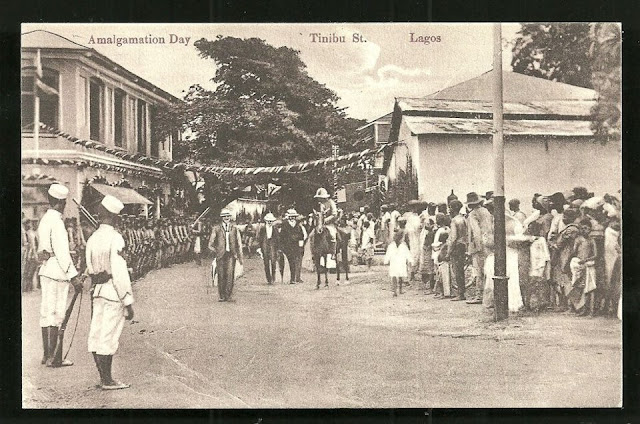
Amalgamation Day in Lagos, 1914

Amalgamation Day in Lagos, 1914

17 July, 2012

Dr. Okonjo-Iweala cannot keep dodging fiscal reality

Everywhere else in the world, governments heave a sigh of relief if the majority of their debt is denominated in their own currency and held by their own citizens and corporations.  This is usually deemed a safer proposition for the government, for all sorts of reasons.

I guess Dr. Ngozi Okonjo-Iweala has different ideas. The Minister of Finance, and "Coordinating Minister for the Economy" has announced her intention to use dollar-denominated borrowing from foreign sources to retire a portion of the debts our governments owes to domestic creditors.  In other words, we would still owe the same amount of debt, but a higher proportion of said debt will be owed to foreign entities and a lower portion owed to domestic creditors.

In the year 2005, the domestic debt load of the Federal Government of Nigeria was $11.83 billion.

In mid-2012, the domestic debt load of the Federal Government of Nigeria is somewhere around $44 billion.

The federal government has borrowed $32 billion in the last 7 years.

Recall that 7 years ago, we were told to celebrate the "debt cancellation" deal brokered by Dr. Okonjo-Iweala on behalf of the Obasanjo Administration. We had borrowed around $19 billion from foreign creditors, paid them around $42 billion over the years, but still owed them about $30 billion, due to capitalized interest and other penalties. The Obasanjo Administration, under the terms of Dr. Okonjo-Iweala's deal, paid out an additional $12 billion in what was essentially a lump sum drawn from our reserves, and our foreign creditors "wrote off" (if you can call it that) the balance of $18 billion. All in all, we borrowed $19 billion, in exchange for which we paid $54 billion.

This happened 7 years ago.

And in those 7 years, we've borrowed $32 billion.

If you want to know how that is possible, consider the fact that Dr. Okonjo-Iweala's plan for the future includes capping our annual borrowing at ₦500 billion, equivalent (at ₦160.00 per $1.00) to $3.12 billion.  If we were borrowing $3.2 billion each year for 7 years, it would add up to $21.84 billion. Now factor in the upward spikes in borrowing in 2007 and 2011; some $6-to-$8 billion in borrowing provided funds to manipulate the outcome of the elections.  Add $10 billion in borrowing in 2010 alone, likely to deal with the budgetary effects of the global economic crisis (and the popping of our separate, self-generated stock market bubble) and you can see how we could have replaced $30 billion in supposedly cancelled debt with $32 billion in new debt in just 7 years.

But, why would we want to transfer our debts from domestic creditors to foreign creditors?  With all due respect and no offence intended, these are the type of decisions that make conspiracy theorists come up with conspiracy theories about people like Dr. Okonjo-Iweala. She is as much a part of the World Bank, as an entity, as a concept, and as a philosophy, as Nelson Mandela is a part of the ANC. The conspiracy theorists accuse people like her of coming up with policies that weaken countries like Nigeria while strengthening countries whose economic interests are served best by the World Bank.

Seriously, we must be the only country in the world that has a choice, and is using that choice to run away from domestic creditors and towards foreign creditors. 

Dr. Okonjo-Iweala has cited two reasons for her decision:
 (a)  The Federal Government's Naira-denominated domestic borrowing is crowding out private sector businesses, and driving up the interest rates;
(b) She believes the Federal Government can get foreign loans at concessional interest rates that are much lower than the interest rates being paid for the Naira-denominated domestic debts.

I agree with the honourable "Coordinating Minister for the Economy" that these are issues that must be tackled. But her proposed solutions remind me of the Nigerian Football Federation, who never address the substantive, structural reasons for the problems in our football, but instead try to paper over everything by hiring a European coach who is always more expensive than a Nigerian coach would have been, and who ends up achieving the same footballing results we would have achieved under a Nigerian coach because the underlying structure and strength of Nigerian football has not changed just because you changed the nationality of the coach.

The solution lies, not in trading one nationality of creditor for another nationality of creditor, but in cutting down on the borrowing in the first place.Bear in mind, what I have written about above is the Federal Government debt.  Most if not all of our 36 States have also gone on a borrowing spree that is every bit as uncontrolled, unchecked and unmonitored as that of the Federal Government.  Collectively, the 37 governments at the Federal and State levels have been borrowing (and are still borrowing) way too much money, and are spending it on things that do not generate returns sufficient to pay off what was borrowed (and in many cases on things that generate no returns at all).

We are talking about transforming the Excess Crude Account into a Sovereign Wealth Fund, when we are no longer generating surpluses to put in such a Fund!  Things are so fiscally tight that the Federal Government is signalling there will be no new capital projects announced in the 2013 Budget.

The solution to our dilemma lies in administrative consolidation.

For what feels like the one millionth time, I will reiterate that the starting point to any substantive process of reform, restructuring and transformation in Nigeria is having:

(a) Between 70 and 84 third-tier administrative units, down from the present-day tally of 774 constitutional LGAs and dozens more unconstitutional LGAs.
(b) Exactly 7 Regions instead of 36 States (with federal territories like Abuja counted among the third-tier units, albeit excluded from any of the 7 Regions).
(c) A Federal Legislative Upper-House that is numerically 70% fewer than what pertains now.
(d) A Federal Legislative Lower-House that is numerically 15% fewer than now.
(e) Hard, constitutional caps on things like the size of the respective cabinets, and on things like assistants, special assistants, senior special assistants, etc.

I won't bore you with the full detail of my calculations, but, believe it or not, we can reduce the size of the political component of our three-tier administration by more than 50%, without overly affecting the Civil Service (a sensitive issue that would otherwise torpedo efforts at reform).  It is not just a question of reducing direct budgetary outlays, but also of easing the further spending occasioned by the decisions made by each of these political points in the matrix. Bear in mind direct theft (a.k.a. corruption) is not the greatest fiscal challenge facing Nigeria; our greatest fiscal challenge is legal waste, and from that perspective we are like a bucket that is leaking from far too many holes.

We should start from here. There are other things we need to do to fix our fiscal problems (and ease the private sector's access to finance, as well as easing the pressure on interests rates) .... but this is the point from which we must start.

Seriously.

Dr. Okonjo-Iweala had initially moved to cut the federal deficity by removing the fuel price subsidy, but she, President Jonathan and CBN Governor Sanusi were forced to backtrack by public protests. To understand why people reacted that way, you have only to look at the many revelations of corruption spilling (unintentionally, it seems) from the legislative probe into the issue. Among other things, billions of dollars in import-subsidizing payments were being paid to people who never imported a single drop of fuel. If Okonjo-Iweala, Jonathan and Sanusi had first clawed back some of these billions by prosecuting the culprits and seizing their wealth, they might still have failed to gain public support, but there would not have been such scorn for their plan.

Nigerians know the current situation is fiscally problematic. However, citizens believe that any funds saved by cancelling the subsidy will simply be stolen or wasted like the rest of the funds available in the budget.  Indeed, people perceived that the government was taking away the subsidy in order to pay for its own fiscal inefficiency, which is a lot easier than taking the decisions that would make our administrative structure more fiscally efficient. If I had a Naira for every time a discussion about how to improve something in Nigeria was brought to an end by a variation of the "They will just steal the money" comment, I would be a rich man.

My take on the issue is the Federal Government has no interest in reducing the number of states and LGAs. And even if some in the government know that administrative consolidation is necessary, the government as a whole is far too cowardly to fight the governors and the broader political class to bring it about.  Heck, this current Administration (like all of its predecessors) could only be in office because of all of the aspects of our governance and administration that would be changed if we were serious about reform. As such, the men and women of the government would be consigning themselves to political irrelevance if they pursued reform.

Making more funds available for the government's discretionary spending by eliminating the fuel subsidy would simply make funds available to keep the fiscally inefficient administrative structure going for a few more years.  Indeed, with the new money, the administrative structure would likely grow, making it even more difficult to force cuts and consolidation, because a larger number of politicians and political dependents would be affected.

This is why the "Coordinating Minister for the Economy" is doing everything in the world except the most important thing we should have been doing these last 14 years. We are wasting time, wasting money and mortgaging the future.

16 July, 2012

Is Ghana starting a trade war?

Have you noticed that in recent years the Ghanaian government seems to be coming up with laws specifically targeted at Nigerians doing business in Ghana?  And not in a positive, trade-promoting way. It seems Accra has decided to make life easier for European, American and Chinese businesses to dominate the Ghanaian market by coming up with all sorts of discriminatory (as in applied only to Nigerians) laws designed to force Nigerian businessmen out of their market.

I wonder what would happen if Nigeria retaliated. It has happened before, except back then, decades ago, the tit-for-tat deportations occured in an era when intra-African trade was much less than it is today (and it is quite low today).

By contrast, in recent years, Ghana has been aggressively marketing themselves as a "gateway" to West Africa, and have sought investment to expand and deepen their ports to position themselves a crucial transshipment hub for West Africa.  When you strip away the consultant-speak, what they are doing, especially now that Cote d'Ivoire is recovering from a long period of national crisis, is marketing themselves as a gateway to Nigeria, and as a transshipment hub for Nigeria.

Why then would they be so keen on starting a trade war with Nigeria?  Does that make any sense?

I suppose they can get away with it.  Nigerian governments from 1960 to 2012 (and, alas, beyond) have had no sense whatsoever of what is or isn't in Nigeria's strategic interest, and wouldn't have any sense of what they should or shouldn't do to advance those interests even if you told them what the interests were.

As I must often do on this blog, I will stress again that nationalism has nothing to do with it.  There are, and have always been, a huge number of Ghanaians living, working and doing business in Nigeria. I was taught by Ghanaians in primary school and secondary school. Actually, while I am being critical (as usual) of the Nigerian government's inaction, it is likely the Nigerian government does not want to punish Ghanaians in Nigeria as a retaliatory measure for what the Ghanaian government seems keen on doing to Nigerians in Ghana.

I like that Nigeria is fairly open to trade and other exchanges with our neighbours. I like that Ecobank International is a Togolese bank, but is one of the largest players in the Nigerian banking industry; their Nigerian arm is more important to the corporate bottom-line than their business in Togo (same is true, actually, of quite a few South African businesses too).  And I like that the flip-side of allowing Togolese banks and South African banks (Standard Chartered) access to the Nigerian market is that Nigerian banks are allowed access to other markets in West Africa and more recently East Africa.

That is the way it is supposed to work.

African Union Commission Chairperson

A job title and job description copied entirely from the European Union. A position that has been as irrelevant to the continent and its people as the position it was supposed to replace -- Secretary-General of the Organization of African Unity.  So, you have two mostly irrelevant entities, the OAU and the AU, what is the difference? Well, at least the OAU had an "original" name.  Sort of.

Anyway, South Africa's Nkosazana Dlamini-Zuma has just been elected Chairperson of the AU Commission.

The headlines focus on the fact that she is the first woman to hold the post. The stories hint at "Francophone" and "Anglophone" differences that stymied the first vote to keep or replace Gabon's Jean Ping in January; a few within those note that nominally "Anglophone" countries like Nigeria, Kenya and Ethiopia opposed Ms. Dlamini-Zuma.  There is mention of the understanding between Africa's more powerful countries that none of their number should hold the seat, an understanding South Africa has just broken; and mention of a retort from South Africa that a Nigerian was Secretary-General of the OAU for two years (more correctly he was interim SG).

And there is a lot of talk of how ineffective her predecessor, Gabon's Jean Ping, was as Commission Chair. Jean Ping is a knight in the service of the Bongo Family monarchy in Gabon.  The set of things that are good for the African continent, and the set of things that are good for the Bongo Family, are mutually contradictory.  No one could expect Jean Ping to advance any of the things that are good for Africa, and it was no surprise that he didn't.

Having said that, I have no idea why the South Africans were so keen on forcibly imposing Ms. Dlamini-Zuma on the African Union Commission.

Don't get me wrong.

No, it is not about nationalism or the supposed rivalry between my country Nigeria and South Africa. To be blunt about it, having a Nigerian occupy some fancy job at an international or multilateral agency or organization produces little or nothing (usually nothing) of value to Nigeria as a whole or to any particular Nigerian outside of that person's immediate family.  In spite of all the public back-slapping and back-patting when it happens, my reaction to it is the same as my reaction to having an ethnic or regional kinsman take a domestic political job -- for all the hype about how it is supposedly a good thing for me, it basically doesn't change anything for me, doesn't improve anything in my life or in my community ... and above all, the issues I have been desperately waiting for someone to address are every bit as ignored as they were when the occupant of the office did not share a language/region/citizenship/etc with me.

And no, it is not that I think she will do a bad job. Nor is it that I think she will do a good job. If anything, the "African Union" will be its usual self, no different than if it was led by a Nigerian, by Jean Ping or by Ms. Dlamini-Zuma. It will not affect the price of matches in Makurdi, nor will it influence the peace (or lack thereof) in Patani.

I am just curious as to what the South Africans, and what SA President Jacob Zuma, think will be accomplished by more or less imposing Ms. Dlamini-Zuma on the job.  If they are thinking that they will now have official sanction to govern the continent, they must surely be kidding themselves. If they think that the reason the rest of the continent has been ignoring their attempts to govern is that they were doing it from Pretoria and not from Addis Ababa, they must really, really be kidding themselves.

Most countries in Africa have ignored the Organization of African Unity and the African Union for decades, simply as a matter of standard operating procedure.  But with a South African at the head of the Commission, a lot of countries, and especially the more powerful countries, will take to ignoring the African Union as a point of diplomatic and political pride, especially because Ms. Dlamini-Zuma will be seen as no more than an echo of President Zuma's decisions.

It is not just that certain countries in Africa do not want to be governed (even indirectly) by Jacob Zuma or any South African president, but even if Zuma made no attempt to do that, these countries will make it a point of projecting to the world that they are not under Zuma's thumb.  In the world of dishonesty that is diplomacy, appearance is sometimes as important as substance, if not moreso.

One way or another, the African Union will continue to be non-functional. And at this point, I am not sure that is a bad thing. I shudder to think what they would do if they had the power to do anything and actually used that power. Indeed, Ms. Dlamini-Zuma is quite like Jean Ping, except where he is a fully integrated part of the Bongo Family political machine, she is just as much a walking, talking embodiment of South Africa's more or less perpetual ruling party the African National Congress.

The ANC is different from the Bongo Family (it is not a monarchy, for one thing), but the ANC is as much a part of the normal politics of Africa as the Bongos. South Africa's liberation may have come three and a half decades after the rest of the continent's, but the ANC are like every other African "liberation movement".

Mind you, we are no longer in the days of the one-party state. We have moved instead to the era of the one-party-dominant state, where a single, massive, all-encompassing, perpetually-ruling, politically unbeatable governing party is surrounded by tiny-by-comparison opposition parties that exist only to allow for nominally/notionally "democratic" elections the ruling party can never lose. 

The first step towards understanding South African policy in Africa is to understand that this is the way the ANC prefers all African countries to be governed; Pretoria is almost never neutral in the internal disputes of other African countries, and 100% of the time favours whoever/whatever is the closest in incarnation to the one-party-dominant model.

Again, this isn't nationalistic criticism. If anything, Nigeria has metamorphosed from a First Republic of mutually antagonistic ethnic/regional political blocs, to a Fourth Republic of the one-party-dominant Peoples Democratic Party (PDP).  Sadly, Abuja and Pretoria, while ostensibly rivalling each other, basically have the same view of what constitutes the "ideal" form of government in any and all African countries. And while you might look at a particular President, and find his or her policies to be against our strategic interests, rest assured that neither Goodluck Jonathan nor Jacob Zuma sees anything wrong with what that Presdient is doing -- if anything, they are doing the same sorts of things in Abuja and Pretoria, albeit with bigger budgets to play with.can never be lost by the governing party. I

09 July, 2012

Development by Doing


I thought about posting this to my football blog, but I decided this wasn't a football issue per se.

In the aftermath of Spain's victory in the 2012 European Championships, an acquaintance of mine suggested we send Nigerian football coaches to be trained in Spain, and send young Nigerian players to be groomed and polished in Spanish club academies. Spain are World Champions, back-to-back European Champions, European Under-21 Champions and European Under-19 Champions.
I respect countries that have strong footballing institutions/industries, and have long believed that the route to Nigeria's emergence as a World (not just African) football power lay in systemic reform and improvement from the bottom of the football pyramid to the very top  --  as opposed to randomly hiring and firing an endless steam of national team coaches.

With that said, while dancing is dancing ... is dancy, you wouldn't go to the Russian Bolshoi Theatre to learn how to teach Atilogwu to others, nor would you go there seeking their instruction on how to perfect your Atilogwu dancing skills, would you?

Let me put is another way.

At the dawn of the Fourth Republic, I saw a news report about members of the Nigerian National Assembly on an official visit to the British Parliament. They went on and on to the journalist about how they had come to learn parliamentary practice from the world's oldest parliament.

I had a question then, and still have the same question now: Do you really need to fly to Europe to learn how to take turns speaking in a group on an issue before voting on the issue you have been discussing? 

In theory, if not in practice, this blog is read (or could be read) by people from around the world, people whose only impression of "Africa" comes from the "international media".  In other words, people who don't know much about Nigeria or Africa.  So let me give you a little background on why this bothered me.

I grew up in a suburb of one of Nigeria's major cities. In Nigeria, a "suburb" is more often than not a place that was historically a self-standing, self-governing (i.e. "independent") village or town in the precolonial times that happened to be geographically situated near a place that experienced rapid modernization and urban growth in the post-colonial period. In one sense, it is a city neighbourhood, but in another sense it retains its own "nationhood" (I don't know how else to put it) complete with all the structures of African traditional government.

Traditional government means different things in different parts of Nigeria. Some parts of Nigeria have been monarchies for thousands of years. Other parts of Nigeria practiced what has come to be known as the "village republic" model of government.

I happened to grow up in a "suburb" that was a village republic.

Every once in a while, the men of the community ("indigenes" only) would gather at the village hall. There would be animated debate of whatever was the issue at stake, after which there would be a decision. The men of this community did not need to go to Britain to learn parliamentary procedure. Quite a large number of Nigerian towns and villages were convening "parliaments" long before the British people created the supposed "Mother of all Parliaments".

Don't get the wrong idea.This isn't about nationalism, or about trying to prove who did it first.

I am saying there a tendency, in the Nigerian elite, the African elite and the "global" elite, to portray the African continent and the people of Africa as being incapable of doing anything, and more specifically as being incapable of doing anything right. There are a lot of people invested in this idea, a lot of people who derive wealth and exercise power and influence, explained away as being necessary because without them Africans would not be able to tie their shoe laces, much less anything else.

Yes, I know, to those of you who know of Africa only through the "international" media, it might seem like we just let things happen to us and don't proactively advance our wellbeing, but this is a false image.

We are compelled to do things for ourselves that people in the rest of the world get spoonfed. You rely on a utility company for electricity; we have to generate our own electricity. You rely on a utility company to pipe water to your homes; we have to pump and pipe our own water. You rely on your governments to build roads; we pay and contract with workers to carve out roads to our homes, and we pay to cover the roads with gravel or sand. You rely on the police for your security; we have to provide our own security, high walls, vicious dogs ... and the ubiquitous, if unregistered, firearms. And we sure as heck provide our own welfare or dole or health "insurance", not to mention pay from our pockets to take care of our elderly in their retirement.

The secondary school in my ancestral home town was built because the people gathered together in a village parliament and agreed to impose mandatory contributions from everyone in the village to pay to build the school. In effect, it was no different than a "government" imposing "taxes" on the people, monitoring the collection of those taxes, and then efficiently carrying out what it was the "voters" want.

The problem is there is, and has been since the colonial days, a disconnection between the "Africa" represented by the governments and other official institutions, and the "Africa" of entrepreneurial people who have to be very creative and innovation to survive because they don't have the option of marching down the streets demanding the government allow them to retire on full government-paid pensions at the age of 42.

But there is only so much you can do at the subsistence or "micro" level.  The problem with Africa is the "macro" level of politics and economics is controlled by Official Africa, and Official Africa has a different set of risks, motivations and interests. It is possible to build an Africa free from endemic starvation, but it doesn't happen because no matter how severe a hunger crisis may be, Official Africa never starves, and as such is not particularly motivated by the fear of starvation.  There is more to be said about this (including the fact that a population that can independently feed itself without need to rely on centrally distributed food relief is a population even less under the control of Official Africa than it already is), but I would be digressing into a separate, lengthy discourse.

As Nigerians/Africans, we have come to realize that there are things we are not going to be allowed to do. We have come to realize that force will be used against us if we attempt to do those things. Nigeria has swung like a pendulum between military-led administrations and civilian-led administrations; under the former, the threat of force keeps us quiet, and under the latter ubiquitous violence tends to spread across the country, frightening people into avoiding politics.
But don't ever allow yourself to think that the dysfunction of the people in power means that we the people are incapable of function. It is the weird thing about Nigeria and indeed about Africa. Indeed, "international" journalists have travelled to "lawless" and "ungoverned" Somalia and been surprised to find a financial industry that is in some ways more sophisticated than what you might find in certain "lawful" and "governed" African countries.

It makes me angry.  For example, we Nigerians complain about our maintenance culture. We despair that we build fantastic football stadia, oil refineries, power plants, roads and other infrastructure only to leave them to rot into disrepair and dysfunction. But you know what? We know we are supposed to maintain these things. And we have the expertise necessary to do so. Nothing in the world stops us from doing it. But somehow it doesn't get done.

In every instance we know what to do and we know how to do it. We just don't do it because the system is built around it not being done. For the system to "work" as it does, for example, the police has to be non-functional. The excuse given for the dysfunction is to continue to repeat that there is no "administrative capacity", in other words that we are not able to run a decent police force even if we tried (never mind that they are deliberately not trying). A corollary of this is we are supposed to seek foreign assistance to learn how to tie our shoe laces.

It is aggravating.  There is a vast society of capable, intelligent, entrepreneurial people that is ruled (not governed) by people whose first response to any situation is to act like they don't know anything and can't do anything unless led by the hand by a foreigner.

They have handed sovereign control of economic policy to multilateral institutions and "development partners", and wring their hands as we continue to operate just below basic survival rather than move towards our maximum production possibilities.  They watch on the sidelines while non-governmental organizations provide insufficient health care and education by consuming resources that could otherwise have created functional and sufficient healthcare and education institutions.

They talk to themselves, and leave we the people out of the conversation, on the assumption that we the people are not capable of understanding their high-level discussions ... discussions that produce an endless stream of bad policy.

Those National Assembly members who wasted scarce public funds to fly to Britain to supposedly learn how to be parliamentarians, came back home and delivered to us a National Assembly that was and remains a dysfunctional institution known only for collecting bribes and passing legislation to raise the salaries and benefits of its members. On the other hand, those men of the community where I grew up, men who had never stepped foot outside Nigeria, much less gone to Westminster, but were still able to come to functional decisions about issues affecting the village through "parliamentary" debate followed by a decision binding on everyone -- those men are allowed no input in the political process. Their votes don't count at elections, their voice does not matter between elections.

People like to use words like "ignorance" when discussing the sort of person who seeks first to abjure responsibility and transfer decision-making to supposedly expert foreigners who are paid outlandish fees and salaries for their supposed expertize.  But it has nothing to do with education, or with a person's educational attainment. It is more an ideology, one shared by a section of the "educated" elite on our continent, and by the elite on two other continents.

From as far back as the colonial days, there was a tendency among certain (but not all) "educated" Africans to assume that they were now less like their fellow Africans and more like the colonials. Without digressing too far into that emotive side-topic, let me just say that this particular sub-fraction of the African population (i.e. those who felt less affinity with their fellow African and more with the colonials) happened to be over-represented in the post-colonial governments. This too is a topic on its own, but these are the sort of people who 50 years later will look you in the face and tell you they have to travel to Britain to learn how to be parliamentarians from the Mother Country, rather than allow the genuine democracy of the village republic and the checked-and-balanced authority of the monarch be the building block of an African-style democracy. Sure, our precolonial governments were not perfect, but neither were (or are) the governments of the countries we are told we must view as the epitome of perfection.

Look, football is not rocket science (though, having said that, Nigeria and Africa do have a good number of people with the education and experience -- often abroad -- to be rocket scientists).
Do we really need to fly our coaches to Spain for them to learn how to notice that a goalkeeper is a vampire (i.e. afraid of crosses)?  Do we need to send our coaches to Spain for them to notice that our tallest players are ironically poor at heading the ball?

Do our goalkeepers have to travel to Europe to be put in a training regimen to learn how to deal with crosses?  Do you tall players have to fly to Europe to be put through heading drills to learn, through repetitive experience, how to properly head the ball?

Before they invented the various euphemisms of "sports science", the original innovators in the field of bringing athletes to peak performance were people with exactly the same academic qualifications that are quite abundant in Nigeria: biology, anatomy, physiology, smedicine, physical education, nutrition, etc. Heck, the tools and machinery used in "sports science" are jazzed up versions of tools that have been around for decades, albeit fine-tuned for purpose by people who realized that the initial versions were not giving them the data or functionality they needed.

But what drives this innovation is actually very simple. You don't have to be a genius to know that the younger-version Okocha couldn't control his powerful shots, nor do you have to be a genius to start thinking, "well, how can I teach him how to control his shots?" You make him take shots over and over again, watch what he is doing, see what happens when his shots "work" and what happens when they doesn't, and use the lessons to fine-tune his practice sessions and to plan the practice sessions of other players with his exact problem. Somewhere along the way, you will come to the conclusion that you need to fine-tune a piece of technology, and because you know exactly what you want, you are able to tell the technician or engineer or whatever exactly what "tweaks" you need. I was embarrassed when Rabiu Ibrahim arrived in Europe and his first club decided he was far too one-legged and put him on a special training regimen to strengthen his right leg. Seriously, we can't do that in Nigeria?

But we will never get to where we need to go if the people in charge continue their habitual first reaction of a shoulder shrug, followed by handing everything over to the nearest foreigner.

I know some of you are thinking, "you are exaggerating. one can always gain additional knowledge by travelling to countries who have perfected it."  But this is a deceptive lie.  Nigerians and Africans have been travelling to foreign countries to learn from them for more than a century. If you count the "Nigerians" who travelled on pilgrimages to the Arabian peninsula via Egypt and Iraq, for many centuries.

As of 2012, Nigeria and Africa possess sufficient numbers with sufficient knowledge, but we either don't use them or we give them away to other countries. We give away our football players. But much more self-damagingly, we give away our doctors and nurses. We don't have enough doctors and nurses, and yet we do nothing to hold on to the ones we have. And then we start with the resource-hungry non-governmental organizations that could never properly replace a functional healthcare system.

I am tired of it.

The first female Chief Justice of Nigeria

Firstly, news of more "communal violence", this time in Ogun State.

Secondly, better news. It looks like the Federal Republic of Nigeria will get its first female Chief Justice of Nigeria.  President Goodluck Jonathan has sent Justice Aloma Mariam Mukhtar's name to the Senate for confirmation as the next Chief Justice of the Supreme Court. It might be the first thing he has done since assuming the Presidency that I wholeheartedly support and endorse.

 Usually, rising up the ladder in Nigeria implies the status quo is happy with your work; underneath what appears on the surface to be movement in shifting sands of Nigerian politics masks the presence of an immobile rock just beneath the sand.

But this is different.  Whatever else is true of her, Justice Mukhtar has spent her life being the first to do a lot of things, things that stereotypically she supposedly should not have been in a position to do.

Usually I post just links, so the newspapers get the traffic their investment merit, but this time I will post the full article from This Day here.

Before I do, let me tell you something that makes me angry and sad at the same time.  You see, I posted news of Justice Mukhtar's pending appointment to a discussion forum for Nigerian affairs that I frequent. To my surprise, the first response came from a man who proceeded to insist it was a bad move from Jonathan because "they" (his words) would be in control when challenges to Jonathan's 2015 election come before the Supreme Court.

We complain a lot about our leaders. But as I always say, the path towards changing our Federal Republic lies in changing ourselves first. Far too many of us think the way he thinks. As long as that remains the case, we will continue to have the kind of leaders we have.

Do you know that "zoning" is not just a national political phenomenon? In my little Local Government Area, a place most of you have never heard of, the Chairmanship, Councillor seats, Federal legislative seat, and State assembly seats are all zoned to different sections of the LGA. And much like at the Federal level, it has not produced the best of leaderships ....

The story:


Justice Aloma Mukhtar Nominated First Female CJN
05 Jul 2012

By Kunle Akogun
Nigeria is set to get its first female chief justice with President Goodluck Jonathan sending the name of Justice Aloma Mariam Mukhtar to the Senate for confirmation as the new Chief Justice of Nigeria (CJN).
If confirmed by the Senate, Justice Mukhtar will succeed the CJN, Justice Dahiru Musdapher, who is due to retire on July 14 having attained the mandatory retirement age of 70 years.
Even though, Mukhtar, expected to be sworn in by July 16, will be the first woman to be appointed CJN, her elevation will not be the first time she will be making history on the bench.
Born in Kano State, Mariam was the first female Northerner to become a lawyer. She was the first woman to be appointed a justice of the Court of Appeal. She is also the first female justice of the Court of Appeal to make it to the Supreme Court.
Her appointment, after the Senate clearance, will make her the 13th head of the nation’s judiciary since the appointment of Chief Justice Adetokunbo Ademola, the first CJN, who held the post from 1958–1972.
Jonathan, in a letter dated July 3, and read on the floor of the Senate Wednesday by Senate President David Mark, sought the senators’ approval to make Mukhtar Musdapher’s successor.
In the letter, Jonathan told the senators that Mukhtar’s nomination was in conformity with Section 231 Sub-section (1) of the 1999 Constitution.
The letter read: “In conformity with Section 231 Sub-section (1) of the 1999 Constitution of the Federal Republic of Nigeria, as amended, which gives the president powers to appoint a Chief Justice of Nigeria, acting on the recommendation of the National Judicial Council and subject to confirmation of the appointment by the Senate, I have the honour to forward the nomination of Honourable Justice Aloma Mariam Mukhtar, CON, CFR, for confirmation as Chief Justice of Nigeria.
“It is my hope that this request will receive the usual expeditious attention of the distinguished Senate of the Federal Republic of Nigeria.”
Jonathan also forwarded to the Senate the names of Hon. Justices Kumai Bayang Akaahs (North-west zone) and Stanley Shenko Alagoa (South-south zone) for confirmation as justices of the Court of Appeal.
Jonathan, in a letter also read by Mark, said both “appointments have been necessitated by the impending retirement from service of Hon. Justice Dahiru Musdapher, Chief Justice of Nigeria, and Hon. Justice F. F. Tabai.”
The road to Mukhtar’s historic emergence began in April when Musdapher served the National Judicial Council (NJC) the mandatory three-month notice of retirement.
Mukthar was called to the Nigerian Bar on June 26, 1967. By September 24, 1987, she became the first female to be sworn into the Court of Appeal. When the Senate confirmed her appointment on May 10, 2005, she was also the first female justice of the Supreme Court of Nigeria.
Born on November 20, 1944, she attended St. George’s Primary School, Zaria, St. Bartholomew’s School, Wusasa, Zaria, Rossholme School for Girls, East Brent, Somersets, England, Reading Technical College, Reading, Berkshire England, Gibson and Weldon College of Law and was called to the English Bar in Absentia in November, 1966.
She worked as a pupil state counsel, Ministry of Justice, Northern Nigeria in 1967; Office of the Legal Draftsman, Interim Common Services Agency, Magistrate Grade I, North Eastern State Government in 1971; Chief Registrar, Kano State Government Judiciary, 1973; Judge of the High Court of Kano State, 1977-1987; Justice of the Court of Appeal, 1987-1993; presiding justice of the Court of Appeal, 1993-2005; and justice of the Supreme Court from June 2005 to date.

01 July, 2012

Who is "Nigeria"?

We complain a lot that "Nigeria" has problems, or that "Government" did or didn't do this or that.

But who is "Nigeria"?

Some days ago, I read this article on the food crisis currently afflicting the Northwest and Northeast regions of our beautiful Federal Republic. It is really bad. And we knew little or nothing about it because our governments (at all three tiers) keep things like this secret for as long as they can.

It isn't a secret to the people and the states that are experiencing it, and one would have thought the media based in those regions would have done more to sensitize the rest of the country about what was happening, but ....

It got me to thinking about people, Nigerians and foreigners alike, who say things like "the government neglected the Niger-Delta (or Lagos or Southeastern highways or the oil refineries or the football stadia or etc.)", as well as people who insist "Nigeria has failed" or claim "Amalgamation is the worst thing that ever happened".

The truth is we are responsible for our mutual neglect of each other. Our ancestors did not protect each other from the Slave Trade, and did not protect each other from the British invasions. We, the present-day "Nigerians" do not look out for each other either. Our collective non-reaction to recurrent starvation in the North comes from the same places as our collective non-reaction to recurrent pollution in the Niger-Delta.

As individuals we are all weak relative to the entities that impose hardship on us. The only way any of us could hope to frighten the powers-that-be into changing what their are doing in our individual neighbourhoods is by counting on the massive support of all of our countrymen, including the mega-majority not directly affected by what is happening in our neighbourhood.

The British never had enough soldiers in Nigeria to hold the entire country if the entire country rose up in revolt at the same time, but they never had to worry about it. If one community rose in revolt, they had all the time and freedom to crush it with the full might of their tiny army. Come to think of it, their tiny army was made up mostly of Nigerians anyway, so it was we Nigerians crushing each other on behalf of the British (sort of how we hunted down ourselves to sell as slaves on both the Saharan and Atlantic trade routes).

Look, so long as we refuse to stand for each other, we will fall alone.

We need each other. This is something you never hear in our politics. The loudest, most-heard voices in Nigeria belong to people who sell this idea that we would all be better off apart from each other, but that is nonsense. It started being nonsense the moment the European "explorers" rounded the west coast of Africa, and has been nonsense ever since.

We need each other. We need to start thinking about each other.  And we need to start fighting for each other.

On the so-called "reprisals".

He is not my friend, but he and I frequent the same places, and so I hear the things he says.

I am talking about someone, a fellow Nigeria from the Southern half of the country who supports what the media calls "reprisal" violence against people from the North in response to the bombings of churches in the North. His exact words were, "doing nothing is not an option".

The problem with his point of view is ... the reprisals do nothing.

When you attack innocent members of another sociocultural community, you have not injured, hurt, apprehended or killed any of the people who carried out the attack. They are still around, freely preparing their next attacks, and laughing at you because you are doing exactly what they want.

The attackers want Nigerians from different religions to fight each other. That is how they want the world to be. That is the point of their attacks on the churches.

You see, contrary to everything you may have heard from Nigerian and foreign pundits, the people of Nigeria are not interested in killing each other. Most of us are not as brave as the courageous citizens whose profile articles I included on this blog (HERE, HERE, HERE and HERE). We are afraid of standing up to killers because we don't want to be killed ourselves. This applies not just to "communal" violence but to armed robbery as well as to government agents and agencies violently maltreating citizens. Inaction has never meant support.

But when one set of citizens attacks another set of citizens in the name of "reprisal" violence, they create a separate cycle of violence that has nothing to do with the initial attack. Recently in the City of Kaduna, gangs of youths from one community carried out "reprisals", which prompted youths from the community thus attacked to carry out "reprisals" to the "reprisals", at which point the first group of youths carried out a "reprisal" to the "reprisal" to the "reprisal" and so forth until the Kaduna State government imposed a curfew and the federal government deployed troops to the streets. None of the youths spilling blood on the Kaduna City streets, from either side, had anything to do with the initial attack that sparked the initial reprisal. And none of the people they killed had anything to do with that attack either.

Insecurity in the North has hurt Moslems AND Christians both. The insurgents are killing Nigerians regardless of their religious affiliation. The reprisals are simply adding to the insecurity, and are not in any way, shape or form having an impact on the likelihood of more insurgent attacks.

I believe the 13-year period from 1999 to 2012 is the second-most violent in our modern history behind only the period from 1966 to 1970. Do you recall what happened in 1966 and 1967?  Southern Christians, particularly the Igbo, were attacked in what the attackers claimed was a reprisal for what the attackers perceived to be as an "Igbo" coup-de-tat.

Bore anyone starts abusing me, I am not saying the 1966-1967 attackers were right to view it as an "Igbo" coup, and I am not saying they were right or justified in attacking the Igbo because of it.

Listen to me clearly and hear that I am making the opposite case.

It is wrong to attack innocent members of a sociocultural community simply because they share the same language, ethnicity, region of origin or religion as a person or group of people who committed a violent crime.

It is wrong today. It was wrong yesterday. It will be wrong tomorrow.

And it has the dangerous effect of moving our country from a situation where a small group of people do a violent thing, to a situation where millions of people start feeling obliged to fight Civil Wars against millions of other people when absolutely none of them was involved in conceiving, planning or carrying out the initial act of violence -- and when none of them even asked for or supported the initial act of violence in the first place.

It is so frustrating.

This should be a moment in history for the entirety of the Nigerian citizenry to rallies to confrong a shared threat. But lo and behold, our distrust of each other is as high as ever, and our perception of each other as being threats to ourselves is just as strong.

In prior posts, I have argued that our leaders do not want to fix underlying problems that give rise to violence because they rely on the continuation of those problems for their continued access to power, influence and wealth.

But what is our excuse as citizens?  Do we gain anything from acting in a way that fuels the fire that will consume us all if we are not careful?  We are like our ancestors who were still throwing spears at each other while a shared enemy approached with giant iron ships and Maxim guns to conquer us all.

If more of us were like the courageous few detailed in those links I provided, Nigeria would be a safer, better, happier place for all of us. We should lionize the good citizens among us, place them on a pedestal and hold them out to our children as examples for us all to follow.  They are the ones who should lead us away from the precipice.

Where is the debate on our external military deployments?

As recently as 2008, there were over 5,000 Nigerian soldiers deployed on various "peacekeeping" missions worldwide.

Our soldiers have been on "peacekeeping" duty in Darfur for years now, and apparently there are still Nigerian "peacekeepers" in Liberia almost a quarter of a century since we first intervened. The Nigerian government has sent or will soon be sending Nigerian police officers to Mogadishu to "train" the Somali police. Nigerian soldiers are being sent to Guinea-Bissau as part of an ECOWAS force. There is much talk of deploying Nigerian soldiers as part of an ECOWAS force that will be sent to Mali. There are (or were) Nigerian soldiers and police officers deployed to Haiti (I found out when I read the news of one of them being killed there).


I don't know if Nigerian soldiers are posted to other locations, because there is very little public discussion of where it is we are sending our soldiers, why it is we are sending them, what it is that we expect them to do once they get there, how they are supposed to do what we expect, and (most importantly) whether any of it makes any sense, both in terms of the official mission goals and in terms of our own strategic interests.

We have court-martialed soldiers who served with ECOMOG for protesting that their peacekeeping pay was being stolen by their senior officers (life sentences for 27 protesting soldiers were commuted to 7 years imprisonment). We have court-martialed wounded former ECOMOG soldiers for protesting at their abandonment at Egyptian hospitals. And Nigerian soldiers have died in Somalia, Haiti, Darfur, Liberia and Sierra Leone. We really ought to do better for our troops.

Peacekeeping, as a concept, enjoys the support of most of the world's politicians, diplomats, pundits, bureaucrats, journalists, etc., and as such enjoys excellent public relations. No one would ever dare to publicly question whether peacekeeping missions actually succeed at what it is the proponents say peacekeeping does. When missions end, there is a tendency to declare whatever is left behind to be a success (something which happens with wars too), and then to stop talking aloud about the country in question -- especially when the country in question starts to go down a path that makes you wonder what the point of the peacekeeping was (or whether the mission ended because people got bored, or ran out of money, and not because something substantial had changed).

Before you get on my case, this blog post is not about "peacekeeping" per se.

I do have to say that I wonder about the fact that we Nigerians pride ourselves (for example) on participating in peacekeeping operations in the Congo/Zaire in the 1960s, and on the fact that the late General J.T.U. Aguiyi-Ironsi commanded that peacekeeping operation. In my opinion, that mission was a fig leaf behind which the charismatic and courageous Patrice Lumumba was murdered by his foreign and local enemies, who then replaced him with the kleptocratic, nation-destroying Mobutu Sese Seko. In other words, I fear we helped perpetuate the two-century-long and on-going destructive exploitation of the Congo.

This is how I think. Call me crazy if you want, but again, this blog post is not about peacekeeping per se.

During the ECOMOG wars, we used to ask ourselves: "Why is Nigeria fighting to bring democracy to other countries when there is no democracy in Nigeria?"

Today, you can ask the question: "Why is Nigeria fighting to bring security and stability to other countries when security and stability are at risk in Nigeria?"

It isn't as simple as demanding that our security forces focus on providing security at home. You see, even if you are someone who believes in external interventions, you have to ask a very, very pointed question: "Why are we ignoring Niger Republic and the Republic of Chad, but are sending soldiers to Mali, Darfur and Somalia?"

There are certain countries in the world who like to refer to themselves as "the international community", and who like to act like decisions they make among themselves are the decisions of the whole world. It seems to me that Nigeria's polices on peacekeeping are driven primarily by what the "international community" thinks is important to the "international community" and not by what is important to Nigeria.

There are reasons why Mali and Somalia make the "international community" nervous, and Darfur became something of a cause celebre among "international" journalists as well as among Hollywood stars. These places get talked about a lot in multilateral agencies, in diplomatic circles, and on the 24-hour "global" news cycle. Nigerian and African leaders want to be seen as "world leaders" hobnobbing with the leaders of the "international community", standing "shoulder to shoulder" to face "the world's problems".

Did you know that Northwestern and Northeastern Nigeria are currently suffering from wide-scale starvation? I am going to post about that next, but what I want to say here and now is that the Nigerian government is doing exactly NOTHING to help the Nigerian citizens in the Northwest and Northeast. Do you know why they are doing nothing? Because nobody is talking about it in the "global" news, and it isn't a topic at multilateral agencies and diplomatic circles, and think tanks in the countries of the "international community" are not producing papers about it.

Indeed, Nigeria had neither a presence nor influence in terms of the substantive responses to the crises in the Cote d'Ivoire, and area of immense strategic importance to us, because the "international community" did not desire us to be there (being as Cote d'Ivoire is an overseas department of a key member of the "international community").

And the Nigerian government has taken an extremely disinterested, laissez faire, approach to the absolute tyranny to our south in Equatorial Guinea. Back in the 1980s, Nigeria had to bribe the Nguema Clan to drop their plans to offer their country to the Apartheid government in South Africa for the construction of a forward air base. But more important than that, countries like Equatorial Guinea, and governments like the one led by the Nguema Clan, are part of the reason our continent keeps having these crises, and are (just as importantly) part of the reason why the continent's ability to react to crises is limited. We can't rely on Equatorial Guinea to help do things in Africa that they have been trying to avoid ever happening in their own country; indeed, if the number of African countries with "good" governments increased, then the number of countries that would want to see the end of the Nguema Clan's rule would by definition have increased by the same amount.

But Nigeria does nothing about it. Partly because Nigeria's leaders are also keen to maintain the current state of African governance -- like the Nguema Clan, they too fear an Africa of "good" government.  But the other reason Nigeria does nothing about Equatorial Guinea is the government of Equatorial Guinea is a vital, strategic partner of the "international community", so there is no pressure from them on Nigeria to contribute troops to an Equatorial Guinea intervention force.


You may not recognize President Teodoro Obiang Nguema standing next to the smiling President Barrack Obama in a 2009 photograph. You also may not know that the Nguema Clan lead the worst dictatorship in Africa; Equatorial Guinea is an African version of North Korea, right down to the pseudo-monarchic rule of one family. Except unlike North Korea, Equatorial Guinea has crude oil, and the Nguema Clan have sided with the USA (rather than China) in the race for African resources. C'est la vie.


But I digress ..

We've got to start thinking about our continent and our planet from our own perspective. We've got to think through problems as they actually are, and not approach fundamental issues based on whatever is the flavour of the moment on the 24-hour "global" news channels, and in the halls of multilateral agencies and state houses of the "international community"

The fundamental nature of Niger Republic and the Republic of Chad is such that they both constitute a hindrance to any serious efforts to make peace, safety and security permanent in the north of our Federal Republic. We cannot solve our problems without solving their problems, and their problems are long-standing. We have known about their problems (and our interlinked problems) forever, but we have been of no use to them (or to ourselves) in terms of solving the problems. We ignore our own problems, and apply the same disregard to their problems.

Look, the things I wish for Nigeria are the same things I wish for every country in the world. But even if we "succeeded" (whatever that means) in Darfur or Mali, we would not have succeeded at all because the wider Sahel Region would still lack any kind of anchor to peace, prosperity, growth and stability. Indeed, what would be the point of success in Darfur, when the Darfur Region is surrounded by Libya, Chad, Sudan, South Sudan and the Central African Republic? Any "success" there would be fleeting, and to be honest, there has been no success so far, and there is unlikely to be any success, so it is a moot point, apart from the fact that our soldiers have been dying there.

I don't understand how our leaders think. If you were sitting in Abuja, thinking about the best thing you could do, from Abuja, to improve the security and prosperity of Nigeria and of the entire African continent, why exactly would you do any of the things our government chooses to do. Do we really think that this is where our scarce resources would be the most effective in tackling the issue?  Indeed, while I wish for Somalia everything that I wish for Nigeria, why would participation in a Horn of African intervention be high on your list? And why do we continually commit troops to missions that we neither fund nor control?  Why do we assume the decisions made by outside powers on how to react to African issues are the best choices? And why do we trust that promised funds and equipment will be forthcoming, no matter how many times we learn otherwise?


Nigeria's strategic interests in Africa are actually quite simple.  One could bore you with a long, verbose exposition, but the simple phrase "Peace and Prosperity" sums it up nicely. We need our neighbours to be peaceful. We need our neighbours to be prosperous. Heck, we could do with some peace and prosperity ourselves. But this paradigm we have committed ourselves to is not working, is it?


If anything, interventions have a way of leading to outcomes that were not intended by those who championed, approved of, and ordered the interventions. When retired General Ibrahim Babangida made the decision to initiate the ECOMOG operation (for reasons that remain shrouded in mystery), I am quite sure he never anticipated Nigeria would get drawn into two full-fledged wars in Liberia and Sierra Leone.  The Nigerian government has never revealed the truth about casualties, or about the massive expenditure required to sustain our war effort for as long as we did.

And I am sure Babangida didn't expect we would still have soldiers in Liberia and Sierra Leone 20 years later.

Heck, if we take it all the way back to the beginning of our participation in such mission, I am quite sure the First Republic government did not intend to help provide cover for Lumumba's assassination when they decided to commit Nigerian troops to the mission.

I am afraid that the current federal administration will sleep-walk Nigeria into another long-term war, this time in Mali, and with greater casualties than the last time.  And leaving aside the question of whether this is or is not the right thing to do (by the way, I don't think it is the right thing to do) there is no guarantee that the "international community" countries that want us to fight this war will provide any materiel or funding.

One thing I have learned from ECOMOG is there is a limit to the number of Nigerian soldiers we can forward-deploy to participate in a war. The maximum number was insufficient to do more than hold Monrovia, and when the defence of Freetown became vital (after Taylor outflanked us by expanding the war to Freetown), we had to participate in a charade in order to pull our troops out of Monrovia to go and hold Freetown.

By "charade", I mean the Liberian Presidential "Election" won by Charles Taylor. The small group of countries that call themselves the "international community" were uncomfortable with Nigeria's Abacha-era ECOMOG presence in Liberia; they paid for the elections and were quick to hail the polls as a successful conclusion of the Liberian Civil War.  The Nigerian government played along with this because it allowed us to declare "victory" and move our forward-deployed troops to Freetown. Liberia was still prone to the same disaster the "elections" had supposedly forestalled. That both the Nigerian government and the "international community" knew that Taylor was behind the war in Sierra Leone, and that he was indirectly killing thousands of Sierra Leonians, and an unknown number of Nigerian soldiers. Yet, everyone played along with the farce that Taylor was a president and the elections were a success (which is a reminder of why we should look very carefully at the "victories" declared in wars and other interventions, including "peacekeeping").

Permit me to digress and say that Taylor's ability to make war in Liberia and Sierra Leone was linked to his support in certain neighbouring ECOWAS member countries, and to his ability to trade with countries in Europe. The two wars only started going against Taylor when a new government came to power in his most powerful regional rival, and when talk of "blood diamonds" shamed his trading partners outside Africa into cutting their trade with him. While our soldiers were dying at the hands of Taylor's army as well as his proxy army, we did little or nothing to interdict his sources of support. As students, we were all familiar with the statement "plus one minus one equals zero". The great problem with ECOMOG is we were committing plus-X to the fight, while doing nothing about the circumstances that allowed Charles Taylor the freedom to respond with minus-X, thus creating a long stalemate.

This is the problem with Darfur, and will be the problem with Mali.

There are only so many soldiers Nigeria can forward-deploy beyond our borders. The number is insufficient to pacify Darfur, even if we committed it entirely to Darfur. Because Darfur is surrounded by Libya, Sudan, South Sudan, Chad and the Central African Republic, places where Nigeria has zero influence, we are unable to do anything about the things that fuel the conflict in Darfur.  Adding Mali to the mix just adds another straw to the back of a camel that has already set down most of its existing load due to lack of capacity.


The things I wish for Nigeria are the same things I wish for all our neighbours in Africa. But the things the Nigerian government keeps involving itself with lead to the loss of Nigerian soldiers' lives, without in anyway achieving the creation of the peaceful and prosperous Africa we need. It didn't happen in the Congo/Zaire in the 1960s and it hasn't been happening since then.  The "international community" doesn't credit us with participating in winning World War Two, and doesn't seem to acknowledge that we lost a lot of soldiers during our participation in the Somalia intervention from which the term "Blackhawk Down" was derived. On behalf of the families of the soldiers we lost in Somalia, I must ask, what was the point of that intervention? What did it achieve? Was it worth their lives?


People will say that I should not let the "great" be the enemy of the "good", that the imperfection of these interventions shouldn't be a reason to "abandon" the people of these countries....

.... but you know what? A lot of the things that are done in the international sphere seem to be part and parcel of what creates the problems in the first place. And when asked to participate in and interventions, it is almost like we are being asked to restore the situation back to what it was, even though what it was is what gave rise to the crisis in the first place. Everyone has heard the adage about people not learning from history being doomed to repeat it? It seems to me that our soldiers are being sent to warfronts in order to initiate the repetition of history.

In short, to say we are doing the "good" because we can't do the "great" is to assume that "good" is being done. Yes, I know the wars come to an end, but do the wars really end any sooner than they would have if there had been no intervention? In spite of thousands of peacekeeping soldiers, the Great Lakes are still afire, and Sudan (North, South and Darfur) are not at peace. It was more than a decade after the ECOMOG intervention before the Liberian and Sierra Leonian wars petered out (and no, it was not the United Kingdom that ended the wars, contrary to wat you might have heard).

Besides, I am not saying Nigeria should do nothing.  I am saying that what we are currently doing is not what we should be doing, and that we are focused too far afield when the first priority must be Niger Republic and the Republic of Chad (but only in concert with efforts to bring the same measure of peace and stability to every region of Nigeria, not just the North, but every part of the country).

We start from there. Whatever else we do after that, we must start from there.

I cannot stop our government from deploying our soldiers and policemen. I am just asking that we debate and discuss each deployment before approving it.

Even if you entirely disagree with everything I have written, surely you agree that we should discuss these deployments a lot more than we do?

30 June, 2012

A government working against itself - IV


Look, this isn't a slanderous rant by a faceless internet blogger.

Ex-President Obasanjo himself admitted he knew Chris Uba rigged the 2003 Anambra Election, and also knew Chris Uba subsequently had then-Governor Ngige kidnapped and extorted. These are among the most serious crimes in our legal codes (indeed, the kidnapping was borderline coup-de-tat, which is treason), and in order to facilitate these destination crimes, Chris Uba and other co-conspirators would have had to have committed a swathe of lesser-included crimes as well (including, for example, suborning the Anambra State police command). Yet, our President, Olusegun Obasanjo admitted, without shame that he considered it "a family affair" -- by which he meant that he and the federal government he led had no interest in investigating, arresting or prosecuting any of the criminals.

The Obasanjo Federal Government went on to ally itself to Chris Uba as the godfather waged a 3-year war (2003-2006) to destroy his erstwhile godson Chris Ngige, but the anarchy in Anambra State really started as far back as 1999. He was merely continuing a pattern, indeed, the Obasanjo Federal Government treated the earlier 1999-2003 "war" between Chief Emeka Offor (a corrupt billionaire and political godfather) and then-Governor Chinwoke Mbadinuju as "a family affair" and did nothing while the political machines allied to these two men brought the state to its knees.

All in all, Anambra State was at a complete standstill for 7 long years between 1999 and 2006 because our three tiers of government considered the political anarchy and violence to be nothing more than "normal" politics. All of them came to office through this kind of politics, so none of them thinks there is anything wrong with it. The total absence of public service delivery was of no importance or consequence to them. I passed through Onitsha during this time, and we can only thank God that an epidemic did not break out, because people and houses were outnumbered and overrun by the greatest stockpile of filth I had ever seen.

Do you understand that this is why we cannot stop violent groups in Nigeria? President Goodluck Jonathan is personally acquainted with Niger-Delta "militant" leaders, and owes them political favours for services they rendered to him in the course of his political rise.  The late former President Yar'Adua was likely not personally acquainted with the Niger-Delta militants, but he was elected in 2007 in part because of the militants' "delivery" of the Niger-Delta to the PDP as part of ex-President Obasanjo's do-or-die politics. As for Obasanjo, as noted in the prior paragraphs, he owes his both of his two terms in office to riggers, manipulators, scoundrels and thieves like Atiku Abubakar, Tony Anenih and the brothers Chris and Andy Uba.


I suppose I can't heap all the blame on the politicians.  A few of us citizens approve of this sort of governance, and hail the people who are successful at it as manly men of timbre and calibre. Most of us don't approve, but don't lift a finger to do anything about it.  We all watched as Anambra State was made a mess for 7 years.  They didn't help themselves and we didn't help them. We just let it happen.

But I am digressing.

I don't take the governments (at all three tiers) seriously when they say that they are going to tackle the insurgency. Whatever they are doing is not going to succeed, because they will deliberately avoid doing anything that will fundamentally change the nature of the Fourth Republic.

Understand that it is possible that they might stop the current insurgency, but the nature of things guarantees that even if they do, it will be replaced by another insurgency operating somewhere else in the country ....

....quite possibly, but not necessarily, in the Niger-Delta. There is much talk of the "amnesty", but I suspect the Niger-Delta militants are observing a temporary truce that will evaporate the moment Goodluck Jonathan is no longer president, whether it happens in 2015 or 2019, but especially if it happens in 2015.

Violence since 1999 has not been concentrated in any one single place. It flares up intensely in one place for a time, then it tapers down in that place and flares up somewhere else. The City of Jos is probably the one place where violence has been near-constant since 1999.


At the micro-level, the level of the ordinary citizen, a lot of Nigerians have been working to bring us together. I have posted profiles of some courageous and wonderful citizens on my blog (examples HERE, HERE, HERE and HERE). But everything good that is done at the micro-level is undone at the macro-level by people whose political and business fortunes would be hurt by societal rapprochement

I love the Federal Republic of Nigeria. I love my homeland enough to be honest about our public safety/security institutions.  The Nigerian Police Force, the Federal Investigations and Intelligence Bureau, the Code of Conduct Bureau, the Independent Corrupt Practices Commission, the Nigerian Customs Service, the Civil Defence Corps, the various (unconstitutional) state-owned pseudo police, the State Security Service and all the other intelligence agencies, and the Economic and Financial Crimes Commission have hundreds of thousands of men at their command, but in many respects the Federal Republic of Nigeria often feels like a place entirely lacking in law enforcement.

A friend of mine once said he thought the murder rate in London was higher than the murder rate in Lagos. To be honest, it is hard to know if that is true or not, as Nigerian statistics are either non-existent or untrustworthy, but I felt that he was missing the point in terms of public security, or maybe public perceptions of security.

I was never the victim of a crime, violent or otherwise, in Nigeria, but I was a victim of an attempted burglary when I lived in the United States. When I saw the burglar through the window, I called the police and they arrived quickly, surprisingly quick to be honest. By contrast, when I am in Nigeria, my assumption (and the assumption of every citizen) is that if armed robbers attack there will be no assistance forthcoming from the police.

Read that last paragraph again. It encapsulates everything I am trying to get across.

While things are not "anarchic" in Nigeria, not yet anyway, there is actually nothing in place to stop anarchists from running wild if and when they choose to run wild.

This is why seemingly "stable" countries like Cote d'Ivoire and Libya collapse so quickly. In autocratic dictatorships, the dictator makes sure to avoid the creation of strong institutions that could challenge his exercise of unchecked power. The problem is, the day that dictator dies or loses even a fraction of his grip, you suddenly realize that there is a giant vacuum where real institutions should be.  Even the respective armies fracture and disintegrate quickly, or retreat (as Idi Amin and Mobutu's soldiers did) rather than die to defend a leader and government they don't really like any more than anyone else in the country. Liberia existed for more than 100 years without any institutions worthy of the name; Charles Taylor entered the country with maybe 25 men, and that was enough to collapse everything like a pack of cards.

Understand that we can't keep going down this road.  Something has to be done, not just to protect the status quo, but to move us to a position of ensured and reliable security. If we continue to emulate those African countries that did nothing when they began to drift down the problematic path, the consequences will be ... well, our population is much larger than theirs.

This is the time to act. It is bad enough already. We shouldn't wait for it to get worse.

A government working against itself - III


There has been little or no proper debate of the spiraling violence since 1999. The discourse is locked on a set of assumptions that have hung on our necks like albatrosses since the 1950s.  We really need to abandon the politics of blaming everything on leaders and ordinary citizens from every Region other than our own, while simultaneously exonerating ourselves and our own Regional leaders from any responsibility.

Many react to the current insurgency in the north of our country by blaming "Northerners" and "Northern Leaders". But the problem of insecurity, and the sources of the problem of insecurity are pan-Nigerian and pan-Federal; the things that cause or make it easy for violence of small or large magnitude to happen in one part of Nigeria are the same things that cause or make it easy for it to happen anywhere else in Nigeria ... and every part of Nigeria suffers as a consequence of the dysfunction in or absence of structures meant to prevent, combat and/or ameliorate violence.

Sociocultural diversity is not the problem. People say African countries would be more peaceful if colonialism had not forced us together, but if that were true Somalia would be the most peaceful country in Africa. I suppose they would counter-argue that Somalia's clans were forced together, to which I would respond that the clans were fighting each other before they were forced together, so you can't blame the conflicts in the Horn on their being forced together.

In Nigeria, violence has flared up everywhere from Ife-Modakeke in the Southwest and Aguleri-Umuleri in the Southeast to the incessant farmers-versus-herders murders in the Middle Belt. You may think these many, many, too many incidents are somehow different from what is happening in Maiduguri, but from the perspectives of the families who have to bury their relatives there is no difference in the consequences of shared vulnerability to unchecked violence.

None of us are safe.

Two acquaintances of mine have been in the vicinity of armed robberies; one occurred within sight of a police checkpoint, while my friend who escaped the second incident came upon a checkpoint not too far from where the robbers were operation. In both cases, the police officers flat out refused to do anything to intervene. In a separate incident reported in the media, the robbers left the scene after operating without challenge for hours, but then returned later to riddle with bullets the home of a man who had called the police after they left, begging the question of how they knew he had called and how they knew who had called. Believe it or not, the reaction of these specific police officers to these specific armed robberies is indicative of our Federal Republic's incapacity to react to what we call "communal violence".

No one is perfect, I know, and no country can perfectly prevent violence, I know that too. But my problem is we are not even genuinely trying.  Again, I point to Jos and to the farmers-versus-herders violence, predictable and persistent -- tell me, has anything really been done to try to bring these situations under control?  Forget the promises, the assurances, the warnings and the rest of the usual governmental reaction to outbreaks of violence (including but not limited to "panel of inquiry", "consultation with stakeholders/elders", "Joint Task Force", and "sack the NSA). Look at the situation over the last 13 years, focus if you must on specific long-running issues like Jos, and be honest about whether you think the governments at all three tiers have so much as lifted a finger in the direction of real, substantive effort at problem-solving.

I am not even sure they would know what to do even if they desired to do something, but I question whether they really desire to do anything.  Fixing the problem runs contrary to the interests of the people in charge of fixing the problem. They profit from divide-and-rule politics, so bringing our sociocultural communities together is anathema to them. The benefit from the absence of effective law enforcement, so reforming and improving the public security agencies is anathema to them.

And even if they suddenly experienced a Paul-at-Damascus conversion, they have spent their entire lives killing any credibility they might have in terms of fixing our problems. Even if they honestly tried to bring warring factions to the table of peace, one or the other or both of the factions would not trust them, because they are firmly identified with one or the other faction, or with an outside faction that both warring factions distrust.


As long as we keep acting as though the problem is a problem of "them" and not a problem of "all of us" then all of us will remain at risk.  If the federal and state governments (and the citizenry) are dormant when ethnic/regional/"vigilance" militia like the OPC and Bakassi Boys appoint themselves judges, jurors and executioners of Nigerian citizens, what makes you think the same federal and state governments (and citizens) will suddenly show signs of institutional capacity to effectively stop with insurgents in Maiduguri doing the same thing?

Our governments at all three tiers are supposed to be doing things that make us safer, but instead they do things that make it safer for violent groups to operate (not just insurgents and militia, but armed robbers as well), while simultaneously and deliberately  making it difficult for the security service to effectively curtail insecurity.  They do these things in the open, sometimes with the acquiescence of we the citizens.

Almost everyone praises Lagos Governor Babatunde Fashola. But Fashola is part of ex-Governor Bola Tinubu's political machine. Tinubu, like the late Lamidi Adedibu in Ibadan, distributes money (extracted illegally and semi-legally from the government) to Area Boys and other thuggish elements in Lagos. The hired thugs work for Tinubu when it is time to control electoral outcomes, intimidate political opponents, and exert control over the vast informal sectors of the Lagos economy. With Tinubu's endorsement, these gangs have taken over Road Transporters' Unions in Lagos, and enrich themselves by collecting "dues" from bus, taxi and okada drivers. Every once in a while, these gangs engage in violent territorial battle for control of the lucrative union dues, and each time this happens, the media rather laughably describes them as clashes between rival unions. Click on the links to read of some of the factions' violent clashes over territory, influence and "toll" collection thus far this year, in January (no fewer than seven dead), in February (local police accused of supporting one side in the clash) and in May (one dead, several injured).

This is more or less what happened in the Niger-Delta, where the so-called "militant" armies began as groups of political thugs recruited by regional politicians to seize direct control of territory they could trade during elections in exchange for post-election favours.  Indeed, these thugs were (and are) so good at their job that the Peoples Democratic Party won (and wins) elections in Rivers and Bayelsa with the kind of margins unheard of anywhere outside Nguema's Equatorial Guinea.  Where Tinubu's goons squeeze small money from Road Transporters' Unions, their counterparts in the Niger-Delta discovered Big Money could be made by blasting a whole in an oil pipeline and stealing the crude. When the politicians stopped paying them in between elections, they started making fortunes from oil theft.  The men who command these militia are now dollar multi-millionaires with mansions at home and abroad. Mind you, they are careful to shunt a share of their profits to the politicians and to some of the Armed Forces brass. Indeed, what made MEND and the other "militant" groups militarily difficult to beat is the support and information they were getting from many of the same leaders (in the Niger-Delta and in Abuja) who were in theory responsible for hunting them down.

No one really knows what is behind the insurgency in the North, as noted in this cartoon by Asuquo E.B.:
 

But beyond the usual 1950s-style back-and-forth rhetoric, a senior PDP politician (i.e. not the most reliable of sources) from Borno State accused the governor of cutting a deal with the movement that later became the insurgent group to help him win the 2003 elections.

Somewhat more credibly (but not that much more), retired General Jerry Useni mentioned in passing that on one occasion when he was been driven through the streets of Maiduguri with the Governor, he had told the governor that he had to do something about the presence of so many poverty-stricken young men visible on the streets lest it become a problem in the future.  According to Useni, the Governor replied that it was good that there were so many young, jobless men, because when it came to time for election, they would be available for use in manipulating the outcome.

I want to make clear that I am not personally accusing the Governor of creating or starting the insurgent group. What I am saying is I believe that modus operandi of the governor, like that of every other governor, and of all of our presidents, lends itself to the emergence and strengthening of armed groups of one kind or another ... groups which initially prove useful to politicians, but then become independent operators, beyond the control of the politicians, at which point anything can happen.

Indeed, while I am on the topic, I know people who argue that the financial relationships between governors and gangs are necessary, because if the governors don't pay them, they will find ways to pay themselves. But how is this the solution to the problem?  And haven't they noticed that this "solution" has been tried before in other countries, and only ever gave armed groups enough time to build up their strength to the point of not needing to fear the absence of governmental acquiescence?