Amalgamation Day in Lagos, 1914
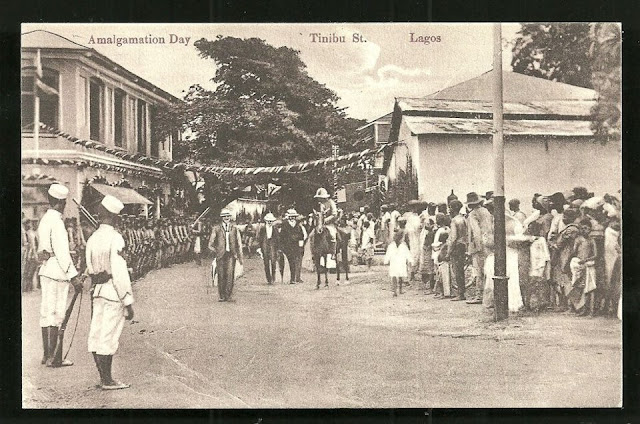
24 November, 2009


11 November, 2009
Raindrops make mighty rivers
As citizens, we Nigerians complain about a lot of things. Usually we externalize the blame, point a finger at "our leaders", at "XYZ ethnic group or region", at something other than ourselves. Sometimes we insist the very existence of "Nigeria" is to blame for our perceived woes; holding the amalgamation to blame is an indirect way of blaming every other ethnic group for allegedly bringing your own group down (not to mention an indirect way of calling for a break-up of the federal republic).
The truth is Nigeria is a river, and we the people are the raindrops that ultimately make up the river called Nigeria. All the individual decisions we make, and actions we take, collectively create the pool of our shared outcomes, positive and negative.
I have noticed something that bothers me.
When we Nigerians discuss our issues in a broad, generalized sense, we seem to properly identify problems, prospects and solutions, and to fervently support the search for optimality in all of our affairs as a society. But when it gets down to the hard specifics of deciding and acting, a strange metamorphosis takes place, and the very same people start defending and advocating the very things (people, decisions, actions, choices, systems, institutions, frameworks) that create and sustain the very problems they otherwise complain about. And where assertions of support for optimality never proceed beyond the level of verbal/rhetorical insistence, the protection of the sources of our problem can get stringent, bellicose, and even violent.
To some degree we are afraid of the unknown. The system may be broken, but it is a system we understand. Most of us have (following great struggle) found niches within the system, and are able to support ourselves and our families to the best of our abilities within the system. And as much as we realize the system is limiting the horizon for ourselves and our children, we are afraid that we might not find a place in the new, improved system (particularly since our survival skills are adapted to the current system, and may or may not be relevant to the new one).
To some degree, we defend the status quo because we do not see any worthwhile alternative. If you lived in the First Republic, and all of the major and minor parties are either ethnic blocs or regional pressure groups, you really don't have a choice but to vote for your ethnic bloc or your regional pressure group. No seriously, what would be the point of voting in another party whose official or unoffical goal is the advancement of another ethnic bloc or regional agenda? The fact that your own ethnic bloc or regional group is as corrupt, waste-prone, autocratic, antidemocatic, police-misusing, and minority-oppressing as its rivals does not have much of an impact on your decision -- you either pick that group or no group, if for nothing other than the sense of self-defence that is created within ethnic/regional blocs when they perceive the other ethnic/regional blocs to be maneuvring to control the central government.
But I don't really want to take up too much space with this blog post. I am not really in a mood to delve deeper into this issue.
What motivated me to mention it is the many weeks of discussion I witnessed and participated in on a Nigerian online discussion forum. The topic was Adokie Amiesimaka's accusation of cheating levelled against the Nigerian (Under-17) Eaglets team at the recent FIFA Under-17 world championships hosted by Nigeria.
It is not my intention here to discuss the substance of Adokiye's allegation. Rather there is something else that caught my attention in the arguments that pit dozens of Nigerians against each other on that discussion forum.
What caught my intention is the number of people who SUPPORTED age-cheating. Don't misunderstand me. I am not saying they agreed that there was age-cheating. In fact they insisted no such thing had happened. That was not what bothered me.
What bothered me is their declaration that even if age-cheating existed, Adokiye should not have said anything about it. They said he was unpatriotic to try to expose it. They questioned his motives, and insisted that if he had bad motives, then we shouldn't listen to his allegation even if it was true. They said life was hard for young men in Nigeria, and so if they had to age-cheat to make it out, we should not pour sand in their garri (a Nigerian phrase that roughly translates as spoiling a good thing for them). They said every team age-cheated, and that we had to age-cheat to keep up with them. And they said (and this was really perplexing) that if you support the SENIOR Eagles team, then you cannot criticize age-cheating at the junior levels because (wait till you hear this) the senior team players were guilty too! Yes, they insisted you must boycott all of Nigerian football if you think we shouldn't age-cheat at the youth levels.
Again, none of this proves we do or did age-cheat.
In fact I want to make clear that I am not saying we do or did (nor am I saying we don't or didn't). You see, that ceased to be important to me, as I watched a raging argument in which a majority of the discussants DEFENDED age-cheating as a concept, regardless of whether we do it or not.
The odd thing is this argument raged in the two weeks before our make-or-break World Cup qualifier away at Kenya, which (along with the result between Tunisia and Mozambique in Maputo) would decide whether we qualified for the 2010 World Cup.
The same people who were gladly defending age-cheating would have attacked, trashed and bashed the Nigerian Football Federation, the manager Amodu Shuaibu, and the Eagles' players if we had not qualified for the World Cup. They would have raged and railed, wondered why bad things always happen to Nigeria, called the country all sorts of horrible names, claimed (with inferiority complexes) that Ghana is so much better at electricity, football, blah, blah, blah.
Now there are many things that contribute toward ending up with a national team that is not dominant, and that has to struggle mightily where others (e.g. Ghana and Cote d'Ivoire in the 2010 qualifiers) sail more smoothly. Indeed, every team, even the good ones, goes through a cycle that resembles the sine and cosine curves -- sometimes you are up, sometimes you are down (Ghana just emerged 3 years ago from an extended period of being down).
Still, the way we manage our football at the grassroots and youth levels are part and parcel of the wider picture of dysfunction in Nigerian football. It is both hypocritical and (more importantly) self-defeating to support that, while complaining that our League, our senior national team, and our current international "stars" are not meeting your lofty expectation. You cannot plant pawpaw and harvest yam. Actually in this case, we are not planting anything at all, but are somehow expecting a bumper harvest, and (worst of all) proceed to complain, whine, bitch and moan when no such bountiful harvest occurs.
Seriously, how can you expect any output at all (even electricity generation) to come out optimal, when the input is consistently suboptimal? If you support the input, fine, that is your right, but don't then join me to complain about the output.
Many of those supporting age-cheating claimed Brazil did the same thing. Mind you, there were other countries they mentioned, but the tendency of comparing ourselves to Brazil in football (the "we produced abundant talent, only matched by Brazil" myth) makes them a very apt example to use to counter those who advocate self-defeating behaviour.
I have watched a documentary film crew go to the grassroots children's football club where Brazilian international Kaka got his start. We all knew what Ronaldinho could do while he was still at Gremio, and were thrilled by Robinho while still at Santos. There is no comparison in Nigeria. It is not just the fact that the histories of "young" players are shrouded in mystery, rumour and innuendo, but the League itself can not be compared to the Brazilian league.
There was a time in life that I stopped taking our age-restricted successes seriously. What little regard I had for them quenched after our success at the age-restricted 1996 Atlanta Olympics. We won that tournament using our de facto national team (minus Finidi), comprising 1994 World Cup and Nations Cup veterans, players from the Under-17 triump in 1993, and a sprinkling of others (notably Victor Ikpeba, from the 1989 Under-17 team).
We beat Brazil (yes, them, I bet you know where this is going) in the semifinals of the 1996 Olympics, in one of the greatest comebacks in our history. That Brazilian team, and those Brazilian players, went on to make it to the final of the 1998 World Cup, went on to WIN the 2002 World Cup, and quite a few of them were still around and kicking when Brazil made it as far as the final eight in 2006.
By contrast, the 1996 Nigerian Olympians, heroes of the nation went on to ..... well, there were a lot of blowout losses in 1998, most significantly to Denmark in 1998, and a general continuation of the 15 years of decline that began in 1994 and continued up till 2008. And it is not yet uhuru (permit me to misuse the term) in 2009, though our qualification for the World Cup could turn out to be the first spark of the revival.
One team in that 1996 semifinal was around the starting point of an upward growth in their developmetnal process, while the other team was at the height of its abilities (remember many of them had won the 1994 Nations Cup).
I will leave it at that. It is not my thesis that we are age-cheats. It is my thesis that we cannot point to Brazil, claim (without proof) that they age-cheat, and then insist that if they do it, we can do it too. Haba, the Brazilians have a football system that produces world champions, world players of the year, and some of the best players in the history of football, on a continuous and consistent basis. To point to them, and say that they are proof that it is okay for us to do the wrong thing, the stupid thing, the self-defeating thing, is insane.
In fact, we shouldn't compare ourselves to ANYBODY, successful or not. The question should be, "Does it work for Nigeria? Does it achieve Nigeria's goals?" If your goal is endlessly winning kiddie tournaments, that is one thing, but if you are looking to be a long-term, permanent, continuous WORLD POWER, then you cannot possibly bring yourself to support the continued absence of the necessary structures and foundations.
But I am (as always) starting to digress.
The point I am making is that for all our complaining about issues, we are often the footsoldiers who fight to protect, defend, sustain and continue the exact things that produce the outcomes we complain about.
In fact, that is why we have "bad leaders". These so-called leaders were born into the same families as the rest of us, into the same lives we all lead, except some quirk of fate gave them a chance to step into leadership. And you know what? The things they do once in office are the same things too many of the rest of us would do if we got that same chance. Far too many of us spend our days hoping and praying for the chance to do exactly what "they" are doing.
But then we complain when the persistence of such decision-making leads to problematic output and negative outcomes.
It is too difficult to try to change all of Nigeria at once. By contrast, we can all change ourselves as individuals, which would have the effect of changing all of Nigeria.
The thing is, it has to be in the context of a revolution, because we all have to do it at the same time. If only one person changes, and everyone else remains the same, then he or she will simply lose out in the vicious competition for survival under the current system. This is the fear that keeps Nigeria from reform, transformation and substantive change -- the fear that if I or you change alone as individuals, no one else will, and the only result would be the loss of our individual niche in the system.
The truth is Nigeria is a river, and we the people are the raindrops that ultimately make up the river called Nigeria. All the individual decisions we make, and actions we take, collectively create the pool of our shared outcomes, positive and negative.
I have noticed something that bothers me.
When we Nigerians discuss our issues in a broad, generalized sense, we seem to properly identify problems, prospects and solutions, and to fervently support the search for optimality in all of our affairs as a society. But when it gets down to the hard specifics of deciding and acting, a strange metamorphosis takes place, and the very same people start defending and advocating the very things (people, decisions, actions, choices, systems, institutions, frameworks) that create and sustain the very problems they otherwise complain about. And where assertions of support for optimality never proceed beyond the level of verbal/rhetorical insistence, the protection of the sources of our problem can get stringent, bellicose, and even violent.
To some degree we are afraid of the unknown. The system may be broken, but it is a system we understand. Most of us have (following great struggle) found niches within the system, and are able to support ourselves and our families to the best of our abilities within the system. And as much as we realize the system is limiting the horizon for ourselves and our children, we are afraid that we might not find a place in the new, improved system (particularly since our survival skills are adapted to the current system, and may or may not be relevant to the new one).
To some degree, we defend the status quo because we do not see any worthwhile alternative. If you lived in the First Republic, and all of the major and minor parties are either ethnic blocs or regional pressure groups, you really don't have a choice but to vote for your ethnic bloc or your regional pressure group. No seriously, what would be the point of voting in another party whose official or unoffical goal is the advancement of another ethnic bloc or regional agenda? The fact that your own ethnic bloc or regional group is as corrupt, waste-prone, autocratic, antidemocatic, police-misusing, and minority-oppressing as its rivals does not have much of an impact on your decision -- you either pick that group or no group, if for nothing other than the sense of self-defence that is created within ethnic/regional blocs when they perceive the other ethnic/regional blocs to be maneuvring to control the central government.
But I don't really want to take up too much space with this blog post. I am not really in a mood to delve deeper into this issue.
What motivated me to mention it is the many weeks of discussion I witnessed and participated in on a Nigerian online discussion forum. The topic was Adokie Amiesimaka's accusation of cheating levelled against the Nigerian (Under-17) Eaglets team at the recent FIFA Under-17 world championships hosted by Nigeria.
It is not my intention here to discuss the substance of Adokiye's allegation. Rather there is something else that caught my attention in the arguments that pit dozens of Nigerians against each other on that discussion forum.
What caught my intention is the number of people who SUPPORTED age-cheating. Don't misunderstand me. I am not saying they agreed that there was age-cheating. In fact they insisted no such thing had happened. That was not what bothered me.
What bothered me is their declaration that even if age-cheating existed, Adokiye should not have said anything about it. They said he was unpatriotic to try to expose it. They questioned his motives, and insisted that if he had bad motives, then we shouldn't listen to his allegation even if it was true. They said life was hard for young men in Nigeria, and so if they had to age-cheat to make it out, we should not pour sand in their garri (a Nigerian phrase that roughly translates as spoiling a good thing for them). They said every team age-cheated, and that we had to age-cheat to keep up with them. And they said (and this was really perplexing) that if you support the SENIOR Eagles team, then you cannot criticize age-cheating at the junior levels because (wait till you hear this) the senior team players were guilty too! Yes, they insisted you must boycott all of Nigerian football if you think we shouldn't age-cheat at the youth levels.
Again, none of this proves we do or did age-cheat.
In fact I want to make clear that I am not saying we do or did (nor am I saying we don't or didn't). You see, that ceased to be important to me, as I watched a raging argument in which a majority of the discussants DEFENDED age-cheating as a concept, regardless of whether we do it or not.
The odd thing is this argument raged in the two weeks before our make-or-break World Cup qualifier away at Kenya, which (along with the result between Tunisia and Mozambique in Maputo) would decide whether we qualified for the 2010 World Cup.
The same people who were gladly defending age-cheating would have attacked, trashed and bashed the Nigerian Football Federation, the manager Amodu Shuaibu, and the Eagles' players if we had not qualified for the World Cup. They would have raged and railed, wondered why bad things always happen to Nigeria, called the country all sorts of horrible names, claimed (with inferiority complexes) that Ghana is so much better at electricity, football, blah, blah, blah.
Now there are many things that contribute toward ending up with a national team that is not dominant, and that has to struggle mightily where others (e.g. Ghana and Cote d'Ivoire in the 2010 qualifiers) sail more smoothly. Indeed, every team, even the good ones, goes through a cycle that resembles the sine and cosine curves -- sometimes you are up, sometimes you are down (Ghana just emerged 3 years ago from an extended period of being down).
Still, the way we manage our football at the grassroots and youth levels are part and parcel of the wider picture of dysfunction in Nigerian football. It is both hypocritical and (more importantly) self-defeating to support that, while complaining that our League, our senior national team, and our current international "stars" are not meeting your lofty expectation. You cannot plant pawpaw and harvest yam. Actually in this case, we are not planting anything at all, but are somehow expecting a bumper harvest, and (worst of all) proceed to complain, whine, bitch and moan when no such bountiful harvest occurs.
Seriously, how can you expect any output at all (even electricity generation) to come out optimal, when the input is consistently suboptimal? If you support the input, fine, that is your right, but don't then join me to complain about the output.
Many of those supporting age-cheating claimed Brazil did the same thing. Mind you, there were other countries they mentioned, but the tendency of comparing ourselves to Brazil in football (the "we produced abundant talent, only matched by Brazil" myth) makes them a very apt example to use to counter those who advocate self-defeating behaviour.
I have watched a documentary film crew go to the grassroots children's football club where Brazilian international Kaka got his start. We all knew what Ronaldinho could do while he was still at Gremio, and were thrilled by Robinho while still at Santos. There is no comparison in Nigeria. It is not just the fact that the histories of "young" players are shrouded in mystery, rumour and innuendo, but the League itself can not be compared to the Brazilian league.
There was a time in life that I stopped taking our age-restricted successes seriously. What little regard I had for them quenched after our success at the age-restricted 1996 Atlanta Olympics. We won that tournament using our de facto national team (minus Finidi), comprising 1994 World Cup and Nations Cup veterans, players from the Under-17 triump in 1993, and a sprinkling of others (notably Victor Ikpeba, from the 1989 Under-17 team).
We beat Brazil (yes, them, I bet you know where this is going) in the semifinals of the 1996 Olympics, in one of the greatest comebacks in our history. That Brazilian team, and those Brazilian players, went on to make it to the final of the 1998 World Cup, went on to WIN the 2002 World Cup, and quite a few of them were still around and kicking when Brazil made it as far as the final eight in 2006.
By contrast, the 1996 Nigerian Olympians, heroes of the nation went on to ..... well, there were a lot of blowout losses in 1998, most significantly to Denmark in 1998, and a general continuation of the 15 years of decline that began in 1994 and continued up till 2008. And it is not yet uhuru (permit me to misuse the term) in 2009, though our qualification for the World Cup could turn out to be the first spark of the revival.
One team in that 1996 semifinal was around the starting point of an upward growth in their developmetnal process, while the other team was at the height of its abilities (remember many of them had won the 1994 Nations Cup).
I will leave it at that. It is not my thesis that we are age-cheats. It is my thesis that we cannot point to Brazil, claim (without proof) that they age-cheat, and then insist that if they do it, we can do it too. Haba, the Brazilians have a football system that produces world champions, world players of the year, and some of the best players in the history of football, on a continuous and consistent basis. To point to them, and say that they are proof that it is okay for us to do the wrong thing, the stupid thing, the self-defeating thing, is insane.
In fact, we shouldn't compare ourselves to ANYBODY, successful or not. The question should be, "Does it work for Nigeria? Does it achieve Nigeria's goals?" If your goal is endlessly winning kiddie tournaments, that is one thing, but if you are looking to be a long-term, permanent, continuous WORLD POWER, then you cannot possibly bring yourself to support the continued absence of the necessary structures and foundations.
But I am (as always) starting to digress.
The point I am making is that for all our complaining about issues, we are often the footsoldiers who fight to protect, defend, sustain and continue the exact things that produce the outcomes we complain about.
In fact, that is why we have "bad leaders". These so-called leaders were born into the same families as the rest of us, into the same lives we all lead, except some quirk of fate gave them a chance to step into leadership. And you know what? The things they do once in office are the same things too many of the rest of us would do if we got that same chance. Far too many of us spend our days hoping and praying for the chance to do exactly what "they" are doing.
But then we complain when the persistence of such decision-making leads to problematic output and negative outcomes.
It is too difficult to try to change all of Nigeria at once. By contrast, we can all change ourselves as individuals, which would have the effect of changing all of Nigeria.
The thing is, it has to be in the context of a revolution, because we all have to do it at the same time. If only one person changes, and everyone else remains the same, then he or she will simply lose out in the vicious competition for survival under the current system. This is the fear that keeps Nigeria from reform, transformation and substantive change -- the fear that if I or you change alone as individuals, no one else will, and the only result would be the loss of our individual niche in the system.
07 November, 2009
What is a "Natural" Country?
Everywhere you go, you hear people say that African countries are unnatural colonial constructs. Many Africans believe this explains many of our post-colonial problems; non-Africans who perceive themselves to be "liberal" or "progressive" say the same thing. [Of course many other non-Africans quietly believe racial theories of intelligence explain Africa's difficultues, though they would never admit it openly in the world of 21st century politically correctness -- some don't even admit it openly to themselves. But that particularly brand of persistent insanity is not the focus of this blog post.]
No, this post focuses on the theory that most every problem in Africa flows from the multi-ethnic, multi-religious, "artificial" borders of post-colonial African federal or unitary republics. They say the borders split contiquous geo-culture zones apart, and forced other geo-culture zones together, that the borders do not follow any rational geographic or geologic sense. That the borders are a causal factor in our post-colonial crises.
Yeah, that theory. It is very popular. I don't think a single person argues against it.
Which is one of the key reasons our different crises take the (false) appearance of being insoluble. It is difficult, oft impossible, to solve a problem if you deceive yourself about what the problem actually is and about what actually causes the problem. You end up deceiving yourself about what will treat the symptoms and stop the causative factors, and investing a lot of energy, effort and resources on roads that do not take you anywhere.
Somalia is a country with only one ethnicity and only one religion, yet it is the most extreme example of post-colonial crisis in Africa. The causal factors behind the persistent Somali crisis (and for the record, it began decades before the events depicted in Black Hawk Down) are the same causal factors behind crises elsewhere in Africa. I could go into detail here (trust me I can), but surely this is enough to let everyone know that it has nothing to do with having many ethnic groups within your borders.
But lets stick with Somalia for a second so I can tell militant atheists and fundamentalist Christians that Islam is not the issue either. The Hutus and Tutsis of Rwanda and Burundi are all predominantly Roman Catholic. Come to think of it, the Hutus and Tutsis also share a single language known as Kinyarwanda in Rwanda and Kirundi in Burundi. Think about that for a second. For all the media and pop culture descriptions of Hutus and Tutsis as irrevocable foes bent on each other's destruction, in fact these are two peoples that share the same language, the same religion, the same black skin, and have lived together in the same geographic space for centuries; are they really "two" peoples are just one? Not surprisingly, the same people who blame colonial borders also blame the Belgians for the Rwanda-Burundi post-colonial crises. I know the Belgians did a lot of physical, economic and psychological damage in Ruanda-Urundi and the Congo, but 34 years after the "Independence" era, we should be looking elsewhere for causality -- or did the Belgians create the "Ivorite" ideology that helped speed the Cote d'Ivoire along to civil war? At the very least we should look squarely at Rwanda and Burundi and ask why the "Belgian problem" (if that is what it is) persisted so long after Independence, or perhaps more properly why there were no social/political/cultural/economic developments to wipe out the supposed "Belgian problem".
So Africa's crises, past and/or present are not a function of multi-ethnicity or religious plurality; the same things happen in mono-culture countries.
You know what? It isn't a Sub-Saharan or Black African thing, either. There has been violence (particularly in Algeria), repression and autocracy in the Maghreb and Egypt. There has also been disputes over language and culture between the Imazighen (once termed "Berbers") and Arabs in those countries. And as much as I criticize and ridicule Nigerian politics, the political situation in Madagascar is so much worse.
I feel I should make something clear at this point, given the fact that any number of non-Africans (and Africans, sadly enough) think there is something wrong with us as a people. Forget the subliminal messages embedded in the international news coverage -- violence and warfare are not unique to Africa. Historically, the wars of the Europeans and the European settlers in the Americas and Australasia, in Europe and outside it, against themselves and near-genocidally against non-European peoples, have wrought more death on Earth than the wars of any other global region. And ditch the myth of Europe learning from World War II and embracing peace; Europe was not at peace, and and the "Cold" War was never actually Cold -- the Europeans and Americans continued fighting each other after 1945, but were careful to do it in other people's countries (the so-called proxy wars), using the rest of the world's cities and villages as their theatres and the rest of the world's bodies as their cannon fodder. More recently, the war of the Serbs, Croats and Bosnians was not too dissimilar from those of the Rwandans and Burundians (peoples who speak the same language, in their case Serbo-Croatian) or from the recurrent violence in Nigeria (pitting people who are basically the same against each other based on which external religious proselytizers reached which regions first).
But this is another digression. This blog post is not about humanity's addiction to strife, dischord and violence. It is instead about the assertion that African countries are "artificial", and that this artificiality is the source of much of our post-colonial angst.
Here is a newsflash for you: Every country in the world is artificial, and every ethno-cultural group is artificial too. All of them were created, directly or indirectly, by war -- just like the modern borders of post-colonial Africa.
Every boundary on the global map was created by vicious, bloody war. No nation just miraculously came to be. Every one of them was created by armies, empire-builders, would-be monarchs, warlords, slave-raiders, colonizers, occupiers, genocidaires and others skilled at warfare and killing. The nations of the Americas, North and South, are all "artificial creations". Seemingly "natural" island-nations, like Japan and Britain, were created from pre-existing smaller entities that were merged forcibly through war.
The massive landmass of Eurasia has seen the ebb and flow of uncountable "national" boundaries over thousands of years, with a prodigious number of changes taking place over the last 110 years alone. War was the source, peace the confirmation, of all of these borders and boundaries. Part of Russia used to be Finland; all of Taiwan used to be (how do I put this?) governed from Beijing. "Saudi Arabia" came into being not too long before Nigeria's Amalgamation. And while there were always Kazakhs in Central Asia, there was no "Kazakhstan" until the Cold War (there is that word again, "war") came to an end -- leading to the dismantling of a Russian Empire that was itself created in war.
The idea that Africa's problems arise from "unnatural" borders ignores the fact that all of the world's richest nations have borders that are just as "unnatural" as ours. What is "natural" about the United States or Canada? Is there something "natural" about the Korean peninsula (home to South Korea) being divided in two?
When some Africans look at France (for example), they see everyone in the country speaks French, and they conclude that a reason for French success (and African difficulty) is the "natural" effect of a single culture living in the boundaries of a nation-state.
This is laughable.
Firstly, France is itself a product of external colonialism and empire-building.
Secondly, the "single culture" of France was imposed on peoples who were initially as diverse as the peoples within post-colonial African borders. The "French people" descend from Scandinavian Norsemen, Celtic peoples, Germanic people, Latin people and even Central Asian peoples. If you see them speaking French today, know they do it for the same reason "Francophone" countries in Africa do -- a central government and/or economic system that directly or indirectly forces a single language onto people who used to speak other tongues. And even after condition made the crayfish bend (as we say in Nigeria), with French emergent as the dominant language in the area, as recently as the era of Jeanne d'Arc, the modern-day French region of Burgundy de facto insisted upon its independence and separation from France, with an eye on recovering the sprawling empire controlled by previous generations of Burgundians in a prior age when "France" was considered an unnatural idea. Oddly enough, it was the Jeanne-d'Arc-assisted victory of the French over the English in the 100 Years Wars (there it is again, "war") that confirmed the existence of "France" as we know it today. Had they lost, a large portion of today's France would either have been a mainland Europe equivalent of Northern Ireland, a mainland equivalent of the Republic of Ireland, or an English-speaking cross-channel variant of the Austria-Germany dynamic.
That everyone in France speaks French today is about as "natural" as everyone in tdoay's Nigeria speaking English and Pidgin English. Our ancestors did not speak English. What happened between then and now was the British military invasion, and the after-effects of that invasion. Provided the effects of the wars last long enough, the passage of time (and the centralization of commerce and government) tends to produce a homogenization of previously disparate peoples, a convergence to a new socio-political norm.
This tendency towards covergence is how every modern ethnicity came to be. The vast "Arab" peoples of today are descended from a variety of peoples, ranging from Phoenicians and other Aramaics to Greeks, Turkic, South Asians and Black Africans. The sprawling Kanuri peoples of Nigeria are also the result of homogenizing changes brought to conquered peoples by the over-a-millennia-old empire of Borno-Kanem.
Which bring up an important point. At least it is important to me. You see, one of the things I most love about Nigeria is its rich, incredible cultural, linguistic and religious diversity. However, if "Nigeria" lasts long enough, the same thing that happened to "France" or "United States of America" or even "China" will happen here too -- a drift towards homogenization and convergence. One could argue that underneath a surface of visible internecine strife, said convergence has already been occuring; and perhaps a lot of the reflexive traits when term "tribalism" derive from a fear of this convergence, a fear that it means "we" will lose "our" culture as it gets swamped by "their" culture (or by Euro-American "Western" values, or by Saudi Arabian values).
The ideal, transformative constitution for Nigeria must be constructed such that our geo-cultural groups are the building blocks; provided there is a Tiv province or district, for example, there will be a Tiv social, political, cultural,educational and economic construct. The new federal republc we create must be built on these pillars of our traditions, languages and cultures; the act of governance itself must reinforce our diversity. Accomplishing this without strangling our unity is not as hard as it appear -- and is a topic for discussion another day.
The point is, all countries are artificial creations. Even if you revise Africa's boundaries to make them all single-ethnicity republics, the new republics will be artificial too, as they would correspond to NO historic kingdom, empire or political unit in African history. The idea that doing so would constitue restoring the precolonial past is fallacious. There was no Republic of Hausa or Republic of Igbo in the past; the city-states of Hausaland and the Igbo village republics were independent entities. A similar truth held for other peoples, like the Ijaw and Tiv. The only constant in our history was change, with the Yoruba and Jukun, for example, going through different political iterations over the centuries. Which one of these is the "authentic" one we are supposed to restore? Why should we assume that "Republic of Yoruba" would not be prone to the same divisionist and irredentist pressures as the Federal Republic of Nigeria? After all, the Oyo Empire split apart at the end of the 19th Century pretty much the same way the Russian Empire did at the end of the 20th.
And why are we obsessing over these borders, when the crucial, critical issues (the issues that made Somalia what it is today, the issues that hobble Nigeria's march to its potential) continue to be ignored? I mean, who gives a rat's nyash about the borders?
Yes, the borders cut through "natural" geographic and economic zones. But you know what? We can TRADE across those borders so freely that it doesn't matter that a border is there.
Yes, the borders cut across "natural" ethno-cultural groups. Again, you know what? With free movement across the borders, peoples with shared traditions can practice those traditions together, even if a "border" putatively exists across their lands.
Nothing stops nomadic herdsmen from moving between Nigeria, Chad and the Niger Republic, interacting with peoples and environments the way they always have. The same could apply to other social, cultural and economic groups.
At the end of the day, the borders are not as important as they are made out to be. In fact, any "barriers" as exist are created by us, by human beings, by our governments and by governmental policy. That is what is not natural.
It is not natural for our governments to behave as if the borders are the Great Wall of China. It is not natural for our governments to make economic policy as if they were islands disconnected from their neighbours.
In fact, our post-colonial governments have continued the colonial-era practice of making policy as if the most important relationship is that between us (the colonized) and the Euro-American "West". Where this colonial bond has weakened, it was replaced by new colonial bonds to the erstwhile Soviet Union or to the 21st century Peoples Republic of China. Saudi Arabia may lack political clout on the continent, but its cultural influence is strong in particular regions.
We have politicians, businessmen, and (to be honest) citizens as well, who downgrade intra-African relationships, and then blame inanimate political borders for the lines that separate us.
I am sorry, but I am sick and tired of hearing about "Pan-Africanism", "Black Unity", "NEPAD", "United States of Africa" and all the rest of the malarkey. These empty phrases and ideologies have become crutches. Instead of doing the practical and substantive things that build intra-African development, we invest our time repeating the same tired phrases that have never translated into anything practical.
You know what? If Rwanda (currently led by Paul Kagame) and Burundi (currently led by Pierre Nkurunziza) were serious about "integration" and "unity", their two countries would long since have merged to become one. But this has not happened. They very deliberately sidestep this, in favour of blandishments about East African Unity and a "Union Government" of Africa -- two "unnatural" concepts favoured over that most natural of unions joining the Kinyarwanda/Kirundi peoples (they can't even give their shared language a single name). Seriously, if two people who are exactly the same cannot come to the decision to share a government, what makes anyone think they will manage it long-term in a much broader, much less "natural" setting?
Now I am digressing AND rambling.
Actually, no I am not.
The "East African Federation" project is exactly the sort of thing I am talking about. If I made a list of the things holding Kenya back, a list of the thing hobbling Uganda, and a list of priorities for Tanzania, the creation of new supra-national borders will not make any of the lists.
There is a lot of talk in East Africa about the larger market, and how it will solve all of their problems. The thing is, Nigeria is a larger market (alone we are as populated as all of East Africa), so they should trust me when I say their problems will still be waiting for them after they create this larger market.
We have got to face the core problems, and stop playing around with borders or using them as an excuse or crutch. You might have noticed I did not actually make lists of the core issues Kenya, Uganda, Tanzania or Rwanda/Burundi need to address, because such a list would turn this blog post into a multi-volume set of thick e-books. And the lists (items, analyses, prescriptions and recommendations) are that long precisely because they continue to pile up, decade after decade, while we obsess about borders and "artificiality".
Put down the crutch and WALK. We might then discover that there was nothing wrong with our legs all along. Heck, we might even begin to RUN to development, instead of shuffling along slowly, telling ourselves that our legs are "artificial".
No, this post focuses on the theory that most every problem in Africa flows from the multi-ethnic, multi-religious, "artificial" borders of post-colonial African federal or unitary republics. They say the borders split contiquous geo-culture zones apart, and forced other geo-culture zones together, that the borders do not follow any rational geographic or geologic sense. That the borders are a causal factor in our post-colonial crises.
Yeah, that theory. It is very popular. I don't think a single person argues against it.
Which is one of the key reasons our different crises take the (false) appearance of being insoluble. It is difficult, oft impossible, to solve a problem if you deceive yourself about what the problem actually is and about what actually causes the problem. You end up deceiving yourself about what will treat the symptoms and stop the causative factors, and investing a lot of energy, effort and resources on roads that do not take you anywhere.
Somalia is a country with only one ethnicity and only one religion, yet it is the most extreme example of post-colonial crisis in Africa. The causal factors behind the persistent Somali crisis (and for the record, it began decades before the events depicted in Black Hawk Down) are the same causal factors behind crises elsewhere in Africa. I could go into detail here (trust me I can), but surely this is enough to let everyone know that it has nothing to do with having many ethnic groups within your borders.
But lets stick with Somalia for a second so I can tell militant atheists and fundamentalist Christians that Islam is not the issue either. The Hutus and Tutsis of Rwanda and Burundi are all predominantly Roman Catholic. Come to think of it, the Hutus and Tutsis also share a single language known as Kinyarwanda in Rwanda and Kirundi in Burundi. Think about that for a second. For all the media and pop culture descriptions of Hutus and Tutsis as irrevocable foes bent on each other's destruction, in fact these are two peoples that share the same language, the same religion, the same black skin, and have lived together in the same geographic space for centuries; are they really "two" peoples are just one? Not surprisingly, the same people who blame colonial borders also blame the Belgians for the Rwanda-Burundi post-colonial crises. I know the Belgians did a lot of physical, economic and psychological damage in Ruanda-Urundi and the Congo, but 34 years after the "Independence" era, we should be looking elsewhere for causality -- or did the Belgians create the "Ivorite" ideology that helped speed the Cote d'Ivoire along to civil war? At the very least we should look squarely at Rwanda and Burundi and ask why the "Belgian problem" (if that is what it is) persisted so long after Independence, or perhaps more properly why there were no social/political/cultural/economic developments to wipe out the supposed "Belgian problem".
So Africa's crises, past and/or present are not a function of multi-ethnicity or religious plurality; the same things happen in mono-culture countries.
You know what? It isn't a Sub-Saharan or Black African thing, either. There has been violence (particularly in Algeria), repression and autocracy in the Maghreb and Egypt. There has also been disputes over language and culture between the Imazighen (once termed "Berbers") and Arabs in those countries. And as much as I criticize and ridicule Nigerian politics, the political situation in Madagascar is so much worse.
I feel I should make something clear at this point, given the fact that any number of non-Africans (and Africans, sadly enough) think there is something wrong with us as a people. Forget the subliminal messages embedded in the international news coverage -- violence and warfare are not unique to Africa. Historically, the wars of the Europeans and the European settlers in the Americas and Australasia, in Europe and outside it, against themselves and near-genocidally against non-European peoples, have wrought more death on Earth than the wars of any other global region. And ditch the myth of Europe learning from World War II and embracing peace; Europe was not at peace, and and the "Cold" War was never actually Cold -- the Europeans and Americans continued fighting each other after 1945, but were careful to do it in other people's countries (the so-called proxy wars), using the rest of the world's cities and villages as their theatres and the rest of the world's bodies as their cannon fodder. More recently, the war of the Serbs, Croats and Bosnians was not too dissimilar from those of the Rwandans and Burundians (peoples who speak the same language, in their case Serbo-Croatian) or from the recurrent violence in Nigeria (pitting people who are basically the same against each other based on which external religious proselytizers reached which regions first).
But this is another digression. This blog post is not about humanity's addiction to strife, dischord and violence. It is instead about the assertion that African countries are "artificial", and that this artificiality is the source of much of our post-colonial angst.
Here is a newsflash for you: Every country in the world is artificial, and every ethno-cultural group is artificial too. All of them were created, directly or indirectly, by war -- just like the modern borders of post-colonial Africa.
Every boundary on the global map was created by vicious, bloody war. No nation just miraculously came to be. Every one of them was created by armies, empire-builders, would-be monarchs, warlords, slave-raiders, colonizers, occupiers, genocidaires and others skilled at warfare and killing. The nations of the Americas, North and South, are all "artificial creations". Seemingly "natural" island-nations, like Japan and Britain, were created from pre-existing smaller entities that were merged forcibly through war.
The massive landmass of Eurasia has seen the ebb and flow of uncountable "national" boundaries over thousands of years, with a prodigious number of changes taking place over the last 110 years alone. War was the source, peace the confirmation, of all of these borders and boundaries. Part of Russia used to be Finland; all of Taiwan used to be (how do I put this?) governed from Beijing. "Saudi Arabia" came into being not too long before Nigeria's Amalgamation. And while there were always Kazakhs in Central Asia, there was no "Kazakhstan" until the Cold War (there is that word again, "war") came to an end -- leading to the dismantling of a Russian Empire that was itself created in war.
The idea that Africa's problems arise from "unnatural" borders ignores the fact that all of the world's richest nations have borders that are just as "unnatural" as ours. What is "natural" about the United States or Canada? Is there something "natural" about the Korean peninsula (home to South Korea) being divided in two?
When some Africans look at France (for example), they see everyone in the country speaks French, and they conclude that a reason for French success (and African difficulty) is the "natural" effect of a single culture living in the boundaries of a nation-state.
This is laughable.
Firstly, France is itself a product of external colonialism and empire-building.
Secondly, the "single culture" of France was imposed on peoples who were initially as diverse as the peoples within post-colonial African borders. The "French people" descend from Scandinavian Norsemen, Celtic peoples, Germanic people, Latin people and even Central Asian peoples. If you see them speaking French today, know they do it for the same reason "Francophone" countries in Africa do -- a central government and/or economic system that directly or indirectly forces a single language onto people who used to speak other tongues. And even after condition made the crayfish bend (as we say in Nigeria), with French emergent as the dominant language in the area, as recently as the era of Jeanne d'Arc, the modern-day French region of Burgundy de facto insisted upon its independence and separation from France, with an eye on recovering the sprawling empire controlled by previous generations of Burgundians in a prior age when "France" was considered an unnatural idea. Oddly enough, it was the Jeanne-d'Arc-assisted victory of the French over the English in the 100 Years Wars (there it is again, "war") that confirmed the existence of "France" as we know it today. Had they lost, a large portion of today's France would either have been a mainland Europe equivalent of Northern Ireland, a mainland equivalent of the Republic of Ireland, or an English-speaking cross-channel variant of the Austria-Germany dynamic.
That everyone in France speaks French today is about as "natural" as everyone in tdoay's Nigeria speaking English and Pidgin English. Our ancestors did not speak English. What happened between then and now was the British military invasion, and the after-effects of that invasion. Provided the effects of the wars last long enough, the passage of time (and the centralization of commerce and government) tends to produce a homogenization of previously disparate peoples, a convergence to a new socio-political norm.
This tendency towards covergence is how every modern ethnicity came to be. The vast "Arab" peoples of today are descended from a variety of peoples, ranging from Phoenicians and other Aramaics to Greeks, Turkic, South Asians and Black Africans. The sprawling Kanuri peoples of Nigeria are also the result of homogenizing changes brought to conquered peoples by the over-a-millennia-old empire of Borno-Kanem.
Which bring up an important point. At least it is important to me. You see, one of the things I most love about Nigeria is its rich, incredible cultural, linguistic and religious diversity. However, if "Nigeria" lasts long enough, the same thing that happened to "France" or "United States of America" or even "China" will happen here too -- a drift towards homogenization and convergence. One could argue that underneath a surface of visible internecine strife, said convergence has already been occuring; and perhaps a lot of the reflexive traits when term "tribalism" derive from a fear of this convergence, a fear that it means "we" will lose "our" culture as it gets swamped by "their" culture (or by Euro-American "Western" values, or by Saudi Arabian values).
The ideal, transformative constitution for Nigeria must be constructed such that our geo-cultural groups are the building blocks; provided there is a Tiv province or district, for example, there will be a Tiv social, political, cultural,educational and economic construct. The new federal republc we create must be built on these pillars of our traditions, languages and cultures; the act of governance itself must reinforce our diversity. Accomplishing this without strangling our unity is not as hard as it appear -- and is a topic for discussion another day.
The point is, all countries are artificial creations. Even if you revise Africa's boundaries to make them all single-ethnicity republics, the new republics will be artificial too, as they would correspond to NO historic kingdom, empire or political unit in African history. The idea that doing so would constitue restoring the precolonial past is fallacious. There was no Republic of Hausa or Republic of Igbo in the past; the city-states of Hausaland and the Igbo village republics were independent entities. A similar truth held for other peoples, like the Ijaw and Tiv. The only constant in our history was change, with the Yoruba and Jukun, for example, going through different political iterations over the centuries. Which one of these is the "authentic" one we are supposed to restore? Why should we assume that "Republic of Yoruba" would not be prone to the same divisionist and irredentist pressures as the Federal Republic of Nigeria? After all, the Oyo Empire split apart at the end of the 19th Century pretty much the same way the Russian Empire did at the end of the 20th.
And why are we obsessing over these borders, when the crucial, critical issues (the issues that made Somalia what it is today, the issues that hobble Nigeria's march to its potential) continue to be ignored? I mean, who gives a rat's nyash about the borders?
Yes, the borders cut through "natural" geographic and economic zones. But you know what? We can TRADE across those borders so freely that it doesn't matter that a border is there.
Yes, the borders cut across "natural" ethno-cultural groups. Again, you know what? With free movement across the borders, peoples with shared traditions can practice those traditions together, even if a "border" putatively exists across their lands.
Nothing stops nomadic herdsmen from moving between Nigeria, Chad and the Niger Republic, interacting with peoples and environments the way they always have. The same could apply to other social, cultural and economic groups.
At the end of the day, the borders are not as important as they are made out to be. In fact, any "barriers" as exist are created by us, by human beings, by our governments and by governmental policy. That is what is not natural.
It is not natural for our governments to behave as if the borders are the Great Wall of China. It is not natural for our governments to make economic policy as if they were islands disconnected from their neighbours.
In fact, our post-colonial governments have continued the colonial-era practice of making policy as if the most important relationship is that between us (the colonized) and the Euro-American "West". Where this colonial bond has weakened, it was replaced by new colonial bonds to the erstwhile Soviet Union or to the 21st century Peoples Republic of China. Saudi Arabia may lack political clout on the continent, but its cultural influence is strong in particular regions.
We have politicians, businessmen, and (to be honest) citizens as well, who downgrade intra-African relationships, and then blame inanimate political borders for the lines that separate us.
I am sorry, but I am sick and tired of hearing about "Pan-Africanism", "Black Unity", "NEPAD", "United States of Africa" and all the rest of the malarkey. These empty phrases and ideologies have become crutches. Instead of doing the practical and substantive things that build intra-African development, we invest our time repeating the same tired phrases that have never translated into anything practical.
You know what? If Rwanda (currently led by Paul Kagame) and Burundi (currently led by Pierre Nkurunziza) were serious about "integration" and "unity", their two countries would long since have merged to become one. But this has not happened. They very deliberately sidestep this, in favour of blandishments about East African Unity and a "Union Government" of Africa -- two "unnatural" concepts favoured over that most natural of unions joining the Kinyarwanda/Kirundi peoples (they can't even give their shared language a single name). Seriously, if two people who are exactly the same cannot come to the decision to share a government, what makes anyone think they will manage it long-term in a much broader, much less "natural" setting?
Now I am digressing AND rambling.
Actually, no I am not.
The "East African Federation" project is exactly the sort of thing I am talking about. If I made a list of the things holding Kenya back, a list of the thing hobbling Uganda, and a list of priorities for Tanzania, the creation of new supra-national borders will not make any of the lists.
There is a lot of talk in East Africa about the larger market, and how it will solve all of their problems. The thing is, Nigeria is a larger market (alone we are as populated as all of East Africa), so they should trust me when I say their problems will still be waiting for them after they create this larger market.
We have got to face the core problems, and stop playing around with borders or using them as an excuse or crutch. You might have noticed I did not actually make lists of the core issues Kenya, Uganda, Tanzania or Rwanda/Burundi need to address, because such a list would turn this blog post into a multi-volume set of thick e-books. And the lists (items, analyses, prescriptions and recommendations) are that long precisely because they continue to pile up, decade after decade, while we obsess about borders and "artificiality".
Put down the crutch and WALK. We might then discover that there was nothing wrong with our legs all along. Heck, we might even begin to RUN to development, instead of shuffling along slowly, telling ourselves that our legs are "artificial".
02 November, 2009
Stereotypes, Prejudices and Violence
I rarely go to the cinema, and when I do, I never go on opening weekend. If you wait a while, you can enjoy the same film on the giant screen in less-crowded circumstances. There have been zero movies I thought were so good that I had to go see them early, lest they prove commercial failures and disappear from theatres before I can see them. Like I said, I rarely go to the cinema anyway (and no, I don't watch much TV either).
Yet there I sat, in a stuffily crowded theatre to see District 9. In the ads, it looked like something I'd enjoy. More importantly, it was a big-budget, sci-fi action movie shot in Africa (South Africa) with a mostly African cast and an African writer/director; big box office numbers on the opening weekend (assisted by my $10.00 ticket) could mean more of the same in the future. The beneficiaries of such future investment would likely be South Africa, Botswana and the other handful of countries that combine the "safari-style" locations the rest of world believes to be "Africa", and a global reputation for being "stable" in the African context. South Africa has the additional benefits of urban landscapes familiar to Europe/America (I know of one film, starring the beautiful Rachel True, that was set in Southern California, but which was actually filmed in Sandton City, north of Johannesburg).
I don't care that Nigeria would not be a direct beneficiary; the continent of Africa needs economic expansion and job-creation desperately. Even South Africa is facing problems with high unemployment and under-employment. Besides, Nigeria has its own film industries (plural, because of the different independent nodes). I hope and pray Nigeria's film industries raise the quantity of investment, as well as the quality of output, so we can tap into global markets as the "voice" of African movie-making. This is already happening; compare recent output with output from the early days and you can see a clear upward trajectory on all counts. Long may it continue.
Yeah, I felt great sitting there, supporting the "African" film industry, watching District 9 amidst the close-packed crowd, as the movie began. Alas, midway through the film, I deeply regretted wasting my hard-earned money on yet another example of South African Naijaphobia.
District 9 is supposed to be an allegorical film; everything is a metaphor or stand-in for something else. Allegories are not meant to be blunt instruments. That staple of fiction, the archetype, is the preferred tool of this most distinguished of genres. The reader (or in this case viewer) either instantly knows or discovers along the way that the name and circumstances of the archetype are irrelevant; it is what he, she or it represents that is important. Animal Farm by George Orwell is one of the best in the genre; read it if you haven't already.
In District 9, the extra-terrestrial Prawns symbolized refugees, illegal aliens, foreigners targeted for xenophobia and black South Africans under Apartheid. Multinational United (hence MNU), stood in for powerful, globe-spanning businesses, but also governments, governmental bureaucracies and civil services, and (I suspect) for non-governmental organizations (NGOs) as well. And the worst crimes and catastrophes in history were possible only because of seemingly decent, "just doing my job and making a living" people like the character Wikus Van Der Merwe -- they act without malice or malevolence, in line with the operative societal ethos (if it is wrong, it would be illegal, they say to themselves) but without them, no big, eye-catching horror would have been possible.
The South African writer/director of District 9 set his tale in "Johannesburg" but beyond that, nothing in the story is connected to the real world, and everything is a metaphor disconnected from any real person or entity. If there was a South African government in the world of District 9, it was a curiously invisible body that allowed MNU act as thought it were the government. Indeed, the writer/director was careful to make clear Multinational United's mandate came from some fictional, metaphoric stand-in for the United Nations (itself probably an allegoric comment on the UN's policies and performance in such situations).
Everything was a metaphor, symbolic, a stand-in. Everything except the disgusting, ultra-violent, sub-human criminals who exploited the Prawns. These were clearly identified as "Nigerians".
In an allegorical context, you need only depict the criminal archetype. If there was a need to ascribe a name to them, it could have been something blandly decriptive, in the way "Multinational United" is a very unimaginative name for a "multinational" business. He could have said "gangs" and everyone in the world would understand what you meant. He could have said "organized crime" and everyone would know what he meant. We all watched the mercenaries hired by MNU, and we all knew exactly what and who they represented, but we did not care about the nationality and citizenship of the mercenaries, did we? Were they Ukrainian? French? Russian? South African? Who cared? They were "mercenaries", hired killers, and we understood.
So why did the retch-inducing crimninals have to be "Nigerians"?
Because in South Africa, "Nigerian" is the archetype for "dreadful criminal". In much the same way as we all understood the other archetypes, the South African writer/director of District 9 expected us to understand the moment we heard the word "Nigerian". In truth, we Nigerians are the victims of dreadful stereotyping worldwide, so I guess he figured the whole world would understand the metaphor; the people exploiting the vulnerable and broken Prawns represented the worst of humanity, ipso facto "Nigerians".
Had he not ascribed a specific nationality to the crooks, the viewers might have assumed they were "South African" like everyone else in the movie, except we all knew as viewers that these "South African" characters were not in fact South African at all, but were commentaries on all of us; indeed, all of our nations have nasty, disgusting criminals. But no, the bloody man had to specify, just so we know, that these were "Nigerians".
Mind you, this blog post is NOT about countering the world's stereotypes about Nigerians. True, we seem to be the only people in the world for whom it is still politically correct to hold and express nasty stereotypical views. So what if the Nigerians narcotics industry is microscopic compared to its peers in the United States, the EU-members, Latin America and South and Southeast Asia? So what if every Naira and Dollar stolen by 419 operators combined is nothing compared to the individual frauds of Madoff, Enron, and quite frankly the entire global financial industry (which seems to have been either a giant Ponzi scheme professing to have created wealth where none existed, or a 419 scheme inspiring millions to exchange real money for make-believe value). I cannot think of a single criminal endeavor in which Nigerians are the world's number one, yet we get typecast as genetic crooks or something.
No, this is not about that.
This is about my fellow Nigerians, participants in a discussion form I am part of. You see, in the aftermath of District 9, a thread was started to discuss the extremely negative perception of Nigerians in South African pop culture. As this South African writer laments in the Mail and Guardian ( paragraph 13 ), "Must Nigerians always be the bad guys?" Ironically, the Mail and Guardian is one of a handful of South African news sources that have angered me over the years with reporters and columnists just casually repeating what are nasty stereotypes about Nigerians as if they were confirmed facts.
The thing that flabbergasted me, that always flabbergasts me when topics like this come up, is the NIGERIAN discussants on the forum in question predominantly agreed (over 85% by rough estimate) that we Nigerian had EARNED the negative reputation South Africans had of us. As always, the existence of Nigerian criminals in the "other" country (doesn't matter what country) as proof that Nigerians were deservedly identified as criminals.
Again, this blog post is not intended to argue against this obviously wrong, and obviously stupid conclusion. I wouldn't waste my time on that.
There is something more important here.
Black Africans and people of Black African descent worldwide have a hair-trigger, knee-jerk reaction to "racism" from every other "race". It doesn't take much for a non-black person to be accused of racism by a black person.
While we spend all our energy chasing "external racism", we seem oblivious to the fact that the biggest threat to Black Africans is the racism of Black Africans against other Black Africans.
Our nasty stereotypes about each other, prejudice toward each other, our superiority complexes focused on each other, distrust of each other, internal discrimination and segregation from each other, and in extreme cases our hatred of each other are prime causative factors of our stagnation, the slow pace of our progress, and of the disasters (including violent, murderous massacres) that scar our continent. It is why our countries are weak; and frankly, given the fact that such behaviour exists even between sub-groups of the same ethnicity and/or religion, the idea that the blame lies with "colonial" borders creating multi-ethnic countries is farcical. If we do not defeat black-on-black prejudice, it will continue to bite us in the nyash whether we break the colonial lines or not.
It baffles me that any Nigerians would suggest that any manifestation of this black-on-black prejudice was justifiable. If Nigerians are so terrible that South Africans are justified in holding prejudices against us, how does that explain the prejudice and recurrent VIOLENCE in South Africa against Mozambicans, Somalians, Malians and Zimbabweans? Are they genetic criminals too?
If it seems I am scapegoating South Africa, trust me, I am not.
This black-on-black prejudice and VIOLENCE exists in Nigeria too. In Rwanda. In Burundi. In Senegal. In Cote d'Ivoire. In both Congos. In Kenya. In Zimbabwe; it is strange that the world reacted when Mugabe turned on the white farmers, but no one, sadly not even African countries, said anything during or after the Mugabe regime's black-on-black, Shona-vs-Ndebele Gukurahundi massacres of the early 1980s. In (amazingly and depressingly) uni-lingual, uni-religious, uni-cultural Somalia.
I could go on and on and on, but the point is simple. The exterior descriptions of the prejudices differ from place to place (though the belief that "they" are trying to politically and economically dominate "us" is the most popular), with the same single person or group of people often holding different negative prejudices for different peoples in their vicinity. The "explanations" and "rationales" people offer themselves and others for their prejudicial beliefs are different (a Gambian I know excused violence against Somali refugees in another African country because, as he put it, "The Somalis are too clannish"; yes, that was his explanation of the murder of human beings and the burning down of their businesses), though the idea that "we" must defend ourselves against "them" is again the most popular.
Substantively the prejudices are based on outright falsehoods, massive exaggerations of comparatively infinitesimal historical facts, wilful and involuntary ignorance, and (above all) the principle of collective punishment where the crimes of a single individual or a small group of individuals serves to indict and convict every other person that shares an ethnicity, religion, region or nationality with the guilty party.
Violence is the consequence of these attitudes, but is treated by true believers as the proof of the belief. As such it becomes a self-reinforcing cycle; it happens because we believe it, and we believe it because it happens.
The sad irony is the South African writer/director of District 9 intended his film to highlight several things about human beings, one of which is our treatment of immigrants within our midst. Yet, by using the South African vision of the criminal archetype, the "Nigerian", he in fact commits the same fault he ostensibly is trying to highlight.
To be honest, by the end of the movie, as I trudged out, angry that I had wasted my money boosting District 9's box office, and entirely aware that I was probably the only person in the cinema who knew (or cared) about South African stereotypes of Nigerians (wouldn't it have been different if the examples of the worst in humanity had been called "Americans" or "Frenchmen" or "Indonesians"), a thought occurred to me: District 9 would have been so much more effective at making its allegorical point if the extra-terrestrial aliens had been called amakwerekwere instead of Prawns. Better yet, he could have called the disgusting, criminals amakwerekwere. Then again, the "Nigerians" and the Prawns had sex, well not so much sex as inter-species prostitution. That does make sense; in real-life South Africa, everyone "knows" the immigrants are responsible for all of the crime; as such, both the Prawns and the "Nigerians" are amakwerekwere, explaining why their sexual organs were compatible enough for inter-species sex.
I wish I could ask for my money back.
Yet there I sat, in a stuffily crowded theatre to see District 9. In the ads, it looked like something I'd enjoy. More importantly, it was a big-budget, sci-fi action movie shot in Africa (South Africa) with a mostly African cast and an African writer/director; big box office numbers on the opening weekend (assisted by my $10.00 ticket) could mean more of the same in the future. The beneficiaries of such future investment would likely be South Africa, Botswana and the other handful of countries that combine the "safari-style" locations the rest of world believes to be "Africa", and a global reputation for being "stable" in the African context. South Africa has the additional benefits of urban landscapes familiar to Europe/America (I know of one film, starring the beautiful Rachel True, that was set in Southern California, but which was actually filmed in Sandton City, north of Johannesburg).
I don't care that Nigeria would not be a direct beneficiary; the continent of Africa needs economic expansion and job-creation desperately. Even South Africa is facing problems with high unemployment and under-employment. Besides, Nigeria has its own film industries (plural, because of the different independent nodes). I hope and pray Nigeria's film industries raise the quantity of investment, as well as the quality of output, so we can tap into global markets as the "voice" of African movie-making. This is already happening; compare recent output with output from the early days and you can see a clear upward trajectory on all counts. Long may it continue.
Yeah, I felt great sitting there, supporting the "African" film industry, watching District 9 amidst the close-packed crowd, as the movie began. Alas, midway through the film, I deeply regretted wasting my hard-earned money on yet another example of South African Naijaphobia.
District 9 is supposed to be an allegorical film; everything is a metaphor or stand-in for something else. Allegories are not meant to be blunt instruments. That staple of fiction, the archetype, is the preferred tool of this most distinguished of genres. The reader (or in this case viewer) either instantly knows or discovers along the way that the name and circumstances of the archetype are irrelevant; it is what he, she or it represents that is important. Animal Farm by George Orwell is one of the best in the genre; read it if you haven't already.
In District 9, the extra-terrestrial Prawns symbolized refugees, illegal aliens, foreigners targeted for xenophobia and black South Africans under Apartheid. Multinational United (hence MNU), stood in for powerful, globe-spanning businesses, but also governments, governmental bureaucracies and civil services, and (I suspect) for non-governmental organizations (NGOs) as well. And the worst crimes and catastrophes in history were possible only because of seemingly decent, "just doing my job and making a living" people like the character Wikus Van Der Merwe -- they act without malice or malevolence, in line with the operative societal ethos (if it is wrong, it would be illegal, they say to themselves) but without them, no big, eye-catching horror would have been possible.
The South African writer/director of District 9 set his tale in "Johannesburg" but beyond that, nothing in the story is connected to the real world, and everything is a metaphor disconnected from any real person or entity. If there was a South African government in the world of District 9, it was a curiously invisible body that allowed MNU act as thought it were the government. Indeed, the writer/director was careful to make clear Multinational United's mandate came from some fictional, metaphoric stand-in for the United Nations (itself probably an allegoric comment on the UN's policies and performance in such situations).
Everything was a metaphor, symbolic, a stand-in. Everything except the disgusting, ultra-violent, sub-human criminals who exploited the Prawns. These were clearly identified as "Nigerians".
In an allegorical context, you need only depict the criminal archetype. If there was a need to ascribe a name to them, it could have been something blandly decriptive, in the way "Multinational United" is a very unimaginative name for a "multinational" business. He could have said "gangs" and everyone in the world would understand what you meant. He could have said "organized crime" and everyone would know what he meant. We all watched the mercenaries hired by MNU, and we all knew exactly what and who they represented, but we did not care about the nationality and citizenship of the mercenaries, did we? Were they Ukrainian? French? Russian? South African? Who cared? They were "mercenaries", hired killers, and we understood.
So why did the retch-inducing crimninals have to be "Nigerians"?
Because in South Africa, "Nigerian" is the archetype for "dreadful criminal". In much the same way as we all understood the other archetypes, the South African writer/director of District 9 expected us to understand the moment we heard the word "Nigerian". In truth, we Nigerians are the victims of dreadful stereotyping worldwide, so I guess he figured the whole world would understand the metaphor; the people exploiting the vulnerable and broken Prawns represented the worst of humanity, ipso facto "Nigerians".
Had he not ascribed a specific nationality to the crooks, the viewers might have assumed they were "South African" like everyone else in the movie, except we all knew as viewers that these "South African" characters were not in fact South African at all, but were commentaries on all of us; indeed, all of our nations have nasty, disgusting criminals. But no, the bloody man had to specify, just so we know, that these were "Nigerians".
Mind you, this blog post is NOT about countering the world's stereotypes about Nigerians. True, we seem to be the only people in the world for whom it is still politically correct to hold and express nasty stereotypical views. So what if the Nigerians narcotics industry is microscopic compared to its peers in the United States, the EU-members, Latin America and South and Southeast Asia? So what if every Naira and Dollar stolen by 419 operators combined is nothing compared to the individual frauds of Madoff, Enron, and quite frankly the entire global financial industry (which seems to have been either a giant Ponzi scheme professing to have created wealth where none existed, or a 419 scheme inspiring millions to exchange real money for make-believe value). I cannot think of a single criminal endeavor in which Nigerians are the world's number one, yet we get typecast as genetic crooks or something.
No, this is not about that.
This is about my fellow Nigerians, participants in a discussion form I am part of. You see, in the aftermath of District 9, a thread was started to discuss the extremely negative perception of Nigerians in South African pop culture. As this South African writer laments in the Mail and Guardian ( paragraph 13 ), "Must Nigerians always be the bad guys?" Ironically, the Mail and Guardian is one of a handful of South African news sources that have angered me over the years with reporters and columnists just casually repeating what are nasty stereotypes about Nigerians as if they were confirmed facts.
The thing that flabbergasted me, that always flabbergasts me when topics like this come up, is the NIGERIAN discussants on the forum in question predominantly agreed (over 85% by rough estimate) that we Nigerian had EARNED the negative reputation South Africans had of us. As always, the existence of Nigerian criminals in the "other" country (doesn't matter what country) as proof that Nigerians were deservedly identified as criminals.
Again, this blog post is not intended to argue against this obviously wrong, and obviously stupid conclusion. I wouldn't waste my time on that.
There is something more important here.
Black Africans and people of Black African descent worldwide have a hair-trigger, knee-jerk reaction to "racism" from every other "race". It doesn't take much for a non-black person to be accused of racism by a black person.
While we spend all our energy chasing "external racism", we seem oblivious to the fact that the biggest threat to Black Africans is the racism of Black Africans against other Black Africans.
Our nasty stereotypes about each other, prejudice toward each other, our superiority complexes focused on each other, distrust of each other, internal discrimination and segregation from each other, and in extreme cases our hatred of each other are prime causative factors of our stagnation, the slow pace of our progress, and of the disasters (including violent, murderous massacres) that scar our continent. It is why our countries are weak; and frankly, given the fact that such behaviour exists even between sub-groups of the same ethnicity and/or religion, the idea that the blame lies with "colonial" borders creating multi-ethnic countries is farcical. If we do not defeat black-on-black prejudice, it will continue to bite us in the nyash whether we break the colonial lines or not.
It baffles me that any Nigerians would suggest that any manifestation of this black-on-black prejudice was justifiable. If Nigerians are so terrible that South Africans are justified in holding prejudices against us, how does that explain the prejudice and recurrent VIOLENCE in South Africa against Mozambicans, Somalians, Malians and Zimbabweans? Are they genetic criminals too?
If it seems I am scapegoating South Africa, trust me, I am not.
This black-on-black prejudice and VIOLENCE exists in Nigeria too. In Rwanda. In Burundi. In Senegal. In Cote d'Ivoire. In both Congos. In Kenya. In Zimbabwe; it is strange that the world reacted when Mugabe turned on the white farmers, but no one, sadly not even African countries, said anything during or after the Mugabe regime's black-on-black, Shona-vs-Ndebele Gukurahundi massacres of the early 1980s. In (amazingly and depressingly) uni-lingual, uni-religious, uni-cultural Somalia.
I could go on and on and on, but the point is simple. The exterior descriptions of the prejudices differ from place to place (though the belief that "they" are trying to politically and economically dominate "us" is the most popular), with the same single person or group of people often holding different negative prejudices for different peoples in their vicinity. The "explanations" and "rationales" people offer themselves and others for their prejudicial beliefs are different (a Gambian I know excused violence against Somali refugees in another African country because, as he put it, "The Somalis are too clannish"; yes, that was his explanation of the murder of human beings and the burning down of their businesses), though the idea that "we" must defend ourselves against "them" is again the most popular.
Substantively the prejudices are based on outright falsehoods, massive exaggerations of comparatively infinitesimal historical facts, wilful and involuntary ignorance, and (above all) the principle of collective punishment where the crimes of a single individual or a small group of individuals serves to indict and convict every other person that shares an ethnicity, religion, region or nationality with the guilty party.
Violence is the consequence of these attitudes, but is treated by true believers as the proof of the belief. As such it becomes a self-reinforcing cycle; it happens because we believe it, and we believe it because it happens.
The sad irony is the South African writer/director of District 9 intended his film to highlight several things about human beings, one of which is our treatment of immigrants within our midst. Yet, by using the South African vision of the criminal archetype, the "Nigerian", he in fact commits the same fault he ostensibly is trying to highlight.
To be honest, by the end of the movie, as I trudged out, angry that I had wasted my money boosting District 9's box office, and entirely aware that I was probably the only person in the cinema who knew (or cared) about South African stereotypes of Nigerians (wouldn't it have been different if the examples of the worst in humanity had been called "Americans" or "Frenchmen" or "Indonesians"), a thought occurred to me: District 9 would have been so much more effective at making its allegorical point if the extra-terrestrial aliens had been called amakwerekwere instead of Prawns. Better yet, he could have called the disgusting, criminals amakwerekwere. Then again, the "Nigerians" and the Prawns had sex, well not so much sex as inter-species prostitution. That does make sense; in real-life South Africa, everyone "knows" the immigrants are responsible for all of the crime; as such, both the Prawns and the "Nigerians" are amakwerekwere, explaining why their sexual organs were compatible enough for inter-species sex.
I wish I could ask for my money back.
27 October, 2009
The Bode George conviction
Bode George, former Chairman of the Nigerian Ports Authority, and one of the regional capos-da-tutti-capi of godfathers during the Obasanjo years, has been convicted of corruption. The new EFCC, led by Farida Waziri, brought a long list of charges against him and four other members of the 2001/2003 NPA Board based on the alleged fraudulent award off contracts worth =N=84 billion or US$562 million.
I suppose the five were unaware then-President Obasanjo was waging a "war on corruption" while they were looting. Bode George remained one of Obasanjo's most senior lieutenants all the way up to the "do-or-die" politics of 2007, which makes it amusing that Nuhu Ribadu has tried to inject his presence into the Bode George conviction. Unsurprisingly the "investigation" only gathered pace in July of 2008, after 2007, after Obasanjo, after Ribadu. The blunt fact is the EFCC investigations in the Ribadu era were mostly used (in the aftermath of the failure of the Third Term bid) not for prosecutions, but to threaten and blackmail political figures/networks into supporting the "do or die" politics of 2007 (the Third Term by other means through the installation of a man they believed would be a stooge). The most interesting victim of the arm-twisting has to be Sani Ahmed Yerima, who gained fame as the "Sharia Governor" of Zamfara, but who rather hastily ended his campaign for the presidency and discovered a newfound support for Yar'Adua after hints emerged that the EFCC was thinking about exposing him for who he really was (i.e. just another corrupt governor).
But I digress.
Depending on which source you find most trustworthy, Bode George and his four co-defendants were convicted on 35 (i.e. 28+7) of 68 counts (Daily Trust), 28 of 47 counts (NEXT), or 47 of 68 counts (Guardian).
Media accuracy aside, the men were convicted of 35 counts, and sentenced to six months for each of 28 counts, and two years for each of 7 counts. This adds up to 28 years in jail ....
.... however, this being Nigeria, the sentences are to run concurrently, which means they will actually be in prison for only two years total.
If they were in jail awaiting trial, or in jail during trial, the "time spent" will count against the two years, and they could be out in less than two.
The slap on the wrist serves its political purpose I suppose. We the citizens are treated to a spectacle, much like the Alamieseyegha and Tafa Balogun prosecutions, a big jamboree to "show" the government is serious about corruption (even if the sentences are a joke, as they always are). It is also a warning to the "Obsanjo Boys" to take heed, or else this could be them.
The more sensible Tony Anenih has already transitioned from being an "Obasanjo Boy" to being a "Yar'Adua Boy"; his hand was present in the anti-democratic elevation of Charles Soludo to the PDP Anambra gubernatorial ticket, a move President Yar'Adua has been silently championing for months. Making Soludo the gubernatorial candidate was intended in part to crush the political ambitions of Andy Uba, another "Obsanjo Boy" (and someone who should probably be charged with corruption as well).
A couple of flowers have been plucked, but the forest of misgovernment is still as thick and lush as ever. The manner in which Soludo was "chosen" to inherit the Anambra crown is a pointer to the continued sickness in the system. Charles Soludo has a personality cult, just like Ribadu, but if the system is so dirty that he can not win a candidature nomination or an election without manipulation and rigging, then it is by definition too dirty for anyone to expect him to govern effectively since he will be governing through the same system. And as Ribadu before him, Soludo is now a PARTICIPANT and BENEFICIARY of the system, not an outsider, not a critic, not a reformer; to reform the system is to rob himself of his privileges, status and standard of living. Going forward, Soludo will be as attached to Yar'Adua as Ribadu was to Obasanjo; his job will be to use the governor's office as a bully platform to get the political machines (led by godfathers large and small) in the state to "deliver" Anambra for Yar'Adua's reelection in 2011.
If you are looking for true reform/restructuring/transformation .... don't expect to find it. It is not on Yar'Adua's agenda, nor will it be on Soludo's.
I suppose the five were unaware then-President Obasanjo was waging a "war on corruption" while they were looting. Bode George remained one of Obasanjo's most senior lieutenants all the way up to the "do-or-die" politics of 2007, which makes it amusing that Nuhu Ribadu has tried to inject his presence into the Bode George conviction. Unsurprisingly the "investigation" only gathered pace in July of 2008, after 2007, after Obasanjo, after Ribadu. The blunt fact is the EFCC investigations in the Ribadu era were mostly used (in the aftermath of the failure of the Third Term bid) not for prosecutions, but to threaten and blackmail political figures/networks into supporting the "do or die" politics of 2007 (the Third Term by other means through the installation of a man they believed would be a stooge). The most interesting victim of the arm-twisting has to be Sani Ahmed Yerima, who gained fame as the "Sharia Governor" of Zamfara, but who rather hastily ended his campaign for the presidency and discovered a newfound support for Yar'Adua after hints emerged that the EFCC was thinking about exposing him for who he really was (i.e. just another corrupt governor).
But I digress.
Depending on which source you find most trustworthy, Bode George and his four co-defendants were convicted on 35 (i.e. 28+7) of 68 counts (Daily Trust), 28 of 47 counts (NEXT), or 47 of 68 counts (Guardian).
Media accuracy aside, the men were convicted of 35 counts, and sentenced to six months for each of 28 counts, and two years for each of 7 counts. This adds up to 28 years in jail ....
.... however, this being Nigeria, the sentences are to run concurrently, which means they will actually be in prison for only two years total.
If they were in jail awaiting trial, or in jail during trial, the "time spent" will count against the two years, and they could be out in less than two.
The slap on the wrist serves its political purpose I suppose. We the citizens are treated to a spectacle, much like the Alamieseyegha and Tafa Balogun prosecutions, a big jamboree to "show" the government is serious about corruption (even if the sentences are a joke, as they always are). It is also a warning to the "Obsanjo Boys" to take heed, or else this could be them.
The more sensible Tony Anenih has already transitioned from being an "Obasanjo Boy" to being a "Yar'Adua Boy"; his hand was present in the anti-democratic elevation of Charles Soludo to the PDP Anambra gubernatorial ticket, a move President Yar'Adua has been silently championing for months. Making Soludo the gubernatorial candidate was intended in part to crush the political ambitions of Andy Uba, another "Obsanjo Boy" (and someone who should probably be charged with corruption as well).
A couple of flowers have been plucked, but the forest of misgovernment is still as thick and lush as ever. The manner in which Soludo was "chosen" to inherit the Anambra crown is a pointer to the continued sickness in the system. Charles Soludo has a personality cult, just like Ribadu, but if the system is so dirty that he can not win a candidature nomination or an election without manipulation and rigging, then it is by definition too dirty for anyone to expect him to govern effectively since he will be governing through the same system. And as Ribadu before him, Soludo is now a PARTICIPANT and BENEFICIARY of the system, not an outsider, not a critic, not a reformer; to reform the system is to rob himself of his privileges, status and standard of living. Going forward, Soludo will be as attached to Yar'Adua as Ribadu was to Obasanjo; his job will be to use the governor's office as a bully platform to get the political machines (led by godfathers large and small) in the state to "deliver" Anambra for Yar'Adua's reelection in 2011.
If you are looking for true reform/restructuring/transformation .... don't expect to find it. It is not on Yar'Adua's agenda, nor will it be on Soludo's.
12 October, 2009
Nuhu Ribadu's "War" on Corruption
A publication, The Nation, claims Nuhu Ribadu, the former boss of the Economic and Financial Crimes Commissionwill form a new political movement with Nasir El-Rufai (theformer FCT boss), retired General Theophilus Danjuma (one of those officers who have been at the heart of Nigerian political events since 1966), Ken Nnamani (a former Senate President), Bello Masari (a former Speaker of the Representatives) and others. No other publication has corroborated this news; the only other mention has been from a Daily Trust columnist who cited The Nation as his source. I don't really trust The Nation, but the suggestion of Ribadu entering politics does open the door to comment.
Ribadu is a hero to the mainstream Nigerian media and the online commentariat who between them have created this image of a warrior against corruption, brought down by pro-corruption forces. Debate on whether this image is supported by reality is not permitted; to even suggest such a thing is to draw massed condemnation from what is not too far from becoming a personality cult.
The arrests of Diepriye Alamieseyegha, then the Governor of Bayelsa, and Tafa Balogun, Inspector General of Police at the time, definitely caused a sensation in the broader Nigerian public. Debate on whether these stunts actually achieved anything concrete in terms of combatting corruption is another thing that is not apparently open for debate or disccusion.
To question conventional wisdom is to be ostracized and castigated, yet if you study our history you will find that many of the most popular people, concepts and ideas ultimately failed to achieve what was promised. Usually when this happens, people blame an oft-repeated set of criticisms ranging from corruption and mismanagement to tribalism, marginalization, a lack of a maintenance culture and so much more. Criticisms that fall under the collective banner "the Nigerian Factor".
What is never considered is the idea that the thing in question was never as good as advertized in the first place. That the thing in question was bound to fail, because it was inappropriate, inadequate, poorly thought-out, badly constructed, or was just plain wrong. That perhaps we invested great amounts of mental, physical and spiritual energy, not to mention scarce public resources, on something that was bound to fail from the get go.
Almost the only thing people do question is the existence of Nigeria itself. But then again, the idea that all of our problems were caused by the Amalgamation, and that we would be so much happier if the country broke up .... is one of those bits of conventional wisdom that prove to be nonsensical when subjected to any kind of serious, objective scrutiny.
But lets not digress. Lets stick to Ribadu.
All my life I have heard Nigerian VIPs in government and the private sector hailed, praised and lauded for "great achievements", but aside from their skill at acquiring great personal wealth, I have struggled to isolate and identify what exactly it is they substantively accomplished. If you try to inquire, you get slapped down with a "bad belle" or "PhD (Pull Him Down)" yabbis, as if it is your divinely ordained duty as a citizen to join the praise-worship even if you do not see any concrete reason for doing so. And depending on who you are criticizing, you might even be told you don't like him because of his ethnicity or religion, which is amusing because the so-called "great men" from my region, religion and ethnicity are as bereft of substantive accomplishment as any other.
No seriously.
Take the great leaders of the First Republic. Now I say this with the greatest of respect, but if they had been "successful", we wouldn't have had a civil war, decades of dictatorship, a continued lack of substantive democracy, and a near-50-year history of misgovernment at all federal tiers. "Success" in the immediate post-Independence 1960s should mean laying a foundation for continued, sustained, progress on all of the indicators; "success" in the First Republic would have meant we would now be celebrating 50 great years built on the achievements of the first post-Independence governments. But we don't define success this way, do we? Nor do we critically examine why it is we ended up going in the wrong direction; if we did we might just find that the decisions made and actions taken by the great leaders during the 1950s negotiations with the British and the 1960s First Republic played a decisive role in propelling us towards electoral rigging, corruption, misuse of security agencies, and civil war.
I am not trying to offend anyone. The problem isn't really with the leadership, but with we the people. The so-called "leaders" are cups of water drawn from the lake that is the wider society. We have got to change the way we think about things ... about everything.
As much as we the people complain about misgovernment, waste, corruption and social/political/economic underperformance, deep down in our hearts too many of us secretly dream of getting a chance to join in the looting; indeed, the looters (be they politicians or police at a checkpoint) are citizens like the rest of us, who are using the small or large bit of "power" they have to milk as much as they can, the same way many of the rest of us citizens would do if and when we get access to so much as a drop of authority. It sort of stops us from fighting to change things, because people don't want the tap of illicit wealth to be shut off until after they have drank enough for themselves.
I am digressing again. Lets get back to Ribadu.
One of my childhood chores at home was cutting the grass in the backyard and clearing weeds from the small garden. At primary and secondary school I was subject to Friday afternoon manual labour, a period when the school used us students as free labour to clear the ever-encroaching tropical bush. There was no lawnmower or herbicide; I worked with the strength of my right arm, a machete and/or a hoe.
My father taught me to uproot the weeds/grass in the farm and backyard, to bring the whole thing up out of the ground, leaves, stems AND roots. You could make it look like cleared space by cutting the stem from the ground, but if you have left the roots in the ground the grass grows back faster than it otherwise would. You can not stop the grass permanently (nor should you want to in my view), but by uprooting you cut down on the number of times you had to come back out to clear the grass.
At school, older students initially taught me how to tackle the portion -- the stretch of tropical bush bordered by invisible parrallel or V-shaped lines that was assigned to each student for manual labour. You start at a specific point A, and work to another point B, leaving cleared ground behind you and "wilderness” in front of; you could stop at any point and anyone could tell what you had done and what you had left to do -- and if a new person were asked to take over that portion, he or she would know where to start and what to do next.
At school or behind the home, swing your machete so the cuttings fall from uncleared space into the cleared section; if you did it the other way round, you increased the weight your arms had to contend with as you tried to move forward with your work.
With this simple childhood system in mind, examine Nuhu Ribadu's EFCC.
Be honest. At best, he wandered around a vast, uncut wilderness, mostly not doing anything, occasionally picking up a brightly coloured wilderness flower and holding it up for public viewing. The public was so astounded at the delicate beauty of each of these flowers, so surprised to see someone actually pick a flower up, that it did not seem to occur to anyone that randomly picking up a half-dozen flowers does not in anyway diminish the thickness of the forest of corruption.
Would the level of "economic and financial crime" in Nigeria in 2009 have been any greater or lesser if we had never heard of Ribadu? Did he make any difference?
Our federal republic presently comprises 811 juridictions -- one federal government, 36 state administrations, 1 territorial entity, and 774 local government areas. Which of these 811 "portions" was substantially cleansed or even just marginally dusted in the Ribadu era? Did he cut the levels of graft anywhere? Break the power of a single godfather/oligarch?
All I see is a continuous stream of corruption that started in the colonial period, continued through the First Republic, the Oil Boom, the Babangida years, the Abacha period, and into the second-coming of Olusegun Obasanjo. The waste, corruption and mismanagement between 1999 and 2007 was probably the worst in our history, with the least in the way of institutional or informal/voluntary checks.
Corruption and economic crime are pervasive in Nigeria, more than one man's life's work to combat. The first mistake of the emerging Cult of Ribadu is one many Nigerians make, that of looking for a "superman" to save us all, the so-called "good leader" mythos. In truth, as I said earlier in this piece, corruption, waste and other social ills will diminish only when 100+ million Nigerians change their way of thinking and their expectations of themselves and of their society, and only when they follow this up by forcefully demanding and participating in the creation and sustenance of change. As courageous an individual as the late Gani Fawehinmi was in life, he never changed the substance of Nigeria; we the people are the substance of Nigeria, and as long as we remain as we are, a thousand Ganis would not change anything. Standing by the sidelines apathetically clapping for Gani does not help Gani achieve the fulfillment of his life's work.
But even by this standard, Nuhu Ribadu is not what his cultists portray him to be. His EFCC should have isolated a specific "portion" to clear, with a defined "Point A" opening act, a method to the swing of their machete, and a target "Point B" at the other side. He should have focused the EFCC's scarce resources (and time) on up-rooting as much of the portion as possible, slicing stems and leaves only where the roots are too strongly embedded. We should have been able to empirically identify the cleared space behind the Ribadu EFCC's actions, and the wilderness still lying ahead; his successor would have known exactly where to start from and what the next line of action was.
And the portion the Ribadu EFCC should have chosen is the Nigerian Police Force!
The first step of any War on Corruption (or Crime in general) is cleaning up and transforming the Nigerian Police Force! You would instantly add HUNDREDS OF THOUSANDS of new workers to the anti-crime, anti-corruption workforce, each with a portion, all the individual portions addinig up to more than Ribadu and his EFCC cohorts could ever have hoped to do alone.
By failing to do their jobs properly, the criminal investigation services (police, FIIB, etc) abet the commission of financial and economic crimes. And the judiciary if these services were to provide the judicial branch with sufficient evidence for convictions. Importantly, those police officers with direct or indirect, formal or informal linkages to the political criminals they are refusing to properly investigate should be liable (under a new law if necessary, or a Sharia law if must be) for aiding and abetting.
I had a depressing experience a few years ago (during the Obasanjo/Ribadu years) when I escorted a cousin to meet his employer (a businessman) at an exclusive social club in one of our biggest cities; the employer (being as boastful, extravagant, ostentatious and conspicuously consumptive as Big Men tend to be), took great pride in pointing out to me that he joined the club because judges, police commissioners, administrators, regulators and others are members -- and because, he told me, all sorts of things are "resolved" by members within the club (what Obasanjo would call an "internal family affair" a la the Uba/Ngige wahala).
There are all sorts of "connections" between decision-makers and action-takers in Nigeria (and by the way, elections are not rigged by brute force, but by various actors in control of various machines and structures putting those machines/structures to work on behalf of whomever); if we do not break up those that link judges and police officers to the perpetrators, we are not going to go anywhere with any fight on crime. Quid-pro-quo is the name of the game among Nigeria's social, economic and political Big Men level; the police look the other way either in exchange for something positive, or for fear of something negative.
The EFCC could have championed a law to give something like 15% of funds that were stolen-but-recovered or would-have-been-stolen to whichever police unit or team of investigators cracked the relevant case (and perhaps another 10% for the police pension fund). If they lack capacity, the EFCC could have set up seminars to train self-selected investigators in all the state/area commands to conduct financial forensic audits and other investigative techniques for "white collar" crimes.
The assault on corruption would then be wide-ranging, reaching down into the most remote of local government areas, with few places to run or hide for the criminal elite. As opposed to the waste of setting up new resource-consuming agencies like the EFCC and the less-glamourous Independent Corrupt Practices Commission (ICPC), just to superintend the continuation of a warped and crooked system.
Systemically reforming the criminal justice system in its entirety is not an easy task, nor one that could be completed in a day, a week, a month or a year. It would take time, effort, focus, resources, courage and political will. It would be possible only with the effective, involved and participatory support of the population at large; if we cannot scare the political leadership into believing we will force them out of social/political/economic power if if they don't reform the system, they will never do anything about it. It is not in their interests to do anything about it. Until their survival instinct is directly linked to their performance on reform, we can wait from now till eternity and there will be no reform. As I said earlier, they don't take the demands of the citizenry seriously, because they know that deep down inside most of us citizens dream of an opportunity to join them in the chopping. Indeed, most of these so-called Big Men are just regular citizens like the rest of us, who happened to get and seize the chance to sit at the table to chop.
Until there are changes in the fabric of society itself, the leadership will only ever give lip service to like "War on Corruption", "Food for all by the Year Blah", Vision 20XX, and (significantly) democratic elections. The EFCC is and has always been the public relations arm of this lip service, the agency set up to make people think something productive was being done. And Nuhu Ribadu was not a pawn in this process -- he knew exactly what he was doing.
Devotees of the Cult of Ribadu insist anyone who accuses him of political bias misses the point. They believe we should praise Ribadu for at least trying, for at least arresting SOMEBODY rather than nobody. They feel it is the best we could have expected under the constraints he was operating under, that it was a "start" we could have built on.
But if a person attacks one branch of the vast and sprawling corruption network with the deliberate intent of giving a political advantage to another branch of the same corruption network, of what use is that to the rest of us? One thief replaces another thief, and the system continues as usual, nothing gained. If this is all Ribadu was expected to do, why complain when he is sacked? By your own admission, even if he wasn't sacked, corruption would have continued at the same level, except carried out by people more acceptable to Ribadu's bosses.
The Ribadu EFCC is not the first public safety/security agency to be used as a pawn by the government of the day, nor the first to practice selective justice based on political considerations. The colonial police did it. The First Republic regional police did it. The defunct National Security Organization (NSO) did it in the 1970s, and the Nigerian Police did it in the Second Republic. The State Security Service (SSS) has been doing it ever since they replaced the NSO.
This is, unfortunately, the natural function of such entities in the context of the Nigerian social/political/economic system. You cannot claim "constitutional immunity" is stopping you from prosecuting governors, while prosecuting Diepriye Alamieseyegha and Joshua Dariye. And all of Nigeria watched in amazement as Chris Uba broke several of the federal republic's most serious laws, all to get his hands on the treasury (economic/financial crime) of Anambra State; did Uba have constitutional immunity too? The late Lamidi Adedibu?
Then-President Obasanjo initially tried to bury the report of his first Auditor-General, Vincent Azie, because it detailed the pervasive graft and waste in the federal ministries. He then sacked Azie when the Auditor-G leaked the report to the media. Next, Obasanjo emasculated the Office of the Auditor-General, which was non-functional for the rest of his term. After Azie, the next credible report from an Auditor-General came from Robert Ejenavi, two years after Obasanjo left office. And Ejenavi's report echoed Azie's report, which indicates the so-called "War on Corruption" had no effect on the federal executive.
Surely Ribadu had access to the Azie report? At one point, Ribadu was probably the second-most powerful man in the federal executive, so surely he had Obasanjo's ear. What did they use the Azie report to do?
At this point, Ribadu cultists usually claim there was a "plan" -- to prosecute the corrupt governors after they left office in 2007.
First of all, why is it necessary to focus all of your attention on governors? The governors are bright and shiny flowers that would not exist with the roots, stems and leaves of the plants that sustain them. The whole point of a War on Corruption is to attack the roots of it, the web of interlocking networks binding concentric layers of patrons and clients, godfathers and godsons, plutocrats and ex-securocrats; it is these networks that "annoint" governors, at which point the governors have to repay the favour, and not necessarily with "criminal" theft -- we lose so much more of our resources to wasteful contracts, security votes and assorted other "legal" methods of disbursing patronage to a vast number of parasites.
Secondly, how was it possible to take on Alamieseyegha and Dariye, but not possible to take on other governors?
Finally, and most importantly, this so-called "plan" had nothing to do with fighting corruption, and everything to do with securing Olusegun Obasanjo a Third Term by other means. The then-president's team of warriors executed what they called "do or die politics" with Nuhu Ribadu front and centre to lead the assault.
Devotees of the Cult of Ribadu cheered them on. The Ribadu fan club portrayed Atiku Abubakar as being far too corrupt to be allowed to be President. In truth Atiku is as corrupt as they say he is, but then Obasanjo as president was a product of networks previously beholden to Atiku -- they chose Obasanjo because they knew he would permit their corruption, which in fact he did, so what is the difference?
Ribadu cultists believed the outcome of an Atiku presidency would be so devastating to Nigeria that they threw their full support behind the "do or die politics". No matter what Obasanjo's minions did, no matter how criminal, how illegal, how anti-constitutional, how anti-democratic, they supported it. Atiku had to be stopped.
The problem was, "do or die politics" in practice meant a continuation of the lawless, anti-constitutional, anti-democratic practices that have marked (and marred) the ten years of the Fourth Republic. Everything that made it possible for massive corruption (and election rigging) to happen without checks and balances. Far from fighting against these problems, the Obasanjo team was exploiting the problems for their own benefit, same as they did in 2003.
The 2007 "do or die" elections turned out to be the worst election in the history of Nigeria.
This is important, because according to Ribadu cultists, "the plan" was for him to prosecute the governors after the election.
But since the 2007 elections were even dirtier than the 2003 elections, they produced a new crop of corrupt politicians to replace the ones who had just stepped aside.
This is even more important, because the last thing any of these new politicians would want is to set a precedent .... a precedent that could mean they would be prosecuted themselves when they left office in 2017.
THERE IS NO WAY IN HELL THESE POLITICIANS WERE GOING TO PERMIT ANYONE TO PROSECUTE THE IMMEDIATE PAST STATE GOVERNORS.
The "do or die politics" (with its manipulated and rigged election) Ribadu was playing with Obasanjo basically guaranteed doom to any plan to prosecute anyone after 2007. Their failure to clean up the system, to enact any true and substantive reform or restructuring, their failure to transform politics because they were too busy taking advantage of it, basically made a nonsense of Ribadu cultists believe in a "plan".
What plan? I don't think there was a plan.
Any plan to prosecute corrupt politicians once their constitutional immunity ran out would have to have involved prosecuting Obasanjo himself; much like the rest of the political class, he had a vested interest in making sure no such precedent was started. Obasanjo had eight years to at least try to clean up the system, but aside from being a product of the system, and a man who enjoyed the privileges that came with it, he was also too busy trying to take advantage of the institutional weaknesses he was supposed to be fixing. The man created Transcorp as part of a plan to transfer valuable publicly-owned assets to himself and his cronies, with hapless Nigerian investors (seeing a chance of joining to chop) financing the whole thing with their savings (while the erstwhile Central Bank boss Charles Soludo motionlessly watched the banks give unsecured loans for these "investors" to pour into paper entities like Transcorp).
And it should not have surprised anyone when Umaru Yar'Adua turned on Obasanjo.
Nigerian political history is replete with godsons turning on their erstwhile godfathers. Among the most historically significant of such political schism was the break between the late Ladoke Akintola and the late Obafemi Awolowo. Arguably the assassinations in January 1966 of senior officers like Maimalari, Largema and Pam in by junior officers falls into this category of previous subordinates turning against their erstwhile superiors. And even if you rule out January 1966, you cannot rule out the events of subsequent decades, when a hyper-politicized Nigerian Armed Forces went through repeated coups in which godsons and juniors overthrew and/or assasinated their superiors.
In more recent times, nearly every Fourth Republic governor in Nigeria immediately embarked on dual wars as soon as they were sworn into office, one against their principal godfather and the other against their deputy-governor.
And then you have Obasanjo himself, who turned against his own principal godfather and his constitutional deputy, who were one and the same man -- Atiku Abubakar. But it was not just Atiku and his alliance of godfathers. You see, Obasanjo was not sure of his team of godfathers in 2003, so he used ethno-cultural appeals to get the support of the AD/Afenifere machine .... used them astutely .... and then promptly destroyed the AD/Afenifere machine so utterly that it ceased to exist as a worthwhile political force.
This is Nigerian politics.
Of course Yar'Adua turned on Obasanjo. Umaru might be mild-mannered, but he is also a scion of one of Nigeria's most powerful political families; his older brother, the late General Shehu Yar'Adua (along with Theophilus Danjuma) more or less made Obasanjo the presiden in 1976. Shehu Yar'Adua's political machine was powerful enough to have made him president as far back as 1993, if Babangida hadn't annulled Yar'Adua's nomination as the PDP candidate (and Adamu Ciroma's as the NRC candidate; and not to offend anyone, but I do not recall the late Moshood Abiola fighting against these prior annulments; not to digress or anything, but this situation is is sort of like Ribadu's -- if you know the game is rigged and you play the game because you think the rigging favours you, you cannot be surprised or shocked when the rigging turns against you; this is Nigeria, land of the everlasting backstabs). And it was Shehu Yar'Adua's machine that Atiku Abubakar more or less hijacked to become something of a godfather-of-godfathers for a few years after 1999.
Of course Umaru turned on Olusegun.
Back during the "do or die" politics of the 2007 election, Ribadu cultists told us Umaru Yar'Adua was not corrupt. This was true. But of what gain is it to all of us Nigerians if an uncorrupt puppet is manipulated by a corrupt puppet-master? The point of "the plan" was to use Yar'Adua as a puppet, with Obasanjo controlling the strings. It was meant to be a Third Term by other means.
Ironically, when the supposedly uncorrupt puppet turned on his corrupt puppet-master, the Ribadu cultists were enraged. Turning their ire on their former puppet, they lampooned him as "Baba Go Slow". It is true, he does move slow (sometimes not at all), but what exactly did his predecessor do in eight years? Fix electricity? The police? The elections? Corruption? Anything?
In 2003, Obasanjo hedged his bets against his erstwhile network of godfathers by seeking out the AD/Afenifere. Four years later, Umaru Yar'Adua would hedge his own bets by expanding his base of godfather support beyond those loyal to Obasanjo -- by offering them Nuhu Ribadu on a silver platter.
Ribadu had been the second-most powerful man in the Obasanjo presidency. More importantly he had been Obasanjo's enforcer, the man who twisted arms, bullied and blackmailed, forcing Big Men to act like Small Sheep in service of "do or die" politics. Before his EFCC posting, Ribadu was "nobody" in the parlance of Nigerian Big Men; it must have chafed their pomposity to have to say "oga sir" to such a "small boy". Ribadu's power certainly annoyed his erstwhile superiors at the Nigerian Police Force, who were more than glad to embarass the man once his powerful backer was out of the way.
And so Ribadu is gone. Another day in "do or die" Nigerian politics. At no point was corruption even dented, much less damaged or even briefly inhibited.
I do not know if Ribadu is forming a new political organization. It would not surprise me if he was. That too is part and parcel of Nigerian politics; when the pendulum of favour swings against you, you either decamp to a rival party (in some cases, like Bauchi Governor Isa Yuguda, to return to your first party after returning to favour) or you form a party of your own (as Bola Tinubu and Orji Uzor Kalu did).
Nor would it surprise me if Ribadu, in forming said party, would associate with the sort of politicians he was supposed to have been investigating. Heck, this is a world in which the former superstar Central Bank Governor, Charles Soludo, is the gubernatorial candidate in Anambra State for the mega-corrupt Peoples Democratic Party. Unsurprisingly Soludo became the party's official candidate in a rigged, anti-democratic process; I don't know if to say he was imposed by decree or by fiat, but there was nothing even remotely democratic about it (nor will there be anything democratic about the February, 2010 Anambra State Election).
As usual the apologists for people like Ribadu and Soludo, and the rest of the so-called "progressives", "true federalists", "resource controlists" and "pro-demos" will tell us that you have to work through the system, that you cannot make change happen if you don't have power, that you have to play the game to get to where you need to go to do what you want to do.
Sure, whatever you say. Corruption is alive and well .... and those consolidated banks created a separate, internal Nigerian credit crunch that has nothing to do with the broader global credit crunch. The effort to tackle the "toxic assets" of Nigeria's post-consolidation banking sector have so far absorbed some =N=920 billion or US$6.2 billion in federal government and (Lamido Sanusi-led) Central Bank bailout funding.
There is no substitute for real, true, systemic and substantive citizen-led reform, restructuring and transformation. No substitute. The apologists continue to deceive the citizenry by convincing them to place their hopes in people, groups and ideologies that will never achieve the optimal outcomes we are all praying for.
Ribadu is a hero to the mainstream Nigerian media and the online commentariat who between them have created this image of a warrior against corruption, brought down by pro-corruption forces. Debate on whether this image is supported by reality is not permitted; to even suggest such a thing is to draw massed condemnation from what is not too far from becoming a personality cult.
The arrests of Diepriye Alamieseyegha, then the Governor of Bayelsa, and Tafa Balogun, Inspector General of Police at the time, definitely caused a sensation in the broader Nigerian public. Debate on whether these stunts actually achieved anything concrete in terms of combatting corruption is another thing that is not apparently open for debate or disccusion.
To question conventional wisdom is to be ostracized and castigated, yet if you study our history you will find that many of the most popular people, concepts and ideas ultimately failed to achieve what was promised. Usually when this happens, people blame an oft-repeated set of criticisms ranging from corruption and mismanagement to tribalism, marginalization, a lack of a maintenance culture and so much more. Criticisms that fall under the collective banner "the Nigerian Factor".
What is never considered is the idea that the thing in question was never as good as advertized in the first place. That the thing in question was bound to fail, because it was inappropriate, inadequate, poorly thought-out, badly constructed, or was just plain wrong. That perhaps we invested great amounts of mental, physical and spiritual energy, not to mention scarce public resources, on something that was bound to fail from the get go.
Almost the only thing people do question is the existence of Nigeria itself. But then again, the idea that all of our problems were caused by the Amalgamation, and that we would be so much happier if the country broke up .... is one of those bits of conventional wisdom that prove to be nonsensical when subjected to any kind of serious, objective scrutiny.
But lets not digress. Lets stick to Ribadu.
All my life I have heard Nigerian VIPs in government and the private sector hailed, praised and lauded for "great achievements", but aside from their skill at acquiring great personal wealth, I have struggled to isolate and identify what exactly it is they substantively accomplished. If you try to inquire, you get slapped down with a "bad belle" or "PhD (Pull Him Down)" yabbis, as if it is your divinely ordained duty as a citizen to join the praise-worship even if you do not see any concrete reason for doing so. And depending on who you are criticizing, you might even be told you don't like him because of his ethnicity or religion, which is amusing because the so-called "great men" from my region, religion and ethnicity are as bereft of substantive accomplishment as any other.
No seriously.
Take the great leaders of the First Republic. Now I say this with the greatest of respect, but if they had been "successful", we wouldn't have had a civil war, decades of dictatorship, a continued lack of substantive democracy, and a near-50-year history of misgovernment at all federal tiers. "Success" in the immediate post-Independence 1960s should mean laying a foundation for continued, sustained, progress on all of the indicators; "success" in the First Republic would have meant we would now be celebrating 50 great years built on the achievements of the first post-Independence governments. But we don't define success this way, do we? Nor do we critically examine why it is we ended up going in the wrong direction; if we did we might just find that the decisions made and actions taken by the great leaders during the 1950s negotiations with the British and the 1960s First Republic played a decisive role in propelling us towards electoral rigging, corruption, misuse of security agencies, and civil war.
I am not trying to offend anyone. The problem isn't really with the leadership, but with we the people. The so-called "leaders" are cups of water drawn from the lake that is the wider society. We have got to change the way we think about things ... about everything.
As much as we the people complain about misgovernment, waste, corruption and social/political/economic underperformance, deep down in our hearts too many of us secretly dream of getting a chance to join in the looting; indeed, the looters (be they politicians or police at a checkpoint) are citizens like the rest of us, who are using the small or large bit of "power" they have to milk as much as they can, the same way many of the rest of us citizens would do if and when we get access to so much as a drop of authority. It sort of stops us from fighting to change things, because people don't want the tap of illicit wealth to be shut off until after they have drank enough for themselves.
I am digressing again. Lets get back to Ribadu.
One of my childhood chores at home was cutting the grass in the backyard and clearing weeds from the small garden. At primary and secondary school I was subject to Friday afternoon manual labour, a period when the school used us students as free labour to clear the ever-encroaching tropical bush. There was no lawnmower or herbicide; I worked with the strength of my right arm, a machete and/or a hoe.
My father taught me to uproot the weeds/grass in the farm and backyard, to bring the whole thing up out of the ground, leaves, stems AND roots. You could make it look like cleared space by cutting the stem from the ground, but if you have left the roots in the ground the grass grows back faster than it otherwise would. You can not stop the grass permanently (nor should you want to in my view), but by uprooting you cut down on the number of times you had to come back out to clear the grass.
At school, older students initially taught me how to tackle the portion -- the stretch of tropical bush bordered by invisible parrallel or V-shaped lines that was assigned to each student for manual labour. You start at a specific point A, and work to another point B, leaving cleared ground behind you and "wilderness” in front of; you could stop at any point and anyone could tell what you had done and what you had left to do -- and if a new person were asked to take over that portion, he or she would know where to start and what to do next.
At school or behind the home, swing your machete so the cuttings fall from uncleared space into the cleared section; if you did it the other way round, you increased the weight your arms had to contend with as you tried to move forward with your work.
With this simple childhood system in mind, examine Nuhu Ribadu's EFCC.
Be honest. At best, he wandered around a vast, uncut wilderness, mostly not doing anything, occasionally picking up a brightly coloured wilderness flower and holding it up for public viewing. The public was so astounded at the delicate beauty of each of these flowers, so surprised to see someone actually pick a flower up, that it did not seem to occur to anyone that randomly picking up a half-dozen flowers does not in anyway diminish the thickness of the forest of corruption.
Would the level of "economic and financial crime" in Nigeria in 2009 have been any greater or lesser if we had never heard of Ribadu? Did he make any difference?
Our federal republic presently comprises 811 juridictions -- one federal government, 36 state administrations, 1 territorial entity, and 774 local government areas. Which of these 811 "portions" was substantially cleansed or even just marginally dusted in the Ribadu era? Did he cut the levels of graft anywhere? Break the power of a single godfather/oligarch?
All I see is a continuous stream of corruption that started in the colonial period, continued through the First Republic, the Oil Boom, the Babangida years, the Abacha period, and into the second-coming of Olusegun Obasanjo. The waste, corruption and mismanagement between 1999 and 2007 was probably the worst in our history, with the least in the way of institutional or informal/voluntary checks.
Corruption and economic crime are pervasive in Nigeria, more than one man's life's work to combat. The first mistake of the emerging Cult of Ribadu is one many Nigerians make, that of looking for a "superman" to save us all, the so-called "good leader" mythos. In truth, as I said earlier in this piece, corruption, waste and other social ills will diminish only when 100+ million Nigerians change their way of thinking and their expectations of themselves and of their society, and only when they follow this up by forcefully demanding and participating in the creation and sustenance of change. As courageous an individual as the late Gani Fawehinmi was in life, he never changed the substance of Nigeria; we the people are the substance of Nigeria, and as long as we remain as we are, a thousand Ganis would not change anything. Standing by the sidelines apathetically clapping for Gani does not help Gani achieve the fulfillment of his life's work.
But even by this standard, Nuhu Ribadu is not what his cultists portray him to be. His EFCC should have isolated a specific "portion" to clear, with a defined "Point A" opening act, a method to the swing of their machete, and a target "Point B" at the other side. He should have focused the EFCC's scarce resources (and time) on up-rooting as much of the portion as possible, slicing stems and leaves only where the roots are too strongly embedded. We should have been able to empirically identify the cleared space behind the Ribadu EFCC's actions, and the wilderness still lying ahead; his successor would have known exactly where to start from and what the next line of action was.
And the portion the Ribadu EFCC should have chosen is the Nigerian Police Force!
The first step of any War on Corruption (or Crime in general) is cleaning up and transforming the Nigerian Police Force! You would instantly add HUNDREDS OF THOUSANDS of new workers to the anti-crime, anti-corruption workforce, each with a portion, all the individual portions addinig up to more than Ribadu and his EFCC cohorts could ever have hoped to do alone.
By failing to do their jobs properly, the criminal investigation services (police, FIIB, etc) abet the commission of financial and economic crimes. And the judiciary if these services were to provide the judicial branch with sufficient evidence for convictions. Importantly, those police officers with direct or indirect, formal or informal linkages to the political criminals they are refusing to properly investigate should be liable (under a new law if necessary, or a Sharia law if must be) for aiding and abetting.
I had a depressing experience a few years ago (during the Obasanjo/Ribadu years) when I escorted a cousin to meet his employer (a businessman) at an exclusive social club in one of our biggest cities; the employer (being as boastful, extravagant, ostentatious and conspicuously consumptive as Big Men tend to be), took great pride in pointing out to me that he joined the club because judges, police commissioners, administrators, regulators and others are members -- and because, he told me, all sorts of things are "resolved" by members within the club (what Obasanjo would call an "internal family affair" a la the Uba/Ngige wahala).
There are all sorts of "connections" between decision-makers and action-takers in Nigeria (and by the way, elections are not rigged by brute force, but by various actors in control of various machines and structures putting those machines/structures to work on behalf of whomever); if we do not break up those that link judges and police officers to the perpetrators, we are not going to go anywhere with any fight on crime. Quid-pro-quo is the name of the game among Nigeria's social, economic and political Big Men level; the police look the other way either in exchange for something positive, or for fear of something negative.
The EFCC could have championed a law to give something like 15% of funds that were stolen-but-recovered or would-have-been-stolen to whichever police unit or team of investigators cracked the relevant case (and perhaps another 10% for the police pension fund). If they lack capacity, the EFCC could have set up seminars to train self-selected investigators in all the state/area commands to conduct financial forensic audits and other investigative techniques for "white collar" crimes.
The assault on corruption would then be wide-ranging, reaching down into the most remote of local government areas, with few places to run or hide for the criminal elite. As opposed to the waste of setting up new resource-consuming agencies like the EFCC and the less-glamourous Independent Corrupt Practices Commission (ICPC), just to superintend the continuation of a warped and crooked system.
Systemically reforming the criminal justice system in its entirety is not an easy task, nor one that could be completed in a day, a week, a month or a year. It would take time, effort, focus, resources, courage and political will. It would be possible only with the effective, involved and participatory support of the population at large; if we cannot scare the political leadership into believing we will force them out of social/political/economic power if if they don't reform the system, they will never do anything about it. It is not in their interests to do anything about it. Until their survival instinct is directly linked to their performance on reform, we can wait from now till eternity and there will be no reform. As I said earlier, they don't take the demands of the citizenry seriously, because they know that deep down inside most of us citizens dream of an opportunity to join them in the chopping. Indeed, most of these so-called Big Men are just regular citizens like the rest of us, who happened to get and seize the chance to sit at the table to chop.
Until there are changes in the fabric of society itself, the leadership will only ever give lip service to like "War on Corruption", "Food for all by the Year Blah", Vision 20XX, and (significantly) democratic elections. The EFCC is and has always been the public relations arm of this lip service, the agency set up to make people think something productive was being done. And Nuhu Ribadu was not a pawn in this process -- he knew exactly what he was doing.
Devotees of the Cult of Ribadu insist anyone who accuses him of political bias misses the point. They believe we should praise Ribadu for at least trying, for at least arresting SOMEBODY rather than nobody. They feel it is the best we could have expected under the constraints he was operating under, that it was a "start" we could have built on.
But if a person attacks one branch of the vast and sprawling corruption network with the deliberate intent of giving a political advantage to another branch of the same corruption network, of what use is that to the rest of us? One thief replaces another thief, and the system continues as usual, nothing gained. If this is all Ribadu was expected to do, why complain when he is sacked? By your own admission, even if he wasn't sacked, corruption would have continued at the same level, except carried out by people more acceptable to Ribadu's bosses.
The Ribadu EFCC is not the first public safety/security agency to be used as a pawn by the government of the day, nor the first to practice selective justice based on political considerations. The colonial police did it. The First Republic regional police did it. The defunct National Security Organization (NSO) did it in the 1970s, and the Nigerian Police did it in the Second Republic. The State Security Service (SSS) has been doing it ever since they replaced the NSO.
This is, unfortunately, the natural function of such entities in the context of the Nigerian social/political/economic system. You cannot claim "constitutional immunity" is stopping you from prosecuting governors, while prosecuting Diepriye Alamieseyegha and Joshua Dariye. And all of Nigeria watched in amazement as Chris Uba broke several of the federal republic's most serious laws, all to get his hands on the treasury (economic/financial crime) of Anambra State; did Uba have constitutional immunity too? The late Lamidi Adedibu?
Then-President Obasanjo initially tried to bury the report of his first Auditor-General, Vincent Azie, because it detailed the pervasive graft and waste in the federal ministries. He then sacked Azie when the Auditor-G leaked the report to the media. Next, Obasanjo emasculated the Office of the Auditor-General, which was non-functional for the rest of his term. After Azie, the next credible report from an Auditor-General came from Robert Ejenavi, two years after Obasanjo left office. And Ejenavi's report echoed Azie's report, which indicates the so-called "War on Corruption" had no effect on the federal executive.
Surely Ribadu had access to the Azie report? At one point, Ribadu was probably the second-most powerful man in the federal executive, so surely he had Obasanjo's ear. What did they use the Azie report to do?
At this point, Ribadu cultists usually claim there was a "plan" -- to prosecute the corrupt governors after they left office in 2007.
First of all, why is it necessary to focus all of your attention on governors? The governors are bright and shiny flowers that would not exist with the roots, stems and leaves of the plants that sustain them. The whole point of a War on Corruption is to attack the roots of it, the web of interlocking networks binding concentric layers of patrons and clients, godfathers and godsons, plutocrats and ex-securocrats; it is these networks that "annoint" governors, at which point the governors have to repay the favour, and not necessarily with "criminal" theft -- we lose so much more of our resources to wasteful contracts, security votes and assorted other "legal" methods of disbursing patronage to a vast number of parasites.
Secondly, how was it possible to take on Alamieseyegha and Dariye, but not possible to take on other governors?
Finally, and most importantly, this so-called "plan" had nothing to do with fighting corruption, and everything to do with securing Olusegun Obasanjo a Third Term by other means. The then-president's team of warriors executed what they called "do or die politics" with Nuhu Ribadu front and centre to lead the assault.
Devotees of the Cult of Ribadu cheered them on. The Ribadu fan club portrayed Atiku Abubakar as being far too corrupt to be allowed to be President. In truth Atiku is as corrupt as they say he is, but then Obasanjo as president was a product of networks previously beholden to Atiku -- they chose Obasanjo because they knew he would permit their corruption, which in fact he did, so what is the difference?
Ribadu cultists believed the outcome of an Atiku presidency would be so devastating to Nigeria that they threw their full support behind the "do or die politics". No matter what Obasanjo's minions did, no matter how criminal, how illegal, how anti-constitutional, how anti-democratic, they supported it. Atiku had to be stopped.
The problem was, "do or die politics" in practice meant a continuation of the lawless, anti-constitutional, anti-democratic practices that have marked (and marred) the ten years of the Fourth Republic. Everything that made it possible for massive corruption (and election rigging) to happen without checks and balances. Far from fighting against these problems, the Obasanjo team was exploiting the problems for their own benefit, same as they did in 2003.
The 2007 "do or die" elections turned out to be the worst election in the history of Nigeria.
This is important, because according to Ribadu cultists, "the plan" was for him to prosecute the governors after the election.
But since the 2007 elections were even dirtier than the 2003 elections, they produced a new crop of corrupt politicians to replace the ones who had just stepped aside.
This is even more important, because the last thing any of these new politicians would want is to set a precedent .... a precedent that could mean they would be prosecuted themselves when they left office in 2017.
THERE IS NO WAY IN HELL THESE POLITICIANS WERE GOING TO PERMIT ANYONE TO PROSECUTE THE IMMEDIATE PAST STATE GOVERNORS.
The "do or die politics" (with its manipulated and rigged election) Ribadu was playing with Obasanjo basically guaranteed doom to any plan to prosecute anyone after 2007. Their failure to clean up the system, to enact any true and substantive reform or restructuring, their failure to transform politics because they were too busy taking advantage of it, basically made a nonsense of Ribadu cultists believe in a "plan".
What plan? I don't think there was a plan.
Any plan to prosecute corrupt politicians once their constitutional immunity ran out would have to have involved prosecuting Obasanjo himself; much like the rest of the political class, he had a vested interest in making sure no such precedent was started. Obasanjo had eight years to at least try to clean up the system, but aside from being a product of the system, and a man who enjoyed the privileges that came with it, he was also too busy trying to take advantage of the institutional weaknesses he was supposed to be fixing. The man created Transcorp as part of a plan to transfer valuable publicly-owned assets to himself and his cronies, with hapless Nigerian investors (seeing a chance of joining to chop) financing the whole thing with their savings (while the erstwhile Central Bank boss Charles Soludo motionlessly watched the banks give unsecured loans for these "investors" to pour into paper entities like Transcorp).
And it should not have surprised anyone when Umaru Yar'Adua turned on Obasanjo.
Nigerian political history is replete with godsons turning on their erstwhile godfathers. Among the most historically significant of such political schism was the break between the late Ladoke Akintola and the late Obafemi Awolowo. Arguably the assassinations in January 1966 of senior officers like Maimalari, Largema and Pam in by junior officers falls into this category of previous subordinates turning against their erstwhile superiors. And even if you rule out January 1966, you cannot rule out the events of subsequent decades, when a hyper-politicized Nigerian Armed Forces went through repeated coups in which godsons and juniors overthrew and/or assasinated their superiors.
In more recent times, nearly every Fourth Republic governor in Nigeria immediately embarked on dual wars as soon as they were sworn into office, one against their principal godfather and the other against their deputy-governor.
And then you have Obasanjo himself, who turned against his own principal godfather and his constitutional deputy, who were one and the same man -- Atiku Abubakar. But it was not just Atiku and his alliance of godfathers. You see, Obasanjo was not sure of his team of godfathers in 2003, so he used ethno-cultural appeals to get the support of the AD/Afenifere machine .... used them astutely .... and then promptly destroyed the AD/Afenifere machine so utterly that it ceased to exist as a worthwhile political force.
This is Nigerian politics.
Of course Yar'Adua turned on Obasanjo. Umaru might be mild-mannered, but he is also a scion of one of Nigeria's most powerful political families; his older brother, the late General Shehu Yar'Adua (along with Theophilus Danjuma) more or less made Obasanjo the presiden in 1976. Shehu Yar'Adua's political machine was powerful enough to have made him president as far back as 1993, if Babangida hadn't annulled Yar'Adua's nomination as the PDP candidate (and Adamu Ciroma's as the NRC candidate; and not to offend anyone, but I do not recall the late Moshood Abiola fighting against these prior annulments; not to digress or anything, but this situation is is sort of like Ribadu's -- if you know the game is rigged and you play the game because you think the rigging favours you, you cannot be surprised or shocked when the rigging turns against you; this is Nigeria, land of the everlasting backstabs). And it was Shehu Yar'Adua's machine that Atiku Abubakar more or less hijacked to become something of a godfather-of-godfathers for a few years after 1999.
Of course Umaru turned on Olusegun.
Back during the "do or die" politics of the 2007 election, Ribadu cultists told us Umaru Yar'Adua was not corrupt. This was true. But of what gain is it to all of us Nigerians if an uncorrupt puppet is manipulated by a corrupt puppet-master? The point of "the plan" was to use Yar'Adua as a puppet, with Obasanjo controlling the strings. It was meant to be a Third Term by other means.
Ironically, when the supposedly uncorrupt puppet turned on his corrupt puppet-master, the Ribadu cultists were enraged. Turning their ire on their former puppet, they lampooned him as "Baba Go Slow". It is true, he does move slow (sometimes not at all), but what exactly did his predecessor do in eight years? Fix electricity? The police? The elections? Corruption? Anything?
In 2003, Obasanjo hedged his bets against his erstwhile network of godfathers by seeking out the AD/Afenifere. Four years later, Umaru Yar'Adua would hedge his own bets by expanding his base of godfather support beyond those loyal to Obasanjo -- by offering them Nuhu Ribadu on a silver platter.
Ribadu had been the second-most powerful man in the Obasanjo presidency. More importantly he had been Obasanjo's enforcer, the man who twisted arms, bullied and blackmailed, forcing Big Men to act like Small Sheep in service of "do or die" politics. Before his EFCC posting, Ribadu was "nobody" in the parlance of Nigerian Big Men; it must have chafed their pomposity to have to say "oga sir" to such a "small boy". Ribadu's power certainly annoyed his erstwhile superiors at the Nigerian Police Force, who were more than glad to embarass the man once his powerful backer was out of the way.
And so Ribadu is gone. Another day in "do or die" Nigerian politics. At no point was corruption even dented, much less damaged or even briefly inhibited.
I do not know if Ribadu is forming a new political organization. It would not surprise me if he was. That too is part and parcel of Nigerian politics; when the pendulum of favour swings against you, you either decamp to a rival party (in some cases, like Bauchi Governor Isa Yuguda, to return to your first party after returning to favour) or you form a party of your own (as Bola Tinubu and Orji Uzor Kalu did).
Nor would it surprise me if Ribadu, in forming said party, would associate with the sort of politicians he was supposed to have been investigating. Heck, this is a world in which the former superstar Central Bank Governor, Charles Soludo, is the gubernatorial candidate in Anambra State for the mega-corrupt Peoples Democratic Party. Unsurprisingly Soludo became the party's official candidate in a rigged, anti-democratic process; I don't know if to say he was imposed by decree or by fiat, but there was nothing even remotely democratic about it (nor will there be anything democratic about the February, 2010 Anambra State Election).
As usual the apologists for people like Ribadu and Soludo, and the rest of the so-called "progressives", "true federalists", "resource controlists" and "pro-demos" will tell us that you have to work through the system, that you cannot make change happen if you don't have power, that you have to play the game to get to where you need to go to do what you want to do.
Sure, whatever you say. Corruption is alive and well .... and those consolidated banks created a separate, internal Nigerian credit crunch that has nothing to do with the broader global credit crunch. The effort to tackle the "toxic assets" of Nigeria's post-consolidation banking sector have so far absorbed some =N=920 billion or US$6.2 billion in federal government and (Lamido Sanusi-led) Central Bank bailout funding.
There is no substitute for real, true, systemic and substantive citizen-led reform, restructuring and transformation. No substitute. The apologists continue to deceive the citizenry by convincing them to place their hopes in people, groups and ideologies that will never achieve the optimal outcomes we are all praying for.
09 October, 2009
Nobel Peace Prize
This will probably be the briefest blog post ever.
Today the Nobel prize committee in Sweden (or is it Norway?) announced US President Barrack Obama as the 2009 Nobel Peace Prize winner.
With all due respect to the man (he didn't ask them to pick him) and to the committee (though they are sycophantic, hero-worshippers with childish thinking processes) this is ridiculous. It is like an April Fool's joke.
Wow.
The Nobel Peace Prize has become steadily more irrelevant and worthless over the years. I think this just about ends any credibility it ever had.
Today the Nobel prize committee in Sweden (or is it Norway?) announced US President Barrack Obama as the 2009 Nobel Peace Prize winner.
With all due respect to the man (he didn't ask them to pick him) and to the committee (though they are sycophantic, hero-worshippers with childish thinking processes) this is ridiculous. It is like an April Fool's joke.
Wow.
The Nobel Peace Prize has become steadily more irrelevant and worthless over the years. I think this just about ends any credibility it ever had.
01 October, 2009
Nigeria's Independence Day
We are not "49 years old". People have been living in Nigeria as long as they have lived anywhere else in the world. The colonial interlude lasted 100 years in Lagos (the Lagos Colony was declared in 1860), decades less elsewhere; but a drop in the bucket that represents thousands of years of Nigerian history.
We did regain self-government 49 years ago, finally ridding ourselves of the British yoke.
We have done some things in that time, some good, some bad, and (contrary to colo-mental orthodoxy) the country is better than it was in 1960. We have more schools, more hospitals, more roads, more television, radio, internet ... more everything.
In the areas where we have stagnated, the colonial era was not "better". There was no electricity in my ancestral home town back then, and there is none now. The difference is people in the town didn't think they deserved it back then, so never complained about it. Now that they know, they are disappointed that we have failed to electrify the country in the last 49 years.
The rail system was better back then (and we do need to fix our rail system as a matter of pan-Nigerian urgency), but the transport links and interconnectivity of the country are better now than the were then. In the old days, different parts of the country might as well have been "over the seven mountains and the seven seas" -- a fact that would come to haunt us in the 1950s as we sprinted to independence as a single country comprised of people who still knew way too little about each other, and were thus far too likely to settle for the safety of backing someone they knew, someone who looked like them, talked their language and shared their religion, rather than take the risk on giving political power over themselves to "the great unknown".
Today, there is still a degree of miseducation and misunderstanding between various regions of the country, but there is so much migration, traveling, inter-state commerce and other connections. Indeed, in the past, ALL of our Big Men aligned themselves into ethno-regional blocs, and used these blocs to bargain (and fight) for a share of the patronage spoils to chop, so much so we ended up in Civil War. By contrast, starting in the 1970s, and reaching its zenith with the Peoples Democratic Party (and with the so-called Mega-Party plan to unite all Big Men who are not already planning to decamp to the PDP), the Big Men evolved, and now form massive, national, pan-Nigerian blocs to unite vast numbers of venal, thieving Big Men for the purpose of dividing the patronage spoils with minimal rancour. The old ethno-relgious bogeymen still exist, but they have long since been marginalized from real power.
With all that said, the last 49 years are ... well ... it could have been different, better. It should have been different, and MUCH better.
We have under-performed severely.
Think of it this way.
South Africa has a bigger economy, bigger per capita income, much larger budget, generates so much more electricity, etc. The also have a much smaller population than we do, something like 33% of our likely population.
And all these things they have, these things they have more of than we do, are insufficient for their population.
A country that has MORE than Nigeria is struggling to provide for a population that is only 33% of ours. Even if our economy grew rapidly enough to be the same size as the South African economy of today, we still wouldn't have enough for one-third of our population, much less all of us.
This is how far we are from where we should be. And the nonsense that has been our political, economic and social discourse/actions over the last 49 years is squarely to blame.
We must do better.
We have to do better.
Happy Independence Day. At least our fate is in our hands, and we don't have to ask permission from some foreign power before we do whatever we decide to do in our own country. This is our right ... but it is also a responsibility. Let us face up to our responsibilities.
Gani Fawinhinmi died recently, and all over Nigeria people were effusive with their praise. If they liked him so much, why didn't they fight for him? Why is it that when we see people fighting for change, we just watch them as if it was football on television? As if all we have to do is cheer like fans from the privacy of our homes? As if we have no responsibility to get out there on the field and participate in the match. We must work together in defence when those who wish to harm Nigeria attack our interests. We must be the midfield, agressively tackling the issues we have thus far refused to face. And we must be the strikers, taking the fight to the enemies of Nigerian progress, overcoming their defense, and powering the ball home to victory, to Nigeria's victory over the issues we have refused to tackle.
Our fate is in our hands.
We are free, self-governing people.
We are "Independent".
We are the Federal Republic of Nigeria.
Happy Independence Day.
We did regain self-government 49 years ago, finally ridding ourselves of the British yoke.
We have done some things in that time, some good, some bad, and (contrary to colo-mental orthodoxy) the country is better than it was in 1960. We have more schools, more hospitals, more roads, more television, radio, internet ... more everything.
In the areas where we have stagnated, the colonial era was not "better". There was no electricity in my ancestral home town back then, and there is none now. The difference is people in the town didn't think they deserved it back then, so never complained about it. Now that they know, they are disappointed that we have failed to electrify the country in the last 49 years.
The rail system was better back then (and we do need to fix our rail system as a matter of pan-Nigerian urgency), but the transport links and interconnectivity of the country are better now than the were then. In the old days, different parts of the country might as well have been "over the seven mountains and the seven seas" -- a fact that would come to haunt us in the 1950s as we sprinted to independence as a single country comprised of people who still knew way too little about each other, and were thus far too likely to settle for the safety of backing someone they knew, someone who looked like them, talked their language and shared their religion, rather than take the risk on giving political power over themselves to "the great unknown".
Today, there is still a degree of miseducation and misunderstanding between various regions of the country, but there is so much migration, traveling, inter-state commerce and other connections. Indeed, in the past, ALL of our Big Men aligned themselves into ethno-regional blocs, and used these blocs to bargain (and fight) for a share of the patronage spoils to chop, so much so we ended up in Civil War. By contrast, starting in the 1970s, and reaching its zenith with the Peoples Democratic Party (and with the so-called Mega-Party plan to unite all Big Men who are not already planning to decamp to the PDP), the Big Men evolved, and now form massive, national, pan-Nigerian blocs to unite vast numbers of venal, thieving Big Men for the purpose of dividing the patronage spoils with minimal rancour. The old ethno-relgious bogeymen still exist, but they have long since been marginalized from real power.
With all that said, the last 49 years are ... well ... it could have been different, better. It should have been different, and MUCH better.
We have under-performed severely.
Think of it this way.
South Africa has a bigger economy, bigger per capita income, much larger budget, generates so much more electricity, etc. The also have a much smaller population than we do, something like 33% of our likely population.
And all these things they have, these things they have more of than we do, are insufficient for their population.
A country that has MORE than Nigeria is struggling to provide for a population that is only 33% of ours. Even if our economy grew rapidly enough to be the same size as the South African economy of today, we still wouldn't have enough for one-third of our population, much less all of us.
This is how far we are from where we should be. And the nonsense that has been our political, economic and social discourse/actions over the last 49 years is squarely to blame.
We must do better.
We have to do better.
Happy Independence Day. At least our fate is in our hands, and we don't have to ask permission from some foreign power before we do whatever we decide to do in our own country. This is our right ... but it is also a responsibility. Let us face up to our responsibilities.
Gani Fawinhinmi died recently, and all over Nigeria people were effusive with their praise. If they liked him so much, why didn't they fight for him? Why is it that when we see people fighting for change, we just watch them as if it was football on television? As if all we have to do is cheer like fans from the privacy of our homes? As if we have no responsibility to get out there on the field and participate in the match. We must work together in defence when those who wish to harm Nigeria attack our interests. We must be the midfield, agressively tackling the issues we have thus far refused to face. And we must be the strikers, taking the fight to the enemies of Nigerian progress, overcoming their defense, and powering the ball home to victory, to Nigeria's victory over the issues we have refused to tackle.
Our fate is in our hands.
We are free, self-governing people.
We are "Independent".
We are the Federal Republic of Nigeria.
Happy Independence Day.
17 September, 2009
Redenomination and New Naira Notes
The Central Bank of Nigeria intends to mint 1.3 billion pieces of new Naira notes, as part of a continuing process to move from circulating short-lived paper notes to circulating more durable polymer notes.
I do wish we had spent the last two years discussing the issue of redenomination, and had come to a conclusion on it before embarking on replacing our stock of paper currency with the new polymers. I would hate to think we would come to a decision on redenomination and then have to entirely replace the polymer notes we have been ordering in the present to replace the paper notes.
I did not agree with Professor Soludo's intention to redenomination by a factor of 100. It would be more appropriate to our economy and our continent if we redenominated by a factor of 10 ( but that is a whole other argument, which we can have another day).
One way or the other we should discuss it politically, and come to an open decision ... one way or the other.
And THEN we replace the paper with polymer.
Oh well.
I do wish we had spent the last two years discussing the issue of redenomination, and had come to a conclusion on it before embarking on replacing our stock of paper currency with the new polymers. I would hate to think we would come to a decision on redenomination and then have to entirely replace the polymer notes we have been ordering in the present to replace the paper notes.
I did not agree with Professor Soludo's intention to redenomination by a factor of 100. It would be more appropriate to our economy and our continent if we redenominated by a factor of 10 ( but that is a whole other argument, which we can have another day).
One way or the other we should discuss it politically, and come to an open decision ... one way or the other.
And THEN we replace the paper with polymer.
Oh well.
14 September, 2009
The New Federal Republic
Six states coterminous with the six major socio-cultural regions, and four federal territories for areas (City of Kaduna, City of Port Harcourt, Region of Ilorin, and the Abuja Municipal Area Council) shared by two socio-cultural zones, or serving as the federal capital city. Six governors, one for each state, and one federal minister for all four territories.
Twelve local administrative districts per state, for a total of seventy-two district assemblies (60 members per district assembly, 40 elected by constituency, and 20 by proportional representation) and four territorial councils, one for each of the four territories (9 members per council, 6 elected from constituencies, 3 appointed by the Minister).
A bicameral Federal Legislature. The lower house will be a 330-member Federal Assembly (220 members elected from constituencies, 110 elected by proportional representation). The upper house will be a 7-member Council of State (comprised of the 6 sitting state governors and the vice-president; it will be chaired by the VP). Full legislative authority over everything except defence and security will be vested in the Federal Assembly; the Council of State will serve as the de facto defence and security council.
Each governor's powers limited to (a) Chairing the state's Land Use Commission; (b) appointing 12 deputy-governors to serve as non-executive and non-voting chairpersons of the District Assemblies; (c) Serving in the Council of State.
Each third-tier legislature (i.e. each District Assembly) has full administrative (executive and legislative) authority over its respective district, subject to the Land Use Commission approval/disapproval only if a project will have land use effects beyond the district's borders. Can make its case before the Commission, or challenge the Commission's jurisdiction over the project in the courts. Governance will be exercised through twelve "departments", six departments for geographic administrative divisions, and six for issue areas (transportation, education, health; there are more issue areas than six, but these will have to be combined into clusters of similar issues to be assigned to single district departments -- the unnecessary and continuous inflation of cabinet sizes must be made unconstitutional).
Each of six Land Use Commissions will comprise 15 members (one each elected by the 12 district assemblies, and 3 members appointed by the federal president with the approval of the Federal Assembly). Each of the six "new" states would in effect be made up of a handful of the currently existing 36 states; each Land Use Commission will assume all assets, liabilities and functions of all the River Basin Development authorities of the defunct states incorporated into each new state; authority to execute RBDA-type projects will nevertheless be subject to the approval of two-thirds of the district assemblies (by simple majority in each assembly).
The federal cabinet will be constitutionally limited to ten full ministries, with a single full minister per ministry. Some of these ministries will have one or more deputy-ministers in charge of distinct-but-included sub-ministries (e.g. a deputy-minister for "Social Welfare" within the Health Ministry, or two deputy-ministers in the External Affairs Ministry, one for "African Affairs" and the other for "Trade Promotion"). What this means is some currently self-standing ministries will become sub-ministries, while others become in effect super-ministries where policy across related issue areas can be drawn up in a coordinated and consistent manner.
The intent is for powers over federal and foreign issues to rest with the federal government, powers over all local issues to rest with the district, and for the middle tier (the states) to serve as a platform to coordinate land use and river basin development across multiple districts, and to be the middleman (through the governor's seat on the Council of State) in the relationship between the districts on one hand and the federal government on the other.
This is only a basic outline. An online blog is hardly the place to provide the fully fleshed version of this proposed administrative structure. The one thing you should note is this structure will reduce the number of elected and pseudo-elected office-holders by more than 60%, while CONSOLIDATING governance and development planning. We would free up billions in cost-savings at all three tiers, funds currently wasted on the the salaries, allowances, and benefits of unproductive political and pseudo-political officialdom, their hangers-on (e.g. special assistants, senior special assistants, office of the first lady, etc, etc), and the godfathers, patrons and clients each of these politically (s)elected and appointed, individuals must financially support directly and indirectly, legally and illegally, from the public purse. We would be MORE EFFICIENT on both the revenue and expense side of budgeting, and more ACCOUNTABLE because the lines dividing the functions of each tier will be clear; in other words, you will know who to blame and penalize electorally if something is not the way it should be (which will become clearer when I speak more on this in future blog posts).
Twelve local administrative districts per state, for a total of seventy-two district assemblies (60 members per district assembly, 40 elected by constituency, and 20 by proportional representation) and four territorial councils, one for each of the four territories (9 members per council, 6 elected from constituencies, 3 appointed by the Minister).
A bicameral Federal Legislature. The lower house will be a 330-member Federal Assembly (220 members elected from constituencies, 110 elected by proportional representation). The upper house will be a 7-member Council of State (comprised of the 6 sitting state governors and the vice-president; it will be chaired by the VP). Full legislative authority over everything except defence and security will be vested in the Federal Assembly; the Council of State will serve as the de facto defence and security council.
Each governor's powers limited to (a) Chairing the state's Land Use Commission; (b) appointing 12 deputy-governors to serve as non-executive and non-voting chairpersons of the District Assemblies; (c) Serving in the Council of State.
Each third-tier legislature (i.e. each District Assembly) has full administrative (executive and legislative) authority over its respective district, subject to the Land Use Commission approval/disapproval only if a project will have land use effects beyond the district's borders. Can make its case before the Commission, or challenge the Commission's jurisdiction over the project in the courts. Governance will be exercised through twelve "departments", six departments for geographic administrative divisions, and six for issue areas (transportation, education, health; there are more issue areas than six, but these will have to be combined into clusters of similar issues to be assigned to single district departments -- the unnecessary and continuous inflation of cabinet sizes must be made unconstitutional).
Each of six Land Use Commissions will comprise 15 members (one each elected by the 12 district assemblies, and 3 members appointed by the federal president with the approval of the Federal Assembly). Each of the six "new" states would in effect be made up of a handful of the currently existing 36 states; each Land Use Commission will assume all assets, liabilities and functions of all the River Basin Development authorities of the defunct states incorporated into each new state; authority to execute RBDA-type projects will nevertheless be subject to the approval of two-thirds of the district assemblies (by simple majority in each assembly).
The federal cabinet will be constitutionally limited to ten full ministries, with a single full minister per ministry. Some of these ministries will have one or more deputy-ministers in charge of distinct-but-included sub-ministries (e.g. a deputy-minister for "Social Welfare" within the Health Ministry, or two deputy-ministers in the External Affairs Ministry, one for "African Affairs" and the other for "Trade Promotion"). What this means is some currently self-standing ministries will become sub-ministries, while others become in effect super-ministries where policy across related issue areas can be drawn up in a coordinated and consistent manner.
The intent is for powers over federal and foreign issues to rest with the federal government, powers over all local issues to rest with the district, and for the middle tier (the states) to serve as a platform to coordinate land use and river basin development across multiple districts, and to be the middleman (through the governor's seat on the Council of State) in the relationship between the districts on one hand and the federal government on the other.
This is only a basic outline. An online blog is hardly the place to provide the fully fleshed version of this proposed administrative structure. The one thing you should note is this structure will reduce the number of elected and pseudo-elected office-holders by more than 60%, while CONSOLIDATING governance and development planning. We would free up billions in cost-savings at all three tiers, funds currently wasted on the the salaries, allowances, and benefits of unproductive political and pseudo-political officialdom, their hangers-on (e.g. special assistants, senior special assistants, office of the first lady, etc, etc), and the godfathers, patrons and clients each of these politically (s)elected and appointed, individuals must financially support directly and indirectly, legally and illegally, from the public purse. We would be MORE EFFICIENT on both the revenue and expense side of budgeting, and more ACCOUNTABLE because the lines dividing the functions of each tier will be clear; in other words, you will know who to blame and penalize electorally if something is not the way it should be (which will become clearer when I speak more on this in future blog posts).
Subscribe to:
Posts (Atom)