I am interested in foreign countries' politics only insofar as it affects their political and economic policies towards Nigeria and Africa. The truth is their basic policies do not change. There is a lot of change in the wrapping paper, but the "gift" remains the same. The funny thing is they tend to criticize each others' policies towards Africa, which is amusing because all of their policies are the same.
This works for them. It serves their interests.
My abiding focus is on figuring out how Nigeria and its African neighbours can start to achieve our own interests.
In most countries in Africa, the opposition complain that the government suppresses democratic freedoms. Funnily enough, when the government and opposition switch places, the erstwhile opposition do exactly the same things the former government did, and the former government (now opposition) starts to whine about democracy and demanding all the things they refused to do when they were in government.
Africa is not alone in this.
All over the world, the different factions in the political world are more similar to each other than they are different. Whether the SPD or CSU wins in Germany, the country will be as it was, and as it will be. Whether the Democrats or Republicans win in the USA, life continues for most Americans as it did before and as it will. The truly important things are usually out of the reach of the politicians anyway. Or more accurately, politicians tend to do nothing about the important things until some sort of crisis forces them to act. And when they do act, they do the same things.
This works for them, but it does not work for us.
Nigeria (and Africa) need a radical paradigm shift in the political, economic and social spheres. And business-as-usual tennis matches, where different factions of the same system pass power back and forth between themselves is not going to get us there.
Most Nigerians have a political hero or two, or even several.
Most Nigerians have a person or persons they believe were great leaders, or the greatest leader that ever lived.
Many of these heroes, dare I say most (or all) of them, appeal to specific sections of the country, and are either (at best) respected abstractly in other sections, or (at worst) distrusted, feared, disliked or hated in other sections (at worst). The reaction of most of the country to the annulment of the 1993 elections is a case in point; even people who ostensibly voted for the late Moshood Abiola could not be bothered to fight for his mandate. Ultimately they gave him their vote because the only other option allowed them was Bashir Tofa; truth be told, these voters probably wanted (and trusted) neither one of them particularly much.
I have always been politically neutral. There is no point supporting the opposition when they would be no different from the sitting government.
Still, I have felt the need to act. I have felt that need since the Second Republic. I was a child then, but even then I knew that it did not make any sense.
Igbos were supposed to vote for NPP because it was the Igbo Party. Yorubas were supposed to vote for UPN because it was the Yoruba Party. Hausas, Fulanis and sections of the Middle Belt were supposed to vote for NPN because it was the NPC reborn (actually, it was the precursor of the NRC, the SDP, the UNCP and the PDP, but that is another story). Other sections of the Middle Belt (the ones that supported the UMBC in the First Republic) were supposed to vote NPP, in a sort of resurrection of the First Republic's All Progressive Grand Alliance, while the people of Kano (who backed NEPU the first time around) were supposed to back the PRP this time around. And the people of the Niger-Delta were supposed to vote NPN as a bulwark against the NPP, for reasons that also dated back to the First Republic. The new kids on the block were the GNPP, whom you were supposed to back if you were from Borno or certain parts of Gongola.
Notice how nothing above had anything to do with policies, ideologies or even a sense of what the federal social contract should be. There was nobody offering a definition of what the federal republic was, what it should be, with an explanation of how we were meant to get there.
Just a bunch of ethno-regional rubbish, masked under pleasant-sounding words and phrases.
I have wanted to be active in politics ever since then, not for any personal ambition, but because I felt (even as a child) that SOMEBODY had to offer something else, something different, something that gave our people a choice.
Too much of our politics does not make sense. From as far back as the 1950s, we have been fighting each other over the wrong things, and neglecting the important things.
I do not support any of the existing political factions. If you read through this blog from the first post to the last post, you will see that I do not discriminate in my critiques on ethnic, regional or religious bases.
Nevertheless, writing critical essays does not really achieve anything. If you want change to happen, you have to create change. You must work for it, sweat blood for it, and if necessary suffer for it.
I came very, very, very close to joining the Nigeria Rally Movement. I might still join in the next few months. I have to think about it. Sometimes things sound like they are what you are looking for, but until you really get to know the things in question you can never tell. I did exchange emails with one of their leaders. It sounds good, but we will see.
What I am trying to say is, if you see me criticizing your own particular political hero, please do not think I am doing it in support of your hero's rival. Odds are I have the same opinion of your hero's rival as I do of your hero.
Oh, and check out the NRM website. If you like what you see, join them.
I might.
I might not.
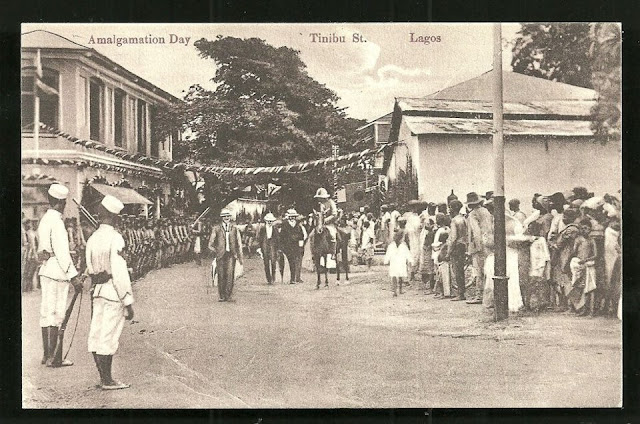
Amalgamation Day in Lagos, 1914
16 June, 2009


FIFA changes the rules
Across the world, more and more people are eligible at birth for the citizenships of more than one country. It used to be if a player featured at any level for a national team of one of the countries he was eligible for, he was locked into playing for that country at the international level forever. Well, not forever, but you get the drift.
The rule was changed, to allow players eligible for more than one citizenship at the time they first donned a junior international jersey to switch, but only once, only if they had never featured for the full senior national team, and only before their 21st birthday. You could play for the Under-17s or Under-21s and still be eligible to switch, provided you did so before your 21st birthday. After you hit 21, you could not change your international allegiance.
This week comes news that FIFA has changed the rule again, taking off the age-limit. Now, provided you have not played for the full senior team, and were eligible for the alternate choice from the start, you can switch your allegiance (only once) at any age (I have seen one source that said the new limit is your 28th birthday, but most sources say there is no limit.
I want Nigeria to develop a programme for developing players in Nigeria. I also want us to start thinking of making our domestic league financially competitive with the biggest leagues in the world (admittedly this is impossible without our broader economy, GDP and GDP/per capita, growing to rival the biggest in size, but then rapid economic growth is a national priority in and of itself).
I am a traditionalist. I believe a Nigerian is a Nigerian regardless of where he is born, and I want the children born in the Diaspora to grow up proud of their Nigerian heritage and identity; and whatever other citizenship documents they may hold, I want them to seek the Nigerian passport as well.
In this vein, I would like our embassies to have an official (no more than one) who's job is to keep in touch with potential sporting stars among the young Diaspora. I don't mean waiting until they are stars, and then trying to claim somebody when we contributed nothing to their development. No, I mean being there from the start. The embassies should look after our citizens, and the parents of every Nigerian child outside our borders (even those who will not become sportsmen) should feel the protective umbrella of the nearest embassy. Indeed, the embassy should be at the heart of the socio-cultural life of our citizen communities abroad.
But specific to sports, we need to have the best Nigerian athletes, born anywhere, proudly representing the federal republic at the highest level. I want us to run successful sports programmes that any athlete would want to be a part of. I want to see sporting teams of Nigerians of various ethnic, regional, religious and "birth place" backgrounds working together as a unit to achieve sportiing success.
Is this not what Nigeria is? A union of differing peoples, united for common advancement and achievement?
We have not really done any of this.
Still, there are young sportsmen and sportswomen of the Diaspora, who could be very important to Nigeria as we seek to climb to the zenith of world sports. As many of them as can be persuaded to don our colours, should be welcomed "home".
The FIFA rule change opens the doors for us to talk to, perhaps even persuade a handful of footballers who have only recently crossed the old age-limit threshold. We do not have to try too hard. If they say no, we can let it go.
But let us at least try, if for no other reason than to convey to them (and to the broader Diaspora) that we recognize them as our brothers, sisters, sons and daughters.
That we do not think of them as "foreigners".
The rule was changed, to allow players eligible for more than one citizenship at the time they first donned a junior international jersey to switch, but only once, only if they had never featured for the full senior national team, and only before their 21st birthday. You could play for the Under-17s or Under-21s and still be eligible to switch, provided you did so before your 21st birthday. After you hit 21, you could not change your international allegiance.
This week comes news that FIFA has changed the rule again, taking off the age-limit. Now, provided you have not played for the full senior team, and were eligible for the alternate choice from the start, you can switch your allegiance (only once) at any age (I have seen one source that said the new limit is your 28th birthday, but most sources say there is no limit.
I want Nigeria to develop a programme for developing players in Nigeria. I also want us to start thinking of making our domestic league financially competitive with the biggest leagues in the world (admittedly this is impossible without our broader economy, GDP and GDP/per capita, growing to rival the biggest in size, but then rapid economic growth is a national priority in and of itself).
I am a traditionalist. I believe a Nigerian is a Nigerian regardless of where he is born, and I want the children born in the Diaspora to grow up proud of their Nigerian heritage and identity; and whatever other citizenship documents they may hold, I want them to seek the Nigerian passport as well.
In this vein, I would like our embassies to have an official (no more than one) who's job is to keep in touch with potential sporting stars among the young Diaspora. I don't mean waiting until they are stars, and then trying to claim somebody when we contributed nothing to their development. No, I mean being there from the start. The embassies should look after our citizens, and the parents of every Nigerian child outside our borders (even those who will not become sportsmen) should feel the protective umbrella of the nearest embassy. Indeed, the embassy should be at the heart of the socio-cultural life of our citizen communities abroad.
But specific to sports, we need to have the best Nigerian athletes, born anywhere, proudly representing the federal republic at the highest level. I want us to run successful sports programmes that any athlete would want to be a part of. I want to see sporting teams of Nigerians of various ethnic, regional, religious and "birth place" backgrounds working together as a unit to achieve sportiing success.
Is this not what Nigeria is? A union of differing peoples, united for common advancement and achievement?
We have not really done any of this.
Still, there are young sportsmen and sportswomen of the Diaspora, who could be very important to Nigeria as we seek to climb to the zenith of world sports. As many of them as can be persuaded to don our colours, should be welcomed "home".
The FIFA rule change opens the doors for us to talk to, perhaps even persuade a handful of footballers who have only recently crossed the old age-limit threshold. We do not have to try too hard. If they say no, we can let it go.
But let us at least try, if for no other reason than to convey to them (and to the broader Diaspora) that we recognize them as our brothers, sisters, sons and daughters.
That we do not think of them as "foreigners".
15 June, 2009
Football and the Olympics
So, Jacques Rogge, the head of the International Olympic Committee has warned that if FIFA changes the eligibility rules for the Olympic Football tournament, the IOC might cut the size of the tournament (i.e. reduce the number of teams) or drop the tournament altogether because "the value of the event" (in Rogge's words) would be diminished.
The Olympics is too large and too expensive for most countries to host. Even those countries that can afford it are essentially wasting money; according to everything I have read over the years, the United States is the only country that makes a profit when it hosts the Olympics. Every other host loses money, though the IOC makes money. Frankly it is a bloated event, that should be hosted across an entire country (maybe more than one) rather than force single cities to build more (white elephant) sporting facilities than they could ever find use for in the decades after the Olympics have moved on.
You can probably guess that I am only interested in a small fraction of the sports at the Olympics. The rest of the events, the majority of the events, do not interest me at all. And I am not alone.
There are two kinds of sports.
The first group, the majority, are sports that use the brand of the Olympics to generate interest in what is essentially their most important global championship. During the Olympics, the "world" pays attention to their sport; after the Olympics, the world loses interest.
The second group are sports that are so popular they do not need the Olympic brand to validate their world championships or world champions. The three biggest sports have self-standing world championships, the FIFA World Cup, the Rugby World Cup and the Cricket World Cup. Association Football is the world's most popular sport, and I suspect most fans would give up any number of Olympic medals in any number of sports if meant their football team would win the World Cup.
In tennis, it is more important to win the Davis Cup, Fed Cup or one of the tennis majors (US Open, Aussie Open, Roland Garros and Wimbledon); the Olympic gold medal in tennis is nowhere near the top of the agenda. I don't know much about golf, but I have never heard of a golf Olympic champion, nor have I noticed any golf fans excited about such a person if he or she exists.
Basketball is different. It is a popular sport worldwide, but the Olympics might just edge the Basketball equivalent of a World Cup in significance. This is probably due to the United States, the home of basketball. Americans love the Olympics; for the average American, "world champion" at something and "Olympic champion" of the same thing are synonymous. But then the broader American public have traditionally had little interest in Football, Rugby and Cricket, the sports that prove that a single-event World Championship can be more prestigious than an Olympic medal -- and this is also the country that describes its national champions as world champions.
For those of us who follow the major world sports, the Olympics congests the calendar while providing little in the way of an explanation for the congestion.
No really, what does the Olympic medal decide in football?
We have a world champion, decided at the World Cup. We have a junior champion, decided at the World Youth Cup. And we have a school-boy or cadet world champion, decided at the Under-17 World Championships. Each of these world championships has an equivalent continental championship that decides the continental champions at each level.
So what does the Olympics decide? The Under-23 champion? Of what use is that?
I am a citizen of a country (Nigeria) that has won the Olympic gold in football (in 1996), and if given the choice, I would trade it in for an extra Nations Cup title or a World Cup title. I don't know what the Olympic gold signifies. We were not the African champion, and we were not the World Champion. It was just another age-restricted trophy.
We endanger the health of football players, and the commercial viability of football (scarcity is value) by forcing our star players to play far too many matches every year, without rest. They don't rest. In the off-season, they are playing friendlies, qualifiers, continental championships and the World Cup.
There is fault on the club end too. The biggest example of unnecessary fixture congestion is the UEFA Champions League. It is bloated, featuring way too many unnecessary (boring) matches in the earlier phases. What used to be rare and fantastic encounters between European giants are now routine, mundane repeats of encounters we have seen several times before (particularly this year when there were nearly four English teams in the semi-finals).
In Africa, the uneccesary Championship of African Nations (CHAN) has been created. We already have the wonderful African Nations Cup, which not only crowns the undisputed champion of Africa, but also is (in my opinion anyway, as an African fan) the second-most important football tournament behind the World Cup. What is the CHAN for? We should not dilute the Nations Cup's value by crowning some sort of co-champion at the CHAN, nor do we need a new tournament restricted to players based in African domestic leagues; we already have the sub-continental championships (the CECAFA Cup, the COSAFA Cup, the Amilcar Cabral Cup, the CEMAC Cup and the Arab Nations Cup) that are contested exclusively by players based in African domestic leagues.
There is a similar story to tell elsewhere. Brazil for one could do with a simpler system of domestic football championships. All in all, football needs to be streamlined so we get quality over quantity, and to give our players time to rest between seasons.
As it stands today, FIFA does not even include the Olympics on its unified calendar, so clubs are not required to release their players for it (something Rogge complained about in the article).
If football was dropped from the Olympics, who would notice? Who would miss it?
There are too many international agencies that continue to operate in the 21st Century in ways that were outdated even in the 20th, and the administrative organs of world sport are no different. The IOC and FIFA could both do with some reform, but in a practical sense the Olympics should be downsized, made less expensive and more focussed by restricting it to those sports that need the Olympic brand. Everything else should have stand-alone World Championships, that are small enough for most countries to dream of hosting.
The Olympics is too large and too expensive for most countries to host. Even those countries that can afford it are essentially wasting money; according to everything I have read over the years, the United States is the only country that makes a profit when it hosts the Olympics. Every other host loses money, though the IOC makes money. Frankly it is a bloated event, that should be hosted across an entire country (maybe more than one) rather than force single cities to build more (white elephant) sporting facilities than they could ever find use for in the decades after the Olympics have moved on.
You can probably guess that I am only interested in a small fraction of the sports at the Olympics. The rest of the events, the majority of the events, do not interest me at all. And I am not alone.
There are two kinds of sports.
The first group, the majority, are sports that use the brand of the Olympics to generate interest in what is essentially their most important global championship. During the Olympics, the "world" pays attention to their sport; after the Olympics, the world loses interest.
The second group are sports that are so popular they do not need the Olympic brand to validate their world championships or world champions. The three biggest sports have self-standing world championships, the FIFA World Cup, the Rugby World Cup and the Cricket World Cup. Association Football is the world's most popular sport, and I suspect most fans would give up any number of Olympic medals in any number of sports if meant their football team would win the World Cup.
In tennis, it is more important to win the Davis Cup, Fed Cup or one of the tennis majors (US Open, Aussie Open, Roland Garros and Wimbledon); the Olympic gold medal in tennis is nowhere near the top of the agenda. I don't know much about golf, but I have never heard of a golf Olympic champion, nor have I noticed any golf fans excited about such a person if he or she exists.
Basketball is different. It is a popular sport worldwide, but the Olympics might just edge the Basketball equivalent of a World Cup in significance. This is probably due to the United States, the home of basketball. Americans love the Olympics; for the average American, "world champion" at something and "Olympic champion" of the same thing are synonymous. But then the broader American public have traditionally had little interest in Football, Rugby and Cricket, the sports that prove that a single-event World Championship can be more prestigious than an Olympic medal -- and this is also the country that describes its national champions as world champions.
For those of us who follow the major world sports, the Olympics congests the calendar while providing little in the way of an explanation for the congestion.
No really, what does the Olympic medal decide in football?
We have a world champion, decided at the World Cup. We have a junior champion, decided at the World Youth Cup. And we have a school-boy or cadet world champion, decided at the Under-17 World Championships. Each of these world championships has an equivalent continental championship that decides the continental champions at each level.
So what does the Olympics decide? The Under-23 champion? Of what use is that?
I am a citizen of a country (Nigeria) that has won the Olympic gold in football (in 1996), and if given the choice, I would trade it in for an extra Nations Cup title or a World Cup title. I don't know what the Olympic gold signifies. We were not the African champion, and we were not the World Champion. It was just another age-restricted trophy.
We endanger the health of football players, and the commercial viability of football (scarcity is value) by forcing our star players to play far too many matches every year, without rest. They don't rest. In the off-season, they are playing friendlies, qualifiers, continental championships and the World Cup.
There is fault on the club end too. The biggest example of unnecessary fixture congestion is the UEFA Champions League. It is bloated, featuring way too many unnecessary (boring) matches in the earlier phases. What used to be rare and fantastic encounters between European giants are now routine, mundane repeats of encounters we have seen several times before (particularly this year when there were nearly four English teams in the semi-finals).
In Africa, the uneccesary Championship of African Nations (CHAN) has been created. We already have the wonderful African Nations Cup, which not only crowns the undisputed champion of Africa, but also is (in my opinion anyway, as an African fan) the second-most important football tournament behind the World Cup. What is the CHAN for? We should not dilute the Nations Cup's value by crowning some sort of co-champion at the CHAN, nor do we need a new tournament restricted to players based in African domestic leagues; we already have the sub-continental championships (the CECAFA Cup, the COSAFA Cup, the Amilcar Cabral Cup, the CEMAC Cup and the Arab Nations Cup) that are contested exclusively by players based in African domestic leagues.
There is a similar story to tell elsewhere. Brazil for one could do with a simpler system of domestic football championships. All in all, football needs to be streamlined so we get quality over quantity, and to give our players time to rest between seasons.
As it stands today, FIFA does not even include the Olympics on its unified calendar, so clubs are not required to release their players for it (something Rogge complained about in the article).
If football was dropped from the Olympics, who would notice? Who would miss it?
There are too many international agencies that continue to operate in the 21st Century in ways that were outdated even in the 20th, and the administrative organs of world sport are no different. The IOC and FIFA could both do with some reform, but in a practical sense the Olympics should be downsized, made less expensive and more focussed by restricting it to those sports that need the Olympic brand. Everything else should have stand-alone World Championships, that are small enough for most countries to dream of hosting.
14 June, 2009
Still on Dredging the Niger
I want to clarify my post on dredging the Niger.
It is not the absolute cost of the project that worries me. I suppose my beef has more to do with the opportunity cost of every Naira spent on the project.
Public services like healthcare and education are obviously important, and I do not mean to neglect them, but our economic growth has long been stymied by our inadequate infrastructure. And it is economic growth (and growth in the disposable income of our citizens) that will pay for public services, and for individual and family access to private health insurance. We cannot get this growth without infrastructure that supports rapid economic development.
In this context, revamping the railway system is a MASSIVE priority. The only things I would rate higher on the infrastructure priority scale would be:
(a) Raising our electricity generation from below 6,000 megawatts to at least 200,000 megawatts if not more. I don't know what a Nigeria operating at maximum potential would require, since it has never happened, but it bothers me that we have been talking for years, decades, about rasing our generation to 10,000 megawatts, when it is clear that 40,000 is insufficient for South Africa (with 33% of our population, and 500% of our per capita income) and they are not operating on maximum potential either! For the record, this counts only electricity generated by entities like PHCN and Eskom, and not the electricity produced by private generators and in-house production by large and small corporations in both countries, but it is enough to surmise that 150,000 megawatts would be barely sufficient to support a Nigeria operating at South African levels of output.
(b) Water. Having individual citizens, firms and corporations randomly sinking boreholes into the ground all over the country does not strike me as a sensible way to manage scarce water resources. I have heard of no concrete plans advanced by any of the major political parties in 1999, 2003 and 2007 for the management, collection, processing and distribution of water on a federal-scale for our urban and rural communities. There are assorted World Bank-backed projects here and there, but our federal republic needs a coordinated approach to an already serious problem that will become even more important going forward.
The above two priorities will require a LOT of investment, public and private, and we do not currently have access to the requisite funding. Added to these two, we must also prioritize the rail system (and the federal inter-city expressways) and we don't necessarily have access to the funds to do that properly either.
We have a couple of state plans (light rail in Cross River and Lagos State), and a federal plan that seems to consist of a Lagos-Kano line that passes through Abuja (or a separate Lagos-Abuja line, hard to tell) and a Port Harcourt-Maiduguri line as mentioned by Presiden Yar'Adua in his 25-page Guardian inteview.
Now if you are the British colonialists, seeking only to export resources to the coast, the federal plan would work for you; and if you have a simplistic view of Nigeria's economic future, the federal plan would work for you too. But if you have an ambitious understanding of the internal economic inter-dependence of the federal republic, and how this inter-dependence can be used to create internal chains of production, and how these chains could create an entirely different type of international trade for the federal republic -- well, then the federal plan is not good enough. The rail system we need desperately is a lot more complex (and hence more expensive) than that. We need it not only to support autochthonous economic development, but to take some of the pressure (and congestion and risk of accidents) of off our inter-city expressways. And if we are serious about protecting vital national resources like the vast Gashaka-Gumpti Reserve, we would have to invest in elevated lines across sensitive areas.
The state plans are interesting in and of themselves, but we risk duplicating costs if the state plans ultimately are incongruent with the eventually improved (I hope) federal plan. Indeed, there is something strange about deciding on the placement of municipal airports, inter-city bus depots, putative inland ports, export promotion zones, and major industrial development projects without first answering the question of where we can and cannot feasibly build, renovate or add a spur or main line of a pan-federal railway system.
My criticism of the spending on dredging the Naira is tied to the fact that I would rather we consolidated what funds (public and private) we have to attack the problem of the pan-federal railway system first. I don't care so much what the absolute cost of the dredging is -- whatever it is, I would rather those funds were first committed to the railways. My point is further buttressed by the fact that once the railways are where they need to be, there will actually be no need to dredge the Niger as intra-Nigerian transportation would be on a solid footing (six inland ports simply do not achieve anywhere near as much in internal and external transport as an effective pan-federal rail system). With proper planning, we could have rail access to the ports of Douala, Porto Novo, Cotonou and perhaps even Accra and Abidjan.
By the way, could someone direct me to the environmental impact study vis-a-vis the Niger Delta? The construction of the Kainji Dam denied the many islands of the Delta their natural source of silt, the earth of which they are made and with which they are sustained. Combined with the rising oceans, many islands were reported to have lost territory to the sea. The loss of territory in Lagos gets more media coverage, but the issue exists in the Niger Delta too.
Sometime soon, we have to ask ourselves questions about how to protect Lagos and the Niger Delta from ocean erosion, how to protect the states created from the defunct "East-Central State" from gulley erosion, and how to protect Niger Republic (which is a climate buffer between our northern frontier and the Sahara Desert) from the southward march of the arid and semi-arid climate zones. These goals will require better understanding of the region of the natural world in which we find ourselves, as well as the political will and access to funding necessary to do whatever is necessary.
It just seems strange to me that everything important is on hold, while we commit scarce funds to dredging the River Niger.
It is not the absolute cost of the project that worries me. I suppose my beef has more to do with the opportunity cost of every Naira spent on the project.
Public services like healthcare and education are obviously important, and I do not mean to neglect them, but our economic growth has long been stymied by our inadequate infrastructure. And it is economic growth (and growth in the disposable income of our citizens) that will pay for public services, and for individual and family access to private health insurance. We cannot get this growth without infrastructure that supports rapid economic development.
In this context, revamping the railway system is a MASSIVE priority. The only things I would rate higher on the infrastructure priority scale would be:
(a) Raising our electricity generation from below 6,000 megawatts to at least 200,000 megawatts if not more. I don't know what a Nigeria operating at maximum potential would require, since it has never happened, but it bothers me that we have been talking for years, decades, about rasing our generation to 10,000 megawatts, when it is clear that 40,000 is insufficient for South Africa (with 33% of our population, and 500% of our per capita income) and they are not operating on maximum potential either! For the record, this counts only electricity generated by entities like PHCN and Eskom, and not the electricity produced by private generators and in-house production by large and small corporations in both countries, but it is enough to surmise that 150,000 megawatts would be barely sufficient to support a Nigeria operating at South African levels of output.
(b) Water. Having individual citizens, firms and corporations randomly sinking boreholes into the ground all over the country does not strike me as a sensible way to manage scarce water resources. I have heard of no concrete plans advanced by any of the major political parties in 1999, 2003 and 2007 for the management, collection, processing and distribution of water on a federal-scale for our urban and rural communities. There are assorted World Bank-backed projects here and there, but our federal republic needs a coordinated approach to an already serious problem that will become even more important going forward.
The above two priorities will require a LOT of investment, public and private, and we do not currently have access to the requisite funding. Added to these two, we must also prioritize the rail system (and the federal inter-city expressways) and we don't necessarily have access to the funds to do that properly either.
We have a couple of state plans (light rail in Cross River and Lagos State), and a federal plan that seems to consist of a Lagos-Kano line that passes through Abuja (or a separate Lagos-Abuja line, hard to tell) and a Port Harcourt-Maiduguri line as mentioned by Presiden Yar'Adua in his 25-page Guardian inteview.
Now if you are the British colonialists, seeking only to export resources to the coast, the federal plan would work for you; and if you have a simplistic view of Nigeria's economic future, the federal plan would work for you too. But if you have an ambitious understanding of the internal economic inter-dependence of the federal republic, and how this inter-dependence can be used to create internal chains of production, and how these chains could create an entirely different type of international trade for the federal republic -- well, then the federal plan is not good enough. The rail system we need desperately is a lot more complex (and hence more expensive) than that. We need it not only to support autochthonous economic development, but to take some of the pressure (and congestion and risk of accidents) of off our inter-city expressways. And if we are serious about protecting vital national resources like the vast Gashaka-Gumpti Reserve, we would have to invest in elevated lines across sensitive areas.
The state plans are interesting in and of themselves, but we risk duplicating costs if the state plans ultimately are incongruent with the eventually improved (I hope) federal plan. Indeed, there is something strange about deciding on the placement of municipal airports, inter-city bus depots, putative inland ports, export promotion zones, and major industrial development projects without first answering the question of where we can and cannot feasibly build, renovate or add a spur or main line of a pan-federal railway system.
My criticism of the spending on dredging the Naira is tied to the fact that I would rather we consolidated what funds (public and private) we have to attack the problem of the pan-federal railway system first. I don't care so much what the absolute cost of the dredging is -- whatever it is, I would rather those funds were first committed to the railways. My point is further buttressed by the fact that once the railways are where they need to be, there will actually be no need to dredge the Niger as intra-Nigerian transportation would be on a solid footing (six inland ports simply do not achieve anywhere near as much in internal and external transport as an effective pan-federal rail system). With proper planning, we could have rail access to the ports of Douala, Porto Novo, Cotonou and perhaps even Accra and Abidjan.
By the way, could someone direct me to the environmental impact study vis-a-vis the Niger Delta? The construction of the Kainji Dam denied the many islands of the Delta their natural source of silt, the earth of which they are made and with which they are sustained. Combined with the rising oceans, many islands were reported to have lost territory to the sea. The loss of territory in Lagos gets more media coverage, but the issue exists in the Niger Delta too.
Sometime soon, we have to ask ourselves questions about how to protect Lagos and the Niger Delta from ocean erosion, how to protect the states created from the defunct "East-Central State" from gulley erosion, and how to protect Niger Republic (which is a climate buffer between our northern frontier and the Sahara Desert) from the southward march of the arid and semi-arid climate zones. These goals will require better understanding of the region of the natural world in which we find ourselves, as well as the political will and access to funding necessary to do whatever is necessary.
It just seems strange to me that everything important is on hold, while we commit scarce funds to dredging the River Niger.
Reflections on June 12
The 1993 elections were contested by two government-manufactured parties. We the people did not create or choose these parties. They were imposed on us by the Babangida diarchy. These were the parties they wanted.
After the diarchy disqualified all of the presidential candidates they did not want, the two prefabricated parties presented Nigerians with a choice between two men. We the people did not choose these candidates. More importantly, we did not have the option of selecting other options, other possibilities that we perhaps would have considered to be superior choices.
We the people were force-fed a choice between two men, in an election that resembled a professional wrestling promotion.
For those of you who have never watched professional wrestling, there are two types of matches. The best-known type of matches are marquee events between two stars. But the most numerous type of matches are "enhancement" matches, which usually feature a star or future star against a nobody; the promoter (i.e. the owner of the company) books the nobody in the match for the specific purpose of having him lose to the star in a way that makes the star look magnificent. Often, the nobody is someone you have never heard of before and will never hear of afterward.
Bashir Tofa was nobody. Not literally, of course, but politically he was a void, a vacuum. He was not even a power in his own home state (it would not surprise me if indigenes of his state had never heard of him before -- I certainly hadn't). Tofa's elevation to the role of presidential candidate, in the context of the heavily government-managed 1993 polls, must raise suspicions that he was a Barry Horowitz or Brooklyn Brawler booked to lose to an Andre the Giant (RIP) or Ric Flair.
The late Moshood Abiola was a man of the system, a dear friend of erstwhile regime head Ibrahim Babangida. There are allegations that Abiola helped fund the 1983 and 1985 coups, and that his newspapers provided propaganda and public relations support for both actions. He definitely garnered great wealth was a key figure in the diarchies of the 1970s, in the Second Republic, and in the diarchies of the 1980s and early 1990s. He was a man of the system. It would not surprise me if his dear friend had manipulated the system to ensure a particular outcome; most of the big names of Nigerian (wuruwuru) politics got the message and did not run, but Babangida certainly disqualified anyone who wanted to run that could have posed a challenge to the desired outcome.
On occasion, the men and women of the system do fight each other for control of the system's levers. Sometimes (too frequently in Nigeria) they even kill each other.
But whomever wins, the system continues.
It is the same everywhere in the world. There may be cosmetic changes here and there when an opposition party replaces a governing party, but the underlying dynamics of the country's social, political and economic life do not change. This is okay in wealthier climes, but it is unfortunate for African countries because we rather strongly need tranformative change and reform. Unfortunately, what we get in Africa is "opposition" politicians complaining about the government, and then doing the same thing themselves after they replace the governing party.
Indeed, "opposition" leaders want to capture the undemocratic, unbound, unchecked and unbalanced powers of the government for themselves, rather than reform and change the system. And to be honest, the leaders of the fight against colonialism ultimately held onto to the colonial government's supreme, unaccountable, de facto dictatorial powers. Colonial governments did not permit such niceties as democratic elections influence their decision-making or their exercise of power; post-colonial regimes were just as disinterested in the democratic voices of the people. The colonial governors perceived themselves as knowing better than the black people they governed; post-colonial leaders, many of whom were in politics strictly because they were part of the well-educated minority in their countries, felt the same way about the people they led.
But I digress.
The fight between the late Sani Abacha and the late Moshood Abiola over which one of them was supposed to succeed their mutual friend Ibrahim Babangida, was real. Power was at stake, and Babangida probably made promises to both of them; they were both influential in bringing Babangida to power in the first place, and had both profited from their friendship with him.
It was a real fight
But it was not a fight about changing the basic nature, structure and function of the Nigerian Federal Republic. Like every fake election and every military coup, it was a fight of "man of the system" against "man of the system".
At some level I think Nigerians know this. There is a reason for the public apathy towards coups and fake elections. Regular Nigerian citizens do not want to die on behalf of any of the putative winners or losers of the coups and rigged polls. None of them is who we really want anyway, none of them would even have been candidates if we had had our way, and none of them offer us anything in the way of policies or possibilities that are worth fighting for or dying for.
As for the politicians (and militicians), well they know the score, don't they? Tom Ikimi and Baba Gana Kingibe were the leaders of the two 1993 political parties, and they jumped ship to become ministers in the Abacha government. Except they didn't really "jump ship" did they? Both parties were part of the same system as the Babangida and Abacha regimes, as was the election itself and the abortive Third Republic. Ikimi and Kingibe simply moved from one functionality within the diarchy to another.
Loyalists do exist, people who fight on for particular Big Men. These loyalists are either Big Men themselves (with a stake in the results) or are the sort of "youths" who, since the before the First Republic, have been ever-willing to fight (literally) for an ethnic kinsman, a co-religionist or a moneybag.
It is never really about the principles of transformation and structural reform.
Many of the men who fought the longest for the late Moshood Abiola's mandate turned around to give their support in 2003 to then-President Olusegun Obasanjo, a man who supported the annulment of the 1993 elections. And after years of supposedly campaigning for democracy, they support a man who was the face of a Peoples Democratic Party machine that revels in subverting and thwarting democracy.
And it is not just an Abiola thing. Supporters of retired General Mohammedu Buhari have also abandoned him, after years of allegedly advocating "democracy" in the face of Obasanjo's often unconstitutional behaviour.
Let us be honest.
Obasanjo satisfied something that the erstwhile pro-Abiola group wanted, and Yar'Adua satisfied something the erstwhile pro-Buhari faction wanted. And we all know what that something is, and we know it has nothing to do with transformation and structural reform, or to do with any policies or ideologies or principles. It is ethnic in nature, isn't it?
And if we are going to keep the spirit of honesty alive, let us admit that part of the apathy (and outright hostility) towards Abiola's mandate in the third leg of the old tripod was just as ethnic-driven. The tripod still works the same way it always has; when two legs gang up on the third, the third loses.
But that is what happens in a country where politicians stand for nothing and offer nothing. Almost the only thing that differentiates them from each other is their ethnicity, their religion, and whether they are ex-army officers or life-long civilians. Other than that, they are mostly the same and would do the same things if placed in office.
The politicians themselves recognize this. Initially, they used their ethnic, regional and religious differences as the basis of mobilizing support. After the Civil War showed the dangers of doing that, we moved into a different era. One of these days, an intelligent researcher needs to write a series of books detailing how Nigerian politics moved from the disaster of the Civil War to the hegemony (for now) of the Peoples Democratic Party. The irony is the late Moshood Abiola was part of that process, though he was consumed by it, as were so many others.
But it isn't just the Big Men. We the people are the same.
Any number of intellectuals, commentators, etc, from any and every corner of the country, have the fascinating ability to massively criticize a regime, demanding accountability, transparency and democracy, only to turn around and become cheerleaders for the regime (or another regime exactly like the one they criticized) because of some perceived advantage for themselves (appointment to a cushy job) or for their socio-cultural groups. We the people cannot criticize our leaders because we do the same thing; in my own ancestral village, the people acquiesced in a game of deception by the former governor of the state, to allow him to claim to have built schools in the area (in his list of accomplishments) even though the schools in question were standing in the colonial days -- my townspeople did this because the governor appointed one of "our sons" to high office.
This is part of the reason why the broader public, 140-million-strong, do not stand up to fight the political battles of any politician. We know that he or she is as likely to turn around and cut a deal with the person who was supposedly the mortal enemy just two seconds ago. We will die, and die, and die, and then (like Mwai Kibaki and Raila Odinga) the people we were fighting for will shake hands and continue to enjoy their positions atop society.
June 12, 1993 is one of the important in our shared history. But we tend to draw the wrong lessions from our important days, and ascribe to them the wrong reasons for significance.
These are days when one faction of the system gained the upper hand over other factions of the system. Advantage, no matter how long it lasts, is always temporary.
And advantage, no matter which faction holds it, does nothing to break the federal republic free from the constraints that keep us from achieving our full potential.
I do not think we will see real change until a date in the future -- when we choose a new system to replace the one we have now.
After the diarchy disqualified all of the presidential candidates they did not want, the two prefabricated parties presented Nigerians with a choice between two men. We the people did not choose these candidates. More importantly, we did not have the option of selecting other options, other possibilities that we perhaps would have considered to be superior choices.
We the people were force-fed a choice between two men, in an election that resembled a professional wrestling promotion.
For those of you who have never watched professional wrestling, there are two types of matches. The best-known type of matches are marquee events between two stars. But the most numerous type of matches are "enhancement" matches, which usually feature a star or future star against a nobody; the promoter (i.e. the owner of the company) books the nobody in the match for the specific purpose of having him lose to the star in a way that makes the star look magnificent. Often, the nobody is someone you have never heard of before and will never hear of afterward.
Bashir Tofa was nobody. Not literally, of course, but politically he was a void, a vacuum. He was not even a power in his own home state (it would not surprise me if indigenes of his state had never heard of him before -- I certainly hadn't). Tofa's elevation to the role of presidential candidate, in the context of the heavily government-managed 1993 polls, must raise suspicions that he was a Barry Horowitz or Brooklyn Brawler booked to lose to an Andre the Giant (RIP) or Ric Flair.
The late Moshood Abiola was a man of the system, a dear friend of erstwhile regime head Ibrahim Babangida. There are allegations that Abiola helped fund the 1983 and 1985 coups, and that his newspapers provided propaganda and public relations support for both actions. He definitely garnered great wealth was a key figure in the diarchies of the 1970s, in the Second Republic, and in the diarchies of the 1980s and early 1990s. He was a man of the system. It would not surprise me if his dear friend had manipulated the system to ensure a particular outcome; most of the big names of Nigerian (wuruwuru) politics got the message and did not run, but Babangida certainly disqualified anyone who wanted to run that could have posed a challenge to the desired outcome.
On occasion, the men and women of the system do fight each other for control of the system's levers. Sometimes (too frequently in Nigeria) they even kill each other.
But whomever wins, the system continues.
It is the same everywhere in the world. There may be cosmetic changes here and there when an opposition party replaces a governing party, but the underlying dynamics of the country's social, political and economic life do not change. This is okay in wealthier climes, but it is unfortunate for African countries because we rather strongly need tranformative change and reform. Unfortunately, what we get in Africa is "opposition" politicians complaining about the government, and then doing the same thing themselves after they replace the governing party.
Indeed, "opposition" leaders want to capture the undemocratic, unbound, unchecked and unbalanced powers of the government for themselves, rather than reform and change the system. And to be honest, the leaders of the fight against colonialism ultimately held onto to the colonial government's supreme, unaccountable, de facto dictatorial powers. Colonial governments did not permit such niceties as democratic elections influence their decision-making or their exercise of power; post-colonial regimes were just as disinterested in the democratic voices of the people. The colonial governors perceived themselves as knowing better than the black people they governed; post-colonial leaders, many of whom were in politics strictly because they were part of the well-educated minority in their countries, felt the same way about the people they led.
But I digress.
The fight between the late Sani Abacha and the late Moshood Abiola over which one of them was supposed to succeed their mutual friend Ibrahim Babangida, was real. Power was at stake, and Babangida probably made promises to both of them; they were both influential in bringing Babangida to power in the first place, and had both profited from their friendship with him.
It was a real fight
But it was not a fight about changing the basic nature, structure and function of the Nigerian Federal Republic. Like every fake election and every military coup, it was a fight of "man of the system" against "man of the system".
At some level I think Nigerians know this. There is a reason for the public apathy towards coups and fake elections. Regular Nigerian citizens do not want to die on behalf of any of the putative winners or losers of the coups and rigged polls. None of them is who we really want anyway, none of them would even have been candidates if we had had our way, and none of them offer us anything in the way of policies or possibilities that are worth fighting for or dying for.
As for the politicians (and militicians), well they know the score, don't they? Tom Ikimi and Baba Gana Kingibe were the leaders of the two 1993 political parties, and they jumped ship to become ministers in the Abacha government. Except they didn't really "jump ship" did they? Both parties were part of the same system as the Babangida and Abacha regimes, as was the election itself and the abortive Third Republic. Ikimi and Kingibe simply moved from one functionality within the diarchy to another.
Loyalists do exist, people who fight on for particular Big Men. These loyalists are either Big Men themselves (with a stake in the results) or are the sort of "youths" who, since the before the First Republic, have been ever-willing to fight (literally) for an ethnic kinsman, a co-religionist or a moneybag.
It is never really about the principles of transformation and structural reform.
Many of the men who fought the longest for the late Moshood Abiola's mandate turned around to give their support in 2003 to then-President Olusegun Obasanjo, a man who supported the annulment of the 1993 elections. And after years of supposedly campaigning for democracy, they support a man who was the face of a Peoples Democratic Party machine that revels in subverting and thwarting democracy.
And it is not just an Abiola thing. Supporters of retired General Mohammedu Buhari have also abandoned him, after years of allegedly advocating "democracy" in the face of Obasanjo's often unconstitutional behaviour.
Let us be honest.
Obasanjo satisfied something that the erstwhile pro-Abiola group wanted, and Yar'Adua satisfied something the erstwhile pro-Buhari faction wanted. And we all know what that something is, and we know it has nothing to do with transformation and structural reform, or to do with any policies or ideologies or principles. It is ethnic in nature, isn't it?
And if we are going to keep the spirit of honesty alive, let us admit that part of the apathy (and outright hostility) towards Abiola's mandate in the third leg of the old tripod was just as ethnic-driven. The tripod still works the same way it always has; when two legs gang up on the third, the third loses.
But that is what happens in a country where politicians stand for nothing and offer nothing. Almost the only thing that differentiates them from each other is their ethnicity, their religion, and whether they are ex-army officers or life-long civilians. Other than that, they are mostly the same and would do the same things if placed in office.
The politicians themselves recognize this. Initially, they used their ethnic, regional and religious differences as the basis of mobilizing support. After the Civil War showed the dangers of doing that, we moved into a different era. One of these days, an intelligent researcher needs to write a series of books detailing how Nigerian politics moved from the disaster of the Civil War to the hegemony (for now) of the Peoples Democratic Party. The irony is the late Moshood Abiola was part of that process, though he was consumed by it, as were so many others.
But it isn't just the Big Men. We the people are the same.
Any number of intellectuals, commentators, etc, from any and every corner of the country, have the fascinating ability to massively criticize a regime, demanding accountability, transparency and democracy, only to turn around and become cheerleaders for the regime (or another regime exactly like the one they criticized) because of some perceived advantage for themselves (appointment to a cushy job) or for their socio-cultural groups. We the people cannot criticize our leaders because we do the same thing; in my own ancestral village, the people acquiesced in a game of deception by the former governor of the state, to allow him to claim to have built schools in the area (in his list of accomplishments) even though the schools in question were standing in the colonial days -- my townspeople did this because the governor appointed one of "our sons" to high office.
This is part of the reason why the broader public, 140-million-strong, do not stand up to fight the political battles of any politician. We know that he or she is as likely to turn around and cut a deal with the person who was supposedly the mortal enemy just two seconds ago. We will die, and die, and die, and then (like Mwai Kibaki and Raila Odinga) the people we were fighting for will shake hands and continue to enjoy their positions atop society.
June 12, 1993 is one of the important in our shared history. But we tend to draw the wrong lessions from our important days, and ascribe to them the wrong reasons for significance.
These are days when one faction of the system gained the upper hand over other factions of the system. Advantage, no matter how long it lasts, is always temporary.
And advantage, no matter which faction holds it, does nothing to break the federal republic free from the constraints that keep us from achieving our full potential.
I do not think we will see real change until a date in the future -- when we choose a new system to replace the one we have now.
08 June, 2009
Dredging the Niger?
The federal government is proceeding with a long-mooted plan to dredge the River Niger.
Dredging the Niger has been talked about for years, usually by people who argue that creating a port at Onitsha would spare businessmen based there the delays of waiting for goods to first clear the ports at Lagos and Port Harcourt (Delay One), and then be transported on our roads that will never be confused for autobahns (Delay Two). The ethno-regional question was also brought up directly or alluded to indirectly, with certain individuals alleging both the delays, the lack of an Onitsha Port, and the placement of Port Harcourt in Rivers State were all part of some nefarious plan to punish a particular ethnic group.
More recently (relatively speaking), there have been new voices calling for the Niger to be dredged all the way up to Abuja, and for the creation of an Abuja Port. Similar arguments are made for the Abuja Port as are made for the Onitsha Port. Similar ethnic innuendo is indirectly alluded to (by proponents and opponents, who feel this will be a port that belongs to a certain ethnic nationality, who will no longer be dependent on ports where they are allegedly discriminated against). And to top it off, those who believe that the national political capital must also be the national commercial/economic capital feel Abuja must have a port (and a stock exchange, and etc).
In this 25-page interview with The Guardian, President Yar'Adua reveals that the plan (presumably devised after years of discussion and debate that preceded his administration) is to create SEVEN inland ports. He did not mention specific cities, but if seven new ports are to be created, it is highly likely both Abuja and Onitsha are on the list (and if Onitsha isn't, there will be another avoidable political crisis).
Before I talk about the dredging, let me talk about the cities in question.
I love Abuja. The decision to move the political capital to Abuja is one of the few decisions made since 1960 that I wholeheartedly agree with. With that said, we have done a poor job of handling the transition. I do not think the planners have a clear idea of what Abuja is and what Abuja should be. For one thing, it should not (and will not) replace Lagos as the commercial/economic capital (I love Lagos too), but I don't want to digress too far off the subject of this post (except to add that the much-praised Nasir El-Rufai's robotic attachment to an outdated city plan should perhaps not be as praised as it is -- it is long past time for us to rethink Abuja, before events move beyond our control).
I love Onitsha. The city went through a period where it was basically abandoned, and became possibly the dirtiest place I had ever seen. Its been a while since I last passed through, and I really hope things have changed for the better. In a way, cities like Onitsha, Ibadan and Enugu have been affected in the post-1960 era by the rise to prominence of other cities that do the sort of things that these cities used to be the hubs for. Still, Onitsha sits at the heart of a productive industrial region (on both sides of the Niger) that has not yet begun to scratch the surface of its full potential. Infrastructure improvements would definitely help unleash some of that potential.
Now, having honestly expressed my affection for these cities, I have to say: Dredging the River Niger is a bad idea.
While Nigerian public opinion continues to see the federal republic as a rich country that spends its money poorly, the truth is the Federal Republic of Nigeria is not a rich country. Our resources and productive capacity have been insufficient to meet our needs and requirements. This has always been true, and we have always needed to be judicious with our spending (unfortunately, we never were), but it is even more important to note this truth in the current economic climate.
President Yar'Adua acknowledges this. In the 25-page intervies, he spoke of having to cut back on grandiose schemes started by the Obasanjo administration because the federal government did not have enough money to pay for all of the schemes. He proposed cutting the pay of (faux) elected and appointed political officials. Yar'Adua also (sensibly in my opinion) asked the National Assembly to revise the 2009 Federal Budget downward, because the revenue projections on which it was based are unrealistic in the light of changes to the world economy (read: the price of crude oil). Last I checked, the President was still wrestling with the Assembly on the budget revision; it seems some legislators are concerned that the President will cut unnecessary spending on constituency projects with which they buy cheap, temporary popularity, so they have challenged him to implement the budget they passed (and he signed) or take them to court to force the revision.
Where we are right now fiscally (and where we have been since BEFORE regaining self-government in 1960) is a place where you have to prioritize and make choices, because you cannot do everything. YES, it is important to unleash the potential power of Onitsha, and YES it is important to link Abuja to the Atlantic. And the other five potential ports are probably also places that could benefit from arterial linkages to the sea.
But we already have a plan for this -- the plan to expand the railway lines.
President Yar'Adua mentioned these plans as well in the interview. I am not sure I agree with the plan (as he described it), and perhaps in that disagreement lies the root of my disagreement with the dredging of the Niger.
If we properly design our new railroad system, it would connect Onitsha and Abuja to the coastal ports. It would also connect both cities to every other major citiy in Nigeria. This second set of connections is important, particularly for Onitsha. With a port, they can bring in their goods. With pan-Nigerian rail-line, they can bring in their goods, and efficiently send those goods to buyers across Nigeria; indeed, Onitsha could actually come to buy more of its merchandise from producers in the rest of Nigeria instead of bringing in imports, because transportation and electricity/power are two infrastructure areas that could dramatically decrease the cost of manufacturing in Nigeria (indeed, it is rather weird that we are proposing to spend so much money on dredging, mainly to facilitate imports of consumer goods for the Onitsha market and the Abuja power elite).
But here is the thing, why should we, a country that does not really have enough money to fix all its problems, spend money on BOTH? The rail line basically fixes the problem that the inland ports are supposed to fix, and has the benefit of doing so much more than that as well. So why not focus all of our scarce funds on expanding and renovating the rail lines, which kills multiple birds with one stone, instead of expending some of it dredging the Niger? However much it is we save, would it not be better to add that many more kilometres of track rather than have to wait that much longer to expand the lines? For those who think "constituency projects" are important, bear in mind EVERY CONSTITUENCY in Nigeria stands to benefit from the economic efficiencies that could be introduced with a real railway network that is appropriate to the Federal Republic's needs (as opposed to being appropriate to the needs of the British colonial government in a time long since passed).
We have to prioritize the rail network -- and electricity -- which should mean that these get frontline consideration for spending our scarce public funds.
You might say the existing ports have only limited capacity, even with as much drastic expansion as is geographically possible, but even then it would be cheaper to encourage outside (as in NOT the Nigerian government) investment in expanding the facilities at Douala, Cotonou-Porto Novo, and even as far afield as Takoradi-Sekondi, and then creating road or rail links between those ports and the Nigerian rail grid. Remember this links go both ways, allowing us to export to these countries, even as their ports ease the congestion in ours. And we do not have to pay for the expansion; I am sure they would be keen to exploit our market, and would either do it themselves or open it up to private investors, some of whom could be Nigerian entrepreneurs or consolidated Nigerian banks. I daresay the competitive and comparative advantages of the seven proposed inland ports lie elsewhere, in economic territory that would more easily be unleashed by rail-links that could bind them (and other cities in Nigeria) into integrated production networks.
Why pay twice for something we could pay for once, while achieving a more efficient and effective outcome?
I don't really blame the government, because they are being pushed by influential segments of the citizenry, who have embraced dredging the Niger almost like a new religion. The odd thing about it is these so-called inland ports cannot possibly achieve their touted objectives without an improved national rail and road network, yet we would not even be thinking about the inland ports if we had the rail and road network we needed.
Dredging the Niger has been talked about for years, usually by people who argue that creating a port at Onitsha would spare businessmen based there the delays of waiting for goods to first clear the ports at Lagos and Port Harcourt (Delay One), and then be transported on our roads that will never be confused for autobahns (Delay Two). The ethno-regional question was also brought up directly or alluded to indirectly, with certain individuals alleging both the delays, the lack of an Onitsha Port, and the placement of Port Harcourt in Rivers State were all part of some nefarious plan to punish a particular ethnic group.
More recently (relatively speaking), there have been new voices calling for the Niger to be dredged all the way up to Abuja, and for the creation of an Abuja Port. Similar arguments are made for the Abuja Port as are made for the Onitsha Port. Similar ethnic innuendo is indirectly alluded to (by proponents and opponents, who feel this will be a port that belongs to a certain ethnic nationality, who will no longer be dependent on ports where they are allegedly discriminated against). And to top it off, those who believe that the national political capital must also be the national commercial/economic capital feel Abuja must have a port (and a stock exchange, and etc).
In this 25-page interview with The Guardian, President Yar'Adua reveals that the plan (presumably devised after years of discussion and debate that preceded his administration) is to create SEVEN inland ports. He did not mention specific cities, but if seven new ports are to be created, it is highly likely both Abuja and Onitsha are on the list (and if Onitsha isn't, there will be another avoidable political crisis).
Before I talk about the dredging, let me talk about the cities in question.
I love Abuja. The decision to move the political capital to Abuja is one of the few decisions made since 1960 that I wholeheartedly agree with. With that said, we have done a poor job of handling the transition. I do not think the planners have a clear idea of what Abuja is and what Abuja should be. For one thing, it should not (and will not) replace Lagos as the commercial/economic capital (I love Lagos too), but I don't want to digress too far off the subject of this post (except to add that the much-praised Nasir El-Rufai's robotic attachment to an outdated city plan should perhaps not be as praised as it is -- it is long past time for us to rethink Abuja, before events move beyond our control).
I love Onitsha. The city went through a period where it was basically abandoned, and became possibly the dirtiest place I had ever seen. Its been a while since I last passed through, and I really hope things have changed for the better. In a way, cities like Onitsha, Ibadan and Enugu have been affected in the post-1960 era by the rise to prominence of other cities that do the sort of things that these cities used to be the hubs for. Still, Onitsha sits at the heart of a productive industrial region (on both sides of the Niger) that has not yet begun to scratch the surface of its full potential. Infrastructure improvements would definitely help unleash some of that potential.
Now, having honestly expressed my affection for these cities, I have to say: Dredging the River Niger is a bad idea.
While Nigerian public opinion continues to see the federal republic as a rich country that spends its money poorly, the truth is the Federal Republic of Nigeria is not a rich country. Our resources and productive capacity have been insufficient to meet our needs and requirements. This has always been true, and we have always needed to be judicious with our spending (unfortunately, we never were), but it is even more important to note this truth in the current economic climate.
President Yar'Adua acknowledges this. In the 25-page intervies, he spoke of having to cut back on grandiose schemes started by the Obasanjo administration because the federal government did not have enough money to pay for all of the schemes. He proposed cutting the pay of (faux) elected and appointed political officials. Yar'Adua also (sensibly in my opinion) asked the National Assembly to revise the 2009 Federal Budget downward, because the revenue projections on which it was based are unrealistic in the light of changes to the world economy (read: the price of crude oil). Last I checked, the President was still wrestling with the Assembly on the budget revision; it seems some legislators are concerned that the President will cut unnecessary spending on constituency projects with which they buy cheap, temporary popularity, so they have challenged him to implement the budget they passed (and he signed) or take them to court to force the revision.
Where we are right now fiscally (and where we have been since BEFORE regaining self-government in 1960) is a place where you have to prioritize and make choices, because you cannot do everything. YES, it is important to unleash the potential power of Onitsha, and YES it is important to link Abuja to the Atlantic. And the other five potential ports are probably also places that could benefit from arterial linkages to the sea.
But we already have a plan for this -- the plan to expand the railway lines.
President Yar'Adua mentioned these plans as well in the interview. I am not sure I agree with the plan (as he described it), and perhaps in that disagreement lies the root of my disagreement with the dredging of the Niger.
If we properly design our new railroad system, it would connect Onitsha and Abuja to the coastal ports. It would also connect both cities to every other major citiy in Nigeria. This second set of connections is important, particularly for Onitsha. With a port, they can bring in their goods. With pan-Nigerian rail-line, they can bring in their goods, and efficiently send those goods to buyers across Nigeria; indeed, Onitsha could actually come to buy more of its merchandise from producers in the rest of Nigeria instead of bringing in imports, because transportation and electricity/power are two infrastructure areas that could dramatically decrease the cost of manufacturing in Nigeria (indeed, it is rather weird that we are proposing to spend so much money on dredging, mainly to facilitate imports of consumer goods for the Onitsha market and the Abuja power elite).
But here is the thing, why should we, a country that does not really have enough money to fix all its problems, spend money on BOTH? The rail line basically fixes the problem that the inland ports are supposed to fix, and has the benefit of doing so much more than that as well. So why not focus all of our scarce funds on expanding and renovating the rail lines, which kills multiple birds with one stone, instead of expending some of it dredging the Niger? However much it is we save, would it not be better to add that many more kilometres of track rather than have to wait that much longer to expand the lines? For those who think "constituency projects" are important, bear in mind EVERY CONSTITUENCY in Nigeria stands to benefit from the economic efficiencies that could be introduced with a real railway network that is appropriate to the Federal Republic's needs (as opposed to being appropriate to the needs of the British colonial government in a time long since passed).
We have to prioritize the rail network -- and electricity -- which should mean that these get frontline consideration for spending our scarce public funds.
You might say the existing ports have only limited capacity, even with as much drastic expansion as is geographically possible, but even then it would be cheaper to encourage outside (as in NOT the Nigerian government) investment in expanding the facilities at Douala, Cotonou-Porto Novo, and even as far afield as Takoradi-Sekondi, and then creating road or rail links between those ports and the Nigerian rail grid. Remember this links go both ways, allowing us to export to these countries, even as their ports ease the congestion in ours. And we do not have to pay for the expansion; I am sure they would be keen to exploit our market, and would either do it themselves or open it up to private investors, some of whom could be Nigerian entrepreneurs or consolidated Nigerian banks. I daresay the competitive and comparative advantages of the seven proposed inland ports lie elsewhere, in economic territory that would more easily be unleashed by rail-links that could bind them (and other cities in Nigeria) into integrated production networks.
Why pay twice for something we could pay for once, while achieving a more efficient and effective outcome?
I don't really blame the government, because they are being pushed by influential segments of the citizenry, who have embraced dredging the Niger almost like a new religion. The odd thing about it is these so-called inland ports cannot possibly achieve their touted objectives without an improved national rail and road network, yet we would not even be thinking about the inland ports if we had the rail and road network we needed.
Presidency says "No" to narrowed focus
The Guardian published this report on the Presidency's reaction to new CBN Governor Sanusi Lamido Sanusi's call to focus on two or three things that can be delivered in four years rather than trying to complete President Yar'Adua's entire Seven Point Agenda.
To make a long story short, the federal executive has no intention of "pruning" the agenda. All seven points will be accomplished, they insist. The President's spokesman pointed out (correctly in my view) that all seven points are important, so important that it would be wrong to drop any one of them.
I repeat, it was correct to say that all seven points are important to the federal republic.
However, as I pointed out in this long and rambling post, the President cannot possibly hope to achieve all seven points in one term in the current political context. Even if he were to win a second term (manipulated polls or not), his are likely to be the umpteenth set of undelivered promises from a federal leader. It is too much to do, in a political context that makes doing anything good more difficult than strictly necessary.
But there is hope. The President can make headway on all seven points (and more) but only if he prioritizes one particular thing: Geographic reform of the federal republic's our three-tier administrative structure.
We should have 7 states and 84 districts, instead of 36 states and 774 LGAs. The combined total of state assemblymen and local councillors should be 66% lower than it is today. There should be 25% fewer federal legislators in a single chamber. The “Federal Capital Territory” should be coterminous with today's Abuja Municipal Area Council, with the rest of the current FCT transferred to one of the 7 proposed states; this reduced FCT would be one of 4 "federal territories" unaffiliated to any of the 7 states.
The effect of creating bigger and stronger second-tier and third-tier federating units would be to relieve the federal government of the responsibility of doing EVERYTHING.
You see, Presiden Yar'Adua's spokesman is right. All seven points (and more) must be done and must be done now. But the federal government does not have to be responsible for doing all seven. Some of the burden can be shifted to new, stronger second- and third-tier federating units. Even things as expensive and far-reaching as heavy infrastucture can be shared more efficiently and effectively across the pyramid.
Right now, most of the LGA governments are run like the personal property of the respective State Governors, and even the few bright spots of governance at the second-tier level are held back by the fact that there are few linkages between their economic development efforts, and the broader regional and federal markets those development efforst will ultimately rely on.
Not to mention the Presidency and the broader federal government will no longer have to worry about how to fix every single problem. It would be so much easier to focus on the big ticket issues when the smaller issues have been devolved, but we need stronger platforms on which to base such devolution.
To make a long story short, the federal executive has no intention of "pruning" the agenda. All seven points will be accomplished, they insist. The President's spokesman pointed out (correctly in my view) that all seven points are important, so important that it would be wrong to drop any one of them.
I repeat, it was correct to say that all seven points are important to the federal republic.
However, as I pointed out in this long and rambling post, the President cannot possibly hope to achieve all seven points in one term in the current political context. Even if he were to win a second term (manipulated polls or not), his are likely to be the umpteenth set of undelivered promises from a federal leader. It is too much to do, in a political context that makes doing anything good more difficult than strictly necessary.
But there is hope. The President can make headway on all seven points (and more) but only if he prioritizes one particular thing: Geographic reform of the federal republic's our three-tier administrative structure.
We should have 7 states and 84 districts, instead of 36 states and 774 LGAs. The combined total of state assemblymen and local councillors should be 66% lower than it is today. There should be 25% fewer federal legislators in a single chamber. The “Federal Capital Territory” should be coterminous with today's Abuja Municipal Area Council, with the rest of the current FCT transferred to one of the 7 proposed states; this reduced FCT would be one of 4 "federal territories" unaffiliated to any of the 7 states.
The effect of creating bigger and stronger second-tier and third-tier federating units would be to relieve the federal government of the responsibility of doing EVERYTHING.
You see, Presiden Yar'Adua's spokesman is right. All seven points (and more) must be done and must be done now. But the federal government does not have to be responsible for doing all seven. Some of the burden can be shifted to new, stronger second- and third-tier federating units. Even things as expensive and far-reaching as heavy infrastucture can be shared more efficiently and effectively across the pyramid.
Right now, most of the LGA governments are run like the personal property of the respective State Governors, and even the few bright spots of governance at the second-tier level are held back by the fact that there are few linkages between their economic development efforts, and the broader regional and federal markets those development efforst will ultimately rely on.
Not to mention the Presidency and the broader federal government will no longer have to worry about how to fix every single problem. It would be so much easier to focus on the big ticket issues when the smaller issues have been devolved, but we need stronger platforms on which to base such devolution.
06 June, 2009
Nigeria versus Kenya - 2010 World Cup & Nations Cup Qualifier
The Eagles take on the Harrambee Stars tomorrow, Matchday Two of the final phase of the joint qualifiers for the 2010 World Cup and Nations Cup. After our morale-boosting away friendly win over Les Bleus of France, I am expecting (and hoping) for a victory that relaunches our campaign for a place in South Africa next year.
We MUST win. Matchdays Three (Tunisia vs. Nigeria) and Four (Nigeria vs. Tunisia) will probably decide the group. Regardless of what happens in the other Matchday Two encounter (between Tunisia and Mozambique) it is vital that we go into Matchday Three with the maximum four points available to us after the draw in Maputo.
As a staunch fan of the Eagles, my tension is high. Not for this match per se, but for the entire qualifier series. You can't blame me, after all we didn't qualify for the 2006 World Cup despite finishing even on points with Angola and ahead on goal difference. I actually like the head-to-head rule, but that did not relieve me of the disappointment (under-statement) I felt when we missed out on the German party.
I hope Mozambique proves strong enough to get a draw away in Tunisia, because even if the Nigeria wins Matchdays Two, Three and Four (my dream results of course), we would be on ten points, only four points ahead of the Tunisians if they beat Mozambique at home to earn six. Better to be six ahead, but that will only happen if the Mozambicans can win a hard-fought draw this weekend.
Yes, I know it seems unrealistic to hope for the Eagles to win away in Tunisia, but it is because I respect the Tunisians that I hope we strive to open as big a lead as we can as early as we can. If this thing stays close (or if we stay behind, as we are right now, on one point to their three), it will get REALLY tense before it is all over.
Good luck Eagles!
We MUST win. Matchdays Three (Tunisia vs. Nigeria) and Four (Nigeria vs. Tunisia) will probably decide the group. Regardless of what happens in the other Matchday Two encounter (between Tunisia and Mozambique) it is vital that we go into Matchday Three with the maximum four points available to us after the draw in Maputo.
As a staunch fan of the Eagles, my tension is high. Not for this match per se, but for the entire qualifier series. You can't blame me, after all we didn't qualify for the 2006 World Cup despite finishing even on points with Angola and ahead on goal difference. I actually like the head-to-head rule, but that did not relieve me of the disappointment (under-statement) I felt when we missed out on the German party.
I hope Mozambique proves strong enough to get a draw away in Tunisia, because even if the Nigeria wins Matchdays Two, Three and Four (my dream results of course), we would be on ten points, only four points ahead of the Tunisians if they beat Mozambique at home to earn six. Better to be six ahead, but that will only happen if the Mozambicans can win a hard-fought draw this weekend.
Yes, I know it seems unrealistic to hope for the Eagles to win away in Tunisia, but it is because I respect the Tunisians that I hope we strive to open as big a lead as we can as early as we can. If this thing stays close (or if we stay behind, as we are right now, on one point to their three), it will get REALLY tense before it is all over.
Good luck Eagles!
05 June, 2009
The 25-page Interview
Five weeks ago, The Guardian published a lengthy interview with the President of the Federal Republic, Umaru Yar'Adua. And when I say lengthy, I mean lengthy -- it was twenty-five pages long in Microsoft Word.
In a country where innuendo and rumour often masquerade as fact, it was refreshing to hear the President's thoughts in his own words. I do think the editorial staff (who incidentally conducted the interview) could have done a better job of organizing the material, they are professionals after all, not mere bloggers such as I. Still, it was highly informative.
There were a few things I agreed with, and many things I didn't, but even where I did not agree, it was "politics" not "morality" that drove the disagreement. In a functioning democracy, citizens are allowed to disagree on policy points. In fact, such disagreement is not only natural, it is the very spice of politics. Of course we are also supposed to have the right to use our votes to make decisions on these disagreements, a right that has yet to be established in Nigeria.
I do not blame Yar'Adua for the democratic deficit. I actually find it rather insane that so many commentators seem to blame him for EVERYTHING wrong in Nigeria. The man has only been in office two years; if these problems still exist, it is because nothing was done about them in the 47 years before he took office.
Oddly enough, many of Yar'Adua's fiercest critics are people who pliantly acquiesced or outrightly supported the eight-year Obasanjo regime that preceded his. To say it is a hypocritical position for them to take on MANY levels is under-statement, but I do not want to digress too much from talking about the 25-page interview.
President Yar'Adua put a lot of things into context, and made a good argument for his government in a number of areas. Again, the editorial team could have done a better job of structuring it, but his arguments are straightforward. Again, I agree with some things, and disagree with many things, but that is life.
Rather than talk about what I agreed with and what I didn't, I decided to focus on two things.
During his Senate confirmation hearing, the new Central Bank Governor, Sanusi Lamido Sanusi, was asked about the federal government's "Seven Point Agenda". He advised the government to focus on two or three points they can realistically finish in four years, rather than attempt to complete all seven.
His advice makes sense. But it is not just "seven points", is it?
Reading through the 25-page interview, there is SO MUCH President Yar'Adua wants to do.
Too much.
It is not bad that he wants to do these things. In fact, when you get a sense of what he wants to do, you start to realize how little the prior regime did in eight years. It appears Yar'Adua has spent the first two years cleaning up behind his predecessor (and erstwhile godfather). There are things he said off-hand in the 25-page interview that got me thinking, a good example being his comments on a $2.5 billion loan the prior government negotiated with the Peoples Republic of China. Again, I don't want to digress.
The point (and the problem) is there is no way Yar'Adua is going to be able to complete his to-do list in the two years left to his administration's first term. And even if he gets a second term, the six years will be just about enough to finish work or two or three things.
He has got to narrow it down!
I know that two or three deliverables are insufficient to reform and transform the federal republic. And I know that transformation requires a multi-faceted, multi-issue, multi-front assault on ALL of the institutional and systemic weaknesses and deficiencies of our federal republic. The "problems" feed on each other, and even if you weaken one "problem", the other "problems" will re-energize it nothing has been done about them.
But let us be honest. Our political system is not capable of the sort of sweeping, transformative reform we need. There is no way Yar'Adua (or anyone else) could get the full agenda effectuated under the current political circumstances.
And even if the software of our politics were to improve dramatically overnight, the hardware is still too unwieldy, inefficient and ineffective. I am sorry, but this 36-state, 774-LGA structure is a hindrance to effective governance under any political circumstances. Nigerians complain about "corruption" and "theft" but the bigger problem is "waste"; even when spending is technically "legal" and "constitutional", too much of it is wasted one way or another.
There was recently a dramatic example of this in Bauchi State, where Governor Isa Yuguda sacked over Nine hundred (900) gubernatorial aides! The list of sacked aides included 23 Special Advisers, 41 Senior Special Assistants, 265 Special Assistants, and 582 Personal Assistants! What the heck?
The articles (here and here) suggest the Bauchi governor decided the state could no longer afford all these aides, due to the effects of global economic downturn. The articles do not mention the fact that the federal and state governments are facing a combined total fiscal deficit of about $11 billion in 2009.
The reporters should have mentioned Bauchi State cannot afford such wasteful spending even in times of plenty! Even if the federal republic entered another Oil Boom, there are far better things to spend that money on; give me the money and give me Bauchi State and let me get to work! Not to mention the fact that each of those gubernatorial aides had a network of patrons and clients to "legally" support through the use of their influence (and of what budgets their offices controlled).
And speaking of patrons and clients, the "innuendo" mills are of the opinion these 900+ were appointed to these meaningless, ceremonial posts as a reward for work they did to propel the governor into office. Presumably now that he is the President's son-in-law, and a returnee member of the PDP, his position is secure enough that he can drop them. Such is Nigerian politics.
While the inherent tendency toward waste and inefficiency is clear, the atomized administrative structure itself makes systemic, transformative change unnecessarily difficult, almost impossible.
If I were an adviser to President Yar'Adua, I would tell him to focus on ONE thing, pushing through constitutional change to cut down the number of states from 36 to 7, to reduce the number of third-tier bodies from 774 LGAs to 84 districts, to cut down the size of the FCT, and to create 4 "federal territories" that are not affiliated to any state.
It would probably take the rest of his first term and all of his second term to complete, given the fact that the entire political system will fight him every step of the way. But he would win a second term in a free and fair vote if he campaigned on this very issue.
Not that there will be a free and fair vote.
In fact, President Yar'Adua will not push this. He couldn't even if he wanted to. He is in office because of the system, has no power outside of it, and could not operate outside of it or without it.
And sadly, he is not the only one. All of the major leaders, regardless of ethnic, religious, regional or political affiliation are all Men Of The System. They will all talk a big game, and then shy away from doing anything substantial for fear it will cause the end of a system they are ultimately comfortable with -- replacing it with a system in which they would never rise quite so high.
I read that whole 25-page interview. I really think Umaru Yar'Adua is at heart a decent, good man. But someone needs to tell him to prioritize constitutional reform to our administrative structure. We start there.
In a country where innuendo and rumour often masquerade as fact, it was refreshing to hear the President's thoughts in his own words. I do think the editorial staff (who incidentally conducted the interview) could have done a better job of organizing the material, they are professionals after all, not mere bloggers such as I. Still, it was highly informative.
There were a few things I agreed with, and many things I didn't, but even where I did not agree, it was "politics" not "morality" that drove the disagreement. In a functioning democracy, citizens are allowed to disagree on policy points. In fact, such disagreement is not only natural, it is the very spice of politics. Of course we are also supposed to have the right to use our votes to make decisions on these disagreements, a right that has yet to be established in Nigeria.
I do not blame Yar'Adua for the democratic deficit. I actually find it rather insane that so many commentators seem to blame him for EVERYTHING wrong in Nigeria. The man has only been in office two years; if these problems still exist, it is because nothing was done about them in the 47 years before he took office.
Oddly enough, many of Yar'Adua's fiercest critics are people who pliantly acquiesced or outrightly supported the eight-year Obasanjo regime that preceded his. To say it is a hypocritical position for them to take on MANY levels is under-statement, but I do not want to digress too much from talking about the 25-page interview.
President Yar'Adua put a lot of things into context, and made a good argument for his government in a number of areas. Again, the editorial team could have done a better job of structuring it, but his arguments are straightforward. Again, I agree with some things, and disagree with many things, but that is life.
Rather than talk about what I agreed with and what I didn't, I decided to focus on two things.
During his Senate confirmation hearing, the new Central Bank Governor, Sanusi Lamido Sanusi, was asked about the federal government's "Seven Point Agenda". He advised the government to focus on two or three points they can realistically finish in four years, rather than attempt to complete all seven.
His advice makes sense. But it is not just "seven points", is it?
Reading through the 25-page interview, there is SO MUCH President Yar'Adua wants to do.
Too much.
It is not bad that he wants to do these things. In fact, when you get a sense of what he wants to do, you start to realize how little the prior regime did in eight years. It appears Yar'Adua has spent the first two years cleaning up behind his predecessor (and erstwhile godfather). There are things he said off-hand in the 25-page interview that got me thinking, a good example being his comments on a $2.5 billion loan the prior government negotiated with the Peoples Republic of China. Again, I don't want to digress.
The point (and the problem) is there is no way Yar'Adua is going to be able to complete his to-do list in the two years left to his administration's first term. And even if he gets a second term, the six years will be just about enough to finish work or two or three things.
He has got to narrow it down!
I know that two or three deliverables are insufficient to reform and transform the federal republic. And I know that transformation requires a multi-faceted, multi-issue, multi-front assault on ALL of the institutional and systemic weaknesses and deficiencies of our federal republic. The "problems" feed on each other, and even if you weaken one "problem", the other "problems" will re-energize it nothing has been done about them.
But let us be honest. Our political system is not capable of the sort of sweeping, transformative reform we need. There is no way Yar'Adua (or anyone else) could get the full agenda effectuated under the current political circumstances.
And even if the software of our politics were to improve dramatically overnight, the hardware is still too unwieldy, inefficient and ineffective. I am sorry, but this 36-state, 774-LGA structure is a hindrance to effective governance under any political circumstances. Nigerians complain about "corruption" and "theft" but the bigger problem is "waste"; even when spending is technically "legal" and "constitutional", too much of it is wasted one way or another.
There was recently a dramatic example of this in Bauchi State, where Governor Isa Yuguda sacked over Nine hundred (900) gubernatorial aides! The list of sacked aides included 23 Special Advisers, 41 Senior Special Assistants, 265 Special Assistants, and 582 Personal Assistants! What the heck?
The articles (here and here) suggest the Bauchi governor decided the state could no longer afford all these aides, due to the effects of global economic downturn. The articles do not mention the fact that the federal and state governments are facing a combined total fiscal deficit of about $11 billion in 2009.
The reporters should have mentioned Bauchi State cannot afford such wasteful spending even in times of plenty! Even if the federal republic entered another Oil Boom, there are far better things to spend that money on; give me the money and give me Bauchi State and let me get to work! Not to mention the fact that each of those gubernatorial aides had a network of patrons and clients to "legally" support through the use of their influence (and of what budgets their offices controlled).
And speaking of patrons and clients, the "innuendo" mills are of the opinion these 900+ were appointed to these meaningless, ceremonial posts as a reward for work they did to propel the governor into office. Presumably now that he is the President's son-in-law, and a returnee member of the PDP, his position is secure enough that he can drop them. Such is Nigerian politics.
While the inherent tendency toward waste and inefficiency is clear, the atomized administrative structure itself makes systemic, transformative change unnecessarily difficult, almost impossible.
If I were an adviser to President Yar'Adua, I would tell him to focus on ONE thing, pushing through constitutional change to cut down the number of states from 36 to 7, to reduce the number of third-tier bodies from 774 LGAs to 84 districts, to cut down the size of the FCT, and to create 4 "federal territories" that are not affiliated to any state.
It would probably take the rest of his first term and all of his second term to complete, given the fact that the entire political system will fight him every step of the way. But he would win a second term in a free and fair vote if he campaigned on this very issue.
Not that there will be a free and fair vote.
In fact, President Yar'Adua will not push this. He couldn't even if he wanted to. He is in office because of the system, has no power outside of it, and could not operate outside of it or without it.
And sadly, he is not the only one. All of the major leaders, regardless of ethnic, religious, regional or political affiliation are all Men Of The System. They will all talk a big game, and then shy away from doing anything substantial for fear it will cause the end of a system they are ultimately comfortable with -- replacing it with a system in which they would never rise quite so high.
I read that whole 25-page interview. I really think Umaru Yar'Adua is at heart a decent, good man. But someone needs to tell him to prioritize constitutional reform to our administrative structure. We start there.
01 June, 2009
Federalism and Africa
A quick note on politics elsewhere in Africa.
We Nigerians have been "federalists" since before regaining our freedom from British imperialism. Indeed we were federalists even before the British yoke; the geographically expansive Sokoto Caliphate was not a unitary kingdom, nor was it an "empire" in the classic sense. You could call it a confederation, but it might have been more accurate to call it an association. Many of the "emirates" that were part of this confederal association bear a striking resemblance to some of the "states" that currently make up the Nigerian federal republic.
In any case we have been the (imperfect) torch-bearers for federalism in Africa. And inasmuch as our federalist-republican system has been very imperfect, the constitutional and practical autonomy enjoyed by second-tier units in Nigeria (regions and later states) has always exceeded the constitutional (but not necessarily practical) autonomy of second-tier units elsewhere in Africa. I say not necessarily practical, because in some countries (those at war and/or those where the national government in particularly weak) administrators of the second-tier entities enjoy a freedom of (often despotic) action that belies the constitutional limitations imposed in their unitary systems.
Add to this the tendency for African countries in the last half-century to have one-party states, military-led governments, civilianj-led dictatorships, and de facto single-party-dominant states (masquerading as multi-party states) and the tendency toward centralism is magnified by the lack of a serious opposition and the citizens' lack of ability to change their government at the polls.
In the 1990s, Ethiopia ostensibly adopted federalism as a constitutional principle, but in practice a repressive national government (borderline civilian dictatorship) and a ruling political alliance that brooks no opposition (borderline one-party state) creates a situation where true federalism is an impossiblitiy.
Sudan is also ostensibly federal, but this is legalese, fine words designed to mask what is in effect a ceasefire line with two "national" governments on either side looking at each other with suspicion. I worry about Sudan for MANY reasons, not the least of which is my fear for this "referendum" they are supposed to hold on contiuned national unity.
Ironically, Sudan is the proof of the point I want to make in this post.
Most countries in Africa (Sudan inclusive) should have adopted true, real, substantive federalism the very moment they freed themselves from the colonial jackboot. The biggest should have been federations from the start, and the bigger-than-average should have been federal republics. The mid-sized countries should have devolved substantial autonomy to the provinces or districts (whatever they called them), giving them self-government just short of federalism. And the smallest African countries should have had self-governing municipalities.
The excuse for centralization was always that the countries were so diverse, they would fall apart without it, but centralization proved to be the divisive factor in early post-colonial Africa -- most spectacularly so in Sudan.
Nigeria is proof that adopting federal principles is not in and of itself sufficient, but centralization was never the solution for the absence of these factors. This false dichotomy is one of those things I criticized in my immediately prior post to this one, in this case the idea bandied about Africa in those days that federalism and devolution (and multi-party democracy) equalled break-up while centralization (and one-party state of civilian-military dictatorship) equalled unity.
What Nigeria needed to do then (and sadly still need to do now) is create the absent factors; not to mention recognize that the three-region structure was as inappropriate as the 36-state structure is now. The Calabar-Ogoja-Rivers provinces should not have been in the Eastern Region (and for the record, I believe we would not have lost Bamenda and Buea to Cameroun if the voters in that referendum had believed they would have been part of a C-O-R-B-B region). The Middle-Belt, the old Gongola State and the old Borno State should not have been in the Northern Region. And obviously the Mid-West should not have been in the West.
Now this may seem like simplistic statements affirming things that we all believe, but we need to recognize that the fact that these changes did not happen on the surface says a lot about the political and socio-cultural climate of Nigeria beneath the surface in the 1950s and 1960s before the Civil War. Indeed, the reason (and method) for the creation of the Mid-West had nothing to do with these underlying currents finally moving in a positive direction. One of these days I will have to write a book (or something) about how the build-up to violence and Civil War actually began in the 1950s and not in the mid-1960s, but I digress.
In any case, Nigeria's experience does not take away from the fact that Africa's countries need a lot more federalism and devolution than is present today. Indeed, it is important to note that federalism in and of itself does not fix the governance problem, but it is the ideal place to start.
Tanzania's national government policy toward Zanzibar (and the ruling Chama Cha Mapinduzi's approach to the Civic United Front) is driven mostly by its fear that Zanzibari autonomy will lead to Zanzibari independence. On the flip-side, Zanzibari opposition politicians are well aware that the CCM and national government prefer a centralized unitary state with a one-party or single-party-dominant system, and are inclined to pull away from central control if only to maintain what autonomy they currently have. Tanzania is geographically larger than Nigeria, if only one-third as populous, and life would be a lot easier on both sides if the mainland regions enjoyed the same kind of autonomy as Zanzibar. For one thing the Zanzibaris would feel more secure about their status. For another thing, the national government would not be so worried about what would then be a normal relationship with all of its second-tier entities (as opposed to the anomaly of its current relationship with Zanzibar versus the rest of the country). And it would improve governance, as the currently under-developed regions of the mainland can move forward to pursue development plans of their own rather than waiting for the slow-slow-slow of Dar Es Salaam to plan for all of them.
The same thing goes for Kenya. The ethnic violence that followed their last election is just the most destructive manifestation of currents that have been running through their society for decades. In any case, there is too much to gain and to lose from controling the national government treasury, which does tend to promote dictatorships (Kenyatta, Moi), and electoral manipulation. Kenya needs first consolidation (of districts and provinces) and then responsible devolution to the new, more sensible second- and third-tier entities.
The same logic could be applied to so many other countries (including West Africans like Liberia and Sierra Leone, where discrepancies in development between coastal capitals and interior provinces are part of sad national stories), but it is particularly apt for the East African countries because they are the best examples of one of the more problematic traits in Africa.
Kenya has not reformed itself or devolved power. Uganda has not reformed itself or devolved power. Tanzania has not reformed itself or devolved power. Rwanda and Burundi are still coming to terms with "ethnic diversity" that extends only to TWO groups, both of whom speak THE SAME LANGUAGE.
Yet all these countries are busily trying to construct a new layer of government on top of the existing layers.
This is the funny thing with most countries in Africa. All of the biggest obstacles to our growth are downward and domestic, yet all of the activity is upwards and international. And they are not even "fixing" anything, just using the fancy new bodies as a sort of
I mean, exactly how are people going to guarantee democracy and constitutionalism in a giant East Africa, when they can not figure out how to get it to work in a small Burundi? If they think more complexity would make it easier, they need only look at Nigeria; I daresay their three big EAC members are already acting the way our three big regions did in the 1950s and 1960s. On the other hand, simplicity does not make it easier either, as Somalia proves.
An Africa comprised of properly governed/administered countries operating under a pared-down, narrow-focused, built-for-specific-purpose African Union is sensible. Creating behemoth structures for the AU, ECOWAS, EAC, etc, and giving them all grandiose aims and goals is pointless when it all comes down to an alliance between a large number of internally-fractious, poorly governed countries.
But I am getting more than a little off point.
I look at South Africa and I do not understand why they don't just go all the way and adopt a federal system. There too, like elsewhere in Africa, the dominant politicians are far too interested in being in control of everything, and far too suspicious of allowing even a modicum of breathing room to ostensibly autonomous entities.
I don't get it. What is with this addiction to excess centralization? It is not a socio-cultural thing, as most of our precolonial states (including the kingdoms and empires) were decentralized, albeit to varying degress. Yes, some degree of consolidation is a help, but there is a happy medium between too much decentralization and too much centralization.
We need to find that happy medium. This equilibrium point will differ for different countries and different sub-regions, but we must all find that point. And we should not just write it into our constitutions, while continuing to practice despotism.
We Nigerians have been "federalists" since before regaining our freedom from British imperialism. Indeed we were federalists even before the British yoke; the geographically expansive Sokoto Caliphate was not a unitary kingdom, nor was it an "empire" in the classic sense. You could call it a confederation, but it might have been more accurate to call it an association. Many of the "emirates" that were part of this confederal association bear a striking resemblance to some of the "states" that currently make up the Nigerian federal republic.
In any case we have been the (imperfect) torch-bearers for federalism in Africa. And inasmuch as our federalist-republican system has been very imperfect, the constitutional and practical autonomy enjoyed by second-tier units in Nigeria (regions and later states) has always exceeded the constitutional (but not necessarily practical) autonomy of second-tier units elsewhere in Africa. I say not necessarily practical, because in some countries (those at war and/or those where the national government in particularly weak) administrators of the second-tier entities enjoy a freedom of (often despotic) action that belies the constitutional limitations imposed in their unitary systems.
Add to this the tendency for African countries in the last half-century to have one-party states, military-led governments, civilianj-led dictatorships, and de facto single-party-dominant states (masquerading as multi-party states) and the tendency toward centralism is magnified by the lack of a serious opposition and the citizens' lack of ability to change their government at the polls.
In the 1990s, Ethiopia ostensibly adopted federalism as a constitutional principle, but in practice a repressive national government (borderline civilian dictatorship) and a ruling political alliance that brooks no opposition (borderline one-party state) creates a situation where true federalism is an impossiblitiy.
Sudan is also ostensibly federal, but this is legalese, fine words designed to mask what is in effect a ceasefire line with two "national" governments on either side looking at each other with suspicion. I worry about Sudan for MANY reasons, not the least of which is my fear for this "referendum" they are supposed to hold on contiuned national unity.
Ironically, Sudan is the proof of the point I want to make in this post.
Most countries in Africa (Sudan inclusive) should have adopted true, real, substantive federalism the very moment they freed themselves from the colonial jackboot. The biggest should have been federations from the start, and the bigger-than-average should have been federal republics. The mid-sized countries should have devolved substantial autonomy to the provinces or districts (whatever they called them), giving them self-government just short of federalism. And the smallest African countries should have had self-governing municipalities.
The excuse for centralization was always that the countries were so diverse, they would fall apart without it, but centralization proved to be the divisive factor in early post-colonial Africa -- most spectacularly so in Sudan.
Nigeria is proof that adopting federal principles is not in and of itself sufficient, but centralization was never the solution for the absence of these factors. This false dichotomy is one of those things I criticized in my immediately prior post to this one, in this case the idea bandied about Africa in those days that federalism and devolution (and multi-party democracy) equalled break-up while centralization (and one-party state of civilian-military dictatorship) equalled unity.
What Nigeria needed to do then (and sadly still need to do now) is create the absent factors; not to mention recognize that the three-region structure was as inappropriate as the 36-state structure is now. The Calabar-Ogoja-Rivers provinces should not have been in the Eastern Region (and for the record, I believe we would not have lost Bamenda and Buea to Cameroun if the voters in that referendum had believed they would have been part of a C-O-R-B-B region). The Middle-Belt, the old Gongola State and the old Borno State should not have been in the Northern Region. And obviously the Mid-West should not have been in the West.
Now this may seem like simplistic statements affirming things that we all believe, but we need to recognize that the fact that these changes did not happen on the surface says a lot about the political and socio-cultural climate of Nigeria beneath the surface in the 1950s and 1960s before the Civil War. Indeed, the reason (and method) for the creation of the Mid-West had nothing to do with these underlying currents finally moving in a positive direction. One of these days I will have to write a book (or something) about how the build-up to violence and Civil War actually began in the 1950s and not in the mid-1960s, but I digress.
In any case, Nigeria's experience does not take away from the fact that Africa's countries need a lot more federalism and devolution than is present today. Indeed, it is important to note that federalism in and of itself does not fix the governance problem, but it is the ideal place to start.
Tanzania's national government policy toward Zanzibar (and the ruling Chama Cha Mapinduzi's approach to the Civic United Front) is driven mostly by its fear that Zanzibari autonomy will lead to Zanzibari independence. On the flip-side, Zanzibari opposition politicians are well aware that the CCM and national government prefer a centralized unitary state with a one-party or single-party-dominant system, and are inclined to pull away from central control if only to maintain what autonomy they currently have. Tanzania is geographically larger than Nigeria, if only one-third as populous, and life would be a lot easier on both sides if the mainland regions enjoyed the same kind of autonomy as Zanzibar. For one thing the Zanzibaris would feel more secure about their status. For another thing, the national government would not be so worried about what would then be a normal relationship with all of its second-tier entities (as opposed to the anomaly of its current relationship with Zanzibar versus the rest of the country). And it would improve governance, as the currently under-developed regions of the mainland can move forward to pursue development plans of their own rather than waiting for the slow-slow-slow of Dar Es Salaam to plan for all of them.
The same thing goes for Kenya. The ethnic violence that followed their last election is just the most destructive manifestation of currents that have been running through their society for decades. In any case, there is too much to gain and to lose from controling the national government treasury, which does tend to promote dictatorships (Kenyatta, Moi), and electoral manipulation. Kenya needs first consolidation (of districts and provinces) and then responsible devolution to the new, more sensible second- and third-tier entities.
The same logic could be applied to so many other countries (including West Africans like Liberia and Sierra Leone, where discrepancies in development between coastal capitals and interior provinces are part of sad national stories), but it is particularly apt for the East African countries because they are the best examples of one of the more problematic traits in Africa.
Kenya has not reformed itself or devolved power. Uganda has not reformed itself or devolved power. Tanzania has not reformed itself or devolved power. Rwanda and Burundi are still coming to terms with "ethnic diversity" that extends only to TWO groups, both of whom speak THE SAME LANGUAGE.
Yet all these countries are busily trying to construct a new layer of government on top of the existing layers.
This is the funny thing with most countries in Africa. All of the biggest obstacles to our growth are downward and domestic, yet all of the activity is upwards and international. And they are not even "fixing" anything, just using the fancy new bodies as a sort of
I mean, exactly how are people going to guarantee democracy and constitutionalism in a giant East Africa, when they can not figure out how to get it to work in a small Burundi? If they think more complexity would make it easier, they need only look at Nigeria; I daresay their three big EAC members are already acting the way our three big regions did in the 1950s and 1960s. On the other hand, simplicity does not make it easier either, as Somalia proves.
An Africa comprised of properly governed/administered countries operating under a pared-down, narrow-focused, built-for-specific-purpose African Union is sensible. Creating behemoth structures for the AU, ECOWAS, EAC, etc, and giving them all grandiose aims and goals is pointless when it all comes down to an alliance between a large number of internally-fractious, poorly governed countries.
But I am getting more than a little off point.
I look at South Africa and I do not understand why they don't just go all the way and adopt a federal system. There too, like elsewhere in Africa, the dominant politicians are far too interested in being in control of everything, and far too suspicious of allowing even a modicum of breathing room to ostensibly autonomous entities.
I don't get it. What is with this addiction to excess centralization? It is not a socio-cultural thing, as most of our precolonial states (including the kingdoms and empires) were decentralized, albeit to varying degress. Yes, some degree of consolidation is a help, but there is a happy medium between too much decentralization and too much centralization.
We need to find that happy medium. This equilibrium point will differ for different countries and different sub-regions, but we must all find that point. And we should not just write it into our constitutions, while continuing to practice despotism.
Subscribe to:
Posts (Atom)