You've probably heard by now that the Central Bank of Nigeria, the National Deposit Insurance Corporation and the Asset Management Company have "nationalized" four banks.
I've been an advocate of forthrightly and determinedly fixing the mess in our banking industry ... but I hope someone, somewhere is keeping a tally of the cost. We've spent billions so far, and it looks like we will spend billions more.
I am on record, on this blog, as saying the Federal Republic could probably afford to spend $10 billion (=N=1.5 trillion). At the time, this seems the most trustworthy estimate for the amount of "toxic assets" on our banks' books. This being Nigeria, I am not sure what we have spent so far; I would like to know if we have breached the $10 billion barrier -- because if we have, my opinion on the continued bailout will change.
In other Central Bank news, Sanusi Lamido Sanusi, the Central Bank Governor, wants =N=2 trillion in pension funding unlocked so it can be used as capital to finance infrastructure projects.
Let me choose my words correctly.
The thing about Sanusi is he is a politicians masquerading as a Central Banker. Wait, wait, before you get the wrong idea, I mean it in the best way possible.
When he was first appointed to head the CBN, I was happy about the appointment.
Most public figures in Nigeria are "blank"; as a citizen, you have no idea what is in their mind. We shouldn't be surprised, because most of them don't have anything in their mind beyond the acquisition of money, power, women or some combination of the aforementioned. I am frequently dismayed by the realization that people in positions of economic and political power do not seem to have spent so much as one second thinking deeply about the issues.
When they are forced to express an opinion, they just regurgitate, as though it were fact, one of several colloquial assumptions that float around in Nigerian public discourse. The decisions we make, and actions we take, based on these assumptions have generally led us down the wrong path. Yet, no one ever truly interrogates these assumptions, or subjects them to empirical analysis.
Sanusi, on the other hand, was someone for whom I could say I had some idea of what his thought-out opinions were on the issues. I had been reading his essays and transcribed speeches for years before his CBN appointment. Sometimes I agreed with him, sometimes I did not, but you could always tell that he was thinking and not simply regurgitating.
He always sounded like a politician (hence my comment above, which was meant, as I say, in the best possible sense). He never, too my knowledge, wrote about the intricacies of the banking system or of national/continental/global finance. It was mostly sociopolitical and sociocultural commentary, and his comments on economic issues were less the data projections of a banker and more the talk of a politician advocating a development agenda.
Thus, I am not surprised that Sanusi has been using his CBN position to interject himself in economic policy areas that lie outside the constitutional remit of a Central Bank governor.
He has intervened in the Agricultural industry. He has intervened in the Electricity industry. And he is intervening in Infrastructure. And while I am still for the most part supportive of his interventions in the Banking/Insurance/Finance sector, I will be honest and tell you that I think some of his actions should have been policy decisions of the federal executive and legislature in tandem ... and not the decision of a single man.
I'd like to say that Central Bank governors are not elected, and that certain kinds of decisions are appropriately left to branches of the government that are elected ... but it is a difficult argument to make when those branches of government are intellectually moribund. Whatever is "constitutionally" proper, the unfortunate "practical" reality is if Sanusi waits for the Aso Rock and the Assembly to generate/initiate and legislate/approve strategically necessary initiatives, he (and we the people) will be waiting forever.
But this, ironically, is my problem with Sanusi's desire to unlock the pension funds for the purpose of infrastructure investment.
Entities like the IMF and World Bank are wrong when they say we should make the investment environment suitable for "foreign investors".
Our strategic priority is, was, and will always be making the investment environment suitable for domestic investment. Nigeria will not be saved or transformed by outside investors; if anything those foreign investors will only arrive in bulk to join in chopping after we Nigerians have already done all of the heavy lifting of economic transformation.
As such, it would of major benefit if we could unlock pension funds for investment in capital infrastructure.
The problem is Nigeria's political, constitutional, legal and policy framework are ... problematic. The way we handle major infrastructural projects, even in supposed showcase states like Lagos, is ... problematic. Our regulatory framework is ... problematic. Our law (and contract) enforcement is .... problematic. Our system of documentation and data-gathering has produced a country that thinks all of its football players are over-aged, and that doubts every Census that has ever been held.
In fact, Sanusi knows the environment is problematic. If he didn't, he wouldn't be trying so hard, and so often to bypass the Federal Government and essentially dictate Nigerian development policy from his perch at the Central Bank. Everything that Sanusi does is a loud announcement of his lack of confidence not only in the executive and legislature, but in the judiciary too. Heck, Sanusi has become the judge, jury and .... the man who sacks errant bank bosses who should probably be behind bars.
Do we really want to pour our PENSION funds into such an environment?
George W. Bush, the ex-president of the United States, suggested investing his country's pension assets in the stock market. Had his plan succeeded, the US social security fund would have taken a massive hit. Yes, this is a simplification of what Bush planned, I know, but you get why I am concerned.
We shouldn't put the cart before the horse.
Reforms first. Investment later. Without the reforms, the investment will likely be wasted.
Sanusi should have run for President. And he and his allies should have built a multi-ethnic political faction to fill enough Assembly seats and state governor's mansions to put a reform agenda squarely in practice ... as a prelude to subsequent massive investment in infrastructure.
PS: It has not escaped my attention that the =N=2 trillion that Sanusi is seeking to unlock for Infrastructure is roughly equivalent (when converted) to the $12 billion that Nigeria gifted the Paris Club in exchange for what was called debt cancellation. I have argued (in less detail on this blog; in greater detail elsewhere) that Nigeria would have been better off spending that money on Infrastructure, using it to leverage even more investment than the $12 billion corpus. Alas, in Nigerian "democracy" there is no real debate about issues; things just happen without anybody inquiring empirically as to whether there is a better thing we could have done with the resources. Say to anyone, "but this is a waste", and they will say to you "Well, if they didn't spend it on XYZ, it just would have been stolen anyway." Which says a lot. All said and done, Nigeria borrowed something like $19 billion from the Paris Club, but paid the Paris Club something between $55 billion and $60 billion -- this being Nigeria, the exact numbers are unclear.
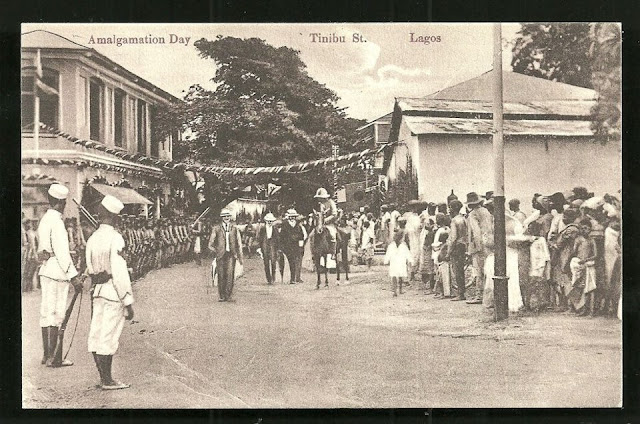
Amalgamation Day in Lagos, 1914
08 August, 2011


Asuquo E.B.

This image is culled from BUSINESS DAY.

I am a daily reader of the excellent newspaper Business Day. For the record, they have paid me nothing for the "endorsement".
Nor have I received anything for telling you this: "Asuquo E.B.", their resident editorial cartoonist, is quite good at his craft. His jabs are pithy and well-directed 98% of the time.
Per the other 2%, well, he did something I don't think anyone in his position should do -- he took sides during the 2011 Presidential Election. He is a citizen, fully entitled to cast his vote for the candidate of his choice, but there is a difference between a satirist and a political propagandist, and Asuquo's election-season bias affected his work.
Still, no two people agree on everything all the time.
I look forward to enjoying Asuquo E.B.'s work for years to come.
And just in case anyone is wondering, I am NOT opposed to interest-free banking (a.k.a. "Islamic Banking"). We should do whatever it takes to bring the majority of Nigerians into the banking system. Indeed, we should forget about what other countries do or do not do and stop trying to mimic Europe, North America or West Asia (a.k.a. the "Middle East"). A proper banking system suited to the environment of Nigeria would be a mix of forms that are otherwise considered "formal", "informal", and "traditional". Somehow, we have to draw it all together into a larger, stronger whole. And if the introduction of interest-free banking will spur on a deepening of the capital market in parts of the country that are currently "under-banked", then I am all for it.
08 July, 2011
Explain it to me
Someone I know accused one of our state governors of staging a robbery. State funds meant to pay off workers in a sector disadvantaged by state government policy were taken from the ministry building by "armed robbers".
Someone else I know got angry about what he felt was a baseless accusation.
They began to argue.
I kept quiet and observed.
I find that when I express my views on Nigerian issues amongst my fellow citizens, I am always the statistically negligible minority viewpoint. Let me put it like this, if we were in the First Republic, the only way to unify the supporters of the NPC, AG, NCNC, UMBC, COR and NEPU would be to ask me to speak on the issues facing the First Republic -- instantaneously, they would all gang up to shout me down. And so we would march toward Civil War.
But I digress.
I won't say the governor's name, because this blog post is not about the governor. It is about we the people, we the citizens of the federal republic, as exemplified by these two arguing acquaintances.
The first guy stuck to his guns, insisting Governor XYZ was a crook who obviously staged the robbery so he could pocket the funds, and then issue new funds for the payoff.
You would think the second guy would restrict his argument to telling the first guy that he had no proof and was merely contributing to the ever-growing stack of rumours inundating Nigeria. This would actually be a conclusive, indisputable point.
But no, that is not what he did.
The second guy, instead, said to the first guy "Governor XYZ would not stoop so low" as to stage a robbery.
This baffled me. No, I should say I was flabbergasted. It was without a doubt the stupidest thing I had ever heard.
Let me explain. Governor XYZ won the 2011 gubernatorial elections after a lot of violence, vice and avarice. The "vice and avarice" were camouflaged, but the violence was not. The capital city of the state witnessed, in broad daylight, a running battle between thugs loyal to the Governor and thugs loyal to the Governor's former godfather. They set buildings and vehicles on fire, among other things.
And this is the man that the second guy says "would not stoop so low" as to carry out petty theft?
So let me get this straight.
Governor XYZ will gladly involve himself in mindless, thuggish violence, endangering the security of the citizens of his state, and promoting communal violence .... but is too good for petty theft?
That doesn't make a shred of sense. And he is not alone. It is bad enough that so many of my countrymen doggedly defend their favoured politicians, but what I don not understand is how they bring themselves to believe certain things about those politicians when we can all clearly see by their in broad daylight actions that they are nothing like what their supporters profess to believe them to be.
People will see a politician who has been corruptly looting his entire political career, and tell you they expect him to lead the fight against corruption. That doesn't make sense.
People see a politician who is part of the reason armed militia and communal violence are so pervasive, and tell you they expect him to improve public security. That makes no sense.
People see a politician who would be in prison if our police force, prosecution services and judiciary were efficient, and tell you he is the man to reform all those institutions. Why would you think that?
He wouldn't stoop so low? This from a man who saw the same thing I saw? The same thing everybody saw? My brother, he has already in your full view stooped lower.
Politics, Politicking and Politicians
[NOTE: This post should have gone up last weekend]
Weekly Trust just published an interview with new Imo State Governor Rochas Okorocha. It is your usual, standard, run-of-the-mill political interview, with the usual question and the usual answers, except for one thing -- the first question:
Governor Okorocha's response was ... what you would expect him to say. But the things our politicians do in search of power bespeaks the ultimate question of what they really stand for. There is pragmatism, and then there is blowing anywhere the wind is blowing as opposed to building an institutional structure that keeps people safe. The wind tends to blow powerfully in the wrong direction, and part of the reason people create government is to protect them against the wind.
As a side note, Daily Times reports Reuben Abati will take over as President Jonathan's official spokesman.
If you don't know, Mr. Abati is on the editorial and management staff of the Guardian and is a long-time, influential columnist on the paper. Sometimes his columns make sense and sometimes they don't (a bit like my blog, some of you might say).
On a serious note the Nigerian media industry suffers because of its financial dependence. The federal- and state-owned media are controlled by the governments, which limits their editorial freedom. Alas, the privately-owned media are bankrolled by powerful plutocrats and politicians, which limits their editorial freedom too. The politicians and the plutocrats have similar interests, so while the private press have a longer leash than their government-owned counterparts, there is only so far they can go in criticizing the status quo -- and there are specific individuals they are not free to criticize.
One of the private newspapers has vociferously criticized everything CBN Governor Sanusi Lamido Sanusi has done. At first I couldn't figure out why they were so opposed even to relatively uncontroversial things ... until I discovered the newspaper was owned by the brother of one of the banking chiefs Sanusi threw out. The woman had stolen from her bank and essentially bankrupted it, but that didn't matter to her brother's paper, which is still on a mission of vengeance.
The political preferences of the paper owners also explains why some politicians are praised despite doing awful things, while other politicians have their dirty laundry washed in public. That, and "brown paper bag" journalism.
In any case, one of the most cynically amusing aspects of politics all over the world (and it does happen all over the world) is when a person gets a lucrative government job and starts defending the very things they criticized when they were outside government. As soon as he settles in, Mr. Abati will start intelligently explaining to us all why everything he used to claim was bad is in fact really quite good.
Weekly Trust just published an interview with new Imo State Governor Rochas Okorocha. It is your usual, standard, run-of-the-mill political interview, with the usual question and the usual answers, except for one thing -- the first question:
In the past twelve years you have changed political parties like eight times. Does that mean we’ll see you ditching APGA anytime soon?
Governor Okorocha's response was ... what you would expect him to say. But the things our politicians do in search of power bespeaks the ultimate question of what they really stand for. There is pragmatism, and then there is blowing anywhere the wind is blowing as opposed to building an institutional structure that keeps people safe. The wind tends to blow powerfully in the wrong direction, and part of the reason people create government is to protect them against the wind.
As a side note, Daily Times reports Reuben Abati will take over as President Jonathan's official spokesman.
If you don't know, Mr. Abati is on the editorial and management staff of the Guardian and is a long-time, influential columnist on the paper. Sometimes his columns make sense and sometimes they don't (a bit like my blog, some of you might say).
On a serious note the Nigerian media industry suffers because of its financial dependence. The federal- and state-owned media are controlled by the governments, which limits their editorial freedom. Alas, the privately-owned media are bankrolled by powerful plutocrats and politicians, which limits their editorial freedom too. The politicians and the plutocrats have similar interests, so while the private press have a longer leash than their government-owned counterparts, there is only so far they can go in criticizing the status quo -- and there are specific individuals they are not free to criticize.
One of the private newspapers has vociferously criticized everything CBN Governor Sanusi Lamido Sanusi has done. At first I couldn't figure out why they were so opposed even to relatively uncontroversial things ... until I discovered the newspaper was owned by the brother of one of the banking chiefs Sanusi threw out. The woman had stolen from her bank and essentially bankrupted it, but that didn't matter to her brother's paper, which is still on a mission of vengeance.
The political preferences of the paper owners also explains why some politicians are praised despite doing awful things, while other politicians have their dirty laundry washed in public. That, and "brown paper bag" journalism.
In any case, one of the most cynically amusing aspects of politics all over the world (and it does happen all over the world) is when a person gets a lucrative government job and starts defending the very things they criticized when they were outside government. As soon as he settles in, Mr. Abati will start intelligently explaining to us all why everything he used to claim was bad is in fact really quite good.
12 June, 2011
Diezani's dodgy deals
You should read this investigative report from NEXT.
I suppose everyone is innocent until proven guilty, but I am cynically amused that Femi Falana has been retained to defend the interests of the beneficiaries of this reportedly dodgy deal. There is a reason most Nigerians don't take the protestations of "progressives" seriously ....

I suppose everyone is innocent until proven guilty, but I am cynically amused that Femi Falana has been retained to defend the interests of the beneficiaries of this reportedly dodgy deal. There is a reason most Nigerians don't take the protestations of "progressives" seriously ....

Former minister of petroleum, Diezani Allison-Madueke, (L) shakes hands with then acting President Goodluck Jonathan after taking the oath of office during the swearing-in ceremony of new ministers in Abuja, April 6, 2010.
Photo Credit: NEXT
Photo Credit: NEXT
07 June, 2011
Soba back on seat
Back in March of 2011, I wrote this blog post titled "Convivial Form, Violent Substance". At the top of the post is a picture of bruised and battered Hajiya Halima Aminu Tijjani, a female politician from Kaduna State who was brutally beaten up by party political thugs on the orders of Barrister Musa Soba, Kaduna State Chairman of the Action Congress of Nigeria (ACN).
Nothing happened to Barrister Soba. The police did not arrest or investigate him. His party did not sanction him. Society did not ostracize him.
Part of me wants to be angry with we the citizens of Nigeria, because it seems like we do not care about important things like this. On the other hand, part of me realizes that things like this are NORMAL in our federal republic. For most citizens, getting upset at this is like getting upset at the sunrise, the sunset and the change of seasons. It is part of the natural order, and frankly the only thing that would have surprised people would have been if Barrister Soba did not behave the way he did.
I bring him up again because the Kaduna State ACN suspended Barrister Soba last month, not for his criminality, but because the party didn't do well in the State. It is bad enough that this is the only reason they would suspend him ...
... but what makes it worse is the national ACN (a euphemism for ex-Governor Bola Ahmed Tinubu of Lagos) "nullified the suspension", as reported by the newspaper NEXT.
So, Barrister Soba is back in charge of the Kaduna State ACN.
Sorry, Hajiya Halima Aminu Tijjani. It seems nobody but me gives a damn about you.
31 May, 2011
Famous Names
Did you know that one country alone accounts for 67% of all the electricity generated in Sub-Saharan Africa? Did you know that country has a population of 50 million, and is facing a crisis because it does not generate sufficient electricity for its people and its economy?
Think about that. Two-thirds of the electricity produced in Africa is not enough for a country of 50 million people to achieve its full economic potential.
Doesn't it make you wonder how we in the rest of Sub-Saharan Africa manage with the 33% share we generate, doesn't it? Makes you think of those night-time pictures taken from space where Africa is the only continent that is totally dark (aside from a bright strip along the Mediterranean coast, and a few dots in South Africa, the 67% country).
Now, you are probably wondering why I am dragging up these old, boring statistics.
Simple reason.
An acquaintance of mine, who happens to be a big fan and supporter of the existing political order in Nigeria, decided to let me know that the world approved of our political system by listing the foreign leaders who attended the recent presidential inauguration.
He was quite proud of this list he sent me, even though 86% of his mostly African dignitaries list was made up of some of Africa's brutal dictators, thieving kleptocrats and the administratively clueless.
The man sent me a list of the sort of leaders that keep Sub-Saharan African in the dark -- literally, figuratively and metaphorically -- and he was so proud that their presence legitimized our inauguration!
There is a fear I have sometimes that things are a certain way in Africa because we the people actively support the things (and people) that guarantee that things will be that way.
Not an eloquent statement of my fear, but you get the point.
17 May, 2011
Working on something
I haven't posted on this blog in 3 weeks. Much has happened since the elections. Enough time has passed for us to see whether trends are likely to change, whether there have been any paradigm shifts or watersheds crossed.
I am working on something that will hopefully get disseminated beyond the limited confines of this blog. After that, I will be back to commentary.
I am working on something that will hopefully get disseminated beyond the limited confines of this blog. After that, I will be back to commentary.
26 April, 2011
Predictable and Inevitable
A month ago, I wrote this post about violence in the build-up to the election. It was a blog post. Blog posts are of necessity brief. To fully and exhaustively discuss violence in the 2011 Elections would require a volume of books; a thorough examination of the place of violence in Nigerian politics historically would require a library of books.
One of the things I pointed out (perhaps not as clearly as I would have wanted) is the connection and (oddly enough) disconnection between political VIPs and the armies of thugs that wreak violence in the name of politics.
The violence in Akwa Ibom was ostensibly "PDP" against "ACN", but (as noted in the post) it had little or nothing to do with Goodluck Jonathan (PDP President), Nuhu Ribadu (ACN Presidential candidate) or Bola Tinubu (ACN Supremo). It was a turf war between local warlords, ex-Governor Victor Attah and current Governor Godswill Akpabio. Attah may cloak himself in ACN colours but he does not take orders from Tinubu; and it is politically weak Jonathan who needed governors like Akpabio to "deliver" states like Akwa Ibom for him and not the other way around.
That blog post referenced incidents of violence ostensibly involving all the major parties, PDP, ACN, ANPP, CPC and APGA. I say "ostensibly" because each violent outcome was the product of local and individual specifics, local and individual quarrels, local and individual VIPs, local and individual Big Men, local and individual political, economic and social dynamics.
Atop this post was the picture of a bruised and battered woman. Her name is Hajiya Halima Aminu Tijjani. She is a Kaduna State politician who was viciously beaten up by thugs on the orders of Barrister Musa Soba, the Kaduna State Chairman of the ACN. I do not like Bola Tinubu. I do not like Nuhu Ribadu. Actually, I do not like any Nigerian politicians. But the honest truth is neither Tinubu nor Ribadu had anything to do with Musa Soba's decision to beat, batter and bruise Hajiya Tijjani. None of the national ACN leaders asked him to have her beaten. What he did to her was "normal" politics in Nigeria. Go to that blog post and click on the link to the Daily Trust article on the story -- there are examples of other such "muscular" political acts (and bear in mind, most political thuggery doesn't get reported by the media; read this blog by journalist China Acheru about journalists being intimidated into silence in 2007).
But, while the respective VIPs of the different parties do not necessarily give the orders authorizing the violence of their underlings .... they do not publicly or privately condemn those underlings, nor do they lift a finger to try to stop them or their armies of thugs. What they do instead is criticize the violent underlings of all the other parties, while pretending not to notice the violent underlings of their own party. In my prior blog post on this issue, I included links to pre-election articles quoting President Jonathan condemning violent CPC thugs, and candidate General Buhari (rtd) condemning violent PDP thugs. Neither man mentioned or acknowledged the thugs from their own parties. I don't recall Shekarau saying anything about ANPP thugs; Tinubu was silent on ACN thugs; and Peter Obi barely acknowledged that a world existed beyond the borders of the electoral constituency he was trying to manipulate in favour of Dora Akunyili (in part by using thugs of his own).
These "grassroots" political machines go by different colloquial names in Nigerian discourse; a news media pundit or beer parlour discussant, for example, make talk about Chief/Alhaji XYZ's "structures on the ground", when discussing his electoral chances. The local warlords, comparatively low-level bosses who run these "grassroots" machines, are more often than not the direct or indirect employers of the various armies of political thugs who are used for the purposes of intimidation, protection, "manipulation" (i.e. rigging) ... and violence.
Each national government on Earth encompasses so much more than its army, but near-every government on Earth feels it strategically necessary to have an army to defend its domain against encroachment by other national governments.
It works the same way with these "grassroots" machines or "structures on the ground". They are much more than just their violent thug branch, and do much more than rote violence. Nevertheless, each machine or "structure" feels it necessary to hire a gang of thugs lest they become the victims of violent encroachment (or takeover) by a rival machine's thug army.
By the way, the preceding paragraph does more (so much more) to explain 12 years of violence in the Niger-Delta than the unfortunately unexamined claims that the "militants" are fighting to stop the exploitation of the Delta's peoples. Each of the so-called "militant" groups started as the violent branch of a local politician's "structures on the ground"; they fought against each other and terrorized the civilian population in order to secure territory for their respective political sponsors. In between elections, when money from politicians dried up, these "militants" would turn to the financially more lucrative work of blowing up pipelines in order to siphon vast amounts of crude oil for sale in illicit international markets. When election season returns, they go back to working for the politicians who kept the Police and Army from disturbing their oil bunkering operations.
Yes, I know the army struck against specific, particular bunkerers, but it was one of those Ribadu-type things, where a single person who has fallen out of political favour is targeted while the numerous people who are still in favour are allowed to continue business-as-usual. Of course they protected their once-and-future allies. Be serious. This is a "Human" political phenomenon that is not restricted to Nigeria.
In any country in the world, be it a democracy or a dictatorship, people in power are indebted to whoever put them in power and go through a great deal of effort to keep those "constituencies" happy so as to assure their continued support; if the army put you in office, you spend a disproportionate amount of the budget on the army; if unions put you in office, you pass laws that allow union bosses take something to their members when it is time for the next election for union leadership; if corporate money put you in power, you cut taxes for corporations.
The key to understanding why these "grassroots" political machines act with criminal impunity lies in this musing from my prior blog post:
In Nigeria, these "structures on the ground" are the decisive chess pieces wielded by the VIPs and Big Men. Unlike checkers (a.k.a. "draught"), chess is not decided by who has no pieces at the end; you can checkmate an opponent, even if he has "structures" still in play. However, as with chess, you can look at the "structures" available to each candidate, study how those "structures" are arrayed on the board, and come to a conclusion as to who has the higher probability of check and mate.
Insofar as the ACN "structures" are controlled by Bola Ahmed Tinubu, the electoral fortunes of ACN candidate Nuhu Ribadu were entirely in Tinubu's hands; had Tinubu sold his candidature to the CPC per the long-running negotiations, that would have been the end of Ribadu as a presidential candidate (and even now, pundits are speculating that Tinubu cut a last-minute deal with Goodluck Jonathan, by way of explaining why ACN-dominated states went en masse for the incumbent rather than the ACN candidate).
But I digress.
Political VIPs and Big Men rely on these local warlords to "deliver" communities, LGAs, senatorial zones, states and regions on election day. They know what these warlords do. They know what will happen when the warlords go to work. The VIPs and Big Men know what the short-term, medium-term and long-term effects of this type of politics are. Unfortunately for the Federal Republic, the Big Men and VIPs perceive the likelihood of their directly benefiting in the short-term to be sufficient enough to warrant blithely consigning the country to seriously negative medium- and long-term effects.
This is the complicated back-story to the outbreak of violence in the North of the Federal Republic in the aftermath of the Presidential election.
Supporters of Goodluck Jonathan, blame second-place finisher General Mohammedu Buhari (rtd) for the violence. My opinion of Buhari is the same as my opinion of every Nigerian politician, Jonathan inclusive -- I am NOT a fan or supporter. However, the accusers seem to imply that Buhari ordered his supporters to kill their fellow citizens and spread anarchy across a handful of northern cities. This is most certainly a lie. Buhari gave no such order. If anything, Buhari has as much (or should I say as little) control over the thuggish wing of his "structures" as Jonathan has over Akpabio's violent "structures" in Akwa Ibom, or Bola Tinubu over Attah's "structures" in the same state.
On the other hand, they are right to criticize Buhari for his hesitation to fully and properly criticize the violence. With that said, they are quite hypocritical in doing so, because they too hesitate to criticize the violence of their structures too.
Aside from his failure to enforce the criminal laws against violent pro-PDP "structures", I have not forgotten the unseemly quickness with which President Goodluck Jonathan exonerated MEND from culpability in the Abuja bomb blasts before there had been even a cursory examination of the evidence, much less a full and conclusive investigation. Unsurprisingly, "militant" leaders in the Niger-Delta have pledged their unflinching support for him and (ominously) warned against any plot to undermine his government. Look at the list of those making the pledge: Chief Government Ekpemupolo (a.k.a. Gen. Tompolo), Chief Ateke Tom, Alhaji Asari Dokubo, Chief Bibopre Ajube (a.k.a. Shoot At Sight), General Ezekiel Akpasibewei, Farah Dagogo, Africa Ukparasia, Paul Ezizi (a.k.a.Comdr. Ogunbos), Pastor Reuben Wilson, Joshua Macaiver, Ferdinand Amaibi (a.k.a. Busta Rhymes, Tamunegiyeifori Proby (a.k.a. Egbele), Kenneth Opusinji (kula Community), Kile Selky Torughedi (a.k.a. Gen. Young Shall Grow) Bonny Gawei, Aboy Muturu, and Hendrick Opukeme. This is a list of men who should be in prison for VIOLENT crimes committed against Nigerian citizens, Nigerian infrastructure, and against institutions of the Federal Republic like the Army and Police. Yet, here they are, as free as free can be, making veiled threats, while our jails are full of innocent citizens who "await trial" for years on charges for which there is no evidence (like the 13-year-old boy arrested and accused of "attempted murder" by way of throwing a sachet of pure water at the car of the Imo State governor).
There is a point I am trying to make.
You see, I understand the way we have been taught to think. There is a 9 in 10 chance that any Nigerian who has read this blog post up to this point is about to accuse me of being an apologist for the extremists who wreaked violence in the North after the election or of being an opponent of Jonathan (or supporter of Buhari) who is trying to tar Jonathan with the same brush as Buhari.
That is how we have been taught to think.
And that is one of many roots of the problem ... but I will not digress from what I am trying to say.
You see, this is NOT about Jonathan as an individual, NOR is is it about Buhari as an individual. Attacking either one of them as an individual is POINTLESS.
This is about the POLITICAL SYSTEM AS A WHOLE.
The Federal Republic of Nigeria is now, and has seemingly always been, governed by a political process in which violence is a NECESSARY part of the system's functioning. If your body is alive, your lungs are going to breathe; if the Nigerian political system continues to exist as it does today (and always has), there will be violence.
All the finger-pointing at this individual or that individual, at this ethnic group or that ethnic group, at this region or that region, at this religion or that religion .... is entirely besides the point.
Somalia is violent despite being a country of uniform ethnicity and religion. Rwanda has been violent for decades despite being mostly Roman Catholic. Cote d'Ivoire has been a semi-disaster for 20 years despite once being known as a West African miracle. Point being, if you do the things that make violence inevitable, then violence will be inevitable
Be honest with yourself. You know, and I know, that if the Independent National Electoral Commission had declared anybody other than Jonathan the winner of the election, the Niger-Delta "militants" listed above would immediately have started blowing up oil pipelines again. Violence is inherent in our system.
As if this isn't bad enough, the VIPs and Big Men are not as much in control of their respective "structures" as they like to pretend. They don't want to reform, restructure and transform the Police and security agencies. They don't want to reform, restructure and transform our political system. And they don't want to destroy their "structures" in case they may need them. And so, when local warlords go on the warpath, the response of a sequence of governments has been noticeably limp. They first wait to see if the violence will subside on its own, and if it doesn't they send in the Army to frighten the thugs into a ceasefire by means of blasting everything in sight. A few token thugs are taken into custody (though I have never heard of any of them being convicted) .... and life goes on exactly as it did before, with the GUARANTEE of a repeat of the violence in a few weeks or months depending on the circumstances. In fact, one of the most annoying things about government in Nigeria is the fact that everyone in the country has a firm grasp of where/when/why communal violence will break out, yet there is never any sign of the government/police/SSS/etc doing anything to pre-emptively or pro-actively responding to forestall repetitive crises.
Keeping with my earlier metaphor, forestalling violence for them is like you or me trying to hold our breath. We might be able to do it for a while, but eventually we are forced to gulp down huge mouthfuls of air. The same is true for our political system; when the violence gets out of hand, they use the Army to put a stop to it, but ultimately they are all utterly reliant on a brand of politics that makes violence a predictable and inevitable result ... so they open the door, and allow it to happen because they see benefits for themselves in the short-term.
One of the things I pointed out (perhaps not as clearly as I would have wanted) is the connection and (oddly enough) disconnection between political VIPs and the armies of thugs that wreak violence in the name of politics.
The violence in Akwa Ibom was ostensibly "PDP" against "ACN", but (as noted in the post) it had little or nothing to do with Goodluck Jonathan (PDP President), Nuhu Ribadu (ACN Presidential candidate) or Bola Tinubu (ACN Supremo). It was a turf war between local warlords, ex-Governor Victor Attah and current Governor Godswill Akpabio. Attah may cloak himself in ACN colours but he does not take orders from Tinubu; and it is politically weak Jonathan who needed governors like Akpabio to "deliver" states like Akwa Ibom for him and not the other way around.
That blog post referenced incidents of violence ostensibly involving all the major parties, PDP, ACN, ANPP, CPC and APGA. I say "ostensibly" because each violent outcome was the product of local and individual specifics, local and individual quarrels, local and individual VIPs, local and individual Big Men, local and individual political, economic and social dynamics.
Atop this post was the picture of a bruised and battered woman. Her name is Hajiya Halima Aminu Tijjani. She is a Kaduna State politician who was viciously beaten up by thugs on the orders of Barrister Musa Soba, the Kaduna State Chairman of the ACN. I do not like Bola Tinubu. I do not like Nuhu Ribadu. Actually, I do not like any Nigerian politicians. But the honest truth is neither Tinubu nor Ribadu had anything to do with Musa Soba's decision to beat, batter and bruise Hajiya Tijjani. None of the national ACN leaders asked him to have her beaten. What he did to her was "normal" politics in Nigeria. Go to that blog post and click on the link to the Daily Trust article on the story -- there are examples of other such "muscular" political acts (and bear in mind, most political thuggery doesn't get reported by the media; read this blog by journalist China Acheru about journalists being intimidated into silence in 2007).
But, while the respective VIPs of the different parties do not necessarily give the orders authorizing the violence of their underlings .... they do not publicly or privately condemn those underlings, nor do they lift a finger to try to stop them or their armies of thugs. What they do instead is criticize the violent underlings of all the other parties, while pretending not to notice the violent underlings of their own party. In my prior blog post on this issue, I included links to pre-election articles quoting President Jonathan condemning violent CPC thugs, and candidate General Buhari (rtd) condemning violent PDP thugs. Neither man mentioned or acknowledged the thugs from their own parties. I don't recall Shekarau saying anything about ANPP thugs; Tinubu was silent on ACN thugs; and Peter Obi barely acknowledged that a world existed beyond the borders of the electoral constituency he was trying to manipulate in favour of Dora Akunyili (in part by using thugs of his own).
These "grassroots" political machines go by different colloquial names in Nigerian discourse; a news media pundit or beer parlour discussant, for example, make talk about Chief/Alhaji XYZ's "structures on the ground", when discussing his electoral chances. The local warlords, comparatively low-level bosses who run these "grassroots" machines, are more often than not the direct or indirect employers of the various armies of political thugs who are used for the purposes of intimidation, protection, "manipulation" (i.e. rigging) ... and violence.
Each national government on Earth encompasses so much more than its army, but near-every government on Earth feels it strategically necessary to have an army to defend its domain against encroachment by other national governments.
It works the same way with these "grassroots" machines or "structures on the ground". They are much more than just their violent thug branch, and do much more than rote violence. Nevertheless, each machine or "structure" feels it necessary to hire a gang of thugs lest they become the victims of violent encroachment (or takeover) by a rival machine's thug army.
By the way, the preceding paragraph does more (so much more) to explain 12 years of violence in the Niger-Delta than the unfortunately unexamined claims that the "militants" are fighting to stop the exploitation of the Delta's peoples. Each of the so-called "militant" groups started as the violent branch of a local politician's "structures on the ground"; they fought against each other and terrorized the civilian population in order to secure territory for their respective political sponsors. In between elections, when money from politicians dried up, these "militants" would turn to the financially more lucrative work of blowing up pipelines in order to siphon vast amounts of crude oil for sale in illicit international markets. When election season returns, they go back to working for the politicians who kept the Police and Army from disturbing their oil bunkering operations.
Yes, I know the army struck against specific, particular bunkerers, but it was one of those Ribadu-type things, where a single person who has fallen out of political favour is targeted while the numerous people who are still in favour are allowed to continue business-as-usual. Of course they protected their once-and-future allies. Be serious. This is a "Human" political phenomenon that is not restricted to Nigeria.
In any country in the world, be it a democracy or a dictatorship, people in power are indebted to whoever put them in power and go through a great deal of effort to keep those "constituencies" happy so as to assure their continued support; if the army put you in office, you spend a disproportionate amount of the budget on the army; if unions put you in office, you pass laws that allow union bosses take something to their members when it is time for the next election for union leadership; if corporate money put you in power, you cut taxes for corporations.
The key to understanding why these "grassroots" political machines act with criminal impunity lies in this musing from my prior blog post:
Would the bosses of "grassroots" political machines wield such power without the patronage and protection of the Big Men? Or is it the Big Men who would not wield the power they control without the backing of the machine bosses? Either way, the two groups work hand in hand to dictate political outcomes.
In Nigeria, these "structures on the ground" are the decisive chess pieces wielded by the VIPs and Big Men. Unlike checkers (a.k.a. "draught"), chess is not decided by who has no pieces at the end; you can checkmate an opponent, even if he has "structures" still in play. However, as with chess, you can look at the "structures" available to each candidate, study how those "structures" are arrayed on the board, and come to a conclusion as to who has the higher probability of check and mate.
Insofar as the ACN "structures" are controlled by Bola Ahmed Tinubu, the electoral fortunes of ACN candidate Nuhu Ribadu were entirely in Tinubu's hands; had Tinubu sold his candidature to the CPC per the long-running negotiations, that would have been the end of Ribadu as a presidential candidate (and even now, pundits are speculating that Tinubu cut a last-minute deal with Goodluck Jonathan, by way of explaining why ACN-dominated states went en masse for the incumbent rather than the ACN candidate).
But I digress.
Political VIPs and Big Men rely on these local warlords to "deliver" communities, LGAs, senatorial zones, states and regions on election day. They know what these warlords do. They know what will happen when the warlords go to work. The VIPs and Big Men know what the short-term, medium-term and long-term effects of this type of politics are. Unfortunately for the Federal Republic, the Big Men and VIPs perceive the likelihood of their directly benefiting in the short-term to be sufficient enough to warrant blithely consigning the country to seriously negative medium- and long-term effects.
This is the complicated back-story to the outbreak of violence in the North of the Federal Republic in the aftermath of the Presidential election.
Supporters of Goodluck Jonathan, blame second-place finisher General Mohammedu Buhari (rtd) for the violence. My opinion of Buhari is the same as my opinion of every Nigerian politician, Jonathan inclusive -- I am NOT a fan or supporter. However, the accusers seem to imply that Buhari ordered his supporters to kill their fellow citizens and spread anarchy across a handful of northern cities. This is most certainly a lie. Buhari gave no such order. If anything, Buhari has as much (or should I say as little) control over the thuggish wing of his "structures" as Jonathan has over Akpabio's violent "structures" in Akwa Ibom, or Bola Tinubu over Attah's "structures" in the same state.
On the other hand, they are right to criticize Buhari for his hesitation to fully and properly criticize the violence. With that said, they are quite hypocritical in doing so, because they too hesitate to criticize the violence of their structures too.
Aside from his failure to enforce the criminal laws against violent pro-PDP "structures", I have not forgotten the unseemly quickness with which President Goodluck Jonathan exonerated MEND from culpability in the Abuja bomb blasts before there had been even a cursory examination of the evidence, much less a full and conclusive investigation. Unsurprisingly, "militant" leaders in the Niger-Delta have pledged their unflinching support for him and (ominously) warned against any plot to undermine his government. Look at the list of those making the pledge: Chief Government Ekpemupolo (a.k.a. Gen. Tompolo), Chief Ateke Tom, Alhaji Asari Dokubo, Chief Bibopre Ajube (a.k.a. Shoot At Sight), General Ezekiel Akpasibewei, Farah Dagogo, Africa Ukparasia, Paul Ezizi (a.k.a.Comdr. Ogunbos), Pastor Reuben Wilson, Joshua Macaiver, Ferdinand Amaibi (a.k.a. Busta Rhymes, Tamunegiyeifori Proby (a.k.a. Egbele), Kenneth Opusinji (kula Community), Kile Selky Torughedi (a.k.a. Gen. Young Shall Grow) Bonny Gawei, Aboy Muturu, and Hendrick Opukeme. This is a list of men who should be in prison for VIOLENT crimes committed against Nigerian citizens, Nigerian infrastructure, and against institutions of the Federal Republic like the Army and Police. Yet, here they are, as free as free can be, making veiled threats, while our jails are full of innocent citizens who "await trial" for years on charges for which there is no evidence (like the 13-year-old boy arrested and accused of "attempted murder" by way of throwing a sachet of pure water at the car of the Imo State governor).
There is a point I am trying to make.
You see, I understand the way we have been taught to think. There is a 9 in 10 chance that any Nigerian who has read this blog post up to this point is about to accuse me of being an apologist for the extremists who wreaked violence in the North after the election or of being an opponent of Jonathan (or supporter of Buhari) who is trying to tar Jonathan with the same brush as Buhari.
That is how we have been taught to think.
And that is one of many roots of the problem ... but I will not digress from what I am trying to say.
You see, this is NOT about Jonathan as an individual, NOR is is it about Buhari as an individual. Attacking either one of them as an individual is POINTLESS.
This is about the POLITICAL SYSTEM AS A WHOLE.
The Federal Republic of Nigeria is now, and has seemingly always been, governed by a political process in which violence is a NECESSARY part of the system's functioning. If your body is alive, your lungs are going to breathe; if the Nigerian political system continues to exist as it does today (and always has), there will be violence.
All the finger-pointing at this individual or that individual, at this ethnic group or that ethnic group, at this region or that region, at this religion or that religion .... is entirely besides the point.
Somalia is violent despite being a country of uniform ethnicity and religion. Rwanda has been violent for decades despite being mostly Roman Catholic. Cote d'Ivoire has been a semi-disaster for 20 years despite once being known as a West African miracle. Point being, if you do the things that make violence inevitable, then violence will be inevitable
Be honest with yourself. You know, and I know, that if the Independent National Electoral Commission had declared anybody other than Jonathan the winner of the election, the Niger-Delta "militants" listed above would immediately have started blowing up oil pipelines again. Violence is inherent in our system.
As if this isn't bad enough, the VIPs and Big Men are not as much in control of their respective "structures" as they like to pretend. They don't want to reform, restructure and transform the Police and security agencies. They don't want to reform, restructure and transform our political system. And they don't want to destroy their "structures" in case they may need them. And so, when local warlords go on the warpath, the response of a sequence of governments has been noticeably limp. They first wait to see if the violence will subside on its own, and if it doesn't they send in the Army to frighten the thugs into a ceasefire by means of blasting everything in sight. A few token thugs are taken into custody (though I have never heard of any of them being convicted) .... and life goes on exactly as it did before, with the GUARANTEE of a repeat of the violence in a few weeks or months depending on the circumstances. In fact, one of the most annoying things about government in Nigeria is the fact that everyone in the country has a firm grasp of where/when/why communal violence will break out, yet there is never any sign of the government/police/SSS/etc doing anything to pre-emptively or pro-actively responding to forestall repetitive crises.
Keeping with my earlier metaphor, forestalling violence for them is like you or me trying to hold our breath. We might be able to do it for a while, but eventually we are forced to gulp down huge mouthfuls of air. The same is true for our political system; when the violence gets out of hand, they use the Army to put a stop to it, but ultimately they are all utterly reliant on a brand of politics that makes violence a predictable and inevitable result ... so they open the door, and allow it to happen because they see benefits for themselves in the short-term.
25 April, 2011
True Courage
An inspiring story reported by NEXT about a Nigerian citizen who risked his life to save his fellow citizens during the post-election violence.
I have two comments for NEXT though.
Firstly, identifying the gentleman by name is risky enough; going further to tell the whole world his place of employment is putting his life in danger. Any violent radical who thinks what he did was wrong could easily go there looking for him.
This is something I don't understand about the Nigerian media in general. They do not investigate or report important stuff we citizens need to know because they don't want to put themselves at risk of commercial, political, and physical retaliation .... but they think nothing of broadcasting other people's phone numbers, home addresses and even graphic pictures of corpses without regard to the sensitivities of family members of the deceased.
Secondly, there is heavy emphasis in NEXT's report (and in the subsequent online public commentary) about how this was a "Moslem" helping "Christians". The impression they give is that they think this singular fact makes it a "man bite dog" story.
Let us be honest with ourselves. When it comes to life-and-death issues, to circumstances where a person runs a real risk of losing their life if they do the right thing, Nigerians in general (regardless of religion or ethnicity) are extremely reluctant to put themselves on the line to protect their fellow citizens .... even if that fellow citizen is of the same ethnic, religious, kindred or village origin.
It is why Fela Kuti sang that song about us being so afraid to die we would never rise up against our oppressors.
It is why incomprehensible things happen to Nigerians all over Nigeria, and there is no reaction whatsoever from the public .... not while it is happening, not after it happens. No reaction. No effort. Nothing.
What this gentleman did is amazing by NIGERIAN standards, not by "Moslem" standards. More than that actually, because what he did was impressive by HUMAN standards; most people on Earth simply would not have done what he did. Even as I salute him, I can but pray that I would find similar courage if I ever found myself in a similar situation.
I wish he was a policeman. Or maybe I should say I wish the Nigerian Police Force was more like him. Either way, he was out in the streets, facing down thugs and protecting citizens.
I have immense respect for him. What he did makes him far more useful to Nigeria and Nigerians than all the useless politicians who ran in the 2011 Elections, both those who "won" and those who "lost".
God bless him.
Subscribe to:
Posts (Atom)