(a) Person A is corrupt.
(b) Person B points finger at Person A, and says he will fight Person A because Person A is corrupt.
(c) Person B removes Person A through coup-de-tat, through some version of Nuhu Ribadu or through power shift/rotation/zoning/term limits.
(d) However, Person B is just as corrupt as Person A.
(e) Person B appoints one of his political allies, Person C to replace Person A.
(f) Person C is just as corrupt as Persons A and B.
(g) Depending on which part of Nigeria Persons A, B and C hail from, sections of the Nigerian public rejoice that Person A is gone because Person A is the root of all of our problems.
(h) If you tell the people referenced in (g) that nothing of substance has changed except the identity of the direct beneficiary of the continuing corruption ... they will abuse you, say that you are a supporter of corrupt Person A, and an enemy of Person C, the great hero of our times.
(i) Two, four, six or eight years later, begin the cycle again at (a).
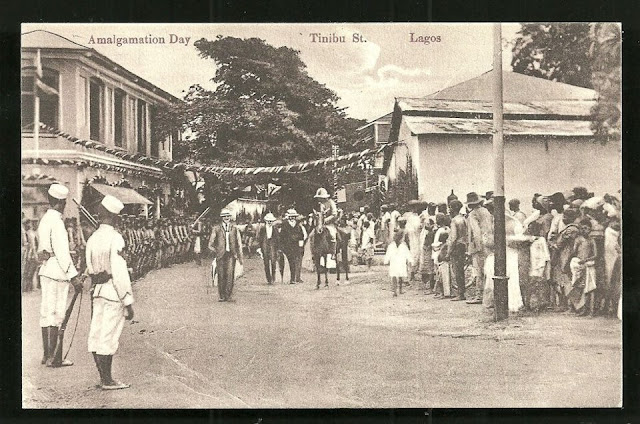
Amalgamation Day in Lagos, 1914
30 November, 2010


15 November, 2010
Emigration solves nothing
My attention was drawn to this story in a British tabloid about a Nigerian caught and arrested while attempting an illegal scheme to allow himself to stay in the United Kingdom beyond the expiration of his documents.
He isn't the only one to go the route of arranging a fake marriage with a local to get around immigration rules. Of course, as an outsider you can't really know for sure that what appears to be a "fake" marriage for immigration is in fact that. Maybe it is genuine. Then again, seven years ago one Nigerian international (won't say his name) was three times denied a work permit by the English FA, despite Derby County's strong desire to sign him; the player managed to get his work permit in time to sign for Portsmouth by marrying a Portuguese citizen. Maybe he was really in love. All I know for sure is barely five years later (when he had played in England long enough to merit a work permit without a marriage), this international had divorced his Portuguese wife and remarried, his second wife a Nigerian and the daughter of a prominent Nigerian football coach.
Notice I didn't say his name. If I did, a lot of my countrymen would call me terrible names for trying to pour sand in the man's garri. We Nigerians, and Africans at large, are all so desperate to leave our countries and go "abroad" that we pretty much consider anything and everything to be moral and proper, so long as it gets us out of the country. I am constantly amused by the people who make the most ridiculous claims when they plead for asylum in Britain, Ireland, Canada and even South Africa. Some say witches, wizards and demonic cults will kill them if they return to Nigeria; some say they will suffer genital mutilation if they return; a few say they are homosexuals who will be hunted down if they return to Nigeria. They pay attention to whatever is the current cause celebre is animating European and American liberals at the moment, then cloak themselves in the fad, whatever it is, then get foreign "civil society" activist to cry on their behalf that dark, dangerous, illiberal Nigeria will destroy them if they are not allowed to stay in Europe or America.
We will say or do anything to leave Africa, won't we?
We are not the only ones. If the mass media is right, a seeming majority of Hispanic-Americans do not appear to believe their country's immigration laws are applicable to citizens of Latin America. Whatever a Latin American person does to get to the USA is every bit as fine to them as our own people's shenanigans are to us.
Unlike the Latin Americans, we Africans do not have "easy" access to the United States, or we would risk our very lives to get there as they do. You can tell by the way we risk life and limb and family assets for the incredibly slim chance of making it to the "easier" (from the African perspective) destinations of Europe and the Middle East.
We sell our family's property, invest our families' entire savings, and borrow copiously on top of that to pay people smugglers for a slim-to-nonexistent chance of sneaking into Europe or the Middle East without being robbed, killed, arrested or repatriated. We risk our lives in rickety boats on the Atlantic, the Mediterranean and the Red Sea (not to mention rickety trucks in the Sahara). Some of us stowaway on ships, and get tossed into the Atlantic; some of us are tossed into the Red Seas off the coast of Yemen. A handful have frozen to death after stowing away in the wheel-well of aircraft, too uneducated to understand that they were committing suicide. Some are just summarily shot by border guards on the frontiers of Egypt or Morocco.
And if we do happen to make it to our final destinations, we are then willing to fight like wounded lions to stay in France, UK or USA. We refuse to let our "human rights" be violated. We call lawyers, campaigners .... we go the distance. An entire industry of "advocacy" institutions have sprung up in Europe and North America to fight respective national governments if they apply their respective immigration laws to illegal immigrants. The same "advocacy" institutions criticize the Middle East because of the treatment of migrant workers from Southeast Asia, South Asia ... and Africa. Frankly, the indigenous "black" population of the Middle East (a legacy of the Slave Trade) are the poorest, most politically, socially and economically marginalized group in the region (which seems to be a theme for people of African descent worldwide).
All that applies to illegal emigrants. Those of us Africans who are "legal" must first go to extraordinary lengths and endure undiplomatic indignities just to convince foreign embassies to give us visas. And if they happen to emigrate to a place like France, they still have to deal with racial profiling by security agencies seeking "les sans papiers" (people without papers), which is what Hispanic-American advocacy groups think the "Arizona law" inflict on legal and illegal Latinos alike.
We would literally go to the ends of the Earth to facilitate our departure from Nigeria/Africa, and put our very lives on the line to do so, risk detention and death (no one seems to be keeping statistics on the number of Nigerians who have died -- been murdered in my view -- in the course of being forcibly repatriated by foreign customs officials).
It is so frustrating.
If we Nigerians/Africans, individually and collectively, took just a microscopic fraction of the courage, effort and sacrifice we exert to emigrate, and invested it in fighting to reform, restructure and transform our countries/continent, we would not have to suffer through the travails and tribulations we are currently putting ourselves through (both in emigrating and in remaining home).
Look, every country has its share of emigrants. But there is a difference between places in the world where emigration is by "choice" and other places where emigration is for "necessity". Indeed, the embassies of "choice" countries treat immigrants from other "choice" countries with respect, and treat we the people of "necessity" countries as though we were dirty vagabonds come to ruin their countries.
I am not saying there would be no migrants from Nigeria/Africa if our homeland was what it should be .... but I am saying that there would be no Africans drowning to death in the Atlantic, Mediterranean and Red Sea.
We Nigerians in particular suffer a sort of simmering, unspoken Naija-phobia, a widespread belief held worldwide that we are all criminals by virtue of being Nigerian. I long for the day the Nigerian citizenry gets fed up with it, and devotes collective energy to achieving our economic potential ... at which point those same foreign countries would probably start begging us to visit them as tourists. But no, we just beg even harder for visas.
I really don't understand my own people sometimes.
We are so animated and active when it comes to fighting for our rights to live and stay in foreign countries ... but become lethargic, apathetic, disbelieving and bereft of hope when the question is how to achieve our just rights in our own country.
Wish I had an emoticon of a sad face.
Living outside Nigeria doesn't change or improve anything in Nigeria. I should know. The impact I have had on Nigeria from outside Nigeria is ZERO.
And so 100 million people continue to live without worthwhile police forces, without worthwhile healthcare systems, without worthwhile education or universities that are globally ranked, without ....
Oh, don't worry.
All of us, all 100 million of us will just emigrate to Canada, Australia, Siberia and Alaska. I've noticed they have plenty of room.
He isn't the only one to go the route of arranging a fake marriage with a local to get around immigration rules. Of course, as an outsider you can't really know for sure that what appears to be a "fake" marriage for immigration is in fact that. Maybe it is genuine. Then again, seven years ago one Nigerian international (won't say his name) was three times denied a work permit by the English FA, despite Derby County's strong desire to sign him; the player managed to get his work permit in time to sign for Portsmouth by marrying a Portuguese citizen. Maybe he was really in love. All I know for sure is barely five years later (when he had played in England long enough to merit a work permit without a marriage), this international had divorced his Portuguese wife and remarried, his second wife a Nigerian and the daughter of a prominent Nigerian football coach.
Notice I didn't say his name. If I did, a lot of my countrymen would call me terrible names for trying to pour sand in the man's garri. We Nigerians, and Africans at large, are all so desperate to leave our countries and go "abroad" that we pretty much consider anything and everything to be moral and proper, so long as it gets us out of the country. I am constantly amused by the people who make the most ridiculous claims when they plead for asylum in Britain, Ireland, Canada and even South Africa. Some say witches, wizards and demonic cults will kill them if they return to Nigeria; some say they will suffer genital mutilation if they return; a few say they are homosexuals who will be hunted down if they return to Nigeria. They pay attention to whatever is the current cause celebre is animating European and American liberals at the moment, then cloak themselves in the fad, whatever it is, then get foreign "civil society" activist to cry on their behalf that dark, dangerous, illiberal Nigeria will destroy them if they are not allowed to stay in Europe or America.
We will say or do anything to leave Africa, won't we?
We are not the only ones. If the mass media is right, a seeming majority of Hispanic-Americans do not appear to believe their country's immigration laws are applicable to citizens of Latin America. Whatever a Latin American person does to get to the USA is every bit as fine to them as our own people's shenanigans are to us.
Unlike the Latin Americans, we Africans do not have "easy" access to the United States, or we would risk our very lives to get there as they do. You can tell by the way we risk life and limb and family assets for the incredibly slim chance of making it to the "easier" (from the African perspective) destinations of Europe and the Middle East.
We sell our family's property, invest our families' entire savings, and borrow copiously on top of that to pay people smugglers for a slim-to-nonexistent chance of sneaking into Europe or the Middle East without being robbed, killed, arrested or repatriated. We risk our lives in rickety boats on the Atlantic, the Mediterranean and the Red Sea (not to mention rickety trucks in the Sahara). Some of us stowaway on ships, and get tossed into the Atlantic; some of us are tossed into the Red Seas off the coast of Yemen. A handful have frozen to death after stowing away in the wheel-well of aircraft, too uneducated to understand that they were committing suicide. Some are just summarily shot by border guards on the frontiers of Egypt or Morocco.
And if we do happen to make it to our final destinations, we are then willing to fight like wounded lions to stay in France, UK or USA. We refuse to let our "human rights" be violated. We call lawyers, campaigners .... we go the distance. An entire industry of "advocacy" institutions have sprung up in Europe and North America to fight respective national governments if they apply their respective immigration laws to illegal immigrants. The same "advocacy" institutions criticize the Middle East because of the treatment of migrant workers from Southeast Asia, South Asia ... and Africa. Frankly, the indigenous "black" population of the Middle East (a legacy of the Slave Trade) are the poorest, most politically, socially and economically marginalized group in the region (which seems to be a theme for people of African descent worldwide).
All that applies to illegal emigrants. Those of us Africans who are "legal" must first go to extraordinary lengths and endure undiplomatic indignities just to convince foreign embassies to give us visas. And if they happen to emigrate to a place like France, they still have to deal with racial profiling by security agencies seeking "les sans papiers" (people without papers), which is what Hispanic-American advocacy groups think the "Arizona law" inflict on legal and illegal Latinos alike.
We would literally go to the ends of the Earth to facilitate our departure from Nigeria/Africa, and put our very lives on the line to do so, risk detention and death (no one seems to be keeping statistics on the number of Nigerians who have died -- been murdered in my view -- in the course of being forcibly repatriated by foreign customs officials).
It is so frustrating.
If we Nigerians/Africans, individually and collectively, took just a microscopic fraction of the courage, effort and sacrifice we exert to emigrate, and invested it in fighting to reform, restructure and transform our countries/continent, we would not have to suffer through the travails and tribulations we are currently putting ourselves through (both in emigrating and in remaining home).
Look, every country has its share of emigrants. But there is a difference between places in the world where emigration is by "choice" and other places where emigration is for "necessity". Indeed, the embassies of "choice" countries treat immigrants from other "choice" countries with respect, and treat we the people of "necessity" countries as though we were dirty vagabonds come to ruin their countries.
I am not saying there would be no migrants from Nigeria/Africa if our homeland was what it should be .... but I am saying that there would be no Africans drowning to death in the Atlantic, Mediterranean and Red Sea.
We Nigerians in particular suffer a sort of simmering, unspoken Naija-phobia, a widespread belief held worldwide that we are all criminals by virtue of being Nigerian. I long for the day the Nigerian citizenry gets fed up with it, and devotes collective energy to achieving our economic potential ... at which point those same foreign countries would probably start begging us to visit them as tourists. But no, we just beg even harder for visas.
I really don't understand my own people sometimes.
We are so animated and active when it comes to fighting for our rights to live and stay in foreign countries ... but become lethargic, apathetic, disbelieving and bereft of hope when the question is how to achieve our just rights in our own country.
Wish I had an emoticon of a sad face.
Living outside Nigeria doesn't change or improve anything in Nigeria. I should know. The impact I have had on Nigeria from outside Nigeria is ZERO.
And so 100 million people continue to live without worthwhile police forces, without worthwhile healthcare systems, without worthwhile education or universities that are globally ranked, without ....
Oh, don't worry.
All of us, all 100 million of us will just emigrate to Canada, Australia, Siberia and Alaska. I've noticed they have plenty of room.
05 November, 2010
Pulling him down
Criticize any major social, political or economic leader in Nigeria, and dozens of people, maybe hundreds or even thousands, will rise up to accuse you of trying to "Pull Him Down". They never disprove the points in your criticism, nor do they provide a superior argument. They just accuse you of jealousy, tell you that your evil plans will not work, invoke the Almighty's protection of their man (which has to be some kind of blasphemy) and dismiss everything you say ... even if their hero is clearly wrong.
Moreso, many citizens have adapted their aspirations in line with the broken system. Rather than get angry about it, they hope and dream of the day that they will be among the elite who benefit from it. As such, if you criticize the wealthy grandees living the high-life on fortunes created by making the lives of Nigerians more difficult than necessary, it is your fellow suffering citizen who will be the first to accuse you of jealousy, to viciously mock your lack of riches (never mind that the little you have, you got honestly, morally, ethically, without harming your country or countrymen) .... and to tell you to go out and grab your own dishonest fortune rather than criticize "sharp" men who have already got theirs.
It is consequently extremely difficult to reform and reorient leadership and followership in Nigeria (and Africa). Our countries and economies sort of limp along without transformation. It is not that we don't grow. We do grow. But it is one thing for an industrial or post-industrial country to say "we have grown X%", and another thing for an exporter of primary resources to say "we have grown X%". Whether "growth" means you are pumping out more primary resources, or that you are getting more money in exchange for your primary resources, you are still an exporter of primary resources.
We tell ourselves things are more difficult than neccessary because of "bad leaders" who are imposed on us. The truth is we are the ones who do most of the hard work of suppressing our own democratic and economic aspirations in the service of the so-called "bad leaders" we complain about. For every so-called "bad leader" you can name, I will show you thousands of Nigerian citizens who will fight (sometimes to their death or yours) to defend him or her, even though they suffer (directly and/or indirectly) the results of the bad leadership just like everyone else ... citizens who will not show the same commitment of purpose if you ask them to lift a finger for the commonwealth of all citizens.
This is the political part of it, as distinguished from the economic dream of one day rising to join the ranks of elites milking the system.
The political part of the equation is built on an ideology of sorts, one reinforced by the actions and utterances of fellow citizens as much as by anything done by the so-called Big Men. It is the repeatedly insisted upon idea that "THEY" are "UNITED", so if "WE" do not stand "UNITED" then "THE" will take over and dominate and marginalize US.
The identity of "they" and "we" and "us" differs, depending on where you are in the country. It also differs depending on whether the contest is one for a stake in federal-level power, for pole position as the "leader" of an ethno-cultural group, for pseudo-monarchic power as a governor, for recognition as the "local champion" of an LGA or group of LGAs in a state, for a share of patronage/contracts/largesse/anti-competitive advantages/etc, or even for the otherwise ceremonial position of traditional ruler.
So long as there is a slice of power, privilege or wealth up for competition, this mindset rears itself almost immediately.
We the people, as individuals, communities and sub-national regions are no more than bargaining chips for a variety of Big Men to use in their negotiations, and ultimately coalitions with each other. We know this is the way the system works, so it is easy for the Big Men to convince us that we will lose out on access to resources if we don't have a "representative" at the table where the national cake will be carved up like the Berlin Conference.
And so ordinary citizens begin to treat anyone from within their sociocultural group who criticizes their supposed sociocultural group leader as a traitor to the group. And any criticism coming from outside the group, well, that is just "those" people trying to "pull down" your man so "their" man can replace him or take his share of the loot in addition to "their" own. They will tell you that the "others" will use your words as an excuse to move against "our" man, and will insist in no uncertain terms that it is your duty as a member of that sociocultural group to give blind loyalty and unflinching support to the Big Man.
The worst thing about it is if you persist, if you tell them that they are allowing a state of affairs to exist that is harmful to them as well as to every other citizen, they look at you as though you are a mugu who doesn't understand Nigerian politics. We are not supposed to discuss Nigerian politics as it should be, but rather to discuss it as it is. What is the point of that? Politics as it is will never deliver any of the things we vitally need it to deliver?
But no one expects it to, and so so no one is ever motivated to make decisions or take actions based on sensible debate about policy alternatives, because we have individually and collectively decided that our best bet in life is to defend our position within the context of the very system of affairs that automatically/inherently limits if not blocks the full attainment of our potential. It is so frustrating when you point out that something could be done better, and someone tells you that the person you are criticizing has done more than you, asks you "where is your own achievement", and tells you that if you think it is easy, you should do it yourself ... as if the system would ever allow you to, which is actually fundamental to the problem of never getting the best policy alternative or policy execution.
Mind you, there is still plenty of criticism in Nigeria. In fact, if criticism was currency, Nigeria would have the biggest GDP in human history. There is A LOT of criticism in Nigeria, however a lot of people only criticize VIPs who do not share the same ethnic, religious or regional origin as themselves. Indeed, when you point out that their own hero is as guilty as the men they are criticizing, they very angrily (and hypocritically) deny it and defend him to the hilt, though he is visibly and egregiously as guilty of the same conduct they were vociferously criticizing only a second ago!
This is really important because it explains in part why it is impossible to rally Nigerians together to fight for causes that will benefit all of us.
We the people now become the system's reinforcement. The "other" people see us defending "our" man, and we see the "other" people defending "their" man. Perhaps more importantly, "we" see "them" criticizing "our" man for committing the same acts that "their" man commits, while defending "their" man from accusations of the same; and "they" see "us" doing the same thing albeit in reverse.
Not only do we become each other's confirmation of why we should stand as a bloc behind our respective Big Man, but we collectively kill any possibility of joint, collective action to improve the system. Why would I rally together with "them", when "they" quite clearly are interested in "their" supremacy and not in principles or issues?
We do not trust each other. Again and again we have (seemingly) betrayed each other, and betrayed the principles we collectively pretend to believe. We listen to the critics, the self-proclaimed reformers and the so-called "progressives", but quietly and totally doubt their sincerity because in practice they swing like a pendulum, depending on their relationship (professional, financial or ethno-cultural) to who/what is in power; if the circumstances are different, they work for the success of the very situations and outcomes that they previously opposed with loud-but-empty rhetoric.
Importantly, it becomes easy to convince ordinary citizens that critics of the Big Man are just trying to "pull him down" because they are "jealous". I mean, why else are they criticizing him? If it was because of the issues, wouldn't charity start at home? Wouldn't they first clean up their own Big Men? In fact, they are defending their Big Men and suggesting their Big Men would do a better job that our own, even though both Big Men are exactly the same. So, ipso facto, they are just trying to "pull him down" for no other reason than to "pull him down".
And ultimately, we Nigerians have spent decades complaining that good projects fail because of a lack of "maintenance culture" or of "policy continuity", yet any attempt to fight in favour of maintenance and continuity will be shouted down by people who insist you are just "pulling down" an "achiever" ... even though the "achiever's" so-called "achievement" is always too expensive (i.e. there is a cheaper alternative), too limited (i.e. you could actually have gotten more of it while spending less), too ineffectual (i.e. if you had done something else, the cost/benefit outcome would be stronger), too inefficient (by definition) and too temporary (the so-called lack of maintenance culture and continuity is built into the system; there is no way to produce these positives in a system built firmly upon the opposite of said positives).
We complain that our governments (and for that matter our private sectors too) are not accountable to us constitutionally or legally, yet we are part-creators of the ideological wall of "don't-pull-him-down-because-you-are-jealous" behind which they can act with impunity. There is nothing a leader can do, not matter how bad it is, for which he cannot count on thousands (sometimes millions) of Nigerians/Africans to defend him from criticism or from action by fellow citizens.
And on this issue, as with many other issues, corruption inclusive, we face a self-defeating contradiction. As much as we complain about the effects of our broken system, those of us not currently enjoying the benefits of the breakages in the system tend to tacitly or openly oppose fixing the system because we hope to rise to a position from which to milk the broken system first before someone else fixes it.
And so the people who suffer the worst aspects of our social/political/economic system unwittingly become the system's greatest defenders, directly (through their defence of factions within the system) and indirectly (because our individual and collective actions add up to a politically gridlocked society incapable of moving toward reform, restructuring and transformation).
It is self-defeating on every level. What appears to be tribalism when this ideology is applied at a federal level is in fact nothing of the sort. If anything, as I have noted earlier, this ideology is applied most frequently WITHIN ethnic, religious and sociocultural groups by one faction jostling for position within the group against all others ... and also by Big Men within the sociocultural group against criticism from the ranks of rank-and-file "Small" Men within the group.
A side-effect of this state of affairs is pervasive apathy. There is no political debate or public discourse as such, and the empty posturing that takes the place of such debate has no connection to government policy-making decisions, to private sector regulations, or to choice of which person or faction occupies which political office(s).
Nothing we the people think, believe, want, hope or say has any relevance at all, so we don't bother. We disengage almost completely, and insofar as participating in or having an influence, directly or indirectly on government policy, we are effectively disconnected from our own political processes. You listen to people discussing our politics, it is almost like they are discussing a novel they read or a film they watched, things done in a fictional world by entertaining fictional characters whose decisions and actions don't have real effects on our real lives. Once the discussion is over, we go back to our real lives, which are made unnecessarily more difficult by policy-making that never took our rational interests into account.
Indeed, in the absence of an external limiting factor, human beings would pursue their own rational self-interest to the exclusion of all else. By relieving our policy-making and administration from any responsibility to ourselves, we permit them to pursue their own individual and sub-group interest, to the exclusion of our own. And yet we complain when the outcomes of their policies is exactly what the outcome of policy must be under those circumstances.
Poverty, not just liquid currency poverty, but asset poverty, savings poverty, economic buffer poverty, and the consequent desperate competition for very scarce resources leaves our federal republic far too prone to outbursts of "communal" violence. No one seems to realize that we the people, we the citizens are ultimately to blame, because we provide the support structure for the very system that makes these outcomes highly likely. We gain nothing from blaming vague and broad concepts like "corruption" or "the colonialists who forced multiple ethnic groups and religions into a geographical expression". The rich and successful countries of the world are as much "geographical expressions" wielded together by the force of war as we are, and "corruption" is universal (if there truly are extraterrestrial aliens on distant planets and star systems, the one thing we know for sure about them is that they have corruption there too).
Ahead of the likely-to-be-rigged 2011 Nigerian elections, there are people arguing "Southerners" should rally behind Goodluck Jonathan, saying the "North" has dominated power because the "South" has never been unified.
And on the flip-side of the coin, their adversaries are seeking a "consensus" candidate, behind whom they expect "Northerners" to rally. (EDIT 25.11.10: Atiku Abubakar is the chosen "consensus" candidate). The word is that the "South" is cheating on the rotation principle, and that it is still the "North's" turn.
Alas, if you made a list of vital issues facing Nigeria and asked the various camps to tell you what their candidate intends to do about those issues you will get (a) very vague language that purports support for things deemed good and opposition to things deemed bad; (b) false promises of things that cannot be delivered least of all in the short time-frame of the promise; (c) lies their candidates do not believe and do not even pretend to believe, but which their partisans will tell you because they know you believe.
What you won't get is an honest answer: They do not know what their candidates would do about these issues, because their candidates don't have any plan to deal with these issues.
There are those who say "progressives" should rally around Nuhu Ribadu, even though the so-called anti-corruption fighter has aligned himself with the corrupt Bola Ahmed Tinubu. Which means we will get more of the Ribadu's specialty, which is strengthening one faction of corrupt Big Men by weakening another faction of corrupt Big Men ... a plus-one-minus-one situation that leaves corruption at the same high level.
Seriously, does it matter whether corruption benefits Obasanjo and the Uba brothers (Andy and Chris) versus benefiting Atiku and Alamieyeseigha?
At the very least, someone should ask Ribadu to explain how he is going to fight corruption as president when he will rely on corrupt people to get to the presidency and (more importantly) to remain there once he gets there. How is he going to deal with a National Assembly full of corrupt people who got their jobs the same way he got his, and who are beholden to godfathers, patrons and clients the same way he is?
Governor Fashola of Lagos pretends not to see corruption all around him. Most Lagosians say it doesn't matter, so long as Fashola is "delivering". But Lagos has tremendous needs, and the budget of the state, one of the largest (if not the largest) state budget in the federal republics, is nevertheless insufficient, severely insufficient for the needs of a city-state like Lagos. The state really cannot afford to divide its revenues between the pursuit of development, and the feeding of parasites. Indeed, far from consolidating the local governments in Lagos to save money, Fashola was obliged to expand them, to create new political appointee positions for Tinubu's cronies.
Babatunde Fashola is not the first "Action Governor" of Lagos, nor is Lagos the only state in Nigerian to have had an "Action Governor" over the last 50 years. Hasn't anyone noticed these Action Governors have never have a long term effect? That their grand projects eventually rot away due to "no maintenance culture"?
Do people not realize that the contradictions built into the system destroy even the good things done?
Oops, sorry.
I am "pulling him down".
Moreso, many citizens have adapted their aspirations in line with the broken system. Rather than get angry about it, they hope and dream of the day that they will be among the elite who benefit from it. As such, if you criticize the wealthy grandees living the high-life on fortunes created by making the lives of Nigerians more difficult than necessary, it is your fellow suffering citizen who will be the first to accuse you of jealousy, to viciously mock your lack of riches (never mind that the little you have, you got honestly, morally, ethically, without harming your country or countrymen) .... and to tell you to go out and grab your own dishonest fortune rather than criticize "sharp" men who have already got theirs.
It is consequently extremely difficult to reform and reorient leadership and followership in Nigeria (and Africa). Our countries and economies sort of limp along without transformation. It is not that we don't grow. We do grow. But it is one thing for an industrial or post-industrial country to say "we have grown X%", and another thing for an exporter of primary resources to say "we have grown X%". Whether "growth" means you are pumping out more primary resources, or that you are getting more money in exchange for your primary resources, you are still an exporter of primary resources.
We tell ourselves things are more difficult than neccessary because of "bad leaders" who are imposed on us. The truth is we are the ones who do most of the hard work of suppressing our own democratic and economic aspirations in the service of the so-called "bad leaders" we complain about. For every so-called "bad leader" you can name, I will show you thousands of Nigerian citizens who will fight (sometimes to their death or yours) to defend him or her, even though they suffer (directly and/or indirectly) the results of the bad leadership just like everyone else ... citizens who will not show the same commitment of purpose if you ask them to lift a finger for the commonwealth of all citizens.
This is the political part of it, as distinguished from the economic dream of one day rising to join the ranks of elites milking the system.
The political part of the equation is built on an ideology of sorts, one reinforced by the actions and utterances of fellow citizens as much as by anything done by the so-called Big Men. It is the repeatedly insisted upon idea that "THEY" are "UNITED", so if "WE" do not stand "UNITED" then "THE" will take over and dominate and marginalize US.
The identity of "they" and "we" and "us" differs, depending on where you are in the country. It also differs depending on whether the contest is one for a stake in federal-level power, for pole position as the "leader" of an ethno-cultural group, for pseudo-monarchic power as a governor, for recognition as the "local champion" of an LGA or group of LGAs in a state, for a share of patronage/contracts/largesse/anti-competitive advantages/etc, or even for the otherwise ceremonial position of traditional ruler.
So long as there is a slice of power, privilege or wealth up for competition, this mindset rears itself almost immediately.
We the people, as individuals, communities and sub-national regions are no more than bargaining chips for a variety of Big Men to use in their negotiations, and ultimately coalitions with each other. We know this is the way the system works, so it is easy for the Big Men to convince us that we will lose out on access to resources if we don't have a "representative" at the table where the national cake will be carved up like the Berlin Conference.
And so ordinary citizens begin to treat anyone from within their sociocultural group who criticizes their supposed sociocultural group leader as a traitor to the group. And any criticism coming from outside the group, well, that is just "those" people trying to "pull down" your man so "their" man can replace him or take his share of the loot in addition to "their" own. They will tell you that the "others" will use your words as an excuse to move against "our" man, and will insist in no uncertain terms that it is your duty as a member of that sociocultural group to give blind loyalty and unflinching support to the Big Man.
The worst thing about it is if you persist, if you tell them that they are allowing a state of affairs to exist that is harmful to them as well as to every other citizen, they look at you as though you are a mugu who doesn't understand Nigerian politics. We are not supposed to discuss Nigerian politics as it should be, but rather to discuss it as it is. What is the point of that? Politics as it is will never deliver any of the things we vitally need it to deliver?
But no one expects it to, and so so no one is ever motivated to make decisions or take actions based on sensible debate about policy alternatives, because we have individually and collectively decided that our best bet in life is to defend our position within the context of the very system of affairs that automatically/inherently limits if not blocks the full attainment of our potential. It is so frustrating when you point out that something could be done better, and someone tells you that the person you are criticizing has done more than you, asks you "where is your own achievement", and tells you that if you think it is easy, you should do it yourself ... as if the system would ever allow you to, which is actually fundamental to the problem of never getting the best policy alternative or policy execution.
Mind you, there is still plenty of criticism in Nigeria. In fact, if criticism was currency, Nigeria would have the biggest GDP in human history. There is A LOT of criticism in Nigeria, however a lot of people only criticize VIPs who do not share the same ethnic, religious or regional origin as themselves. Indeed, when you point out that their own hero is as guilty as the men they are criticizing, they very angrily (and hypocritically) deny it and defend him to the hilt, though he is visibly and egregiously as guilty of the same conduct they were vociferously criticizing only a second ago!
This is really important because it explains in part why it is impossible to rally Nigerians together to fight for causes that will benefit all of us.
We the people now become the system's reinforcement. The "other" people see us defending "our" man, and we see the "other" people defending "their" man. Perhaps more importantly, "we" see "them" criticizing "our" man for committing the same acts that "their" man commits, while defending "their" man from accusations of the same; and "they" see "us" doing the same thing albeit in reverse.
Not only do we become each other's confirmation of why we should stand as a bloc behind our respective Big Man, but we collectively kill any possibility of joint, collective action to improve the system. Why would I rally together with "them", when "they" quite clearly are interested in "their" supremacy and not in principles or issues?
We do not trust each other. Again and again we have (seemingly) betrayed each other, and betrayed the principles we collectively pretend to believe. We listen to the critics, the self-proclaimed reformers and the so-called "progressives", but quietly and totally doubt their sincerity because in practice they swing like a pendulum, depending on their relationship (professional, financial or ethno-cultural) to who/what is in power; if the circumstances are different, they work for the success of the very situations and outcomes that they previously opposed with loud-but-empty rhetoric.
Importantly, it becomes easy to convince ordinary citizens that critics of the Big Man are just trying to "pull him down" because they are "jealous". I mean, why else are they criticizing him? If it was because of the issues, wouldn't charity start at home? Wouldn't they first clean up their own Big Men? In fact, they are defending their Big Men and suggesting their Big Men would do a better job that our own, even though both Big Men are exactly the same. So, ipso facto, they are just trying to "pull him down" for no other reason than to "pull him down".
And ultimately, we Nigerians have spent decades complaining that good projects fail because of a lack of "maintenance culture" or of "policy continuity", yet any attempt to fight in favour of maintenance and continuity will be shouted down by people who insist you are just "pulling down" an "achiever" ... even though the "achiever's" so-called "achievement" is always too expensive (i.e. there is a cheaper alternative), too limited (i.e. you could actually have gotten more of it while spending less), too ineffectual (i.e. if you had done something else, the cost/benefit outcome would be stronger), too inefficient (by definition) and too temporary (the so-called lack of maintenance culture and continuity is built into the system; there is no way to produce these positives in a system built firmly upon the opposite of said positives).
We complain that our governments (and for that matter our private sectors too) are not accountable to us constitutionally or legally, yet we are part-creators of the ideological wall of "don't-pull-him-down-because-you-are-jealous" behind which they can act with impunity. There is nothing a leader can do, not matter how bad it is, for which he cannot count on thousands (sometimes millions) of Nigerians/Africans to defend him from criticism or from action by fellow citizens.
And on this issue, as with many other issues, corruption inclusive, we face a self-defeating contradiction. As much as we complain about the effects of our broken system, those of us not currently enjoying the benefits of the breakages in the system tend to tacitly or openly oppose fixing the system because we hope to rise to a position from which to milk the broken system first before someone else fixes it.
And so the people who suffer the worst aspects of our social/political/economic system unwittingly become the system's greatest defenders, directly (through their defence of factions within the system) and indirectly (because our individual and collective actions add up to a politically gridlocked society incapable of moving toward reform, restructuring and transformation).
It is self-defeating on every level. What appears to be tribalism when this ideology is applied at a federal level is in fact nothing of the sort. If anything, as I have noted earlier, this ideology is applied most frequently WITHIN ethnic, religious and sociocultural groups by one faction jostling for position within the group against all others ... and also by Big Men within the sociocultural group against criticism from the ranks of rank-and-file "Small" Men within the group.
A side-effect of this state of affairs is pervasive apathy. There is no political debate or public discourse as such, and the empty posturing that takes the place of such debate has no connection to government policy-making decisions, to private sector regulations, or to choice of which person or faction occupies which political office(s).
Nothing we the people think, believe, want, hope or say has any relevance at all, so we don't bother. We disengage almost completely, and insofar as participating in or having an influence, directly or indirectly on government policy, we are effectively disconnected from our own political processes. You listen to people discussing our politics, it is almost like they are discussing a novel they read or a film they watched, things done in a fictional world by entertaining fictional characters whose decisions and actions don't have real effects on our real lives. Once the discussion is over, we go back to our real lives, which are made unnecessarily more difficult by policy-making that never took our rational interests into account.
Indeed, in the absence of an external limiting factor, human beings would pursue their own rational self-interest to the exclusion of all else. By relieving our policy-making and administration from any responsibility to ourselves, we permit them to pursue their own individual and sub-group interest, to the exclusion of our own. And yet we complain when the outcomes of their policies is exactly what the outcome of policy must be under those circumstances.
Poverty, not just liquid currency poverty, but asset poverty, savings poverty, economic buffer poverty, and the consequent desperate competition for very scarce resources leaves our federal republic far too prone to outbursts of "communal" violence. No one seems to realize that we the people, we the citizens are ultimately to blame, because we provide the support structure for the very system that makes these outcomes highly likely. We gain nothing from blaming vague and broad concepts like "corruption" or "the colonialists who forced multiple ethnic groups and religions into a geographical expression". The rich and successful countries of the world are as much "geographical expressions" wielded together by the force of war as we are, and "corruption" is universal (if there truly are extraterrestrial aliens on distant planets and star systems, the one thing we know for sure about them is that they have corruption there too).
Ahead of the likely-to-be-rigged 2011 Nigerian elections, there are people arguing "Southerners" should rally behind Goodluck Jonathan, saying the "North" has dominated power because the "South" has never been unified.
And on the flip-side of the coin, their adversaries are seeking a "consensus" candidate, behind whom they expect "Northerners" to rally. (EDIT 25.11.10: Atiku Abubakar is the chosen "consensus" candidate). The word is that the "South" is cheating on the rotation principle, and that it is still the "North's" turn.
Alas, if you made a list of vital issues facing Nigeria and asked the various camps to tell you what their candidate intends to do about those issues you will get (a) very vague language that purports support for things deemed good and opposition to things deemed bad; (b) false promises of things that cannot be delivered least of all in the short time-frame of the promise; (c) lies their candidates do not believe and do not even pretend to believe, but which their partisans will tell you because they know you believe.
What you won't get is an honest answer: They do not know what their candidates would do about these issues, because their candidates don't have any plan to deal with these issues.
There are those who say "progressives" should rally around Nuhu Ribadu, even though the so-called anti-corruption fighter has aligned himself with the corrupt Bola Ahmed Tinubu. Which means we will get more of the Ribadu's specialty, which is strengthening one faction of corrupt Big Men by weakening another faction of corrupt Big Men ... a plus-one-minus-one situation that leaves corruption at the same high level.
Seriously, does it matter whether corruption benefits Obasanjo and the Uba brothers (Andy and Chris) versus benefiting Atiku and Alamieyeseigha?
At the very least, someone should ask Ribadu to explain how he is going to fight corruption as president when he will rely on corrupt people to get to the presidency and (more importantly) to remain there once he gets there. How is he going to deal with a National Assembly full of corrupt people who got their jobs the same way he got his, and who are beholden to godfathers, patrons and clients the same way he is?
Governor Fashola of Lagos pretends not to see corruption all around him. Most Lagosians say it doesn't matter, so long as Fashola is "delivering". But Lagos has tremendous needs, and the budget of the state, one of the largest (if not the largest) state budget in the federal republics, is nevertheless insufficient, severely insufficient for the needs of a city-state like Lagos. The state really cannot afford to divide its revenues between the pursuit of development, and the feeding of parasites. Indeed, far from consolidating the local governments in Lagos to save money, Fashola was obliged to expand them, to create new political appointee positions for Tinubu's cronies.
Babatunde Fashola is not the first "Action Governor" of Lagos, nor is Lagos the only state in Nigerian to have had an "Action Governor" over the last 50 years. Hasn't anyone noticed these Action Governors have never have a long term effect? That their grand projects eventually rot away due to "no maintenance culture"?
Do people not realize that the contradictions built into the system destroy even the good things done?
Oops, sorry.
I am "pulling him down".
Ad-hoc statements masquerading as policy
I have long wondered why high-ranking officials in government, quasi-governmental agencies and the private sector incessantly make public statements that are entirely at odds with observable reality. It is bad enough that government leaders do it, but anywhere you are in the world, you tend to expect politicians to lie to you. It is altogether more worrying when you read (for example) an extensive interview with one of the bosses of one of Nigeria's biggest major banks, and realizing the man was saying things that would cause a secondary school-level economics student to wonder how he got to be the boss of a major bank.
The interview in question was in 2003, a handful of years before the collapse in Nigerian banking assets, but the problem is bigger than that. Many years ago, when I was a secondary school student, a friend of mine whose uncle worked at the Rivers State-owned integrated agribusiness Risonpalm gave me the snapshot of the company's business plan; at the time, I was aghast, and years later I was not surprised to find Risonpalm had basically gone bankrupt (in the last 7 years or so, the Rivers State government has made moves to revive the firm; I visited the company on a school trip back in the day, and was monumentally impressed by the facilities, which made it all the more troubling to realize what the management were doing).
If you've read through the blog from the beginning, you will have noticed I frequently mention the paucity of information quality and quantity as a major stumbling block to the transformation, development and progress of the federal republic. Indeed, if Nigeria were to miraculously become substantively democratic overnight, we won't enjoy the full benefits, because the electorate would cast their votes based on what passes for conventional wisdom about Nigeria, when said conventional wisdom are either falsehoods with no relationship to the facts or guesses/estimates with no empirical foundations.
I do not always agree with Salisu Suleiman, a former blogger turned columnist for NEXT, but he is one of the best Nigerian writers/commentators on the scene today. Not just for the aesthetic quality of his prose, but also for the quality of the thinking behind what he writes, even when I disagree on the specifics of particular issues.
His latest FORENSIC FORCE column in NEXT speaks to the issue raised in the first paragraph of this post.
I don't want to diminish it in any way by paraphrasing it or even discussing it.
Just read it.
Understand that this is a serious problem.
Back in 1999, newly-inaugurated President Obasanjo more or less issued an presidential directive that ordered NEPA to fix the electricity problem in one year. At the time, I didn't understand how anyone in their right mind could think it was possible to do that in one year. But he was serious; in fact, one year later he reshuffled his cabinet in part because then-Minister of Mines and Power, the late Bola Ige, had mad no impact on the electricity situation (not that anyone could, not in one year).
That was bad. Nevertheless, Obasanjo was not and is not a PhD-holding, academic-journal-published university professor. Not that you need to be an expert to know it will take more than a year to fix electricity. What was frankly inexplicable was then-CBN Governor, Professor Chukwuma Soludo, publicly backing the 3-year timetable to merge the currencies of 6 countries that were financially, fiscally, economically, politically and geographically dissimilar. The plan to create the West African Monetary Zone predated Soludo's tenure as CBN boss, but when he came into office he publicly expressed his support for what he surely knew was an unrealistic (dare I say silly) plan.
The proposed West African Monetary Zone was launched in 2000 and was supposed to be completed by 2003. When 2003 came, they pushed the deadline back to 2005. That came and went, and the deadline was pushed to 2009. Soludo was replaced as CBN boss by Sanusi Lamido Sanusi in 2009, but by then the deadline for WAMZ had been moved to first to January 2010 (the global economic downturn was blamed) and eventually to June, 2014, which is the current, just-as-unrealistic new deadline.
The problem with Obasanjo's 1999 electricity decree is different from the problem with Soludo's public support for something he had to know didn't make sense, and the problem with both of those instances is different from the problem Salisu Suleiman outlined in his Forensic Force essay .... but they all boil down to the same thing.
The public utterances of our public and private sector leaders are often at variance with empirical, observable fact. It would not matter so much if there were secret, sensible plans behind the scenes, plans they were hiding by publicly telling us nonsense ... but the reality (as outlined in Suleiman's column) is there are no real plans at all.
Indeed, the random, ad hoc, stochastic, ill-thought-out public utterances occur principally because the speakers do not actually have a plan to refer back to when required to speak publicly on issues. So they just make things up, usually saying whatever they think will come across as "wise", and generally drawing from (and then, in the event, helping to propagate) the same unfounded conventional "wisdom" upon which Nigerian citizens waste so much energy.
In this environment, we (as citizens and as a federal republic) end up expending vast amounts of energy going in no particular direction. Sometimes it is all motion and no movement.
Worst of all, things that were originally very good ideas end up either as failed projects or as projects that couldn't and didn't achieve their full potential because of the lack of planning, monitoring, execution, etc.
Soludo either didn't anticipate what would happen after the banking consolidation, and didn't notice it when it did happen in real-time ... or maybe he noticed it, but was too tied-down by political interference, political affiliations and political debts to do anything about it. As it stands, even as the bubble grew, Soludo publicly said nothing was wrong. And even as the bubble bust, Soludo still insisted in public that nothing was fundamentally wrong.
Unfortunately, we the people never truly know what is going on ... until whatever it is has already happened and there is nothing we can do about it. And even then, we end up arguing with ourselves over what really caused it to happen, a battlefield of dozens, hundreds of baseless arguments warring without quarter or conclusion. The weird thing is, we all seem to think the outcome was the result of a "plan" even though there clearly was no such thing. It is why we are such conspiracy theorists; it is why we find it easy to believe 20 million members of a "rival" ethnic group somehow got together to "plan" the doom of our own ethnic group.
For every major incident in our recent and distant history, the fact is nobody knows what really happened or why things happened the way they did. Nobody will admit they don't know what happened or why.
I guess I digressed ....
The interview in question was in 2003, a handful of years before the collapse in Nigerian banking assets, but the problem is bigger than that. Many years ago, when I was a secondary school student, a friend of mine whose uncle worked at the Rivers State-owned integrated agribusiness Risonpalm gave me the snapshot of the company's business plan; at the time, I was aghast, and years later I was not surprised to find Risonpalm had basically gone bankrupt (in the last 7 years or so, the Rivers State government has made moves to revive the firm; I visited the company on a school trip back in the day, and was monumentally impressed by the facilities, which made it all the more troubling to realize what the management were doing).
If you've read through the blog from the beginning, you will have noticed I frequently mention the paucity of information quality and quantity as a major stumbling block to the transformation, development and progress of the federal republic. Indeed, if Nigeria were to miraculously become substantively democratic overnight, we won't enjoy the full benefits, because the electorate would cast their votes based on what passes for conventional wisdom about Nigeria, when said conventional wisdom are either falsehoods with no relationship to the facts or guesses/estimates with no empirical foundations.
I do not always agree with Salisu Suleiman, a former blogger turned columnist for NEXT, but he is one of the best Nigerian writers/commentators on the scene today. Not just for the aesthetic quality of his prose, but also for the quality of the thinking behind what he writes, even when I disagree on the specifics of particular issues.
His latest FORENSIC FORCE column in NEXT speaks to the issue raised in the first paragraph of this post.
I don't want to diminish it in any way by paraphrasing it or even discussing it.
Just read it.
Understand that this is a serious problem.
Back in 1999, newly-inaugurated President Obasanjo more or less issued an presidential directive that ordered NEPA to fix the electricity problem in one year. At the time, I didn't understand how anyone in their right mind could think it was possible to do that in one year. But he was serious; in fact, one year later he reshuffled his cabinet in part because then-Minister of Mines and Power, the late Bola Ige, had mad no impact on the electricity situation (not that anyone could, not in one year).
That was bad. Nevertheless, Obasanjo was not and is not a PhD-holding, academic-journal-published university professor. Not that you need to be an expert to know it will take more than a year to fix electricity. What was frankly inexplicable was then-CBN Governor, Professor Chukwuma Soludo, publicly backing the 3-year timetable to merge the currencies of 6 countries that were financially, fiscally, economically, politically and geographically dissimilar. The plan to create the West African Monetary Zone predated Soludo's tenure as CBN boss, but when he came into office he publicly expressed his support for what he surely knew was an unrealistic (dare I say silly) plan.
The proposed West African Monetary Zone was launched in 2000 and was supposed to be completed by 2003. When 2003 came, they pushed the deadline back to 2005. That came and went, and the deadline was pushed to 2009. Soludo was replaced as CBN boss by Sanusi Lamido Sanusi in 2009, but by then the deadline for WAMZ had been moved to first to January 2010 (the global economic downturn was blamed) and eventually to June, 2014, which is the current, just-as-unrealistic new deadline.
The problem with Obasanjo's 1999 electricity decree is different from the problem with Soludo's public support for something he had to know didn't make sense, and the problem with both of those instances is different from the problem Salisu Suleiman outlined in his Forensic Force essay .... but they all boil down to the same thing.
The public utterances of our public and private sector leaders are often at variance with empirical, observable fact. It would not matter so much if there were secret, sensible plans behind the scenes, plans they were hiding by publicly telling us nonsense ... but the reality (as outlined in Suleiman's column) is there are no real plans at all.
Indeed, the random, ad hoc, stochastic, ill-thought-out public utterances occur principally because the speakers do not actually have a plan to refer back to when required to speak publicly on issues. So they just make things up, usually saying whatever they think will come across as "wise", and generally drawing from (and then, in the event, helping to propagate) the same unfounded conventional "wisdom" upon which Nigerian citizens waste so much energy.
In this environment, we (as citizens and as a federal republic) end up expending vast amounts of energy going in no particular direction. Sometimes it is all motion and no movement.
Worst of all, things that were originally very good ideas end up either as failed projects or as projects that couldn't and didn't achieve their full potential because of the lack of planning, monitoring, execution, etc.
Soludo either didn't anticipate what would happen after the banking consolidation, and didn't notice it when it did happen in real-time ... or maybe he noticed it, but was too tied-down by political interference, political affiliations and political debts to do anything about it. As it stands, even as the bubble grew, Soludo publicly said nothing was wrong. And even as the bubble bust, Soludo still insisted in public that nothing was fundamentally wrong.
Unfortunately, we the people never truly know what is going on ... until whatever it is has already happened and there is nothing we can do about it. And even then, we end up arguing with ourselves over what really caused it to happen, a battlefield of dozens, hundreds of baseless arguments warring without quarter or conclusion. The weird thing is, we all seem to think the outcome was the result of a "plan" even though there clearly was no such thing. It is why we are such conspiracy theorists; it is why we find it easy to believe 20 million members of a "rival" ethnic group somehow got together to "plan" the doom of our own ethnic group.
For every major incident in our recent and distant history, the fact is nobody knows what really happened or why things happened the way they did. Nobody will admit they don't know what happened or why.
I guess I digressed ....
28 October, 2010
The plot thins ....
Yesterday, I gave the SSS some credit for acting on a tipoff to search the contents of a shipping container at Apapa Port. The container turned out to be full of heavy weapons being smuggled into Nigeria.
Today, Business Day reports the container has been sitting at the Port since July 10, some 3.75 months ago.
Apparently the Nigerian Customs Service blocked clearance of the container because its paperwork was incomplete and rather obviously forged.
It has been there for nearly 4 months. Whatever evidence trail the authorities could have picked up has probably long gone cold. And while I know Nigerians are used to waiting forever for their containers to load, I am going to guess whoever "owned" these weapons has long since given up hope of getting them, and may even have imported a replacement batch through one of the other porous borders.
If there was even the slightest chance that the "owners" were still planning on coming back for it, the publicity surrounding the discovery has more or less killed it. It would have been interesting if we had had the sort of security agencies that could have given the "owners" the illusion that their container had been freed for clearance, only to then follow the goods back to whoever sent for them, before arresting a Big Fish whow can be leveraged to provide information on even bigger fish.
Alas, we have found some guns and rocket launchers that have been sitting at Apapa Port for four months ... and that is about all we will get out of it.
It does beg the question: Who tipped them off?
I don't want the person's identity revealed. I just wonder if it is someone with more information (and if so, is there any way we can get at that information without blowing the informant's cover) or if it was just a dock worker who had seen the container sitting for four months and thought to open it, perhaps to take a little of whatever was inside (in which case we are still stuck at Square One).
Today, Business Day reports the container has been sitting at the Port since July 10, some 3.75 months ago.
Apparently the Nigerian Customs Service blocked clearance of the container because its paperwork was incomplete and rather obviously forged.
It has been there for nearly 4 months. Whatever evidence trail the authorities could have picked up has probably long gone cold. And while I know Nigerians are used to waiting forever for their containers to load, I am going to guess whoever "owned" these weapons has long since given up hope of getting them, and may even have imported a replacement batch through one of the other porous borders.
If there was even the slightest chance that the "owners" were still planning on coming back for it, the publicity surrounding the discovery has more or less killed it. It would have been interesting if we had had the sort of security agencies that could have given the "owners" the illusion that their container had been freed for clearance, only to then follow the goods back to whoever sent for them, before arresting a Big Fish whow can be leveraged to provide information on even bigger fish.
Alas, we have found some guns and rocket launchers that have been sitting at Apapa Port for four months ... and that is about all we will get out of it.
It does beg the question: Who tipped them off?
I don't want the person's identity revealed. I just wonder if it is someone with more information (and if so, is there any way we can get at that information without blowing the informant's cover) or if it was just a dock worker who had seen the container sitting for four months and thought to open it, perhaps to take a little of whatever was inside (in which case we are still stuck at Square One).
27 October, 2010
Man bites dog: Score one for the SSS

The State Security Service (SSS) is the successor agency to the old National Security Organization (NSO). Like its predecessor, the SSS has established a reputation for intimidating, suppressing and oppressing the public on behalf of whichever illegitimate, undemocratic or unconstitutional government happens to be in office at the time. Also like the NSO, the SSS has been a serial failure at its actual, constitutional function, that of using intelligence-gathering and investigation to forestall threats to public security.
As such, Nigerian citizens were surprised to discover earlier today that the SSS can actually do its job when it sets its mind to it. Working with other agencies, the SSS yesterday intercepted 13 containers laden with arms and ammunition including rocket launchers, catridges and hand grenades at the A P Moller Terminals in Apapa port.
No, the bust wasn't the result of an SSS investigation, or of SSS infiltration of the smuggling syndicates. The agency, according to the Vanguard report, was "acting on a tipoff".
I would like to thank whoever it was that gave them that tipoff. And I would like to thank the SSS for actually acting on the information.
This reminds me of an essay I wrote before the 2003 "Elections". I complained that there were too many armed groups in the country, and that the weaponry wielded by such groups was growing ever more sophisticated by the day. I wasn't talking strictly about "outlaw" organizations or the small private armies of various politicians; my fears applied just as much to the "vigilance" militia that were (at the time) sprouting up all over the country, supposedly to protect citizens from armed criminals in place of the ineffective police.
The "vigilante" groups were invariably mono-ethnic or mono-religious, some not extending beyond the local communities that could (and did) sometimes clash over land ownership and/or chieftaincy disputes. Among the larger outfits, the OPC and Hisbah clashed with resident citizens from other ethnicities or religions (if the OPC was set up to fight crime, why did it intervene in the Afonja vs Alimi chieftaincy dispute?). Then there were the militia that were mysteriously attached to particular politicians (including the Bakassi Boys and the groups that metamorphosed over time to become the so-called Niger Delta "militants).
Disturbingly, hundreds of citizens were executed without trial by these vigilantes, particularly by the Bakassi Boys and similar outfits in the Southeast. We Nigerians know all about the extra-judicial executions carried out by the Nigerian Police Force, and we are rightly suspicious of the excuses they routinely trot out after mysterious police-related killings. What is strange is so many commentators and citizens were will to believe the Bakassi Boys or OPC when they trotted out the same ridiculous excuses to explain away their own killings of citizens. As for the Hisbah, while I am a religious man, I tend to be suspicious of individuals and groups who insist their actions, whatever they do, and whoever the do it to, are on the instructions of the Almighty. Human beings are human beings, and every action of a human being is subject to question; it is blasphemous to try to shut down legitimate criticism by claiming anyone who disagrees with you is disagreeing with God. You are not God. You are man. And I can disagree with anything you do.
But I digress.
The point of my essay, written before 2003, was that we were on a path, and if we continued on that path, bad things would happen. I asked that people learn from history. I asked that they study every African country that collapsed into violent anarchy. It never happened all at once. It was always a slow, steady buildup. I asked them to look at what was happening in Nigeria, and to look at what had happened in other African countries, and see if they could not see the same disturbing signs that I did.
Just one commentator responded. He said I was a "nihilist". Which was amusing. People are funny that way. An ex-classmate once called me a "bleeding heart liberal". Another commentator responded to an essay of mine by calling me a "rabid neo-conservative". People who ignore what you wrote or said, and busy themselves with dismissing you by use of negative labels, are usually people with nothing of value to say.
There are still a lot of armed groups in Nigeria. There is still too much in the way of sophisticated weaponry floating around in the hands of these groups. As I type this, a mysterious group which may or may not be Boko Haram has been assassinating police officials in Borno, Bauchi and elsewhere in the Northeast. And just four weeks ago, Nigeria was shocked by the Independence Day bomb blasts; seriously, if someone had told you in 2003 that we would see terrorist-style car bombs at Eagle Square on Independence Day, would you have believe them?
Don't misunderstand me.
I am not predicting imminent doom.
My issue is there is a pattern, an environment that is slowly taking shape, and (as with most things) we seem to be ignoring it, in the hope that it will resolve itself and go away. Maybe we don't even see it around us.
Yesterday, the SSS (acting on a tipoff) came upon evidence that someone or some group is importing heavy weaponry. Whoever it is, this is likely not their first shipment. If Nigeria were a square, we'd have three porous land borders (subject to weapons smuggling among other ills) and one porous coastline (from which oil bunkerers have shipped crude from the Delta to ships waiting off the Nigerian coast for years, and we've all seen the pictures of heavily armed "militants" in the Delta).
It seems to me that at some point before 2003 (probably years before), and continuing till today, we've lost control of the amounts of weapons that get shipped illegally into Nigeria, and have watched unconcerned as the numbers of armed groups have multiplied. Today, our president insults us by talking about MEND as though there is a "good MEND" and a "bad MEND", when it is his job to ensure there is "no MEND".
Below is a pictorial sample of a few of the weapons surrendered to the government a year ago by the faction of MEND led by "General Boyloaf" (Victor Ben Ebikabowei). His was not the only faction of "MEND", and other factions did not participate in that particular amnesty. Even so, the BBC took one look at the quality (or lack thereof) of the "rusted" guns and "mildewed" camouflage turned in by "Boyloaf's" faction, and raised the question of whether they had just turned in their worn-out materiel, saving their still-functional arsenal in a hidden cache somewhere. There is no way to know; "Boyloaf" like most of the "militant" commanders, has connections to senior politicians in the Niger-Delta and Abuja.
Still, take a look at what kind of weapons people are smuggling into Nigeria.

PS: I do not own the copyright to these pictures. No infringement is intended.
26 October, 2010
Cholera spreads
Alarming report from NEXT on the spread of the cholera outbreak.
For background, see earlier posts from a month+ ago, here and here.
For background, see earlier posts from a month+ ago, here and here.
11 October, 2010
Interview with future AMCON boss
NEXT interviews Asset Management Company of Nigeria's Managing Director-designate Mustafa Chike Obi.
Not that I blame him (AMCON is still gestating and has yet to be born), but the interview is long on generalizations and short on specifics. I still support AMCON as a concept, while worring that the reality will turn into a blank cheque transfer for funds from the government treasury to the banks.
Not that I blame him (AMCON is still gestating and has yet to be born), but the interview is long on generalizations and short on specifics. I still support AMCON as a concept, while worring that the reality will turn into a blank cheque transfer for funds from the government treasury to the banks.
08 October, 2010
Today's News
A strong editorial from NEXT complains that the government and opposition are both being dishonest and disingenuous regarding the October 1 Abuja bomb blasts. NEXT regrets that both sides have politicized the issue (as indicated in this Daily Trust report, opposition politicians have demanded Jonathan's resignation, and asked the National Assembly to impeach him if he doesn't resign). NEXT's editorial demands honesty from the president, less flame-fanning from the opposition, and a credible investigation.
Business Day talks to sources about the on-going forensic audit of the Nigerian Stock Exchange. The audit may raise questions about the role of the NSE’s External Auditors, Messrs Akintola Williams Deloitte ... which is interesting, since the current, interim Director-General of the NSE was only recently the chairman and CEO of Akintola Williams Delloite, for West and Central Africa.
And This Day quotes the leader of the "Niger-Delta Peoples Volunteer Force" (another crude oil bunkering, election-rigging "militia") Mujahid Asari-Dokubo blaming Henry Okah exclusively for the October 1 bomb attack in Abuja, while accusing the Nigerian intelligence and security agencies of ignoring the warning he (Dokubo) gave them before the event. Asari-Dokubo further says Henry Okah hates Goodluck Jonathan, that Jonathan was the target of Henry Okah's attacks, and insists Okah is saying the Jonathan administration attempted to get him (Okah) to participate in a cover-up of MEND involvement in order to embarass the Jonathan administration because (again) Okah hates Jonathan.
Henry Okah is a criminal, and lacks credibility. With that said, Mujahid Asari-Dokubo is also a criminal, and also lacks credibility. The various militia groups in the Niger-Delta have frequently gone to war with each other on behalf of different politicians, and sometimes (like most organized crime syndicates) for control of lucrative territory for criminal enterprise (go to the Human Rights Watch website, they have many reports about the violence in the Niger-Delta). Asari-Dokubo indirectly admits in the article that he and Henry Okah are currently enemies, which makes his statements lose even more credibility; the fact that he is clearly currying favour with the government (something he also did under the preceding Obasanjo and Yar'Adua regimes) lowers the already nonexistent credibility even further.
The politicians and their underworld cronies are still playing silly games. Whatever "leads" investigators may have had have probably gone cold by now. The Nigerian Police Force is bad at preventing the contamination of crime scenes, bold-facedly lies to the public about how, why and when suspects in detention died, and has a tendency of arresting innocent people and locking them away for years claiming them to be guilty of a crime (or related by blood to someone they claim is guilty of a crime) with this conviction-by-police-fiat never adequately tested in any court. As for the "intelligence" agencies, the only thing they are good at is harassing the political opponents of whoever/whatever is the government of the day.
It is getting to a point where we may never know who carried out the Abuja Bombing. Like so many other such events (including the murder of Dele Giwa) it may become a thing that everyone spreads rumours and suspicions about, but no one knows for sure.
Business Day talks to sources about the on-going forensic audit of the Nigerian Stock Exchange. The audit may raise questions about the role of the NSE’s External Auditors, Messrs Akintola Williams Deloitte ... which is interesting, since the current, interim Director-General of the NSE was only recently the chairman and CEO of Akintola Williams Delloite, for West and Central Africa.
And This Day quotes the leader of the "Niger-Delta Peoples Volunteer Force" (another crude oil bunkering, election-rigging "militia") Mujahid Asari-Dokubo blaming Henry Okah exclusively for the October 1 bomb attack in Abuja, while accusing the Nigerian intelligence and security agencies of ignoring the warning he (Dokubo) gave them before the event. Asari-Dokubo further says Henry Okah hates Goodluck Jonathan, that Jonathan was the target of Henry Okah's attacks, and insists Okah is saying the Jonathan administration attempted to get him (Okah) to participate in a cover-up of MEND involvement in order to embarass the Jonathan administration because (again) Okah hates Jonathan.
Henry Okah is a criminal, and lacks credibility. With that said, Mujahid Asari-Dokubo is also a criminal, and also lacks credibility. The various militia groups in the Niger-Delta have frequently gone to war with each other on behalf of different politicians, and sometimes (like most organized crime syndicates) for control of lucrative territory for criminal enterprise (go to the Human Rights Watch website, they have many reports about the violence in the Niger-Delta). Asari-Dokubo indirectly admits in the article that he and Henry Okah are currently enemies, which makes his statements lose even more credibility; the fact that he is clearly currying favour with the government (something he also did under the preceding Obasanjo and Yar'Adua regimes) lowers the already nonexistent credibility even further.
The politicians and their underworld cronies are still playing silly games. Whatever "leads" investigators may have had have probably gone cold by now. The Nigerian Police Force is bad at preventing the contamination of crime scenes, bold-facedly lies to the public about how, why and when suspects in detention died, and has a tendency of arresting innocent people and locking them away for years claiming them to be guilty of a crime (or related by blood to someone they claim is guilty of a crime) with this conviction-by-police-fiat never adequately tested in any court. As for the "intelligence" agencies, the only thing they are good at is harassing the political opponents of whoever/whatever is the government of the day.
It is getting to a point where we may never know who carried out the Abuja Bombing. Like so many other such events (including the murder of Dele Giwa) it may become a thing that everyone spreads rumours and suspicions about, but no one knows for sure.
07 October, 2010
Incoherent lords of Spin
I don't know who perpetrated the Independence Day bomb blasts. Maybe MEND is not guilty as the president claims, but that has nothing to do with a president clearly foreclosing (i.e. blocking) any credible investigation of the mere possibility that MEND could in fact be guilty.
The Federal Executive continues to act as MEND's defender-in-chief while simultaneously insisting it is not doing so. In this article from NEXT, the presidential spokesman is quoted saying that rushing to convict MEND in the court of public opinion could compromise the investigation if the security agencies only focused on the MEND angle.
This actually makes sense, and if this was what the president said, I would not have criticized him. However, this is NOT what the president said. Goodluck Jonathan said MEND did not do it, and (worse) said he knew MEND did not do it because he is from the Niger-Delta and he knows the people of the Niger-Delta would not do it because they like the government and know that doing it would compromise the government's support of the Niger-Delta ...
... which makes absolutely no sense whatsoever. As I said in my initial reaction, it is both dangerous and stupid to equate the actions of a specific militia group, MEND, with the thoughts and actions of the millions of Nigerian citizens of Niger-Delta heritage.
The assumption that the actions of five army majors reflected the decisions of an entire ethnic group was the source of much bloodshed in the 1960s. Likewise, towns like Odi and Zaki-Biam have paid the penalty for similar assumptions of collective guilt. The British colonial regime was also a practitioner of collective punishment.
Jonathan showed himself to be much like his predecessors (in both the post-colonial and colonial eras) who had a tragic tendency to impute the actions of a few to their entire ethnic, religious or regional group.
Let me digress for a moment.
No one elected any of the organizations that claim to speak on behalf of Nigerian ethno-cultural communities. No one elected Ohaneze or Igboezue, Afenifere or the Yoruba Council of Elders, the Arewa Consultative Forum or the Northern Political Leaders Forum. No one voted for MASSOB, MEND, Boko Haram or the OPC.
These are all self-selected groups of like-minded individuals, who insist their private thoughts are the thoughts of entire regions of Nigeria.
Meanwhile, we can never hold a credible election because the political class (these pressure groups inclusive) is scared to put their ideas (or lack thereof) to free, fair, substantively democratic tests. Even the supposedly "free and fair" elections of June 1993 were manipulated from start to finish by the Babangida regime; the regime created the parties it wanted, and engineered the nominations of the candidates it wanted.
It is astonishing to see so many people claim to speak on behalf of groups of Nigerians when in fact Nigerians as a whole have never had the chance to express what we really think about issues.
Elections (in theory) are not simply about picking one man over another; if both men offer credible, but varying solutions to specific problems, our votes would be the indicator of which of the policy options we prefer. But aside from the lack of democracy, our politics are a policy vaccuum; no substantive issue is ever debated or decided. Heck, we are still struggling with issues that first reared their heads in the 1950s, and which we have made no effort to resolve till today. You cannot distinguish two politicians or two parties on issues like electricity and reform of the Nigerian Police Force; you do not even know what their position on the issues are, probably because they have no positions on the issues.
But back to the topic.
The presidential spokesman went on to say:
A"gratuitous insult"? to whom? To MEND? To the president? Or (worst of all) to the Niger-Delta?
MEND has been using explosives to blow up pipelines in the Niger-Delta for years. They have also attacked and killed soldiers, policemen and civilians (the Human Rights Watch website has copious information on their attacks).
MEND launched an explosive attack on the city of Lagos.
MEND planted explosive devices outside a Vanguard-sponsored post-Amnesty conference in Warri. And just like the Independence Day blasts, MEND issued a warning before the explosives went off. Again, just like in Abuja on the 1st of October, the authorities in Warri did not react to MEND's warning.
None of the above facts proves that MEND was behind the Independence Day blasts. But at the very least, it is not "a gratuitous insult" for anyone to suspect MEND ...
... and that is without even considering the fact that MEND gave warning of the Abuja Independence Day bomb blasts, and accepted responsibility immediately after the bombs went off (same as happened after the Warri and Lagos attacks).
So, why is it a "gratuitous insult" to suspect MEND?
Perhaps it is a "gratuitous insult" to the president? Why should it be? Why does he identify himself with MEND? Human Rights Watch has gathered a lot of data about the connections between local and national politicians and the various "militant" factions in the Niger-Delta. The presidential spokesman said the government had been in touch with various leaders of MEND, and Jonathan invited a group of them to Abuja as part of his campaign to assure the country MEND was not involved. On a different day, we can discuss the appropriateness of these connections, but even if we take it as it is, President Jonathan's remarks become even more unfortunate. All he did was draw the attention of everyone in Nigeria to the fact that he has a positive opinion of MEND ... which means, as I have said in previous blog posts, that any outcome to the investigation that exonerates MEND will be immediately subject to conspiracy theories, even if the outcome is factually correct.
You can't talk like this, and act like this, if you are the President of the Federal Republic of Nigeria. At least pretend.
For goodness sakes, there are enough people in Nigeria who blame entire religious, ethnic and regional groups for the actions of a few individuals. Our country has been wracked with "communal violence" for years, testament to the fact that our political leaders have failed to rally us past these self-defeating internal prejudices.
The first duty of a Nigerian president in the aftermath of an event like the Abuja blasts is to insist that all citizens focus their anger only on the guilty parties, and then assure the public that you will catch those guilty parties, whoever they are. I have no idea why President Jonathan thinks it is a good idea to continue tying MEND to the Niger-Delta, much less why he is acting as though he is their defence lawyer.
The president's spokesman say they were in contact with leaders of MEND, and the leaders of MEND said they didn't do it.
Wow.
Gee.
The leaders of MEND said "We didn't do it," so the government concludes there is no reason to investigate?
This is the stupidest thing they have said to date.
You are supposed to investigate, and come up with hard evidence to either confirm their protestations of innocence or to expose them for having perjured themselves!!!
Haba!
President Jonathan's position would not make sense even if ex-MEND leader Henry Okah's accusation had never been made or had been disproved instantly. Even so, you don't have to believe Okah (I don't believe any of them) to know Jonathan's exoneration of MEND has no evidentiary foundation.
Jonathan is exposing himself to the accusation he is conducting a politically-biased investigation designed to come to a politically favourable conclusion from the president's perspective. The government has cast a shadow of suspicion on Jonathan's poltical opponents, especially former dictator Ibrahim Babangida (who is the chief suspect in the 1980s bombing death of journalist Dele Giwa). Even if Babangida was guilty,the way the President has gone about things opens vast space for Babangida's campaign to accuse him of using the tragedy as a political tool.
I don't understand it. Who is advising the President? Or are these incoherent, self-defeating interventions all the president's ideas?
The Federal Executive continues to act as MEND's defender-in-chief while simultaneously insisting it is not doing so. In this article from NEXT, the presidential spokesman is quoted saying that rushing to convict MEND in the court of public opinion could compromise the investigation if the security agencies only focused on the MEND angle.
This actually makes sense, and if this was what the president said, I would not have criticized him. However, this is NOT what the president said. Goodluck Jonathan said MEND did not do it, and (worse) said he knew MEND did not do it because he is from the Niger-Delta and he knows the people of the Niger-Delta would not do it because they like the government and know that doing it would compromise the government's support of the Niger-Delta ...
... which makes absolutely no sense whatsoever. As I said in my initial reaction, it is both dangerous and stupid to equate the actions of a specific militia group, MEND, with the thoughts and actions of the millions of Nigerian citizens of Niger-Delta heritage.
The assumption that the actions of five army majors reflected the decisions of an entire ethnic group was the source of much bloodshed in the 1960s. Likewise, towns like Odi and Zaki-Biam have paid the penalty for similar assumptions of collective guilt. The British colonial regime was also a practitioner of collective punishment.
Jonathan showed himself to be much like his predecessors (in both the post-colonial and colonial eras) who had a tragic tendency to impute the actions of a few to their entire ethnic, religious or regional group.
Let me digress for a moment.
No one elected any of the organizations that claim to speak on behalf of Nigerian ethno-cultural communities. No one elected Ohaneze or Igboezue, Afenifere or the Yoruba Council of Elders, the Arewa Consultative Forum or the Northern Political Leaders Forum. No one voted for MASSOB, MEND, Boko Haram or the OPC.
These are all self-selected groups of like-minded individuals, who insist their private thoughts are the thoughts of entire regions of Nigeria.
Meanwhile, we can never hold a credible election because the political class (these pressure groups inclusive) is scared to put their ideas (or lack thereof) to free, fair, substantively democratic tests. Even the supposedly "free and fair" elections of June 1993 were manipulated from start to finish by the Babangida regime; the regime created the parties it wanted, and engineered the nominations of the candidates it wanted.
It is astonishing to see so many people claim to speak on behalf of groups of Nigerians when in fact Nigerians as a whole have never had the chance to express what we really think about issues.
Elections (in theory) are not simply about picking one man over another; if both men offer credible, but varying solutions to specific problems, our votes would be the indicator of which of the policy options we prefer. But aside from the lack of democracy, our politics are a policy vaccuum; no substantive issue is ever debated or decided. Heck, we are still struggling with issues that first reared their heads in the 1950s, and which we have made no effort to resolve till today. You cannot distinguish two politicians or two parties on issues like electricity and reform of the Nigerian Police Force; you do not even know what their position on the issues are, probably because they have no positions on the issues.
But back to the topic.
The presidential spokesman went on to say:
“(The president) thus considered it a gratuitous insult for anyone to claim that it was done by MEND, or had anything to do with the Niger Delta. This is even more so, he said, since government was in touch with the leadership of MEND (all of whom had renounced violence), and they all agree that the organisation had nothing to do with the blasts.
A"gratuitous insult"? to whom? To MEND? To the president? Or (worst of all) to the Niger-Delta?
MEND has been using explosives to blow up pipelines in the Niger-Delta for years. They have also attacked and killed soldiers, policemen and civilians (the Human Rights Watch website has copious information on their attacks).
MEND launched an explosive attack on the city of Lagos.
MEND planted explosive devices outside a Vanguard-sponsored post-Amnesty conference in Warri. And just like the Independence Day blasts, MEND issued a warning before the explosives went off. Again, just like in Abuja on the 1st of October, the authorities in Warri did not react to MEND's warning.
None of the above facts proves that MEND was behind the Independence Day blasts. But at the very least, it is not "a gratuitous insult" for anyone to suspect MEND ...
... and that is without even considering the fact that MEND gave warning of the Abuja Independence Day bomb blasts, and accepted responsibility immediately after the bombs went off (same as happened after the Warri and Lagos attacks).
So, why is it a "gratuitous insult" to suspect MEND?
Perhaps it is a "gratuitous insult" to the president? Why should it be? Why does he identify himself with MEND? Human Rights Watch has gathered a lot of data about the connections between local and national politicians and the various "militant" factions in the Niger-Delta. The presidential spokesman said the government had been in touch with various leaders of MEND, and Jonathan invited a group of them to Abuja as part of his campaign to assure the country MEND was not involved. On a different day, we can discuss the appropriateness of these connections, but even if we take it as it is, President Jonathan's remarks become even more unfortunate. All he did was draw the attention of everyone in Nigeria to the fact that he has a positive opinion of MEND ... which means, as I have said in previous blog posts, that any outcome to the investigation that exonerates MEND will be immediately subject to conspiracy theories, even if the outcome is factually correct.
You can't talk like this, and act like this, if you are the President of the Federal Republic of Nigeria. At least pretend.
For goodness sakes, there are enough people in Nigeria who blame entire religious, ethnic and regional groups for the actions of a few individuals. Our country has been wracked with "communal violence" for years, testament to the fact that our political leaders have failed to rally us past these self-defeating internal prejudices.
The first duty of a Nigerian president in the aftermath of an event like the Abuja blasts is to insist that all citizens focus their anger only on the guilty parties, and then assure the public that you will catch those guilty parties, whoever they are. I have no idea why President Jonathan thinks it is a good idea to continue tying MEND to the Niger-Delta, much less why he is acting as though he is their defence lawyer.
The president's spokesman say they were in contact with leaders of MEND, and the leaders of MEND said they didn't do it.
Wow.
Gee.
The leaders of MEND said "We didn't do it," so the government concludes there is no reason to investigate?
This is the stupidest thing they have said to date.
You are supposed to investigate, and come up with hard evidence to either confirm their protestations of innocence or to expose them for having perjured themselves!!!
Haba!
President Jonathan's position would not make sense even if ex-MEND leader Henry Okah's accusation had never been made or had been disproved instantly. Even so, you don't have to believe Okah (I don't believe any of them) to know Jonathan's exoneration of MEND has no evidentiary foundation.
Jonathan is exposing himself to the accusation he is conducting a politically-biased investigation designed to come to a politically favourable conclusion from the president's perspective. The government has cast a shadow of suspicion on Jonathan's poltical opponents, especially former dictator Ibrahim Babangida (who is the chief suspect in the 1980s bombing death of journalist Dele Giwa). Even if Babangida was guilty,the way the President has gone about things opens vast space for Babangida's campaign to accuse him of using the tragedy as a political tool.
I don't understand it. Who is advising the President? Or are these incoherent, self-defeating interventions all the president's ideas?
Subscribe to:
Posts (Atom)