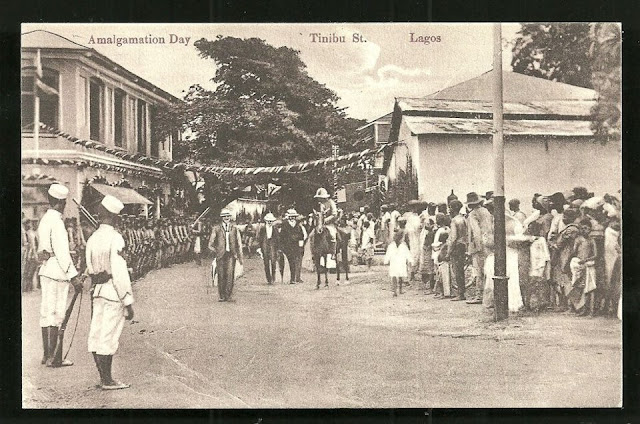
Amalgamation Day in Lagos, 1914

Amalgamation Day in Lagos, 1914

01 July, 2012

Where is the debate on our external military deployments?

As recently as 2008, there were over 5,000 Nigerian soldiers deployed on various "peacekeeping" missions worldwide.

Our soldiers have been on "peacekeeping" duty in Darfur for years now, and apparently there are still Nigerian "peacekeepers" in Liberia almost a quarter of a century since we first intervened. The Nigerian government has sent or will soon be sending Nigerian police officers to Mogadishu to "train" the Somali police. Nigerian soldiers are being sent to Guinea-Bissau as part of an ECOWAS force. There is much talk of deploying Nigerian soldiers as part of an ECOWAS force that will be sent to Mali. There are (or were) Nigerian soldiers and police officers deployed to Haiti (I found out when I read the news of one of them being killed there).


I don't know if Nigerian soldiers are posted to other locations, because there is very little public discussion of where it is we are sending our soldiers, why it is we are sending them, what it is that we expect them to do once they get there, how they are supposed to do what we expect, and (most importantly) whether any of it makes any sense, both in terms of the official mission goals and in terms of our own strategic interests.

We have court-martialed soldiers who served with ECOMOG for protesting that their peacekeeping pay was being stolen by their senior officers (life sentences for 27 protesting soldiers were commuted to 7 years imprisonment). We have court-martialed wounded former ECOMOG soldiers for protesting at their abandonment at Egyptian hospitals. And Nigerian soldiers have died in Somalia, Haiti, Darfur, Liberia and Sierra Leone. We really ought to do better for our troops.

Peacekeeping, as a concept, enjoys the support of most of the world's politicians, diplomats, pundits, bureaucrats, journalists, etc., and as such enjoys excellent public relations. No one would ever dare to publicly question whether peacekeeping missions actually succeed at what it is the proponents say peacekeeping does. When missions end, there is a tendency to declare whatever is left behind to be a success (something which happens with wars too), and then to stop talking aloud about the country in question -- especially when the country in question starts to go down a path that makes you wonder what the point of the peacekeeping was (or whether the mission ended because people got bored, or ran out of money, and not because something substantial had changed).

Before you get on my case, this blog post is not about "peacekeeping" per se.

I do have to say that I wonder about the fact that we Nigerians pride ourselves (for example) on participating in peacekeeping operations in the Congo/Zaire in the 1960s, and on the fact that the late General J.T.U. Aguiyi-Ironsi commanded that peacekeeping operation. In my opinion, that mission was a fig leaf behind which the charismatic and courageous Patrice Lumumba was murdered by his foreign and local enemies, who then replaced him with the kleptocratic, nation-destroying Mobutu Sese Seko. In other words, I fear we helped perpetuate the two-century-long and on-going destructive exploitation of the Congo.

This is how I think. Call me crazy if you want, but again, this blog post is not about peacekeeping per se.

During the ECOMOG wars, we used to ask ourselves: "Why is Nigeria fighting to bring democracy to other countries when there is no democracy in Nigeria?"

Today, you can ask the question: "Why is Nigeria fighting to bring security and stability to other countries when security and stability are at risk in Nigeria?"

It isn't as simple as demanding that our security forces focus on providing security at home. You see, even if you are someone who believes in external interventions, you have to ask a very, very pointed question: "Why are we ignoring Niger Republic and the Republic of Chad, but are sending soldiers to Mali, Darfur and Somalia?"

There are certain countries in the world who like to refer to themselves as "the international community", and who like to act like decisions they make among themselves are the decisions of the whole world. It seems to me that Nigeria's polices on peacekeeping are driven primarily by what the "international community" thinks is important to the "international community" and not by what is important to Nigeria.

There are reasons why Mali and Somalia make the "international community" nervous, and Darfur became something of a cause celebre among "international" journalists as well as among Hollywood stars. These places get talked about a lot in multilateral agencies, in diplomatic circles, and on the 24-hour "global" news cycle. Nigerian and African leaders want to be seen as "world leaders" hobnobbing with the leaders of the "international community", standing "shoulder to shoulder" to face "the world's problems".

Did you know that Northwestern and Northeastern Nigeria are currently suffering from wide-scale starvation? I am going to post about that next, but what I want to say here and now is that the Nigerian government is doing exactly NOTHING to help the Nigerian citizens in the Northwest and Northeast. Do you know why they are doing nothing? Because nobody is talking about it in the "global" news, and it isn't a topic at multilateral agencies and diplomatic circles, and think tanks in the countries of the "international community" are not producing papers about it.

Indeed, Nigeria had neither a presence nor influence in terms of the substantive responses to the crises in the Cote d'Ivoire, and area of immense strategic importance to us, because the "international community" did not desire us to be there (being as Cote d'Ivoire is an overseas department of a key member of the "international community").

And the Nigerian government has taken an extremely disinterested, laissez faire, approach to the absolute tyranny to our south in Equatorial Guinea. Back in the 1980s, Nigeria had to bribe the Nguema Clan to drop their plans to offer their country to the Apartheid government in South Africa for the construction of a forward air base. But more important than that, countries like Equatorial Guinea, and governments like the one led by the Nguema Clan, are part of the reason our continent keeps having these crises, and are (just as importantly) part of the reason why the continent's ability to react to crises is limited. We can't rely on Equatorial Guinea to help do things in Africa that they have been trying to avoid ever happening in their own country; indeed, if the number of African countries with "good" governments increased, then the number of countries that would want to see the end of the Nguema Clan's rule would by definition have increased by the same amount.

But Nigeria does nothing about it. Partly because Nigeria's leaders are also keen to maintain the current state of African governance -- like the Nguema Clan, they too fear an Africa of "good" government.  But the other reason Nigeria does nothing about Equatorial Guinea is the government of Equatorial Guinea is a vital, strategic partner of the "international community", so there is no pressure from them on Nigeria to contribute troops to an Equatorial Guinea intervention force.


You may not recognize President Teodoro Obiang Nguema standing next to the smiling President Barrack Obama in a 2009 photograph. You also may not know that the Nguema Clan lead the worst dictatorship in Africa; Equatorial Guinea is an African version of North Korea, right down to the pseudo-monarchic rule of one family. Except unlike North Korea, Equatorial Guinea has crude oil, and the Nguema Clan have sided with the USA (rather than China) in the race for African resources. C'est la vie.


But I digress ..

We've got to start thinking about our continent and our planet from our own perspective. We've got to think through problems as they actually are, and not approach fundamental issues based on whatever is the flavour of the moment on the 24-hour "global" news channels, and in the halls of multilateral agencies and state houses of the "international community"

The fundamental nature of Niger Republic and the Republic of Chad is such that they both constitute a hindrance to any serious efforts to make peace, safety and security permanent in the north of our Federal Republic. We cannot solve our problems without solving their problems, and their problems are long-standing. We have known about their problems (and our interlinked problems) forever, but we have been of no use to them (or to ourselves) in terms of solving the problems. We ignore our own problems, and apply the same disregard to their problems.

Look, the things I wish for Nigeria are the same things I wish for every country in the world. But even if we "succeeded" (whatever that means) in Darfur or Mali, we would not have succeeded at all because the wider Sahel Region would still lack any kind of anchor to peace, prosperity, growth and stability. Indeed, what would be the point of success in Darfur, when the Darfur Region is surrounded by Libya, Chad, Sudan, South Sudan and the Central African Republic? Any "success" there would be fleeting, and to be honest, there has been no success so far, and there is unlikely to be any success, so it is a moot point, apart from the fact that our soldiers have been dying there.

I don't understand how our leaders think. If you were sitting in Abuja, thinking about the best thing you could do, from Abuja, to improve the security and prosperity of Nigeria and of the entire African continent, why exactly would you do any of the things our government chooses to do. Do we really think that this is where our scarce resources would be the most effective in tackling the issue?  Indeed, while I wish for Somalia everything that I wish for Nigeria, why would participation in a Horn of African intervention be high on your list? And why do we continually commit troops to missions that we neither fund nor control?  Why do we assume the decisions made by outside powers on how to react to African issues are the best choices? And why do we trust that promised funds and equipment will be forthcoming, no matter how many times we learn otherwise?


Nigeria's strategic interests in Africa are actually quite simple.  One could bore you with a long, verbose exposition, but the simple phrase "Peace and Prosperity" sums it up nicely. We need our neighbours to be peaceful. We need our neighbours to be prosperous. Heck, we could do with some peace and prosperity ourselves. But this paradigm we have committed ourselves to is not working, is it?


If anything, interventions have a way of leading to outcomes that were not intended by those who championed, approved of, and ordered the interventions. When retired General Ibrahim Babangida made the decision to initiate the ECOMOG operation (for reasons that remain shrouded in mystery), I am quite sure he never anticipated Nigeria would get drawn into two full-fledged wars in Liberia and Sierra Leone.  The Nigerian government has never revealed the truth about casualties, or about the massive expenditure required to sustain our war effort for as long as we did.

And I am sure Babangida didn't expect we would still have soldiers in Liberia and Sierra Leone 20 years later.

Heck, if we take it all the way back to the beginning of our participation in such mission, I am quite sure the First Republic government did not intend to help provide cover for Lumumba's assassination when they decided to commit Nigerian troops to the mission.

I am afraid that the current federal administration will sleep-walk Nigeria into another long-term war, this time in Mali, and with greater casualties than the last time.  And leaving aside the question of whether this is or is not the right thing to do (by the way, I don't think it is the right thing to do) there is no guarantee that the "international community" countries that want us to fight this war will provide any materiel or funding.

One thing I have learned from ECOMOG is there is a limit to the number of Nigerian soldiers we can forward-deploy to participate in a war. The maximum number was insufficient to do more than hold Monrovia, and when the defence of Freetown became vital (after Taylor outflanked us by expanding the war to Freetown), we had to participate in a charade in order to pull our troops out of Monrovia to go and hold Freetown.

By "charade", I mean the Liberian Presidential "Election" won by Charles Taylor. The small group of countries that call themselves the "international community" were uncomfortable with Nigeria's Abacha-era ECOMOG presence in Liberia; they paid for the elections and were quick to hail the polls as a successful conclusion of the Liberian Civil War.  The Nigerian government played along with this because it allowed us to declare "victory" and move our forward-deployed troops to Freetown. Liberia was still prone to the same disaster the "elections" had supposedly forestalled. That both the Nigerian government and the "international community" knew that Taylor was behind the war in Sierra Leone, and that he was indirectly killing thousands of Sierra Leonians, and an unknown number of Nigerian soldiers. Yet, everyone played along with the farce that Taylor was a president and the elections were a success (which is a reminder of why we should look very carefully at the "victories" declared in wars and other interventions, including "peacekeeping").

Permit me to digress and say that Taylor's ability to make war in Liberia and Sierra Leone was linked to his support in certain neighbouring ECOWAS member countries, and to his ability to trade with countries in Europe. The two wars only started going against Taylor when a new government came to power in his most powerful regional rival, and when talk of "blood diamonds" shamed his trading partners outside Africa into cutting their trade with him. While our soldiers were dying at the hands of Taylor's army as well as his proxy army, we did little or nothing to interdict his sources of support. As students, we were all familiar with the statement "plus one minus one equals zero". The great problem with ECOMOG is we were committing plus-X to the fight, while doing nothing about the circumstances that allowed Charles Taylor the freedom to respond with minus-X, thus creating a long stalemate.

This is the problem with Darfur, and will be the problem with Mali.

There are only so many soldiers Nigeria can forward-deploy beyond our borders. The number is insufficient to pacify Darfur, even if we committed it entirely to Darfur. Because Darfur is surrounded by Libya, Sudan, South Sudan, Chad and the Central African Republic, places where Nigeria has zero influence, we are unable to do anything about the things that fuel the conflict in Darfur.  Adding Mali to the mix just adds another straw to the back of a camel that has already set down most of its existing load due to lack of capacity.


The things I wish for Nigeria are the same things I wish for all our neighbours in Africa. But the things the Nigerian government keeps involving itself with lead to the loss of Nigerian soldiers' lives, without in anyway achieving the creation of the peaceful and prosperous Africa we need. It didn't happen in the Congo/Zaire in the 1960s and it hasn't been happening since then.  The "international community" doesn't credit us with participating in winning World War Two, and doesn't seem to acknowledge that we lost a lot of soldiers during our participation in the Somalia intervention from which the term "Blackhawk Down" was derived. On behalf of the families of the soldiers we lost in Somalia, I must ask, what was the point of that intervention? What did it achieve? Was it worth their lives?


People will say that I should not let the "great" be the enemy of the "good", that the imperfection of these interventions shouldn't be a reason to "abandon" the people of these countries....

.... but you know what? A lot of the things that are done in the international sphere seem to be part and parcel of what creates the problems in the first place. And when asked to participate in and interventions, it is almost like we are being asked to restore the situation back to what it was, even though what it was is what gave rise to the crisis in the first place. Everyone has heard the adage about people not learning from history being doomed to repeat it? It seems to me that our soldiers are being sent to warfronts in order to initiate the repetition of history.

In short, to say we are doing the "good" because we can't do the "great" is to assume that "good" is being done. Yes, I know the wars come to an end, but do the wars really end any sooner than they would have if there had been no intervention? In spite of thousands of peacekeeping soldiers, the Great Lakes are still afire, and Sudan (North, South and Darfur) are not at peace. It was more than a decade after the ECOMOG intervention before the Liberian and Sierra Leonian wars petered out (and no, it was not the United Kingdom that ended the wars, contrary to wat you might have heard).

Besides, I am not saying Nigeria should do nothing.  I am saying that what we are currently doing is not what we should be doing, and that we are focused too far afield when the first priority must be Niger Republic and the Republic of Chad (but only in concert with efforts to bring the same measure of peace and stability to every region of Nigeria, not just the North, but every part of the country).

We start from there. Whatever else we do after that, we must start from there.

I cannot stop our government from deploying our soldiers and policemen. I am just asking that we debate and discuss each deployment before approving it.

Even if you entirely disagree with everything I have written, surely you agree that we should discuss these deployments a lot more than we do?

30 June, 2012

A government working against itself - IV


Look, this isn't a slanderous rant by a faceless internet blogger.

Ex-President Obasanjo himself admitted he knew Chris Uba rigged the 2003 Anambra Election, and also knew Chris Uba subsequently had then-Governor Ngige kidnapped and extorted. These are among the most serious crimes in our legal codes (indeed, the kidnapping was borderline coup-de-tat, which is treason), and in order to facilitate these destination crimes, Chris Uba and other co-conspirators would have had to have committed a swathe of lesser-included crimes as well (including, for example, suborning the Anambra State police command). Yet, our President, Olusegun Obasanjo admitted, without shame that he considered it "a family affair" -- by which he meant that he and the federal government he led had no interest in investigating, arresting or prosecuting any of the criminals.

The Obasanjo Federal Government went on to ally itself to Chris Uba as the godfather waged a 3-year war (2003-2006) to destroy his erstwhile godson Chris Ngige, but the anarchy in Anambra State really started as far back as 1999. He was merely continuing a pattern, indeed, the Obasanjo Federal Government treated the earlier 1999-2003 "war" between Chief Emeka Offor (a corrupt billionaire and political godfather) and then-Governor Chinwoke Mbadinuju as "a family affair" and did nothing while the political machines allied to these two men brought the state to its knees.

All in all, Anambra State was at a complete standstill for 7 long years between 1999 and 2006 because our three tiers of government considered the political anarchy and violence to be nothing more than "normal" politics. All of them came to office through this kind of politics, so none of them thinks there is anything wrong with it. The total absence of public service delivery was of no importance or consequence to them. I passed through Onitsha during this time, and we can only thank God that an epidemic did not break out, because people and houses were outnumbered and overrun by the greatest stockpile of filth I had ever seen.

Do you understand that this is why we cannot stop violent groups in Nigeria? President Goodluck Jonathan is personally acquainted with Niger-Delta "militant" leaders, and owes them political favours for services they rendered to him in the course of his political rise.  The late former President Yar'Adua was likely not personally acquainted with the Niger-Delta militants, but he was elected in 2007 in part because of the militants' "delivery" of the Niger-Delta to the PDP as part of ex-President Obasanjo's do-or-die politics. As for Obasanjo, as noted in the prior paragraphs, he owes his both of his two terms in office to riggers, manipulators, scoundrels and thieves like Atiku Abubakar, Tony Anenih and the brothers Chris and Andy Uba.


I suppose I can't heap all the blame on the politicians.  A few of us citizens approve of this sort of governance, and hail the people who are successful at it as manly men of timbre and calibre. Most of us don't approve, but don't lift a finger to do anything about it.  We all watched as Anambra State was made a mess for 7 years.  They didn't help themselves and we didn't help them. We just let it happen.

But I am digressing.

I don't take the governments (at all three tiers) seriously when they say that they are going to tackle the insurgency. Whatever they are doing is not going to succeed, because they will deliberately avoid doing anything that will fundamentally change the nature of the Fourth Republic.

Understand that it is possible that they might stop the current insurgency, but the nature of things guarantees that even if they do, it will be replaced by another insurgency operating somewhere else in the country ....

....quite possibly, but not necessarily, in the Niger-Delta. There is much talk of the "amnesty", but I suspect the Niger-Delta militants are observing a temporary truce that will evaporate the moment Goodluck Jonathan is no longer president, whether it happens in 2015 or 2019, but especially if it happens in 2015.

Violence since 1999 has not been concentrated in any one single place. It flares up intensely in one place for a time, then it tapers down in that place and flares up somewhere else. The City of Jos is probably the one place where violence has been near-constant since 1999.


At the micro-level, the level of the ordinary citizen, a lot of Nigerians have been working to bring us together. I have posted profiles of some courageous and wonderful citizens on my blog (examples HERE, HERE, HERE and HERE). But everything good that is done at the micro-level is undone at the macro-level by people whose political and business fortunes would be hurt by societal rapprochement

I love the Federal Republic of Nigeria. I love my homeland enough to be honest about our public safety/security institutions.  The Nigerian Police Force, the Federal Investigations and Intelligence Bureau, the Code of Conduct Bureau, the Independent Corrupt Practices Commission, the Nigerian Customs Service, the Civil Defence Corps, the various (unconstitutional) state-owned pseudo police, the State Security Service and all the other intelligence agencies, and the Economic and Financial Crimes Commission have hundreds of thousands of men at their command, but in many respects the Federal Republic of Nigeria often feels like a place entirely lacking in law enforcement.

A friend of mine once said he thought the murder rate in London was higher than the murder rate in Lagos. To be honest, it is hard to know if that is true or not, as Nigerian statistics are either non-existent or untrustworthy, but I felt that he was missing the point in terms of public security, or maybe public perceptions of security.

I was never the victim of a crime, violent or otherwise, in Nigeria, but I was a victim of an attempted burglary when I lived in the United States. When I saw the burglar through the window, I called the police and they arrived quickly, surprisingly quick to be honest. By contrast, when I am in Nigeria, my assumption (and the assumption of every citizen) is that if armed robbers attack there will be no assistance forthcoming from the police.

Read that last paragraph again. It encapsulates everything I am trying to get across.

While things are not "anarchic" in Nigeria, not yet anyway, there is actually nothing in place to stop anarchists from running wild if and when they choose to run wild.

This is why seemingly "stable" countries like Cote d'Ivoire and Libya collapse so quickly. In autocratic dictatorships, the dictator makes sure to avoid the creation of strong institutions that could challenge his exercise of unchecked power. The problem is, the day that dictator dies or loses even a fraction of his grip, you suddenly realize that there is a giant vacuum where real institutions should be.  Even the respective armies fracture and disintegrate quickly, or retreat (as Idi Amin and Mobutu's soldiers did) rather than die to defend a leader and government they don't really like any more than anyone else in the country. Liberia existed for more than 100 years without any institutions worthy of the name; Charles Taylor entered the country with maybe 25 men, and that was enough to collapse everything like a pack of cards.

Understand that we can't keep going down this road.  Something has to be done, not just to protect the status quo, but to move us to a position of ensured and reliable security. If we continue to emulate those African countries that did nothing when they began to drift down the problematic path, the consequences will be ... well, our population is much larger than theirs.

This is the time to act. It is bad enough already. We shouldn't wait for it to get worse.

A government working against itself - III


There has been little or no proper debate of the spiraling violence since 1999. The discourse is locked on a set of assumptions that have hung on our necks like albatrosses since the 1950s.  We really need to abandon the politics of blaming everything on leaders and ordinary citizens from every Region other than our own, while simultaneously exonerating ourselves and our own Regional leaders from any responsibility.

Many react to the current insurgency in the north of our country by blaming "Northerners" and "Northern Leaders". But the problem of insecurity, and the sources of the problem of insecurity are pan-Nigerian and pan-Federal; the things that cause or make it easy for violence of small or large magnitude to happen in one part of Nigeria are the same things that cause or make it easy for it to happen anywhere else in Nigeria ... and every part of Nigeria suffers as a consequence of the dysfunction in or absence of structures meant to prevent, combat and/or ameliorate violence.

Sociocultural diversity is not the problem. People say African countries would be more peaceful if colonialism had not forced us together, but if that were true Somalia would be the most peaceful country in Africa. I suppose they would counter-argue that Somalia's clans were forced together, to which I would respond that the clans were fighting each other before they were forced together, so you can't blame the conflicts in the Horn on their being forced together.

In Nigeria, violence has flared up everywhere from Ife-Modakeke in the Southwest and Aguleri-Umuleri in the Southeast to the incessant farmers-versus-herders murders in the Middle Belt. You may think these many, many, too many incidents are somehow different from what is happening in Maiduguri, but from the perspectives of the families who have to bury their relatives there is no difference in the consequences of shared vulnerability to unchecked violence.

None of us are safe.

Two acquaintances of mine have been in the vicinity of armed robberies; one occurred within sight of a police checkpoint, while my friend who escaped the second incident came upon a checkpoint not too far from where the robbers were operation. In both cases, the police officers flat out refused to do anything to intervene. In a separate incident reported in the media, the robbers left the scene after operating without challenge for hours, but then returned later to riddle with bullets the home of a man who had called the police after they left, begging the question of how they knew he had called and how they knew who had called. Believe it or not, the reaction of these specific police officers to these specific armed robberies is indicative of our Federal Republic's incapacity to react to what we call "communal violence".

No one is perfect, I know, and no country can perfectly prevent violence, I know that too. But my problem is we are not even genuinely trying.  Again, I point to Jos and to the farmers-versus-herders violence, predictable and persistent -- tell me, has anything really been done to try to bring these situations under control?  Forget the promises, the assurances, the warnings and the rest of the usual governmental reaction to outbreaks of violence (including but not limited to "panel of inquiry", "consultation with stakeholders/elders", "Joint Task Force", and "sack the NSA). Look at the situation over the last 13 years, focus if you must on specific long-running issues like Jos, and be honest about whether you think the governments at all three tiers have so much as lifted a finger in the direction of real, substantive effort at problem-solving.

I am not even sure they would know what to do even if they desired to do something, but I question whether they really desire to do anything.  Fixing the problem runs contrary to the interests of the people in charge of fixing the problem. They profit from divide-and-rule politics, so bringing our sociocultural communities together is anathema to them. The benefit from the absence of effective law enforcement, so reforming and improving the public security agencies is anathema to them.

And even if they suddenly experienced a Paul-at-Damascus conversion, they have spent their entire lives killing any credibility they might have in terms of fixing our problems. Even if they honestly tried to bring warring factions to the table of peace, one or the other or both of the factions would not trust them, because they are firmly identified with one or the other faction, or with an outside faction that both warring factions distrust.


As long as we keep acting as though the problem is a problem of "them" and not a problem of "all of us" then all of us will remain at risk.  If the federal and state governments (and the citizenry) are dormant when ethnic/regional/"vigilance" militia like the OPC and Bakassi Boys appoint themselves judges, jurors and executioners of Nigerian citizens, what makes you think the same federal and state governments (and citizens) will suddenly show signs of institutional capacity to effectively stop with insurgents in Maiduguri doing the same thing?

Our governments at all three tiers are supposed to be doing things that make us safer, but instead they do things that make it safer for violent groups to operate (not just insurgents and militia, but armed robbers as well), while simultaneously and deliberately  making it difficult for the security service to effectively curtail insecurity.  They do these things in the open, sometimes with the acquiescence of we the citizens.

Almost everyone praises Lagos Governor Babatunde Fashola. But Fashola is part of ex-Governor Bola Tinubu's political machine. Tinubu, like the late Lamidi Adedibu in Ibadan, distributes money (extracted illegally and semi-legally from the government) to Area Boys and other thuggish elements in Lagos. The hired thugs work for Tinubu when it is time to control electoral outcomes, intimidate political opponents, and exert control over the vast informal sectors of the Lagos economy. With Tinubu's endorsement, these gangs have taken over Road Transporters' Unions in Lagos, and enrich themselves by collecting "dues" from bus, taxi and okada drivers. Every once in a while, these gangs engage in violent territorial battle for control of the lucrative union dues, and each time this happens, the media rather laughably describes them as clashes between rival unions. Click on the links to read of some of the factions' violent clashes over territory, influence and "toll" collection thus far this year, in January (no fewer than seven dead), in February (local police accused of supporting one side in the clash) and in May (one dead, several injured).

This is more or less what happened in the Niger-Delta, where the so-called "militant" armies began as groups of political thugs recruited by regional politicians to seize direct control of territory they could trade during elections in exchange for post-election favours.  Indeed, these thugs were (and are) so good at their job that the Peoples Democratic Party won (and wins) elections in Rivers and Bayelsa with the kind of margins unheard of anywhere outside Nguema's Equatorial Guinea.  Where Tinubu's goons squeeze small money from Road Transporters' Unions, their counterparts in the Niger-Delta discovered Big Money could be made by blasting a whole in an oil pipeline and stealing the crude. When the politicians stopped paying them in between elections, they started making fortunes from oil theft.  The men who command these militia are now dollar multi-millionaires with mansions at home and abroad. Mind you, they are careful to shunt a share of their profits to the politicians and to some of the Armed Forces brass. Indeed, what made MEND and the other "militant" groups militarily difficult to beat is the support and information they were getting from many of the same leaders (in the Niger-Delta and in Abuja) who were in theory responsible for hunting them down.

No one really knows what is behind the insurgency in the North, as noted in this cartoon by Asuquo E.B.:
 

But beyond the usual 1950s-style back-and-forth rhetoric, a senior PDP politician (i.e. not the most reliable of sources) from Borno State accused the governor of cutting a deal with the movement that later became the insurgent group to help him win the 2003 elections.

Somewhat more credibly (but not that much more), retired General Jerry Useni mentioned in passing that on one occasion when he was been driven through the streets of Maiduguri with the Governor, he had told the governor that he had to do something about the presence of so many poverty-stricken young men visible on the streets lest it become a problem in the future.  According to Useni, the Governor replied that it was good that there were so many young, jobless men, because when it came to time for election, they would be available for use in manipulating the outcome.

I want to make clear that I am not personally accusing the Governor of creating or starting the insurgent group. What I am saying is I believe that modus operandi of the governor, like that of every other governor, and of all of our presidents, lends itself to the emergence and strengthening of armed groups of one kind or another ... groups which initially prove useful to politicians, but then become independent operators, beyond the control of the politicians, at which point anything can happen.

Indeed, while I am on the topic, I know people who argue that the financial relationships between governors and gangs are necessary, because if the governors don't pay them, they will find ways to pay themselves. But how is this the solution to the problem?  And haven't they noticed that this "solution" has been tried before in other countries, and only ever gave armed groups enough time to build up their strength to the point of not needing to fear the absence of governmental acquiescence?

A government working against itself - II


The City of Jos is important to any analysis of all three tiers of governments' response to the trend. Violence in Jos has been entirely predictable, year-on-year, for 13 straight years, and continued getting worse for 13 straight years.  We should know by now that we have to prevent it from happening, that we have to heal the city. Yet, not only do we allow violence to recur year after year, but each time it happens our three tiers of government belatedly react as though caught unaware by something unpredictable. 

The different communities resident in Jos lived together in peace for so long, in a city that enjoyed the same reputation Calabar enjoys today; I refuse to believe that there is any fundamental reason beyond divide-and-rule politics for youth gangs from either constituent community to be massacring each other. Unfortunately, 1950s-style divide-and-rule politics appears (on the surface anyway) to colour public reaction to the event in Jos, so rather than come together to force our leaders do actually do something to fix the situation, we (if public commentary is to be believed) instead take sides with one or other of the warring youths.

We also (per the public commentary) take sides when we hear news of farmers and herders involved in tit-for-tat murders in the Middle Belt.  What nobody seems to be doing is questioning why it is that the three tiers of government are doing nothing about it.  We all know that the farmers and herders are competing for the same scarce resource, land, and that this competition, unmoderated by law or law enforcement, has taken the form of attacks and counter-attacks that happen, predictably, every year, and yet there is no institutionalized or systemic response to it.  There are no preventive measures, no efforts to create and enforce mutually beneficial compromises, no efforts to monitor risk factors, and no rapid reaction to outbreaks.

Why would leaders who rely on, and exploit our divisions for political purposes be inclined to do anything about incidents of violence that help keep us divided against each other? But if the people who benefit from the violence don't want to stop it, what is our excuse? We the people are the ones who die in these incidents, or who have to bury our relatives, or who have to dig into our savings to pay for the medical bills of the injured and to repair and replace homes and other property.

Again, I am not saying that things in Nigeria are at the point of anarchy.  What I am saying is that we are sleep-walking down a dangerous road, and while we are not near the end of the road, there is only one thing waiting for us at road's end if we don't change direction.  If we don't address this 13-year trend of rising violence (1999 to 2012), while we still have the ability to do something about it, we will eventually get to the point where we no longer have the ability to do anything about our fate.

Most of us seem to believe that anarchy can only happen in countries like Chad and Somalia, but even the richest countries in Africa, countries like the Cote d'Ivoire and Libya, have collapsed in recent years. And the Republic of Mali was hailed as a bastion of democracy and stability -- up until it collapsed too.

These things do not happen overnight; it is the culmination of many things over a period of many years or even decades -- things that were never inevitable or unavoidable, but things that the relevant parties nevertheless refused to do anything to prevent or avoid. 

It is so frustrating. The cases of Liberia and Sierra Leone are among the worst because the build-up to the catastrophe moved in slow-motion across enough decades that it could have been stopped and avoided long before it happened.

The Federal Republic of Nigeria still has a chance to avoid that destination, though for the families of the many, many victims (dead and injured) since 1999, it is already too late. I doubt the government has been keeping count, and if they have, I am sure they will never release the number to the public because it would be alarming. The 13 years of the Fourth Republic so far have been the second-most violent period of modern Nigerian history, behind only the period from 1966 to 1970. There was a lot of violence between 1960 and 1965, but, while our statistical record-keeping is weak and politicized, I think the cumulative death toll between 1999 and 2012 far exceeds the total from 1960 to 1965.

Two things stand out about the Fourth Republic. These factors were present before the Fourth Republic, but for whatever reason have become more acute since 1999:

(a) Our politicians, political parties and political factions have busied themselves recruiting violent young men to serve as their political enforcers and political defenders. In many cases, they have subsequently lost control of those young men, or have shifted from a situation of total control of the gangs to one of symbiotic (and almost equal) partnership. Our leaders think they are playing clever games among themselves, but if you weaken the capacity of the government to enforce its laws because you want to empower a militia group you think is on your side, the weakened institutions you've created will not be able to stop the militia groups you perceive to be your political enemies.
 
(b) If the law enforcement agencies did their jobs effectively, most of our leaders would be in prison, and they know it. Our political, economic and social leaders have long preferred to keep our law enforcement agencies and intelligence services ineffectual. Or rather, make them very effective a protecting Any Government In Power while being simultaneously ineffective at what it is they are supposed to do for the citizenry in terms of the social contract. But in keeping themselves safe from prosecution, they have long since (for decades now) left the citizens entirely unprotected and insecure. Heck, insofar as they use law enforcement agencies as a tool of government oppression, the people start crying out for protection from the government agencies that are supposed to be protecting them, an emotion exploited by the political recruiters of vigilance/ethnic/regional/militant militias, to gain sympathy from sections of the citizenry that should actually fear them for what they will eventually do/cause.

Some will respond, "well that is why we have to back our own "vigilance" militia, since we can't rely on the government to protect us from the proliferation of armed groups" ... to which I would respond, "Go and look at every country in Africa that did exactly that and see what happened."  Civilians get raped and pillaged by all sides in these long-running low-intensity wars, including by the very militia they once deceived themselves into thinking would fight to defend them as opposed to exploit them. .

Too many of us citizens are too quick to shield and protect the politicians and/or ethnic militia from our own part of the country, rather than work with our fellow citizens across the divides so we can all be safe.  But we citizens do not control or even minimally influence the decision-making of the armed groups or of the politicians that create them. And after a while, in our country (as in every other country in Africa where this has happened), the politicians themselves lose control of the very militia groups they created. These armed groups are exactly like the politicians who create them; they are interested only in their own perpetuation and profitability, even if it comes at the expense of you the ordinary citizen.

A government working against itself - I

What came first, the chicken or the egg? Is it the fractured nature of our society that produces the kind of leaders we have, or is it the leaders we have who work to create the fractured nature of our society?

I personally prefer to look at we the ordinary citizens as being the key protagonists. Both because I think we are (and that we underestimate our individual and collective ability to change things for the better) ... and because I think we the citizens can change ourselves (and thus our society), whereas our leaders are constrained to avoid change with all their might.

The things that most of us consider to be "problems" are the very things upon which our political and business elite rely for their wealth and power.  We can't really look to "the opposition" or to "the next generation", because they too aspire to climb the same greasy pole to wealth and power used by the current set. And if we are honest with ourselves as citizens, we will admit that one of the reasons that we the citizens never really push for fundamental change is the desire deep in our hearts to one day climb that same greasy pole ourselves.

I will hasten to point out that this paradigm isn't unique to us. It is a global phenomenon. Indeed, I am constantly aggravated by ex-leaders worldwide, who, in their retirement years, start spouting all sorts of ideas that they never fought for or enacted when they had power to do something about it. To get power, they played the game. To maintain power once they got it, they played the game. To secure private, personal wealth for themselves after their political careers, they played the game. Finally, with grey hairs on their heads, tens of millions of dollars in their bank accounts, and no with political power or influence left, they start criticizing their successors for doing exactly the same things they did, and for being motivated by the same things that motivated them in their time of power.

But this blog is about the beautiful, wonderful Federal Republic of Nigeria, so I will focus on us....

.... especially since our government's dysfunction is taking the country down a dangerously violent road.

As I have often mentioned on this blog, I wrote an essay on a popular Nigerian website back in 2003, warning that violence levels has risen sharply from 1999 to 2003, and that the trend showed the violence would only increase. I warned (in 2003) of the dangers of having so many ethnic militia, regional militia, private political armies, so-called vigilance groups, armed men loyal to governors and on state public service payrolls and so-called "militants", pointing out that every other country in Africa that had collapsed had gone through a phase where the government lost its monopoly of violence.

I said, in 2003, that while different sections of the Nigerian citizenry might have soft spots for one specific private army (based on the mistaken belief that that specific private army was defending their interests), we should learn from other countries in Africa where people thought the same things about their own ethnic/regional/vigilance/etc militia up until the tipping point to anarchy, beyond which they all began to pine for the "good old days" when a dictator held monopoly rights to violence.

[I promise you I am referencing something I wrote in 2003. I know it sounds like I am talking about things currently happening in certain parts of Africa.]

I argued, in 2003, that a country in which it was embarrassingly easy for one private army to smuggle in sophisticated, military-grade weaponry is a country in which it was just as easy for every private army to do the same. So if a particular political leader, or the government in general, or a specific section of the society chooses to overlook the institutional and systemic problems of border security because they fear fixing the problem would disadvantage their preferred private army, bear in mind that you are in effect empowering every private army and negating whatever relative advantage you think you are giving yourself.

When I wrote that essay in 2003, we had not yet fought a low intensity civil war in the Niger-Delta, nor faced an unchecked insurgency in the North. Back in 2003, I got one response to that essay, from someone who accused me of being an alarmist and a "nihilist" (whatever that means).  It is amusing the way people throw around adjectives.  Over the years, I have been called everything from a "neo-conservative" to a "bleeding heart liberal".  I am none of the things I have been called, and none of the people who called me these things ever presented a convincing argument against anything I said or wrote.

Look ... I am not saying anarchy is imminent in Nigeria. What I was saying back in 2003, and what I am saying now in 2012 is the trend of violence was and is upward, with little or nothing being done to stem the rise.

28 June, 2012

Whatever happened to ....

.... Sergeant Musa Usman?

You don't know who he is, do you?

I read about him nine years ago. The last I heard, he had been placed under arrest. I've wondered since what happened to him. Whether he was released, whether he was still in detention; whether he had retained his job, whether he had been sacked for "insubordination" or whatever excuse.

The fact that he is almost entirely unknown, the fact that his courageous statement to the Minister of Police is entirely forgotten, and the fact that there was exactly ZERO public reaction to his arrest 9 years ago, well, this says a lot about the state of politics in our Federal Republic.

And I am not just talking about the politicians. I am talking about you and me. All of us.

Read what he said (see below). Tell me he didn't have a point.

Absolutely nothing has changed since then, has it? And nothing will change, because we the people are too busy fighting each other to spare any energy to fight for changes that would benefit all of us.

The issue of substantive, meaningful police reform is not even on the agenda. Oh, sure, our leaders  keep promising it (read the articles below, you will see the promises from 9 years ago), but that is like lions promising to work towards vegetarianism on the Serengeti.


Anyway, this is what happened 9 years ago:

 THE SUBSEQUENT ARREST:

Harassment of Sergeant Musa Usman

In August 2003, police officer Sergeant Musa Usman was arrested and questioned by the police after speaking out about corruption and poor conditions in the police force. He voiced his criticisms on August 21, 2003, during a meeting in Lagos addressed by Minister for Police Affairs Broderick Bozimo. The minister had invited those present to express their views. Sergeant Musa spoke in the meeting about corruption in the police force; he complained about the poor pay and other disadvantages faced by junior officers. At one point, the Lagos State Commissioner of Police attempted to stop him by trying to take the microphone, but the minister said he should continue. A few days later, on August 27, Sergeant Musa was arrested and questioned by the Lagos State police in connection with the comments he had made during the meeting. It is not known whether he was subsequently released or transferred to another location. Members of a nongovernmental organization who made inquiries with the police in Ikoyi, Lagos, where he was normally based, were told that he was not there, and have not been able to make direct contact with him since. As of September 2003, his whereabouts were not known. In response to a letter addressed to the Minister for Police Affairs by the Network on Police Reform in Nigeria (NOPRIN), which was made public, the Lagos State commissioner of police denied arresting or questioning Sergeant Musa, claiming that it was a routine procedure. [88]
  WHAT PROMPTED THE ARREST:

You, too, Are Corrupt

By Mathias Oko
Monday, September 01, 2003
Junior police officers, angry at the arrest and dismissal of their colleagues for extortion, accuse their superior officers of the same offence.
The junior ranks of the Nigeria police have ac-cused their superior officers of aiding and abetting corruption in the force. The policemen, who were bitter over the recent sacking of 34 of their colleagues for extortion of money from motorists, said they were merely being used as scapegoats, and called for a similar disciplinary action against their superior officers. The junior policemen narrated their experiences in the hands of their superiors to Broderick Bozimo, minister of police affairs, who was in Lagos on a two-day working tour, August 21 and 22.
Musa Usman, a police sergeant attached to the force mobile unit, stirred the hornet's nest at the Onikan Sports Stadium, Lagos, August 21, when he made startling revelations on why corruption thrive among policemen. The officers present included Adebayo Adeoye, assistant inspector-general of police, AIG, in charge of Zone 11; Young Arebamen, commissioner, Lagos State Police Command; top- ranking police officers and the junior ranks alike, who were on hand to receive Bozimo.
Usman told the audience that poor condition of service was responsible for corruption in the force, and that the superior officers were liable for the much orchestrated extortion experienced daily on the highways. Though, Usman absolved himself of corrupt tendencies, saying he would never stoop low to the point of extorting N20 from anybody, he noted that officers who extort money make "returns" to the superior officers, who send them to check-points, and wondered why only the junior cadre should bear the brunt. "If 34 of our men could be paraded and shown on television to the millions of viewers in the country, and were later sacked, I hope our superior officers who sit in their offices and get returns would be shown on the Cable News Network, CNN, for the world to see," he said.
He attributed the large-scale corruption in the force to insensitivity on the part of the authorities. He also blamed it on the poor salaries of junior officers which he said, cannot take them anywhere in the face of the tight economic situation in the country. He said for instance, that, a police constable earns N8, 500; corporal N10, 000 and sergeant N12, 000. These, he said were grossly inadequate to cater for their immediate families. Usman decried the lack of insurance policy for the hazardous job of securing lives and property of Nigerians.
As Usman eloquently reeled out the ordeal of the junior police officers amidst ovation from his colleagues and admirers who urged him to "fire on," Arebamen, who was visibly angry by the reaction, attempted to seize the microphone from him. But the minister stopped him saying they should be allowed to express their minds.
Each of the six speakers, including a female cop attached to the traffic division spoke in similar vein. Michael Attah, a police inspector, told the audience that contrary to the official claims about the upward review of the minimum wage, policemen were yet to enjoy same with their civil service counterpart in the country. He explained that frustration was largely responsible for corruption and other vices in the force. Many policemen, he said, were dying silently because of series of problems confronting them which were beyond them, noting that the authorities were not doing anything about their plight. Attah noted, for instance, that some of them could not bring their families to join them in Lagos due to lack of official accommodation. "Even the existing accommodation in the barracks are an eye sore," Attah stated.
One of the junior officers who spoke with Newswatch on condition of anonymity at the stadium said the disparity between the senior cadre and their junior colleagues was too wide. According to him, this was the kind of scenario that prompted the nationwide strike last year and some of those fingered as masterminds were made sacrificial lambs. "Now they are at it again. It must be the junior officers they would want to crucify. What an injustice," he said.
Apparently overwhelmed by the outbursts, Bozimo expressed sympathy with their plight and thanked them for their courage in exercising their constitutional right to freedom of speech. He observed that if such freedom was allowed in the past and their problems addressed, the question of strike in the force would have been averted, and that the force would have been the better for it.
He told the agitated cops that he had come and seen, and would take their problems to the president. He spoke on the cardinal programmes for improving the police. These include improved welfare, training and retraining of officers and promised that more training facilities would be acquired to enhance professional training for the teeming incoming members of the service. Acquisition of facilities like computers, vehicles, as well as provision of accommodation, he said would be addressed through the Police Trust Fund Scheme, which he said, would serve as morale booster for the cops. "If these basic things are provided ,it would engender discipline," Bozimo said. He called on journalists and members of the public to help expose corrupt officers. He insisted that members of the public owe it a duty to discourage the police from taking bribe by not giving, because according to him, "if you don't give, they won't take. So don't give at all."
The minister visited several police formations in the zone including the zone II headquarters, Lagos; the Lagos State Command, police air wing and pension unit, all in Ikeja among others. He also paid a courtesy call on Rilwanu Akiolu, the Oba of Lagos.
© 2003 Newswatch Communications Limited

08 May, 2012

Debt Promises

The Minister of Finance and "Coordinating Minister for the Economy", Dr. Ngozi Okonjo-Iweala says the amount of money the Federal Government borrows from domestic sources each year will drop to ₦500 billion by 2015. The exchange rate for $1.00 varies between ₦150.00 and ₦160.00, so think of ₦500 billion as being a little over $3 billion. She says domestic borrowing this year is ₦744 billion (just under $5 billion), down from ₦852 billion (around $5.5 billion) last year.

First off, note that she is only referencing domestic borrowing, no foreign borrowing.That said, I do not believe her projection for domestic borrowing (or any borrowing) in 2015. Mind you, it is not her fault that I don't believe her.

Seven years ago, back in 2005, Dr. Okonjo-Iweala negotiated the famous debt cancellation deal. It cost us a lump sum of $12 billion, but that is besides the point. The point is she made a lot of promises about what would happen now that we were debt free, a lot of assurances about how much we would be saving over a 20 year period, and a lot of promises about what the alleged debt savings would be used to do.

None of what she promised has happened as she promised it, and, again, I will very quickly point out that it is not necessarily her fault. Not too long after the debt cancellation deal, then-President Olusegun Obasanjo moved her out of the Finance Ministry and into the Foreign Affairs Ministry. Shortly thereafter, she left the cabinet and returned to the World Bank, so she ceased being in charge of our fiscal health shortly after the debt cancellation deal was finalized.

Be that as it may, between 2005 and 2011, the Nigerian Federal Government amassed an additional $28 billion in domestic debt. Think about it. We paid $12 billion of $30 billion, had $18 billion cancelled, and then in the space of less than 6 years, we borrowed $28 billion of cumulative new debt (added to $11.8 billion of domestic debt we already held in 2005). For all intents and purposes, we paid out $12 billion for the privilege of being exactly where we were before we paid out $12 billion.

I did not agree with the debt cancellation deal. I think I was probably the only one on Earth who didn't. Dr. Okonjo-Iweala and President Obasanjo were lauded and hailed for it worldwide. But I wrote an essay, which is still floating around somewhere on the internet, questioning whether it was or was not a good deal.But, again, that is not the point. And again, I don't necessarily blame Mrs Okonjo-Iweala. Its not that I support her, I just don't think it is directly her fault.

Dr. Okonjo-Iweala has no real political influence. She has no party, no faction, no political machinery. There is no pro-Iweala parliamentary caucus, no pro-Iweala bloc of governors. She is simply not a political "player" and has no political "big stick" to wield. She has no political constituency to trade. Frankly, if she wants something to happen, and the real power-players in Nigerian politics want something else to happen, then something else will happen and there is NOTHING she can do about it.

I don't know what she would have done if she had been Finance Minister consistently from 2003 till today, and had had the full force of the Presidency behind her in that time. Maybe everything would be different and we would not have $28 billion in extra domestic debt. Maybe everything would be the same.

At the time of her first removal from the Finance Ministry, some commentators felt President Obasanjo had moved her from the Finance Ministry because he was jealous of her renown following the debt cancellation deal. But that is not what happened. In reality, by 2006, President Obasanjo was already looking forward to the 2007 "Do Or Die" Elections. He would need to spend (or rather "waste") billions of dollars in federal government funds to influence the results. He would either buy himself a Third Term, or if that failed, he would buy the 2007 "Do Or Die" Elections for his political proteges, and for the Peoples Democratic Party.

Obasanjo figured Dr.. Okonjo-Iweala wouldn't go for that, or migh insist on some "transparency" in terms of how much was being spent and on what ... so he moved her to where she would not be in charge of the money.  And there was nothing she could do about it. When she realized she was powerless as Foreign Minister, and was just there because Obasanjo was concerned about what the outside world would think if he just sacked her, Dr. Okonjo-Iweala resigned and went back to the World Bank.

So, what does this have to do with her predictions on 2015?

President Goodluck Jonathan reappointed Dr. Okonjo-Iweala as Finance Minister after the 2011 Elections. You see, he needed her name recognition in his cabinet, but only after the election, get it? He put her in charge of the money after the 2011 elections for the same reason Obasanjo removed her from control of the money before the 2007 elections.

You see where I am going with this, don't you?
 
There will be another Election in 2015. President Jonathan will seek reelection in an atmosphere in which a substantial chunk of the country thinks he shouldn't have had a first term to begin with. And bear in mind we will be facing the additional political headache of some Big Men saying it will be "the turn" of "the Southeast" after Jonathan's second term, while other Big Men insist that it is "the turn" of "the Northwest" to complete the five or six years they missed out on because of late President Yar'Adua's untimely death. In other words, President Jonathan is going to want, sorry, is going to need to spend a lot of federal government money in order to buy his way to a second term.

She may be grandiosely titled "Coordinating Minister for the Economy", but if Dr. Okonjo-Iweala does not go along with the need to buy the 2015 election, President Jonathan will move her out of the Finance Ministry and put her somewhere where she will not be an impediment to what he needs to do. He might make her Education Minister or Ambassador to Gambia. And there is nothing she will be able to do about it. You know I am telling the truth.

Whatever happens with our domestic and foreign borrowing  in 2012 and 2013 (it might continue to go down) will have no bearing on the inevitable increase in borrowing when electioneering wuru-wuru begins in 2014 and 2015. If anything, because of the many conflicts, political and otherwise, that are in play, it might just be the most expensive political wuru-wuru in Nigerian electoral history.  At the end of the day, our domestic and likely foreign borrowing in 2015 will be higher than Dr. Okonjo-Iweala predicts.

And by the way, all of the above references only federal debts. As you well know, our 36 states have been on an unchecked borrowing spree since 1999.

24 April, 2012

From Asuquo EB

Business Day's Asuquo EB has been my favourite editorial cartoonist for a while now. That does not mean I agree with his underlying theses all the time, but he (or she come to think of it) is creative, often funny and never cruel or insulting. These days a lot of people seem to confuse random unfunny cruelty with comedy.
This image is culled from BUSINESS DAY.

22 April, 2012

Fighting for Peace

I had intended to write about the hype surrounding Finance Minister and "Coordinating Minister for the Economy" Dr. Ngozi Okonjo-Iweala's nomination to replace Robert Zoellick as President of the World Bank Group.

The fact is, if Barrack Obama allowed anyone other than an American hold that job, his reelection prospects would dim. Similarly, the countries of the European Union, while feeling obliged to pretend otherwise, are keen to maintain their grip on the IMF (and can barely disguise their preference for Mr Obama's reelection) and so were always going to give their votes to the USA (in exchange for which the USA will continue to vote for the EU choice for IMF boss).

I am not really sure why we Nigerians (or more properly President Goodluck Jonathan) decided to distract ourselves with this bit of meaningless symbolism when we have practical, real world problems we are still avoiding rather than resolving.

Speaking of which, you might want to read this article by Carmen McCain in this weekend's edition of the Weekly Trust. An excerpt of the first half of the first paragraph:

During the November 2008 crisis in Jos, an old Muslim man went to sit on the steps of the neighborhood Assemblies of God church in Kwararafa. Four times, he turned away angry youth who wanted to burn the church. The fifth time, the youth attacked him. Two weeks later he died of his wounds. Before he died, he told his wife, “You tell Pastor that he shouldn’t worry. For what I have done for the church is for the sake of peace and the neighborhood and I love him very well.” Thus goes one of the first stories found in Fighting for Peace: Learning from the Peace Heroes Among Us by Reverend Yakubu Pam and Dr. Katrina A. Korb.

We spend a lot of time glorifying and hero-worshipping people who don't actually do anything worthy of the praise. And we spend a lot of time talking as if the worst of our number are the true representation of who we are as Nigerians. I mean, it is bad enough that most of the world (including our fellow Africans) negatively stereotype, so why do we pile on and negatively stereotype ourselves? Why do we do that?

In my opinion, the unnamed old man referenced in the paragraph above is an exemplar of the best of us, of who most of us are deep in our hearts even if we don't always have the courage to act on our convictions.

You know what is sad? That old man's sacrifice is entirely unknown to the majority of Nigerians, busy as we are discussing the World Bank Presidency prospects of someone who was never going to be World Bank President.

That old man should get a posthumous national award. He and everyone else whose story is told in that book.

But its not going to happen, is it?