I have posted substantively in a while.
The University of Benin Teaching Hospital performed the first stem cell transplant in Nigeria. The patient was a 7-year old with sickle cell anaemia, and the donor was his 14-year-old brother.
This is wonderful news, and I wish the child a full and complete recovery.
The cost of the surgery seems rather prohibitive for most Nigerian families. I like the underlying idea behind the newish the National Health Insurance Scheme, though it comes with the usual problems with government bureaucracy and the usual unclear policy direction. It is not likely to have the resources to support even a basic level of healthcare for the majority of Nigerians, but it is a platform from which a this level of care for the majority of Nigerian citizens.
Lagos State has its own public Health Insurance scheme. It began with a pilot project back in 2008 which has been since been expanded . The Lagos State government nevertheless admits the reach of the scheme will be far from universal, given that the majority of the state's population is in low-income, "informal" employment not covered by the scheme
Having said that, we have to think carefully about how to advance these programmes and in what direction. I am not being cynical. Let me explain myself.
There is this thing we do in Nigeria and in Africa. If we see that Europe is rich and has a European Union, we rename our non-functioning continental organization "African Union". If Europeans create a single currency called "euro", we start advocating a single African currency called "afro". If Europe switches from three continental club championships (Champions Cup, Cup Winners Cup and UEFA Cup) to two continental club championships, we follow suit, and we copy the names they use.
Rather than think about what works for us, we have become shallow mimics of what we see other people doing, creating an endless series of facades designed to look like something without actually being that thing -- and I say this without delving into the question of whether the things we are mimicking are relevant to Nigeria/Africa in the first place.
Coming closer to home, the USA has an FBI, so Nigeria creates an FIIB. The USA has an FDA, so Nigeria creates a NAFDAC. Ex-dictator Ibrahim Babangida named his two artificial political parties the Social Democratic Party and National Republican Convention, which were alleged to lean a little to the left and right respectively, like the USA's Democratic and Republican parties.
So here is my problem. Changing the name of the "Organization of African Unity" to "African Union" and mimicking all the unnecessary institutional structures of the European Unions has not in any way, shape or form advanced the continent's strategic interests. I could say the same thing for the other mimicries.
I get the impression that the inspiration behind our relatively new National Health Insurance Scheme (NHIS) was the United Kingdom's NHS. I worry that an official or politician, desiring to seem like he was doing something about the issue, just created a new agency/bureaucracy with a name that he or she is familiar with from his or her days as a student in the UK.
This is not to say that it cannot be made to be successful, but that I am not aware of any national debate on what our public health insurance scheme should be, who should or shouldn't be covered by it, what should or shouldn't be covered by it, should it be state-based or federal or both (and if both, who handles what), and most importantly of all, how we should fund it long-term.
I do not think a Nigerian "NHIS" would succeed in the short-, medium- or long-term if it is designed to be a simulacrum of the British "NHS", but that is a conversation/argument to have if and when our country actually gets around to deciding properly how to handle it.
To be honest, those countries that have generous welfare states have never really been able to afford it, regardless of what their politicians have told them over the decades. The conditions that allowed them to act uneconomically are coming to an end and will probably never return.
This something no one really thinks about. When Imo State Governor Rochas Okorocha announced a scheme to begin making stipend payments to schoolchildren in Imo State, he was roundly praised. I am too lazy right now to find the links, but I do believe Okorocha has either implemented or is planning to implement free healthcare and free education up to secondary school.
These popular and populist measures always earn politicians praise as "achievers" and "action governors" who have "pro-people" policies. Nobody pays much attention to the fact that the state's public debt starts to sharply rise, that spending on other vital areas (like roads, particularly in the Southeast) get squeezed or wiped out, or that projects begin with great fanfare but are then abandoned because funds run out.
Understand me. I am not saying this is a bad thing per se. Brazil's Bolsa Familia has not only raised living standards, but has kept a lot of children in school who would otherwise have dropped out (something Imo State has to worry about). But on the other hand, Brazil is a subcontinental country with the world's 10th largest GDP and is fast rising higher up the GDP list (it will overtake the United Kingdom in the near future). Where Brazil's richest state, Sao Paolo, has a bigger GDP than all of Nigeria, Imo State is not even Nigeria's richest state....
.... and most of our 36 states are already committing a problematic proportion of their revenues to servicing ever-growing (and unmonitored) debts.
Improving social welfare in Nigeria will be a complex task that involves balancing what we want to do against what we can do.
Unfortunately, there is not much debate about this in our federal republic. I keep coming back to my disappointment with the fact that the 2011 Presidential Election was deciding based on nothing more complex than whether you thought it was (vote Buhari) or was not (vote Jonathan) still the North's turn in the North/South Rotational Presidency system. Ours is a three-tier federal system, so this was neither the only electoral race nor the only "issue" at stake at the polls, but it is a good indicator of the level of the "debate" surrounding the election.
And no, I am not suggesting that we Nigerians are not interested in the important, substantive issues. Quite the contrary. Start a conversation with a group of Nigerians on the substantively important issues, and you will get a myriad of very serious opinions on the way forward. You will not agree with all of the opinions, but that is (supposed to be) the nature of democratic politics.
What annoys and flabbergasts me is the fact that our politics has NEVER reflected our debates and discussions on the vital issues facing the federal republic ... and the the fact that we the people are actually quick to drop our concerns to rally behind the divisive laagers the politicians stoke.
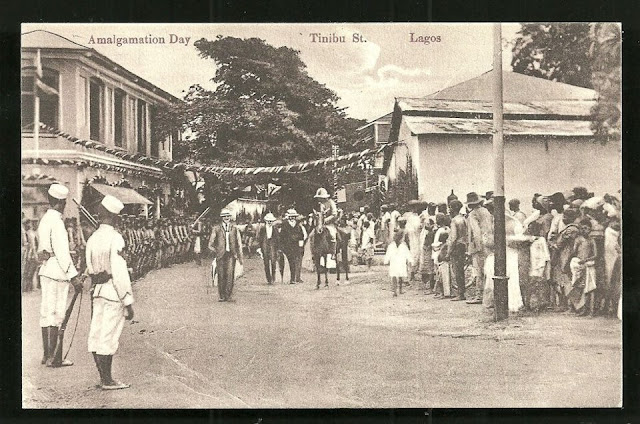
Amalgamation Day in Lagos, 1914
12 November, 2011


09 November, 2011


03 October, 2011
On the Economy
THE GOOD
The Nigerian middle-class is growing demographically, expanding to make up 23% of the population according to Business Day. It is also getting wealthier, incomes rising in tune with the growth in the GDP.
Some of you, particularly those who live "abroad" may have done the Naira-to-Dollar conversion on Business Day's figures, and might be thinking this is not a lot of money we are talking about. But you would be missing the point if you did that. Let me put it this way, read the millions of articles praising places like Brazil, China and India for cutting poverty and growing their middle-class, and you will find that these are exactly the income numbers they used to make the optimistic case for the improvement in social welfare in those economies.
We Nigerians are an entrepreneurial people. As we say in pidgin, e go betta.
THE INTERESTING
Read this interview of Alhaji Sani Aminu Dutsinma, published by Daily Trust. He discusses non-interest banking, avoiding the sensationalism surrounding Sanusi Lamido Sanusi's move to establish guidelines for the establishment of non-interest banking institutions, and providing real information about what exactly is being proposed.
THE WORRYING
There is a difference between capitalism and the sort of the sort of thing that happens when business moguls and politicians collaborate to transfer publicly-owned de facto monopolies into private hands.
Why is the Securities and Exchange Commission in such a rush to "demutualize" (euphemism for "privatize") the Nigerian Stock Exchange? If ex-President Olusegun Obasanjo was still in office, I would have predicted they would "sell" it to Transcorp.
As near as I can tell, the current "Mutual" structure does not mean it is owned by government, rather that it is "owned" (sort of) by the members of the Stock Exchange (i.e. by anyone with trading rights on the Exchange).
I suppose the SEC would justify their move by pointing to the fact that many of the world's biggest stock exchanges demutualized in the last 20 years. We Africans like copying whatever we see other people doing, even if it is not relevant to our situation.
But more importantly, the demutualization of the world's major stock markets was one of several key parts of the process that led to the Great Recession, the global economic crisis of the last four years. It is not a good idea, no matter what doctrinaire ideologues might tell you.
THE UNCLEAR
It is probably the fault of the journalist who wrote this article, or maybe of the editor who published it. But you can make up your own mind after you read this report of a press conference held by Finance Minister Ngozi Okonjo-Iweala at the conclusion of the IMF and World Bank Annual Meetings.
To me, it seems to say a lot without saying anything. If she was quoted properly, she does seem to be laying all our problems at the door of the IMF, IFC and World Bank (and China), seemingly in the (unrealistic) hope that they will solve the problems for us. On the other hand, she was being asked about the IMF and World Bank Annual Meetings, so maybe she was just focusing on what those multilateral bodies could do for us. And on the third hand, she is career World Bank bureaucrat, who probably thinks that the road to Promised Land runs through the Bretton Woods.
The Nigerian middle-class is growing demographically, expanding to make up 23% of the population according to Business Day. It is also getting wealthier, incomes rising in tune with the growth in the GDP.
Some of you, particularly those who live "abroad" may have done the Naira-to-Dollar conversion on Business Day's figures, and might be thinking this is not a lot of money we are talking about. But you would be missing the point if you did that. Let me put it this way, read the millions of articles praising places like Brazil, China and India for cutting poverty and growing their middle-class, and you will find that these are exactly the income numbers they used to make the optimistic case for the improvement in social welfare in those economies.
We Nigerians are an entrepreneurial people. As we say in pidgin, e go betta.
THE INTERESTING
Read this interview of Alhaji Sani Aminu Dutsinma, published by Daily Trust. He discusses non-interest banking, avoiding the sensationalism surrounding Sanusi Lamido Sanusi's move to establish guidelines for the establishment of non-interest banking institutions, and providing real information about what exactly is being proposed.
THE WORRYING
There is a difference between capitalism and the sort of the sort of thing that happens when business moguls and politicians collaborate to transfer publicly-owned de facto monopolies into private hands.
Why is the Securities and Exchange Commission in such a rush to "demutualize" (euphemism for "privatize") the Nigerian Stock Exchange? If ex-President Olusegun Obasanjo was still in office, I would have predicted they would "sell" it to Transcorp.
As near as I can tell, the current "Mutual" structure does not mean it is owned by government, rather that it is "owned" (sort of) by the members of the Stock Exchange (i.e. by anyone with trading rights on the Exchange).
I suppose the SEC would justify their move by pointing to the fact that many of the world's biggest stock exchanges demutualized in the last 20 years. We Africans like copying whatever we see other people doing, even if it is not relevant to our situation.
But more importantly, the demutualization of the world's major stock markets was one of several key parts of the process that led to the Great Recession, the global economic crisis of the last four years. It is not a good idea, no matter what doctrinaire ideologues might tell you.
THE UNCLEAR
It is probably the fault of the journalist who wrote this article, or maybe of the editor who published it. But you can make up your own mind after you read this report of a press conference held by Finance Minister Ngozi Okonjo-Iweala at the conclusion of the IMF and World Bank Annual Meetings.
To me, it seems to say a lot without saying anything. If she was quoted properly, she does seem to be laying all our problems at the door of the IMF, IFC and World Bank (and China), seemingly in the (unrealistic) hope that they will solve the problems for us. On the other hand, she was being asked about the IMF and World Bank Annual Meetings, so maybe she was just focusing on what those multilateral bodies could do for us. And on the third hand, she is career World Bank bureaucrat, who probably thinks that the road to Promised Land runs through the Bretton Woods.
02 October, 2011
Good news on the banking front
It appears the long-running banking industry bailout and restructuring programmes are on the road to success. And the good news seems to have lifted the stock market.
29 September, 2011
Troubling data from our prisons
‘74% of prison inmates un-convicted’
About 35,000 (representing about 74 per cent) of the over 48,000 inmates languishing in Nigerian prisoners are un-convicted while majority had spent years in jail before their trial commenced, a rights group has said.
The Legal Officer, African Program of Open Society Justice Initiative Professor Chidi Odinkalu made the remarks yesterday at a press conference organized by the Rights Enforcement and Public Law Centre (REPLACE) in Abuja.
I wonder if these statistics are true. I do not trust the government's numbers, but I am just as dubious of numbers introduced by NGOs and multilateral agencies. It is quite unfortunate because accurate statistics are vital for economic planning.
It would not be so bad if the government were using real statistics in its internal planning while feeding we the people rosy-but-fake statistics. Unfortunately, I fear our government deceives itself every bit as much as it deceives us.
As for the NGOs and multilateral agencies, lets just say that I am continuously amazed at their ability to project population (and health, education, etc) figures for Nigeria when we have never had a fully credible census at any point in our history.
Nonetheless, this NGO, the Rights Enforcement and Public Law Centre, makes a very important point. It doesn't matter if the "real" percentage is 74 or 54 or 94, the truth is the majority of citizens languishing in our prisons have not been convicted of anything. And many of them, who might actually be innocent, end up serving more time awaiting trial than they would have been sentenced to if they had been found guilty.
27 September, 2011
Inland Waterways to become Inland Superhighways
Dredging of the River Niger from Baro to the coast is mostly complete. The Federal Government has insisted from time to time since July that there are plans to dredge the River Benue as well. It is apparently part of the Ministry of Transportations "Nigerian Transportation Masterplan"
The dredging of the two major rivers is part of a drive to use the inland waterways as commercial corridors, as shown in the map below (click to enlarge):
 [Disclosure: I got the map from the Nigeria pages of SkyscraperCity, though I can't recall which specific thread I got it from]
The dredging of the two major rivers is part of a drive to use the inland waterways as commercial corridors, as shown in the map below (click to enlarge):

15 September, 2011
Business Day's Asuquo EB on recurring crises in Jos

08 September, 2011
Scapegoating "non-indigenes"
Governor Theodore Orji of Abia has just been criticized for "disengaging" (i.i. sacking) non-indigenes in the Abia State Civil Service.
Governor Fashola of Lagos State "deported" (as though they were citizens of a foreign country) 3,029 non-indigene "beggars" to their "states of origin". (If you don't trust The Nation, here is a link from NEXT).
This sort of thing has happened frequently over the decades, in every state. For the most part, you cannot predict when a state governor will whip out the "scapegoat non-indigenes" card, except when new states are created from old states; the tendency is for the old state to sack all indigenes of the new state who remain in what had until recently been a shared state bureaucracy.
I complain rather frequently that not much discourse or debate occurs before policy is implemented in Nigeria. But it is not just a before-the-fact problem, it is an after-the-fact problem too. We go around in circles on issues (for example electricity) not simply because not much thought went into the policy in the first place, but because after the policy has failed nobody really gives much thought to why it failed. The popular thing is to classify the failure as being the result of "corruption" or "the Nigerian factor" or blame whichever region/ethnicity/religion of the country we do not belong to, blah, blah, blah.
Then a few months or years pass, and we do the same thing again, with the usual fanfare (and lack of discourse and debate), only be be shocked, shocked I tell you, when the thing doesn't work as well as promised.
Let me ask a question.
What was the effect on important statistics (e.g. unemployment, poverty, crime rate, etc) of sacking non-indigenes from your state civil service or deporting "non-indigene" beggars to their states of origin?
I don't just mean in the present instance (Orji and Fashola) but historically. Our states have done things like this so many times that we have (or should have) built up more than enough data to make an empirical, peer-reviewable set of findings on the efficacy of scapegoating non-indigenes in the name of serving indigenes.
Do you know of any studies of said effects?
I don't.
Yet our states keep doing it.
I am not going to pretend that I have the hard data. Nobody does, because far too many people don't care, and the few of us who do (me, for example) can have no access to the data because none of our state (or federal or local) governments keeps any such data. If you ask them, they will insist that the programme had fantastic and wonderful effects ... but then our governments lie to us so unabashedly that it has actually become counterproductive for them, in the sense that nobody in Nigeria really believes the government even when the government is telling the truth (assuming they ever do).
So no, I won't pretend to have the data.
But using my ordinary human powers of observation, it occurs to me that scapegoating non-indigenes has NO EFFECT WHATSOEVER on the welfare of indigenes. It is not that it makes their lives worse or makes their lives better, it is that IT HAS NO EFFECT.
It is cruelty for cruelty's sake.
The political/economic powers-that-be and leaders of thought, rather than admit they have no idea how to improve their state, distract and misdirect people by labeling non-indigenes as the source of the state's problems. Getting rid of the "foreigners" (their Nigerian citizenship counting for nothing) is portrayed as the only solution available to the "Action Governor", who duly take action.
In the warped world of our public discourse, this actually garners them popularity from a section of their state's population; lets face it, human beings in general are rather prone to this type of argument. Indeed, the saddest part of the saga is that those sacked or deported are the lucky ones; the unlucky ones become the targets of violent mobs of unemployed, unemployable, destitute youths who see what possessions the non-indigenes have as having been taken at the expense of "sons of the soil" like themselves.
On a different but similar note ....
Former FCT Minister Nasir El-Rufai rendered as many as (or more than) 800,000 people homeless by bulldozing their dwellings in and around Abuja. According to him, "Abuja is not for everyone," by which he meant the Capital City of the Federal Republic was not meant for the poor. It was not built for poor economic migrants, people El-Rufai thought should go back to their states of origin instead of messing up his shiny-shiny Abuja with their dishevelled presence. The people who should have questioned El-Rufai, be they legislators or the Nigerian commentariat, were full of praise for him for trying to reimpose the outdated, obsolete, unrealistic-from-day-one Abuja "masterplan".
But seriously, does anyone think that any amount of bulldozing will stop poor people from migrating to Abuja? And does anyone think the high cost of accommodation in the city won't inspire the creation of "informal" settlements?
If you don't masterplan for poor people showing up, that won't stop poor people from showing up. Why was there no debate and no discussion of replacing the unrealistic masterplan with a new one that took REALITY into consideration?
I just don't understand how and why it is politically and socially acceptable to try to deport Nigerians from Abuja or any other state in which they live. Because that is all they are doing ... trying.
Eventually, the people return, and in bigger numbers.
You can adapt your development planning model (assuming any exists) to reflect rational and realistic expectations in terms of the influx of economic migrants, or you can continue trying to deceive people that you are doing something by harassing, discriminating against and or deporting non-indigenes.
Governor Fashola of Lagos State "deported" (as though they were citizens of a foreign country) 3,029 non-indigene "beggars" to their "states of origin". (If you don't trust The Nation, here is a link from NEXT).
This sort of thing has happened frequently over the decades, in every state. For the most part, you cannot predict when a state governor will whip out the "scapegoat non-indigenes" card, except when new states are created from old states; the tendency is for the old state to sack all indigenes of the new state who remain in what had until recently been a shared state bureaucracy.
I complain rather frequently that not much discourse or debate occurs before policy is implemented in Nigeria. But it is not just a before-the-fact problem, it is an after-the-fact problem too. We go around in circles on issues (for example electricity) not simply because not much thought went into the policy in the first place, but because after the policy has failed nobody really gives much thought to why it failed. The popular thing is to classify the failure as being the result of "corruption" or "the Nigerian factor" or blame whichever region/ethnicity/religion of the country we do not belong to, blah, blah, blah.
Then a few months or years pass, and we do the same thing again, with the usual fanfare (and lack of discourse and debate), only be be shocked, shocked I tell you, when the thing doesn't work as well as promised.
Let me ask a question.
What was the effect on important statistics (e.g. unemployment, poverty, crime rate, etc) of sacking non-indigenes from your state civil service or deporting "non-indigene" beggars to their states of origin?
I don't just mean in the present instance (Orji and Fashola) but historically. Our states have done things like this so many times that we have (or should have) built up more than enough data to make an empirical, peer-reviewable set of findings on the efficacy of scapegoating non-indigenes in the name of serving indigenes.
Do you know of any studies of said effects?
I don't.
Yet our states keep doing it.
I am not going to pretend that I have the hard data. Nobody does, because far too many people don't care, and the few of us who do (me, for example) can have no access to the data because none of our state (or federal or local) governments keeps any such data. If you ask them, they will insist that the programme had fantastic and wonderful effects ... but then our governments lie to us so unabashedly that it has actually become counterproductive for them, in the sense that nobody in Nigeria really believes the government even when the government is telling the truth (assuming they ever do).
So no, I won't pretend to have the data.
But using my ordinary human powers of observation, it occurs to me that scapegoating non-indigenes has NO EFFECT WHATSOEVER on the welfare of indigenes. It is not that it makes their lives worse or makes their lives better, it is that IT HAS NO EFFECT.
It is cruelty for cruelty's sake.
The political/economic powers-that-be and leaders of thought, rather than admit they have no idea how to improve their state, distract and misdirect people by labeling non-indigenes as the source of the state's problems. Getting rid of the "foreigners" (their Nigerian citizenship counting for nothing) is portrayed as the only solution available to the "Action Governor", who duly take action.
In the warped world of our public discourse, this actually garners them popularity from a section of their state's population; lets face it, human beings in general are rather prone to this type of argument. Indeed, the saddest part of the saga is that those sacked or deported are the lucky ones; the unlucky ones become the targets of violent mobs of unemployed, unemployable, destitute youths who see what possessions the non-indigenes have as having been taken at the expense of "sons of the soil" like themselves.
On a different but similar note ....
Former FCT Minister Nasir El-Rufai rendered as many as (or more than) 800,000 people homeless by bulldozing their dwellings in and around Abuja. According to him, "Abuja is not for everyone," by which he meant the Capital City of the Federal Republic was not meant for the poor. It was not built for poor economic migrants, people El-Rufai thought should go back to their states of origin instead of messing up his shiny-shiny Abuja with their dishevelled presence. The people who should have questioned El-Rufai, be they legislators or the Nigerian commentariat, were full of praise for him for trying to reimpose the outdated, obsolete, unrealistic-from-day-one Abuja "masterplan".
But seriously, does anyone think that any amount of bulldozing will stop poor people from migrating to Abuja? And does anyone think the high cost of accommodation in the city won't inspire the creation of "informal" settlements?
If you don't masterplan for poor people showing up, that won't stop poor people from showing up. Why was there no debate and no discussion of replacing the unrealistic masterplan with a new one that took REALITY into consideration?
I just don't understand how and why it is politically and socially acceptable to try to deport Nigerians from Abuja or any other state in which they live. Because that is all they are doing ... trying.
Eventually, the people return, and in bigger numbers.
You can adapt your development planning model (assuming any exists) to reflect rational and realistic expectations in terms of the influx of economic migrants, or you can continue trying to deceive people that you are doing something by harassing, discriminating against and or deporting non-indigenes.
08 August, 2011
Central Bank
You've probably heard by now that the Central Bank of Nigeria, the National Deposit Insurance Corporation and the Asset Management Company have "nationalized" four banks.
I've been an advocate of forthrightly and determinedly fixing the mess in our banking industry ... but I hope someone, somewhere is keeping a tally of the cost. We've spent billions so far, and it looks like we will spend billions more.
I am on record, on this blog, as saying the Federal Republic could probably afford to spend $10 billion (=N=1.5 trillion). At the time, this seems the most trustworthy estimate for the amount of "toxic assets" on our banks' books. This being Nigeria, I am not sure what we have spent so far; I would like to know if we have breached the $10 billion barrier -- because if we have, my opinion on the continued bailout will change.
In other Central Bank news, Sanusi Lamido Sanusi, the Central Bank Governor, wants =N=2 trillion in pension funding unlocked so it can be used as capital to finance infrastructure projects.
Let me choose my words correctly.
The thing about Sanusi is he is a politicians masquerading as a Central Banker. Wait, wait, before you get the wrong idea, I mean it in the best way possible.
When he was first appointed to head the CBN, I was happy about the appointment.
Most public figures in Nigeria are "blank"; as a citizen, you have no idea what is in their mind. We shouldn't be surprised, because most of them don't have anything in their mind beyond the acquisition of money, power, women or some combination of the aforementioned. I am frequently dismayed by the realization that people in positions of economic and political power do not seem to have spent so much as one second thinking deeply about the issues.
When they are forced to express an opinion, they just regurgitate, as though it were fact, one of several colloquial assumptions that float around in Nigerian public discourse. The decisions we make, and actions we take, based on these assumptions have generally led us down the wrong path. Yet, no one ever truly interrogates these assumptions, or subjects them to empirical analysis.
Sanusi, on the other hand, was someone for whom I could say I had some idea of what his thought-out opinions were on the issues. I had been reading his essays and transcribed speeches for years before his CBN appointment. Sometimes I agreed with him, sometimes I did not, but you could always tell that he was thinking and not simply regurgitating.
He always sounded like a politician (hence my comment above, which was meant, as I say, in the best possible sense). He never, too my knowledge, wrote about the intricacies of the banking system or of national/continental/global finance. It was mostly sociopolitical and sociocultural commentary, and his comments on economic issues were less the data projections of a banker and more the talk of a politician advocating a development agenda.
Thus, I am not surprised that Sanusi has been using his CBN position to interject himself in economic policy areas that lie outside the constitutional remit of a Central Bank governor.
He has intervened in the Agricultural industry. He has intervened in the Electricity industry. And he is intervening in Infrastructure. And while I am still for the most part supportive of his interventions in the Banking/Insurance/Finance sector, I will be honest and tell you that I think some of his actions should have been policy decisions of the federal executive and legislature in tandem ... and not the decision of a single man.
I'd like to say that Central Bank governors are not elected, and that certain kinds of decisions are appropriately left to branches of the government that are elected ... but it is a difficult argument to make when those branches of government are intellectually moribund. Whatever is "constitutionally" proper, the unfortunate "practical" reality is if Sanusi waits for the Aso Rock and the Assembly to generate/initiate and legislate/approve strategically necessary initiatives, he (and we the people) will be waiting forever.
But this, ironically, is my problem with Sanusi's desire to unlock the pension funds for the purpose of infrastructure investment.
Entities like the IMF and World Bank are wrong when they say we should make the investment environment suitable for "foreign investors".
Our strategic priority is, was, and will always be making the investment environment suitable for domestic investment. Nigeria will not be saved or transformed by outside investors; if anything those foreign investors will only arrive in bulk to join in chopping after we Nigerians have already done all of the heavy lifting of economic transformation.
As such, it would of major benefit if we could unlock pension funds for investment in capital infrastructure.
The problem is Nigeria's political, constitutional, legal and policy framework are ... problematic. The way we handle major infrastructural projects, even in supposed showcase states like Lagos, is ... problematic. Our regulatory framework is ... problematic. Our law (and contract) enforcement is .... problematic. Our system of documentation and data-gathering has produced a country that thinks all of its football players are over-aged, and that doubts every Census that has ever been held.
In fact, Sanusi knows the environment is problematic. If he didn't, he wouldn't be trying so hard, and so often to bypass the Federal Government and essentially dictate Nigerian development policy from his perch at the Central Bank. Everything that Sanusi does is a loud announcement of his lack of confidence not only in the executive and legislature, but in the judiciary too. Heck, Sanusi has become the judge, jury and .... the man who sacks errant bank bosses who should probably be behind bars.
Do we really want to pour our PENSION funds into such an environment?
George W. Bush, the ex-president of the United States, suggested investing his country's pension assets in the stock market. Had his plan succeeded, the US social security fund would have taken a massive hit. Yes, this is a simplification of what Bush planned, I know, but you get why I am concerned.
We shouldn't put the cart before the horse.
Reforms first. Investment later. Without the reforms, the investment will likely be wasted.
Sanusi should have run for President. And he and his allies should have built a multi-ethnic political faction to fill enough Assembly seats and state governor's mansions to put a reform agenda squarely in practice ... as a prelude to subsequent massive investment in infrastructure.
PS: It has not escaped my attention that the =N=2 trillion that Sanusi is seeking to unlock for Infrastructure is roughly equivalent (when converted) to the $12 billion that Nigeria gifted the Paris Club in exchange for what was called debt cancellation. I have argued (in less detail on this blog; in greater detail elsewhere) that Nigeria would have been better off spending that money on Infrastructure, using it to leverage even more investment than the $12 billion corpus. Alas, in Nigerian "democracy" there is no real debate about issues; things just happen without anybody inquiring empirically as to whether there is a better thing we could have done with the resources. Say to anyone, "but this is a waste", and they will say to you "Well, if they didn't spend it on XYZ, it just would have been stolen anyway." Which says a lot. All said and done, Nigeria borrowed something like $19 billion from the Paris Club, but paid the Paris Club something between $55 billion and $60 billion -- this being Nigeria, the exact numbers are unclear.
I've been an advocate of forthrightly and determinedly fixing the mess in our banking industry ... but I hope someone, somewhere is keeping a tally of the cost. We've spent billions so far, and it looks like we will spend billions more.
I am on record, on this blog, as saying the Federal Republic could probably afford to spend $10 billion (=N=1.5 trillion). At the time, this seems the most trustworthy estimate for the amount of "toxic assets" on our banks' books. This being Nigeria, I am not sure what we have spent so far; I would like to know if we have breached the $10 billion barrier -- because if we have, my opinion on the continued bailout will change.
In other Central Bank news, Sanusi Lamido Sanusi, the Central Bank Governor, wants =N=2 trillion in pension funding unlocked so it can be used as capital to finance infrastructure projects.
Let me choose my words correctly.
The thing about Sanusi is he is a politicians masquerading as a Central Banker. Wait, wait, before you get the wrong idea, I mean it in the best way possible.
When he was first appointed to head the CBN, I was happy about the appointment.
Most public figures in Nigeria are "blank"; as a citizen, you have no idea what is in their mind. We shouldn't be surprised, because most of them don't have anything in their mind beyond the acquisition of money, power, women or some combination of the aforementioned. I am frequently dismayed by the realization that people in positions of economic and political power do not seem to have spent so much as one second thinking deeply about the issues.
When they are forced to express an opinion, they just regurgitate, as though it were fact, one of several colloquial assumptions that float around in Nigerian public discourse. The decisions we make, and actions we take, based on these assumptions have generally led us down the wrong path. Yet, no one ever truly interrogates these assumptions, or subjects them to empirical analysis.
Sanusi, on the other hand, was someone for whom I could say I had some idea of what his thought-out opinions were on the issues. I had been reading his essays and transcribed speeches for years before his CBN appointment. Sometimes I agreed with him, sometimes I did not, but you could always tell that he was thinking and not simply regurgitating.
He always sounded like a politician (hence my comment above, which was meant, as I say, in the best possible sense). He never, too my knowledge, wrote about the intricacies of the banking system or of national/continental/global finance. It was mostly sociopolitical and sociocultural commentary, and his comments on economic issues were less the data projections of a banker and more the talk of a politician advocating a development agenda.
Thus, I am not surprised that Sanusi has been using his CBN position to interject himself in economic policy areas that lie outside the constitutional remit of a Central Bank governor.
He has intervened in the Agricultural industry. He has intervened in the Electricity industry. And he is intervening in Infrastructure. And while I am still for the most part supportive of his interventions in the Banking/Insurance/Finance sector, I will be honest and tell you that I think some of his actions should have been policy decisions of the federal executive and legislature in tandem ... and not the decision of a single man.
I'd like to say that Central Bank governors are not elected, and that certain kinds of decisions are appropriately left to branches of the government that are elected ... but it is a difficult argument to make when those branches of government are intellectually moribund. Whatever is "constitutionally" proper, the unfortunate "practical" reality is if Sanusi waits for the Aso Rock and the Assembly to generate/initiate and legislate/approve strategically necessary initiatives, he (and we the people) will be waiting forever.
But this, ironically, is my problem with Sanusi's desire to unlock the pension funds for the purpose of infrastructure investment.
Entities like the IMF and World Bank are wrong when they say we should make the investment environment suitable for "foreign investors".
Our strategic priority is, was, and will always be making the investment environment suitable for domestic investment. Nigeria will not be saved or transformed by outside investors; if anything those foreign investors will only arrive in bulk to join in chopping after we Nigerians have already done all of the heavy lifting of economic transformation.
As such, it would of major benefit if we could unlock pension funds for investment in capital infrastructure.
The problem is Nigeria's political, constitutional, legal and policy framework are ... problematic. The way we handle major infrastructural projects, even in supposed showcase states like Lagos, is ... problematic. Our regulatory framework is ... problematic. Our law (and contract) enforcement is .... problematic. Our system of documentation and data-gathering has produced a country that thinks all of its football players are over-aged, and that doubts every Census that has ever been held.
In fact, Sanusi knows the environment is problematic. If he didn't, he wouldn't be trying so hard, and so often to bypass the Federal Government and essentially dictate Nigerian development policy from his perch at the Central Bank. Everything that Sanusi does is a loud announcement of his lack of confidence not only in the executive and legislature, but in the judiciary too. Heck, Sanusi has become the judge, jury and .... the man who sacks errant bank bosses who should probably be behind bars.
Do we really want to pour our PENSION funds into such an environment?
George W. Bush, the ex-president of the United States, suggested investing his country's pension assets in the stock market. Had his plan succeeded, the US social security fund would have taken a massive hit. Yes, this is a simplification of what Bush planned, I know, but you get why I am concerned.
We shouldn't put the cart before the horse.
Reforms first. Investment later. Without the reforms, the investment will likely be wasted.
Sanusi should have run for President. And he and his allies should have built a multi-ethnic political faction to fill enough Assembly seats and state governor's mansions to put a reform agenda squarely in practice ... as a prelude to subsequent massive investment in infrastructure.
PS: It has not escaped my attention that the =N=2 trillion that Sanusi is seeking to unlock for Infrastructure is roughly equivalent (when converted) to the $12 billion that Nigeria gifted the Paris Club in exchange for what was called debt cancellation. I have argued (in less detail on this blog; in greater detail elsewhere) that Nigeria would have been better off spending that money on Infrastructure, using it to leverage even more investment than the $12 billion corpus. Alas, in Nigerian "democracy" there is no real debate about issues; things just happen without anybody inquiring empirically as to whether there is a better thing we could have done with the resources. Say to anyone, "but this is a waste", and they will say to you "Well, if they didn't spend it on XYZ, it just would have been stolen anyway." Which says a lot. All said and done, Nigeria borrowed something like $19 billion from the Paris Club, but paid the Paris Club something between $55 billion and $60 billion -- this being Nigeria, the exact numbers are unclear.
Asuquo E.B.

This image is culled from BUSINESS DAY.

I am a daily reader of the excellent newspaper Business Day. For the record, they have paid me nothing for the "endorsement".
Nor have I received anything for telling you this: "Asuquo E.B.", their resident editorial cartoonist, is quite good at his craft. His jabs are pithy and well-directed 98% of the time.
Per the other 2%, well, he did something I don't think anyone in his position should do -- he took sides during the 2011 Presidential Election. He is a citizen, fully entitled to cast his vote for the candidate of his choice, but there is a difference between a satirist and a political propagandist, and Asuquo's election-season bias affected his work.
Still, no two people agree on everything all the time.
I look forward to enjoying Asuquo E.B.'s work for years to come.
And just in case anyone is wondering, I am NOT opposed to interest-free banking (a.k.a. "Islamic Banking"). We should do whatever it takes to bring the majority of Nigerians into the banking system. Indeed, we should forget about what other countries do or do not do and stop trying to mimic Europe, North America or West Asia (a.k.a. the "Middle East"). A proper banking system suited to the environment of Nigeria would be a mix of forms that are otherwise considered "formal", "informal", and "traditional". Somehow, we have to draw it all together into a larger, stronger whole. And if the introduction of interest-free banking will spur on a deepening of the capital market in parts of the country that are currently "under-banked", then I am all for it.
Subscribe to:
Posts (Atom)