It has six months and two weeks since I started this blog, and in that half-year, I have probably written more posts on Nigeria's banking industry and financial markets than I have on anything else.
This 1st April post discussed the estimated $10 billion in toxic assets on the books of Nigerian banks. This number may or may not have been accurate. This Bloomberg article, quotes the Eurasia Group, researchers who help publish the Global Political Risk Index saying it is probably $10 billion, and also quotes Bank of America as saying Nigerian banks gave $6.8 billion in margin loans for borrowers to buy shares, but in this piece Bloomberg quotes Soludo saying the toxic assets figure was $5.3 billion in January.
The banks have been less than transparent in their information disclosures, and the more we learn, the more we doubt many of the Soludo-era Central Bank's statements on the banks and the financial and equity markets (Bode Agusto called it "voodoo accounting").
It subsequently proved difficult to ascertain if the government or the Central Bank was going to bail out the banks. I wrote this piece in reaction to a NEXT article that claimed Charles Soludo had spent =N=1 trillion (then worth $6.7 billion) to bail out the banks. I followed it up with this brief piece to link you to a statement from Soludo (quoted in Bloomberg) that Nigeria could not afford a bailout or a stimulus.
I have said frequently on this blog that the quality, quantity and substantive depth of information supply in Nigeria are problematic. It is difficult to identify and distinguish the truth; sometimes the truth is not even one of the information options you are restricted to choosing from.
The alleged $6.7 billion bailout was cited in a NEXT piece that was clearly designed to attack Charles Soludo. Now there are many things about Soludo's tenure that deserve criticism in retrospect (and other things that should have been criticized contemporaneously, but were not because the politico-economic discourse, much like information in general, is shallow, weak and frequently dishonest). But NEXT provided no proof of this bailout, and given recent happenings in the industry (more on that later) it is clear no bank had been bailed out as of the start of the Sanusi era at the CBN. It is okay to criticize someone without starting unproven rumours.
What is proven is the three tiers of Nigerian government (federal, state and local) were facing a potential need to borrow $11 billion to finance projected 2009 deficits (raising questions of whether the CBN-imposed interest rate ceiling was designed to allow the federal government to borrow at below-market rates from domestic banks as they had done in the past). And the Central Bank of Nigeria had expended $14 billion of our external reserves to defend the exchange value of the Naira to the Dollar in the six months from October 2008 to April 2009, dropping our reserves from just above $60 billion to under $47 billion.
So I am leaning towards believing that Soludo did not in fact bail out the banks. He did not perform his role as a regulator particularly well, but that is a different issue. A difficult issue too, as the banks, the CBN and the government have been less than forthcoming with truthful information over the last year-and-half.
Okay, having read through a digest version of six months of blog posts wondering why nothing concrete was being done (or even substantively discussed as a prelude to action) about the possibly $10 billion in toxic assets on our banks books, we now get to current events ....
Nearly a year after these "toxic" issues came to light (with the domestic stock market correction, the global credit crunch, and the dramatic fall in the price-per-barrel of crude oil), the still-relatively-new Sanusi Lamido Sanusi sacked the CEOs and executive directors of five of the 24 post-consolidation banks. These five banks are (allegedly) responsible for 40.81% of the banking sector’s total non-performing loans.
I prefer to speak in Naira terms. Becoming a massive exporter of crude oil has had many positive and negative impacts on our economy, and I suspect the dollarization of our mentality has something to do with our excessive reliance on crude exports. In a more natural economic setting, we'd probably be just as concerned (if not more so) with the CFA Franc, the SA Rand, the Maghreb dinar and the EA Shillings. Still, I started this process months ago talking about an estimated $10 billion in toxic assets, so I am going to stick to the dollar so we can keep things in a consistent context.
According to Sanusi, the five banks have a total loan portfolio of $17.5 billion, of which some $2.8 billion represents exposure to margin loans (money lent so borrowers can buy equity, too frequently shares from the bank issuing the loans), while exposure to the oil-and-gas sector (too frequently for the importation of refined fuel, an activity that was hit hard by the volatility in crude pricing and the lack of policy consistency from the Nigerian government) is estimated at $3.0 billion.
I am tempted to use the $5.8 billion figure for the five banks' total exposure to margin loans and oil-and-gas exposure, and the fact that the CBN said these five banks were responsible for 40% of all non-performing loans in the banking sector, to calculate the CBN figure for total toxic assets across all 24 post-consolidation banks. I won't because I have not seen any article where Sanusi specifically said that ALL of the $5.8 billion in loans were non-performing; the Central Bank has injected $2.6 billion in new capital into the five banks, but I have not seen them say anywhere that this will clear the problem.
I do not think they are planning on writing off all of the non-performing loans, because the Central Bank is bringing in other federal agencies (notably the Economic and Financial Crimes Commission) to help force the banks' debtors to pay back their loans. The CBN has published a list of the five banks' "non-performing" debtors. Some of the alleged debtors have refuted the CBN's allegations, arguing that their loans are in good standing, or that the amounts cited as owed are inaccurate, or that the CBN erred in naming them as directors of corporations they are not connected to. A few have threatened to sue, leading the CBN to release this statement, describing the document as being current at 31st May, 2009, indirectly admitting some of the information may no longer be current (but in standard Naija fashion, declined to admit error), and essentially promising revisions, corrections and (most intriguingly) additions as the audit of all of Nigeria's banks continues.
It is not an ideal or optimal way of doing things. One would rather there were civil lawsuits that would produce clear rulings on whether Loan XYZ was non-performing, that could then either force the adoption of a structured payment plan or authorize the seizure of assets subsequent to legally defined default. There are corporate heavyweights on the list that might not have liquid assets to pay back their loans, but do have other assets than could be seized to defray at least a portion of the debt -- the rest may have to be written off. Maybe in some way the process could establish a distinction between businessmen and bankers who are true entrepreneurs, and businessmen and bankers who exist only by virtue of exploiting the many loopholes in the Nigerian political and economic system. In other words, I wish this were more constitutional and legalistic, with a more systemic approach toward solving the toxic asset dillemma.
Then again, there is something to be said for shock therapy .... and in a land dominated by Big Men and Big Women, a federal republic where constitutionality and law are "options" not guarantees, perhaps the best way to compel Big Men and Big Women to act is to threaten them with the public embarassment of pointing out that the emperor is without clothing. Nothing is more important to Big People than the public perception that they are Big; the moment a Big Person starts to look Small, their rivals and potential competitors as well as the millions of Small people who apathetically concede power to you because of intimidation factor, all lose their fear. Many a Big Man brought low has been mocked, assaulted or even chased into exile by all the people who used to cringe at their feet.
There are some really Big names on the CBN list of "non-performing" debtors, and there is a possibility these men and women could react by pulling the considerable strings of their direct and indirect political power and influence. Yes, Sanusi has thrown down the gauntlet in a very public way, so if he is mysteriously sacked (or something else) there will be no scope for pretending it is not linked to his actions to clean up the banks. On the other hand, there is not a lot the broader public can do to stop the Big People from doing what they want; our elections are a sham so the politicians do not fear the loss of votes, and we the people are so divided by regional, religious, ethnic and other superficial differences, as well as by pervasive mutual distrust, that we are so much more likely to ignore or oppose any attempt to create a fist out of our weak fingers.
Still, Sanusi's move is something of a quiet politico-economic earthquake, and the people of the federal republic are watching with interest as the battle unfolds.
The Central Bank are currently auditing all of the banks (with rumours that more bank CEOs and directors face the sack). The pressure is on the banks to improve the accuracy of their reporting or face the consequences. In terms of the five banks sanctioned and bailed-out so far, I have not seen any article where the CBN says whether or not the $11.7 billion non-margin, non-oil-and-gas balance of the five banks' collective loan portfolio of $17.5 billion is "performing". Perhaps they should say something about that.
But Sanusi has a lot on his plate right now.
Responding to speculation that the $2.6 billion injection of capital represented a federal takeover of the five banks (a "nationalization" so to speak) Sanusi made clear that this was a temporary measure. The CBN will be seeking investors, local and foreign, to come in to take over the banks as soon as possible.
I trust him on this because it is consistent with other things he has said since taking over the CBN governorship (and with things he has said and written in the years before his new appointment). Not long after taking the apex CBN job, Sanusi signalled his intention to raise the ceiling on the percentage of Nigerian banks that can be owned by foreign investors. I wrote this blog post examining the different dimensions of the move; in there is a paragraph where I recognize that Sanusi was planning to use foreign investment to provide the capital to "dissolve" our relatively small (in global terms) $10 billion toxic asset issue. Even then Sanusi must have been planning temporary federal bail-outs as a prelude to what he hopes will be increased foreign investment in the sector.
Sanusi has been pushing strongly for the banks to improve their transparency and their honesty in financial reporting. I believe these reforms (and others he plans or is already carrying out) are designed to make the sector much more attractive to investors, while strengthening Nigeria's financial markets (and the Nigerian Stock Exchange). I have mixed feelings about foreign banks owning majority stakes in Nigerian banks (concerns I discussed in that blog post), but I can understand the thinking behind a plan to attract a relatively paltry $10 billion (or more) from global markets to solve the problem and open the door to bigger opportunities. I must have written half-a-dozen or so blog posts that directly or indirectly discussed the growing footprint of Nigerian banks across the entire African continent -- perhaps this is a necessary step, the next stage of the financial revolution. Time will tell.
Sanusi has also repeated assurances given earlier by his predecessor Charles Soludo, that no Nigerian bank will be allowed to fail. The CBN has also guaranteed "all foreign loans and correspondent banking lines of the 5 banks".
Significantly Sanusi has also echoed Soludo's view that the Nigerian banking sector will have to go through a second round of consolidation; Soludo wanted bigger banks (the quest for them defined his tenure) while Sanusi has said further consolidation was likely. In responding to suspicions the five banks had been nationalized, Sanusi said "investors, local and foreign,", then specifically added "banks, local and foreign" would be allowed to open discussions with the Central Bank about taking over the five sanctioned and bailed-out banks. I do not think the CBN would be opposed to bigger Nigerian banks absorbing the smaller ones, nor opposed to bigger foreign banks taking stakes in those bigger Nigerian banks.
In this way Sanusi continues, while refining, the best of Soludo, but is (so far anyway) careful to avoid Soludo's mistakes. It might seem a little chaotic in the present day, but I think the future of Nigerian banking is bright. Hopefully, the Fashola/Tinubu "Eko Atlantic City" project and the rest of their "Mega-city" projects come to fruition, and Lagos City and State take the stage as the continent's premier financial centre.
Of course we have many more bridges to cross .... but we will get there.
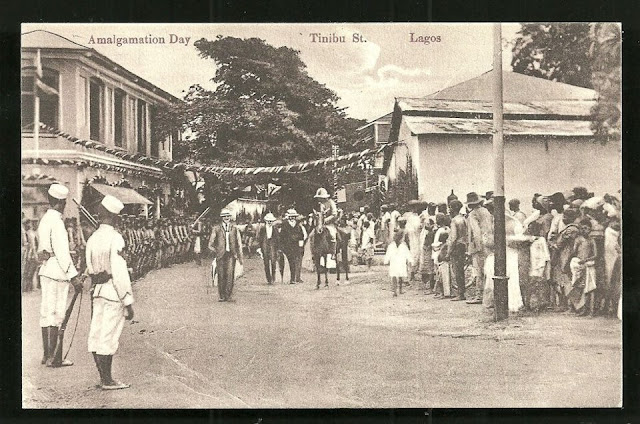
Amalgamation Day in Lagos, 1914
23 August, 2009


22 August, 2009

09 August, 2009
Healthcare and the Political Discourse
First the good news.
The federal Minister of Health just commissioned a fantastic new ₦100 million accident and emergency spill over ward, expanding the facilities at the Lagos University Teaching Hospital (LUTH).
Alas, the Minister went a step further to promise that pregnant women and children below five years would henceforth get free medical treatment in Nigeria. He assured his listeners that the federal government was providing the states with enough funds to make this happen.
Every one of our federal and state governments over the decades have made promises like this. The promise of uninterrupted electricity supply is perhaps the most famously repeated of them.
What we need in our political discourse is a mature discussion of what we are going to do, and of how we are going to do it.
The minister needs to tell us (a) how many pregnant women and children under five are treated in the hospitals every year; (b) how many are unable to go to hospitals, particularly in the severely under-served north-western and north-eastern parts of the country; (c) what it will cost to give them all free and accessible healthcare; and (d) how much money the federal government has given the states, so we can see if it matches the financial need thus established.
If the government does not give us this information, then university researcher should. We can't make decisions on things if we have nothing but empty rhetoric on which to decide.
Before you get on my case for "unnecessary negativity", read this story about healthcare in Benue State. The situation is not "good" in any part of the federal republic, but it is worse in some places than it is in others.
If we do not have the basic infrastructure of healthcare already set up, then even if we did allocate the necessary funding for "free" care to the states, there would be little or no capacity to put the funds to good use.
Adding the =N=100 million wing at LUTH is positive, but given the fact that we need to expand facilities and staffing all over the country before we can effectively start a "free" care programme, perhaps the Minister needs to handle that part of the equation first before promising something he knows he cannot deliver.
To be honest, the total budget (federal and state combined) for healthcare in Nigeria is TOO SMALL to expand facilities and staffing, or to pay for "free" care. And because our economy/GDP is too small relative to our population, and the combined federal and state budgets are consequently too small to fund public services for that population, I cannot see where the Minister is expecting to find the extra money for this.
Before you attack me for criticizing his "good intentions", remember that the paucity of funds has meant most "free" government programmes are never as "free" as advertized. The executives, ministers and technocrats usually continue using the word "free", even as the civil servants and administrators who actually deal directly with the public ensure that you cannot access the "free" service without paying one or other fee. It is not always about corruption; the doctors and nurses might insist on fees because their hospitals are under-funded and under-resourced to begin with, and would remain so even if you paid those fees.
Our political discourse is seriously limp. These are the sorts of issues that should be discussed aggresively.
There is always more than one side to an issue, and so long as we never debate which is the best way forward, we will continue to have sub-optimal outcomes.
I am still waiting for someone to ask whether it was wise to spend US$26 billion on cancelling our debt ($12 billion) and shoring up the value of the Naira ($14 billion between October, 2008 and April 2009), when our economy continues to suffer from a massive deficit in electricity generation.
Our debt-per-capita was never particularly large by global standards, but was only unmanageable because our GDP was too small (with effects on government revenues, and on broader societal welfare). With a bigger GDP, our required payments of $3 billion in interest would have been very manageable. But how do you grow your economy when you do not have sufficient electricity/energy/power?
Likewise a fall in the exchange value of the Naira relative to world currencies should have been a boon for export-oriented industries, if our economy was diversified and structured to take advantage of such opportunities. But our economy is incapable of taking such advantage, in large part because of structural weaknessess, perhaps the biggest of which is our MASSIVE ELECTRICITY DEFICIT! What the CBN saw in currency depreciation was a difficulty to IMPORT, and hence Professor Soludo poured billions into protecting the Naira.
There was a mini-Oil-Boom in the first decade of the 21st Century, a boomlet that expanded our currency reserves to over $60 billion. Of this sum, we have paid out $26 billion for debt cancellation and currency defense, only to find ourselves with a LOWER electricity output than we started with, and thus with less of an opportunity to defeat poverty and enshrine rapid growth.
I know it is not easy.
I am not saying I could have done better.
I am just saying our political discourse needs to improve, and our decision-making needs to be based on a higher quality of substantive information. We waste so much energy fighting each other over irrelevant rubbish, while important things just happened sub-optimally, with no one giving it much thought.
The federal Minister of Health just commissioned a fantastic new ₦100 million accident and emergency spill over ward, expanding the facilities at the Lagos University Teaching Hospital (LUTH).
Alas, the Minister went a step further to promise that pregnant women and children below five years would henceforth get free medical treatment in Nigeria. He assured his listeners that the federal government was providing the states with enough funds to make this happen.
Every one of our federal and state governments over the decades have made promises like this. The promise of uninterrupted electricity supply is perhaps the most famously repeated of them.
What we need in our political discourse is a mature discussion of what we are going to do, and of how we are going to do it.
The minister needs to tell us (a) how many pregnant women and children under five are treated in the hospitals every year; (b) how many are unable to go to hospitals, particularly in the severely under-served north-western and north-eastern parts of the country; (c) what it will cost to give them all free and accessible healthcare; and (d) how much money the federal government has given the states, so we can see if it matches the financial need thus established.
If the government does not give us this information, then university researcher should. We can't make decisions on things if we have nothing but empty rhetoric on which to decide.
Before you get on my case for "unnecessary negativity", read this story about healthcare in Benue State. The situation is not "good" in any part of the federal republic, but it is worse in some places than it is in others.
If we do not have the basic infrastructure of healthcare already set up, then even if we did allocate the necessary funding for "free" care to the states, there would be little or no capacity to put the funds to good use.
Adding the =N=100 million wing at LUTH is positive, but given the fact that we need to expand facilities and staffing all over the country before we can effectively start a "free" care programme, perhaps the Minister needs to handle that part of the equation first before promising something he knows he cannot deliver.
To be honest, the total budget (federal and state combined) for healthcare in Nigeria is TOO SMALL to expand facilities and staffing, or to pay for "free" care. And because our economy/GDP is too small relative to our population, and the combined federal and state budgets are consequently too small to fund public services for that population, I cannot see where the Minister is expecting to find the extra money for this.
Before you attack me for criticizing his "good intentions", remember that the paucity of funds has meant most "free" government programmes are never as "free" as advertized. The executives, ministers and technocrats usually continue using the word "free", even as the civil servants and administrators who actually deal directly with the public ensure that you cannot access the "free" service without paying one or other fee. It is not always about corruption; the doctors and nurses might insist on fees because their hospitals are under-funded and under-resourced to begin with, and would remain so even if you paid those fees.
Our political discourse is seriously limp. These are the sorts of issues that should be discussed aggresively.
There is always more than one side to an issue, and so long as we never debate which is the best way forward, we will continue to have sub-optimal outcomes.
I am still waiting for someone to ask whether it was wise to spend US$26 billion on cancelling our debt ($12 billion) and shoring up the value of the Naira ($14 billion between October, 2008 and April 2009), when our economy continues to suffer from a massive deficit in electricity generation.
Our debt-per-capita was never particularly large by global standards, but was only unmanageable because our GDP was too small (with effects on government revenues, and on broader societal welfare). With a bigger GDP, our required payments of $3 billion in interest would have been very manageable. But how do you grow your economy when you do not have sufficient electricity/energy/power?
Likewise a fall in the exchange value of the Naira relative to world currencies should have been a boon for export-oriented industries, if our economy was diversified and structured to take advantage of such opportunities. But our economy is incapable of taking such advantage, in large part because of structural weaknessess, perhaps the biggest of which is our MASSIVE ELECTRICITY DEFICIT! What the CBN saw in currency depreciation was a difficulty to IMPORT, and hence Professor Soludo poured billions into protecting the Naira.
There was a mini-Oil-Boom in the first decade of the 21st Century, a boomlet that expanded our currency reserves to over $60 billion. Of this sum, we have paid out $26 billion for debt cancellation and currency defense, only to find ourselves with a LOWER electricity output than we started with, and thus with less of an opportunity to defeat poverty and enshrine rapid growth.
I know it is not easy.
I am not saying I could have done better.
I am just saying our political discourse needs to improve, and our decision-making needs to be based on a higher quality of substantive information. We waste so much energy fighting each other over irrelevant rubbish, while important things just happened sub-optimally, with no one giving it much thought.
05 August, 2009
Without preparation and information we cannot be safe
The State Security Service claims it informed the Borno State government of the Boko Haram threat well in advance of the outbreak of violence. Addressing the House of Representatives, the SSS Director-General blamed politicians and "action agencies" for failing to act:
In the best of circumstances, it is difficult to tell when someone is lying. In Nigeria, there are no institutional structures to test and/or verify public statements and pronouncements.
I don't know if the State Security Service is telling the truth. The only thing we can know for sure are the visible outcomes of whatever it was that they did or did not do. We know of the extra-judicial killings because people took pictures and video and posted same to the internet.
Sometimes people in power are intentionally or unintentionally honest. We learned much about the true nature of Nigerian politics from men like the late Wada Nas, the late Lamidi Adedibu, Chris and Andy Uba, Arthur Nzeribe, and many others. What they do and did, deliberately and unintentionally, revealed to us the true method by which Nigeria is governed.
If the State Security Service had been monitoring this group, they would have had extensive records from their surveillance. Pictures and video of members, finger prints and DNA from objects "stolen" from there bases. They would have identified the sources of arms, and been in a position to interdict same.
The whole thing perhaps could have been less randomly violent, more judicial. There could have been live men in prisons awaiting trial, and not rows of bodies of men who may or may not have committed a capital crime or any crime at all.
During the ECOMOG wars in Liberia and Sierra Leone, our soldiers faced enemies that did not wear uniform. They could not even assume that children were non-combatants.
In Maiduguri, hundreds of devout, bearded Muslims rushed to completely shave off their beards.
A Daily Trust reporter was briefly detained at the height of the action:
The SSS says it provided the relevant governmental agencies and federal and state administrations with information sufficient to forestall the violence. The reality on the ground seems to suggest the army and police had very little in the way of information to guide what it was they were doing.
The one part of the SSS statement I believe where they suggest the politicians were reluctant to intervene to forestall violence.
Our political leaders are not pro-active in seeking peace, stability and security for the citizenry. When confronted by extremist groups, some of them try to use these groups for their own benefit -- to directly prop up their power, indirectly promote the mutual fear that keeps us citizens divided against each other, or to point to as a threat that might get out of control if they do not get their way in the negotiations for slices of the national cake. Other politicians talk and act in a way that makes you suspect they secretly admire militia groups and vigilantes.
The Armed Forces and the Nigerian Police Force are left to respond, when it is too late, to various outbreaks of communal, cult or gangster-related violence. And they are not given the equipment, the training or the information necessary. In recent fighting in the Niger-Delta, communities like Oporoza, Kunukunuma, Okerenkoko and Kurutie were reportedly destroyed with obvious results for the civilian population.
We are too quick to use our uniformed services as a blunt instrument to smash and flatten anything and everything.
The Nigerian Armed Forces and the Nigerian Police Force have vitally important jobs to do on behalf of we the citizens. During the colonial era, one could understand if the British did not want to give them the best of training, weaponry, strategic planning and indoctrination, because the last thing they wanted was a strong and effective army comprised almost entirely of Nigerians, with only a smattering of British officers at the top. If such an army had turned against the colonialists, "Nigeria" would have regained its self-government a lot sooner than 1960.
What I don't understand is why post-Independence Nigeria has failed to build the Armed Force, Police Force, and State Security agencies that we so desperately need in a frequently violent world. We have not given them the tools they need, we have not given them the strategic framework they needs, and we have certainly not given them the DOCTRINE they must have if they are to be our protectors rather than a group of armed men that we are all afraid of.
People are blaming Yar'Adua, but this is unfair. It has been nearly 50 years since we retook our country from the British, and across several administrations in that time, there has been no effort to reform, restructure and transform these vital federal republic's institutions. Yar'Adua inherited these problems from all of his predecessors. Granted he does not appear willing or able to fix the situation, but his predecessors were no better at it, and I doubt his successors will do any better.
We have lost billions of dollars to "bunkering" in the Niger-Delta. How is this possible? They keep telling us about the maze of creeks and waterways, and the many vulnerable kilometres of pipelines, and the "militants" abilities to attack barges on the high seas.
But what has that got to do with stopping bunkering?
In order to get the crude onto world markets, the bunkerers must take the stolen oil to oil tankers out in the ocean. Unlike Somali pirates who can go anywhere at any time, the oil tankers must come to Nigerian territorial waters to get their illegal crude supply. Our coast is not overly huge, nor are our territorial waters particularly vast. Oil tankers are slow, lumbering vessels, and there cannot possibly be that many of them involved in picking up bunkered oil as there amount being bunkered, while considerable, would not exactly fill a fleet of super-tankers.
Is it really so hard for the Air Force to pick them out from the sky? I don't mean attack them; OECD countries don't mind when their citizens steal other people's offshore fish, steal their crude oil, or deliver weapons to rebels, but will get quite angry if you attack there citizens extra-judicially. But at least we could identify them, sue them, name and shame them, or do something else to force them to stop coming to Nigeria to collect crude. If all else fails, the Air Force can spot them while NNS Aradu or some other vessels is stationed in the territorial waters to give chase once the Air Force gives the word.
If we do not have the equipment to do this, we can always pay the countries with spy satellites to give us constantly updated satellite imagery of our territorial waters, allowing us to spot which oil tanker shows up in our waters and just sits around without making for Bonny or Port Harcourt.
It is not like we have not done similar before.
In 2003 we captured and detained the MT African Pride, a Greek-owned ship with a Russian crew, some 31 miles off the Nigerian coast as it awaited delivery of bunkered crude. Sadly, two Nigerian Navy admirals were convicted, along with junior officers, of assisting the MT African Pride's escape from detention. Navy officers actually "escorted" the criminal vessel out of the harbour, and into the high seas, where it transferred its cargo of 30,000 barrels of crude to another ship, and then continued to the safety of its home port, wherever that is (likely in Europe).
As near as I can tell, the authorities in that home port did not re-arrest the ship and force it back to Nigeria. Come to think of it, I have not seen any evidence that our government requested such an arrest. And the sentences handed out to the Navy officers and to the Russian sailors were ridiculously light, in view of the billions of dollars in lost revenue we suffer from bunkering -- with consequent effects on everything from infrastructure to healthcare, not to mention fuelling the insurgency (and attendant counter-insurgency) in the Niger-Delta which has claimed hundreds of lives. I am afraid the only reason anyone was court martialed, much less convicted for the escape of the MT African Pride, was the fact that the escape was so public it was basically an international embarrassment, that made us look like amateurs.
In a later incident, we came close to capturing a bunkering barge laden with tonnes of crude, but someone in the government or the military high command tipped off the bunkerers and again they escaped. If you read the barge article, note the description in the final paragraph of a separate incident in which Fillipino sailors were arrested for bunkering, sentenced to five years, but were released almost immediately on payment of a fine. A fine? Their punishment was a fine? That could have been easily paid by senior figures in the bunkering trade?
And by the way, did we interrogate any of these sailors? Get them to point the finger at figures higher up on the ladder?
What sort of self-defeating behaviour is this?
“Nobody was taken by surprise; it was something that was adequately covered; that was adequately reported, but to have the will to take action on this, people felt reluctant and, of course, a lot of sentiments,” he said.
In the best of circumstances, it is difficult to tell when someone is lying. In Nigeria, there are no institutional structures to test and/or verify public statements and pronouncements.
I don't know if the State Security Service is telling the truth. The only thing we can know for sure are the visible outcomes of whatever it was that they did or did not do. We know of the extra-judicial killings because people took pictures and video and posted same to the internet.
Sometimes people in power are intentionally or unintentionally honest. We learned much about the true nature of Nigerian politics from men like the late Wada Nas, the late Lamidi Adedibu, Chris and Andy Uba, Arthur Nzeribe, and many others. What they do and did, deliberately and unintentionally, revealed to us the true method by which Nigeria is governed.
If the State Security Service had been monitoring this group, they would have had extensive records from their surveillance. Pictures and video of members, finger prints and DNA from objects "stolen" from there bases. They would have identified the sources of arms, and been in a position to interdict same.
The whole thing perhaps could have been less randomly violent, more judicial. There could have been live men in prisons awaiting trial, and not rows of bodies of men who may or may not have committed a capital crime or any crime at all.
During the ECOMOG wars in Liberia and Sierra Leone, our soldiers faced enemies that did not wear uniform. They could not even assume that children were non-combatants.
In Maiduguri, hundreds of devout, bearded Muslims rushed to completely shave off their beards.
The mass shaving began after it became clear that bearded men, irrespective of their ideologies, affiliations, occupations or ages, were not safe at the heat of the crisis.
A Daily Trust reporter was briefly detained at the height of the action:
The police told our reporter who was arrested in the heat of the crisis to shave his beards too, saying, “If you don’t shave, we cannot guarantee your safety”.
The SSS says it provided the relevant governmental agencies and federal and state administrations with information sufficient to forestall the violence. The reality on the ground seems to suggest the army and police had very little in the way of information to guide what it was they were doing.
The one part of the SSS statement I believe where they suggest the politicians were reluctant to intervene to forestall violence.
Our political leaders are not pro-active in seeking peace, stability and security for the citizenry. When confronted by extremist groups, some of them try to use these groups for their own benefit -- to directly prop up their power, indirectly promote the mutual fear that keeps us citizens divided against each other, or to point to as a threat that might get out of control if they do not get their way in the negotiations for slices of the national cake. Other politicians talk and act in a way that makes you suspect they secretly admire militia groups and vigilantes.
The Armed Forces and the Nigerian Police Force are left to respond, when it is too late, to various outbreaks of communal, cult or gangster-related violence. And they are not given the equipment, the training or the information necessary. In recent fighting in the Niger-Delta, communities like Oporoza, Kunukunuma, Okerenkoko and Kurutie were reportedly destroyed with obvious results for the civilian population.
We are too quick to use our uniformed services as a blunt instrument to smash and flatten anything and everything.
The Nigerian Armed Forces and the Nigerian Police Force have vitally important jobs to do on behalf of we the citizens. During the colonial era, one could understand if the British did not want to give them the best of training, weaponry, strategic planning and indoctrination, because the last thing they wanted was a strong and effective army comprised almost entirely of Nigerians, with only a smattering of British officers at the top. If such an army had turned against the colonialists, "Nigeria" would have regained its self-government a lot sooner than 1960.
What I don't understand is why post-Independence Nigeria has failed to build the Armed Force, Police Force, and State Security agencies that we so desperately need in a frequently violent world. We have not given them the tools they need, we have not given them the strategic framework they needs, and we have certainly not given them the DOCTRINE they must have if they are to be our protectors rather than a group of armed men that we are all afraid of.
People are blaming Yar'Adua, but this is unfair. It has been nearly 50 years since we retook our country from the British, and across several administrations in that time, there has been no effort to reform, restructure and transform these vital federal republic's institutions. Yar'Adua inherited these problems from all of his predecessors. Granted he does not appear willing or able to fix the situation, but his predecessors were no better at it, and I doubt his successors will do any better.
We have lost billions of dollars to "bunkering" in the Niger-Delta. How is this possible? They keep telling us about the maze of creeks and waterways, and the many vulnerable kilometres of pipelines, and the "militants" abilities to attack barges on the high seas.
But what has that got to do with stopping bunkering?
In order to get the crude onto world markets, the bunkerers must take the stolen oil to oil tankers out in the ocean. Unlike Somali pirates who can go anywhere at any time, the oil tankers must come to Nigerian territorial waters to get their illegal crude supply. Our coast is not overly huge, nor are our territorial waters particularly vast. Oil tankers are slow, lumbering vessels, and there cannot possibly be that many of them involved in picking up bunkered oil as there amount being bunkered, while considerable, would not exactly fill a fleet of super-tankers.
Is it really so hard for the Air Force to pick them out from the sky? I don't mean attack them; OECD countries don't mind when their citizens steal other people's offshore fish, steal their crude oil, or deliver weapons to rebels, but will get quite angry if you attack there citizens extra-judicially. But at least we could identify them, sue them, name and shame them, or do something else to force them to stop coming to Nigeria to collect crude. If all else fails, the Air Force can spot them while NNS Aradu or some other vessels is stationed in the territorial waters to give chase once the Air Force gives the word.
If we do not have the equipment to do this, we can always pay the countries with spy satellites to give us constantly updated satellite imagery of our territorial waters, allowing us to spot which oil tanker shows up in our waters and just sits around without making for Bonny or Port Harcourt.
It is not like we have not done similar before.
In 2003 we captured and detained the MT African Pride, a Greek-owned ship with a Russian crew, some 31 miles off the Nigerian coast as it awaited delivery of bunkered crude. Sadly, two Nigerian Navy admirals were convicted, along with junior officers, of assisting the MT African Pride's escape from detention. Navy officers actually "escorted" the criminal vessel out of the harbour, and into the high seas, where it transferred its cargo of 30,000 barrels of crude to another ship, and then continued to the safety of its home port, wherever that is (likely in Europe).
As near as I can tell, the authorities in that home port did not re-arrest the ship and force it back to Nigeria. Come to think of it, I have not seen any evidence that our government requested such an arrest. And the sentences handed out to the Navy officers and to the Russian sailors were ridiculously light, in view of the billions of dollars in lost revenue we suffer from bunkering -- with consequent effects on everything from infrastructure to healthcare, not to mention fuelling the insurgency (and attendant counter-insurgency) in the Niger-Delta which has claimed hundreds of lives. I am afraid the only reason anyone was court martialed, much less convicted for the escape of the MT African Pride, was the fact that the escape was so public it was basically an international embarrassment, that made us look like amateurs.
In a later incident, we came close to capturing a bunkering barge laden with tonnes of crude, but someone in the government or the military high command tipped off the bunkerers and again they escaped. If you read the barge article, note the description in the final paragraph of a separate incident in which Fillipino sailors were arrested for bunkering, sentenced to five years, but were released almost immediately on payment of a fine. A fine? Their punishment was a fine? That could have been easily paid by senior figures in the bunkering trade?
And by the way, did we interrogate any of these sailors? Get them to point the finger at figures higher up on the ladder?
What sort of self-defeating behaviour is this?
Lagos LGAs - Arguing about the wrong thing
So the issue of Local Government Areas in Lagos State has cropped up again.
According to the constitution, there are 20 LGAs in Lagos State. During his 8 years in office, former governor Bola Tinubu ostensibly created 37 LGAs by carving 17 new LGAs out of the existing 20.
You may recall Tinubu and then-President Olusegun Obasanjo had what amounted to a running battle for supremacy in Lagos and the broader "South-west" (long story, Afenifere/AD opposing Obasanjo in 1999, then turning around to support him in 2003, then getting double-crossed by him and more or less wiped out politically, leaving Tinubu as the last-man-standing against PDP domination).
Time passed, current Governor Babatunde Fashola took over Lagos. He is part of Tinubu's political machine, and Lagos (city and state) have benefitted somewhat from the continuity in policy-making. It would be nice if there was a viable opposition in the State Assembly, to keep an eye on finances, on the rising debt profile, and to give the government a reason to put a social face on the upheavals necessary to fix the mega-city (right now, they can bulldoze your home, school or business and not have to worry about losing an election if they don't compensate you properly, or give adequate support to alternatives).
At the federal level, President Umaru Yar'Adua took over. His predecessor was probably hoping to pull the strings from behind the stage, but Yar'Adua has since declared his independence. But as positive as it was to ditch a number of problematic policies and projects that defined the Obasanjo regime, Yar'Adua has not done anything that could be said to define the Yar'Adua administration.
In all this time, nothing was said really about the "new" LGAs in Lagos. The issue was still open, as neither the federal government, nor Tinubu (and Fashola, his hand-picked successor) had conceded the point.
It looks like the issue might pick up again, but only by a little bit. Without meaning offence to anyone, I perceive Yar'Adua and Fashola to be much more urbane, cultured, gentlemanly and civilized than their respective predecessors. I am not surprised that they quickly moved to tone down the rhetoric (as opposed to Obasanjo and Tinubu, who were wrestling in the marketplace).
What really annoys me is BOTH SIDES ARE WRONG.
We should not be arguing about whether Lagos should have 20 or 37 LGAs.
We should be debating how best to reduce the number of third-tier government zones from 774 LGAs to 84 districts. In other words, we should neither be maintaining the status quo, nor expanding it ... we should be REDUCING it.
In the future, restructured Nigeria, the mega-city would most likely form a single district as part of a state embracing what is today called the "South-west" (which would be one of 7 states).
Some might claim that this district government could conceivably govern the city via 37 sub-divisions (for lack of a beter term) organized as departments within the district government, but even then it makes no sense to slice-and-dice the city into atomic bits and pieces designed to create opportunities for patronage politics, to reward supporters with political offices and bureaucracies that do not need to exist.
Frankly, even 20 sub-divisions would be too many. The city is a densely packed, highly interconnected web of hyper-urban settlements that need to be administered in a coordinated way. The lowest tier of organized budgeting and planning cannot be atomic in size.
Something between five (if we want to be fiscally sound) and eight (if we have to pander to politics) sub-divisions would work out a lot better than 37 or 20.
This issue might seem irrelevant to you, but it is symptomatic of a broader problem in Nigerian socio-politics, which is that we are perennially and incessantly arguing with (and even fighting) each other over THE WRONG THINGS. We get really worked up, really outraged, and really upset if we lose. Meanwhile, win, lose or draw, we have yet to scratch the surface of what we really should have been DOING, as in actually DOING it, not even the preliminary phase of DEBATING how to do it.
According to the constitution, there are 20 LGAs in Lagos State. During his 8 years in office, former governor Bola Tinubu ostensibly created 37 LGAs by carving 17 new LGAs out of the existing 20.
You may recall Tinubu and then-President Olusegun Obasanjo had what amounted to a running battle for supremacy in Lagos and the broader "South-west" (long story, Afenifere/AD opposing Obasanjo in 1999, then turning around to support him in 2003, then getting double-crossed by him and more or less wiped out politically, leaving Tinubu as the last-man-standing against PDP domination).
Time passed, current Governor Babatunde Fashola took over Lagos. He is part of Tinubu's political machine, and Lagos (city and state) have benefitted somewhat from the continuity in policy-making. It would be nice if there was a viable opposition in the State Assembly, to keep an eye on finances, on the rising debt profile, and to give the government a reason to put a social face on the upheavals necessary to fix the mega-city (right now, they can bulldoze your home, school or business and not have to worry about losing an election if they don't compensate you properly, or give adequate support to alternatives).
At the federal level, President Umaru Yar'Adua took over. His predecessor was probably hoping to pull the strings from behind the stage, but Yar'Adua has since declared his independence. But as positive as it was to ditch a number of problematic policies and projects that defined the Obasanjo regime, Yar'Adua has not done anything that could be said to define the Yar'Adua administration.
In all this time, nothing was said really about the "new" LGAs in Lagos. The issue was still open, as neither the federal government, nor Tinubu (and Fashola, his hand-picked successor) had conceded the point.
It looks like the issue might pick up again, but only by a little bit. Without meaning offence to anyone, I perceive Yar'Adua and Fashola to be much more urbane, cultured, gentlemanly and civilized than their respective predecessors. I am not surprised that they quickly moved to tone down the rhetoric (as opposed to Obasanjo and Tinubu, who were wrestling in the marketplace).
What really annoys me is BOTH SIDES ARE WRONG.
We should not be arguing about whether Lagos should have 20 or 37 LGAs.
We should be debating how best to reduce the number of third-tier government zones from 774 LGAs to 84 districts. In other words, we should neither be maintaining the status quo, nor expanding it ... we should be REDUCING it.
In the future, restructured Nigeria, the mega-city would most likely form a single district as part of a state embracing what is today called the "South-west" (which would be one of 7 states).
Some might claim that this district government could conceivably govern the city via 37 sub-divisions (for lack of a beter term) organized as departments within the district government, but even then it makes no sense to slice-and-dice the city into atomic bits and pieces designed to create opportunities for patronage politics, to reward supporters with political offices and bureaucracies that do not need to exist.
Frankly, even 20 sub-divisions would be too many. The city is a densely packed, highly interconnected web of hyper-urban settlements that need to be administered in a coordinated way. The lowest tier of organized budgeting and planning cannot be atomic in size.
Something between five (if we want to be fiscally sound) and eight (if we have to pander to politics) sub-divisions would work out a lot better than 37 or 20.
This issue might seem irrelevant to you, but it is symptomatic of a broader problem in Nigerian socio-politics, which is that we are perennially and incessantly arguing with (and even fighting) each other over THE WRONG THINGS. We get really worked up, really outraged, and really upset if we lose. Meanwhile, win, lose or draw, we have yet to scratch the surface of what we really should have been DOING, as in actually DOING it, not even the preliminary phase of DEBATING how to do it.
03 August, 2009
Information - Whom to believe
Bode Agusto's column in NEXT is becoming one of my favourites. His piece on the 2008 Annual Report of the Central Bank of Nigeria illustrated something I have worried about for years. Our governmental agencies (in this case ex-Governor Charles Soludo's CBN) are forever releasing information and statistics that are at odds with observable reality.
Nigeria is not the only country in the world where business and political leaders engage in "spin" ... or in outright lies. A major war was launched against Iraq based on falsehoods propagated by the governments of two permanent members of the UN Security Council; and the prior president of one of those countries famously (infamously?) over-parsed the meaning of the word "is" to avoid a simple admission that he lied about an affair.
So this is not about Nigeria-bashing. The world has more than enough people who talk about Nigeria as if nothing good ever happened, and as if every bad thing in the world has a Nigerian passport. They make life difficult for people who want to make constructive critiques, because it is then easy for supporters of the status quo to sweep everyone together into a single pile of negativity.
Nevertheless we cannot escape the fact that the quality and quantity of information, and its effective dissemination, are vital for a country in Nigeria's position. As citizens we are all agreed that the federal republic is not where it should be, but we cannot get from where we are to where we should be without information.
Indeed, a big part of the reason our progress has been slower-than-necessary is the information on which we the people individually and collectively make our decisions. For example, when people discriminate against each other on ethnic, regional or religious bases, they are acting in what they believe to be their best interests based on beliefs that are built on a lifetime of the information they have absorbed about themselves, about the supposed ambitions of other sections of the Nigerian populace, about why things are they way they are and who is the cause of things being that way, and so many other issues. What seems from the outside like a self-defeating decision or action actually makes sense if you are thinking from within a particular prism of information.
Information shapes the sociopolitical ideology of the citizenry, and as such it would influence their voting. This might not seem important right now, given we have yet to embrace substantive democracy, but the sociopolitical ideology of the citizenry influences our peace and security even in the absence of democracy. We have lived with the effect of our current ideological framework since the 1950s; what has happened since then (and specifically the mass violence of the 1960s) would not have been possible if we all didn't have certain opinions of each other.
Our ability to bring true democracy to life, to make the federal republic work better, or to institute a social contract binding our peoples to a common goal, these are all things that will be decided, yay or nay, by the magnitude, degree and depth of the sociopolitical opinions held by the mass of the citizenry.
On a practical, economic, level, information influences investment and consumption decisions. One of the biggest drivers of economic decision-making at the micro and macro levels in Nigeria is pervasive uncertainty. Whether it is difficulty in obtaining credit and loans because of a paucity of credit ratings for individuals and firms, or indigenes of a town or village reacting negatively (sometimes violently) to the perception that "outsiders" are taking over their land (with no security net to speak of, and no predictable expectation of employment levels conducive to economic safety, Nigerians will fight to the death to control ancestral lands and grazing rights, concrete things they know they can squeeze subsistence from if all else fails -- and nobody trusts the governments or the courts or the broader economy to ameliorate their economic situation).
Much of the bribery, nepotism, man-know-man and other wuruwuru that exists in our economic sector is driven by firms' and individuals' desire to hedge against uncertainty. It has reached a point that many firms and corporations do not necessarily trust the university degrees that our young people spend years earning. Many football fans mentally add two or three years to the "official ages" of football players, just to be on the safe side. Nobody trusts any census, and EVERYONE walks around an inflated assumption of the numbers of their own particular ethnic, regional and/or religious group (in the space of a couple of weeks in the 1990s, I met an Igbo man who believed there were 60 million Igbos and a Yoruba man who believed there were 60 million Yorubas, which was hilarious, because the estimated population of Nigeria at that time was 120 million!).
Nigeria is defined by pervasive uncertainty. It is one reason we the citizens are not cohesive -- we are too scared to put our trust in each other, and if something goes wrong, we see nothing (not the courts, not the polls, not the elders, not anything) that will rescue us from an accident of misplaced trust.
We cannot downplay, ignore or write off our shallow, inaccurate, untrustworthy system of information gathering and dissemination. It is imperative that Nigeria work on improving the substance, the quality, the quantity and the accessibility of information.
This issue came to mind this morning when reading the latest news of the Boko Haram violence. The police apparently executed suspects extra-judicially shortly after detaining them, or in some cases instead of detaining them. The media have noted the extra-judicial execution of the Boko Haram leader, and that of the group's alleged financier. In both cases, the police flat out denied executing the men, insisting the men had either been dead or dying before they came into police custody. Evidence then came out, in the form of a picture in the first case, and a video in the other, proving that the police had simply, clearly and unambiguously lied.
Not that anyone was surprised.
We should separate issues now, so we don't confuse one thing with another.
There are (unfortunately in my view) a large number of Nigerian citizens who favour or at least tolerate the idea of summary justice without trial. Each year there are confirmed and unconfirmed reports of lynchings and other vigilante violence against alleged "armed robbers" and other accused persons, even for alleged crimes as mild as pickpocketing. In the last 10 years since the restoration of civilian-led rule, many (far too many) vigilante milita have arisen to great (if temporary) acclaim in the public for supposedly fighting armed robbers, kidnappers, and other criminals; the acclaim tends to die down when the militia attach themselves to a politician or political party or faction, and become a more violent version of the "youth wings" from our political past (one of the days, someone is going to seriously investigate the spate of assassinations we witnessed since 1999). Some citizens have even asked a federal minister to support and ensure the continued existence of their local vigilantes.
A lot of this is due to desperation. Citizens perceive their lives to be insecure, and do not trust the police, the government or (significantly) the judiciary to pro-actively safeguard public safety. We hide in police and army barracks when "communal violence" breaks out, but do not expect the institutions of state to prevent it in the first place. Even where suspects are arrested, there is no public confidence that justice will be served; the innocent languish in prison for years "awaiting trial", while the guilty roam the streets as free men.
Unfortunately, the police and army have as little confidence in the system as the citizens, and also share the citizenry's tolerance for extra-judicial violence against those perceived (rightly or wrongly) to be guilty of violent crime. I suppose it shouldn't be surprising; soldiers and policemen are sons, husbands, brothers and fathers who come from the same communities, families, villages, towns, cities and sociocultural groups as the rest of us. They also perceive themselves to be insecure and do not trust their political, judicial and in-force superiors to do the things that would improve their security or at least bring the perpetrators of violence against them to book.
Take the well-covered news of the extra-judicial execution of the leader of what was described as a militant faction in the Niger-Delta; the man was arrested one day, and extra-judicially executed the next day. The man in question, and his gang, were the principal suspects in the killings of 12 policemen....
.... the same killings that led to the destruction of Odi Town by Nigerian military forces, an act of collective punishment and extra-judicial revenge against innocent citizens. Collective punishment is a relic of the colonial era policing and pacification that is still alive in 21st century Nigeria. Why must entire towns like Odi and Zaki-Biam pay for the crimes of a relative handful of town indigenes? How does it help the army or police to create or further stoke anger against the respective forces among citizens who didn't participate or approve the original violence against the forces? It makes no sense.
I don't understand why these things are done. How does it help the police or army? How does it help Nigeria. Read my comments on the police officers who killed a 3-year-old girl while firing their guns to intimidate a bus driver into paying them a =N=20 bribe. Far from being apologetic, the police threatened and harassed the late little girl's father, because in their opinion he had embarrassed them by talking about the incident to the media. Several extra-judicial killings are mentioned in this article.
But the problem, the lack of confidence in institutions, goes much deeper than all that. Take the "militant leader" accused of masterminding the killing of the 12 policemen. Before he became a "militant leader", he was a paid party political thug in the employ of a faction of the ruling Peoples Democratic Party in Bayelsa State. Men like him helped the PDP to "electoral" victories of near-100% of the vote in a region where near-everyone hates the PDP. The policemen who extra-judicially killed him likely believed putting him in jail would only result in his eventual release as part of an "amnesty", despite the deaths of their 12 colleagues.
This is the insidiousness of a system where nobody trusts the system; the police are meant to be the enforcers of the system's rules, but even they don't trust the system they are sworn to uphold.
The reaction of the Obasanjo administration to the killings was to deploy the army to destroy Odi town. In the meantime, the actual suspects alleged to have committed the crime remained free for another ten years, working for PDP factions at election time and bunkering oil the rest of the time. Perhaps the police killed him ins an act of extra-judicial revenge. Then again, with everything the "militant leader" knew about senior factional leaders of the PDP, perhaps there were political forces who felt it would be inconvenient if he was subjected to a publicly visible trial.
Who knows. Information is scarce to begin with, and unreliable where available.
Rumours thrive in Nigeria, and suspicion is rife. But what do you expect in a country where the police can look you in the face and flat out LIE? Citizens end up speculating about what really happened, which each person's speculation reflecting prejudices they held long before the incident on which they speculate.
Many officers and men of the police and military forces have done valuable, under-appreciated, poorly remunerated work. Some have stood between us citizens and those that would do us violence. It is who go into the streets to restore order when we citizens go after each other in bouts of so-called "communal violence". They work in dangerous places, amidst wars in Somalia, Liberia, Sierra Leone and Sudan.
But we have to stop the extra-judicial killings.
Statistics are not published on the number of citizens the police shoot dead every year. And if statistics were published, they would most likely be lies.
No one cares, no one investigates, no one follows up on these incidents of police killing. If the media happens to pick up on any particular shooting, the police declare the person was an "armed robber" killed in a gunfight with police (if they were killed outside of the cells) or say that they were shot "while attempting escape" if they were killed inside the cells.
Do not misunderstand me.
The Police and Army have a constitutional duty to protect and preserve the security and safety of the Nigerian citizenry. And in many cases, extra-judicial killings happen after police officers or soldiers have been murdered in cold blood.
But extra judicial killings in Maiduguri did not make Maiduguri or Nigeria safer. It die d not make police officers, banks, prisons and police stations any safer in northeast of the country. While devout Muslims rushed to shave off their thick beards because the police and army were treating anyone with a beard as a Boko Haram suspect, the actual members of the group remained at large. How many of those killed in Maiduguri had never committed any crime? And how did their extra-judicial deaths make any of us safer?
This is not right.
And then they had to lie to us, as if they don't know that they have lied so often, we assume everything they say is a lie. Do they understand how much that weakens their authority and their ability to do anything substantive when they really need to?
Information influences sociopolitical and socioeconomic decision-making. Nigerians for the most part are NOT members of violent or extremists groups, but far too many of us take political positions that make it difficult for the federal republic to be what we need it to be, which makes it easy for extremist groups to emerge and thrive.
How can we change this dynamic, when there are no leaders who command the trust of the majority of the populace? No one willing to speak the truth to the people and to the power, with the credibility needed to make it count? We all know the fiercest critics of the status quo metamorphose into rabid defenders of the same status quo once appointed to a cushy political job or given access to an economic niche from which they can prosper. Being a local, regional or ethnic strongman means you are the machine-boss of a minority among hundreds of other minorities. And being a president or prime-minister chosen because you are not a threat to entrenched power structures makes you inherently unable to convince the citizenry that your words are anything more than empty rhetoric, because we know the powerful forces behind you have no interest in the policies and reforms you profess to believe in.
We do not even have the luxury of "learning from the past so we won't repeat it", because we cannot so much as agree on what the recent past actually was! We argue with each other over contradictory hearsay, rumours and propaganda. Universally accepted information on our recent history is in short supply.
I have reached the point where I have moved beyond the uncertainty of who did what, when and how. I pay attention to what I know to be true -- which is the outcomes of whatever decisions and actions the protagonists took. We can see the outcome, touch it, feel it. And since our historical figures are not proud of the outcomes, they lie to us about what they did.
And the lie becomes the foundation and platform of the next round of problems we have to deal with.
Nigeria is not the only country in the world where business and political leaders engage in "spin" ... or in outright lies. A major war was launched against Iraq based on falsehoods propagated by the governments of two permanent members of the UN Security Council; and the prior president of one of those countries famously (infamously?) over-parsed the meaning of the word "is" to avoid a simple admission that he lied about an affair.
So this is not about Nigeria-bashing. The world has more than enough people who talk about Nigeria as if nothing good ever happened, and as if every bad thing in the world has a Nigerian passport. They make life difficult for people who want to make constructive critiques, because it is then easy for supporters of the status quo to sweep everyone together into a single pile of negativity.
Nevertheless we cannot escape the fact that the quality and quantity of information, and its effective dissemination, are vital for a country in Nigeria's position. As citizens we are all agreed that the federal republic is not where it should be, but we cannot get from where we are to where we should be without information.
Indeed, a big part of the reason our progress has been slower-than-necessary is the information on which we the people individually and collectively make our decisions. For example, when people discriminate against each other on ethnic, regional or religious bases, they are acting in what they believe to be their best interests based on beliefs that are built on a lifetime of the information they have absorbed about themselves, about the supposed ambitions of other sections of the Nigerian populace, about why things are they way they are and who is the cause of things being that way, and so many other issues. What seems from the outside like a self-defeating decision or action actually makes sense if you are thinking from within a particular prism of information.
Information shapes the sociopolitical ideology of the citizenry, and as such it would influence their voting. This might not seem important right now, given we have yet to embrace substantive democracy, but the sociopolitical ideology of the citizenry influences our peace and security even in the absence of democracy. We have lived with the effect of our current ideological framework since the 1950s; what has happened since then (and specifically the mass violence of the 1960s) would not have been possible if we all didn't have certain opinions of each other.
Our ability to bring true democracy to life, to make the federal republic work better, or to institute a social contract binding our peoples to a common goal, these are all things that will be decided, yay or nay, by the magnitude, degree and depth of the sociopolitical opinions held by the mass of the citizenry.
On a practical, economic, level, information influences investment and consumption decisions. One of the biggest drivers of economic decision-making at the micro and macro levels in Nigeria is pervasive uncertainty. Whether it is difficulty in obtaining credit and loans because of a paucity of credit ratings for individuals and firms, or indigenes of a town or village reacting negatively (sometimes violently) to the perception that "outsiders" are taking over their land (with no security net to speak of, and no predictable expectation of employment levels conducive to economic safety, Nigerians will fight to the death to control ancestral lands and grazing rights, concrete things they know they can squeeze subsistence from if all else fails -- and nobody trusts the governments or the courts or the broader economy to ameliorate their economic situation).
Much of the bribery, nepotism, man-know-man and other wuruwuru that exists in our economic sector is driven by firms' and individuals' desire to hedge against uncertainty. It has reached a point that many firms and corporations do not necessarily trust the university degrees that our young people spend years earning. Many football fans mentally add two or three years to the "official ages" of football players, just to be on the safe side. Nobody trusts any census, and EVERYONE walks around an inflated assumption of the numbers of their own particular ethnic, regional and/or religious group (in the space of a couple of weeks in the 1990s, I met an Igbo man who believed there were 60 million Igbos and a Yoruba man who believed there were 60 million Yorubas, which was hilarious, because the estimated population of Nigeria at that time was 120 million!).
Nigeria is defined by pervasive uncertainty. It is one reason we the citizens are not cohesive -- we are too scared to put our trust in each other, and if something goes wrong, we see nothing (not the courts, not the polls, not the elders, not anything) that will rescue us from an accident of misplaced trust.
We cannot downplay, ignore or write off our shallow, inaccurate, untrustworthy system of information gathering and dissemination. It is imperative that Nigeria work on improving the substance, the quality, the quantity and the accessibility of information.
This issue came to mind this morning when reading the latest news of the Boko Haram violence. The police apparently executed suspects extra-judicially shortly after detaining them, or in some cases instead of detaining them. The media have noted the extra-judicial execution of the Boko Haram leader, and that of the group's alleged financier. In both cases, the police flat out denied executing the men, insisting the men had either been dead or dying before they came into police custody. Evidence then came out, in the form of a picture in the first case, and a video in the other, proving that the police had simply, clearly and unambiguously lied.
Not that anyone was surprised.
We should separate issues now, so we don't confuse one thing with another.
There are (unfortunately in my view) a large number of Nigerian citizens who favour or at least tolerate the idea of summary justice without trial. Each year there are confirmed and unconfirmed reports of lynchings and other vigilante violence against alleged "armed robbers" and other accused persons, even for alleged crimes as mild as pickpocketing. In the last 10 years since the restoration of civilian-led rule, many (far too many) vigilante milita have arisen to great (if temporary) acclaim in the public for supposedly fighting armed robbers, kidnappers, and other criminals; the acclaim tends to die down when the militia attach themselves to a politician or political party or faction, and become a more violent version of the "youth wings" from our political past (one of the days, someone is going to seriously investigate the spate of assassinations we witnessed since 1999). Some citizens have even asked a federal minister to support and ensure the continued existence of their local vigilantes.
A lot of this is due to desperation. Citizens perceive their lives to be insecure, and do not trust the police, the government or (significantly) the judiciary to pro-actively safeguard public safety. We hide in police and army barracks when "communal violence" breaks out, but do not expect the institutions of state to prevent it in the first place. Even where suspects are arrested, there is no public confidence that justice will be served; the innocent languish in prison for years "awaiting trial", while the guilty roam the streets as free men.
Unfortunately, the police and army have as little confidence in the system as the citizens, and also share the citizenry's tolerance for extra-judicial violence against those perceived (rightly or wrongly) to be guilty of violent crime. I suppose it shouldn't be surprising; soldiers and policemen are sons, husbands, brothers and fathers who come from the same communities, families, villages, towns, cities and sociocultural groups as the rest of us. They also perceive themselves to be insecure and do not trust their political, judicial and in-force superiors to do the things that would improve their security or at least bring the perpetrators of violence against them to book.
Take the well-covered news of the extra-judicial execution of the leader of what was described as a militant faction in the Niger-Delta; the man was arrested one day, and extra-judicially executed the next day. The man in question, and his gang, were the principal suspects in the killings of 12 policemen....
.... the same killings that led to the destruction of Odi Town by Nigerian military forces, an act of collective punishment and extra-judicial revenge against innocent citizens. Collective punishment is a relic of the colonial era policing and pacification that is still alive in 21st century Nigeria. Why must entire towns like Odi and Zaki-Biam pay for the crimes of a relative handful of town indigenes? How does it help the army or police to create or further stoke anger against the respective forces among citizens who didn't participate or approve the original violence against the forces? It makes no sense.
I don't understand why these things are done. How does it help the police or army? How does it help Nigeria. Read my comments on the police officers who killed a 3-year-old girl while firing their guns to intimidate a bus driver into paying them a =N=20 bribe. Far from being apologetic, the police threatened and harassed the late little girl's father, because in their opinion he had embarrassed them by talking about the incident to the media. Several extra-judicial killings are mentioned in this article.
But the problem, the lack of confidence in institutions, goes much deeper than all that. Take the "militant leader" accused of masterminding the killing of the 12 policemen. Before he became a "militant leader", he was a paid party political thug in the employ of a faction of the ruling Peoples Democratic Party in Bayelsa State. Men like him helped the PDP to "electoral" victories of near-100% of the vote in a region where near-everyone hates the PDP. The policemen who extra-judicially killed him likely believed putting him in jail would only result in his eventual release as part of an "amnesty", despite the deaths of their 12 colleagues.
This is the insidiousness of a system where nobody trusts the system; the police are meant to be the enforcers of the system's rules, but even they don't trust the system they are sworn to uphold.
The reaction of the Obasanjo administration to the killings was to deploy the army to destroy Odi town. In the meantime, the actual suspects alleged to have committed the crime remained free for another ten years, working for PDP factions at election time and bunkering oil the rest of the time. Perhaps the police killed him ins an act of extra-judicial revenge. Then again, with everything the "militant leader" knew about senior factional leaders of the PDP, perhaps there were political forces who felt it would be inconvenient if he was subjected to a publicly visible trial.
Who knows. Information is scarce to begin with, and unreliable where available.
Rumours thrive in Nigeria, and suspicion is rife. But what do you expect in a country where the police can look you in the face and flat out LIE? Citizens end up speculating about what really happened, which each person's speculation reflecting prejudices they held long before the incident on which they speculate.
Many officers and men of the police and military forces have done valuable, under-appreciated, poorly remunerated work. Some have stood between us citizens and those that would do us violence. It is who go into the streets to restore order when we citizens go after each other in bouts of so-called "communal violence". They work in dangerous places, amidst wars in Somalia, Liberia, Sierra Leone and Sudan.
But we have to stop the extra-judicial killings.
Statistics are not published on the number of citizens the police shoot dead every year. And if statistics were published, they would most likely be lies.
No one cares, no one investigates, no one follows up on these incidents of police killing. If the media happens to pick up on any particular shooting, the police declare the person was an "armed robber" killed in a gunfight with police (if they were killed outside of the cells) or say that they were shot "while attempting escape" if they were killed inside the cells.
Do not misunderstand me.
The Police and Army have a constitutional duty to protect and preserve the security and safety of the Nigerian citizenry. And in many cases, extra-judicial killings happen after police officers or soldiers have been murdered in cold blood.
But extra judicial killings in Maiduguri did not make Maiduguri or Nigeria safer. It die d not make police officers, banks, prisons and police stations any safer in northeast of the country. While devout Muslims rushed to shave off their thick beards because the police and army were treating anyone with a beard as a Boko Haram suspect, the actual members of the group remained at large. How many of those killed in Maiduguri had never committed any crime? And how did their extra-judicial deaths make any of us safer?
This is not right.
And then they had to lie to us, as if they don't know that they have lied so often, we assume everything they say is a lie. Do they understand how much that weakens their authority and their ability to do anything substantive when they really need to?
Information influences sociopolitical and socioeconomic decision-making. Nigerians for the most part are NOT members of violent or extremists groups, but far too many of us take political positions that make it difficult for the federal republic to be what we need it to be, which makes it easy for extremist groups to emerge and thrive.
How can we change this dynamic, when there are no leaders who command the trust of the majority of the populace? No one willing to speak the truth to the people and to the power, with the credibility needed to make it count? We all know the fiercest critics of the status quo metamorphose into rabid defenders of the same status quo once appointed to a cushy political job or given access to an economic niche from which they can prosper. Being a local, regional or ethnic strongman means you are the machine-boss of a minority among hundreds of other minorities. And being a president or prime-minister chosen because you are not a threat to entrenched power structures makes you inherently unable to convince the citizenry that your words are anything more than empty rhetoric, because we know the powerful forces behind you have no interest in the policies and reforms you profess to believe in.
We do not even have the luxury of "learning from the past so we won't repeat it", because we cannot so much as agree on what the recent past actually was! We argue with each other over contradictory hearsay, rumours and propaganda. Universally accepted information on our recent history is in short supply.
I have reached the point where I have moved beyond the uncertainty of who did what, when and how. I pay attention to what I know to be true -- which is the outcomes of whatever decisions and actions the protagonists took. We can see the outcome, touch it, feel it. And since our historical figures are not proud of the outcomes, they lie to us about what they did.
And the lie becomes the foundation and platform of the next round of problems we have to deal with.
30 July, 2009
On State Police
From my first blog post till date, I have consistently advocated a 7-state, 84-district (and 4-mini-territories) structure for Nigeria.
Philosophically, ideologically I also support the concept, idea and principle of State Police, provided there is a (separate) Federal police to handle special (i.e. extreme) crimes as well as to take the lead on investigations that cross state boundaries (of which there will be many, as Nigeria, nearly 100 years after colonial amalgamation, is far more integrated than extremists and secessionists acknowledge). The federal republic I dream of will have 7 states, 84 districts (and 4 mini-territories) .... and nine police forces, one in each of seven states, one shared by the four territories, and one central federal force to handle those major investigations that should be handled federally (where we can share resources, and do not have to worry about jurisdictional boundaries).
Having said that, and as much as I support federalism in our police structure as a theoretical concept, if anyone tried to do introduce state police in Nigeria as it is today in 2009, I would fiercely oppose that person or group.
Does that sound contradictory?
It really isn't.
Yam does not become maize just because you cut it into. The issues and problems we must overcome are systemic and pervasive. Nothing is untouched by this rot. We have to secure and enforce constitutional protections, enshrine separation of powers, or create and safeguard the independence of institutions like the police, the public broadcasters, the Independent National Electoral Commission, or anything else.
"State Police" today would replicate all of the problems of the Nigerian Police Force, while adding new problems to the list.
State-level politicians are good at directing public anger away from themselves and onto resident non-indigenes; this has been a characteristic of our politics since 1950. Non-indigenes in each state suffer discrimination already, and are not really safe in spite of living ostensibly under the protection of a federal police force that is required to have a minimum percentage of non-indigenes in each of its state commands.
State governors are like absolute monarchs, more dictatorial within their domains than any Nigerian president can be over the federal republic. It was that way with the Regions in the 1950s and 1960s, but is even more so now that states have been atomized. Handing them a force of tens of thousands of armed men to command is asking for trouble.
Even worse than that is the risk that such state forces fall under the control of one or more of the shadowy "godfathers". Men like Chris Uba and the late Lamidi Adedibu have already exercised unconstitutional control of the state commands of what is supposed to be an Abuja-run police force. While our current federal force imperfectly helps to rig elections, the replacement state forces will be better able to recreate the efficient bully-boy tactics of First Republic politics.
In the last ten years, since the restoration of civilian-led government, quite a few state governors have established what are basically state-run pseudo-police. Some of the state forces are new bureaucracies created to collect taxes, enforce state government decrees dressed, or control traffic. Others began life as militia (OPC, Bakassi Boys, Niger-Delta "militants", etc.) before a state governor opened up the treasury and took them under his wing. Some are political party thugs of the governor's party, given uniforms, a state-funded salary, and a name like "Mission Against Indolence" and then sent out to harass the indolent. A few have been given the role of enforcing sociocultural norms on indigenes and non-indigenes alike.
These state-run pseudo-police are not all the same, but have so far mostly been a bad advert for State Police. Even the better ones operate in an unconstitutional grey zone that allows the State pseudo-police the maximum amount of action against the citizenry, while giving the citizenry the minimum amount of democratic control over the State pseudo-police.
And then there is the threat of civil war.
Liberia was "bad" during its century-and-a-half of "stability" as a republic set up by African-American returnees to Africa. And the ex-Zaire was also "bad" during its decades of "stability" under Mobutu. Both these countries became unbelievably WORSE when civil war shattered the "stability" of prior years.
The blunt fact is in Nigeria, politicians gain relevance by using divide-and-rule to create barganing chips, by violently fighting each other locally to determine who controls each chip, and by promising to "deliver" the support of the bargaining chip to the federal government of the day (civilian-led or soldier-led) in exchange for political and economic benefits. Our political and social discourse consists of powerful men stirring up fear and distrust of people from other communities, regions, religions and ethnicities. We use each other as scapegoats, telling our indigenes that non-indigenes are taking their jobs, their university places, their land, their future, and then sacking non-indigenes from state civil service jobs and looking the other way when mobs of angry, hungry youths violently extract the property of the non-indigenes.
Indeed, state governors have been suspected or implicated in communal violence in places like Jos. Politicians and retired officers have been implicated in violence elsewhere. And even those not directly implicated (at the federal and state levels alike) are guilty of being interested in communal violence only when it is their own ethno-regional and religious communities bearing the brunt of it.
And into this mix, we are supposed to introduce civil armies of tens of thousands to be commanded by these same local political bosses?
I am sorry, but I do not trust these men to govern our states WITHOUT personal armies, so why the heck would I trust them to govern our states WITH personal armies. As insecure as we are now, at least it is not as bad as it would be if we allow them to start a full-fledged civil war again.
The solution to our insecurity lies in reforming, restructuring, and transforming our shared land. Then, and only then we can amicably set about the process of creating nine police forces, one for each of seven states, one for the four federal mini-territories, and one to tackle major investigations that should be handled at the federal level.
Philosophically, ideologically I also support the concept, idea and principle of State Police, provided there is a (separate) Federal police to handle special (i.e. extreme) crimes as well as to take the lead on investigations that cross state boundaries (of which there will be many, as Nigeria, nearly 100 years after colonial amalgamation, is far more integrated than extremists and secessionists acknowledge). The federal republic I dream of will have 7 states, 84 districts (and 4 mini-territories) .... and nine police forces, one in each of seven states, one shared by the four territories, and one central federal force to handle those major investigations that should be handled federally (where we can share resources, and do not have to worry about jurisdictional boundaries).
Having said that, and as much as I support federalism in our police structure as a theoretical concept, if anyone tried to do introduce state police in Nigeria as it is today in 2009, I would fiercely oppose that person or group.
Does that sound contradictory?
It really isn't.
Yam does not become maize just because you cut it into. The issues and problems we must overcome are systemic and pervasive. Nothing is untouched by this rot. We have to secure and enforce constitutional protections, enshrine separation of powers, or create and safeguard the independence of institutions like the police, the public broadcasters, the Independent National Electoral Commission, or anything else.
"State Police" today would replicate all of the problems of the Nigerian Police Force, while adding new problems to the list.
State-level politicians are good at directing public anger away from themselves and onto resident non-indigenes; this has been a characteristic of our politics since 1950. Non-indigenes in each state suffer discrimination already, and are not really safe in spite of living ostensibly under the protection of a federal police force that is required to have a minimum percentage of non-indigenes in each of its state commands.
State governors are like absolute monarchs, more dictatorial within their domains than any Nigerian president can be over the federal republic. It was that way with the Regions in the 1950s and 1960s, but is even more so now that states have been atomized. Handing them a force of tens of thousands of armed men to command is asking for trouble.
Even worse than that is the risk that such state forces fall under the control of one or more of the shadowy "godfathers". Men like Chris Uba and the late Lamidi Adedibu have already exercised unconstitutional control of the state commands of what is supposed to be an Abuja-run police force. While our current federal force imperfectly helps to rig elections, the replacement state forces will be better able to recreate the efficient bully-boy tactics of First Republic politics.
In the last ten years, since the restoration of civilian-led government, quite a few state governors have established what are basically state-run pseudo-police. Some of the state forces are new bureaucracies created to collect taxes, enforce state government decrees dressed, or control traffic. Others began life as militia (OPC, Bakassi Boys, Niger-Delta "militants", etc.) before a state governor opened up the treasury and took them under his wing. Some are political party thugs of the governor's party, given uniforms, a state-funded salary, and a name like "Mission Against Indolence" and then sent out to harass the indolent. A few have been given the role of enforcing sociocultural norms on indigenes and non-indigenes alike.
These state-run pseudo-police are not all the same, but have so far mostly been a bad advert for State Police. Even the better ones operate in an unconstitutional grey zone that allows the State pseudo-police the maximum amount of action against the citizenry, while giving the citizenry the minimum amount of democratic control over the State pseudo-police.
And then there is the threat of civil war.
Liberia was "bad" during its century-and-a-half of "stability" as a republic set up by African-American returnees to Africa. And the ex-Zaire was also "bad" during its decades of "stability" under Mobutu. Both these countries became unbelievably WORSE when civil war shattered the "stability" of prior years.
The blunt fact is in Nigeria, politicians gain relevance by using divide-and-rule to create barganing chips, by violently fighting each other locally to determine who controls each chip, and by promising to "deliver" the support of the bargaining chip to the federal government of the day (civilian-led or soldier-led) in exchange for political and economic benefits. Our political and social discourse consists of powerful men stirring up fear and distrust of people from other communities, regions, religions and ethnicities. We use each other as scapegoats, telling our indigenes that non-indigenes are taking their jobs, their university places, their land, their future, and then sacking non-indigenes from state civil service jobs and looking the other way when mobs of angry, hungry youths violently extract the property of the non-indigenes.
Indeed, state governors have been suspected or implicated in communal violence in places like Jos. Politicians and retired officers have been implicated in violence elsewhere. And even those not directly implicated (at the federal and state levels alike) are guilty of being interested in communal violence only when it is their own ethno-regional and religious communities bearing the brunt of it.
And into this mix, we are supposed to introduce civil armies of tens of thousands to be commanded by these same local political bosses?
I am sorry, but I do not trust these men to govern our states WITHOUT personal armies, so why the heck would I trust them to govern our states WITH personal armies. As insecure as we are now, at least it is not as bad as it would be if we allow them to start a full-fledged civil war again.
The solution to our insecurity lies in reforming, restructuring, and transforming our shared land. Then, and only then we can amicably set about the process of creating nine police forces, one for each of seven states, one for the four federal mini-territories, and one to tackle major investigations that should be handled at the federal level.
28 July, 2009
Guns, Disaffection and Violence
Back in May of 2009, I wrote this blog post referencing an essay I had written (on another site) before the 2003 elections.
In that 2003 essay I expressed my concerns, my fears actually, about the convergence and combination of a number of factors, including:
(a) A rise in the smuggling of weaponry of all kinds, and sophisticated weaponry in particular, into Nigeria;
(b) A rise in the number, sophistication and variety of armed militia in the country, some of which professed to be crime-fighting "vigilance" outfits, while others bluntly averred an intent to fight for specific ethnic and religious agendas;
(c) Rising dissatisfaction in the population, and an increasing willingness among the most disheartened to grant a measure of legitimacy if not support to some of these militia. Some felt the so-called "vigilance" militia were better than the police at fightiing crime, while others felt the various secessionist and religious extremist forces would bring them the paradise on Earth (or at least a better life)that the federal republic had failed to deliver.
I don't want to go on and on about it, but back in 2003 it worried me. In the decade-and-half prior to 2003, quite a few African countries had gone from seemingly "normal" and "stable" (albeit economically, politically and socially sub-optimal) to "collapse" seemingly faster than a blink. Other countries did not exactly collapse, but did lose vast swathes of their territory to a kind of simmering semi-anarchy, to low intensity conflict, or to civil war.
Meaning no offence to anyone, or to anyone's political heroes past or present, but it occurred to me then that there had never been a time in Nigerian politics when our political leaders had shown any kind of ability to manage tensions and forestall unnecessary conflict. If anything, they liked to keep the boiling pot stirred, so we the people could waste all our time fighting each other rather than asking ourselves the important questions we have ignored since the 1950s.
Our so-called "intelligence" agencies are now and have always been a joke. They spend so much time harassing the political opponents of Any Government In Power, but produce no wortwhile pre-emptive information on domestic or external threats.
At the end of the day, violence has been recurrent in Nigeria, and the after-the-fact response is always a BRUTAL crackdown that subsumes the innocent as well as the guilty. And no one goes back to investigate why it happened, what should have done about it, and how it could have been handled better.
That biggest strength any country has in its fight for internal peace, public safety, security and political stability is its people. The citizenry give their government, and their security agencies, the kind of strategic depth that enemies of peace lack. But while the super-majority of Nigerians want peace, security and economic growth, we have grown so despairing of our country that most of us adopt an apathetic approach, unwilling to risk our selves for the greater good of the country, because we don't think the country gives a rat's ass about us.
The basic belief is if you as a citizen stand up against a militant organization of one kind or another, your fellow citizens would not stand up with you, and even if you "succeed", you would be rewarded with a government (civilian or military) that you did not want, which will inflict policies upon you that you did not approve, making your life worse than it could have been if everything was optimal in Nigeria. The average citizen believes that the outcome of any political fight in Nigeria is like flipping a coin when you know you would lose regardless of which side of the coin lands facing up. Study all of the major political battles that have taken place in Nigeria since 1970, and you would notice it is the Big Men (and a core of their most dedicated followers) doing the battling, while the rest of the country just sits out, tries to dodge any bullets and machetes that may come flying, and waits to see who will win. There are no mass movements in Nigeria; even the Nigerian Labour Congress can not claim to represent more than a fractional minority of our population.
And so there I was, ahead of the 2003 elections, worrying about all the weapons making it into the country, worrying about the rise in the number and sophistication of militia groups. And some mugu wrote back to tell me I was worrying for no reason.
I am well aware of the fact that violence has long been with us in Nigeria. The pre-colonial era was violent. The colonial era was violent. The First Republic was violent, as was the pre-Civil War and Civil War periods. And post-Civil War Nigeria has seen recurrent "communal" violence and "religious riots".
But I am uncomfortable with the surge in violence, be it from MEND in the south or the Boko Haram in the north. Major violence has broken out in Maiduguri, and Bauchi, not too long after MEND expanded their operations beyond the Niger-Delta by attacking Atlas Cove in Lagos. The Nigerian Armed Forces have been deployed in combat in the coastal regions and in the north-east but the bigger question is how we allowed ourselves get to this point in the first place. The things I was worried about during the Obasanjo Administration were not ignored; on the contrary, they were manipulated by politicians for selfish gain. I still cannot believe what the Uba brothers, Emeka Offor, Chris Ngige and Chinwoke Mbadinuju were allowed to get away with ... in broad daylight!
Sauce for the goose is sauce for the gander; if you weaken state institutions so as to allow yourself to exploit the state, you should not be surprised if someone else (a "militant" for example) exploits those same weaknesses you created for his own purposes. Nigeria has a long history, dating back to the colonial and precolonial eras, of state institutions being bent and weakened to extend and protect the power of whomever happens to be the ruling class at the time. The powerful and the rich believe the institutions of state must remain hollow and insubstantial, lest they lose control, and we all have to live with the consequences.
I do not doubt Yar'Adua's sincerity in wanting to restore security in the country, but surely he realizes the election that brought him into office was fraudulent; he does not have the confidence of the populace, and is in no position to provide the "national symbol" king of leadership that rallies people to a cause. But this is so much bigger than Yar'Adua, and in fact, his rivals for the presidency are all arguably WORSE options than he is.
I don't know what came first, apathetic followership or venal leadership. Half the time I feel our leaders are a reflection of we the people. The rest of the time I think we the people act the way we do as a rational response to the leadership we have had, post-colonial, colonial and precolonial.
Leadership means looking at the big picture, at the long-term probabilities. It is not just about asking if you have garri enough for today. Our federal republic is not where it was supposed to be in 2009 is we have lacked this kind of big picture leadership. Our First Republic leaders were men who had all been born in a time when "Nigeria" really was just a British colonial expression, and I honestly do not think any of them really had a conception of what "Nigeria" was or should be beyond the fact that it existed and they wanted to govern it; we still live today without a pan-federal social contract and our constitutions are still empty technocratic rhetoric without roots in the land the documents purport to define. The colonial leaders definitely saw Nigeria a "geographical expression", some lines designating an area they ruled by force. One could argue that our precolonial rulers lacked a sense of the "big picture" too, what with their cooperation in the Trans-Atlantic and Trans-Saharan slave trades, even as it weakened and undermined their domains and eventually their independence.
It is baffling. The Nigerian Stock Exchange experienced a major slump in 2008, and the Central Bank of Nigeria under Charles Soludo expended much (perhaps too much) of our external reserves battling to protect the value of the Naira. And in the middle of all this, Aliko Dangote and Femi Otedola, dollar-billionaire businessmen with tremendous influence, have nothing better to do than childishly try to depress each other's stock. What the heck?
Here we are in 2009, and things that we could have foreseen long ago are biting us in the nyash.
Nigeria's social, political and economic leadership think they are clever, but the things they do have a tendency of producing not just the opposite of what the people want, but to a certain degree the opposite of what the Big Men want as well. All of the things that give rise to popular unrest are things that exist only because Big Men believe they can gain wealth and power if things are this way, but they end up killing the goose that is laying their golden eggs in the process. They don't want the goose dead -- a dead goose lays no eggs -- but they cannot bring themselves to doing anything other than the same tired, failed things they have been doing for decades.
But more on this later. This issue is complicated, too complicated to be conclusively discussed in a single blog post. I begin to think the purpose of this blog, and all 71 posts on it (so far) is to continually chip away at different pieces of the issue.
In that 2003 essay I expressed my concerns, my fears actually, about the convergence and combination of a number of factors, including:
(a) A rise in the smuggling of weaponry of all kinds, and sophisticated weaponry in particular, into Nigeria;
(b) A rise in the number, sophistication and variety of armed militia in the country, some of which professed to be crime-fighting "vigilance" outfits, while others bluntly averred an intent to fight for specific ethnic and religious agendas;
(c) Rising dissatisfaction in the population, and an increasing willingness among the most disheartened to grant a measure of legitimacy if not support to some of these militia. Some felt the so-called "vigilance" militia were better than the police at fightiing crime, while others felt the various secessionist and religious extremist forces would bring them the paradise on Earth (or at least a better life)that the federal republic had failed to deliver.
I don't want to go on and on about it, but back in 2003 it worried me. In the decade-and-half prior to 2003, quite a few African countries had gone from seemingly "normal" and "stable" (albeit economically, politically and socially sub-optimal) to "collapse" seemingly faster than a blink. Other countries did not exactly collapse, but did lose vast swathes of their territory to a kind of simmering semi-anarchy, to low intensity conflict, or to civil war.
Meaning no offence to anyone, or to anyone's political heroes past or present, but it occurred to me then that there had never been a time in Nigerian politics when our political leaders had shown any kind of ability to manage tensions and forestall unnecessary conflict. If anything, they liked to keep the boiling pot stirred, so we the people could waste all our time fighting each other rather than asking ourselves the important questions we have ignored since the 1950s.
Our so-called "intelligence" agencies are now and have always been a joke. They spend so much time harassing the political opponents of Any Government In Power, but produce no wortwhile pre-emptive information on domestic or external threats.
At the end of the day, violence has been recurrent in Nigeria, and the after-the-fact response is always a BRUTAL crackdown that subsumes the innocent as well as the guilty. And no one goes back to investigate why it happened, what should have done about it, and how it could have been handled better.
That biggest strength any country has in its fight for internal peace, public safety, security and political stability is its people. The citizenry give their government, and their security agencies, the kind of strategic depth that enemies of peace lack. But while the super-majority of Nigerians want peace, security and economic growth, we have grown so despairing of our country that most of us adopt an apathetic approach, unwilling to risk our selves for the greater good of the country, because we don't think the country gives a rat's ass about us.
The basic belief is if you as a citizen stand up against a militant organization of one kind or another, your fellow citizens would not stand up with you, and even if you "succeed", you would be rewarded with a government (civilian or military) that you did not want, which will inflict policies upon you that you did not approve, making your life worse than it could have been if everything was optimal in Nigeria. The average citizen believes that the outcome of any political fight in Nigeria is like flipping a coin when you know you would lose regardless of which side of the coin lands facing up. Study all of the major political battles that have taken place in Nigeria since 1970, and you would notice it is the Big Men (and a core of their most dedicated followers) doing the battling, while the rest of the country just sits out, tries to dodge any bullets and machetes that may come flying, and waits to see who will win. There are no mass movements in Nigeria; even the Nigerian Labour Congress can not claim to represent more than a fractional minority of our population.
And so there I was, ahead of the 2003 elections, worrying about all the weapons making it into the country, worrying about the rise in the number and sophistication of militia groups. And some mugu wrote back to tell me I was worrying for no reason.
I am well aware of the fact that violence has long been with us in Nigeria. The pre-colonial era was violent. The colonial era was violent. The First Republic was violent, as was the pre-Civil War and Civil War periods. And post-Civil War Nigeria has seen recurrent "communal" violence and "religious riots".
But I am uncomfortable with the surge in violence, be it from MEND in the south or the Boko Haram in the north. Major violence has broken out in Maiduguri, and Bauchi, not too long after MEND expanded their operations beyond the Niger-Delta by attacking Atlas Cove in Lagos. The Nigerian Armed Forces have been deployed in combat in the coastal regions and in the north-east but the bigger question is how we allowed ourselves get to this point in the first place. The things I was worried about during the Obasanjo Administration were not ignored; on the contrary, they were manipulated by politicians for selfish gain. I still cannot believe what the Uba brothers, Emeka Offor, Chris Ngige and Chinwoke Mbadinuju were allowed to get away with ... in broad daylight!
Sauce for the goose is sauce for the gander; if you weaken state institutions so as to allow yourself to exploit the state, you should not be surprised if someone else (a "militant" for example) exploits those same weaknesses you created for his own purposes. Nigeria has a long history, dating back to the colonial and precolonial eras, of state institutions being bent and weakened to extend and protect the power of whomever happens to be the ruling class at the time. The powerful and the rich believe the institutions of state must remain hollow and insubstantial, lest they lose control, and we all have to live with the consequences.
I do not doubt Yar'Adua's sincerity in wanting to restore security in the country, but surely he realizes the election that brought him into office was fraudulent; he does not have the confidence of the populace, and is in no position to provide the "national symbol" king of leadership that rallies people to a cause. But this is so much bigger than Yar'Adua, and in fact, his rivals for the presidency are all arguably WORSE options than he is.
I don't know what came first, apathetic followership or venal leadership. Half the time I feel our leaders are a reflection of we the people. The rest of the time I think we the people act the way we do as a rational response to the leadership we have had, post-colonial, colonial and precolonial.
Leadership means looking at the big picture, at the long-term probabilities. It is not just about asking if you have garri enough for today. Our federal republic is not where it was supposed to be in 2009 is we have lacked this kind of big picture leadership. Our First Republic leaders were men who had all been born in a time when "Nigeria" really was just a British colonial expression, and I honestly do not think any of them really had a conception of what "Nigeria" was or should be beyond the fact that it existed and they wanted to govern it; we still live today without a pan-federal social contract and our constitutions are still empty technocratic rhetoric without roots in the land the documents purport to define. The colonial leaders definitely saw Nigeria a "geographical expression", some lines designating an area they ruled by force. One could argue that our precolonial rulers lacked a sense of the "big picture" too, what with their cooperation in the Trans-Atlantic and Trans-Saharan slave trades, even as it weakened and undermined their domains and eventually their independence.
It is baffling. The Nigerian Stock Exchange experienced a major slump in 2008, and the Central Bank of Nigeria under Charles Soludo expended much (perhaps too much) of our external reserves battling to protect the value of the Naira. And in the middle of all this, Aliko Dangote and Femi Otedola, dollar-billionaire businessmen with tremendous influence, have nothing better to do than childishly try to depress each other's stock. What the heck?
Here we are in 2009, and things that we could have foreseen long ago are biting us in the nyash.
Nigeria's social, political and economic leadership think they are clever, but the things they do have a tendency of producing not just the opposite of what the people want, but to a certain degree the opposite of what the Big Men want as well. All of the things that give rise to popular unrest are things that exist only because Big Men believe they can gain wealth and power if things are this way, but they end up killing the goose that is laying their golden eggs in the process. They don't want the goose dead -- a dead goose lays no eggs -- but they cannot bring themselves to doing anything other than the same tired, failed things they have been doing for decades.
But more on this later. This issue is complicated, too complicated to be conclusively discussed in a single blog post. I begin to think the purpose of this blog, and all 71 posts on it (so far) is to continually chip away at different pieces of the issue.
Our children
There is a difference between rhetoric and reality, between what we say and what we do, between what we profess to believe and the way we actually live our lives.
Three recent articles on Nigerian children (here, here, and here). And in previous blogs I have referenced other, older articles like this one.
In theory, every Nigerian places the safety, security, growth, health and economic future of our children at or near the top of the priority list. And on a day to day level, parents all over Nigeria work hard and hustle hard to somehow, some way feed their children, send them to school and to have some kind of financial reserves to deal with any health crises. It is that important.
But somewhere between the level of the "individual" and the level of "society", we lose something, and the sum of our parts (i.e. the people of the federal republic as a collective whole) shows astonishingly low interest in children's welfare. The irony is our disinterest as a collective whole makes life more-difficult-than-necessary for the individual parent/family units that strive for the welfare of their children.
Oh, there are grand events and assorted "pet projects" of First Ladies. The churches and mosques do some things, as do charitable organizations and citizen associations. And (with great fanfare) the National Assembly passed a law about children's rights and what-not, just a few years ago.
But if you strip aside the rhetoric, what is the reality? The reality is what was described in those articles above. Let me be clear, it is NOT the case that every child in Nigeria is suffering. But when we refuse to look beyond the surface, we leave ourselves vulnerable, much like those countries that seem to be normal (or better than normal) for long periods of time before some tiny spark exposes fissures and chasms that everyone knew were there all along, but assiduously affected to ignore since there was no urgent need to face them.
There are certain things that are continuous, things that happened before, are happening now, and will happen in the future. We all know about these things. We all know these things are either completely wrong, or are at least not ideal, not optimal, not likely to take our societies collectively where they need to go.
But we do nothing about it.
It is not about our system being undemocratic, because there are many things we debate and discuss, quite vociferously too, even though we know the likelihodd that we as citizens can force our government to do said things is nil. Many of the things we argue most vehemently about have nothing to do with any of the things that actually affect our quality of life, or in this case the quality of life of our children.
When I was a child, the institution of "house helps" bothered me. These children, whether they were extended family relatives or were totally unrelated to their host families, did not seem to have any legal protections. I do not agree with those journalists and "activists" in Europe and North America who call the system "slavery" (to a certain extent, I suspect they are trying to make themselves feel better about their countries' histories), but it was abundantly clear to me, even as a child that these CHILDREN did not have any practical legal protection, nothing to safeguard their welfare.
Most of them had decent host families. Most of them had food, a roof over their heads and some degree of schooling, though never as good as the children of the host family. And defenders of this system like to point out that these are things the children would not have had but for the househelp system.
But some of the girls in these circumstances were sexually exploited (actually, the word is "raped") by the men and boys of the house, and for that matter some of the boys in this situation were exploited for sex too, by the women of the house. This never provoked a surge of public demands for federal and/or state regulation of the househelp system, or (better yet) of its abolishment and replacement with commercial (and adult-employing) cleaning and child-care services. In fact, some people (not a majority) would blame the female child for supposedly seducing the old man of the house, or claim she was trying to trap one of the sons into marriage.
Seriously, who is stupid enough that they do not know it is the husbands and sons who (sometimes forcefully) initiate the act? But the fact of that belief is less important than the broader picture of acceptance.
Even those of us who do not like these things nevertheless live our daily lives accepting that they exist, and displaying no interest in trying to change them. It is not just that we have no interest, we do not even have the BELIEF that change is possible.
Indeed, we do the opposite. Because we perceive that we cannot make things better, we proceed to make up excuses to ourselves for why we let these things continue. We start to explain to ourselves, and to anyone that cares to listen, that these things are in fact good.
I am sure that deep down in their hearts and souls, a super-majority (if not all) of the parents of the almajiri would prefer it if the had the financial wherewithal to keep their sons at home, well-fed and taken care of, attending Koranic schools in their home communities, and receiving (at those schools or elsewhere) additional education of the sort that could get them white collar or blue collar or any collar jobs, or give them the tools to create their own businesses as sole proprietors and small-scale entrepreneurs. Because this is not possible (given our too-small economy, and too-small levels of personal income across too-many millions of our citizens), we end up with parents (and broader communities) who defend themselves (and make themselves feel better about choices that were forced on them) by professing to support the system as it currently exists.
You get the same thing from people all over the country who would defend the househelp system. Or people who would argue that there is nothing wrong with child labour (I worked in the family shop as a child and did a little backyard farming too, but there is a difference between what I did, and what many children go through as professional beggars, as professional road-intersection-and-motor-park hawkers, as househelps, as scavengers for electrical parts on toxic-waste-filled refuse heaps, etc.). Indeed, if you criticize the pastors who accused children of being "witches", and who superintended the beatings and abandonment of these children, there are those who would leap to accuse you of going against "Men of God", which is quite a paradox, considering the fact that one of the early rallying points of Christianity in Nigeria was the fight against religious leaders who claimed God almighty wanted us to throw children (i.e. newborn twins) in the bush to die because they were demonic. What is the difference between that and what these pastors are doing? Do not mistake me; like most Nigerians, I believe in the
But even that is not the big problem.
You see, any Nigerian who reads this blog will probably get angry with me, and accuse me of generalizations. They will insist that they support all the things that are good for children and oppose all the things that are bad for children.
And you know what? They do.
But there is a gigantic disconnect between what we the people of Nigeria want, and what our country as a collective whole actually does. And we the people have more or less given up on trying to close that gap. Frankly we are much more likely to point fingers at each other for causing the gap, while nobody (myself included) is lifting a damn finger to close it.
Children's issues do not factor anywhere near the top of the list of things Nigerians argue about in political discourse. I personally believe that the day our political discourse changes, the day we actually start to talk about things that are important, will be the day that these ephemeral differences (ethnicity, region, religion) will stop dominating the discourse, because the things that are important to us (like our children) are things that affect us all, things on which we have the same opinions, things through which we all benefit from the positive and lose from the negative.
Three recent articles on Nigerian children (here, here, and here). And in previous blogs I have referenced other, older articles like this one.
In theory, every Nigerian places the safety, security, growth, health and economic future of our children at or near the top of the priority list. And on a day to day level, parents all over Nigeria work hard and hustle hard to somehow, some way feed their children, send them to school and to have some kind of financial reserves to deal with any health crises. It is that important.
But somewhere between the level of the "individual" and the level of "society", we lose something, and the sum of our parts (i.e. the people of the federal republic as a collective whole) shows astonishingly low interest in children's welfare. The irony is our disinterest as a collective whole makes life more-difficult-than-necessary for the individual parent/family units that strive for the welfare of their children.
Oh, there are grand events and assorted "pet projects" of First Ladies. The churches and mosques do some things, as do charitable organizations and citizen associations. And (with great fanfare) the National Assembly passed a law about children's rights and what-not, just a few years ago.
But if you strip aside the rhetoric, what is the reality? The reality is what was described in those articles above. Let me be clear, it is NOT the case that every child in Nigeria is suffering. But when we refuse to look beyond the surface, we leave ourselves vulnerable, much like those countries that seem to be normal (or better than normal) for long periods of time before some tiny spark exposes fissures and chasms that everyone knew were there all along, but assiduously affected to ignore since there was no urgent need to face them.
There are certain things that are continuous, things that happened before, are happening now, and will happen in the future. We all know about these things. We all know these things are either completely wrong, or are at least not ideal, not optimal, not likely to take our societies collectively where they need to go.
But we do nothing about it.
It is not about our system being undemocratic, because there are many things we debate and discuss, quite vociferously too, even though we know the likelihodd that we as citizens can force our government to do said things is nil. Many of the things we argue most vehemently about have nothing to do with any of the things that actually affect our quality of life, or in this case the quality of life of our children.
When I was a child, the institution of "house helps" bothered me. These children, whether they were extended family relatives or were totally unrelated to their host families, did not seem to have any legal protections. I do not agree with those journalists and "activists" in Europe and North America who call the system "slavery" (to a certain extent, I suspect they are trying to make themselves feel better about their countries' histories), but it was abundantly clear to me, even as a child that these CHILDREN did not have any practical legal protection, nothing to safeguard their welfare.
Most of them had decent host families. Most of them had food, a roof over their heads and some degree of schooling, though never as good as the children of the host family. And defenders of this system like to point out that these are things the children would not have had but for the househelp system.
But some of the girls in these circumstances were sexually exploited (actually, the word is "raped") by the men and boys of the house, and for that matter some of the boys in this situation were exploited for sex too, by the women of the house. This never provoked a surge of public demands for federal and/or state regulation of the househelp system, or (better yet) of its abolishment and replacement with commercial (and adult-employing) cleaning and child-care services. In fact, some people (not a majority) would blame the female child for supposedly seducing the old man of the house, or claim she was trying to trap one of the sons into marriage.
Seriously, who is stupid enough that they do not know it is the husbands and sons who (sometimes forcefully) initiate the act? But the fact of that belief is less important than the broader picture of acceptance.
Even those of us who do not like these things nevertheless live our daily lives accepting that they exist, and displaying no interest in trying to change them. It is not just that we have no interest, we do not even have the BELIEF that change is possible.
Indeed, we do the opposite. Because we perceive that we cannot make things better, we proceed to make up excuses to ourselves for why we let these things continue. We start to explain to ourselves, and to anyone that cares to listen, that these things are in fact good.
I am sure that deep down in their hearts and souls, a super-majority (if not all) of the parents of the almajiri would prefer it if the had the financial wherewithal to keep their sons at home, well-fed and taken care of, attending Koranic schools in their home communities, and receiving (at those schools or elsewhere) additional education of the sort that could get them white collar or blue collar or any collar jobs, or give them the tools to create their own businesses as sole proprietors and small-scale entrepreneurs. Because this is not possible (given our too-small economy, and too-small levels of personal income across too-many millions of our citizens), we end up with parents (and broader communities) who defend themselves (and make themselves feel better about choices that were forced on them) by professing to support the system as it currently exists.
You get the same thing from people all over the country who would defend the househelp system. Or people who would argue that there is nothing wrong with child labour (I worked in the family shop as a child and did a little backyard farming too, but there is a difference between what I did, and what many children go through as professional beggars, as professional road-intersection-and-motor-park hawkers, as househelps, as scavengers for electrical parts on toxic-waste-filled refuse heaps, etc.). Indeed, if you criticize the pastors who accused children of being "witches", and who superintended the beatings and abandonment of these children, there are those who would leap to accuse you of going against "Men of God", which is quite a paradox, considering the fact that one of the early rallying points of Christianity in Nigeria was the fight against religious leaders who claimed God almighty wanted us to throw children (i.e. newborn twins) in the bush to die because they were demonic. What is the difference between that and what these pastors are doing? Do not mistake me; like most Nigerians, I believe in the
But even that is not the big problem.
You see, any Nigerian who reads this blog will probably get angry with me, and accuse me of generalizations. They will insist that they support all the things that are good for children and oppose all the things that are bad for children.
And you know what? They do.
But there is a gigantic disconnect between what we the people of Nigeria want, and what our country as a collective whole actually does. And we the people have more or less given up on trying to close that gap. Frankly we are much more likely to point fingers at each other for causing the gap, while nobody (myself included) is lifting a damn finger to close it.
Children's issues do not factor anywhere near the top of the list of things Nigerians argue about in political discourse. I personally believe that the day our political discourse changes, the day we actually start to talk about things that are important, will be the day that these ephemeral differences (ethnicity, region, religion) will stop dominating the discourse, because the things that are important to us (like our children) are things that affect us all, things on which we have the same opinions, things through which we all benefit from the positive and lose from the negative.
27 July, 2009
Trust Is Earned
A few days ago I posted a blog praising NEXT for setting the pace for Nigerian media houses online. In that piece I briefly mentioned the Daily Trust, but did not do them justice as the piece was primarly about NEXT.
The Daily Trust, and its sister papers the Weekly Trust and the Sunday Trust have also established a strong online presence. The Trust group bring a perspective to Nigerian news different from those of the Lagos-based newspaper giants.
It is important to get the full picture. The Nigerian film industry is a case in point. I do not claim to have read every single edition of every single Nigerian newspaper, but over the years I have found articles on the Kano branch of the film industry only in the Trust group and NEXT. Everywhere else (internatonal media inclusive), the film industry is treated as synonmous with Lagos. By the way, I hate the words "Nollywood" and "Kannywood". Someone needs to come up with a better name for our film industry!
Come to think of it, what is up with the mimicry? European Union begat African Union, UEFA Champions League begat CAF Champions League, Federal Bureau of Investigation (FBI) begat Federal Intelligence and Investigation Bureau (FIIB), and who do they think they are fooling, hiding FDA (Food and Drug Administration) in the middle of NAFDAC (National Food and Drug Administration and Control. What is with these technocrats? They school abroad (or study "abroad" in university at Nigeria), and come to the conclusion that the solution to a problematic institution (e.g. the Organization of African Unity) is to change its name to a name they see in Europe or North America? Haba, don't they get that it wouldn't matter if we called it the Pounded Yam Union, provided it actually and substantively delivered the services it was created to do, abi? At the end of the day, there is nothing to gain from constantly rearranging the facade of things, while studiously ignoring the substance.
You know what provides good substance?
The Trust group of news media sites.
The Daily Trust, and its sister papers the Weekly Trust and the Sunday Trust have also established a strong online presence. The Trust group bring a perspective to Nigerian news different from those of the Lagos-based newspaper giants.
It is important to get the full picture. The Nigerian film industry is a case in point. I do not claim to have read every single edition of every single Nigerian newspaper, but over the years I have found articles on the Kano branch of the film industry only in the Trust group and NEXT. Everywhere else (internatonal media inclusive), the film industry is treated as synonmous with Lagos. By the way, I hate the words "Nollywood" and "Kannywood". Someone needs to come up with a better name for our film industry!
Come to think of it, what is up with the mimicry? European Union begat African Union, UEFA Champions League begat CAF Champions League, Federal Bureau of Investigation (FBI) begat Federal Intelligence and Investigation Bureau (FIIB), and who do they think they are fooling, hiding FDA (Food and Drug Administration) in the middle of NAFDAC (National Food and Drug Administration and Control. What is with these technocrats? They school abroad (or study "abroad" in university at Nigeria), and come to the conclusion that the solution to a problematic institution (e.g. the Organization of African Unity) is to change its name to a name they see in Europe or North America? Haba, don't they get that it wouldn't matter if we called it the Pounded Yam Union, provided it actually and substantively delivered the services it was created to do, abi? At the end of the day, there is nothing to gain from constantly rearranging the facade of things, while studiously ignoring the substance.
You know what provides good substance?
The Trust group of news media sites.
Subscribe to:
Posts (Atom)