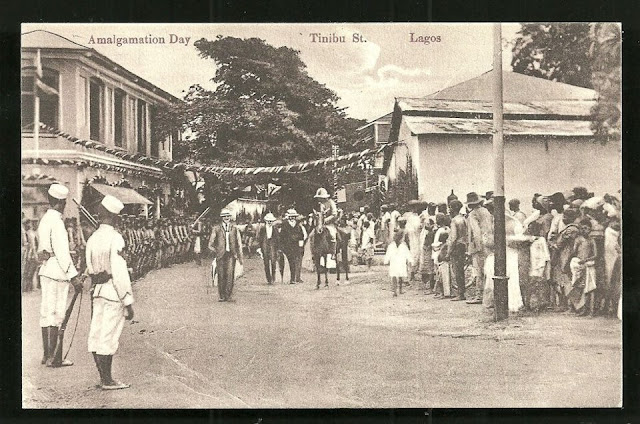
Amalgamation Day in Lagos, 1914
06 May, 2010
Senate passes Asset Management Company bill
Perhaps the most recurring theme on this blog has been the question of how to handle the toxic asset problem in the Nigerian banking industry. CBN Governor Sanusi Lamido Sanusi's proposed Asset Management Company crossed one hurdle yesterday.


President Umaru Yar'Adua died yesterday
Yesterday, 5th May 2010 at 9pm, the 13th President of the Federal Republic of Nigeria passed away. Reports from Daily Trust and NEXT. He will be buried today at 2pm Nigerian time.
May his soul Rest In Perfect Peace.
Goodluck Ebele Jonathan was sworn in as President this morning.
Thursday, 6th of May has been declared a national holiday, and President Jonathan has called for a week of mourning.
From a historical perspective, President Yar'Adua is the fifth Head of State/Government of the federal republic to die in office in the last half-century. Prime Minister Tafawa Balewa was assasinated (1966), as were Heads of State J.T.U. Aguiyi-Ironsi (1967) and Murtala Mohammed (1976). Mystery still surrounds the death of Sani Abacha, and certain supporters of the late Moshood Abiola would insist President Yar'Adua was the sixth.
A decent man died yesterday. It doesn't mean we must stop talking about issues that affect the lives and welfare of over 100 million of God's children, but my condolences go out to his family and to my fellow citizens.
May his soul Rest In Perfect Peace.
Goodluck Ebele Jonathan was sworn in as President this morning.
Thursday, 6th of May has been declared a national holiday, and President Jonathan has called for a week of mourning.
From a historical perspective, President Yar'Adua is the fifth Head of State/Government of the federal republic to die in office in the last half-century. Prime Minister Tafawa Balewa was assasinated (1966), as were Heads of State J.T.U. Aguiyi-Ironsi (1967) and Murtala Mohammed (1976). Mystery still surrounds the death of Sani Abacha, and certain supporters of the late Moshood Abiola would insist President Yar'Adua was the sixth.
A decent man died yesterday. It doesn't mean we must stop talking about issues that affect the lives and welfare of over 100 million of God's children, but my condolences go out to his family and to my fellow citizens.
04 May, 2010
Sanusi under attack
Last Friday was the deadline for Nigerian banks to adhere to the common year-end policy of the Central Bank of Nigeria.
With President Yar'Adua more or less in retirement, and Acting President Goodluck Jonathan in full charge of the federal executive, it appears CBN Governor Sanusi Lamido Sanusi has lost the political backing of Aso Rock. The Acting President's recently re-appointed National Security Adviser, retired Lt Gen Aliyu Gusau wasted no time in criticizing Sanusi's reforms, blaming them for damaging the economy.
It is unclear whether Gusau was speaking indirectly for Acting President Jonathan or whether he was speaking for Jonathan's godfather Obasanjo (Gusau was Obasanjo's NSA too; in fact Jonathan seems to be resurrecting the careers of a lot of Obasanjo-era powerbrokers). Gusau could also have been speaking on behalf of major vested interests in big banking, big business and big politics, believed to be upset with CBN boss Sanusi's crackdown on their mostly parasitic relationship with Nigerian banking. And Gusau could be speaking for himself (or for whatever shadowy faction of Big Men he truly represents).
Quite a few players in the banking and equity trading industries echoed the retired general's criticisms. Like Gusau, these industry insiders have blamed Sanusi for the difficult situation facing Nigerian banks and the Nigerian Stock Exchange.
The truth is, the Nigerian banking industry and the Nigerian Stock market were in trouble BEFORE Sanusi Lamido Sanusi was appointed Governor of the Central Bank. The truth is, lax/negligent regulation of the financial and equity markets by the Obasanjo II Administration (of which Gusau was part), and borderline criminal stock market manipulation by industry insiders created an asset bubble that coincidentally (but separately) blew up the same time as we were hit by the Global Credit Crunch in 2008.
Indeed, between October 2008 and May of 2009, Nigeria's external reserves dropped from $61 billion to $47 billion because the immediate past Governor of the Central Bank, Professor Charles Soludo, pumped $14 billion from the reserves into the currency markets to defend the value of the Naira.
And the decline in banking industry share prices on the Nigerian Stock Market was responsible for a 37% drop in the All-Share Index, the steepest decline of any of the 89 benchmark indexes tracked by Bloomberg media.
All of this happened BEFORE Sanusi was named Central Bank Governor, and so NONE OF THIS can be blamed on Sanusi's actions since becoming Central Bank Governor. The Central Bank, reacting to retired Gen. Gusau's criticism, made just that argument.
The CBN's self-defence is backed by Lawson A. Omokhodion, who insists in this essay that Sanusi's interventions were designed to save the Nigerian banking from a mess of its own creation. These interventions include, a massive =N=620 billion ($4.13 billion) bailout for the most distressed banks, and a proposed Asset Management Company to buy up =N=1.2 trillion ($8 billion) in toxic assets held by Nigerian banks. Given the fact that the Eurasia Group estimated "bad loans" (a.k.a. toxic assets) on the books of Nigeria's banks added up to at least $10 billion, it is perhaps not a coincidence that Sanusi's $4.13 billion quick bailout and $8 billion Asset Management Company plan add up to a $12.13 billion intervention to cure the "toxic assets" problem of Nigerian banks.
It also makes you wonder about erstwhile CBN Governor Soludo's claim (published by Bloomberg a month after the same outlet had reported the Eurasia Group's estimate), that the toxic assets problems amounted to just $5.3 billion. Was this the same sort of official procedure under which Nigerian governmental agencies release casualty figures, after incidents of communal violence or police/army reprisals, that are so much less than the real casualty figures?
To a degree, General Gusau, and his supporters within the political class, the banking industry and the stock market, are playing politics.
In most countries in the world, citizens are enraged at the fact that taxpayer's funds are being used to bail out big banks; in these citizens' opinion, it is the big banks that created their own problems (and problems for the rest of their respective economies).
In Nigeria, there has not been much public reaction to the news that $12.13 billion is being pumped directly or indirectly into the banking industry. Part of this is due to the fact that Nigerian citizens perceive government money/funds and external reserves to be "oil money" and not taxes taken from the sweat of the citizens' brows, so no one feels like money is being directly taken from them (i.e. the people) and being given to the banks. Indeed, the attitude toward "government" and (more importantly) "government property" is almost a perfect illustration of Garrett Hardin's "Tragedy of the Commons" ... but that is a different discussion to be postponed till another day.
In fact, we the people are wrong to ignore what has happened, and what is happening to correct and/or ameliorate some of what happened.
In this, the Gusau Crew (if I can call them that) are adopting first-strike politics, using propaganda to plant the idea in the minds of Nigerian citizens that all of the problems were caused by Sanusi Lamido Sanusi. Effectively, they want to coopt the citizens into their Crew by convincing the people that any pain felt by the economy or by the citizens is to be blamed not on the Crew but on Sanusi.
Within the context of Nigerian politics, it is not difficult for this brand of politics to work. There are certain people who were immediately inclined to dislike Sanusi because of the difference between his geographical region of origin (and his religion) and the same criteria for his predecessor. For some, it was the difference between those criteria for the man who appointed Sanusi, as compared to the same for the man who appointed Sanusi's predecessor. For many of those with this sort of visceral dislike of Sanusi, it didn't help that he and the president who appointed him were from the same region and same religion. Before Sanusi so much as uttered a word, or did anything, these people were already accusing him of being part of a regionalist and religionist plan to destroy the banks because (in the view of these sectionalists), the banks were dominated by people from other regions and religions. Indeed, when Sanusi forced the resignations and dismissals of certain CEOs, the ethno-religious warriors kept saying Sanusi did it because he wanted to install his kinsmen in charge of the five affected banks in place of people from other socio-cultural groups, when in fact Sanusi was exactly regulatory sanction on five banks that were collectively responsible for 40.81% of all toxic assets in the Nigerian banking industry.
General Gusau (rtd) is a ex-military strongman from the part of the country that should ostensibly be pro-Sanusi, if the ethnic/religious propaganda suffusing the Nigerian political marketplace had any credence.
The truth is Sanusi has stepped on powerful toes from all over Nigeria, regardless of region or religion. The powerful plutocrats who dominated and still dominate the commanding heights of the Nigerian economy enjoyed a cozy, mutually-lucrative, quid-pro-quo relationship with the Obasanjo II administration. Sanusi embarassed a lot of them by exposing to the public the "bad debts" they owed Nigerian banks, as a way to force them (via the court of public opinion) to make good on their debts. He also revealed how the executives at major banks dominated by a small coterie of shareholders based around a particular family, pulled a variation of the Bernard Madoff fraud, enriching themselves along the way (as Madoff did) often by directly transferring customer deposits to themselves (by spending it on themselves and their expanding personal asset portfolios). The banks not so much "lent" as "gave" money to their business and political contacts; and they gave large amounts of "margin loans" to speculators (and to themselves) for the purpose of buying their own stock, and hence pushing their stock price up.
No doubt a few innocent parties were inadvertently subjected to public scorn they did not deserve, indeed, in response to the publication of the list, I said
It is extremely unfortunate that more sophisticated, more accurately targeted methods were not used, but in the Nigerian context there was probably no other way to pressure the mega-powerful plutocrats to make arrangements to pay up or to restructure their debts so they could eventually pay up. Those affected by Sanusi's actions, including some of the most powerful players in Nigerian business, hate his guts.
And then you have the thousands of bank workers who have been sacked since the Sanusi reforms began. Within the political context, they blame Sanusi for their lost employment, when in fact the economic factors that made them redundant existed BEFORE Sanusi came to office. As stated above, the precipitous drop in the value of Nigerian banking shares led to a 37% drop in Nigeria's All Share Index. After years of expanding their staff totals during the (at least partially artificial) boom years, Nigeria's banks from 2008 onward were clearly struggling, and were always going to have to think of cutting costs (including payroll).
Those bank workers who have lost their jobs blame Sanusi, because the effect of some of his reforms was to force the banks to make accurate public statements about their financial status. Previously, the numbers released by some banks were not reflective of the banks' true financial position. When banks were forced to face up to their true economic health, and to make provisions for their losses and bad loans, they were forced to take appropriate cost-cutting steps they would have otherwise pretended they didn't need to do.
To a large degree, driven by the lack of formal employment opportunities in the Nigerian economy, there is a philsophy among sections of those lucky enough to be formally employed that they should be kept on the job even if the corporate entity they are working for experiences a financial/commercial collapse. In the private sector (like the banking industry), this philosophy is less powerful, but in the public sector, moribund parastatals like the Railways, NITEL and the Steel Complexes nevertheless boast thousands of staff. Indeed, even as federal, state and local governments are running deficits and running up debts to meet their recurrent costs, civil services at all three tiers remain over-staffed.
Regardless, you can't blame Sanusi Lamido Sanusi for the job losses.
These are testing times for the CBN governor, and he does appear to have lost the support of Aso Rock. Will he concede ground to his powerful enemies, and step back from the necessary reforms and sanitization of the banking industry?
Time will tell.
With President Yar'Adua more or less in retirement, and Acting President Goodluck Jonathan in full charge of the federal executive, it appears CBN Governor Sanusi Lamido Sanusi has lost the political backing of Aso Rock. The Acting President's recently re-appointed National Security Adviser, retired Lt Gen Aliyu Gusau wasted no time in criticizing Sanusi's reforms, blaming them for damaging the economy.
It is unclear whether Gusau was speaking indirectly for Acting President Jonathan or whether he was speaking for Jonathan's godfather Obasanjo (Gusau was Obasanjo's NSA too; in fact Jonathan seems to be resurrecting the careers of a lot of Obasanjo-era powerbrokers). Gusau could also have been speaking on behalf of major vested interests in big banking, big business and big politics, believed to be upset with CBN boss Sanusi's crackdown on their mostly parasitic relationship with Nigerian banking. And Gusau could be speaking for himself (or for whatever shadowy faction of Big Men he truly represents).
Quite a few players in the banking and equity trading industries echoed the retired general's criticisms. Like Gusau, these industry insiders have blamed Sanusi for the difficult situation facing Nigerian banks and the Nigerian Stock Exchange.
The truth is, the Nigerian banking industry and the Nigerian Stock market were in trouble BEFORE Sanusi Lamido Sanusi was appointed Governor of the Central Bank. The truth is, lax/negligent regulation of the financial and equity markets by the Obasanjo II Administration (of which Gusau was part), and borderline criminal stock market manipulation by industry insiders created an asset bubble that coincidentally (but separately) blew up the same time as we were hit by the Global Credit Crunch in 2008.
Indeed, between October 2008 and May of 2009, Nigeria's external reserves dropped from $61 billion to $47 billion because the immediate past Governor of the Central Bank, Professor Charles Soludo, pumped $14 billion from the reserves into the currency markets to defend the value of the Naira.
And the decline in banking industry share prices on the Nigerian Stock Market was responsible for a 37% drop in the All-Share Index, the steepest decline of any of the 89 benchmark indexes tracked by Bloomberg media.
All of this happened BEFORE Sanusi was named Central Bank Governor, and so NONE OF THIS can be blamed on Sanusi's actions since becoming Central Bank Governor. The Central Bank, reacting to retired Gen. Gusau's criticism, made just that argument.
The CBN's self-defence is backed by Lawson A. Omokhodion, who insists in this essay that Sanusi's interventions were designed to save the Nigerian banking from a mess of its own creation. These interventions include, a massive =N=620 billion ($4.13 billion) bailout for the most distressed banks, and a proposed Asset Management Company to buy up =N=1.2 trillion ($8 billion) in toxic assets held by Nigerian banks. Given the fact that the Eurasia Group estimated "bad loans" (a.k.a. toxic assets) on the books of Nigeria's banks added up to at least $10 billion, it is perhaps not a coincidence that Sanusi's $4.13 billion quick bailout and $8 billion Asset Management Company plan add up to a $12.13 billion intervention to cure the "toxic assets" problem of Nigerian banks.
It also makes you wonder about erstwhile CBN Governor Soludo's claim (published by Bloomberg a month after the same outlet had reported the Eurasia Group's estimate), that the toxic assets problems amounted to just $5.3 billion. Was this the same sort of official procedure under which Nigerian governmental agencies release casualty figures, after incidents of communal violence or police/army reprisals, that are so much less than the real casualty figures?
To a degree, General Gusau, and his supporters within the political class, the banking industry and the stock market, are playing politics.
In most countries in the world, citizens are enraged at the fact that taxpayer's funds are being used to bail out big banks; in these citizens' opinion, it is the big banks that created their own problems (and problems for the rest of their respective economies).
In Nigeria, there has not been much public reaction to the news that $12.13 billion is being pumped directly or indirectly into the banking industry. Part of this is due to the fact that Nigerian citizens perceive government money/funds and external reserves to be "oil money" and not taxes taken from the sweat of the citizens' brows, so no one feels like money is being directly taken from them (i.e. the people) and being given to the banks. Indeed, the attitude toward "government" and (more importantly) "government property" is almost a perfect illustration of Garrett Hardin's "Tragedy of the Commons" ... but that is a different discussion to be postponed till another day.
In fact, we the people are wrong to ignore what has happened, and what is happening to correct and/or ameliorate some of what happened.
In this, the Gusau Crew (if I can call them that) are adopting first-strike politics, using propaganda to plant the idea in the minds of Nigerian citizens that all of the problems were caused by Sanusi Lamido Sanusi. Effectively, they want to coopt the citizens into their Crew by convincing the people that any pain felt by the economy or by the citizens is to be blamed not on the Crew but on Sanusi.
Within the context of Nigerian politics, it is not difficult for this brand of politics to work. There are certain people who were immediately inclined to dislike Sanusi because of the difference between his geographical region of origin (and his religion) and the same criteria for his predecessor. For some, it was the difference between those criteria for the man who appointed Sanusi, as compared to the same for the man who appointed Sanusi's predecessor. For many of those with this sort of visceral dislike of Sanusi, it didn't help that he and the president who appointed him were from the same region and same religion. Before Sanusi so much as uttered a word, or did anything, these people were already accusing him of being part of a regionalist and religionist plan to destroy the banks because (in the view of these sectionalists), the banks were dominated by people from other regions and religions. Indeed, when Sanusi forced the resignations and dismissals of certain CEOs, the ethno-religious warriors kept saying Sanusi did it because he wanted to install his kinsmen in charge of the five affected banks in place of people from other socio-cultural groups, when in fact Sanusi was exactly regulatory sanction on five banks that were collectively responsible for 40.81% of all toxic assets in the Nigerian banking industry.
General Gusau (rtd) is a ex-military strongman from the part of the country that should ostensibly be pro-Sanusi, if the ethnic/religious propaganda suffusing the Nigerian political marketplace had any credence.
The truth is Sanusi has stepped on powerful toes from all over Nigeria, regardless of region or religion. The powerful plutocrats who dominated and still dominate the commanding heights of the Nigerian economy enjoyed a cozy, mutually-lucrative, quid-pro-quo relationship with the Obasanjo II administration. Sanusi embarassed a lot of them by exposing to the public the "bad debts" they owed Nigerian banks, as a way to force them (via the court of public opinion) to make good on their debts. He also revealed how the executives at major banks dominated by a small coterie of shareholders based around a particular family, pulled a variation of the Bernard Madoff fraud, enriching themselves along the way (as Madoff did) often by directly transferring customer deposits to themselves (by spending it on themselves and their expanding personal asset portfolios). The banks not so much "lent" as "gave" money to their business and political contacts; and they gave large amounts of "margin loans" to speculators (and to themselves) for the purpose of buying their own stock, and hence pushing their stock price up.
No doubt a few innocent parties were inadvertently subjected to public scorn they did not deserve, indeed, in response to the publication of the list, I said
(This) is not an ideal or optimal way of doing things. One would rather there were civil lawsuits that would produce clear rulings on whether Loan XYZ was non-performing, that could then either force the adoption of a structured payment plan or authorize the seizure of assets subsequent to legally defined default. There are corporate heavyweights on the list that might not have liquid assets to pay back their loans, but do have other assets than could be seized to defray at least a portion of the debt -- the rest may have to be written off. Maybe in some way the process could establish a distinction between businessmen and bankers who are true entrepreneurs, and businessmen and bankers who exist only by virtue of exploiting the many loopholes in the Nigerian political and economic system. In other words, I wish this were more constitutional and legalistic, with a more systemic approach toward solving the toxic asset dillemma.
It is extremely unfortunate that more sophisticated, more accurately targeted methods were not used, but in the Nigerian context there was probably no other way to pressure the mega-powerful plutocrats to make arrangements to pay up or to restructure their debts so they could eventually pay up. Those affected by Sanusi's actions, including some of the most powerful players in Nigerian business, hate his guts.
And then you have the thousands of bank workers who have been sacked since the Sanusi reforms began. Within the political context, they blame Sanusi for their lost employment, when in fact the economic factors that made them redundant existed BEFORE Sanusi came to office. As stated above, the precipitous drop in the value of Nigerian banking shares led to a 37% drop in Nigeria's All Share Index. After years of expanding their staff totals during the (at least partially artificial) boom years, Nigeria's banks from 2008 onward were clearly struggling, and were always going to have to think of cutting costs (including payroll).
Those bank workers who have lost their jobs blame Sanusi, because the effect of some of his reforms was to force the banks to make accurate public statements about their financial status. Previously, the numbers released by some banks were not reflective of the banks' true financial position. When banks were forced to face up to their true economic health, and to make provisions for their losses and bad loans, they were forced to take appropriate cost-cutting steps they would have otherwise pretended they didn't need to do.
To a large degree, driven by the lack of formal employment opportunities in the Nigerian economy, there is a philsophy among sections of those lucky enough to be formally employed that they should be kept on the job even if the corporate entity they are working for experiences a financial/commercial collapse. In the private sector (like the banking industry), this philosophy is less powerful, but in the public sector, moribund parastatals like the Railways, NITEL and the Steel Complexes nevertheless boast thousands of staff. Indeed, even as federal, state and local governments are running deficits and running up debts to meet their recurrent costs, civil services at all three tiers remain over-staffed.
Regardless, you can't blame Sanusi Lamido Sanusi for the job losses.
These are testing times for the CBN governor, and he does appear to have lost the support of Aso Rock. Will he concede ground to his powerful enemies, and step back from the necessary reforms and sanitization of the banking industry?
Time will tell.
03 May, 2010
The Acting President and the $13.5 million seizure
Four years ago, the Economic and Financial Crimes Commissions separately seized =N=104 million first and US$13.5 million later from then-Governor Goodluck Jonathan of Bayelsa. Jonathan had only recently replaced ex-Governor Diepriye Alamieyeseigha, who had been jailed, charged and impeached and stripped of office for basically the same act -- theft of public funds and money laundering.
The media and the EFCC made it out to be a case against Patience Jonathan, wife of then-Governor Jonathan, but lets not get bogged down by money laundering semantics; the only place she could have got that money is her husband. It would not be the first time Nigerian politicians have run their schemes through their wives and girlfriends; Nnamdi "Andy" Uba famously used accounts opened in the name of his American mistress Loretta Mabinton.
The case of the mysterious US$13.5 million disappeared from the media and the public consciousness rather quickly.
After the defeat of his Third Term Agenda, then-President Olusegun Obasanjo had seized control of the Peoples Democratic Party, using Ribadu and the EFCC as part of a carrot-and-stick process to extort support from the Big Men and godfathers of the PDP. Play ball with me, and enjoy your ill-gotten loot in peace, defy me and watch me jail you.
Obasanjo imposed then-Governor Umaru Yar'Adua as his chosen successor, believing the erstwhile Katsina governor to be weak enough to be manipulable. Obasanjo also selected then-Governor Goodluck Jonathan to be Yar'Adua's running mate ... at which point, Ribadu forgot case against Goodluck Jonathan.
In a world where political godsons routinely turn on their godfathers, it was important to have some kind of tool for keeping godsons in line. Famously, Chris Uba (Andy's kid brother) made Chris Ngige, then a candidate for Governor of Anambra, swear fealty to Uba before a juju shrine; Nigerians, mostly adherents of two global religions, nevertheless take oaths to shrines a lot more seriously than they take oaths made on any other basis. Even then Ngige and Uba fell out.
Obasanjo did not rely on oaths. What he did was have Ribadu open an investigation against someone (say, for example, Bode George), then have Ribadu suspend the investigation once that person became a dutiful godson to Obasanjo. Should that godson step out of line, and/or annoy pater familias Obasanjo, he could then have Ribadu reopen the investigation as a means of punishing the errant godson. As such, men like Bode George were very loyal, while other men, like Sani Ahmed Yerima, were very afraid; either way, they did what Obasanjo needed them to do, and the abysmal, shameful spectacle that was the 2007 Elections came to pass.
The $13.5 million seized from Goodluck Jonathan was not the first step towards a prosecution; it was instead the collateral or surety for the political investment that made Goodluck Jonathan the next Vice-President. The one thing Obasanjo never counted on was Umaru Yar'Adua sacking Nuhu Ribadu. Alas, all godsons turn on their godfathers (as Obasanjo had turned on his, Atiku Abubakar).
Yar'Adua's move was meant to build for himself an independent power base among the Big Men, offering them freedom from Ribadu's Revenge if they stopped their unwilling support of Obasanjo's efforts to continue pulling the strings behind the scenes. They duly broke with Obasanjo, ending his control of the PDP, rendering him just another ex-President.
The thing is ... once the anti-democratic, pro-corruption, mafia-style extortion leverage of Ribadu's fake corruption war was gone, Yar'Adua lacked a hammer of his own to keep the Big Men in line. Thus came the sense of drift.
Don't get me wrong. I am not advocating the Obasanjo/Ribadu model. For one thing, the eight years from 1999 to 2007 will probably be remembered as the single most corrupt "decade" (you know what I mean) in the federal republic's history -- not just post-colonial history, but entire history going back to the Stone Age. The rot reached all the way to the top, with both President Obasanjo and Vice-President Atiku sharing in a $74 million bribe from Halliburton, among other things (I wish the federal republic was blessed with the sort of investigative writers and/or documentary film-makers who could tell the full tale of Transcorp, and Obasanjo's other attempts to transfer public property to his private ownership). There was so much hype about Obasanjo/Ribadu's attempts to keep Atiku off the ballot because "he was corrupt", not to mention impeaching Alamieyeseigha because "he was corrupt", only to sweep a US$13.5 million investigation under the carpet to impose Goodluck Jonathan as Vice-President and now Acting President.
War on Corruption? Rubbish!
And the "drift" that characterized the Yar'Adua administration is no different from the "drift" (save cellphone deregulation) that characterized the Obasanjo Administration's first five or six years (out of eight), and much of the activity that followed revolved around attempts to revise the constitution for a Third Term and efforts to maximize the transfer of public property to the private pockets of a coterie of business moguls who surrounded Obasanjo (and who cut him into their deals).
So it is not like we achieved any great reforms to any vital federal institution. The political machine created by Olusegun Obasanjo in his second term was good at what it was designed to do -- keep the machine in power directly before 2007 and (it hoped) indirectly afterward. It had no ambitions beyond that, touted no reforms and no restructuring, made no war on waste or graft.
In its own way, it was like everything that came before it, and everything (Yar'Adua and Jonathan alike) that came after it. Our governments lack substance and legitimacy, and even if they desired otherwise, they are generally unable to achieve much beyond just hanging onto power. Even now, this final year of what was to be Yar'Adua's first term is dominated by nothing beyond questions of whether Jonathan will be able to hang on to the Presidency after 2011, and if he doesn't, who is best placed to replace him.
Sadly, whoever "wins" the (sure-to-be-rigged) elections next year, we will be back to square one. If someone from north of the Niger-Benue wins, their will be an instant shift in focus to the question of whether the South-East or South-South should come next in the "rotation system", and maneuvering by various Big Men to put themselves in the frame. Conversely, if Jonathan retains, certain Big Men will argue that the next term (2015-2019) should go back to the North-West because they only had one while the South-West had two, or whether it should go to the South-East because they haven't had anyone since Ironsi and they can't wait just because the South-South jumped their turn.
Long story short ....
....substantive reform, restructuring and transformation are not on the agenda!
But still ... what happened to the $13.5 million investigation of the Jonathan family?
The media and the EFCC made it out to be a case against Patience Jonathan, wife of then-Governor Jonathan, but lets not get bogged down by money laundering semantics; the only place she could have got that money is her husband. It would not be the first time Nigerian politicians have run their schemes through their wives and girlfriends; Nnamdi "Andy" Uba famously used accounts opened in the name of his American mistress Loretta Mabinton.
The case of the mysterious US$13.5 million disappeared from the media and the public consciousness rather quickly.
After the defeat of his Third Term Agenda, then-President Olusegun Obasanjo had seized control of the Peoples Democratic Party, using Ribadu and the EFCC as part of a carrot-and-stick process to extort support from the Big Men and godfathers of the PDP. Play ball with me, and enjoy your ill-gotten loot in peace, defy me and watch me jail you.
Obasanjo imposed then-Governor Umaru Yar'Adua as his chosen successor, believing the erstwhile Katsina governor to be weak enough to be manipulable. Obasanjo also selected then-Governor Goodluck Jonathan to be Yar'Adua's running mate ... at which point, Ribadu forgot case against Goodluck Jonathan.
In a world where political godsons routinely turn on their godfathers, it was important to have some kind of tool for keeping godsons in line. Famously, Chris Uba (Andy's kid brother) made Chris Ngige, then a candidate for Governor of Anambra, swear fealty to Uba before a juju shrine; Nigerians, mostly adherents of two global religions, nevertheless take oaths to shrines a lot more seriously than they take oaths made on any other basis. Even then Ngige and Uba fell out.
Obasanjo did not rely on oaths. What he did was have Ribadu open an investigation against someone (say, for example, Bode George), then have Ribadu suspend the investigation once that person became a dutiful godson to Obasanjo. Should that godson step out of line, and/or annoy pater familias Obasanjo, he could then have Ribadu reopen the investigation as a means of punishing the errant godson. As such, men like Bode George were very loyal, while other men, like Sani Ahmed Yerima, were very afraid; either way, they did what Obasanjo needed them to do, and the abysmal, shameful spectacle that was the 2007 Elections came to pass.
The $13.5 million seized from Goodluck Jonathan was not the first step towards a prosecution; it was instead the collateral or surety for the political investment that made Goodluck Jonathan the next Vice-President. The one thing Obasanjo never counted on was Umaru Yar'Adua sacking Nuhu Ribadu. Alas, all godsons turn on their godfathers (as Obasanjo had turned on his, Atiku Abubakar).
Yar'Adua's move was meant to build for himself an independent power base among the Big Men, offering them freedom from Ribadu's Revenge if they stopped their unwilling support of Obasanjo's efforts to continue pulling the strings behind the scenes. They duly broke with Obasanjo, ending his control of the PDP, rendering him just another ex-President.
The thing is ... once the anti-democratic, pro-corruption, mafia-style extortion leverage of Ribadu's fake corruption war was gone, Yar'Adua lacked a hammer of his own to keep the Big Men in line. Thus came the sense of drift.
Don't get me wrong. I am not advocating the Obasanjo/Ribadu model. For one thing, the eight years from 1999 to 2007 will probably be remembered as the single most corrupt "decade" (you know what I mean) in the federal republic's history -- not just post-colonial history, but entire history going back to the Stone Age. The rot reached all the way to the top, with both President Obasanjo and Vice-President Atiku sharing in a $74 million bribe from Halliburton, among other things (I wish the federal republic was blessed with the sort of investigative writers and/or documentary film-makers who could tell the full tale of Transcorp, and Obasanjo's other attempts to transfer public property to his private ownership). There was so much hype about Obasanjo/Ribadu's attempts to keep Atiku off the ballot because "he was corrupt", not to mention impeaching Alamieyeseigha because "he was corrupt", only to sweep a US$13.5 million investigation under the carpet to impose Goodluck Jonathan as Vice-President and now Acting President.
War on Corruption? Rubbish!
And the "drift" that characterized the Yar'Adua administration is no different from the "drift" (save cellphone deregulation) that characterized the Obasanjo Administration's first five or six years (out of eight), and much of the activity that followed revolved around attempts to revise the constitution for a Third Term and efforts to maximize the transfer of public property to the private pockets of a coterie of business moguls who surrounded Obasanjo (and who cut him into their deals).
So it is not like we achieved any great reforms to any vital federal institution. The political machine created by Olusegun Obasanjo in his second term was good at what it was designed to do -- keep the machine in power directly before 2007 and (it hoped) indirectly afterward. It had no ambitions beyond that, touted no reforms and no restructuring, made no war on waste or graft.
In its own way, it was like everything that came before it, and everything (Yar'Adua and Jonathan alike) that came after it. Our governments lack substance and legitimacy, and even if they desired otherwise, they are generally unable to achieve much beyond just hanging onto power. Even now, this final year of what was to be Yar'Adua's first term is dominated by nothing beyond questions of whether Jonathan will be able to hang on to the Presidency after 2011, and if he doesn't, who is best placed to replace him.
Sadly, whoever "wins" the (sure-to-be-rigged) elections next year, we will be back to square one. If someone from north of the Niger-Benue wins, their will be an instant shift in focus to the question of whether the South-East or South-South should come next in the "rotation system", and maneuvering by various Big Men to put themselves in the frame. Conversely, if Jonathan retains, certain Big Men will argue that the next term (2015-2019) should go back to the North-West because they only had one while the South-West had two, or whether it should go to the South-East because they haven't had anyone since Ironsi and they can't wait just because the South-South jumped their turn.
Long story short ....
....substantive reform, restructuring and transformation are not on the agenda!
But still ... what happened to the $13.5 million investigation of the Jonathan family?
02 May, 2010
Social Welfare Improves With Economic Growth
The federal character "zoning" formula, and the fragmented multiplicity of states, guarantee a bloated federal cabinet. There must be one minister or minister-of-state from each of the 36 states and from the FCT, as well as one minister or minister-of-state from each of the six so-called "geo-political zones". So the cabinet must have 43 ministers. They say they do it so we the people can have proper representation at the high table, but in fact these 43 "federal character" delegates are chosen to represent powerful factions within the political class; in a sense they are providing for "federal character" (i.e. the absence of ethno-regional advantage)within the context of the political factions' ever-shifting balance-of-power arrangements, but do not in any way, shape or form constitute representation for the actual people in whose name they ostensibly claim a place at the table. If federal character is supposed to ensure we all have a voice, then it should include the voices of the 99% of Nigerians who are currently unheard around the federal cabinet table.
In any case, if a minister resigns from cabinet or is dropped in a cabinet reshuffle, a replacement minister from that person's home state or "geo-political zone" will be added to the cabinet.
In 2006, a year before the (rigged) 2007 "elections", the designated minister from Gombe State was the Minister of Commerce, Ambassador Adamu Waziri. He is married to Mrs Farida Waziri, who is currently the head of the Economic and Financial Crimes Commission, and who has served both the Yar'Adua and Jonathan administrations in that role. This too is a characteristic of the Fourth Republic, this practice of appointing to high office the daughters, sons, wives, husbands and in-laws of crucial Big Men and Big Women. The Fourth Republic is also noteworthy for the political wars between godfathers and godsons; I suppose picking a family-member to be your designated proxy in the federal cabinet government is a more secure proposition than anointing one of your godsons who may turn on you as soon as he feels secure enough in his new position to allow his ambition to be a godfather in his own right to run free.
Adamu Waziri resigned from the Obasanjo II cabinet in 2006 as part of an administration policy that any ministers seeking electoral office in the 2007 polls step down from their cabinet positions and focus on their electoral race. President Obasanjo chose Mrs Amina Ibrahim to replace Waziri in Gombe State's spot on the federal cabinet, but Mrs Ibrahim asked to have her name withdrawn. Obasanjo obliged her.
I had never heard of a Nigerian turning down a chance to be a federal minister, so the "man bites dog" nature of the news brought Mrs. Amina Ibrahim to my attention. Interestingly, and I don't know entirely know why, she asked that the media and the public stop referring to her as Mrs Amina Ibrahim. She is now known, at her own request, as Hajia Amina Az Zubair. This doesn't make too much of a practical difference, except if you are going to do research to find out more about her, understand that half of the internet-accessible material about her come under the name "Amina Ibrahim" and the other half are under the name "Amina Az Zubair".
Hajiya Amina Az Zubair is a fixture of the Fourth Republic, having served the Obasanjo II, Yar'Adua and Jonathan Administrations in a succession of social welfare positions. She entered government as the National Coordinator of Education for All (EFA) at the Federal Ministry of Education, having been one of the leaders of "civil society" efforts to get the Obasanjo II administration to set up an EFA programme. Sh then became successively the Presidential Adviser, Special Assistant and Senior Special Assistant for Education, Poverty Alleviation and the Millennium Development Goals. In the mid-1990s, as founder of a firm called Afri-Projects, she was involved in setting up the Petroleum Trust Fund. Before that, she worked for 11 years with a private sector engineering firm.
Hajia Az Zubair seems to belong to a specific part of the so-called "progressive" tendency in Nigerian politics.
First some clarification, for any non-Nigerian reader of this blog. The word "progressive" in the context of Nigerian politics means something very different from whatever it means in your country or your part of the world.
If taken at her word, and in full consideration of her actions, Hajia Az Zubair seems to be of that part of the so-called "progressive" tendency who believe in working within the system to implement their "progressive" ideas. They tend to have deep connections with the powerful political factions, tend to serve in governments dominated by the interests of those factions, and tend to present a "human face" and positive, moral rhetoric to the public (even as the governments they serve continue "business as usual"). Ultimately, they do not achieve the lofty goals they promised from their alliance with the powerful political factions. Some leave government with their reputations and popularity intent, while others metamorphose and become denizens of those factions themselves, acting as the "intellectual" wing of the inter-locking machines that maintains the status quo.
Hajiya Az Zubair sounds like she genuinely believes in what she says. On the other hand, she has been a loyal part of three Fourth Republic administrations that have not prioritized those important things she says she believes in. She has defended and still defends all three administrations' records and achievements in terms of those social welfare/development goals that are ostensibly her brief.
All things considered, she seems to be more of a diplomat than an administrator, travelling the globe to attend international conferences on various aspects of socio-economic development and public welfare, representing Nigeria and making wonderful speeches about what the world should do, and what Nigeria (she claims) is doing. She is a member of several international fora, like the Program Advisory Panel of the Global Development Program of the Bill and Melinda Gates FoundationGates Foundation, and the Board of the International Development Research Centre.
,
To the extent that the federal republic is trying to "rebrand" itself, in terms of international perceptions of Nigeria,, I wonder if Hajia Az Zubair wouldn't have been more effective as the rebranding efforts lead spokesperson than she has been at making social welfare a central to government policy at all three tiers. I daresay diplomacy and relations with external partners are a better fit for her, because the way she talks about all three Fourth Republic administrations in her interviews, you wouldn't think things like this or this or (more importantly) this were the "normal" everyday consequences of ineffectual governance, and an aversion to reform, restructuring and transformation across all three tiers of the federal republic.
Like I said earlier, she seems to believe what she says. Maybe she really does. Or maybe I too am affected by the same qualities that I suspect would make her an excellent diplomat.
Take this interview with Economic Confidential, where she talks about her work on the MDG project (and very briefly speaks on the minsterial offer she turned down) is a case in point. Very deftly, she says many things without saying anything. It is almost like she (politician and diplomat to fore) set out to praise all of the political stakeholders, to give the reporter (and we the readers) the best possible image of the MDG project, and to (importantly) stoke hope and optimism in the heart of anyone who truly loves Nigeria. If she said anything else, she would lose her job.
In other contexts however, Hajia Az Zubair indirectly admits to economic and political reasons that success in social welfare promotion will elude her. In this December, 2009 interview with This Day, she said Nigeria needed =N=25.557 trillion (or US$170.38 billion) to fully achieve the Millenium Development Goals over a period of six years (2009 to 2015). That is something like =4.259 trillion (or US$28.4 billion) annually.
We don't have that kind of money.
Besides, much of the spending at all three tiers of government is tied up in recurrent expenses (mainly salaries for bloated civil service payrolls), and on payments to banks for ballooning loans that were borrowed (at all three tiers) and spent with little or no oversight, planning or empirical projections. What little is left in the budgets after this is tied up in grand prestige projects (that provide plenty of scope for waste, rentier activity, patron-client redistribution, graft and outright theft).
Hajia Az Zubair's core budget is supposed to be $1 billion a year, which is meant to reflect the amount of annual debt service payments we saved by paying a $12 billion lump sum on a $30 billion debt in exchange for our creditors writing off the $18 billion balance.
For one thing, as she essentially admitted in the This Day interview, $1 billion/annum is nothing in the context of a country with over 100 million people, a high poverty rate, insufficient infrastructure and questionable governance. For another, much of (if not all of) the $1 billion a year in debt service savings on the old, now-cancelled debt has been eroded by new debt service commitments on new debts. All three tiers of government have been borrowing assiduously and issuing bonds.
The size of our external debts was never the problem. The richest countries in the world all have public debts bigger than ours was before "debt cancellation". Their debts are bigger in absolute magnitude, as a proporition of national GDP and in per capita terms.
The real problem of the Nigerian federal republic was and remains the size of our economy. Like every other country in the world, our government absorbs and then spends a percentage of our GDP. If the government's percentage of the Nigerian GDP remained the same, but the Nigerian GDP doubled, the government's revenue would double. This, simplistic as it may sound, is the true route towards not only social welfare improvement. It would not only cause the general improvement that comes with rising incomes across the economy, but would also specifically empower the government (since it would have so much more in funds to redistribute) to have more of an effect on fighting poverty and achieving the Millennium Development Goals. Crucially, a bigger budget would also allow the government to pay its debt service obligations, which were hardly among the most onerous in the world if looked at only as an absolute numbers, detached from considerations of our then-and-now insufficient federal budget.
Our debt was not too big. It was (and is) our economy that was (and is) too small.
Now some people would admit that an extra $1 billion/annum in freed spending in the budget is not much, considering our massive population, but would then insist that it is better to have that drop in the bucket spent on Nigerian social welfare programmes than having that drop in the bucket leave the country in interest payments. They would also point out that our debt service payments were meant to be around $3 billion, but since we could only afford to pay $1 billion, something like $2 billion/annum (probably less) was being capitalized, which is why the debt kept growing.
In the absence of a substantively democratic system, a properly adversarial structure of policy debate, and rigorous academic critique, there are a few things no one mentions.
We paid $12 billion, all at once, in a lump sum, to achieve this "cancellation". The opportunity cost of using these resources as investment capital to drive economic growth exceeds the utility of using these funds to buy debt forgiveness. Our economy is hobbled by a lack of electricity, a lack of a functional pan-federal network of railroads, by a lack of so much infrastructure. Compare what you could do to fight these deficiences by leveraging $12 billion as a foundation to attract billions more in investment, in a sort of Big Bang expansion of infrastructure federation-wide, against what you could do with a mere $1 billion/annum which is (quite rightly) being used for recurrent expenditure on social welfare because it sure as heck cannot be used as a fund for infrastructure development.
We can always generate $1 billion a year to make payments as we were doing before cancellation, and the key to taking care of our domestic and international debts always lay in expanding the GDP as rapidly and steeply as possible, which would require massive improvements in electricity, rail, education and other infrastructure. But in the light of impact on the Nigerian economy of local and global events in 2008-2010, our governments at all three tiers are running deficits, drawing down the Excess Crude Account, and the Soludo-led Central Bank depleted the external reserve from $61 billion to $47 billion in a matter of months to defen the Naira. We are in no position to generate $12 billion in surpluses for infrastructure or anything else. The moment was lost, and we are left to praise ourselves for being able to spend $1 billion/annum recurrently, with even this being cancelled out by new debt service payments on new debts. It is also painful to realize we lost $23.7 billion in 9 months to attacks and theft by "militants" in the Niger-Delta.
Note also that in 2005-2006, we were told that the debt cancellation deal would save us $20 billion over 20 years. In actuality, the $12 billion lump sum we paid out in 2005-2006 had a future value (if invested in relatively modest instruments, and allowed to earn compounded interest) of $20 billion over 20 years. So we paid in one lump sum, the same amount we would have paid out over 20 years. Initially when Dr. Ngozi Okonjo-Iweala had pleaded for full debt cancellation, the creditors had refused; when she returned after a couple of years with the $12 billion payment for $18 billion cancelled offer, I am not surprised they accepted the offer.
Successive Nigerian governments have had a vested interest in keeping Nigerians misinformed about revenues and expenses, and the Paris Club understands the public relations difficulties inherent in de facto promotion of capital flight from poverty-striken nations; the exact numbers are clouded by some degree of fog, but figures I read a long time ago suggest the cumulative principal borrowed by Nigeria was $19 billion, the cumulative payments made by Nigeria were $42 billion, yet we ended up owing about $33 billion! This was due to penalties for missed payments and capitalization of the balance after under-payment. Nevertheless, if (a) you have already received twice as much as you lent; (b) you are now being offered a present-value lump sum of what you would expect to receive in future value over the next 20 years; and (c) you stand to gain tremendous goodwill and positive publicity from announcing you have charitably cancelled the debts of a poor African country ...
... why wouldn't you take the deal?
Reading through much of what Hajia Az Zubair has said in interviews, I get the impression the $1 billion is not even a discrete, distinct amount specifically handed over to her agency to be spent. I get the impression the three tiers of government just budget funds in the normal way, and a portion of what they normally spend in the budget for healthcare, education, etc is designated as the portion they are spending for Millennium Development Goals. Hajia Az Zubair has also said that so-called "constituency projects" are also counted as part of what has been spent for MDGs. "Constituency projects" are a fiscally wasteful concept through which federal, state and local budgets allocate funds legislators at all three tiers for use (at the legislator's discretion) in community development projects in the legislators' constiuency. It boils down to legislators' raiding the public treasury to buy themselves support ahead of the next election, a way to be seen to have brought Abuja money to your constituency, a way to be praised as the man (or woman) who can dribble a few crumbs to poverty-stricken constituency residents. No one can seriously think "constituency projects" have a lasting effect on poverty-reduction, can they?
All things considered, as controversial as this may sound to some of you, I do not think Nigeria should fight poverty by "fighting poverty". We should fight poverty by focusing on rapid, sustainable, broad and deep economic growth. Everything we do should be driven by the desire for economic growth.
We should stop getting bogged down in semantics. Because "debt" is bad, we put all of our attention on defeating "debt", even if defeating it did nothing for economic growth. Seriously, everybody owes debt. Debt is ubiquitous. There will never come a time that we do not owe debt, so why focus so much on defeating "debt" that we forget our greater need for growth?
In like fashion, I tire of these "Wars on Corruption" that do not address the fundamental fact that the very structure of the political system makes corruption inevitable. If you have no interest in substantively reforming, restructuring and transforming politics, the economy and society, don't waste our time singing the praises of a "War" you are not serious about -- a war that frankly does not exist and never existed.
As for Hajia Az Zubair's "Millenium Development Goals" ... there is a reason I am frustrated with so-called progressives in government. They never admit to themselves, much less anyone else, that they can never achieve their "progressive" goals by working within the system. It is impossible to know if Hajia Az Zubair truly believes in the potential of the system to change Nigeria. Take the "constituency projects" for example; even if she knew they were a waste of scarce budget funds, there is no way she could stop the National Assembly from budgeting money for them. Perhaps she has decided that if she cannot beat them, she can at least influence how they spend their unjust budget allocations. I guess a drop of water is better than nothing, but it betrays a serious lack of ambition if all we do is try to lick the morning dew off the leaves, when a substantial investment in irrigation could do so much more for us.
In any case, if a minister resigns from cabinet or is dropped in a cabinet reshuffle, a replacement minister from that person's home state or "geo-political zone" will be added to the cabinet.
In 2006, a year before the (rigged) 2007 "elections", the designated minister from Gombe State was the Minister of Commerce, Ambassador Adamu Waziri. He is married to Mrs Farida Waziri, who is currently the head of the Economic and Financial Crimes Commission, and who has served both the Yar'Adua and Jonathan administrations in that role. This too is a characteristic of the Fourth Republic, this practice of appointing to high office the daughters, sons, wives, husbands and in-laws of crucial Big Men and Big Women. The Fourth Republic is also noteworthy for the political wars between godfathers and godsons; I suppose picking a family-member to be your designated proxy in the federal cabinet government is a more secure proposition than anointing one of your godsons who may turn on you as soon as he feels secure enough in his new position to allow his ambition to be a godfather in his own right to run free.
Adamu Waziri resigned from the Obasanjo II cabinet in 2006 as part of an administration policy that any ministers seeking electoral office in the 2007 polls step down from their cabinet positions and focus on their electoral race. President Obasanjo chose Mrs Amina Ibrahim to replace Waziri in Gombe State's spot on the federal cabinet, but Mrs Ibrahim asked to have her name withdrawn. Obasanjo obliged her.
I had never heard of a Nigerian turning down a chance to be a federal minister, so the "man bites dog" nature of the news brought Mrs. Amina Ibrahim to my attention. Interestingly, and I don't know entirely know why, she asked that the media and the public stop referring to her as Mrs Amina Ibrahim. She is now known, at her own request, as Hajia Amina Az Zubair. This doesn't make too much of a practical difference, except if you are going to do research to find out more about her, understand that half of the internet-accessible material about her come under the name "Amina Ibrahim" and the other half are under the name "Amina Az Zubair".
Hajiya Amina Az Zubair is a fixture of the Fourth Republic, having served the Obasanjo II, Yar'Adua and Jonathan Administrations in a succession of social welfare positions. She entered government as the National Coordinator of Education for All (EFA) at the Federal Ministry of Education, having been one of the leaders of "civil society" efforts to get the Obasanjo II administration to set up an EFA programme. Sh then became successively the Presidential Adviser, Special Assistant and Senior Special Assistant for Education, Poverty Alleviation and the Millennium Development Goals. In the mid-1990s, as founder of a firm called Afri-Projects, she was involved in setting up the Petroleum Trust Fund. Before that, she worked for 11 years with a private sector engineering firm.
Hajia Az Zubair seems to belong to a specific part of the so-called "progressive" tendency in Nigerian politics.
First some clarification, for any non-Nigerian reader of this blog. The word "progressive" in the context of Nigerian politics means something very different from whatever it means in your country or your part of the world.
If taken at her word, and in full consideration of her actions, Hajia Az Zubair seems to be of that part of the so-called "progressive" tendency who believe in working within the system to implement their "progressive" ideas. They tend to have deep connections with the powerful political factions, tend to serve in governments dominated by the interests of those factions, and tend to present a "human face" and positive, moral rhetoric to the public (even as the governments they serve continue "business as usual"). Ultimately, they do not achieve the lofty goals they promised from their alliance with the powerful political factions. Some leave government with their reputations and popularity intent, while others metamorphose and become denizens of those factions themselves, acting as the "intellectual" wing of the inter-locking machines that maintains the status quo.
Hajiya Az Zubair sounds like she genuinely believes in what she says. On the other hand, she has been a loyal part of three Fourth Republic administrations that have not prioritized those important things she says she believes in. She has defended and still defends all three administrations' records and achievements in terms of those social welfare/development goals that are ostensibly her brief.
All things considered, she seems to be more of a diplomat than an administrator, travelling the globe to attend international conferences on various aspects of socio-economic development and public welfare, representing Nigeria and making wonderful speeches about what the world should do, and what Nigeria (she claims) is doing. She is a member of several international fora, like the Program Advisory Panel of the Global Development Program of the Bill and Melinda Gates FoundationGates Foundation, and the Board of the International Development Research Centre.
,
To the extent that the federal republic is trying to "rebrand" itself, in terms of international perceptions of Nigeria,, I wonder if Hajia Az Zubair wouldn't have been more effective as the rebranding efforts lead spokesperson than she has been at making social welfare a central to government policy at all three tiers. I daresay diplomacy and relations with external partners are a better fit for her, because the way she talks about all three Fourth Republic administrations in her interviews, you wouldn't think things like this or this or (more importantly) this were the "normal" everyday consequences of ineffectual governance, and an aversion to reform, restructuring and transformation across all three tiers of the federal republic.
Like I said earlier, she seems to believe what she says. Maybe she really does. Or maybe I too am affected by the same qualities that I suspect would make her an excellent diplomat.
Take this interview with Economic Confidential, where she talks about her work on the MDG project (and very briefly speaks on the minsterial offer she turned down) is a case in point. Very deftly, she says many things without saying anything. It is almost like she (politician and diplomat to fore) set out to praise all of the political stakeholders, to give the reporter (and we the readers) the best possible image of the MDG project, and to (importantly) stoke hope and optimism in the heart of anyone who truly loves Nigeria. If she said anything else, she would lose her job.
In other contexts however, Hajia Az Zubair indirectly admits to economic and political reasons that success in social welfare promotion will elude her. In this December, 2009 interview with This Day, she said Nigeria needed =N=25.557 trillion (or US$170.38 billion) to fully achieve the Millenium Development Goals over a period of six years (2009 to 2015). That is something like =4.259 trillion (or US$28.4 billion) annually.
We don't have that kind of money.
Besides, much of the spending at all three tiers of government is tied up in recurrent expenses (mainly salaries for bloated civil service payrolls), and on payments to banks for ballooning loans that were borrowed (at all three tiers) and spent with little or no oversight, planning or empirical projections. What little is left in the budgets after this is tied up in grand prestige projects (that provide plenty of scope for waste, rentier activity, patron-client redistribution, graft and outright theft).
Hajia Az Zubair's core budget is supposed to be $1 billion a year, which is meant to reflect the amount of annual debt service payments we saved by paying a $12 billion lump sum on a $30 billion debt in exchange for our creditors writing off the $18 billion balance.
For one thing, as she essentially admitted in the This Day interview, $1 billion/annum is nothing in the context of a country with over 100 million people, a high poverty rate, insufficient infrastructure and questionable governance. For another, much of (if not all of) the $1 billion a year in debt service savings on the old, now-cancelled debt has been eroded by new debt service commitments on new debts. All three tiers of government have been borrowing assiduously and issuing bonds.
The size of our external debts was never the problem. The richest countries in the world all have public debts bigger than ours was before "debt cancellation". Their debts are bigger in absolute magnitude, as a proporition of national GDP and in per capita terms.
The real problem of the Nigerian federal republic was and remains the size of our economy. Like every other country in the world, our government absorbs and then spends a percentage of our GDP. If the government's percentage of the Nigerian GDP remained the same, but the Nigerian GDP doubled, the government's revenue would double. This, simplistic as it may sound, is the true route towards not only social welfare improvement. It would not only cause the general improvement that comes with rising incomes across the economy, but would also specifically empower the government (since it would have so much more in funds to redistribute) to have more of an effect on fighting poverty and achieving the Millennium Development Goals. Crucially, a bigger budget would also allow the government to pay its debt service obligations, which were hardly among the most onerous in the world if looked at only as an absolute numbers, detached from considerations of our then-and-now insufficient federal budget.
Our debt was not too big. It was (and is) our economy that was (and is) too small.
Now some people would admit that an extra $1 billion/annum in freed spending in the budget is not much, considering our massive population, but would then insist that it is better to have that drop in the bucket spent on Nigerian social welfare programmes than having that drop in the bucket leave the country in interest payments. They would also point out that our debt service payments were meant to be around $3 billion, but since we could only afford to pay $1 billion, something like $2 billion/annum (probably less) was being capitalized, which is why the debt kept growing.
In the absence of a substantively democratic system, a properly adversarial structure of policy debate, and rigorous academic critique, there are a few things no one mentions.
We paid $12 billion, all at once, in a lump sum, to achieve this "cancellation". The opportunity cost of using these resources as investment capital to drive economic growth exceeds the utility of using these funds to buy debt forgiveness. Our economy is hobbled by a lack of electricity, a lack of a functional pan-federal network of railroads, by a lack of so much infrastructure. Compare what you could do to fight these deficiences by leveraging $12 billion as a foundation to attract billions more in investment, in a sort of Big Bang expansion of infrastructure federation-wide, against what you could do with a mere $1 billion/annum which is (quite rightly) being used for recurrent expenditure on social welfare because it sure as heck cannot be used as a fund for infrastructure development.
We can always generate $1 billion a year to make payments as we were doing before cancellation, and the key to taking care of our domestic and international debts always lay in expanding the GDP as rapidly and steeply as possible, which would require massive improvements in electricity, rail, education and other infrastructure. But in the light of impact on the Nigerian economy of local and global events in 2008-2010, our governments at all three tiers are running deficits, drawing down the Excess Crude Account, and the Soludo-led Central Bank depleted the external reserve from $61 billion to $47 billion in a matter of months to defen the Naira. We are in no position to generate $12 billion in surpluses for infrastructure or anything else. The moment was lost, and we are left to praise ourselves for being able to spend $1 billion/annum recurrently, with even this being cancelled out by new debt service payments on new debts. It is also painful to realize we lost $23.7 billion in 9 months to attacks and theft by "militants" in the Niger-Delta.
Note also that in 2005-2006, we were told that the debt cancellation deal would save us $20 billion over 20 years. In actuality, the $12 billion lump sum we paid out in 2005-2006 had a future value (if invested in relatively modest instruments, and allowed to earn compounded interest) of $20 billion over 20 years. So we paid in one lump sum, the same amount we would have paid out over 20 years. Initially when Dr. Ngozi Okonjo-Iweala had pleaded for full debt cancellation, the creditors had refused; when she returned after a couple of years with the $12 billion payment for $18 billion cancelled offer, I am not surprised they accepted the offer.
Successive Nigerian governments have had a vested interest in keeping Nigerians misinformed about revenues and expenses, and the Paris Club understands the public relations difficulties inherent in de facto promotion of capital flight from poverty-striken nations; the exact numbers are clouded by some degree of fog, but figures I read a long time ago suggest the cumulative principal borrowed by Nigeria was $19 billion, the cumulative payments made by Nigeria were $42 billion, yet we ended up owing about $33 billion! This was due to penalties for missed payments and capitalization of the balance after under-payment. Nevertheless, if (a) you have already received twice as much as you lent; (b) you are now being offered a present-value lump sum of what you would expect to receive in future value over the next 20 years; and (c) you stand to gain tremendous goodwill and positive publicity from announcing you have charitably cancelled the debts of a poor African country ...
... why wouldn't you take the deal?
Reading through much of what Hajia Az Zubair has said in interviews, I get the impression the $1 billion is not even a discrete, distinct amount specifically handed over to her agency to be spent. I get the impression the three tiers of government just budget funds in the normal way, and a portion of what they normally spend in the budget for healthcare, education, etc is designated as the portion they are spending for Millennium Development Goals. Hajia Az Zubair has also said that so-called "constituency projects" are also counted as part of what has been spent for MDGs. "Constituency projects" are a fiscally wasteful concept through which federal, state and local budgets allocate funds legislators at all three tiers for use (at the legislator's discretion) in community development projects in the legislators' constiuency. It boils down to legislators' raiding the public treasury to buy themselves support ahead of the next election, a way to be seen to have brought Abuja money to your constituency, a way to be praised as the man (or woman) who can dribble a few crumbs to poverty-stricken constituency residents. No one can seriously think "constituency projects" have a lasting effect on poverty-reduction, can they?
All things considered, as controversial as this may sound to some of you, I do not think Nigeria should fight poverty by "fighting poverty". We should fight poverty by focusing on rapid, sustainable, broad and deep economic growth. Everything we do should be driven by the desire for economic growth.
We should stop getting bogged down in semantics. Because "debt" is bad, we put all of our attention on defeating "debt", even if defeating it did nothing for economic growth. Seriously, everybody owes debt. Debt is ubiquitous. There will never come a time that we do not owe debt, so why focus so much on defeating "debt" that we forget our greater need for growth?
In like fashion, I tire of these "Wars on Corruption" that do not address the fundamental fact that the very structure of the political system makes corruption inevitable. If you have no interest in substantively reforming, restructuring and transforming politics, the economy and society, don't waste our time singing the praises of a "War" you are not serious about -- a war that frankly does not exist and never existed.
As for Hajia Az Zubair's "Millenium Development Goals" ... there is a reason I am frustrated with so-called progressives in government. They never admit to themselves, much less anyone else, that they can never achieve their "progressive" goals by working within the system. It is impossible to know if Hajia Az Zubair truly believes in the potential of the system to change Nigeria. Take the "constituency projects" for example; even if she knew they were a waste of scarce budget funds, there is no way she could stop the National Assembly from budgeting money for them. Perhaps she has decided that if she cannot beat them, she can at least influence how they spend their unjust budget allocations. I guess a drop of water is better than nothing, but it betrays a serious lack of ambition if all we do is try to lick the morning dew off the leaves, when a substantial investment in irrigation could do so much more for us.
18 April, 2010
Ajaokuta Steel Complex
An interesting report by Sunday Trust on the eponymous moribund industrial complex. We have spent billions of dollars on the project .... billions.
We've got to make Ajaokuta work. Not as a political or patriotic statement, but as a sustainable commercial and industrial powerhouse.
At this point I suppose the Complex will probably never repay the billions (in US dollars) of government funds already spent in its genesis. Indeed, as the article notes, the Complex has billions (in Naira) of additional loans to repay to private-sector banks (which would or should have priority over the federal government in any repayment plan).
Nevertheless, at this point it would just be a depressing waste (in every conceivable way) if we don't get the Complex up and running as originally planned.
There is certainly a market, or should I say potential market for it. Nigeria, West Africa, Central Africa and the Rest Of Africa all suffer SEVERELY from the lack of basic infrastructure, which will require prodigious amounts of iron and steel to remedy.
Then again, the issues that have contributed to the continuing lack of infrastructure as late as the 21st century have also contributed to keeping Ajaokuta Steel Complex moribund.
It is sad.
We've got to make Ajaokuta work. Not as a political or patriotic statement, but as a sustainable commercial and industrial powerhouse.
At this point I suppose the Complex will probably never repay the billions (in US dollars) of government funds already spent in its genesis. Indeed, as the article notes, the Complex has billions (in Naira) of additional loans to repay to private-sector banks (which would or should have priority over the federal government in any repayment plan).
Nevertheless, at this point it would just be a depressing waste (in every conceivable way) if we don't get the Complex up and running as originally planned.
There is certainly a market, or should I say potential market for it. Nigeria, West Africa, Central Africa and the Rest Of Africa all suffer SEVERELY from the lack of basic infrastructure, which will require prodigious amounts of iron and steel to remedy.
Then again, the issues that have contributed to the continuing lack of infrastructure as late as the 21st century have also contributed to keeping Ajaokuta Steel Complex moribund.
It is sad.
14 April, 2010
Rule of Law and the power of video
A Borno State High Court has awarded =N=100 million (about US$670 thousand) in damages to the survivors of the late Alhaji Baba Fugu Mohammed, a 72-year-old citizen extra-judicially killed by the certain specific officers of the police because he was the father-in-law of the leader of Boko Haram.
The 72-year-old Alhaji Fugu Mohammed had voluntarily surrendered himself to the police after being told by his family that he was wanted by the police. Sometime afterward, while in police custody, Alhaji Mohammed was killed, his body dumped in a mass grave along with other extra-judicially executed suspects.
No charges were proffered against him. There was no arraignment, no trial. Nothing.
Apparently, he had given his son-in-law a house which was subsequently used as the headquarters of Boko Haram. For whatever reason, certain specific officers of the police thought this was reason enough to kill him.
Alhaji Mohammed's family told the Borno Hgh Court that their father and grandfather had given the house to his daughter's husband long before the formation of Boko Haram. Far from making a contribution to the group, the late Alhaji Mohammed just provided a home for his grandchildren and helped support a son-in-law whose poverty was probably a contributing factor to his later radicalization.
If the police had any information to the contrary, they should not have killed him. They should have kept him alive, taken him to court and presented whatever evidence they felt they had so all of us could rationally come to a conclusion as to what really happened. Only a court of law is constitutionally empowered to determine guilt or innocence.
I don't understand why our country is plagued by so much violence. It is not just the police killing people, but also people killing the police. I am critical of the police for their many extra-judicial killings, but I am just as opposed to the murder of police officers.
So much violence. So many families left in so much unnecessary pain.
The police have a thankless, low-paid job that brings them criticism, disdain and fear, and very little in the way of respect, financial security or protection from unchecked violence. But they can't keep randomly killing citizens who have NOT been convicted of any crime. It is too much and no one is safe.
For the sake of =N=20 at checkpoints, a three-year-old girl, as well as the drivers and passengers of commercial vehicles have been killed.
There are many reasons why the relatives of suspects don't come forward to help put their kinsmen in jail, or to help the security agencies preemptively stop their relatives from acts of violence. Among these reasons is the relatives' fear of what would happen to their relatives in police custody should they help the police catch them. Indeed, different district police commands have been known to detain the innocent relatives of suspects indefinitely, effectively holding them ransom until their relative turns himself or herself in, which rarely happens. Why would you want to go to the station to put yourself at risk of that?
A police force cannot be effective without the cooperation of the citizenry. In our particular case, the police can't really criticize people for essentially covering up for their relatives when the police are themselves frequently guilty of covering up (or attempting to cover up) the criminal actions of policemen. They denied that there were any extra-judicial killings in Maiduguri until exposed by pictures, video and the army's refusal to participate in the coverup.
This isn't helping.
The late Alhaji Mohammed's survivors have been awarded =N=100 million in damages. They owe the verdict to the power of video and the internet in the 21st Century.
A similar thing happened with the Miss Uzoma Okere case. Without the power of tiny phones to capture video and upload them to the web, she would have been just another Nigerian citizen brutalized by enlisted soldiers acting on the orders of a commissioned officer. But with the video having gone worldwide, there was nowhere for the Navy (or the judicial system) to hide. Miss Okere was awarded a judgment against the Navy, and =N=100 million in damages. The Navy is appealing the Uzoma Okere judgment, insisting the =N=100 million award is excessive.
There is far too much violence in Nigeria. Violence against uniformed officials of state, and violence by uniformed officials of state. We have so much to do before we can say we live in a safe, secure, stable environment. Reform, restructuring and transformation can't wait another day. Alas, I fear we will have to endure much more violence ahead. It makes me sad.
The 72-year-old Alhaji Fugu Mohammed had voluntarily surrendered himself to the police after being told by his family that he was wanted by the police. Sometime afterward, while in police custody, Alhaji Mohammed was killed, his body dumped in a mass grave along with other extra-judicially executed suspects.
No charges were proffered against him. There was no arraignment, no trial. Nothing.
Apparently, he had given his son-in-law a house which was subsequently used as the headquarters of Boko Haram. For whatever reason, certain specific officers of the police thought this was reason enough to kill him.
Alhaji Mohammed's family told the Borno Hgh Court that their father and grandfather had given the house to his daughter's husband long before the formation of Boko Haram. Far from making a contribution to the group, the late Alhaji Mohammed just provided a home for his grandchildren and helped support a son-in-law whose poverty was probably a contributing factor to his later radicalization.
If the police had any information to the contrary, they should not have killed him. They should have kept him alive, taken him to court and presented whatever evidence they felt they had so all of us could rationally come to a conclusion as to what really happened. Only a court of law is constitutionally empowered to determine guilt or innocence.
I don't understand why our country is plagued by so much violence. It is not just the police killing people, but also people killing the police. I am critical of the police for their many extra-judicial killings, but I am just as opposed to the murder of police officers.
So much violence. So many families left in so much unnecessary pain.
The police have a thankless, low-paid job that brings them criticism, disdain and fear, and very little in the way of respect, financial security or protection from unchecked violence. But they can't keep randomly killing citizens who have NOT been convicted of any crime. It is too much and no one is safe.
For the sake of =N=20 at checkpoints, a three-year-old girl, as well as the drivers and passengers of commercial vehicles have been killed.
There are many reasons why the relatives of suspects don't come forward to help put their kinsmen in jail, or to help the security agencies preemptively stop their relatives from acts of violence. Among these reasons is the relatives' fear of what would happen to their relatives in police custody should they help the police catch them. Indeed, different district police commands have been known to detain the innocent relatives of suspects indefinitely, effectively holding them ransom until their relative turns himself or herself in, which rarely happens. Why would you want to go to the station to put yourself at risk of that?
A police force cannot be effective without the cooperation of the citizenry. In our particular case, the police can't really criticize people for essentially covering up for their relatives when the police are themselves frequently guilty of covering up (or attempting to cover up) the criminal actions of policemen. They denied that there were any extra-judicial killings in Maiduguri until exposed by pictures, video and the army's refusal to participate in the coverup.
This isn't helping.
The late Alhaji Mohammed's survivors have been awarded =N=100 million in damages. They owe the verdict to the power of video and the internet in the 21st Century.
A similar thing happened with the Miss Uzoma Okere case. Without the power of tiny phones to capture video and upload them to the web, she would have been just another Nigerian citizen brutalized by enlisted soldiers acting on the orders of a commissioned officer. But with the video having gone worldwide, there was nowhere for the Navy (or the judicial system) to hide. Miss Okere was awarded a judgment against the Navy, and =N=100 million in damages. The Navy is appealing the Uzoma Okere judgment, insisting the =N=100 million award is excessive.
There is far too much violence in Nigeria. Violence against uniformed officials of state, and violence by uniformed officials of state. We have so much to do before we can say we live in a safe, secure, stable environment. Reform, restructuring and transformation can't wait another day. Alas, I fear we will have to endure much more violence ahead. It makes me sad.
11 April, 2010
Babangida declares, Atiku's back in PDP, Pat Utomi throws a party
A couple of weeks ago, I noted on the blog thatAtiku Abubakar was mulling a return to the Peoples Democratic Party. His intent (and the intent of the Big Men in the PDP who are inviting him back) is to take up the presidential nomination for the 2011 Presidential "polls" (if you can call them polls) in place of President Umaru Yar'Adua who will definitely not be running.
This being Nigeria, and the rotation system being what it is, the 2011-2015 presidential term will be held by a candidate from north of the Niger-Benue line. The vice-president will come from from "below" the southern borders of Kwara, Kogi, Benue and Taraba.
The Big Men of the PDP are not interested in a General Mohammedu Buhari (rtd) presidency, or in resurrecting the political career of General Ibrahim Babangida (rtd), which leaves the PDP with the option of either selecting a sitting or former state governor (and if they pick one from the horde, the rest will rebel) or selecting former Vice-President Atiku Abubakar, a man whom many of them owe political favours (never mind that they sold him out under when Obasanjo used Ribadu to blackmail and threaten Atiku backers).
The PDP presidential candidate is guaranteed to "win" next year's presidential election. It isn't really an election ... and Nigeria isn't really democratic. So, it is not really surprising that Atiku did in fact return to the PDP, as also noted on the blog. After all of Obasanjo's "do or die" politics of 2007, it looks like he only delyaed Atiku's presidential ambitions by four years. Basically the former vice-president is the odds-on favourite to replace Acting President Jonathan Goodluck after next year's formalities.
But wait one minute ....
Former diarchy regime leader and Head of State General Ibrahim Babangida (rtd) has thrown his hat into the ring, saying to newsmen at the airport in Asaba, "On the speculation by Nigerians of my 2011 presidential ambition I must say “the speculation is correct”."
Babangida intends to contest for the presidency on the PDP platform, which means Atiku Abubakar might not get a free ride to the PDP presidential nomination. We will see which of the two men has the more influential concentric networks of patron-client relationships. In fact, the contest between these men for the PDP nomination will probably be more important in determining the future of the Nigerian presidency than the so-called "elections" .... or even the supposed electoral reforms.
How many constitutions and "electoral reforms" have we been through since 1960? Look, I love football, but I am not good enough to be a professional football player. If you put me in a 4-4-2 formation, I will not be good enough to be a professional footballer. If you put me in a 3-5-2 formation, I will not be good enough to be a professional footballer. If you put me in 4-5-1, 4-3-3, 3-4-3, 4-2-3-1, 4-3-2-1 .... it does not matter what formation you use, I will still not be good enough to be a professional footballer.
Nigeria's problem is not the combination of words in a piece of paper called "constitution", nor is our problem the presence or absence of open ballot, secret ballot or option A-4, nor does changing the name from FEDECO to NEC to NECON to INEC address in any way our core problem.
There is a fundamental, practical truth and reality about the practice of politics in Nigeria ... and until we address that fundamental truth, everything else is just window-dressing.
Speaking of which, Pat Utomi one of the founders of the Lagos Business School (which has since metamorphosed into the Pan-African University), and a 2007 Presidential candidate on the platform of the African Democratic Congress, has announced the formation of the Social Democratic Movement Party. Utomi says the party "will be an entrepreneurial party focused on market economy", which isn't surprising considering he co-founded the Lagos Business School and is a classic economic liberal ... but interestingly, Olawale Okunniyi, secretary of the Harmonisation Team for the Mega Party project, says the SDMP will be built around support from organized labour, as well as alliances with various "opposition" political parties and factions (most of which are, frankly, anti-labour if the actual past practices -- as opposed to empty rhetoric -- of the leaders of these "opposition" parties is anything to go by).
If that seems to be a contradiction, note that the Social Democratic Movement Party is supposed to to be the culmination of years of efforts by opposition parties and by the "Conference of Nigerian Political Parties", to create what they call a "Mega Party" to compete with the dominant Peoples Democratic Party.
The SDMP is supposed to be the Mega Party, but in recent months, as the consolidation process approached completion ... the major planks of the proposed party began splitting away. For one thing, many opposition figures have moved to join or rejoin the PDP, including Atiku Abubakar, previously a supporter of the Mega Party project (Atiku desperately wants to be president by any means necessary, and when he couldn't beat the Big Men of the PDP, he was all for a Mega Party; now that the Big Men of the PDP want to make him their candidate, Atiku has ditched the Mega Party).
General Mohammedu Buhari was another name mentioned in connection with the Mega Party, but no one every explained how they were going to persuade Buhari or Atiku to step down for the other man. Not known for wasting time with such ajasco dancing, Buhari decided to pursue his continuing presidential ambitions on the platform of the Congress for Progressive Change, having realized that his previous party, the All Nigerian Peoples Party, has become the PDP's Division Two feeder team. Most anyone who is anyone in the ANPP is only there because they couldn't get a nomination in the PDP, and (like Atiku) will join or rejoin the PDP in due course of time (or will stay in the ANPP and run PDP-esque state governments). Buhari has thus cut himself free from the Mega Party project.
Then you have Bola Ahmed Tinubu's sole proprietorship, the Action Congress, which was supposed to be the nucleus around which the Mega Party would be built. But Tinubu is pursuing a separate, Lagos-and-Southwest-focused agenda to turn his Action Congress into the new Action Group (the First Republic ethno-regionalist party built by the late Chief Obafemi Awolowo). In fact, to paraphrase another giant figure from First Republic politics, Tinubu would rather be the capo-da-tutti-capi of Lagos State than be President of Nigeria (an office he more or less has no chance of ever occupying). Oddly enough, Atiku Abubakar was the Action Congress' 2007 presidential candidate, and he has left the AC to rejoin PDP (which says a lot about a lot of things, both related to Atiku and related to the AC).
The Action Congress and the Congress for Progressive Change both refused to merge into the proposed Mega Party, and even Balarabe Musa of the CNPP says he will work with the SDMP while maintaining his leadership of the Peoples Redemption Party, another sole proprietorship, albeit one pretending to continue the legacy of the late Mallam Aminu Kano.
Beyond all of this pointless politicking, the only thing that Social Democrtic Movement Party members will have in common is their shared desire to replace the Peoples Democratic Party as the dominant group of allied Big Men. There is no ideological similarity or compatibility, no commonality of thought, desire or approach .... nothing at all binding these people other than their weakness in the face of the PDP. It is not surprising that they cannot come to agreement on anything of substance, because they respective worldviews and (more importantly) their respective ambitions are contradictory.
Recall I said earlier in this blog post that the All Nigerian Peoples Party (and for that matter the Progressive Peoples Alliance as well) consist of people who could not win (more like buy, extort or "negotiate") nominations and candidacies in the PDP. In Nigeria, nobody accepts the reality of losing an intra-party primary (or rig-ary) to choose candidates, and I suppose you can't really blame them because most of the primaries are in fact rig-aries and the losing candidates do not perceive themselves to have really lost per se. So what happens is people who can't get a PDP nomination either create a brand new sole proprietorship political party, that exists for no reason other than to facilitate their candidacy (i.e. giving themselves a 110% guarantee that they will be the candidate) or they join an existing micro-party which exists to rent out candidacies to aspiring candidates, or (because certain smaller parties like the idea of having structures in every state, even if their party is thin on members and resources) they take over their state's branch of a small party (as Andy Uba did when he paradoxically ran as candidate for Anambra Governor under the Labour Party banner).
The so-called Mega Party Movement that (supposedly) gave rise to the Social Democratic Movement Party is comprised of too many people who want to be president at all costs ... people who would withdraw from the "movement" the moment they either believed it would not endorse them as "consensus" presidential candidate (i.e. candidate by acclamation and negotiated agreement, without need for primary) or that their chances to be president would be better elsewhere (e.g. Atiku Abubakar).
Pat Utomi, the "Pro-tem National Chairman" of the SDLM already has a website up for his 2011 Presidential campaign (really a continuation of his 2007 campaign). For the record, Utomi is one of the more thoughtful Nigerian politicians (though, like the rest of them, he tends to speak in generalities with nothing specific you can analyze to see if it is possible, probable, unlikely or flat out wrong), but even Utomi is not immune to the "briefcase party" phenomenon; his candidature on the platform of the African Democratic Congress had nothing to do with the ideology (if it has any) of the ADC, and everything to do with the ADC's willingness to make him their "consensus" presidential candidate.
Bola Tinubu, who is trying to make himself the "president" of the Southwest, covets the independent identity of the Action Congress because it would be more difficult to convince voters in the Southwestern states that his party is the successor of the AG, UPN and AD if his party is actually "national" in orientation as the "Mega Party" is meant to be.
[The media often talk about ex-Governor of Sokoto State, Attahiru Baffarawa, as though he were one of the big names on the Mega Party sheet .... but to be honest, he and his sole proprietorship party, the Democratic Peoples Party DPP, are barely relevant in Sokoto, much less anywhere else.]
All things considered, the People's Democratic Party look set to "engineer" an official win for themselves next year, with little in the way of formal or informal opposition.
The "Social Democratic Movement Party" is neither a party, nor a "movement".
EDIT 11-04-10: The Guardian reports former Governor (1999-2007) of Cross River State, Donald Duke, will announce that he will be a candidate for next year's presidential "election. The Guardian did not provide any quote or confirmation from Duke himself (or from anyone with an iota of crediblity to speak for Duke), so I suspect this is just a bit of sensationalism from a newspaper that is usually one of the more reliable and the least driven to sensationalistic-but-wholly-without-evidence stories (and on this note I must say that for a moment there I thought NEXT was going to revolutionize the Nigerian media industry .... but then they too started publishing unproven, sensationalistic headlines). Besides, why in heck would a Nigerian presidential candidate launch his campaign in a five-city tour of the USA? That makes no sense at all, particularly from a candidate who, if our elections were truly free and fair, would realize that his biggest challenge was his lack of any kind of profile (or more importantly, any kind of political machine) in the majority of Nigerian states.
This being Nigeria, and the rotation system being what it is, the 2011-2015 presidential term will be held by a candidate from north of the Niger-Benue line. The vice-president will come from from "below" the southern borders of Kwara, Kogi, Benue and Taraba.
The Big Men of the PDP are not interested in a General Mohammedu Buhari (rtd) presidency, or in resurrecting the political career of General Ibrahim Babangida (rtd), which leaves the PDP with the option of either selecting a sitting or former state governor (and if they pick one from the horde, the rest will rebel) or selecting former Vice-President Atiku Abubakar, a man whom many of them owe political favours (never mind that they sold him out under when Obasanjo used Ribadu to blackmail and threaten Atiku backers).
The PDP presidential candidate is guaranteed to "win" next year's presidential election. It isn't really an election ... and Nigeria isn't really democratic. So, it is not really surprising that Atiku did in fact return to the PDP, as also noted on the blog. After all of Obasanjo's "do or die" politics of 2007, it looks like he only delyaed Atiku's presidential ambitions by four years. Basically the former vice-president is the odds-on favourite to replace Acting President Jonathan Goodluck after next year's formalities.
But wait one minute ....
Former diarchy regime leader and Head of State General Ibrahim Babangida (rtd) has thrown his hat into the ring, saying to newsmen at the airport in Asaba, "On the speculation by Nigerians of my 2011 presidential ambition I must say “the speculation is correct”."
Babangida intends to contest for the presidency on the PDP platform, which means Atiku Abubakar might not get a free ride to the PDP presidential nomination. We will see which of the two men has the more influential concentric networks of patron-client relationships. In fact, the contest between these men for the PDP nomination will probably be more important in determining the future of the Nigerian presidency than the so-called "elections" .... or even the supposed electoral reforms.
How many constitutions and "electoral reforms" have we been through since 1960? Look, I love football, but I am not good enough to be a professional football player. If you put me in a 4-4-2 formation, I will not be good enough to be a professional footballer. If you put me in a 3-5-2 formation, I will not be good enough to be a professional footballer. If you put me in 4-5-1, 4-3-3, 3-4-3, 4-2-3-1, 4-3-2-1 .... it does not matter what formation you use, I will still not be good enough to be a professional footballer.
Nigeria's problem is not the combination of words in a piece of paper called "constitution", nor is our problem the presence or absence of open ballot, secret ballot or option A-4, nor does changing the name from FEDECO to NEC to NECON to INEC address in any way our core problem.
There is a fundamental, practical truth and reality about the practice of politics in Nigeria ... and until we address that fundamental truth, everything else is just window-dressing.
Speaking of which, Pat Utomi one of the founders of the Lagos Business School (which has since metamorphosed into the Pan-African University), and a 2007 Presidential candidate on the platform of the African Democratic Congress, has announced the formation of the Social Democratic Movement Party. Utomi says the party "will be an entrepreneurial party focused on market economy", which isn't surprising considering he co-founded the Lagos Business School and is a classic economic liberal ... but interestingly, Olawale Okunniyi, secretary of the Harmonisation Team for the Mega Party project, says the SDMP will be built around support from organized labour, as well as alliances with various "opposition" political parties and factions (most of which are, frankly, anti-labour if the actual past practices -- as opposed to empty rhetoric -- of the leaders of these "opposition" parties is anything to go by).
If that seems to be a contradiction, note that the Social Democratic Movement Party is supposed to to be the culmination of years of efforts by opposition parties and by the "Conference of Nigerian Political Parties", to create what they call a "Mega Party" to compete with the dominant Peoples Democratic Party.
The SDMP is supposed to be the Mega Party, but in recent months, as the consolidation process approached completion ... the major planks of the proposed party began splitting away. For one thing, many opposition figures have moved to join or rejoin the PDP, including Atiku Abubakar, previously a supporter of the Mega Party project (Atiku desperately wants to be president by any means necessary, and when he couldn't beat the Big Men of the PDP, he was all for a Mega Party; now that the Big Men of the PDP want to make him their candidate, Atiku has ditched the Mega Party).
General Mohammedu Buhari was another name mentioned in connection with the Mega Party, but no one every explained how they were going to persuade Buhari or Atiku to step down for the other man. Not known for wasting time with such ajasco dancing, Buhari decided to pursue his continuing presidential ambitions on the platform of the Congress for Progressive Change, having realized that his previous party, the All Nigerian Peoples Party, has become the PDP's Division Two feeder team. Most anyone who is anyone in the ANPP is only there because they couldn't get a nomination in the PDP, and (like Atiku) will join or rejoin the PDP in due course of time (or will stay in the ANPP and run PDP-esque state governments). Buhari has thus cut himself free from the Mega Party project.
Then you have Bola Ahmed Tinubu's sole proprietorship, the Action Congress, which was supposed to be the nucleus around which the Mega Party would be built. But Tinubu is pursuing a separate, Lagos-and-Southwest-focused agenda to turn his Action Congress into the new Action Group (the First Republic ethno-regionalist party built by the late Chief Obafemi Awolowo). In fact, to paraphrase another giant figure from First Republic politics, Tinubu would rather be the capo-da-tutti-capi of Lagos State than be President of Nigeria (an office he more or less has no chance of ever occupying). Oddly enough, Atiku Abubakar was the Action Congress' 2007 presidential candidate, and he has left the AC to rejoin PDP (which says a lot about a lot of things, both related to Atiku and related to the AC).
The Action Congress and the Congress for Progressive Change both refused to merge into the proposed Mega Party, and even Balarabe Musa of the CNPP says he will work with the SDMP while maintaining his leadership of the Peoples Redemption Party, another sole proprietorship, albeit one pretending to continue the legacy of the late Mallam Aminu Kano.
Beyond all of this pointless politicking, the only thing that Social Democrtic Movement Party members will have in common is their shared desire to replace the Peoples Democratic Party as the dominant group of allied Big Men. There is no ideological similarity or compatibility, no commonality of thought, desire or approach .... nothing at all binding these people other than their weakness in the face of the PDP. It is not surprising that they cannot come to agreement on anything of substance, because they respective worldviews and (more importantly) their respective ambitions are contradictory.
Recall I said earlier in this blog post that the All Nigerian Peoples Party (and for that matter the Progressive Peoples Alliance as well) consist of people who could not win (more like buy, extort or "negotiate") nominations and candidacies in the PDP. In Nigeria, nobody accepts the reality of losing an intra-party primary (or rig-ary) to choose candidates, and I suppose you can't really blame them because most of the primaries are in fact rig-aries and the losing candidates do not perceive themselves to have really lost per se. So what happens is people who can't get a PDP nomination either create a brand new sole proprietorship political party, that exists for no reason other than to facilitate their candidacy (i.e. giving themselves a 110% guarantee that they will be the candidate) or they join an existing micro-party which exists to rent out candidacies to aspiring candidates, or (because certain smaller parties like the idea of having structures in every state, even if their party is thin on members and resources) they take over their state's branch of a small party (as Andy Uba did when he paradoxically ran as candidate for Anambra Governor under the Labour Party banner).
The so-called Mega Party Movement that (supposedly) gave rise to the Social Democratic Movement Party is comprised of too many people who want to be president at all costs ... people who would withdraw from the "movement" the moment they either believed it would not endorse them as "consensus" presidential candidate (i.e. candidate by acclamation and negotiated agreement, without need for primary) or that their chances to be president would be better elsewhere (e.g. Atiku Abubakar).
Pat Utomi, the "Pro-tem National Chairman" of the SDLM already has a website up for his 2011 Presidential campaign (really a continuation of his 2007 campaign). For the record, Utomi is one of the more thoughtful Nigerian politicians (though, like the rest of them, he tends to speak in generalities with nothing specific you can analyze to see if it is possible, probable, unlikely or flat out wrong), but even Utomi is not immune to the "briefcase party" phenomenon; his candidature on the platform of the African Democratic Congress had nothing to do with the ideology (if it has any) of the ADC, and everything to do with the ADC's willingness to make him their "consensus" presidential candidate.
Bola Tinubu, who is trying to make himself the "president" of the Southwest, covets the independent identity of the Action Congress because it would be more difficult to convince voters in the Southwestern states that his party is the successor of the AG, UPN and AD if his party is actually "national" in orientation as the "Mega Party" is meant to be.
[The media often talk about ex-Governor of Sokoto State, Attahiru Baffarawa, as though he were one of the big names on the Mega Party sheet .... but to be honest, he and his sole proprietorship party, the Democratic Peoples Party DPP, are barely relevant in Sokoto, much less anywhere else.]
All things considered, the People's Democratic Party look set to "engineer" an official win for themselves next year, with little in the way of formal or informal opposition.
The "Social Democratic Movement Party" is neither a party, nor a "movement".
EDIT 11-04-10: The Guardian reports former Governor (1999-2007) of Cross River State, Donald Duke, will announce that he will be a candidate for next year's presidential "election. The Guardian did not provide any quote or confirmation from Duke himself (or from anyone with an iota of crediblity to speak for Duke), so I suspect this is just a bit of sensationalism from a newspaper that is usually one of the more reliable and the least driven to sensationalistic-but-wholly-without-evidence stories (and on this note I must say that for a moment there I thought NEXT was going to revolutionize the Nigerian media industry .... but then they too started publishing unproven, sensationalistic headlines). Besides, why in heck would a Nigerian presidential candidate launch his campaign in a five-city tour of the USA? That makes no sense at all, particularly from a candidate who, if our elections were truly free and fair, would realize that his biggest challenge was his lack of any kind of profile (or more importantly, any kind of political machine) in the majority of Nigerian states.
08 April, 2010
Atiku returns to the PDP
He is baaaaack.
Atiku Abubakar returns to the PDP to be annointed the PDP presidential candidate for the second four years of the Northern swing of the North/South rotational pendulum.
Can't say I am surprised. This isn't even a passable dog bite man story. It is more like a "the sun rose this morning and will set tonight" story.
Yawn.
Atiku Abubakar returns to the PDP to be annointed the PDP presidential candidate for the second four years of the Northern swing of the North/South rotational pendulum.
Can't say I am surprised. This isn't even a passable dog bite man story. It is more like a "the sun rose this morning and will set tonight" story.
Yawn.
05 April, 2010
Bank deposits decrease
A brief but interesting article from Vanguard.
I'm not going to comment on it. It isn't really subject matter for a "commentary". It is more an issue of keeping up with the changing economic trends.
I kind of wish there was a publication I could rely on not just for current facts, but also for analysis of long-term trends and credible projections. I have always liked Business Day , and for a time I thought they would be the ones to take financial/economic reporting in Nigeria to the next level. They are still a good source (and excellent source actually), but we are missing so much.
Oops. A bit of commentary slipped out, didn't it?
I'm not going to comment on it. It isn't really subject matter for a "commentary". It is more an issue of keeping up with the changing economic trends.
I kind of wish there was a publication I could rely on not just for current facts, but also for analysis of long-term trends and credible projections. I have always liked Business Day , and for a time I thought they would be the ones to take financial/economic reporting in Nigeria to the next level. They are still a good source (and excellent source actually), but we are missing so much.
Oops. A bit of commentary slipped out, didn't it?
Subscribe to:
Posts (Atom)