The National Assembly is in the process of considering a bill to establish a Sovereign Wealth Fund. The bill will most likely be passed.
In recent years, there has been much discussion of doing this.
I like the idea of a Sovereign Wealth Fund. I believe it is a good thing. But I fear that unless we fix the substance of economic governance, it will not matter what form we give that governance.
The Excess Crude Account was ostensibly set up to operate in a specific and particular way. In reality, it operated within the context of the substance of our economic and political governance ... and so an account that had $20 billion at one point is now nearly empty.
Lots of other things were ostensibly set up to operate in specific and particular ways. Nigerian Airways. The National Electric Power Authority (by whatever name). The Nigerian Police Force. Each and every federal budget since the début of the Fourth Republic nearly 12 years ago. Charles Soludo's "consolidation" of banks. The Economic and Fiscal Crimes Commission.
The list goes on. It is a long list. A looooooong list.
Over decades, we have repeatedly created entities, programmes, plans, projects, agencies, etc, etc, etc ... things that are always intended (or so we were told) to serve a specific and particular purpose .... things always end up functioning very, very, very differently from what we were told was the plan.
The outcome is always disappointing.
And we always claim it is the Nigerian Factor.
There is no such thing as a Nigerian Factor. The fact is, if you plant beans, you will harvest beans. Once you have planted beans, you cannot then say that the Nigerian Factor is the reason you didn't harvest yam. You didn't harvest yam before you never planted it in the first place. That agency you created and named the "Yam Planting Agency" planted nothing but beans because that was what you wanted, and so a harvest of beans and nothing but beans is what you will get.
Accept responsibility!
This history worries me.
It worries me regarding the Asset Management Corporation.
And it worries me regarding the Sovereign Wealth Fund.
One way or another, these entities are not going to function the way they are supposed to. And it is very disappointing to me, because we need both entities, and we need both entities to function exactly as they are supposed to.
I want to see fundamental reforms to the way we do things. If we don't change what we substantively do, then it won't matter what bright new ideas we profess to have, because it just won't work.
The governing board of the Sovereign Wealth Fund is to be an unwieldy leviathan that draws in all sorts of characters, including (depressingly) the president and the 36 governors .... the same people who depleted the Excess Crude Account, and spent it all on recurrent waste and political patronage. The very Assembly right now moving to pass the bill has NEVER in the last 12 years adequately performed its role as a check and balance on the executive.
We are planning on putting a big, juicy stack of money into a pot that no one of ethical standing will watch over.
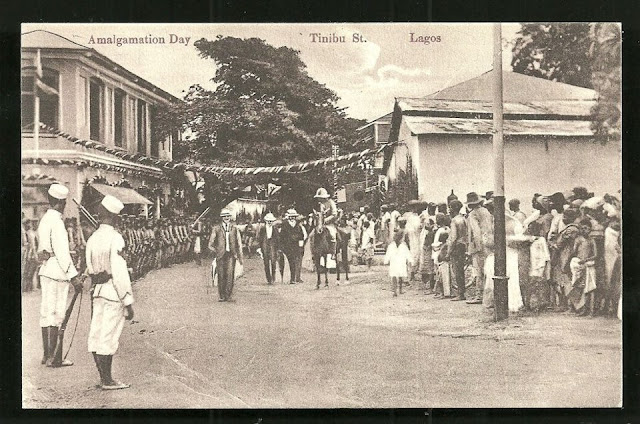
Amalgamation Day in Lagos, 1914
12 March, 2011


08 March, 2011
Fiscal Oil
So prices of crude oil have spiked up in recent days, and analysts worldwide have had fun discussing every aspect of it.
In terms of our Federal Republic, there is a curiously contradictory outcome.
On the one hand, higher oil prices mean more revenue for the government and higher GDP growth figures. The infamous "Excess Crude Account", which had been on the brink of being completely depleted, has bounced back, with an estimated US$2.1 billion in new funds accrued to the account in the last seven weeks. And we all know how the Obasanjo II Administration claimed the credit for "economic growth" in the early 2000s when demand from India and China exogenously raised the barrel price of Nigerian crude.
But on the other hand, the equally infamous "fuel subsidy" somewhat negates the effect. We get a certain price for our exports of unrefined crude. We then import refined fuel products. Part of the price of the imports is paid by the consumer, and the rest, the so-called subsidy, is conventionally assumed to be paid by the federal government, but is apparently actually paid by the Nigerian National Petroleum Corporation (NNPC).
Trustworthy (emphasis on trustworthy) information about the fiscal picture of our federal republic is scarce. All three tiers of government have a vested interest in making sure no one can accurately track exactly how much money is coming in to government coffers and how much is going out. But as near as I can tell, there is a fiscal sleight-of-hand going on. The extra revenue is going to the government, not the NNPC, but the extra expense is going to the NNPC, not the government. The government is free to spend the "awoof" as though it were free money, a true windfall, with no costs attached, making no provisions to deal with funding the subsidy since that is the NNPC's responsibility ... while the NNPC faces increased costs which it cannot offset against the fiscally detached, surging revenue stream.
In the last year or so, there has been much discussion of whether or not the NNPC is bankrupt. I have not said anything about it on my blog, because there is very little substantive information on which to base an opinion (which is, alas, the normal state of things in our Federal Republic). The different sides of the argument just insist on their position, and say a few meaningless things designed to sound as if they have given you the fiscal facts even though they haven't actually said anything about anything, least of all the NNPC.
What is certain is the NNPC owes billions in payments to the importers of refined fuel products. In January of 2011, a report in the excellent Business Day said the NNPC's debt to importers was =N=499 billion (US$3.3 billion), and quoted sources who predicted the debt would rise to =N=600 billion (US$4 billion) by June of 2011.
In addition to this, NNPC reportedly owes =N=450 billion (US$3 billion) to the Federal Government, or more appropriately the Federation Account from which all three tiers of government are "allocated" funds. The National Assembly has variously attempted to force the NNPC to cough up the funds, which seems to be something of an exercise in fiscal self-delusion.
And I don't know if it has been released yet, or if the investigation is still on-going, but I have not yet heard the result of the probe into the =N=1.2 trillion (US$8 billion) "scandal" involving the mishandling, mismanagement, misallocation and alleged embezzlement (of a portion thereof) of fuel-subsidy-related expenses managed by the Petroleum Products Pricing Regulatory Agency (PPPRA) in the five years between 2005 and 2010. The investigation began in December, 2010.
Because the NNPC cannot pay its debts, the Federal Government must, every so often, grant, allocate or (amusingly) loan billions of dollars to the NNPC to service its debts. Since these funds ultimately come out of the federal budget, the federal government in effect has spent =N=2 trillion (US$13.3 billion) on the fuel subsidy in the last four years.
Last year, the Deputy Finance Minister, Remi Babalola, ignited controversy when he said the NNPC was "insolvent". What followed was a year of denials by the federal government and by the NNPC ... until February 2011 when Business Day ran a report captioned:Finally, NNPC admits: ‘We are broke’. Speaking at the Oil and Gas Conference and Exhibition in Abuja, the corporation's senior officials went so far as to say corporate failure was possible if the NNPC didn't undergo "transformation" major Oil and Gas Conference. Interestingly, they also said the NNPC cannot pay its =N=450 billion (US$3 billion) debt to the Federal Government until the Federal Government pays the NNPC =N=1.156 trillion (US$7.7 billion) in reimbursements for fuel subsidy expenses.
This is our fiscal dilemma.
On the one hand, higher barrel prices for crude oil mean more revenue for our three tiers of government, and higher GDP growth.
And on the other hand, the dubious structure of our accounts means the gains are less than they appear to be ... and the three tiers of government will continue the practice of spending as "profit" funds that should have gone to pay the costs of the subsidy.
It is the sort of thing that led to problems for RISONPALM, for Nigerian Airways, for the Refineries, the Railways and everything else. It is not just that we consume capital rather than invest it. It is not just that we consume "input" as though it were "output", leaving us with insufficient input to create future output. It is not just that we consume funds that should have been used for maintenance. But we are now taking the money that is supposed to pay for our subsidy, and spending it on short-term consumables as though it were "profit" from increased crude prices.
Electrified
We want to be a "Top 20 by 2020" economy.
Our economy is currently smaller than South Africa's.
Our population is [u]officially[/u] three times South Africa's.
To have the same GDP per capita as South Africa has today, our economy would have to be three times as large.
South Africa generates 40,000MW of electricity .... and has been suffering power outages for years.
Nigeria does NOT generate up to 10,000MW of electricity.
Depending on what type of technology you use, it could take up to $1 billion to generate 1,000MW.
Do the mathematics.
Ask yourself if there is even a single candidate for (rigged) election at any of the three tiers of government who has a plan that is rational and feasible.
We are wasting time.
06 March, 2011
It is OUR money, isn't it?
This happened recently:
Some months ago:
When these politicians (and their wives) want to generate cheap popularity, they pull stunts like this. There is really no institutionalized or systemic government-run social welfare net in our Federal Republic. Oh, there are a lot of agencies that in theory fulfill that role, but in practice with an estimated (more like guess-timated) 70% of the population in need of some form of social welfare assistance (including significantly health care, education and nutrition), the fact is most Nigerians don't receive anything of note from any of the three tiers of government.
Mind you, it isn't simply a lack of will. Much more important than that is the lack of resources, even if the will was there. On this blog, I have criticized Amina Az Zubair and the Millennium Development Goals Office because they keep talking about what they believe they will achieve, without being honest about the fact that they have never been given sufficient resources/funding to achieve the things they say they want to achieve.
Adding all three tiers of government in the Federal Republic together, there simply isn't enough in the budget to fund any such programmes .... and what little funding there is (relative to our HUGE population) is wasted on a political-administrative structure that pays for far too many political office-holders of one sort or another, as well as funding the patron/client networks connected to each office-holder "legally" (examples include excessive/unnecessary/disadvantageous contract awards and the use of one's office to bend commercial/market/economic decisions in the direction of one's self, one's patrons and one's clients) and illegally (including but not limited to outright theft).
Every once in a while, in every state of the Federal Republic you hear of political figures magnanimously distributing rice .... or motorcycles .... or raw cash. Sometimes the political figure establishes himself as a "Pillar of Sports", pouring cash into the state's professional football club, or creating a new club from scratch.
They do this in a highly personalized way. Rather than create an institutionalized or systemic method of continuously and consistently provided welfare assistance for citizens, they prefer random, one-off EVENTS .... with the magnanimous political figure clearly identified as the source of the largesse.
But are they really the source? Aren't they just spending GOVERNMENT MONEY, which belongs to all citizens, and which is supposed to be budgeted for in an organized fashion on a yearly basis .... as opposed to spent in bulk on nothing more than the private whim of a political figure? And I am not just talking about individuals who are in government; those out of government are usually spending funds acquired through dubious, unfulfilled contracts -- and in one case giving us millions of dollars from a billion-dollar stash gained from the receipt of an oil block given by a military dictatorship that bought political influence by dashing oil blocks to political friends (and federal ministers).
They take our money .... and then make us thank them for dribbling a few crumbs of our own money back into our hands. We have to beg them, kiss their arses, and praise them to high heaven because money that could have improved electricity, water-supply, education, healthcare or roads went into someone's pocket, and that someone has pitied us and dashed us a few kobo to use and buy groundnut.
How did we allow ourselves to fall so low?
Five students were killed and several others reportedly injured during a riot by students who wanted a share of the ₦15 million distributed by the Akwa Ibom State governor Godswill Akpabio. The tragedy occurred yesterday at the Government House Uyo and the Ibom Hall where undergraduate students and unemployed graduates gathered at the instance of the state governor.
...........................................................................................................
Mr. Akpabio had announced a ₦10 million largesse for undergraduate students who were supposed to get their money at the Government House. His running mate in the gubernatorial election, Nsima Ekere, was billed to distribute the rest ₦5 million to unemployed graduates who converged at the Ibom Hall.
Trouble started with the rumour that organisers of the event have taken away ₦4 million out of the ₦10 million given to the students. After waiting for more than four hours for the remaining ₦6 million to be shared, the students started a protest.
The protest turned into a stampede as security agencies tried to remove them from the premises. In the ensuing scramble, gunshots were fired by the police and the protesting students responded by hurling stones at the police officers.
Some months ago:
For the nation’s 50th year anniversary celebrations the president’s wife, Patience Jonathan, decided to share bags of rice to “alleviate the poverty” of local women – and did this in the crudest, most elementary way possible – by calling people together and throwing them bags of rice like beggars.
By the time she was through, there were plenty of casualties, some fatal, as citizens struggled not just for rice but also against the complete absence of crowd control measures or indeed any kind of preparation to handle the melee that was sure to ensue from that method of distribution.
The bottom line: someone wanted to make a public show of doing good, but the action was neither thought through nor planned well; a metaphor for many of this administration’s handling of crucial issues.
When these politicians (and their wives) want to generate cheap popularity, they pull stunts like this. There is really no institutionalized or systemic government-run social welfare net in our Federal Republic. Oh, there are a lot of agencies that in theory fulfill that role, but in practice with an estimated (more like guess-timated) 70% of the population in need of some form of social welfare assistance (including significantly health care, education and nutrition), the fact is most Nigerians don't receive anything of note from any of the three tiers of government.
Mind you, it isn't simply a lack of will. Much more important than that is the lack of resources, even if the will was there. On this blog, I have criticized Amina Az Zubair and the Millennium Development Goals Office because they keep talking about what they believe they will achieve, without being honest about the fact that they have never been given sufficient resources/funding to achieve the things they say they want to achieve.
Adding all three tiers of government in the Federal Republic together, there simply isn't enough in the budget to fund any such programmes .... and what little funding there is (relative to our HUGE population) is wasted on a political-administrative structure that pays for far too many political office-holders of one sort or another, as well as funding the patron/client networks connected to each office-holder "legally" (examples include excessive/unnecessary/disadvantageous contract awards and the use of one's office to bend commercial/market/economic decisions in the direction of one's self, one's patrons and one's clients) and illegally (including but not limited to outright theft).
Every once in a while, in every state of the Federal Republic you hear of political figures magnanimously distributing rice .... or motorcycles .... or raw cash. Sometimes the political figure establishes himself as a "Pillar of Sports", pouring cash into the state's professional football club, or creating a new club from scratch.
They do this in a highly personalized way. Rather than create an institutionalized or systemic method of continuously and consistently provided welfare assistance for citizens, they prefer random, one-off EVENTS .... with the magnanimous political figure clearly identified as the source of the largesse.
But are they really the source? Aren't they just spending GOVERNMENT MONEY, which belongs to all citizens, and which is supposed to be budgeted for in an organized fashion on a yearly basis .... as opposed to spent in bulk on nothing more than the private whim of a political figure? And I am not just talking about individuals who are in government; those out of government are usually spending funds acquired through dubious, unfulfilled contracts -- and in one case giving us millions of dollars from a billion-dollar stash gained from the receipt of an oil block given by a military dictatorship that bought political influence by dashing oil blocks to political friends (and federal ministers).
They take our money .... and then make us thank them for dribbling a few crumbs of our own money back into our hands. We have to beg them, kiss their arses, and praise them to high heaven because money that could have improved electricity, water-supply, education, healthcare or roads went into someone's pocket, and that someone has pitied us and dashed us a few kobo to use and buy groundnut.
How did we allow ourselves to fall so low?
03 March, 2011
Democracy II?
Some days ago, I posted this piece called "Democracy?", discussing Bauchi Governor Isa Yuguda's executive order banning any campaign but that of President Jonathan from placing posters or banners in any of Bauchi's principal cities and towns. No campaign paraphernalia is to be allowed in public within 20 kilometres of the cities and towns except that of the President.
Today comes this report from Daily Trust about the PDP governors of Niger, Ebonyi and Benue banning, barring or blocking the presidential campaign rallies of the CPC, ANPP and ACN respectively.
Ah, the joys of "dem-go-crazy".
Today comes this report from Daily Trust about the PDP governors of Niger, Ebonyi and Benue banning, barring or blocking the presidential campaign rallies of the CPC, ANPP and ACN respectively.
Ah, the joys of "dem-go-crazy".
Doctors on Strike
Do something for me. Read this article. Think about it.
Now answer a question for me.
Why do doctors and nurses in Nigeria go on strike?
A commenter on another website had this to say:
A second commenter concurred with him:
That is certainly one way to look at it .... a way of looking at it that does not, cannot, will not comfort those who have watched members of their families die while doctors and nurses are striking.
What makes it so much worse is their going on strike achieves NOTHING.
I am not old, but I am not young, and I have seen so many of these medical strikes come and go .... and all I have to say about the success-rate of these strikes is the current strikes are about the same issues that were not resolved by the previous strikers! These issues will not be resolved by the current strikes either. And so long as Nigeria remains politically, fundamentally, structurally, systemically, economically, societally and institutionally the same as it is now, future strikes will be just as useless in resolving these issues.
Look, either a person or group takes firm (dare I say "revolutionary") action to change the political, fundamental, structural, systemic, economic, societal and institutional nature of the Federal Republic of Nigeria .... or they should stop wasting our time (and our lives)!
These doctors and their strikes have NO EFFECT on the basic, core nature of the way things are. Supposedly, 2011 is an election year, but health care (or the lack thereof) will play no role whatsoever in deciding which of the politicians occupy the Presidency, National Assembly, State Assembly, Governorships, etc .... and will play little or no role in what policy decisions these politicians make when they are in office. After we have wasted so much money and time on the charade, the countdown will begin till the next doctors and nurses strike.
PS: Yes, I saw the part of the article where it said a woman in critical need of emergency medical care was turned away because her husband didn't have =N=150,000.00 to pay for a Caesarean section. Unfortunately, this is also "normal" in Nigeria. I saw it upfront and personally decades ago when I broke my arm as a child. I have never forgotten it. I will never forget it.
Now answer a question for me.
Why do doctors and nurses in Nigeria go on strike?
A commenter on another website had this to say:
Cause and effect. The strike is the effect. We should be looking at causes. Govts shouldn’t be creating conditions that force doctors to go on strike.
It is easy to say they should be on a higher moral plane, but being on a higher moral plane does not mean they should allow a criminal govt to continue shafting them. If you are a doctor in Naija, you would have seen way too many people die from criminal negligence by the govt, from inadequate equipment to NEPA doing their thing during surgery, to babies in incubators dying when there is a power failure, etc. Being a doctor required to work in terrible conditions can make you immune to the suffering of your patients.
A second commenter concurred with him:
Boy, until you enter the 'situation' yourself, its kind of easy to talk. I am against doctors striking myself, but don't forget that doctors too are victims of a negligent government. A doctor that hasn't been paid for six months is equally in danger of his own sick child or pregnant wife dying needlessly from poor facilities.
Moreover doctor's strikes have often been less about salaries and more about inadequate or non-existent facilities.
As a doctor, how many times for instance can you use your personal money to buy drugs or drips or needles for a patient you know is sure to die if you don't? These things happen regularly, nobody hears about them but everyone hears about the strikes.
I have my own personal stories from when I was a rookie doctor in Naija
That is certainly one way to look at it .... a way of looking at it that does not, cannot, will not comfort those who have watched members of their families die while doctors and nurses are striking.
What makes it so much worse is their going on strike achieves NOTHING.
I am not old, but I am not young, and I have seen so many of these medical strikes come and go .... and all I have to say about the success-rate of these strikes is the current strikes are about the same issues that were not resolved by the previous strikers! These issues will not be resolved by the current strikes either. And so long as Nigeria remains politically, fundamentally, structurally, systemically, economically, societally and institutionally the same as it is now, future strikes will be just as useless in resolving these issues.
Look, either a person or group takes firm (dare I say "revolutionary") action to change the political, fundamental, structural, systemic, economic, societal and institutional nature of the Federal Republic of Nigeria .... or they should stop wasting our time (and our lives)!
These doctors and their strikes have NO EFFECT on the basic, core nature of the way things are. Supposedly, 2011 is an election year, but health care (or the lack thereof) will play no role whatsoever in deciding which of the politicians occupy the Presidency, National Assembly, State Assembly, Governorships, etc .... and will play little or no role in what policy decisions these politicians make when they are in office. After we have wasted so much money and time on the charade, the countdown will begin till the next doctors and nurses strike.
PS: Yes, I saw the part of the article where it said a woman in critical need of emergency medical care was turned away because her husband didn't have =N=150,000.00 to pay for a Caesarean section. Unfortunately, this is also "normal" in Nigeria. I saw it upfront and personally decades ago when I broke my arm as a child. I have never forgotten it. I will never forget it.
Revolution in Nigeria?
The Federal Executive Council says an Egyptian-style revolution is impossible in Nigeria. Laughably, a spokesman said this is because Nigeria is "being run on constitutional order where the tenure of office of leaders is fixed". As though the people rebelled simply because of the length of tenure of the North African autocrats. The young Tunisian who set himself on fire, sparking the chain of events, did not do so merely because Ben Ali had been in office for decades.
as reason for his optimism.
The Speaker of the House, Dimeji Bankole (who becomes a mirror-world parody of himself more and more with each passing day) added his voice to the noise, telling a delegation of German parliamentarians a revolution was impossible in Nigeria because the "acceptance of democracy by the citizens" meant "North Africa’s experience was, therefore, not applicable to Nigeria".
Oh come on Dimeji. You know more than most that our democracy is all form and no substance.
But, while the FEC and the Speaker are definitely self-serving with their comments, they may have a point.
No revolution is imminent in Nigeria.
In our Federal Republic, nearly everyone is "marginalized" in one way or another; for example, we are all marginalized politically, because we still can't use our votes to decide who should hold political/government office. Unfortunately, we the people are divided against ourselves, each of us believing himself and his group to be the victims of "Nigeria" (where "Nigeria" is defined as every other individual and sociocultural group not ourselves).
But there is one other, possibly more influential issue.
I look at the transition in Egypt and Tunisia, and it seems to me the pre-existing political elite are still in charge, save for the musical-chairs removal of respective unpopular figureheads.
I suspect Nigerian citizens are reluctant to put their lives on the line and die for "change", because we all believe that the political beneficiaries of any such action on our part will not be much different from the people we would have died to remove from office. I suspect the average Nigerian citizens believes the consequent and subsequent economic structure following their sacrifice would not be much different from the economic structure they died to change.
No one actually says this out loud ... but nobody ever bothers to protest or fight when there is a rigged election, a military coup or an annulled election. Deep down in our hearts, Nigerians believe the victims and beneficiaries of such plots and shenanigans are more like each other than they are like we the average citizens.
We would not be fighting to free ourselves, but fighting to decide which of several political barons will oppress us for the next few year. Our lives won't change either way, so we don't even waste our time thinking about it, much less doing something about it.
But let me tell you something.
You know what will happen after the 2011 (rigged) elections?
The same things that happened before it. Jos will erupt in violence. Random killings will continue in the Northeast. There is quite a long list of things that will just continue as usual ... and even though these things happen with the frequency of the sunrise and the sunset, the federal, state and local governments will continue to react as though they were surprised and thus unprepared.
But there is one man with cautious optimism. A man who provided a ray of intelligent commentary on the comparison between Nigeria and the status quo ante in North Africa before the citizen revolts. Unsurprisingly it comes from Sanusi Lamido Sanusi, the current Governor of the Central Bank of Nigeria. Speaking after receiving an honorary doctorate from the University of Nigeria, Nsukka he affirmed that our Federal Republic had everything it needed to succeed and warned that unless we harnessed our strengths to achieve our true potential we would be running the risk of a North-African-style popular revolt in Nigeria.
Apex Socio-Cultural Organization of A Geo-Political Zone
We often talk about countries doing things.
(a) Tensions rise between Ethiopia and Eritrea.
(b) Rwanda invades DR-Congo.
(c) Nigeria wins the 2012 Nations Cup.
We know what we mean when we say these things, but if these statements are taken literally, it is as if we are saying:
(a) Tensions rise between 85,000,000 individual people and 5,000,000 individual people.
(b) 11,000,000 individual people invade 71,000,000 individual people.
(c) 120,000,000 individual people win the 2012 Nations Cup.
It doesn't make sense, does it? When we speak of entire nations "doing" something, we are really referencing the specific decisions and actions of a micro-minority of that country's overall population.
It is not pedantic. It is actually quite important, especially in the Federal Republic of Nigeria.
Far too many of us Nigerians tend to hold EVERYONE in an ethnic/regional/religious group responsible for the decisions and actions of a micro-minority of members of that group.
Far too many of us Nigerians treat the statements and actions of the unelected (and often self-proclaimed) "leaders" of ethnic/regional/religious as though these statements and actions ipso facto represented the thoughts, desires, wishes and intentions of everyone in the groups these "leaders" claim to speak for. In particular, I am sick and tired of the Nigerian news media imbuing the words of "apex sociocultural/geopolitical groups" with a credibility they do not deserve and have not earned or proven.
Like all Nigerians, I too am part of an ethnic community, a regional community and a religious community. The thing is, when the publicly-claimed, so-called "leaders" of my specific groups open their mouths, NOTHING they say reflects anything I have ever thought, hoped, wished, desired or intended in my entire life ... yet the media treats them as if they are my leaders, as if what they say reflects my opinion ... and depending on where I am in Nigeria when crises break out, I could actually pay with MY LIFE when youths from another sociocultural group attack me to punish me for being (in their minds) complicit in decisions by men I don't even like, and for supporting (as far as they are concerned) actions that I in fact had opposed from the start.
It doesn't make any sense.
We are so powerless as citizens that we do not influence anything. We are like spectators in our own country. Yet we keep blaming each other for stuff none of us are in control of, rather than joining our forces together to fight for ALL OF US to finally be in control of our individual and collective destinies after thousands of years of being puppets in our own land.
PS: If you are wondering what prompted this post, well, I was privy to a conversation involving a group of Nigerians, the majority of whom believed that sociocultural groups benefit from having "one of their sons" in political power. A corollary to that argument is the insistence that the sociocultural groups whose "sons" are not in power are "marginalized". The reality is ALL OF NIGERIA is marginalized, has been marginalized and will remain marginalized deep into the future because we the ordinary people are too busy treating each other as rivals and enemies to work together to end our collective marginalization. Raise your head up and look around; not only are we marginalized in our own country, but are country (inasmuch as it pretends to be an African "giant") is thoroughly marginalized in strategic world power politics and the ever-more-complex global economy.
One good move, two bad moves
GOOD MOVE:
The Central Bank of Nigeria has banned banks from funding political campaigns.
BAD MOVES
Even as the federal and state governments run up new mountains of unproductive debt, the Senate has approved new debt for the first and second tiers of government.
The courts grant yet another set of inexplicable tenure extensions to state governors, this time to five governors at one go. The courts keep acting as if the constitution was designed to give the protect the politicians' right to four years in office.
Contrary to the courts' illogical, irrational, inexplicable and probably unconstitutional perspective, I have said repeatedly on this blog that the four-year term is meant to constitutionally guarantee citizens the right to choose their political leaders every four years; when you extend terms willy-nilly, you end up with a situation like Anambra State, where the citizens went SEVEN YEARS (from 2003 to 2010) without substantive input in their own governance.
The four-year term is designed as a democratic protection for citizens, not a job-safety device for politicians. The slow-moving courts need to speed up the adjudication of electoral disputes, rather than continually grant politicians tenure-extensions that defeat the purpose of democracy.
PS: You know the funny thing? It doesn't really matter, does it? Look at me, using Anambra State as an example .... as though any of the "elections" held there were substantively democratic. Maybe the courts grant tenure-extensions because they know it doesn't defeat democracy since there is no democracy to be defeated in the first place. Maybe the courts think they are better-placed to impose candidates on the citizens, rather than leaving it to Big Men's back-room deals. Why else did the courts name Rotimi Amaechi the Governor of Rivers State even though he was not even on the ballot and consequently received exactly ZERO VOTES?
01 March, 2011
The River Dredged
I still believe fixing AND EXPANDING the railways is a much, much, much, much higher priority than dredging the River Niger. A functional, pan-federal rail network would connect the ENTIRE federal republic and support economic development and social welfare in more ways than I can describe on a blog.
However ....
.... since the federal government decided to prioritize the dredging project, I am pleased to see that it is coming together nicely.
Yes, you heard me. I gave the federal government a compliment. And I stress that the compliment is for the government, not for any particular president, because this project cuts across the past two or three presidential administrations (definitely the last two, and probably the one before them).
Read about it in this report from Daily Trust. I can't wait to take a trip down the River myself.
Subscribe to:
Posts (Atom)