A few minutes ago, I read one (of very, very, very many) essays advocating United Nations reform. These essays usually focus on the UN Security Council. They tend to call for the inclusion of Brazil, Japan, Germany, India as permanent (albeit non-veto holding) members of the Security Council. Supposedly it is to reflect the changing politico-economic power dynamics of the 21st century.
A sub-set of these commentators call for the addition of two African permanent non-veto members. One part of this sub-set consists of politically correct non-Africans, and non-Africans who see themselves as the official guardians of otherwise defenceless Africans. The other, larger part of this sub-set consists of African intellectuals, commentators and political figures who unanimously endorse the "two permanent non-veto seats for Africa" idea, and disagree only on the identity of the countries to hold the seats. Nigerians assume it should be Nigeria and South Africa; Egyptians assume it means Egypt and South Africa; Senegal, Algeria and Kenya assert it is themselves respectively and South Africa; while South Africans believe it is South Africa and somebody else.
I suspect the "two seats for Africa" argument was designed to usher South Africa and Egypt into the Security Council as permanent, non-veto members. The nations of Western Europe and North America (who more less control pretty much all the so-called "multilateral institutions") have more or less appointed South Africa the "official" representative to Africa. And Egypt would fulfill the politically correct requirement to give every global region a permanent seat, by representing West Asia (a.k.a "the Middle East").
I am not sure what Mexico or Canada or South Korea or any number of other countries think about the "two seats for Africa scenario". It would be politically incorrect of them to openly criticize it, but I bet it would irritate them if politico-economically weaker African nations got permanent council status ahead of them because of a sort of global affirmative action.
Speaking as a Nigerian, I think it is nothing short of ludicrous to suggest that our 140 million people are somehow "represented" by giving a seat of any kind to some other country, be it South Africa, the USA, or Kazakhstan. Come to think of it, giving a seat to Nigeria would not grant an iota of representation for Guinea, Congo or Tanzania. Every human being on the world should have the right to cast a vote for his/her government, and that government (provided it is democratically chosen) is the only valid representative of the people therein.
Besides, I would much rather have the real security accruing from a Federal Republic of Nigeria that is a bona fide and substantive politico-economic global power .... rather than the fake, self-deceiving comforts of a cosmetic device granted only to present a public face of politically correct inclusivity.
But I digress.
Here is the thing that bothers me:
Why does every commentator start with the assumption that the Security Council has to exist? The first step to democratic, sensible, efficient, effective reform of the United Nations is to getting rid of the albatross of the Security Council. It is about as useful to the cause of human progress as the UN Human Rights Council.
No, seriously.
At the end of World War Two and start of the so-called Cold War, the victors of WW2 were the dominant powers on Earth. They created a body (the Security Council) that would give them the right to control the agenda of the new United Nations; basically they could veto anything the rest of the world might agree on, provided it violated whatever they perceived to be their national interests (conversely, to get anything done, you had to make sure they agreed to it).
Officially this was done to ensure "world peace", but in reality the Security Council was a neutral place for serious discussions between the major powers to avoid war .... in Europe, North America and the Soviet Union.
The rest of us were screwed.
The Cold War was not Cold at all, or more correctly, it was Cold only in Europe, North America and the Soviet Union. For the rest of the world, it was quite HOT. It was like there was an unwritten agreement between NATO and the Warsaw Pact to use the rest of the world as their battleground, thus keeping their homelands safe. Powers on both sides invested vast resources to create and/or sustain endless civil wars, to prop up mass-killing tyrants, and to arm and train disparate guerrilla armies in the arts of terror. And the truth is there is no way on Earth the Apartheid regime could have acquired its nuclear weapons without the tacit approval of the big NATO powers; indeed, the technical assistance to create those weapons was provided by a country that does not make a move without seeking US approval first.
The Cold War ended, and the Security Council remained useless. You can't really blame the body; no matter how much rhetoric you pour on it, a fish cannot become an elephant.
When I think about peace and stability in Nigeria, in the neighbouring West African and Central African regions, and across all of Africa, I do not think about the Security Council or its permanent five. Nigeria and Africa need transformation that verges on the revolutionary in DOMESTIC and INTRA-CONTINENTAL politics, economics, society, government and culture. Without this, we have nothing.
Take Sudan for example. By and large, Sudan has been at war with itself since 1955, some 54 years interrupted by a brief pause (a cynic might say the pause was just long enough to give birth to the soldiers who eventually took over the fighting in the 1990s and 2000s). There is something fundamentally and systemically wrong with Sudan, something that was wrong long before Omar Al-Bashir became president of the country, something that affects the whole country, north, east and south, as well as the west (i.e. Darfur). It is this systemic deficiency (whatever it substantively is), and not Al-Bashir as a man, and the "international community's" obssession with him rather misses the point entirely.
If Sudan had a democracy, judiciary, law enforcement worth of the name, and already-existing peace, they would have no use for a so-called "International Criminal Court". More to the point, they would have no use for men like Al-Bashir, his allies and his current-day rivals. And it would be in the hands of Sudanese citizens to decide whether to punish the guilty, or to adopt the "South African model" of allowing the guilty to go free from punishment in exchange for relinquishing power without war.
We are supposed to be seeking a "normal Sudan" not cementing abnormality, and whether the Euro-American commentariat admit it or not, there is something distinctly abnormal about these so-called "global governance" institutions. Anyone who reads this blog would know I am a critic of the Nigerian political system, but I would fervently oppose any "international" body that purports to have the right to depose a Nigerian president, even a terrible one. That right is OURS as Nigerians, and when we lose that right, bad things result. Mind you, if we don't exercise that right when faced with bad government, bad things result too. This is the central issue, our rights, whether we have them and whether we use them, not some debate over whether the doctrine of "humanitarian intervention" permits foreign countries to compel outcomes in our countries. Why do people act like the choice is between a cabal of unelected domestic leaders and a cabal of unelected (by us) foreign leaders? When do we get to decide? Probably when we insist on deciding, and stop being so damn passive and apathetic.
So how do we change Sudan? Difficult question, mainly because only the Sudanese can change Sudanese society. But if Sudan was surrounded on all sides by neighbours that had undergone transformation, it would be difficult for them to sustain their lack of it. They would come under pressure from neighbours concerned at the potential for spillover and refugees .... and from a continent that needs Sudan (a land of great potential wealth) to pull its weight in uplifting the continental economy (I know Nigeria for one could do great trade/business with a resurgent Sudan).
Unfortunately, Sudan is surrounded by Chad, Central African Republic, Libya, Uganda, Ethiopia, DR-Congo, Eritrea and (mostly disappointingly of all, given their influence in Sudan) Egypt. Far from coming under pressure for their abnormality, the Sudanese leadership probably feels quite normal in this neighbourhood. The political leaders of these neighbouring countries are unlikely to see anything fundamentally wrong with the way Sudan has run itself over the last half-century; their countries may be more peaceful than Sudan (only slightly so in some cases) but these leaders (and their predecessors and successors) run their countries in modes that are but branches of the same tree as Sudan.
In fact this is the central problem with African stability. This is where the problem lies, not thousands of kilometres away in the UN's "Security Council"
For example, instead of asking why the "Security Council" did nothing about the Rwandan genocide, we Africans should ask why Africa did nothing about the Rwandan massacre. If we can answer that question, we will be on our way towards preventing tragedies like that from happening in the future. Almost every African country suffers (to varying degrees) the same poisonous ethnic chauvinism and internal xenophobia that brought Rwanda to violence, indeed, most of us have tasted inter-communal violence too. Our armies and police can barely keep the peace in our own borders much less contribute toward stabilizing a neighbour, and our governments are more likely to cause strife between citizens than they are to solve it.
The solutions to these issues are in our hands, not in the hands of the permanent five, or the new permanent ten or permanent fifteen. If anything, the current permanent five (and their allies) have strategic and commercial interests that too frequently lead to decisions and actions that are the opposite of what Africa needs for true long-term stability, peace and growth. Take the hypocrisy of Europe and North America criticizing China's role in Sudan and Robert Mugabe's rule in Zimbabwe, when the USA and Western European powers are bosom buddies with the violent, kleptocratic, de facto monarchic dictatorship in Equatorial Guinea! In this world, everyone ultimately looks out for their own interests, and the day we Africans start looking out for ours (continental peace and stability inclusive) is the day we stop accepting and tolerating a lot of the rubbish that we do.
I am not interested in UN Security Council reform. The functions cited as necessitating the Security Council's existence are functions best handled by organizations like the African Union, ASEAN, the Arab League, the Council of Europe, the OAS, etc. Those are the institutions we need to reform. Adding new permanent members certainly gives the newbies a psychological boost, a prop for national self-esteem, but what really does it do to bring peace to anyone? Will the Kashmir dispute be resolved by adding Brazil, India, Japan and Germany to the Security Council?
I am no Nkrumah (RIP), and I do not particularly support the idea of a single government ruling over all of Africa (more on that later), but I would feel so much more secure if NATO, Russia and China had to take into consideration a stronger, more allied Africa when they made their "strategic interest" decisions. There is no security in in weakness and the vain, naive hope that an expanded council of Big Powers will somehow give us peace.
I am sick of the cult of dependence; stability in our lands is our responsibility as Africans. I am more interested in Nigerian Police Force reform, in Nigerian Armed Forces reform, in Nigerian political reform, in ECOWAS reform, and in African Union reform (new name for starters) than I am in ANYTHING at all related to the UN Security Council. The things I care about have direct impact on the lives of my countrymen, and will have (if reformed) a direct and positive impace on security and stability on my continent.
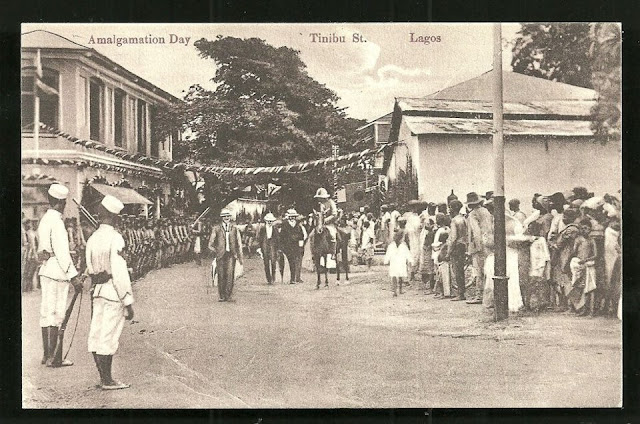
Amalgamation Day in Lagos, 1914
08 April, 2009


07 April, 2009
Still on the rate ceiling
An interesting essay in the impressive new publication NEXT.
Their columnist, Bode Agusto, takes us back to the 1980s and 1990s when governments led by generals tried to control the interest rates, noting that the banks merely impose non-interest "fees" on private sector borrowers, equivalent to the difference between the market interest rate and the government-imposed interest rate ceiling.
He argues our governments' (past and present) official explanation of these rate ceilings (that it is necessary to allow the private sector to access loans/capital at affordable rates) are a smokescreen. The real purpose, in his view, is to allow governments facing fiscal problems to fund their deficits by borrowing at below-market rates.
In Mr Agusto's words:
Our governments, state and federal, will be borrowing an estimated $11 billion this year to fund their deficits, most of that from local banks.
I am troubled by this. We do not really know what the CBN is thinking or why they do what they do. I do not trust the public statements of any political figure, be they Nigerian or otherwise, but in Nigeria specifically there is so little credible information out there that rumours and innuendo rule the roost. Even the so-called credible leaders spend most of their time talking out of both sides of their mouths because that is the only way to keep their jobs; for example the CBN's Charles Soludo had a lot more influence during the Obasanjo regime than he has had under the Yar'Adua regime, but in exchange for that influence, he kept his mouth shut while Obasanjo, the PDP, and Obasanjo's bosom allies the Uba brothers more or less wrecked Soludo's own home state Anambra. See no evil, hear no evil, speak no evil of the Ubas made Soludo a jolly CBN governor .... but that sort of attitude basically undermines any good a person thinks they are doing.
Basically, what I am getting at is Charles Soludo is not going to tell us if the government's rate ceiling is just a command economy ruse to get cheap money out of the banks to fund the deficit.
And at a time when the banks are carrying $10 billion in toxic assets, it seems odd the government would oblige them to find $11 billion in loans for which they cannot expect a full market rate of return. It is easy to say the bigger banks could just absorb the smaller banks, but is it not better to be safe than sorry?
And do we really want to crowd out the private sector in a time when credit is in short supply worldwide?
I have a feeling I will make several more blog posts exploring this issue further ... but for now, I suggest we look at the other side of the ledger, to rationalize, simplify and tighten up our tax collection. And we can dramatically cut costs by pushing the administrative realignment I advocated thus:
This would save us a lot of money. And if it is done right, we would NOT have to sack civil servants to see the benefits of cost savings (but that should be the topic of a separate post .... nevertheless, the strange thing about Nigeria is every time you ask the government to cut costs, they start talking about the effects of laying off civil servants, when civil servants are not the problem and have never been the problem. We keep creating new reasons for new political jobs, be they "elected" posts or "appointed" posts. The only "reforms" our leaders are capable of are the creation of new LGAs, new states, new political bureacracies that duplicate, triplicate, and quadruplicate existing functionalities .... only for the collective mass of bureaux and commissions to fail to do the job that one could have done.)
Their columnist, Bode Agusto, takes us back to the 1980s and 1990s when governments led by generals tried to control the interest rates, noting that the banks merely impose non-interest "fees" on private sector borrowers, equivalent to the difference between the market interest rate and the government-imposed interest rate ceiling.
He argues our governments' (past and present) official explanation of these rate ceilings (that it is necessary to allow the private sector to access loans/capital at affordable rates) are a smokescreen. The real purpose, in his view, is to allow governments facing fiscal problems to fund their deficits by borrowing at below-market rates.
In Mr Agusto's words:
In the end,businesses pay market rates while government borrows at below mar-ket rates. The high interest rates and weakening exchange rates will ultimately impact product prices and erode purchasing power. The poor, the very ones we are trying to protect, suffer most.
It is therefore in the interest of the poor to have high interest rates now because this may force the government to address the fundamental problem the level of government spending.
Our governments, state and federal, will be borrowing an estimated $11 billion this year to fund their deficits, most of that from local banks.
I am troubled by this. We do not really know what the CBN is thinking or why they do what they do. I do not trust the public statements of any political figure, be they Nigerian or otherwise, but in Nigeria specifically there is so little credible information out there that rumours and innuendo rule the roost. Even the so-called credible leaders spend most of their time talking out of both sides of their mouths because that is the only way to keep their jobs; for example the CBN's Charles Soludo had a lot more influence during the Obasanjo regime than he has had under the Yar'Adua regime, but in exchange for that influence, he kept his mouth shut while Obasanjo, the PDP, and Obasanjo's bosom allies the Uba brothers more or less wrecked Soludo's own home state Anambra. See no evil, hear no evil, speak no evil of the Ubas made Soludo a jolly CBN governor .... but that sort of attitude basically undermines any good a person thinks they are doing.
Basically, what I am getting at is Charles Soludo is not going to tell us if the government's rate ceiling is just a command economy ruse to get cheap money out of the banks to fund the deficit.
And at a time when the banks are carrying $10 billion in toxic assets, it seems odd the government would oblige them to find $11 billion in loans for which they cannot expect a full market rate of return. It is easy to say the bigger banks could just absorb the smaller banks, but is it not better to be safe than sorry?
And do we really want to crowd out the private sector in a time when credit is in short supply worldwide?
I have a feeling I will make several more blog posts exploring this issue further ... but for now, I suggest we look at the other side of the ledger, to rationalize, simplify and tighten up our tax collection. And we can dramatically cut costs by pushing the administrative realignment I advocated thus:
Nigeria should have 7 states and 84 local administrative districts, instead of 36 states and 774-and-rising local government areas. The combined total of state assemblymen and local councillors in the new setup should be at least 66% lower that the comparable figure for today.
There should be 25% fewer total federal legislators in a single parliamentary chamber, rather than two.
This would save us a lot of money. And if it is done right, we would NOT have to sack civil servants to see the benefits of cost savings (but that should be the topic of a separate post .... nevertheless, the strange thing about Nigeria is every time you ask the government to cut costs, they start talking about the effects of laying off civil servants, when civil servants are not the problem and have never been the problem. We keep creating new reasons for new political jobs, be they "elected" posts or "appointed" posts. The only "reforms" our leaders are capable of are the creation of new LGAs, new states, new political bureacracies that duplicate, triplicate, and quadruplicate existing functionalities .... only for the collective mass of bureaux and commissions to fail to do the job that one could have done.)
06 April, 2009
When law enforcers and law breakers are the same people
Intriguing editorial today in The Guardian. It says 680,000 barrels of Nigerian crude oil are stolen every day.
The editorial highlights a crucial problem with law enforcment in Nigeria -- the fact that the people in charge of enforcing our laws are too often "allied" to the people breaking the law.
It is no secret that most of the Niger-Delta militias began as paid political thugs in the employ of senior politicians, shifted to oil bunkering when the politicians were not forthcoming with payments, and have since discovered bunkering to be more lucrative than party-political thuggery and election rigging. It is unlikely the connections between politicians and militia-men were ever severed.
In like fashion, serving and retired generals have been accused of involvement "oil bunkering", a connection that became difficult to deny when the bunkering ship MT African Pride was allowed to sail away from custody. The MT African Pride incident was so blatant, the authorities were forced to try and convict two admirals. And it is not just the fat cats at the top of the food chain; mid- and lower-ranking officers have been known to get a slice of the action too, like these officers who charge fees for protection to citizens who scooped crude oil from a vandalized pipeline.
Of course many Nigerians, in government, the civil service, and the wider society, are very keen on enforcing the rule of law. And soldiers and policemen have lost their lives in the fight against bunkerers, militia-men, armed robbers and extremists of any colour .... but the efforts of these men and women are wasted in a situation where senior leadership figures play both sides of the fence, and where their own mid- to lower-ranked colleagues exploit the gaps in the system to milk a little extra cash.
We the people of Nigeria are the losers. It is not enough that public money officially disappears or is wasted after entering the public treasury, but with the rise of bunkering we the citizens are losing the money even before it gets to the Treasury.
At a time when the state and federal governments are about to borrow $11 billion in total to finance their deficits, our crude oil exports have dropped dramatically, partly because of the global economic downturn but mostly because of theft and violence, including this recent attack that cut production by 300,000 barrels a day. According to the report, The Guardian's sources in the Central Bank of Nigeria made availabe a CBN report on our oil exports in January, 2009 which revealed Nigeria was only able to export 1.45 million barrels a day, from production of 1.92 mbd (down 300,000 from 2.2 mpd due to violence).
Between violence and theft, the deficit is worse than it need be.
Of course, I am not saying that all would be well if we stopped theft and violence ... but we should be focusing on the reforms we need, rather than adding more problems to the onese we already have.
And it is simply impossible to enforce laws in a situation where the chief law enforcers are also the chief law breakers. In the near-future I am going to do a blog post on the failure of the Nuhu Ribadu-led Economic and Financial Crimes Commission, a sort of rebuttal to his army of admirers .... and one major factor in his failure is that he was in fact part of a corrupt, law-breaking federal government, a singular fact that was always going to render him ineffective even if he was truly committed to the task.
The system is not working. We need to change the system.
The editorial highlights a crucial problem with law enforcment in Nigeria -- the fact that the people in charge of enforcing our laws are too often "allied" to the people breaking the law.
It is no secret that most of the Niger-Delta militias began as paid political thugs in the employ of senior politicians, shifted to oil bunkering when the politicians were not forthcoming with payments, and have since discovered bunkering to be more lucrative than party-political thuggery and election rigging. It is unlikely the connections between politicians and militia-men were ever severed.
In like fashion, serving and retired generals have been accused of involvement "oil bunkering", a connection that became difficult to deny when the bunkering ship MT African Pride was allowed to sail away from custody. The MT African Pride incident was so blatant, the authorities were forced to try and convict two admirals. And it is not just the fat cats at the top of the food chain; mid- and lower-ranking officers have been known to get a slice of the action too, like these officers who charge fees for protection to citizens who scooped crude oil from a vandalized pipeline.
Of course many Nigerians, in government, the civil service, and the wider society, are very keen on enforcing the rule of law. And soldiers and policemen have lost their lives in the fight against bunkerers, militia-men, armed robbers and extremists of any colour .... but the efforts of these men and women are wasted in a situation where senior leadership figures play both sides of the fence, and where their own mid- to lower-ranked colleagues exploit the gaps in the system to milk a little extra cash.
We the people of Nigeria are the losers. It is not enough that public money officially disappears or is wasted after entering the public treasury, but with the rise of bunkering we the citizens are losing the money even before it gets to the Treasury.
At a time when the state and federal governments are about to borrow $11 billion in total to finance their deficits, our crude oil exports have dropped dramatically, partly because of the global economic downturn but mostly because of theft and violence, including this recent attack that cut production by 300,000 barrels a day. According to the report, The Guardian's sources in the Central Bank of Nigeria made availabe a CBN report on our oil exports in January, 2009 which revealed Nigeria was only able to export 1.45 million barrels a day, from production of 1.92 mbd (down 300,000 from 2.2 mpd due to violence).
Between violence and theft, the deficit is worse than it need be.
Of course, I am not saying that all would be well if we stopped theft and violence ... but we should be focusing on the reforms we need, rather than adding more problems to the onese we already have.
And it is simply impossible to enforce laws in a situation where the chief law enforcers are also the chief law breakers. In the near-future I am going to do a blog post on the failure of the Nuhu Ribadu-led Economic and Financial Crimes Commission, a sort of rebuttal to his army of admirers .... and one major factor in his failure is that he was in fact part of a corrupt, law-breaking federal government, a singular fact that was always going to render him ineffective even if he was truly committed to the task.
The system is not working. We need to change the system.
02 April, 2009
Update on oil export license
Read this first.
New development:
The Federal Ministry of Commerce is pointing the finger of blame at the NNPC. The Minister of State in the Ministry of Commerce, Mr. Humphery Abbah, said the NNPC submitted the "large volume of documents" to his office Tuesday night. He says he got to work on it instantly.
Based on this timeline, the signing and approval process obviously could not be completed in a single night. Indeed, the license documents would still have to go to the Customs Service, and be distributed to all Customs offices nationwide.
But investigations by The Guardian reveal the license documents left the NNPC on the 13th of February, some six and a half weeks ago.
So it was not really the NNPC's fault.
The documents have spent the last seven weeks, slowly, slowly, slowly working their way up to the desk of the Minister for approval, after which they will slowly, slowly, slowly make it to Customs, and then slowly, slowly, slowly circulate around the Customs' many offices.
Gee.
I guess that explains why we lost 100s of millions of dollars yesterday.
It is nice to know that the most strategically important export of our federal republic is handled in such an efficient and expeditious manner.
New development:
The Federal Ministry of Commerce is pointing the finger of blame at the NNPC. The Minister of State in the Ministry of Commerce, Mr. Humphery Abbah, said the NNPC submitted the "large volume of documents" to his office Tuesday night. He says he got to work on it instantly.
Based on this timeline, the signing and approval process obviously could not be completed in a single night. Indeed, the license documents would still have to go to the Customs Service, and be distributed to all Customs offices nationwide.
But investigations by The Guardian reveal the license documents left the NNPC on the 13th of February, some six and a half weeks ago.
So it was not really the NNPC's fault.
The documents have spent the last seven weeks, slowly, slowly, slowly working their way up to the desk of the Minister for approval, after which they will slowly, slowly, slowly make it to Customs, and then slowly, slowly, slowly circulate around the Customs' many offices.
Gee.
I guess that explains why we lost 100s of millions of dollars yesterday.
It is nice to know that the most strategically important export of our federal republic is handled in such an efficient and expeditious manner.
Fiscal 2009 will be a rough one.
Soludo had come under criticism for his slow response to the unfolding crisis (words like "slapdash" were used by The Guardian). I suspect much of the disappointment derives from the fact that Soludo kept insisting Nigeria would not be affected by the global economic crisis, while commentators and industry participants were expecting the CBN to act to forestall a crisis they saw coming.
It is important that we Nigerians separate two issues and handle each separately.
The first are the impacts of the global crisis, which affects Nigeria in a few ways, notably falling demand (and hence prices) for crude oil, capital flight by international investors, lower foreign direct investment, and fewer loans from foreign banks to our banks and import-exporters.
There is not a lot we can do about the global component to the problem, except reorient ourselves away from reliance on North American, Western European and East Asian markets, and instead priotize economiic growth in Africa, transforming the 922 million people of the continent into a large, more secure market. And when I say prioritize African economic growth, I do not mean repeating those meaningless "Pan-Africanist" slogans that have never created a job, ended a war or planted a single seed of maize. Less talk, more work.
The second are the uniquely Nigerian aspects of our domestic crisis, issues I partly discussed here, issues that require serious reform. Unfortunately, I do not think our political-economic-social system as currently constituted is capable of the necessary reform, but I live in hope.
The other thing I want to say is I think we should be trying to deal with the crisis in a "natural" way rather than a "command, statist" way. Rather than out-of-the-blue-with-no-warning imposition of official, governmental deposit and lending rates, the Central Bank should have addressed the other side of the ledger, so to speak. At some point in my long rant, I mentioned the fact that "toxic assets" on the books of Nigerian banks are estimated at about $10 billion. As I said then, this is a manageable number, and there are any number of ways to assure the market (national and international) that we have it covered .... including techniques that do not require us to pay out a lump sum of $10 billion.
If a bank has "crossed the Rubicon" so to speak, it should probably be acquired by a bigger bank. But if it has solid fundamentals, again there are ways the CBN could allay the liquidity and deposit fears of such a bank, without "commanding" it to apply a randomly chosen deposit rate.
If I seem to be a little "vague" on specifying what these techniques are, then (a) it does not matter because the experts and the CBN should know them; and (b) it is because the issues are very big, and require an INTEGRATED approach that is too big to discuss on a blog.
It is not just a stock market issue, or a banking issue. Our federal and state governments will be running budget deficits this year; deficits that will ultimately be financed by $11 billion in loans according to Bloomberg, much of that borrowed from domestic banks. Knowing our fiscal management (and knowing the volatile price of crude oil) the borrowing to fund the deficit may turn out to be more than $11 billion.
Is it just me, or has there been LITTLE OR NO PUBLIC DISCUSSION of this borrowing, of its short-term and long-term? And please don't say the word "stimulus", because much of this will probably finance regular, normal spending (i.e. spending that does not create wealth or increase productivity) that would otherwise have been funded by crude oil receipts.
The Year 2009 is only 3 months old, and it is already proving to be a rocky year. Nigeria needs to make some serious, coordinated and integrated adjustments .... and quick.
It is important that we Nigerians separate two issues and handle each separately.
The first are the impacts of the global crisis, which affects Nigeria in a few ways, notably falling demand (and hence prices) for crude oil, capital flight by international investors, lower foreign direct investment, and fewer loans from foreign banks to our banks and import-exporters.
There is not a lot we can do about the global component to the problem, except reorient ourselves away from reliance on North American, Western European and East Asian markets, and instead priotize economiic growth in Africa, transforming the 922 million people of the continent into a large, more secure market. And when I say prioritize African economic growth, I do not mean repeating those meaningless "Pan-Africanist" slogans that have never created a job, ended a war or planted a single seed of maize. Less talk, more work.
The second are the uniquely Nigerian aspects of our domestic crisis, issues I partly discussed here, issues that require serious reform. Unfortunately, I do not think our political-economic-social system as currently constituted is capable of the necessary reform, but I live in hope.
The other thing I want to say is I think we should be trying to deal with the crisis in a "natural" way rather than a "command, statist" way. Rather than out-of-the-blue-with-no-warning imposition of official, governmental deposit and lending rates, the Central Bank should have addressed the other side of the ledger, so to speak. At some point in my long rant, I mentioned the fact that "toxic assets" on the books of Nigerian banks are estimated at about $10 billion. As I said then, this is a manageable number, and there are any number of ways to assure the market (national and international) that we have it covered .... including techniques that do not require us to pay out a lump sum of $10 billion.
If a bank has "crossed the Rubicon" so to speak, it should probably be acquired by a bigger bank. But if it has solid fundamentals, again there are ways the CBN could allay the liquidity and deposit fears of such a bank, without "commanding" it to apply a randomly chosen deposit rate.
If I seem to be a little "vague" on specifying what these techniques are, then (a) it does not matter because the experts and the CBN should know them; and (b) it is because the issues are very big, and require an INTEGRATED approach that is too big to discuss on a blog.
It is not just a stock market issue, or a banking issue. Our federal and state governments will be running budget deficits this year; deficits that will ultimately be financed by $11 billion in loans according to Bloomberg, much of that borrowed from domestic banks. Knowing our fiscal management (and knowing the volatile price of crude oil) the borrowing to fund the deficit may turn out to be more than $11 billion.
Is it just me, or has there been LITTLE OR NO PUBLIC DISCUSSION of this borrowing, of its short-term and long-term? And please don't say the word "stimulus", because much of this will probably finance regular, normal spending (i.e. spending that does not create wealth or increase productivity) that would otherwise have been funded by crude oil receipts.
The Year 2009 is only 3 months old, and it is already proving to be a rocky year. Nigeria needs to make some serious, coordinated and integrated adjustments .... and quick.
Nigeria and the Credit Crunch 2
In the last few days the Central Bank of Nigeria has made a few decisions (without warning or public debate).
Legally, I suppose, the CBN does not need "public debate" in order to do its job, but our regulatory agencies (CBN, the SEC, the Ministry of Finance, the EFCC, the NSE, etc) have not been doing their regulatory jobs properly, which has added a specific Nigerian icing to the global cake in terms of how the worldwide crisis is affecting our economy. Like all governmental and quasi-governmenal entities, they operate in a vacuum, where there is no accountability to the public, and no transparency in decision-making.
It is difficult for we ordinary citizens to know what our government is actually doing. There are so many rumours masquerading as facts, and our leaders (like leaders all over the world) are not particularly honest in the statements to the broader public. Sometimes we are left to use consequences to work backwards to the actions and inactions that created the consequences. I do not believe our governmental and quasi-governmental agencies made contingency plans for the inevitable market correction; in the aftermath they have appeared to be scrambling from one ad hoc move to another (much like their counterparts elsewhere in the world).
In fact, when the slowdown began, the Nigerian authorities seemed keen on anti-market interventions to force the index to keep going up, measures that predictably failed.
This bothers me. I do not pretend to be a genius, so when I notice something and the supposed "experts" do not, it worries me. I knew it was a bubble, back when it was still expanding. And I knew that we (particularly citizen investors who flocked to the NSE, drawn by some of the highest rates of return in the world) were unprepared for what was always going to be a painful and inevitable market correction, even without the global crisis that just happened to occur at the same time our domestic equity bubble popped. And back when the bubble was still expanding, I was quietly wishing the governmental and quasi-governmental agencies would move, quietly but effectively, to slow it down and then ease the markets into more sane and sensible territory (the so-called "soft landing") rather than wait for the pop -- a pop they were unprepared for, though they should have long expected it.
Anyway, on to the CBN's announcements.
Firstly, the CBN has imposed maximum deposit and lending rates for Nigerian banks. The ceiling for deposit rates is 15%, and the ceiling for lending is 22%.
Secondly, Charles Soludo, the Central Bank governor, has insisted the CBN will not allow any bank to fail.
The hard ceiling on deposit rates appears to be linked to the desperation of some of the smaller banks facing a liquidity crisis. In order to attract new and higher deposits, these banks had raised their deposit rates as high as 21%. The larger, more liquid banks kept their deposit rates at an average of 11%. The CBN ceiling is 15%.
On the lending side, banks were raising their rates, reflecting a more cautious, risk-averse approach as the economy hits difficult times. Even in good times, our banks are known for favouring "easy money" options over risky entrpreneurial gambles. Apparently some lending rates were as high as 32%. The CBN has capped lending rates at 22%
This is a critique of the CBN announcements . I do not agree with everything the author says. For one thing, I think it might be "good" if liquid banks with solid fundamentals took over banks in distress, and don't understand why he thinks it is a bad thing. But I am intrigued by his suggestion that a another parallel market could develop. When the "government rate/price" and the "market rate/" differ in Nigeria, parallel (a.k.a "black") markets form; we have seen this in the foreign exchange and retail petrol markets. I am not sure how that would work in the lending markets, though. It is far more likely (as the author also mentions) that banks would comply with the new rates, but then charge additional "non-interest" fees that add up to what they would have taken in had they been allowed to set the interest themselves.
We'll see how it turns out.
Legally, I suppose, the CBN does not need "public debate" in order to do its job, but our regulatory agencies (CBN, the SEC, the Ministry of Finance, the EFCC, the NSE, etc) have not been doing their regulatory jobs properly, which has added a specific Nigerian icing to the global cake in terms of how the worldwide crisis is affecting our economy. Like all governmental and quasi-governmenal entities, they operate in a vacuum, where there is no accountability to the public, and no transparency in decision-making.
It is difficult for we ordinary citizens to know what our government is actually doing. There are so many rumours masquerading as facts, and our leaders (like leaders all over the world) are not particularly honest in the statements to the broader public. Sometimes we are left to use consequences to work backwards to the actions and inactions that created the consequences. I do not believe our governmental and quasi-governmental agencies made contingency plans for the inevitable market correction; in the aftermath they have appeared to be scrambling from one ad hoc move to another (much like their counterparts elsewhere in the world).
In fact, when the slowdown began, the Nigerian authorities seemed keen on anti-market interventions to force the index to keep going up, measures that predictably failed.
This bothers me. I do not pretend to be a genius, so when I notice something and the supposed "experts" do not, it worries me. I knew it was a bubble, back when it was still expanding. And I knew that we (particularly citizen investors who flocked to the NSE, drawn by some of the highest rates of return in the world) were unprepared for what was always going to be a painful and inevitable market correction, even without the global crisis that just happened to occur at the same time our domestic equity bubble popped. And back when the bubble was still expanding, I was quietly wishing the governmental and quasi-governmental agencies would move, quietly but effectively, to slow it down and then ease the markets into more sane and sensible territory (the so-called "soft landing") rather than wait for the pop -- a pop they were unprepared for, though they should have long expected it.
Anyway, on to the CBN's announcements.
Firstly, the CBN has imposed maximum deposit and lending rates for Nigerian banks. The ceiling for deposit rates is 15%, and the ceiling for lending is 22%.
Secondly, Charles Soludo, the Central Bank governor, has insisted the CBN will not allow any bank to fail.
The central bank plans to carry out a “rigorous” examination of the nation’s banks to detect “early warning signals” about possible failures, Soludo said in a presentation today in the commercial capital, Lagos. Banks in distress may be provided with loans, have their management restructured, be forced to merge or be acquired by another bank, he said.
The hard ceiling on deposit rates appears to be linked to the desperation of some of the smaller banks facing a liquidity crisis. In order to attract new and higher deposits, these banks had raised their deposit rates as high as 21%. The larger, more liquid banks kept their deposit rates at an average of 11%. The CBN ceiling is 15%.
On the lending side, banks were raising their rates, reflecting a more cautious, risk-averse approach as the economy hits difficult times. Even in good times, our banks are known for favouring "easy money" options over risky entrpreneurial gambles. Apparently some lending rates were as high as 32%. The CBN has capped lending rates at 22%
This is a critique of the CBN announcements . I do not agree with everything the author says. For one thing, I think it might be "good" if liquid banks with solid fundamentals took over banks in distress, and don't understand why he thinks it is a bad thing. But I am intrigued by his suggestion that a another parallel market could develop. When the "government rate/price" and the "market rate/" differ in Nigeria, parallel (a.k.a "black") markets form; we have seen this in the foreign exchange and retail petrol markets. I am not sure how that would work in the lending markets, though. It is far more likely (as the author also mentions) that banks would comply with the new rates, but then charge additional "non-interest" fees that add up to what they would have taken in had they been allowed to set the interest themselves.
We'll see how it turns out.
01 April, 2009
Nigeria and the Credit Crunch
I just read a disturbing report from Bloomberg. The All Share Index of the Nigerian Stock Exchange fell by 37% in the first quarter of 2009, the steepest drop of any of the 89 benchmark indexes tracked by Bloomberg.
At some point in the future I will talk in more detail about what has been going on in our stock market and financial sector these last several years, the bubble and the bust, as well as the regulatory issues and unethical practices. It needs not just detailed discussion, but careful discussion.
The thing I want to say right now is the issue of "toxic assets" on the books of Nigerian banks is manageable. The Bloomberg article estimates these bad assets to be about $10 billion, which is the number I have seen in other sources that I do not have the time to quote right now.
The Federal Republic of Nigeria is not "rich" by any sensible statistical measure, but we are definitely rich enough to deal with a $10 billion problem. We wouldn't even have to dip into the reserves (and I would rather we didn't). Indeed, we have the credit-worthiness to raise the funds from the World Bank or IMF; I am not saying we should, just that we can. More to the point, we do not have to come up with $10 billion outright, in a lump sum; I can think of a number of ways to amortize any toxic-asset-related commitment.
It need not be a burden on the current budget revenue streams.
Nigeria's tax system is still a mess. Reform faces two major difficulties. The first is the federal and state governments' ability to use oil revenues to cover up for it. The second is the continuing lack of substantive democracy. No one wants to pay taxes when they feel they have no influence over the spending decisions of the government, that the government does not serve them, that the government is uninterested in their needs; the willingness to pay drops even further the poorer those people are and/or the more businesses have to struggle with infrastructural and systemic obstacles. Our corporations must provide their own "public services" and infrastructure, and (like the average citizens) do not benefit from any rule of law, any law enforcement, or any other public good of note. Why pay?
Still, we need reform in taxation .... and massive reform in financial and equity markets.
Like I said earlier, these are vast topics require much careful, detailed commentary. What bothers me is every once in a while the federal government and/or the Central Bank and/or the NSE have made decisions ostensibly designed to shore up the stock market like suspending trading of a particular stock or ordering buy-backs or talking about selecting certain banks to be "market makers" (I have yet to see a full description of this "plan", but I am guessing this would involve certain banks using injections of federal funds to reflate the markets) .... and of a $20 billion "shock absorber" or stimulus to be funded from the federal governments reserves.
I am concerned because we the people (as usual) have no say in what they are going to use our money to do ... and the relationships between the politicians who run government, the plutocrats who run business, and the "technocrats" who run the regulatory agencies (CBN and SEC) and the markets (NSE) are far too cosy for my liking. A late-2008 editorial from The Guardian briefly discusses the lax regulation before the start of the stock market slump, and "slapdash" and "laughable" (their words) reactions of the NSE, CBN and Ministry of Finance after it began.
The system is unethical. Infact the banks knowingly and deliberately created the bubble; basically XYZ Bank would loan money to individuals, brokers and firms for the purpose of buying XYZ bank stock, in order to raise the share price of XYZ Bank -- in May 2008, a JPMorgan report said our top 7 banks might have been over-valued by 56%. Austin Avuru analyzes the workings of the Nigerian Stock Exchange in this essay,, and concludes the stock market was rigged like our elections.
Bank shares represent a huge chunk of the NSE, and the fall in bank share prices over the last five quarters is a driving force in the drop of the All Share Index. This is a failure of regulation, and I am almost tempted to say that bankers (and investors who want to chop voodoo money rather than creating wealth) should be left to learn a bitter lesson that would force all of us to adopt safer, more sensible practices in the future.
Still, the equity and financial market are massively important to the health of the Nigerian economy, and to our future prospects of growth and development. We have to fix the mess. We just have to. Luckily (if you can call it that), the toxic assets are $10 billion, which is a manageable magnitude -- provided we know what we are doing, and do it well.
But we should not spend a kobo of public money, directly or indirectly, on fixing the mess without TRANSFORMATIONAL REFORM AND RESTRUCTURING of the finance/equity/insurance/real-estate sectors. Anything else, and we are just wasting our money, funding the lavish lifestyle of rent-seekers and market distorters who misallocate scarce investment capital.
I doubt our political system is capable of the sort of reforms we need. The only thing they are good at is accepting money from crude oil sales, and spending that money on whatever catches their fancy. If they do bailout the banks, they will do it with oil money, without reforms, and without input from we the people.
And yet I hope we move quickly to assure the markets, and foreign trade partners that we can handle a $10 billion toxic assets problem without trouble. It is $10 billion. Surely we can convince national and global markets that we can handle it .... without paying out a kobo .... not until we get some reform. I daresay a credible promise of reform would even do more for confidence than merely showing we have $10 billion available for a bailout.
At some point in the future I will talk in more detail about what has been going on in our stock market and financial sector these last several years, the bubble and the bust, as well as the regulatory issues and unethical practices. It needs not just detailed discussion, but careful discussion.
The thing I want to say right now is the issue of "toxic assets" on the books of Nigerian banks is manageable. The Bloomberg article estimates these bad assets to be about $10 billion, which is the number I have seen in other sources that I do not have the time to quote right now.
The Federal Republic of Nigeria is not "rich" by any sensible statistical measure, but we are definitely rich enough to deal with a $10 billion problem. We wouldn't even have to dip into the reserves (and I would rather we didn't). Indeed, we have the credit-worthiness to raise the funds from the World Bank or IMF; I am not saying we should, just that we can. More to the point, we do not have to come up with $10 billion outright, in a lump sum; I can think of a number of ways to amortize any toxic-asset-related commitment.
It need not be a burden on the current budget revenue streams.
Nigeria's tax system is still a mess. Reform faces two major difficulties. The first is the federal and state governments' ability to use oil revenues to cover up for it. The second is the continuing lack of substantive democracy. No one wants to pay taxes when they feel they have no influence over the spending decisions of the government, that the government does not serve them, that the government is uninterested in their needs; the willingness to pay drops even further the poorer those people are and/or the more businesses have to struggle with infrastructural and systemic obstacles. Our corporations must provide their own "public services" and infrastructure, and (like the average citizens) do not benefit from any rule of law, any law enforcement, or any other public good of note. Why pay?
Still, we need reform in taxation .... and massive reform in financial and equity markets.
Like I said earlier, these are vast topics require much careful, detailed commentary. What bothers me is every once in a while the federal government and/or the Central Bank and/or the NSE have made decisions ostensibly designed to shore up the stock market like suspending trading of a particular stock or ordering buy-backs or talking about selecting certain banks to be "market makers" (I have yet to see a full description of this "plan", but I am guessing this would involve certain banks using injections of federal funds to reflate the markets) .... and of a $20 billion "shock absorber" or stimulus to be funded from the federal governments reserves.
I am concerned because we the people (as usual) have no say in what they are going to use our money to do ... and the relationships between the politicians who run government, the plutocrats who run business, and the "technocrats" who run the regulatory agencies (CBN and SEC) and the markets (NSE) are far too cosy for my liking. A late-2008 editorial from The Guardian briefly discusses the lax regulation before the start of the stock market slump, and "slapdash" and "laughable" (their words) reactions of the NSE, CBN and Ministry of Finance after it began.
The system is unethical. Infact the banks knowingly and deliberately created the bubble; basically XYZ Bank would loan money to individuals, brokers and firms for the purpose of buying XYZ bank stock, in order to raise the share price of XYZ Bank -- in May 2008, a JPMorgan report said our top 7 banks might have been over-valued by 56%. Austin Avuru analyzes the workings of the Nigerian Stock Exchange in this essay,, and concludes the stock market was rigged like our elections.
Bank shares represent a huge chunk of the NSE, and the fall in bank share prices over the last five quarters is a driving force in the drop of the All Share Index. This is a failure of regulation, and I am almost tempted to say that bankers (and investors who want to chop voodoo money rather than creating wealth) should be left to learn a bitter lesson that would force all of us to adopt safer, more sensible practices in the future.
Still, the equity and financial market are massively important to the health of the Nigerian economy, and to our future prospects of growth and development. We have to fix the mess. We just have to. Luckily (if you can call it that), the toxic assets are $10 billion, which is a manageable magnitude -- provided we know what we are doing, and do it well.
But we should not spend a kobo of public money, directly or indirectly, on fixing the mess without TRANSFORMATIONAL REFORM AND RESTRUCTURING of the finance/equity/insurance/real-estate sectors. Anything else, and we are just wasting our money, funding the lavish lifestyle of rent-seekers and market distorters who misallocate scarce investment capital.
I doubt our political system is capable of the sort of reforms we need. The only thing they are good at is accepting money from crude oil sales, and spending that money on whatever catches their fancy. If they do bailout the banks, they will do it with oil money, without reforms, and without input from we the people.
And yet I hope we move quickly to assure the markets, and foreign trade partners that we can handle a $10 billion toxic assets problem without trouble. It is $10 billion. Surely we can convince national and global markets that we can handle it .... without paying out a kobo .... not until we get some reform. I daresay a credible promise of reform would even do more for confidence than merely showing we have $10 billion available for a bailout.
Nigerian-Chinese Car Assembly Plant
An interesting article from The Guardian, March 12, 2009 edition.
A Nigerian firm is hooking up with a Chinese firm to assemble three- and four-wheel vehicles in Nigeria (do they mean two- and four-wheel?).
I hope it happens, and is not like those other deals that get announced with great fanfare but never amount to anything on the ground.
Would it be cheaper for them (and more efficient all-round) to buy and reactivate those old car assembly plants that closed down .... rather than build new plants from scratch?
A Nigerian firm is hooking up with a Chinese firm to assemble three- and four-wheel vehicles in Nigeria (do they mean two- and four-wheel?).
I hope it happens, and is not like those other deals that get announced with great fanfare but never amount to anything on the ground.
Would it be cheaper for them (and more efficient all-round) to buy and reactivate those old car assembly plants that closed down .... rather than build new plants from scratch?
Still on Constitutional and Administrative Reform
Do you remember this post I made almost six weeks ago on the constitutional review process?
Well, the Joint Constitutional Review Committee is still bogged down on the question of which Big Man is the Bigger Man. The Senate Deputy President still insists that he alone be the chairman of the committee, and the Deputy Speaker of the House of Representatives still insists that he be co-chair of the committee.
This is Issue Number One for the committee. Six weeks later, no one has conceded ground, so no work has been done on anything else.
There has been some movement on electoral reform -- if you want to call it movement. Three weeks ago, the Federal Executive Council (a.k.a. the federal cabinet) announced a series of weak, underwhelming "reforms" to the electoral system.
I did not bother to blog on it, because it amounted to no more than appointing new people to the Independent National Electoral Commission, which is a bit like saying the Nigerian Football Federation will be efficient if you appoint a new board.
We have a systemic, institutionalized, social and societal problem with democracy and electoral commissions in Nigeria. Elections were rigged in the First Republic, rigged in the Second Republic, rigged in the Babangida-Abacha pseudo-Third Republic, and have been rigged in the Fourth Republic. These were all different commissions, with different names (FEDECO, NEC, NECON, INEC), and different memberships.
The only decent element to the so-called "reform" of the electoral system was the decision to abolish the State Independent Electoral Commissions (SIECs). The SIECs exist only to serve as tools for godfathers and state governors to manipulate, rig and control elections in the respective states. As bad as INEC is, the SIECs are worse.
Not surprisingly, the state governors immediately moved to oppose any abolishment of the SIECs.
This is important. In Nigeria we like to believe that our Presidents, Heads of State, and (in the past) Prime Ministers are these all-powerful individuals, when in reality most of them were figureheads appointed to be the face of the political class. We have had political instability, coups and counter-coups in large part because the political class disagree on who this figurehead should be, and not because there is any ideological difference between them or any disagreement in their ranks on what the Nigerian Federal Republic should be. I would go so far as saying that the principal goal of the Peoples Democratic Party (PDP) is to bring together all of the Big Men under a single umbrella to decide this issue "by consensus", thus making long-term stability (albeit corrupt stability) in governance possible.
The point is, when a President or Head of State loses the confidence of the political class (plutocrats inclusive), he loses power, one way or another. For all the gra-gra of Olusegun Obasanjo's final two years in office, they denied him his Third Term agenda, and once he was out of office they were quick to lean on Umaru Yar'Adua to "punish" Obasanjo's senior lieutenants like Nuhu Ribadu. Yet, for "consensus" purposes, they have protected Obasanjo from revenge, much as they protect Ibrahim Babangida, Chris and Andy Uba, and the list goes on.
Umaru Yar'Adua will not scrap the SIECs if the governors unanimously oppose him doing so. Indeed, former Vice President Atiku Abubakar is maneuvering to replace him as PDP presidential candidate for 2011. President Yar'Adua will have to tread a fine line if he wants two terms in office; even the abrasive Obasanjo kissed up to Atiku's political machine to get his second term.
Nigeria is unlikely to see any substantial constitutional reform. Remember what I said six weeks ago? Let me remind you:
The above quote is, in my view, only the starting point of a real process of pan-Nigerian discourse on constitutional and administrative reform. There is so much more we need to talk about, so much more we need to do. And the thing is, with the political system we have, NONE OF THE ABOVE is likely to occur.
You know what we will get? More inefficiency and waste. The Federal Electoral Commission's proposals include the creation of several new bureaucracies. The State Governors' counter-proposal also includes the creation of several new bureaucracies. That is what we do. We avoid the problem, and just create a new bureacracy. If the NPF does not work, create ICPC. If ICPC doesn't work, create EFCC. If EFCC doesn't work, create ......
Well, the Joint Constitutional Review Committee is still bogged down on the question of which Big Man is the Bigger Man. The Senate Deputy President still insists that he alone be the chairman of the committee, and the Deputy Speaker of the House of Representatives still insists that he be co-chair of the committee.
This is Issue Number One for the committee. Six weeks later, no one has conceded ground, so no work has been done on anything else.
There has been some movement on electoral reform -- if you want to call it movement. Three weeks ago, the Federal Executive Council (a.k.a. the federal cabinet) announced a series of weak, underwhelming "reforms" to the electoral system.
I did not bother to blog on it, because it amounted to no more than appointing new people to the Independent National Electoral Commission, which is a bit like saying the Nigerian Football Federation will be efficient if you appoint a new board.
We have a systemic, institutionalized, social and societal problem with democracy and electoral commissions in Nigeria. Elections were rigged in the First Republic, rigged in the Second Republic, rigged in the Babangida-Abacha pseudo-Third Republic, and have been rigged in the Fourth Republic. These were all different commissions, with different names (FEDECO, NEC, NECON, INEC), and different memberships.
The only decent element to the so-called "reform" of the electoral system was the decision to abolish the State Independent Electoral Commissions (SIECs). The SIECs exist only to serve as tools for godfathers and state governors to manipulate, rig and control elections in the respective states. As bad as INEC is, the SIECs are worse.
Not surprisingly, the state governors immediately moved to oppose any abolishment of the SIECs.
This is important. In Nigeria we like to believe that our Presidents, Heads of State, and (in the past) Prime Ministers are these all-powerful individuals, when in reality most of them were figureheads appointed to be the face of the political class. We have had political instability, coups and counter-coups in large part because the political class disagree on who this figurehead should be, and not because there is any ideological difference between them or any disagreement in their ranks on what the Nigerian Federal Republic should be. I would go so far as saying that the principal goal of the Peoples Democratic Party (PDP) is to bring together all of the Big Men under a single umbrella to decide this issue "by consensus", thus making long-term stability (albeit corrupt stability) in governance possible.
The point is, when a President or Head of State loses the confidence of the political class (plutocrats inclusive), he loses power, one way or another. For all the gra-gra of Olusegun Obasanjo's final two years in office, they denied him his Third Term agenda, and once he was out of office they were quick to lean on Umaru Yar'Adua to "punish" Obasanjo's senior lieutenants like Nuhu Ribadu. Yet, for "consensus" purposes, they have protected Obasanjo from revenge, much as they protect Ibrahim Babangida, Chris and Andy Uba, and the list goes on.
Umaru Yar'Adua will not scrap the SIECs if the governors unanimously oppose him doing so. Indeed, former Vice President Atiku Abubakar is maneuvering to replace him as PDP presidential candidate for 2011. President Yar'Adua will have to tread a fine line if he wants two terms in office; even the abrasive Obasanjo kissed up to Atiku's political machine to get his second term.
Nigeria is unlikely to see any substantial constitutional reform. Remember what I said six weeks ago? Let me remind you:
Nigeria should have 7 states and 84 local administrative districts, instead of 36 states and 774-and-rising local government areas.
The combined total of state assemblymen and local councillors in the new setup should be at least 66% lower that the comparable figure for today.
There should be 25% fewer total federal legislators in a single parliamentary chamber, rather than two.
The “Federal Capital Territory” should extend no further than the limits of the current Abuja Municipal Area Council; the rest of the current FCT should be transferred to the most appropriate of the 7 proposed states.
The new, reduced, FCT would be one of four geographically dispersed cities we should designate ‘federal territories’ and kept unaffiliated to any of the 7 states.
The above quote is, in my view, only the starting point of a real process of pan-Nigerian discourse on constitutional and administrative reform. There is so much more we need to talk about, so much more we need to do. And the thing is, with the political system we have, NONE OF THE ABOVE is likely to occur.
You know what we will get? More inefficiency and waste. The Federal Electoral Commission's proposals include the creation of several new bureaucracies. The State Governors' counter-proposal also includes the creation of several new bureaucracies. That is what we do. We avoid the problem, and just create a new bureacracy. If the NPF does not work, create ICPC. If ICPC doesn't work, create EFCC. If EFCC doesn't work, create ......
Inefficiency, waste and financial loss
So yesterday I posted a link to Charles Onyango-Obbo's positive piece on Nigeria. I will admit to you it felt good reading it. In fact, I sent Mr Onyango-Obbo an email thanking him for the piece, and he was kind enough to reply. Thanks again.
Today my mood is soured again.
The Guardian reports today a day's worth of crude oil exports is trapped at the terminals because (get this) no export license has been issued for the day's exports. Worse yet, it appears the reason for the delay in issuing the license is the Minister is out of the country, in the United States.
So we lose money, lose more money, and then ... well ... lose money.
Wow.
This is the contradiction of our land. On the one hand, boundless potential and entrepreneurial spirit, and on the other hand, unnecessary inefficiencies, distortions, limiting factors and stumbling blocks that keep us from thriving as we could and should.
When the Minister gets back from his holiday, and the license is issued, it will still be a while before export commences:
Given that this is how we handle our number one export, it is perhaps not surprising that we still hear of ports congestion in Lagos (involving less important imports), decades after we first faced the issue in the 1970s. It has been three decades, so we have had enough time to work out strategies to minimize the problem, and to bring the strategies to fruition.
And please don't give me that "military rule" excuse. The same political, civil administrative and "technocratic experts" run the government under civilians and generals, and the same plutocrats dominate business and investment. These men and women have had their whole lives to think about these problems and ponder solutions to everything (particularly the electricity crisis) yet they continuously act as if it is the first time they have seen each of these problems, as if they have never thought about it before, as if they need time and resources to hold conferences, stakeholders meetings, seminars, overseas trips and whatever else .... only to still have no solution.
Haba.
Today my mood is soured again.
The Guardian reports today a day's worth of crude oil exports is trapped at the terminals because (get this) no export license has been issued for the day's exports. Worse yet, it appears the reason for the delay in issuing the license is the Minister is out of the country, in the United States.
A source explained further that apart from the NNPC and the oil multinationals that would be liable to pay penalties for not being able to supply the crude to their customers, all the cargoes already programmed for today but could not lift crude would incur a demurrage of $50,000 per day and this amount would be paid by the corporation.
So we lose money, lose more money, and then ... well ... lose money.
Wow.
This is the contradiction of our land. On the one hand, boundless potential and entrepreneurial spirit, and on the other hand, unnecessary inefficiencies, distortions, limiting factors and stumbling blocks that keep us from thriving as we could and should.
When the Minister gets back from his holiday, and the license is issued, it will still be a while before export commences:
"If the minister signs the permit today, it is already 3.30 p.m., we cannot load any cargo for Wednesday because the document will take a process before getting to us .The Customs will be given such a permit which they will send to all their locations where crude export takes place", the source stated.
"The Customs will first certify the permit and thereafter circulate it to all their export terminal locations and that will take time," he stated.
Given that this is how we handle our number one export, it is perhaps not surprising that we still hear of ports congestion in Lagos (involving less important imports), decades after we first faced the issue in the 1970s. It has been three decades, so we have had enough time to work out strategies to minimize the problem, and to bring the strategies to fruition.
And please don't give me that "military rule" excuse. The same political, civil administrative and "technocratic experts" run the government under civilians and generals, and the same plutocrats dominate business and investment. These men and women have had their whole lives to think about these problems and ponder solutions to everything (particularly the electricity crisis) yet they continuously act as if it is the first time they have seen each of these problems, as if they have never thought about it before, as if they need time and resources to hold conferences, stakeholders meetings, seminars, overseas trips and whatever else .... only to still have no solution.
Haba.
Subscribe to:
Posts (Atom)